Physical distancing (remaining at least 6 feet or ∼2 m from other individuals) is widely recognized as a key approach to prevent transmission of SARS-COV-2 virus. 1,2 Risk factors for transmission of coronavirus disease 2019 (COVID-19) between healthcare workers (HCWs) include close proximity during mealtimes and failure to keep recommended physical distance from other HCWs. These factors have been associated with increased risk of infection and outbreaks of COVID-19 among HCWs. Reference Schneider, Piening, Nouri-Pasovsky, Krüger, Gastmeier and Aghdassi3,Reference Çelebi, Pişkin and Çelik Bekleviç4 Despite this knowledge, unique challenges in the hospital environment may prevent maintaining this recommended physical distance. HCWs are essential personnel that direct provide patient care, so remote participation or reduced in-person attendance are not viable options. Additionally, the built environment of many hospital settings was not designed to accommodate spaces between healthcare staff. Through interviews and observations, we have previously shown that environmental factors (eg, proximity of computer workstations) and cultural factors (eg, desire to have a social connection with colleagues) are barriers to physical distancing in the healthcare setting. Reference Keller, Pau and Salinas5 Few investigators have examined the actual physical distance between HCWs during daily practice because the use of quantitative measures is not routinely feasible. Studies examining HCW locations have been limited to modeling contact tracing, and they were conducted prior to the emphasis on physical distancing brought about by the COVID-19 pandemic. Reference Bian, Zhou and Lukowicz6–Reference Barrat, Cattuto, Tozzi, Vanhems and Voirin11 We previously evaluated a strategy to measure the physical distance between HCWs on an acute-care unit using wearable proximity beacons. Reference Keller, Salinas and Oladapo-Shittu12 The proximity beacon data was validated using in-person observations, and we found that HCWs on an acute-care floor spent a significant time close to each other during a typical shift.
To improve HCW physical distancing, proposed interventions include restructuring workrooms and workstations, Reference Parmasad, Keating, Carayon and Safdar13 rewarding positive behavior, encouraging physically distant social connections, videoconferencing, and cognitive aids to assist HCWs with physical distancing. Reference Keller, Pau and Salinas5 Other methods of audit and feedback such as signals or auditory cues have been employed in hand hygiene improvement. Reference Fuller, Michie and Savage14 To prevent avoidable transmissions of SARS-COV-2 and other respiratory viruses among HCWs during a pandemic, it is critical to understand which interventions are not only feasible but also effective to improve HCW physically distancing. Using a human factors and systems approach, we developed a stakeholder-informed bundle of interventions providing environmental changes, cognitive aids, and real-time feedback to improve physical distancing in a pediatric intensive care unit. We used wearable proximity beacons to measure the impact on physical distancing between HCWs.
Methods
Setting
We implemented the intervention in the Johns Hopkins Hospital Pediatric Intensive Care Unit (PICU), a quaternary referral 28-bed unit with medical and surgical patients located in Baltimore, Maryland. In this study, we focused on HCWs specifically assigned to work in the PICU including nurses, respiratory therapists, and clinicians (ie, advanced practice providers and attending, fellow, and resident physicians). To avoid interfering with direct patient care, we focused on areas outside patient rooms.
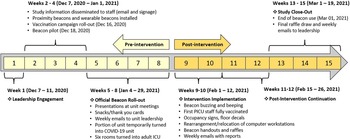
This study was conducted from December 1, 2020, to February 28, 2021. We collected baseline data, performed observations, and conducted intervention planning from December 21, 2020, to January 31, 2021. Implementation of intervention bundle components occurred from January 25, 2021, to February 5, 2021 (Fig. 1). Postintervention data collection occurred from February 1, 2021, to February 28, 2021. The study was conducted during the winter 2020–2021 wave of COVID-19 cases in Maryland. During the study period, cases peaked at 53.4 cases per 100,000 population on January 12, 2021, and this rate declined to a nadir of 12.4 cases per 100,000 population on February 21, 2021. 15 For the week of January 21–29, 8 rooms were segregated as a COVID-19–only unit and beacons were not used in that area. Optional COVID-19 vaccination become available for PICU staff starting December 16, 2021. This study was acknowledged by the Johns Hopkins Medicine’s Institution Review Board as a quality improvement project.
Detailed timeline of study activities.

Wearable proximity beacons
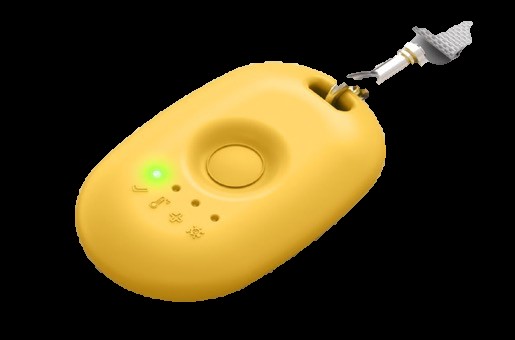
The wearable proximity beacons (Estimote Technologies, Krakow, Poland) pictured in Supplementary Figure 2 (online) were validated by our group in another hospital unit. Reference Keller, Salinas and Oladapo-Shittu12 The devices are 3 inches long and can be attached to the participant by lanyard or badge clip. The beacons measure the distance and duration in proximity to one another and transmit data wirelessly. The beacons were programmed to track interactions once 2 beacons came within 6 feet (∼2 m) of each other for ≥5 seconds, and they stopped tracking when the beacons separated by >6 feet for ≥15 seconds. For example, if 2 individuals were 4 feet apart for 1 minute, separated to 7 feet for 10 seconds, then returned to 5 feet, a single interaction would be logged (1 minute at 4 feet and 5 feet for the remaining time). The sensors automatically turned off once beacons were plugged into a charging station. Because the beacons were sometimes left unplugged near the charging station, we excluded interactions for which ≥95% of interaction time was spent ≤2 feet, and interactions lasting ≥2 hours, assuming that 2 HCWs did not remain so close for that long. To determine the location of individuals wearing beacons, we placed stationary beacons in the ceilings of the break rooms, team rooms, offices, supply, nutrition, storage rooms, and nursing stations.
In total, 40 beacons were provided, enough for the 25 nurses, 10 clinicians, and 5 respiratory therapists working during a typical day shift from 7:00 a.m. to 7:00 p.m. Beacons were reserved for staff physically stationed in the PICU throughout their shift and were not provided to staff who also worked in other units (eg, consulting physicians, pharmacists, physical therapists, etc). Each HCW selected a random beacon at the start of their shift and then returned it at the end of the shift to charge overnight. To encourage use of the beacons, we sought engagement from the unit leadership; we also presented at staff meetings, distributed fliers and e-mails, and informed staff during in-person rounds. HCWs were not compensated for participation beyond thank you notes and snacks.
Physical distancing improvement intervention
We used a participatory ergonomics approach Reference Xie, Woods-Hill, Berenholtz and Milstone16 to develop and implement a multifactorial bundle of interventions informed by findings from interviews and observations in another hospital unit, Reference Keller, Pau and Salinas5 as well as the active involvement of key PICU staff during preintervention meetings and in-person discussions focusing on the interventions’ design. The intervention bundle comprised 4 general strategies: (1) modifying the physical environment, (2) cognitive aids and reminders, (3) adaptive changes to address cultural barriers to distancing, and (4) feedback using the beacons themselves. The implementation timeline is presented in Figure 1.
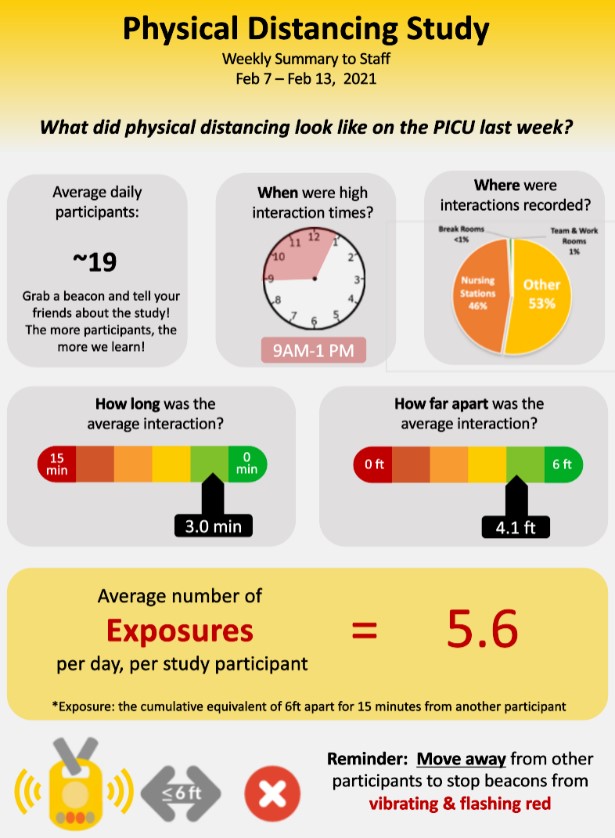
Physical environmental changes to facilitate distancing included relocating computer workstations to be 6 feet apart, adding workstations in new locations, and creating “parking spots” for computers on wheels to improve accessibility. Cognitive aids included floor decals to provide visual guides to where individuals should sit or stand to remain 6 feet apart. We also placed maximum occupancy signs (eg, 4 people in a room) based on workspace dimensions and posted flyers reminding staff about physical distancing. Changes that focused on improving the culture and motivation to physically distance included discussing the project at meetings of the Comprehensive Unit-based Safety Program (CUSP), Reference Pronovost, Weast and Rosenstein17 carrying out weekly competitions for the highest number of beacons worn among the HCW groups (eg, doctors vs nurses vs respiratory therapists) in the study, conducting weekly raffle draws for individual HCWs who wore beacons, and providing weekly physical distancing feedback reports to the unit (Supplementary Fig. 1 online). Lastly, we used the beacons to provide individual feedback by turning on a feature for the beacons to vibrate for 5 seconds if they came within 6 feet of another HCW beacon.
Outcomes
The primary outcome of this study was the number of beacon interactions <6 feet apart for >5 seconds. Additional outcomes included (1) distance in meters between HCWs <6 feet, (2) duration of time in minutes spent ≤6 feet apart, and (3) a composite outcome effective exposure risk score. Effective exposure risk score was a measure based on the CDC approach to contact exposures (within 6 feet for ≥15 minutes) 18 and was defined as [(seconds spent within 6 feet/feet apart)×(5.5 feet/900 seconds)]. This measure assumed distance and duration scaled linearly with risk of viral transmission to 6 feet and 900 seconds (15 minutes). For example, if 2 HCWs spent exactly 900 seconds (15 minutes) 5.5 feet apart, this would be considered an effective exposure risk of 1. If 2 HCWs spent 900 seconds 2 feet apart, this would have an effective exposure risk of 2.75.
Analysis
We examined the total interactions, distance, duration, and effective exposure risk by calendar day, by location in the unit, and by hour of the day to characterize the time and spaces that were most vulnerable for breaches in physical distancing between HCWs. Categorical differences were compared using the χ2 test. Recognizing that the number of devices worn per day was variable and that the interaction count was influenced by how many devices were worn, we generated a parameter to indicate the maximum potential interactions based on the number of devices worn defined as [n×(n − 1)]/2], where n is the number of beacons worn during that shift.
Assessment of intervention impact
Negative binomial regression models were constructed to compare daily interaction counts before and after the intervention. We hypothesized that the ratio between the daily interaction count and the potential maximum interaction would decrease after the intervention was implemented, that is, with similar number of devices worn in the unit, the number of interactions <6 feet would decrease in the postintervention period. To test the hypothesis, we included a dichotomous variable indicating the pre- versus postintervention period, the potential maximum interaction variable, and the interaction of the 2 variables in the regression models. We examined the number of interactions in specific areas and in specific hours of the day using a similar approach. To assess intensity of interactions, we tested the differences in median duration, median distance, and median effective exposure risk score per day before and after the intervention using Wilcoxon rank-sum tests.
Observations
To contextualize the quantitative beacon data, we conducted direct observations of HCWs in the PICU. To facilitate data collection, we developed and pilot tested a semistructured observation form based on a map of the unit, excluding patient rooms. Observations were performed by 2 observers (P.O. and S.C.K.) from December 4, 2020, to February 22, 2021. Observers counted the number of HCWs in their visual field that appeared to be within 6 feet of each other every 5 minutes. Reference Keller, Pau and Salinas5 If 2 people sat in close proximity for 10 minutes, each 5-minute period was considered separately. If a group of 3 HCWs was spaced <6 feet from each other, this was considered 3 interactions: between A and B, between B and C, and between A and C). Observations were enriched for relevant times and locations, (eg, the break room during lunch times). In addition, the observers gathered unstructured observations and solicited informal feedback from HCWs about their experience with the beacons and the intervention bundle.
Results
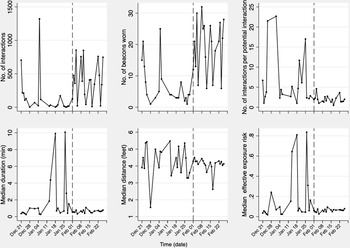
Overall, 10,788 interactions <6 feet and >5 seconds were recorded during the study period. The number of HCWs wearing beacons on a given day fluctuated, with an overall daily average of 13 beacons worn (32% of possible staff; range, 2–32 beacons per day). The number of beacons worn increased over time, with a daily average of 7 per day before the intervention and a daily average of 19 after the intervention (Fig. 2).
Run chart of unadjusted measures of interactions between healthcare workers within 6 feet by day over the study period. Note: From left to right top to bottom, the graphs depict the number of daily interactions within 6 feet, the number of beacon devices worn by day, the number of interactions per potential beacon interaction by day, the daily median duration of interaction in minutes, the daily median distance of interaction in feet, and the daily median effective exposure risk of the interactions. The vertical line depicts introduction of interventions to improve physical distancing between healthcare workers.

Interactions before and after implementation of bundle components
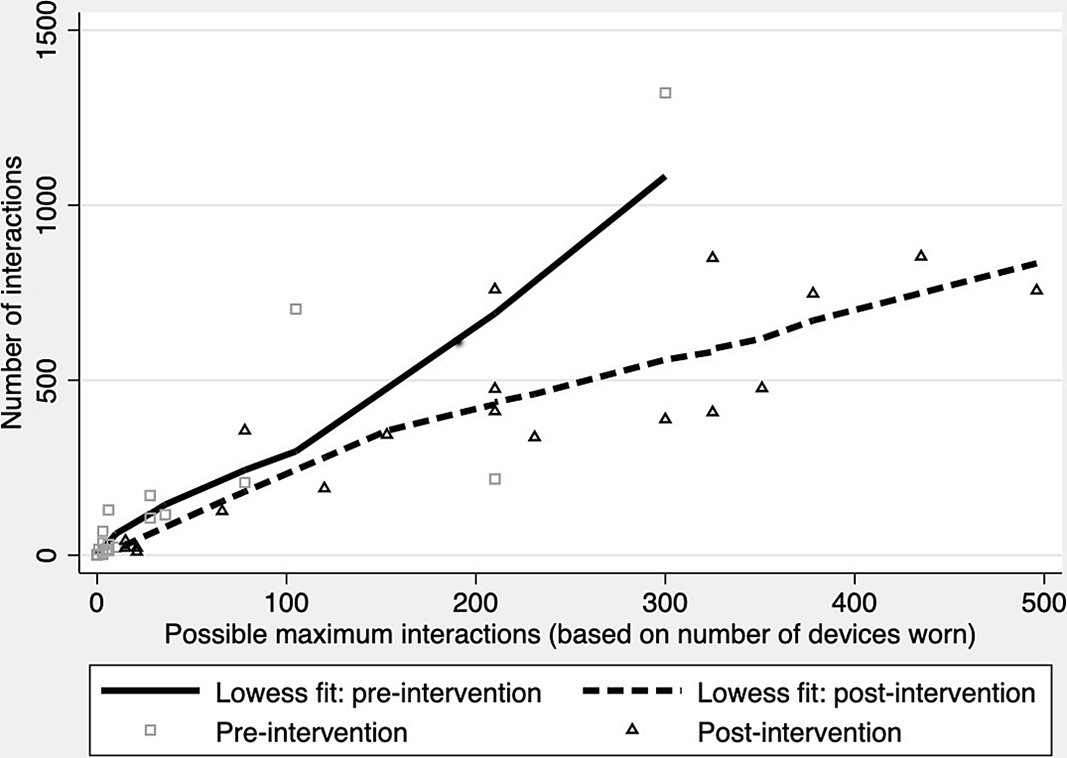
Before the intervention, 3,218 interventions were recorded, and after the intervention, 7,570 interventions were recorded. Using regression analysis accounting for the maximum number of potential interactions on a given day, we detected a 1% decline in the number of interactions per possible interaction (incident rate ratio [IRR], 0.99; 95% confidence interval [CI], 0.98–1.00; P = .02). When more beacons were worn (increasing interaction opportunities), the number of interactions per possible interaction was greatly reduced in the postintervention period compared with the preintervention period (Fig. 3).
Number of interactions in pre- or postintervention periods by number of possible interactions based on the total number of beacons worn on the same day.

Interactions by location and time of day
Most interactions occurred in hallways and general spaces (labeled as “other”), and most interactions, particularly during the preintervention period, occurred during morning patient rounds between 9 a.m. and 12 p.m. (Supplementary Table 1 online). Examining location and time of day interaction trends using regression analysis, we detected a significant decline in the number of interactions per possible interactions at nursing stations (IRR, 0.99; 95% CI, 0.98–1.00; P = .045) and inside the team work rooms (IRR, 0.99; 95% CI, 0.97–1.0; P = .024) but not in other areas (IRR, 0.99; 95% CI, 0.98–1.00; P = .082). Regarding time of the day, the regression analysis revealed a significant decline in interactions during rounds between 9 a.m. and 11 a.m. (IRR, 0.98; 95% CI, 0.97–0.99; P = .001).
Intensity of interactions before and after implementation of bundle components
The daily average duration, distance, and effective exposure risk are presented in Figure 2. After introduction of intervention elements, we detected no differences in these individual measures (Supplementary Table 2 online).
Observations
We performed 1,765 minutes of observations (Supplementary Table 3 online). We commonly observed interactions in the hallways during rounds, at nursing stations and in team rooms, More rarely, we observed interactions in the break room and in the medication, supply, and nourishment rooms. Videoconferencing was used to mitigate some physical distancing interactions. Closely spaced interactions tended to occur when HCWs were having conversations about patients. Common times and locations for HCWs to not be physically distancing included in nursing stations during reporting in the early morning, hallways during rounds in the mid-morning, and team rooms in the afternoon, all of which corroborated with beacon data.
Feedback from HCWs
HCWs commented on the difficulty of physical distancing during rounds due to the need to discuss patient information. Some noted that the interventions were not always feasible. For example, a small office used by 2–3 people might contain only enough space for 1 HCW. Some felt that physical distancing was less important after vaccination. HCWs reported tolerating wearing the beacons, and some forgot they were wearing beacons. Some HCWs wore the beacons on their belts or in their pockets because they felt bulky or in the way. Some HCWs did not like the beacons vibrating when they were close to another HCW during patient care activities and took them off.
Discussion
Using quantitative data from wearable proximity beacons, we detected an overall decline in interactions within 6 feet between HCWs in a busy intensive care unit after implementation of a multifaceted bundle of interventions to improve physical distancing. This study is one of the first to assess physical distancing using devices that can measure the physical distance between HCWs and to assess the impact of interventions that promote distancing between HCWs during routine work activities in a hospital setting.
The interventions were multifactorial and were implemented as a successive bundle. Therefore, we could not distinguish whether one intervention was more effective than another. We suspect that changes in the physical environment (eg, moving computer workstations) were more constructive than reminders (eg, maximum occupancy signs) because HCWs commented that compliance with such signs was not always feasible. Importantly, we noted that morning rounds were a particularly high-risk time for proximity between HCWs because of the need to share patient information between multiple healthcare team members. This unit had recognized this issue previously and had attempted to employ virtual rounding. However, due to missed opportunities for communication and logistical barriers of timing, internet access, or delays, as well as the need to still physically evaluate patients, this approach was abandoned. Some staff disclosed that, even with the buzzing feature, they did not modify their physical distancing during patient rounds.
Participation in this study was fully voluntary, with variable daily participation. We addressed initial low participation by offering a raffle incentive, treats, and active encouragement. As a result, HCW participation increased over the course of the study, such that there were more opportunities for beacons to measure interactions in the postintervention period. To account for this, we compared the number of beacon interactions against the number of possible interactions based on number of beacons worn on that day. The divergence in interaction frequency between pre- and postintervention data with increasing numbers of devices worn indicates that if all HCWs had worn beacons throughout the study period, we may have measured an even greater difference in the frequency of interactions in the postintervention period.
Other limitations of this study include a short study period influenced by the dynamics of the COVID-19 pandemic. This study occurred during a regional COVID-19 surge, patient acuity was high, and the unit was stretched to care for both adult and pediatric patients. This factor may have reduced enthusiasm to participate or reduced attention to physical distancing recommendations. Also, COVID-19 vaccination availability may have decreased motivation to follow physical distancing recommendations for some HCWs. Furthermore, some of the potential maximum interactions used to normalize data may have been overestimated if participants removed or turned off their beacons during their shift. Further study is needed to optimize beacon wearability. In addition, HCWs who chose to participate may have been more conscious of their physical distancing. Beacons were not provided to non-PICU staff, so we did not measure all of the possible HCW interactions, though our observation data corroborated the findings of the beacon data. All of these limitations bias the findings toward the null, but our analysis still supported an improvement in physical distancing after implementation of the bundle elements.
The COVID-19 global pandemic continues to evolve; vaccination availability and uptake rates are geographically heterogeneous; and SARS-CoV-2 variants of concern are emerging, putting some populations at higher risk for infection. Reference Murthy19–21 Physical distancing remains a key pillar in prevention of SARS-CoV-2 transmission between HCWs, particularly when the local incidence of COVID-19 is high and even vaccinated individuals may be susceptible to infection. Reference Schneider, Piening, Nouri-Pasovsky, Krüger, Gastmeier and Aghdassi3,Reference Çelebi, Pişkin and Çelik Bekleviç4 Although these beacons may not be readily accessible, this study demonstrates that wearable proximity devices can play a role in the assessment of the movements and interactions between HCWs. Even in a busy intensive care unit during a pandemic surge, it is possible to work with a unit using interventions to address local barriers, cognitive aids, or individual feedback from wearable devices to improve physical distancing between HCWs. These findings may be applicable to nonhealthcare settings and future viral pandemics.
Supplementary material
To view supplementary material for this article, please visit https://doi.org/10.1017/ice.2021.501
Acknowledgments
We thank the staff of the Johns Hopkins Pediatric Intensive Care Unit for their engagement and participation in this study. The content is solely the responsibility of the authors and does not necessarily represent the official views of the funding agency.
Financial support
This work was funded by the Centers for Disease Control and Prevention Epicenter Program (COVID-19 supplement to grant no. 6 U01CK000554-02-02).
Conflicts of interest
All authors report no conflicts of interest relevant to this article.