Introduction
Problem statement
Agricultural production relies on the use of natural resources but in Europe, those resources are being overexploited, resulting in (soil) degradation and irreversible losses of biodiversity or topsoils (European Commission—Joint Research Centre—IES, 2012). This depletion of natural resources in general, and soils in particular, can be attributed in most cases to specific agricultural production techniques. Many of those practices and the corresponding environmental problems can be addressed by well-known conservation practices. For example, measures to combat soil degradation should ‘reduce the impact of rainfall and wind by covering the soil, impede runoff and maintain and restore soil fertility and structure’ (de Graaf et al., Reference de Graaf, Kessler and Olsen2010). To achieve those aims, reduced soil disturbance practices (e.g., non-inversion tillage or mulching) and planting of cover crops are recommended. Cover crops not only reduce wind and water erosion, some also take up mineral nitrogen (N) during the winter period in temperate climates (Lemaire et al., Reference Lemaire, Recous and Mary2004). When incorporated into the soil as green manures, they provide an extra source of energy and contribute to carbon (C) sequestration. Leguminous cover crops also fix N biologically and may improve soil N fertility (Kuo and Sainju, Reference Kuo and Sainju1998; Vaughan et al., Reference Vaughan, Hoyt and Wollum2000; Gselman and Kramberger, Reference Gselman and Kramberger2008).
Since the introduction of agri-environmental schemes in Europe in 1992 (European Union, EU Regulation 2078/92), a range of conservation practices are promoted politically and are also increasingly supported through agricultural extension activities (Ahnstrom et al., Reference Ahnstrom, Hockert, Bergea, Francis, Skelton and Hallgren2009). But are the farmers interested in and able to adopt such soil, water and biodiversity conservation measures?
Farm-level soil conservation and soil-sensitive land use practices have been addressed by rural sociologists using case studies and regional surveys (e.g., Currle, Reference Currle1995; Prager, Reference Prager2002; Quast et al., Reference Quast, Böhme, Ehlert, Ette, Gottschik, Jaeckel, Knierim, Messal, Sawicka, Sbjeschni, Schmidt, Szerencsits and Tümpling2011). In most cases the studies disclose a complex set of influencing factors on farmers’ behavior, which is also true for conservation issues in agriculture in general (Siebert et al., Reference Siebert, Toogood and Knierim2006). However, these studies also reveal serious difficulties and challenges for farmers’ adoption of soil conservation measures. For instance, Prager (Reference Prager2002) shows that the complexity of soil cultivation management makes it difficult for farmers to relate to knowledge about environmental correlations in their decision making processes. The dimensional complexity results from the interdependent bio-physical and chemical soil processes, which makes it very difficult for non-experts to understand and deal with sustainable soil management (Watson et al., Reference Watson, Atkinson, Gosling, Jackson and Rayns2002). This might translate into low adoption rates, resulting in continued depletion of natural resources (European Commission—Joint Research Centre—IES, 2012).
There is also a long history of studies using farm economic concepts and theories to explain adoption of new technologies, including conservation practices. Although farmers are certainly concerned about financial profit, cost–benefit models cannot capture the complexity of farmers’ behavior and attitudes (ATT) (e.g., Turvey, Reference Turvey1991; Lynne et al., Reference Lynne, Casey, Hodges and Rahmani1995; Vanslembrouck et al., Reference Vanslembrouck, Van Huylenbroeck and Verbeke2002; Flett et al., Reference Flett, Alpass, Humphries, Massey, Morriss and Long2004). In addition to purely economic factors, further studies investigate a range of other factors that may influence farmers’ decision to adopt conservation practices, such as socio-demographic factors (e.g., Young and Shortle, Reference Young and Shortle1984), farm structural factors (e.g., Ervin and Ervin, Reference Ervin and Ervin1982), farm biophysical factors (e.g., Soule et al., Reference Soule, Abebayehu and Keith2000), diffusion factors (e.g., McCann et al., Reference McCann, Sullivan, Ericson and DeYoung1997) and socio-psychological factors (e.g., Napier et al., Reference Napier, Thraen, Gore and Goe1984). In a meta-analysis of 69 empirical studies on the adoption of soil conservation, Wauters and Mathijs (Reference Wauters and Mathijs2014) show that, indeed, variables that are since decades regarded as classical adoption of innovation variables converge to an insignificant influence.
Most of these studies lack a theoretical and conceptual framework to suggest how different kinds of influences work together to influence behavior. In social psychology, 40 yr of studies have been devoted to developing frameworks meant to understand human behavior (Beedell and Rehman, Reference Beedell and Rehman2000). The theory of reasoned action (TRA) and its extension, the theory of planned behavior (TPB) (Fishbein and Ajzen, Reference Fishbein and Ajzen1975; Ajzen, Reference Ajzen1991) are the models currently most commonly used by social psychologists when studying human behavior (St John at al., Reference St John, Edwards-Jones and Jones2010; p. 659). Several studies on the adoption of conservation measures suggest that TPB offers a suitable framework for investigating conservation measures in farm management (e.g., Meijer et al., Reference Meijer, Catacutan, Sileshi and Nieuwenhuis2015; van Dijk et al., Reference van Dijk, Lokhorst, Berendse and de Snoo2015). By using the TPB, we apply such a theoretical framework to the problem of adoption of cover cropping as a soil conservation measure.
Theory of planned behavior
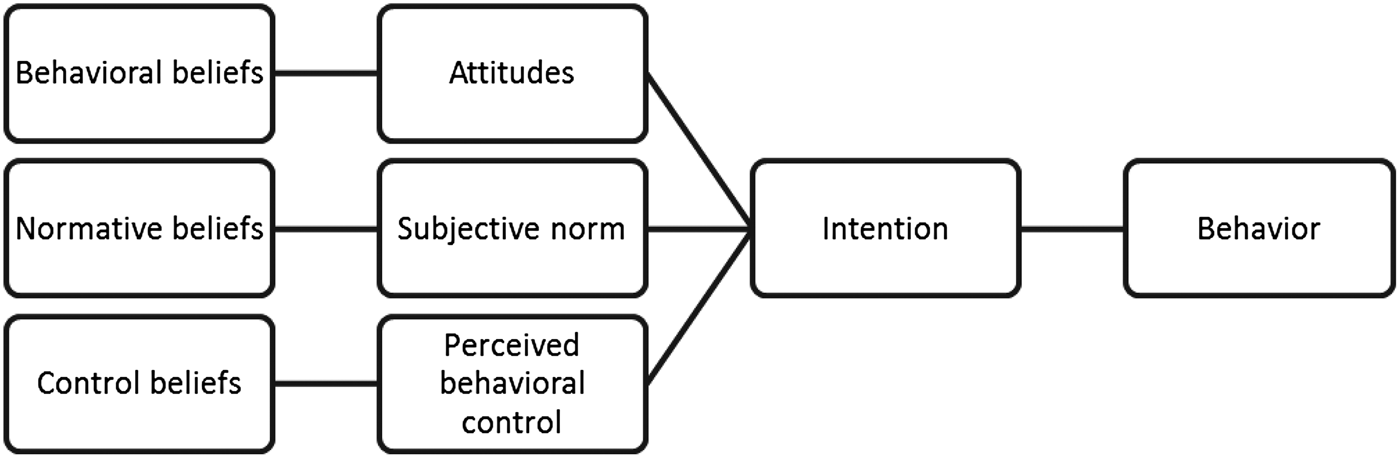
According to the TPB, individual beliefs about a behavior or practice determine both intent and behavior (Ajzen, Reference Ajzen1991). The intention of a farmer to implement a certain conservation measure is determined by the degree to which implementing the measure is evaluated positively or negatively by the farmer (ATT), the feeling of social pressure from others to perform or not perform a certain measure [subjective norm (SN)] and the subjective beliefs about the ease or difficulty of successfully performing the measure [perceived behavioral control (PBC); Fig. 1]. The combination of these socio-psychological constructs results in a positive or negative intention to perform the behavior. The TPB assumes that if the farmer has sufficient actual behavioral control (i.e., whether the required prerequisites in terms of capital, knowledge, skills and opportunities are available), intentions will be converted into actual behavior (e.g., adoption/non-adoption of conservation measure).
Theory of planned behavior, adapted from Ajzen (Reference Ajzen1991).

In this theory, therefore, the behavior of a person is explained by the sum of his/her beliefs that together build the belief structure. Different beliefs lead to different ATTs and different behavior. By revealing a person's underlying beliefs, TPB may provide an approach to understand what farmers intend to do but also to investigate why they do it (Beedell and Rehman, Reference Beedell and Rehman2000; p. 119).
Farmers’ adoption of conservation measures
Research on farmers’ conservation adoption using the TPB covers various aspects from different fields of agriculture, ranging from soil erosion control measures [buffer strips and reduced tillage (Wauters et al., Reference Wauters, Bielders, Poesen, Govers and Mathijs2010)], to water protection [fencing riparian zones to control livestock access to the river and creating off-river watering points (Fielding et al., Reference Fielding, Terry, Masser, Bordia and Hogg2005), ditch bank management (van Dijk et al., Reference van Dijk, Lokhorst, Berendse and de Snoo2015); integrated pest control (Heong and Escalada, Reference Heong and Escalada1999), improving conditions for wildlife (meadow bird protection; van Dijk et al., Reference van Dijk, Lokhorst, Berendse and de Snoo2015), hedge management (Carr and Tait, Reference Carr and Tait1991; Beedell and Rehman, Reference Beedell and Rehman1999) and tree planting (Zubair and Garforth, Reference Zubair and Garforth2006; Meijer et al., Reference Meijer, Catacutan, Sileshi and Nieuwenhuis2015)].
Most authors find that it is possible to differentiate between two groups of farmers: the ones who intend to adopt (or have already adopted) the behavior and the ones who do not. These differences are explained by differences in ATTs, SNs and PBC (e.g., Lokhorst et al., Reference Lokhorst, Staats, van Dijk, van Dijk and de Snoo2011; van Dijk et al., Reference van Dijk, Lokhorst, Berendse and de Snoo2015). Many studies investigate these constructs using direct measures for ATTs, PBC and SNs. Generally they find that farmers with positive intentions have more favorable ATTs toward the behavior and perceive positive outcomes as being more likely to occur than non-intenders (e.g., Fielding et al., Reference Fielding, Terry, Masser, Bordia and Hogg2005; Meijer et al., Reference Meijer, Catacutan, Sileshi and Nieuwenhuis2015). Positive intenders are also more influenced by SNs. Recent studies also contribute to our understanding of farmers’ application of conservation measures by identifying referents that are best positioned to influence the views of farmers [e.g., local council, conservation farming group (Beedell and Rehman, Reference Beedell and Rehman1999)]. PBC did not make a difference in some studies (Beedell and Rehman, Reference Beedell and Rehman1999) but Fielding et al. (Reference Fielding, Terry, Masser, Bordia and Hogg2005) found that positive intenders perceive lower extents to which barriers would impede management of riparian zones.
Fielding et al. (Reference Fielding, Terry, Masser, Bordia and Hogg2005) also notice considerable overlap between negative outcomes of riparian zone management and perception of barriers: financial and time-related factors appear in both. They assume that this effect may be due to inadequate conceptualization and measurement of control beliefs (Fielding et al., Reference Fielding, Terry, Masser, Bordia and Hogg2005; p. 19). This is supported by Wauters et al. (Reference Wauters, Bielders, Poesen, Govers and Mathijs2010), who differentiated the concept of perceived control into two sub-constructs: actually perceived control (perceived degree of control the farmers have on applying the behavior) and perceived difficulty (measure of the perceived ease to apply the behavior). Other researchers add variables to the TPB. Some have been shown to improve the predictive power of the model for farmers’ conservation behavior, such as self-identity, connectedness to nature (Lokhorst et al., Reference Lokhorst, Hoon, Le Rutte and de Snoo2014), group norm (GN) and group facilitation (van Dijk et al., Reference van Dijk, Lokhorst, Berendse and de Snoo2015).
Despite the attention devoted to this subject, only few studies provide in-depth insights into farmers’ underlying belief structures (Beedell and Rehman, Reference Beedell and Rehman2000). Beliefs play a central role in the TPB. Beliefs are assumed to provide the cognitive and affective foundations for ATTs, SNs, and perceptions of behavioral control (Ajzen, Reference Ajzen2002). If this assumption is correct, it is possible to also obtain belief-based measures of these constructs. Measurement of beliefs can be useful to theoretically gain insight into the underlying cognitive foundation: it gives researchers a way to explore why people have certain ATTs, SNs and perceptions of behavioral control.
Positive intenders were influenced by beliefs about the benefits of the practice (Fielding et al., Reference Fielding, Terry, Masser, Bordia and Hogg2005), e.g. they believed the positive consequences of the conservation measure for wildlife and the preventive effect on soil erosion to be more likely to occur than non-intenders did (Carr and Tait, Reference Carr and Tait1991) and considered the conservation value of the measure to be higher than non-intenders did (Beedell and Rehman, Reference Beedell and Rehman1999). In contrast, non-intenders were found to be more influenced by beliefs about farm productivity, ease of maintenance (Carr and Tait, Reference Carr and Tait1991) and farm management (Beedell and Rehman, Reference Beedell and Rehman1999). Likewise, non-intenders perceive barriers to be bigger than intenders do (Fielding et al., Reference Fielding, Terry, Masser, Bordia and Hogg2005). Meijer et al. (Reference Meijer, Catacutan, Sileshi and Nieuwenhuis2015) found that the three main barriers perceived by non-intenders toward tree planting were ‘laziness’, ‘land scarcity’ and ‘lack of seeds’. Fielding et al. (Reference Fielding, Terry, Masser, Bordia and Hogg2005) found no difference concerning beliefs about negative consequences of riparian management between farmers with high versus no intention; furthermore, ‘lack of money’ was identified as a barrier with equally strong influence in both groups of farmers.
Although analysis of belief structures seems to be promising for understanding farmers’ conservation behavior, to our knowledge it has only been conducted for very few measures. The objective of this paper is therefore to further investigate how farmers’ beliefs about a conservation measure influence their decision to apply the measure. The ultimate goal is to gain additional insight into how to increase the compatibility between farmers’ needs and conservation measures, and finally how to facilitate adoption of that measure. In this study, we apply the TPB to the case of cover cropping in Brandenburg.
Materials and Methods
Study area
The study was conducted in Brandenburg, a German federal state (Bundesland) located in northeastern Germany, near sea level. Brandenburg's climate is oceanic with continental influences; its sloping terrain has light soils and a high risk for wind erosion. Mean annual temperature is 9°C. Average annual precipitation is low (562 mm yr−1). The European soil map (European Commission, 2012) shows that Brandenburg has coarse soils with a clay fraction <18% and a sand fraction >65%. In combination with high-intensity arable farming and large field sizes (>50 ha) these sandy soils are prone to losing soil organic C from topsoil and wind erosion (Hijbeek et al., Reference Hijbeek, Wolf and van Ittersum2014), especially in fallow periods. The German Ministry for Food and Agriculture therefore recommends maintaining a soil coverage ration above 25% throughout the year, by applying cover cropping and undersowing (BMELV, 2013). During the study period, cover cropping in Brandenburg was also subsidized as voluntary agro-ecological measure [Art. 39 VO (EG) Nr. 1698/2005: Förderprogramm 675 der Richtlinie KULAP 2007].
The main farm types in Brandenburg are arable farms (33.4%) and dairy farms (37.7%) with arable land and grassland comprising on average 78 and 21%, respectively, of the Utilized Agricultural Area (UAA). The main cultivated crops are cereals (50% of arable land), silage maize and ley (27.4%) and rapeseed (13%) (Amt für Statistik Berlin-Brandenburg, 2015).
Data collection
In this study, we applied a sequential mixed method by combining qualitative and quantitative research techniques at different stages in time (Creswell and Plano Clark, Reference Creswell and Plano Clark2007). The predominant quantitative (questionnaire-based) data collection was preceded by a qualitative step, namely face-to-face interviews.
Between November 2012 and March 2013, semi-structured interviews with farmers (n = 21) were conducted. Interviewees were selected via purposive sampling through contact persons from extension services and public agricultural authorities. The purpose was to interview the greatest possible diversity of farmers to capture as many aspects of the problem as possible. Criteria for selection were farm specialization, accessibility of the farm, age and innovative/conservative farm style. In the semi-structured interviews, the structure was based on questions designed to elicit a list of behavioral outcomes, normative referents and control factors (Ajzen, Reference Ajzen2002).
Questionnaire design
Following the approach from Wauters et al. (Reference Wauters, Bielders, Poesen, Govers and Mathijs2010) the obtained list was used to construct a questionnaire divided into three parts: (1) socio-psychological characteristics (=direct measures): intention, ATTs, SNs, GNs and PBC, (2) the underlying beliefs (i.e., belief-based measures) about cover cropping and (3) socio-economic and structural characteristics of the farm and the farmer. For more details on questionnaire design see also Wauters et al. (Reference Wauters, Bielders, Poesen, Govers and Mathijs2010). The direct measures of part 1 (intention, ATTs, SNs, GNs and PBC) were measured using direct reflective measurement scales: both Likert scales (5-point scale from 1 to 5 with extremes as endpoints) and the semantic differential (the respondent is asked to choose where his or her position lies, on a scale between the two bipolar adjectives). Because reflective measurement assumes that the construct causes the indicators and that if the construct changes, each of the indicators change accordingly, we used statistics to assess the reliability and internal consistency of the measurement scales. Validity of the measurement scales was ensured by adapting measurement scales from previous studies that applied reflective measurement scales for each of the variables of interest. The measurement constructs and their indicators are presented in Table 1.
Measurement constructs and indicators.

Part 2 of the questionnaire was completely based on the semi-structured interviews. The TPB was operationalized based on Ajzen (Reference Ajzen2002) with belief-based measures. Behavioral beliefs were operationalized by asking farmers: (1) to rate the probability of that specific outcome when implementing cover cropping (belief strength); and (2) to evaluate this outcome on a scale from ‘very bad’ to ‘very good’ (outcome evaluation). To operationalize normative beliefs, for each referent, farmers were asked to indicate their perception of whether the referent thinks that the farmer should grow cover crops (normative belief strength) and to which degree the farmer is influenced by the opinion of that specific referent (motivation to comply). Third and last, to measure control beliefs, farmers were asked to rate the extent to which a control factor could hamper cover cropping (control belief power) and the perceived effort needed to control these barriers on their farm (control belief strength).
Part 3 contained general characteristics of the farm and the farmer: age, sex, farm size, crops, animals, soil types, etc. These characteristics have been identified in literature as variables that might have an influence on cover cropping.
All questions were measured in random order on a 5-point scale from 1 to 5 with extremes as endpoints. A number of questions were also phrased negatively in order to avoid anchoring effects. A pre-test was conducted with five farmers and their comments and questions were used to improve the questionnaire.
Sampling
Farmers’ addresses were first requested from contact persons in farmers’ associations, but this did not yield enough addresses. We therefore added additional addresses from the official database of apprentice training farms (compiled by the Brandenburg Ministry of Agriculture). We considered the expected introduction of specific bias as acceptable, since apprentice farms are normal farms that participate in the German educational system for farmers and are not operated differently than the other farms in our study.
A total of 671 questionnaires were distributed by post and an email containing a link to an online questionnaire. Response rate was almost 15%, with 98 questionnaires returned. Considering the length of the questionnaire (test farmers took 30 min to answer all the questions) this response rate seemed acceptable for a farm survey, as a response rate of around 20% is usually reported in mail surveys (Yammarino et al., Reference Yammarino, Skinner and Childers1991) and no further measures were taken to increase it. Two of the returned questionnaires had to be discarded due to incomplete data and irregular answering patterns, resulting in 96 questionnaires for analysis. We controlled for potential bias caused by the small sample size by conducting one-way analysis of variance (ANOVA) and a simple ordinary least squares (OLS) to check for the robustness of our results (see subsection ‘Belief-based measures’). The samples are biased toward a larger share of bigger farms in our sample than in the whole population of farms in Brandenburg.
Data analysis
Direct measures
The reflective measurement scales of the socio-psychological constructs and their impact on intention to apply cover crops were analyzed using structural equation modeling with IBM SPSS AMOS 22.0. In the first step, we analyzed the measurement model using a collection of goodness-of-fit indices [CMIN/df (Schumacker and Beyerlein, Reference Schumacker and Beyerlein2000), comparative fit index (CFI) (Byrne and Watkins, Reference Byrne and Watkins2003), root-mean-square error of approximation (RMSEA) (Browne and Cudeck, Reference Browne and Cudeck1992), Tucker–Lewis index (TLI) (Hu and Bentler, Reference Hu and Bentler1998)]. When these did not show adequate fit, we inspected the standardized loadings of each item on its intended construct and either removed items with insignificant loading and/or loadings lower than 0.5 one by one, or we combined items into new constructs.
After obtaining an acceptable fit (see ‘Result’ section), we then estimated the structural model in which ATT, SN, PBC and GN have a direct influence on intention. The goodness-of-fit of this model was checked using several fit indices. Upon acceptance, standardized regression coefficients and squared multiple correlation were inspected.
Because this approach may be sensitive to small sample sizes we also applied a two-step approach to check robustness of the results. In this two-step approach, we calculated the constructs as the mean of their respective measurement items. Using these calculated values, we estimated the influence of ATT, SNs and PBC on intention using simple OLS. Check for heteroscedasticity did not reveal deviations to the homoscedasticity assumption. However, normality analysis of the residuals did reveal some violation of the normality assumption; so as an additional check, we dichotomized the intention variable and estimated a logistic regression using this dummy variable representing high or low intention as dependent variable and the calculated values for ATT, SN, GN and PBC as independent variables. As a last check of the robustness of the findings, we also did an ANOVA test (known to be robust for small sample sizes) comparing mean values for ATT, SN, GN and PBC between high and low intenders.
Belief-based measures
The analysis of individual beliefs was based on descriptive statistics to reveal means, median and frequencies of the prevalence of the subjective beliefs on the outcomes, referents and control factors. The ATT concept in social psychology is very similar to the subjective expected utility concept in economics. Attitude (A) was indirectly measured by combining the farmers’ belief about the likelihood of occurrence (b) of an outcome i and by his evaluation of these outcomes (e) in the following manner:
 $$A = \sum\limits_{i = 0}^n {{\rm belief}\;{\rm strength}_i \;({\rm outcome}\;{\rm evaluation}_i - 3)} $$
In which n = the total number of outcomes that were involved in the questionnaire. We subtracted 3 because due to our scales, values for outcome evaluation ranged from 1 to 5 and we wanted them to range from −2 to +2, so that results are easier to interpret as barriers (values < 0) or drivers (values > 0). In a similar way, subjective norms (SN) and perceived behavioral control (PBC) were determined as follows (Ajzen, Reference Ajzen1991):
 $${\rm SN} = \sum\limits_{i = 0}^n {{\rm (normative}\;{\rm belief}_i - 3)\;{\rm motivation}\;{\rm to}\;{\rm comply}_i} $$
 $${\rm PBC} = \sum\limits_{i = 0}^n {{\rm (\,perceived}\;{\rm power}_i - 3)\;{\rm control}\;{\rm belief}_i} $$
To compare the beliefs of the weak and strong intenders, ANOVA was performed for each set of beliefs. The two intention questions INT2 and INT3 were averaged to form an index of behavioral intentions (Cronbach's α = 0.83). Variable INT1 had to be deleted because it was missing for most respondents (possibly because this item was placed at the very beginning of the questionnaire in contrast to items INT2 and INT3). Strong intenders were defined as those with an intention score of 5 (n = 61), and weak intenders were those with an intention score below 5 (n = 34, median = 3).
Results
Sample
Our sample consisted of 96 respondents in Brandenburg. All respondents were either farm managers or were responsible for plant production on a farm at the time of the survey. Their age varied from 22 to 74 yr with an average of 46 yr. Nine of the respondents were organic farmers. The average farm size in the sample was 1518 ha, cultivated with an average of 17 employees. Of the 1518 ha, on average 504 ha were owned by the farm enterprise. This farm size is not representative for Brandenburg's farm structure. Table 2 shows an overview of farm statistics for Brandenburg (Amt für Statistik Berlin-Brandenburg, 2015) in comparison with our sample. In our sample, about 306 ha per farm were grasslands; 294 ha were used for the cultivation of maize, followed by 288 ha cultivated with rye, 221 ha rapeseed and the rest mainly with other cereals such as wheat and barley in nearly equal shares. Among the 96 farms included in the survey, 50 farms had dairy cows, with an average number of 392 cows per farm. Other animals were of minor importance. Of the 96 respondents, 76 (81%) indicated an intention to apply cover cropping, but only on small parts of their arable land (mean = 16% of arable land). In the whole population of 3932 farms in 2010, only 656 farms applied for the cover crop subsidy (Statistisches Bundesamt, 2011), which makes up only 19.8% of farms (only those who derive their main income from farming were counted).
Overview farm structure Brandenburg and sample.

1 Note that average farm size alone is not informative because it is very unevenly distributed. 50% of farms together only farm 3% of the land, while 70% of the land is farmed by only 15% of the farms in Brandenburg.
2 Percentage of arable land.
Initial data cleaning
Case-wise missing value analysis showed that all cases could be kept in the database, as all respondents answered the large majority of questions (>75%). Regarding variables, we had to delete variable INT1, as this variable was missing for most respondents. No outliers were detected. Further, all scale variables were sufficiently discriminating, meaning that <90% of answers were on one single scale category and all standard deviations (SD) were acceptably high.
Measurement model
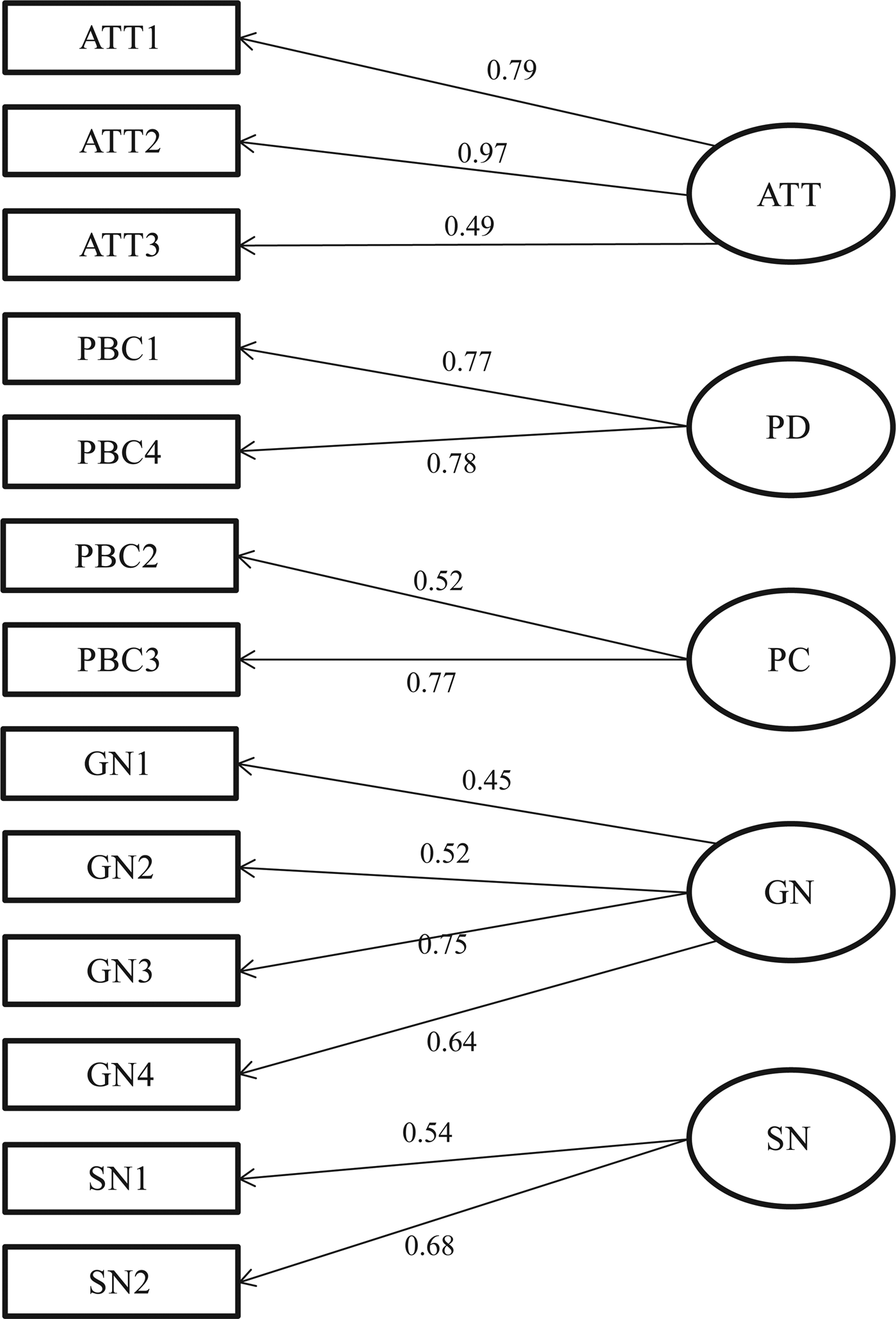
The first test of the measurement model with the hypothesized item structure as shown in Table 1 did not provide adequate fit. An inspection of the standardized loading immediately revealed an issue with the PBC variables, as two items had negative loading (PBC2 and PBC3). Careful inspection of the statement of these two and the two other items of PBC suggested that the PBC construct is in fact a two-dimensional construct, confirming earlier findings of Sheeran et al. (Reference Sheeran, Trafimow and Armitage2003) and Wauters et al. (Reference Wauters, Bielders, Poesen, Govers and Mathijs2010). We thus defined two new constructs. The first, perceived control refers to the perceived degree of control the farmers have on applying cover crops; it is measured by PBC2 and PBC3. The second, perceived difficulty is a measure of the perceived ease to apply cover crops and is measured by PBC1 and PBC 4. This new measurement model was substantially improved in model fit, but was still not adequate. We first removed SN2 as it had the lowest loading of all items on its construct. After inspection of the goodness-of-fit measures, we decided to also remove item GN4, after which very good model of fit was reached (CMIN/DF = 1.151, P = 0.207; CFI = 0.97: RMSEA = 0.039; TLI = 0.95). As this final measurement model has also sufficient theoretical foundation, we decided to accept the final measurement model as shown in Figure 2.
Measurement model.

Direct measures
The summary statistics of the TPB constructs are shown in Table 3. The table reveals very favorable intentions, ATTs, perceived control and GN. SNs are negative (below 3), perceived difficulty is average—slightly above 3—and thus on the positive side of the scale. Note that this sample of farmers was nearly unanimous in favorable ATTs and GNs, as SD are less than 1.
Summary statistics of the TPB constructs.

Prediction of intention
We first estimated a structural model in AMOS (see Figure 3). The model itself has very good model fit: CMIN/DF = 1.100, P = 0.259; CFI = 0.98; RMSEA = 0.031; TLI = 0.97. Inspection of the standardized regression coefficient shows that perceived difficulty is the only significant predictor (PD). The model explains 58% of the variation in intention.
Structural model.

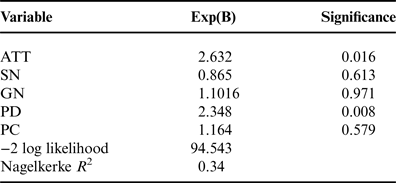
The relationship between intention and its hypothesized PDs was also investigated using a two-step approach, where the PDs were first calculated, after which an OLS was estimated for intention (see Table 4).
Prediction of intention.

These results confirm the results from the one-step structural equation model. Perceived difficulty is the only significant PD, with a higher perceived ease associated with higher intentions to apply cover crops. The Durbin–Watson test statistic of this regression was 1.565, hence no deviation from homoscedasticity was observed. However, analysis of the standardized residuals of this regression revealed deviations from the normality assumption. Whereas such deviation usually has no effect on the coefficients, it may bias the significance parameters. To overcome this, we dichotomized INT into a dummy variable HighINT which was 1 if INT was equal to 5, and 0 if INT was lower than 5. This way of dichotomizing INT was instructed by an inspection of the frequency distribution of INT. Approximately half of the sample had a value of 5 for INT.
The results of the logistic regression with high and low intention as a dummy variable are shown in Table 5. The results confirm the significant effect of PD, and also shows a significant effect of ATT. Farmers with positive ATTs toward cover crops have a higher probability to be strong intenders. As a last check of the validity of the model, we compared TPB values between weak and strong intenders using ANOVA. These results confirmed the results of the logistic regression. Farmers with a more positive ATT and farmers who perceive cover crops as easier to apply therefore are more likely to be among the strong intenders.
Logistic regression.

Overall, there is sufficient empirical support for the ability of the TPB to explain differences in intention to apply cover crops. The overall model has a good fit to the data and explains a substantial amount of the variation in intention. The most important variable that significantly predicts higher intentions at this stage of the diffusion process is perceived difficulty. More positive ATTs are also associated with higher intentions.
Belief-based measures
Beliefs about the outcome
As shown in Table 6, strong intenders rated benefits as more likely to occur than weak intenders and strong intenders are more convinced that cover cropping results in improved soil workability, better soil structure and prevention of nutrient leaching. This is not surprising, as literature dealing with human decision making in general (e.g., climate change adaptation) suggests that perceived efficacy of a practice shapes decision making (Grothmann and Patt, Reference Grothmann and Patt2005). In contrast, concerning the perception that cover cropping offers additional fodder and that it supports survival of bees, no difference between strong and weak intenders was observed. Additionally, those last two benefits were also evaluated as the least positive by both groups. The overall outcome evaluation pattern shows a slightly more positive evaluation for nutrient availability for subsequent crops and improved soil workability, which was of higher value for strong intenders (P < 0.001 and P < 0.01, respectively).
Mean behavioral beliefs concerning cover cropping.

P < 0.05*; P < 0.01**; P < 0.001***.
Beliefs about social environment
One-way ANOVA showed that both strong and weak intenders did not perceive any pressure from beekeepers and predecessors or successors in their decision to grow cover crops (means close to zero) as depicted in Table 7. They also did not show differences in their motivation to comply with these groups. Only the ratings concerning own education were significantly different between weak and strong intenders. Strong intenders feel more supported by education and they also have a higher motivation to comply with contents of their education.
Mean normative beliefs concerning cover cropping.

P < 0.05*; P < 0.01**; P < 0.001***.
Control beliefs
Table 8 summarizes beliefs concerning the control factors. Some barriers were perceived as more powerful by strong intenders (group 1), some by weak intenders (group 2). Other control factors were not acting as barriers (group 3). The control factor ‘overall higher workload’ was not perceived as a barrier by strong intenders in contrast to weak intenders.
Behavioral beliefs concerning cover cropping.

P < 0.05*; P < 0.01**; P < 0.001***.
Concerning control strength, the pattern is different to the control power. Interestingly, the barriers that have the highest negative values for control power have moderate values for control strength and vice versa. This means that the most difficult barriers are not often applicable, while other, less difficult, barriers are more prevalent. Two barriers apply significantly more for weak intenders (see control strength). These are ‘bad previous experience with cover crops’ and having ‘few summer crops’. ‘Having bad experiences with cover crops’ does not occur often, however, with an average value smaller than 3. Other barriers that did not often occur are limited workforce, financial difficulties, no technical solutions for mulch drilling, late harvest dates of main crops, no need to add organic matter to fields, and no motivation to prevent fields from being fallow in winter.
Discussion
Structural model and limitations
Our results support the suitability of TPB to explain differences in intention to conduct cover cropping among farmers in Brandenburg. It explains 58% of variation in intention, which is considerable, given the complexity of conservation decisions (see for example Lokhorst et al., Reference Lokhorst, Staats, van Dijk, van Dijk and de Snoo2011; Lokhorst et al., Reference Lokhorst, Hoon, Le Rutte and de Snoo2014; van Dijk et al., Reference van Dijk, Lokhorst, Berendse and de Snoo2015). In the most widely cited meta-analysis of the TPB, Armitage and Conner (Reference Armitage and Conner2001) reported a 39% of variance explained. Still, meta-analyses do report an intention-behavior gap (Armitage and Conner, Reference Armitage and Conner2001; Hagger et al., Reference Hagger, Chatzisarantis and Biddle2002), showing that people do not always do what they intend to do. Our study analyzes only farmer intention, not their actual behavior. Another reported weakness of the TPB is the fact that is does not always capture social influence very well, something which has led researchers to propose additions to the basic TPB (Beedell and Rehman, Reference Beedell and Rehman2000). We have chosen to use one of the most reported additional variables, the GN variable. Inclusion of the construct GN improves goodness of fit of the measurement model, although GN itself does not significantly contribute to explain variations in intention, as van Dijk et al. (Reference van Dijk, Lokhorst, Berendse and de Snoo2015) found. This indicates that although farmers are influenced by other farmers, it is not the GN per se that determines intentions toward cover cropping.
Attitudes of farmers are positive throughout the sample (as found by Fielding et al., Reference Fielding, Terry, Masser, Bordia and Hogg2005; Wauters et al., Reference Wauters, Bielders, Poesen, Govers and Mathijs2010; Lokhorst et al., Reference Lokhorst, Staats, van Dijk, van Dijk and de Snoo2011; van Dijk et al., Reference van Dijk, Lokhorst, Berendse and de Snoo2015), which is to be expected, considering the high rate (80%) of farmers that at least occasionally apply cover crops. According to Rogers (Reference Rogers2003), who investigated diffusion of new technologies, at this stage of the diffusion process (80% adoption rate) one can expect generally positive ATTs toward the practice. However, farmers apply cover crops only on small parts of their arable land (mean = 16% of arable land). We therefore conclude that the remaining farmers who show throughout positive ATTs toward cover cropping, but still do not actually sow them, or only sow them on small parts of their land, are hindered by some control factors that are hard to overcome. This is also reflected in the significance of the construct of perceived difficulty.
Our analysis also shows that the weaknesses of the construct of PBC (Conner and Armitage, Reference Conner and Armitage1998; Fielding et al., Reference Fielding, Terry, Masser, Bordia and Hogg2005; Zubair et al., Reference Zubair, Garforth, Hussain, Zahid, Baloch, Safdar and Fazalur2011) can partly be overcome by dividing it into two sub-constructs: perceived control and perceived difficulty, confirming previous results by Wauters et al. (Reference Wauters, Bielders, Poesen, Govers and Mathijs2010). Perceived difficulty and ATT are the two constructs that significantly contribute to predicting higher intention. This agrees with the finding of Lokhorst et al. (Reference Lokhorst, Hoon, Le Rutte and de Snoo2014) but contrasts with Beedell and Rehman (Reference Beedell and Rehman2000) or Lokhorst et al. (Reference Lokhorst, Staats, van Dijk, van Dijk and de Snoo2011), where the construct of PBC did not significantly explain variations in intention. These contradictory results might be attributed to differences in the local context. The results about the variables explaining the intention of farmers to grow cover crops apply only to the situational context of Brandenburg in Germany. Hence, no projections may be drawn to the farming population in other countries. Even within the Brandenburg population, since the sample is rather small and not representative, we have to be careful when interpreting the results.
Farms in our sample are considerably larger in UAA than the average farm in Brandenburg and have a higher adoption rate of cover cropping (80%) than the whole population (19.8%). Hence, we can assume that there is a positive bias in the responding sample. A second reason for this difference observed in the adoption rate may also be rooted in the different definitions of cover cropping in official statistics and in our questionnaire. We did not define any dates when cover crops needed to be sown/destroyed nor did we specify the usage of cover crops. In contrast, official statistics only state that a cover crop was sown if cover crops are incorporated into the soil and stay above ground at least until February 15.
The disproportionately large share of large farms in our sample means that results do not represent the full population of farm managers. However, it may be regarded as a minor limitation if the goal is to understand the behavior of those farmers with a high potential to stop soil erosion: in fact, the study of large farms can be particularly valuable because the behavior of the individual farm manager in relation to the amount of land she or he manages has a much higher impact on the preservation of natural resources. Secondly, our sample included a number of farms that educate future farm managers. If we aim to increase on-farm implementation of conservation measures we need to consider their views and perceptions, because those will be passed on to future farmers. This is confirmed also by our results as farmers indicated that they comply with contents of their ‘education’ the most in decision-making about cover crops.
Insights into belief structures
The results of this study suggest that all farmers are aware of the positive effects of cover cropping, but the outcomes that are perceived as more positive by strong intenders are all directly related to improvement of soil quality and structure. This can be explained by literature (e.g., Fielding et al., Reference Fielding, Terry, Masser, Bordia and Hogg2005; Meijer et al., Reference Meijer, Catacutan, Sileshi and Nieuwenhuis2015) which shows that farmers with high intentions are more influenced by the conservation impact (in our case the positive outcomes on soil level) of the measure than those with low intentions.
Mean normative beliefs in our study are negative for weak and positive for strong intenders (except for ‘education’). This means that the latter perceive more endorsement of all referents, which may indicate that in general farmers feel encouraged by their social environment to follow the path they have chosen: those who are in favor of cover cropping feel supported and those against the practice also feel supported in their decision not to grow cover crops. Despite the somewhat trivial nature of this result, it does show that TPB works to explain typical patterns of human behavior.
Concerning PBC, most values for control power are negative, which implies that farmers encounter barriers that hinder the implementation of cover cropping. These barriers mainly relate to farm management (increased workload, lack of irrigation, no own reproduction of seeds). In sum of all control factors, weak intenders perceive control factors as slightly stronger barriers, which confirms earlier results, for example by Beedell and Rehman (Reference Beedell and Rehman1999) or Fielding et al. (Reference Fielding, Terry, Masser, Bordia and Hogg2005) that non-intenders/non-adopters are more influenced by beliefs that relate to farm management issues. However, unlike Fielding et al. (Reference Fielding, Terry, Masser, Bordia and Hogg2005) we found that strong intenders perceive the impact (control power) of the control factor ‘financial difficulties’ to be higher (and not equally high) in comparison to weak intenders. One reason could be that in contrast to Fielding et al. (Reference Fielding, Terry, Masser, Bordia and Hogg2005) we included a high number of control factors (21, compared with 5) in the survey and that especially strong intenders find the relative importance of this control factor high in comparison to the other barriers that they had already overcome. Moreover, both weak and strong intenders often had financial difficulties.
No outstanding barriers were revealed, but this is expected because of the high adoption rate. Nevertheless, based on both control power and control strength, most important barriers for all farmers are ‘no irrigation’, ‘no own reproduction of seeds’ and ‘labor peaks’. A closer comparison of control beliefs between weak and strong intenders shows that weak intenders perceive less behavioral control concerning one specific groups of barriers (group 2): These are barriers related to time pressure (‘early seeding time of cover crops’, ‘late harvest of main crops’), weather (‘extreme wet/drought conditions in autumn’), workload (‘higher workload’) and input prices (‘high seed price’). This shows the overall importance of these barriers and it stands to reason that these issues are especially important for weak intenders. Hence, we argue that non-application of cover cropping among Brandenburg farmers is partly due to the presence of these particular barriers (time pressure, weather, workload and input price related). Considering also that weak intenders have more negative experience with cover crops than strong intenders, practical implication of this result would mean that promoting information about how these barriers can be overcome could contribute to increase application of cover cropping, e.g., by organizing an experience exchange opportunity between farmers that successfully conduct cover cropping and those who do not (yet).
Theoretical implications and practical application
The overall analysis of the socio-psychological constructs of ATTs, SN, GN, perceived control and perceived difficulty shows that ATTs and perceived difficulty significantly explain variations in intention. We could further show that farmers’ ATTs are generally very positive toward cover cropping. Thus, our results suggest that on-farm implementation of this conservation measure can most effectively be increased by a decrease of perceived difficulty.
This can be done by providing information about ways to overcome barriers (Rodriguez et al., Reference Rodriguez, Molnar, Fazio, Sydnor and Lowe2009). A second approach could be to tackle perceived control. Although not significant (keep the small sample size in mind) the construct still has a considerable effect on the intention to conduct cover cropping. In the health domain, interventions designed to develop feelings of control have been explored, but there are few interventions designed to increase application of conservation measures by fostering feelings of control in farmers (Price and Leviston, Reference Price and Leviston2014). In Australia, some promising approaches with mental health programs aim to improve farmers’ wellbeing and feelings of control after prolonged periods of drought (Fragar et al., Reference Fragar, Kelly and Peters2008; Price and Leviston, Reference Price and Leviston2014). Experiences with these programs could be transferred to develop new extension approaches that focus on an increase of the feeling of control in farmers.
Conclusion
We conclude, that farmers’ beliefs toward cover cropping influence their intention to apply this measure and that TPB is able to explain the variations in intention to grow cover crops to a reasonable amount (58%), especially when the construct of PBC is split into two sub-constructs: perceived difficulty and perceived control. Brandenburg farmers’ ATTs are generally positive; together with perceived difficulty they significantly explain variations in intentions to grow cover crops.
Our approach showed that combining direct measures with an in-depth insight into underlying belief structures provides added value. First, this generates an indication of the constructs that actually impact intention. Armed with that knowledge, we can then focus on the belief structures related to this construct (in our case ATT and perceived difficulty). Comparison between belief structures of weak and strong intenders offers some starting points to improve farm compatibility of cover cropping. Our results show that positive ATTs are shaped by beliefs about positive outcomes of the conservation measure (in our case regarding soil) and thus confirm previous results concluding that intenders/adopters are more influenced by beliefs about the conservation impact. Concerning social referents, we conclude that farmers tend to orient toward those that endorse their opinion. Finally, concerning barriers and drivers, we show that weak intenders perceive that they have less behavioral control concerning one specific group of barriers, namely time pressure, weather, workload and input price related barriers. Hence, we conclude that information on how to overcome this group of barriers is most useful and that it is most promising for extension services to focus on these barriers, especially if adopters are included in the knowledge exchange.
When viewed in general, our results show that farmers’ ATTs are very positive toward cover cropping, and if they do not grow them this is due to a specific set of barriers and low levels of perceived control. These results suggest that farm compliance with conservation measures can most effectively be increased by diminishing perceived difficulty, such as through providing specific information concerning barriers and helping the farmers to increase their feeling of control.
Acknowledgements
We wish to thank Fenna Otten and Isabell Raschke for their dedicated and conscientious assistance with data collection and data processing. Two anonymous reviewers provided helpful comments on earlier drafts of the manuscript.
This publication has been funded under the CATCH-C project (Grant Agreement No. 289782) within the 7th Framework Programme for Research, Technological Development and Demonstration, Theme 2—Biotechnologies, Agriculture and Food. Its content does not represent the official position of the European Commission and is entirely under the responsibility of the authors.