Findings about statistical learning abilities in infants have contributed to the debate about what is learned and what is innate in language acquisition, suggesting that learning may be more powerful than it was once believed (Elman et al., Reference Elman, Bates, Johnson, Karmiloff-Smith, Parisi and Plunkett1996). However, this tradition has failed to show that the kind of evidence available in the input is enough for learning the intricate structure of language (Jackendoff, Reference Jackendoff2002). Studies in the generative grammar tradition have examined the development of morphosyntax in various languages with the purpose of finding out which grammatical categories are present in the early grammar, how this grammar can best be characterized, and how much of adult knowledge is present early on (for a survey, see Guasti, Reference Guasti2002). On the basis of the research accumulated so far, there is no doubt that input matters, that acquisition of morphosyntax is a gradual process, and that there is individual variation. These facts are often taken as evidence against a parameter setting model of language acquisition. However, like Jackendoff (Reference Jackendoff2002), we believe that this conclusion is unwarranted and that these facts do not make universal grammar, the system that guides language acquisition, less dispensable. For one thing, certain fundamental questions remain unanswered: why should children look for certain regularities and not for others? Why should we find certain errors and not others? Why do all children deviate from the adult grammar in regular ways? In fact, as we will see, children's grammar does not differ from adult grammar in a random way. Children omit some morphemes in rule-governed ways, in some configurations, but not in others. Because these omissions do not find a correlate in the input, they are likely to arise from the presence of constraints on what a grammar is expected to look like, that is, they are likely to find their reason for existence in a system that expects certain regularities and not others, namely, a system dedicated to language acquisition. Thus, in the attempt to converge on the target grammar, children deviate in ways that are within the realm of a constrained system. We aim to show this by describing the acquisition processes of bound and free morphemes in Italian-speaking children during the third year of life. In particular, we analyze the use of inflectional morphology associated with lexical verbs, copula and auxiliaries, and articles and pronouns. We also consider the issue of verbal paradigms in relation to the null subject parameter. Next, we show that children omit articles, but mostly from the initial clausal position, much as it happens for the omission of subject, a similarity that is at the basis of a unified account between the two phenomena. We examine the use of tonic and clitic pronouns and consider the omission of clitics in the light of Wexler, Gavarrò, and Torrens’ (Reference Wexler, Gavarrò, Torrens, Bok-Bennema, Hollebrandse, Kampers Mahne and Sleeman2004) unique checking constraints (UCCs). The same account is extended to the omission of auxiliary, especially BE, which is more frequently omitted than the copula BE. Although generally the phenomena discussed in this paper are examined in separate studies, we prefer to offer a general overview of a range of phenomena and show how they develop in the same children during the third year of life. As we are considering phenomena that are distinct, a unified account is not always viable.
Our study is based on data collected cross-sectionally from the speech of 59 children. In this respect, it differs from previous research on the acquisition of Italian morphosyntax that, to a large extent, is based on the longitudinal spontaneous production of only a few children (Antelmi, Reference Antelmi1997; Cipriani, Chilosi, Bottari, & Pfanner, Reference Cipriani, Chilosi, Bottari and Pfanner1993; Guasti, Reference Guasti1993/1994; Nelli, Reference Nelli1998; Pizzuto & Caselli, Reference Pizzuto and Caselli1992).
PREVIOUS STUDIES ON THE MORPHOSYNTACTIC DEVELOPMENT OF ITALIAN
Previous studies of the acquisition of Italian suggest that inflectional morphology is mastered before free-standing morphology (Caselli, Leonard, Volterra, & Compagnoli, Reference Caselli, Leonard, Volterra and Campagnoli1993; Devescovi & D'Amico, Reference Devescovi, D'Amico and Camaioni2001; Devescovi & Pizzuto, Reference Devescovi, Pizzuto and Sabbadini1995; Leonard, Caselli, & Devescovi, Reference Leonard, Caselli and Devescovi2002). Despite the great variety of verbal inflected morphemes (generally the verbal paradigm includes six distinct morphemes for first, second, and third person singular and plural), it has been shown that Italian children master a relevant part of this system (the three singular persons) before their English peers, who are learning a language with less verbal morphology (Guasti, Reference Guasti1993/1994; Hyams, Reference Hyams1986; Reference Hyams1992; Pizzuto & Caselli, Reference Pizzuto and Caselli1992). In Italian, errors are rare from early productions, and these are limited to overgeneralizations of the third person singular morpheme, sometimes used in place of third plural morpheme and regularizations of irregular forms (Pizzuto & Caselli, Reference Pizzuto and Caselli1992). The first finite forms acquired are present indicative and imperative (Antelmi, Reference Antelmi1997; Pizzuto & Caselli, Reference Pizzuto and Caselli1992). Among nonfinite forms, past participles are frequently used (Antelmi, Reference Antelmi1997; Camaioni, Reference Camaioni1980). Unlike what has been found for other languages, Italian children rarely produce infinitives in the place of main verbs (Rizzi, Reference Rizzi1993/1994), that is, they fail to produce root infinitives. Generally, their infinitives appear after a governing verb or a preposition, as in the adult language (Antelmi, Reference Antelmi1997; Guasti, Reference Guasti1993/1994). In summary, from previous research, it emerges that inflectional morphemes associated with the verb are gradually acquired, but this acquisition is almost error free.
By contrast, free-standing morphemes, such as copula and auxiliaries, articles and pronouns, are often omitted, although when they are used they are employed appropriately (Antelmi, Reference Antelmi1997; Cipriani, Chilosi, Bottari, & Pfanner, Reference Cipriani, Chilosi, Bottari, Cresti and Moneglia1993; Nelli, Reference Nelli1998; Pizzuto & Caselli, Reference Pizzuto and Caselli1992). Omission of function morphemes is observed not only in spontaneous speech but also in repetition tasks (Crisma & Tomasutti, Reference Crisma and Tomasutti2000; Devescovi, Caselli, Ossella, & Alviggi, Reference Devescovi, Caselli, Ossella and Alviggi1992). More specifically, it is reported that first use of BE is in copular sentences that are generally among the first verbal utterances produced by Italian children (D'Odorico & Carrubbi, Reference D'Odorico and Carrubbi1997). Use of the full form of the copula is preceded by use of schwalike vocalic segments in combination with adjectives, according to some authors (Bottari, Ciprianim & Chilosi, Reference Bottari, Cipriani and Chilosi1993/1994; Nelli, Reference Nelli1998). Although the copula appears early in children's vocabulary, it has been claimed that Italian children master verbal agreement features later in copular clauses than in clauses based on lexical verbs (Antelmi, Reference Antelmi1997; Pizzuto & Caselli, Reference Pizzuto and Caselli1992). The most common error is the replacement of the third plural with the third singular person form (Antelmi, Reference Antelmi1997; Bortolini, Caselli, & Leonard, Reference Bortolini, Caselli and Leonard1997). This has also been documented in an experimental task (Leonard et al., Reference Leonard, Caselli and Devescovi2002). The use of BE as an auxiliary emerges later than the use of BE as a copula (Antelmi, Reference Antelmi1997; Nelli, Reference Nelli1998), and this may be because auxiliary forms are used in compound past tenses that emerge later than the present tense. However, when children start to use auxiliary forms, they almost never substitute BE and HAVE (Antelmi, Reference Antelmi1997; Nelli, Reference Nelli1998; Pizzuto & Caselli, Reference Pizzuto and Caselli1992; Snyder, Hyams, & Crisma, Reference Snyder, Hyams, Crisma and Clark1995).
The use of articles is documented from early words combinations (D'Odorico & Carrubbi, Reference D'Odorico and Carrubbi1997), although an early multiwords stage in which articles are not present is also documented for some children (see Antelmi, Reference Antelmi1997). Age of first use of articles is generally between 18 and 22 months, and often they appear in complementary distribution with presyntactic devices (Bottari, Cipriani, Chilosi, & Pfanner, Reference Bottari, Cipriani, Chilosi and Pfanner2001; Bottari et al., Reference Bottari, Cipriani and Chilosi1993/1994). During development, one observes that article production increases and presyntactic devices disappear. Great individual differences concerning the acquisition of single forms is observed with mastery of the full system being reached during the third year of life (Devescovi & D'Amico, 2000).
In studies on the acquisition of the Italian pronominal system it has been claimed that tonic forms emerge before clitics (Antelmi, Reference Antelmi1997; Pizzuto & Caselli, Reference Pizzuto and Caselli1992), which are acquired simultaneously with verb morphology (Berretta, Reference Berretta and Ramat1986). When pronouns occur in early speech, children do not show mastery of their semantic or case features; furthermore, substitution of subject and object forms are observed (Antelmi, Reference Antelmi1997; Pizzuto & Caselli, Reference Pizzuto and Caselli1992), like number and gender agreement errors; it is of interest, however, that clitics are positioned correctly with respect to the verb, from their first productions (Guasti, Reference Guasti1993/1994; Hyams, 1983/Reference Hyams1986). In summary, bound morphemes are acquired earlier than free morphemes; omissions of free morphemes are observed, but errors are rare.
AN OVERVIEW OF BOUND AND FREE INFLECTIONAL MORPHOLOGY IN ITALIAN
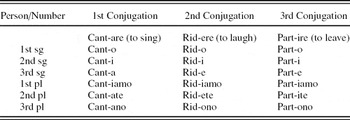
The Italian inflectional verb system is very complex, but very regular. In fact, there are three different series of inflected morphemes, one for each of the three major conjugation classes distinguished by the infinitive ending -are, as in cantare (“sing”), -ere, as in ridere (“laugh”), and -ire, as in partire (“leave”). These morphemes mark person (first, second, third), number (singular and plural), tense (present, past, future), and mood (indicative, imperative, conditional, subjunctive, participle, gerund, infinitive). All conjugations include regular and irregular verbs. Table 1 lists the morphemes of the indicative.
First, second, and third conjugation of Italian verbs

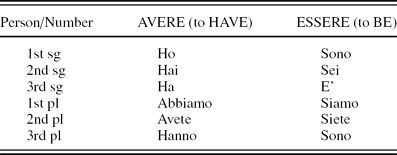
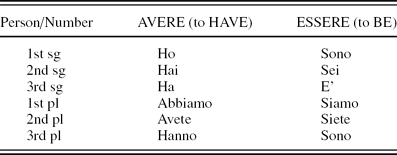
The auxiliary HAVE and BE and the copula BE are fully inflected irregular verbs. The copula BE introduces predicates of various kinds (nominal, adjectival, prepositional). Auxiliaries HAVE and BE are instead used in the formation of compound tenses (e.g., Passato Prossimo). BE is used with unaccusative verbs (partire, “leave”), with reflexive verbs (lavarsi, “wash-self”), in passive sentences, and in conjunction with a past participle that agrees in gender and number with the subject (e.g., I bambini sono partiti, “the children are left”-MASC-PL). HAVE is used with unergative intransitive verbs (telefonare, “phone”) and transitive verbs. It is followed by a past participle that does not agree with the subject and ends with the default masculine singular morpheme (-o). With transitive verbs, the past particle agrees with its object if this is expressed by a clitic (Ho visto la bambina “(I) have seen-MASC-SG the girl” ➔ l'ho vista “I her have seen-FEM-SG”). In Table 2, we report the present indicative of HAVE and BE.
Inflectional paradigms of HAVE and BE
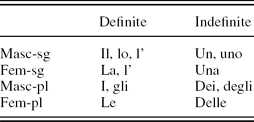
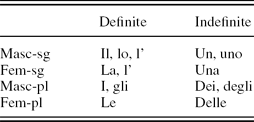
The Italian article system includes many different forms, marked for definiteness, number (singular and plural), and gender (masculine and feminine). Some of these are allophonic variants, the use of which is governed by phonological constraints, for example, lo is used in front of nouns beginning with z, sp, gn, st, sc. Articles must generally precede common nouns, except when these are vocative, and are thus very frequent in the linguistic input. In Table 3, we present the two lists of definite and indefinite articles. The plural forms of the indefinite articles are the so-called partitive articles. Some of the articles are homophonous with object clitic pronouns (lo, la, gli, le, l’).
Definite and indefinite articles
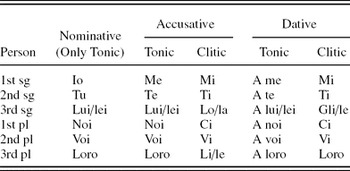
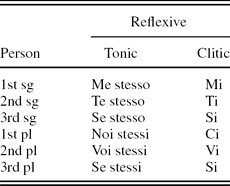
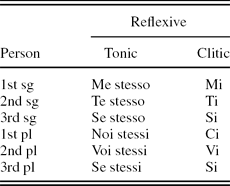
Italian personal pronouns are marked for person (first, second, third), number (singular), gender (masculine and feminine), and grammatical function: subject, direct and indirect object; in addition, there are reflexive pronouns; because the morphological case system is relatively poor, homonymous forms are frequent. Two series of pronouns exist in Italian: tonic (stressed) pronouns and clitic (unstressed) pronouns. Tables 4 and 5 report the various types of pronouns (subject pronouns are only expressed in the tonic form).Footnote 1
Nominative, accusative, and dative pronouns

Reflexive pronouns
Clitic pronouns are bound to a verb host, so they are typically restricted to certain positions: adjacent to the following verb (proclitics) or attached to the preceding verb (enclitics). The position of clitics is grammatically ruled: proclitics occur with finite verbs, except in the imperative mood; instead, enclitics occur with nonfinite verbs and with verbs in the imperative mood. When the infinitive is governed by a modal or an aspectual verb, clitics might appear after the infinitive verb (see Example 1a) or before the finite verb (see Example 1b) through a process referred to as “clitic climbing.”
- 1.
a. Voglio baciar-lo
“(I) want to kiss-him”
b. Lo voglio baciare
“(I) him want to kiss”
Tonic pronouns, subject, and object are employed only in contrastive context and their use is discourse governed.
METHOD
Subjects and linguistic corpora
The participants of our study were 59 children (25 males, 34 females), attending a public day care center, ranging in age from 22 to 35 months (mean age = 28.92, SD = 2.8). Each child was video- and audiotaped using a Panasonic RX20 camera and an Olympus Pearl Coder L200 recorder in a seminatural conversation setting while playing with the caregivers at the nursery school. The toys, which included animals, props, and a farm, were the same for all of the children, so that the verbal interactions turned around these animals. Each recording session lasted about 20–25 min. Each tape was transcribed by one listener and checked by another. All of the doubtful portions were listened to twice, and when the listeners did not reach an agreement, the portions were labeled as unintelligible. Conventional Italian orthography was used. The CHAT format of the CHILDES coding system was adopted for all of the transcriptions (MacWhinney, Reference MacWhinney2000).
To compare the linguistic development of children, we had to divide them into different groups. This division was not based on age because there is a great variability in the linguistic development among children in the same age range. Although other measures have been used in the literature such as verbal utterances (Valian, Reference Valian1991) or proportion of presyntactic devices (Deen, Reference Deen2005; Veneziano & Sinclair, Reference Veneziano and Sinclair2000), we choose to group children by mean length of utterance (MLU)Footnote 2 computed in words (Bates, Reference Bates1976; Pizzuto & Caselli, Reference Pizzuto and Caselli1992). Children were divided into three groups based on MLU in words (MLUW) values: G1 (MLUW = 1.0–1.5; number of subjects = 15; mean age = 27.62, SD = 2.22), G2 (MLUW = 1.5–2.0; number of subjects = 19; mean age = 28.32, SD = 3.07), and G3 (MLUW = 2.0–3.1; number of subjects = 25; mean age = 30.15, SD = 2.47). Our analysis is based on a total of 9,386 utterances: 1,791 produced by children in G1, 2,855 produced by children in G2, and 4,740 produced by children in G3.
Analysis of spontaneous production
We analyzed children's use of inflectional morphemes in the present indicative and in the compound past tense Passato Prossimo and children's use of free-standing morphemes, such as articles, pronouns, copulas, and auxiliaries. In the case of free-standing morphemes we identified (a) correct productions (full forms; establishing correctness based on the extralinguistic context, which was possible given that all sessions were videotaped); (b) deviant productions of morphemes, by distinguishing between errors and phonetic reductions (including phonetic approximations and monosyllabic place holders; see Bottari et al., Reference Bottari, Cipriani and Chilosi1993/1994); and (c) obligatory contexts. Absence of a morpheme was not counted as omission in (a) nonobligatory contexts and (b) when the child repeated what the adult told her or when she completed an adult's utterance. For example, in the case of articles, we did not count as omissions those contexts in which the articles were dropped even in the adult language. These contexts include mass and plural nouns in object position (voglio acqua, “I want water”) and nouns in one-word utterances that might be considered as naming acts (e.g., answers to questions such as: “What is it?” “What is its name?”). In the case of BE, we did not count elliptical phrases, such as il cane (“the dog”) that may stand for è il cane (“it's the dog”) as instances of copula omission, unless the preceding context made it clear that the copula should have been used. As for pronouns, we counted as omissions contexts in which the direct or indirect argument of a verb was missing but was obligatorily required by the argument structure of the verb.
Proportions of occurrence–omission of each function morpheme were calculated for each child with the following formula: morpheme production frequency/total number of obligatory contexts for morphemes. These data were then used for statistical analyses that were computed by the SPSS-10.1 automatic package.
The acquisition of morphemes is often measured by its presence in 90% (Brown, Reference Brown1973; Cazden, Reference Cazden1968; Pizzuto & Caselli, Reference Pizzuto and Caselli1992) or in at least 75% of the obligatory contexts (Cipriani, Chilosi, & Bottari, Reference Cipriani, Chilosi, Bottari, Cresti and Moneglia1993; Cipriani, Chilosi, Bottari, & Pfanner, Reference Cipriani, Chilosi, Bottari and Pfanner1993; Nelli, Reference Nelli1998) for three consecutive speech samples. These levels of attainment are conventional (Stromswold, Reference Stromswold, McDaniel, McKee and Smith Cairns1996), and it is an empirical question to decide how often one morpheme has to be used to be considered as acquired. Some studies emphasize that these quantitative measures may be used in conjunction with measures of formal variability in the use of a morpheme (Baumgartner, Devescovi, & D'Amico, Reference Baumgartner, Devescovi and D'Amico2000; Guasti, Reference Guasti1993/1994). Given the cross-sectional nature of our corpus, we do not have consecutive samples. Therefore, to understand the development of morphosyntax we will provide two different measures of children's use of the relevant morphemes, that is, the percentage of use of the different morphemes and the number of children who used them. In this case, we distinguish among children that never use a given morpheme, those that use it at least once, and those that use it in at least three different contexts. In addition, as criteria of acquisition, we use either the 75% of correct use or the use of a morpheme in three distinct contexts. For each analysis, we will report which measures are being used.
RESULTS
Verb morphology acquisition
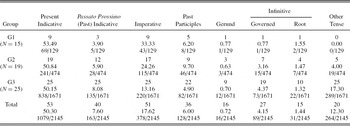
All clauses with a lexical verb were examined and classified in relation to mood (indicative, imperative, etc.) and tense (present, past, future). Table 6 presents the percentages of the different forms used in the corpus. The most frequent form was present indicative, whereas the most infrequent form was the gerund. Past forms (Passato Prossimo), infinitives, and other mood or tense forms (other tenses) increase in relation to MLU. On the contrary, imperative forms decrease. This means that children learn to vary the structure of their verbal utterances and to limit their use of imperative forms. All children in G2 use present indicative, and in G3 they all use both present indicative and Passato Prossimo. Infinitives were rarely produced in the place of main verbs (G1 = 1.55%, G2 = 1.47%, G3 = 1.32%) and in most of the cases they were produced in contexts in which a preposition or modal verb was missing, for example, (voglio-devo) chiudere le porte perchè fanno la nanna” ([“I want-have to] close the doors since [they] sleep”), something that was established on the basis of contextual analysis of the videotaped sessions. These data confirm previous findings that the use of root infinitives is not a feature of Italian typical development (Guasti, Reference Guasti1993/1994). A small percentage of bare past participles are present. These forms are likely forms of the Passato Prossimo lacking the overt expression of the auxiliary, as most of the children used them in contexts in which Passato Prossimo is generally used.
Use of different verbal forms in each MLU group and in the total corpus

Note: For each verbal form we report the number of subjects who use it (first value), the percentage of use in the group (second value), and the number of each form/total number of verbal forms produced (third value).
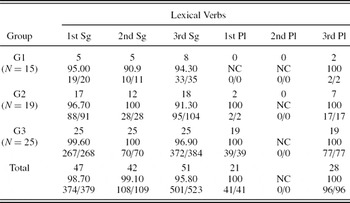
Because the most frequent tense used is the present indicative, we limit further analysis to the development of present tense inflectional morphemes. Initially, we may notice that agreement errors between the subject and the inflected verb seldom occurred. From early productions, children knew how to use inflectional morphemes appropriately as shown in Table 7.
Subject inflected verb agreement in indicative present tense with lexical verbs

Note: For each inflectional morpheme we report the number of subjects who use it (first value), the percentage of correct use in the group (second value), and the number of appropriate inflectional forms/total number of inflectional form produced (third value).
It can be observed that even G1 used the three singular person morphemes correctly most of the time. Plural morphemes start to be employed by G2 and they increase in G3. The second person plural is never used; this may be because the kind of interactions did not favor it. Errors are rare, the most common one being the replacement of the first singular morpheme with the third singular morpheme (39.2% of the total number of errors). Another common error is the use of third singular morpheme in the place of the third plural morpheme (25% of the total number of errors). Some examples of errors are as follows:
2.

3. dorm-e tutti
“sleeps all (they)”
“(they) all sleeps”

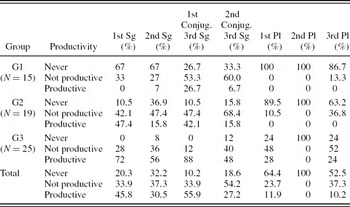
The data reported in Table 7 give an overview of the use of the single inflectional morphemes, but they do not tell us whether the same morpheme is used with different verbs. Therefore, we performed an additional analysis based on criteria of formal variety. For each child, we classified a given morpheme as “never used” (N), “not yet productively used” (NP), and “productively used” (P), and defined a morpheme as productively used if it occurred with at least three different verbs. Table 8 presents the percentages of children who never used a given morpheme or used it productively or not.
Percentages of children who employ the present indicative morphemes: Never, nonproductively (at least once), and productively (in three distinct contexts)

It is possible to observe that the third person singular morpheme is already used productively by 26.7% of the children in G1 (i.e., 26.7% of children use third singular morpheme with three different verbs); first and third person singular morphemes are productively used by about 42% of the children and the second person singular morpheme by 15% of the children in G2; the number of children who use these morphemes productively increases in G3, where also first person and third person plural morphemes are productively used by more than 20% of the children. These findings show that already at G1 some children use the same morpheme with at least three different verbs and that across the three groups more and more children used it productively. Although our data do not prove that all children have generalized the use of different morphemes at the same time, they show that some children have such use quite early and that the use of various inflectional morphemes increases over a relatively short period. This result confirms previous results using a much larger population and does so in a more detailed way for each morpheme of the present indicative (Guasti, Reference Guasti1993/1994). The use of the various inflectional morphemes (productive and not yet productive) increases across the three groups of children, that is, it increases as MLU increases. This statement is corroborated by the fact that a significant association between the variables “group of children” (G1, G2, G3) and “class of use” (N, NP, P) is found for each morpheme; that is, across the three groups of children we observed a significant increase from no use to productive use for each morpheme: first singular, χ2 = 33.084, N = 59, df = 4, p < .001; second singular, χ2 = 20.659, N = 59, df = 4, p < .001; third singular of first conjugation, χ2 = 18.607, N = 59, df = 4, p = .001; third singular of second and third conjugations, χ2 = 11.374, N = 59, df = 4, p = .023; first plural, χ2 = 19.529, N = 59, df = 4, p = .001; and third plural, χ2 = 18.607, N = 59, df = 4, p = .001. In conclusion, already in the youngest group of children some morphemes are used with different verbs, at least by some of the children; by G3, that is, around 2 years, 6 months, this use occurs with several morphemes in a large proportion of children.
Auxiliaries and copula BE. We now examine the use of the verb BE distinguishing between its two functions: copula and auxiliary. In addition, we analyze the use of the auxiliary HAVE. Analyses were made by computing full forms, phonetic reductions (e.g., ono for sono), and presynaptic devices (i.e., phonetically underspecified form, see Bottari et al., Reference Bottari, Cipriani and Chilosi1993/1994) altogether. Let us start with the copula whose use and omission is exemplified in Examples 4 and 5.
4.
5.
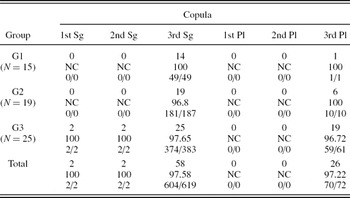
Table 9 reports the correct use of the copula by the three groups of children. Initially, we notice that most of the cases involve the use of the third person singular form of the copula and that this morpheme is already used correctly in G1 by almost all children. The third person plural appears in G2, but it is used by most of the children in G3. The other forms are almost absent, likely because of the kind of linguistic interactions suggested by the toys available.
Correct use of agreement between the copula and its subject

Note: For each inflectional form we report the number of children who use it (first value), the percentage of correct use in the group (second value), and the number of appropriate inflectional forms/total number of inflectional forms produced (third value).
Agreement errors between the copula and its subject seldom occur and mainly concern cases in which the third person singular is used in place of the third person plural morpheme (about 3%; e.g., Dov’ *è i giochi?, “Where's the toys?”); these are reported under the fourth column of Table 9. Other errors are cases in which the third person plural morpheme is used in place of the third person singular morpheme (2.88%).Footnote 3
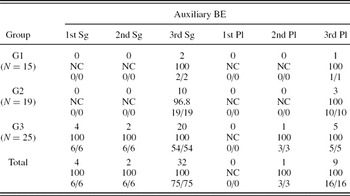
A different pattern is observed in the case of the auxiliary BE, as one can see in Table 10. In each group, children use the third singular form of the auxiliary BE less than the copula BE and the third plural morpheme is used less even by children in G3. However, as observed for the copula, agreement errors are almost absent.
Correct use of agreement between the auxiliary BE and its subject in Passato Prossimo tense

Note: For each inflectional form we report the number of children who use it (first value), the percentage of correct use in the group (second value), and the number of appropriate inflectional forms/total number of inflectional forms produced (third value).
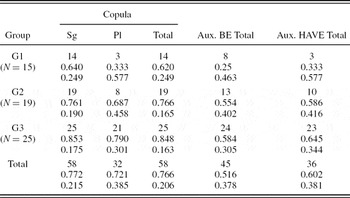
When the copula and auxiliaries are used, they are used with the correct inflection most of the time. However, these morphemes are initially often omitted and their use increases with MLUW. As described before, we have computed the use and omissions of copula and auxiliary BE separately. Contexts in which it is not clear whether BE is a copula or an auxiliary were counted separately. The results of omissions of the copula and the auxiliaries are reported in Table 11. The second, third, and fourth columns include the data concerning the copula; the fifth and sixth columns include the data regarding the auxiliaries BE and HAVE used in compound tenses. In each cell of the table we report the number of children who have at least one context of use of the relevant morpheme (the first number). We then report the mean use of each morpheme (the second number) and the standard deviation (the third number). The mean is calculated by first computing the child's proportion of use of the morpheme in obligatory contexts and by averaging in the group. As we are interested in the proportion of omissions, we included correct and incorrect use of the morphemes.
Number of subjects who use copula and auxiliaries (first values), means (second values), and standard deviations (third values)

We can observe in Table 11 that the use of the copula increases across groups and this is statistically confirmed by Kruskal–Wallis analysis (N = 58, χ2 = 9.750, df = 2, p = .008). Of interest, this increase is essentially because of an increase of singular forms (Kruskal–Wallis N = 58, χ2 = 9.396, df = 2, p = .009), as no significant increase is found for plural ones (Kruskal–Wallis N = 32, χ2 = 2.096, df = 2, p = .351). In addition, the number of children who reach 75% of copula use in obligatory contexts increases across the three groups, and this is confirmed by a significant association between the variable group (G1, G2, G3) and the variable productive use of copula (two categories: 75% of use vs. less than 75% of use; χ2 = 7.583, df = 2, p = .023, N = 47).
By contrast, the use of the auxiliary BE does not display a comparable development to that of the copula. In fact, no significant difference among groups was found (Kruskal–Wallis N = 45, χ2 = 4.278, df = 2, p = .118); that is, the use of the auxiliary BE does not display the same increase across the groups that was found for the copula BE. In fact, a comparison between the use of the auxiliary BE and the copula BE reveals that the proportion of copular forms in obligatory contexts is higher than the corresponding proportion of the auxiliary BE (Wilcoxon N = 45, z = −3.665, p < .001). The proportion of copular forms is also higher than the proportion of the auxiliary HAVE (Wilcoxon N = 36, z = −2.530, p = .011), whereas no difference is found between the proportion of the auxiliary BE and the auxiliary HAVE (Wilcoxon N = 33, z = −0.758, p = .449). These results suggest that children distinguish between the two morphemes BE, despite their allomorphy, and treat the two auxiliary forms, BE and HAVE, as belonging to the same category.
In summary, the use of the copula, but not that of the auxiliaries, increases as a function of the MLUW and certain differences were found between singular and plural forms. Singular forms increase among the three groups. Plural contexts emerge later than singular ones, but when they do, the copula is used frequently and little change is observed among the groups. We also found that children distinguish between two uses of the morpheme BE, auxiliary and copula, as they omit the former more than the latter. Of interest, omission of the auxiliary BE is similar to omission of the auxiliary HAVE, indicating that grammatical category is a more important factor in the process of acquisition than phonological similarity.
Article use
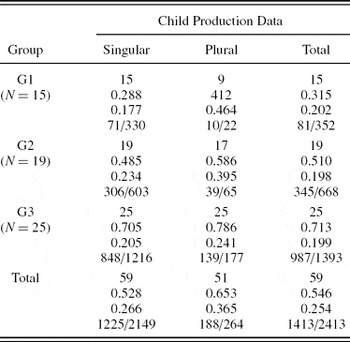
We now turn to articles, whose proportions of occurrence and omission were calculated for every child. Analyses were made by computing full forms, phonetic reductions of articles, and presynaptic devices altogether. The data are shown in Table 12. The mean was calculated by first computing the child's proportion in the use of the morpheme in obligatory contexts and then by averaging in the group.
Child production data of articles by group

Note: The values are the number of subjects who use articles (first values), means (second values) and standard deviations (third values) concerning the use of each child, and the number of articles produced/total number of contexts (fourth values) concerning the group productions.
Results indicate that the use of articles increased among the three groups. There were significant differences among the three groups concerning the singular forms (Kruskal–Wallis N = 58, χ2 = 20.406, df = 2, p < .001), but not the plural ones (test Kruskal–Wallis N = x, χ2 = 5.242, df = 2, p = .07). It should be noticed that plural obligatory contexts were significantly less frequent than singular ones (t = 13.120, df = 58, p < .001), but plural articles were also less frequently omitted than singular ones (Wilcoxon N = z = −2.862, p = .004).Footnote 4 Errors were rare, about 3% of the cases, and were of three types: article–noun/adjective gender agreement: laf.sg* salem.sg (“the salt”) rather than ilm.sg salem.sg; number agreement: ilm.sg* maialim.pl (“the pigs”) rather than impl maialim.pl; and article form selection: un scherzo (“a joke”) rather than uno scherzo.
Articles are frequently omitted, but not in a random way. In the literature it has been proposed that article omission is subject to prosodic constraints. Gerken (Reference Gerken1996) found that English learners tend to omit articles less in front of the direct object than in front of the subjectFootnote 5 (see also Lleò & Demuth, Reference Lleó and Demuth1999). She explained the subject/object asymmetry in article omission in early English in terms of a prosodic constraint on the output of the speech production system, expressed in the trochaic template hypothesis. According to this hypothesis the child applies a trochaic prosodic template (a metrical unit formed by a strong syllable [S] followed by a weak syllable [W]) on her intended utterance that results in the omission of all weak syllables that do not fit the template. Therefore, in utterance Example 9 the article in front of the subject tends to be omitted because it is a weak syllable that does not fit the trochaic template. By contrast, the article in front of the object tends to be omitted less as it forms a trochaic foot with the monosyllabic verb preceding it.
9.
Extending the prosodic approach to Italian, Crisma and Tomasutti (Reference Crisma and Tomasutti2000) experimentally investigated the omission of the article LA (feminine singular) from the object position of verbal utterances and from nouns uttered in isolation (e.g., the dog). They found that in verbal utterances omission was contingent on the prosodic properties of the preceding verb: it was higher when the verb was disyllabic than when it was monosyllabic. These authors explained this asymmetry by claiming that also in Italian the article (a weak syllable) forms a trochaic foot with the preceding verb (a strong syllable) when this was monosyllabic, as shown in Example 11a, but not when the preceding verb was disyllabic. Thus, in this last case the article, a weak syllable, did not fit the trochaic template, as seen in Example 10b, and was therefore omitted.
10.
There are reasons to doubt that omission of articles in Italian is ruled by a prosodic constraint. First, the trochaic template hypothesis rests on the phonological properties of English, a stressed-timed language, in which we observe an alternation of strong and weak syllables that has not been attested in Italian (Ramus, Nespor, & Mehler, Reference Ramus, Nespor and Mehler1999). Although in English the trochaic foot (a strong plus a weak syllable) is a relevant unit for processing lexical items, this is not so in Italian, where the relevant unit is the syllable, because Italian is a syllable-timed language. Second, Crisma and Tomasutti's proposal is problematic on empirical grounds, as our attempt to replicate their results with spontaneous data failed. In fact, no statistical difference in the omission rate of the article LA was found depending on whether or not the preceding verb was monosyllabic (23% article omission) or disyllabic (32% article omission).
We conjecture that what matters in article omission is not the prosodic status of the preceding verb, but the position in the utterance that the article would occupy. To test this hypothesis, we compared omission of all articles in the first position of the utterance (subject position of verbal utterances or in front of nouns uttered in isolation) with omission of all articles after verbs (object position of verbal utterances),Footnote 6 regardless of the syllabic structure of these. Of interest, a difference was still observed in the use/omission of articles depending on their position, sentence initial or following verbs (Wilcoxon Test, z = −4.424, p < .001), but it did not depend on the prosodic status of the preceding verbs. This suggests that the asymmetry is better characterized in terms of different positions in the clause/utterance: omission is higher from the first position, be this the first position of the clause (subject position) or the initial position of noun phrases, as opposed to the clause internal position after the verb.
In summary, article use increases as a function of the MLUW but some differences were found between singular and plural forms. The use of singular articles increases rapidly among the three groups. Plural articles are omitted less often and their use changed slowly; in fact, an increasing trend among the three groups only shows a tendency toward significance. Finally, article omissions displays a systematic pattern whereby more omissions occur in the initial position of an utterance than after the verb or inside the clause.
Pronoun use
We examined tonic and clitic pronouns separately and analyzed them according to their grammatical function (subject, direct object, and indirect object). Notice that subject pronouns are always tonic pronouns and they are used only for emphatic purposes or when a contrast needs to be established (Noi verremo, non voi, “we will come, not you”). Otherwise, the subject is phonologically null (mangio, “eat-1SG”). Object pronouns, however, are obligatory in all contexts, except in emphatic contexts where tonic forms are used (Gianni ha visto te non lui, “Gianni has seen you, not him”).
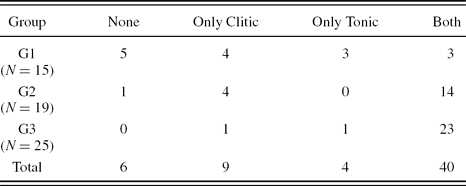
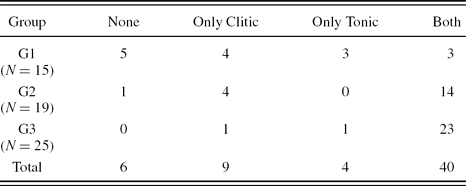
To compare the use of tonic and clitic forms, we distinguished for each MLU group the children who did not produce pronouns (NP), those who produced only tonic forms (TP), those that produced only clitics (CP), and those that produced both (TC). Table 13 displays the number of subjects in each MLU group who used the different forms of the pronouns. As can be seen, most of the subjects used both clitic and tonic pronouns, and there is no evidence that tonic forms were used earlier than clitics. These data do not confirm what was observed in previous research where tonic pronouns were shown to occur before clitics (Antelmi, Reference Antelmi1997; Berretta, Reference Berretta and Ramat1986).
Number of subjects who use different kinds of pronouns in relation to MLUW
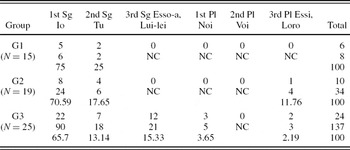
With regard to tonic forms, subject pronouns are employed more than object pronouns. This is expected, because the latter, but not the former, have a corresponding clitic form. Table 14 shows the percentages of each subject pronoun used both in isolation and in verbal sentences.
Child use of subject pronouns by group

Note: The values are the number of subjects who use each subject pronoun (first values), frequencies (second values), and percentages of the use (third values) of each subject pronoun.
Children in G1 use some tonic pronouns. First person singular remains stable across the three groups. Other person pronouns appear in G3, but their use remains low, as it might be expected in a language in which subject pronouns are used for contrastive/emphatic purpose.
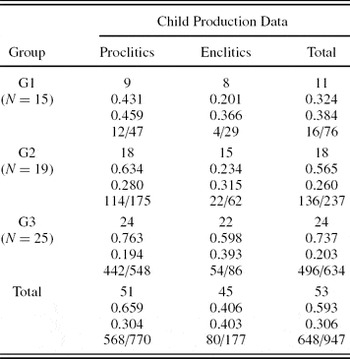
For the clitics, we calculated proportions of use omissionFootnote 7 for each child, both distinguishing and computing altogether proclitic and enclitic contexts. Analyses were made by computing full forms and phonetic reductions together. In the data shown in Table 15 the direct and indirect object clitic pronouns are conflated. In each cell of the table there are the number of children who present at least one context of use of clitics (the first number), the mean of use of clitics (the second number), and the standard deviation (the third number). The mean is calculated by first computing the child's proportion of use of the morpheme in obligatory contexts and then by averaging in the groups.
Child production data of proclitics and enclitics by group

Note: The values are the number of subjects who use proclitics and enclitics (first values), means (second values) and standard deviations (third values) concerning the use of each child, and the number of forms produced/total number of contexts (fourth values) concerning the group productions.
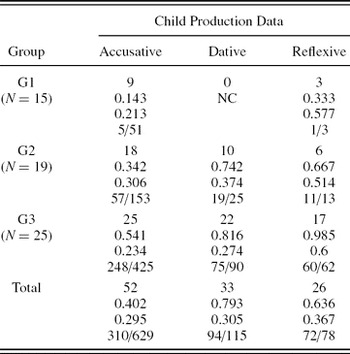
Clitics increase as a function of the MLUW, especially in the case of enclitics. Statistical analyses show significant differences among the three groups in the case of enclitic forms (Kruskal–Wallis N = 42, χ2 = 9.936, df = 2, p = .007), but not in the case of proclitics (Kruskal–Wallis N = 46, χ2 = 5.505, df = 2, p = .064). Overall proclitics are less omitted than enclitics (Wilcoxon N = 41, z = −3.343, p = .001), especially in G2 (Wilcoxon N = 15, z = −2.985, p = .001, Monte Carlo method) and in G3 (Wilcoxon N = 22, z = 1.802, p = .03, Monte Carlo method). Given the small size of the sample, it was not possible to examine G1 productions of proclitis plus enclitics. Clitics were also examined in relation to their grammatical function: accusative, dative, and reflexive clitics. The data are shown in Table 16. Accusative clitics increase among the three groups (Kruskal–Wallis N = 52, χ2 = 17.236, df = 2, p < .001; J-T = 661.5, p < .001) and so do reflexive clitics (Kruskal–Wallis N = 26, χ2 = 7.604, df = 2, p = .022). Dative clitics were absent in G1 and emerge in G2. Their production is already high in G2 and increase slowly from G2 to G3; in fact, no significant difference was found among groups (Mann–Whitney N = 32, z = −.320, p = .749). Examples of productions and omissions of proclitics and enclitics are reported in Examples 11 and 12, respectively.
11.
12.
Pronouns use is generally correct from early productions; in fact, the wrong selection of morphological case occurred in 1.8%, for example, *a io (“to I”) rather than a me; agreement errors occurred in 0.3% of the cases for gender and in 0.02% of the cases for number io non lom.sg mangio tante cicchef.pl (“I don't eat it many chewing-gums”) rather than io non lefem.pl mangio tante cicchef.pl (“I don't eat them many chewing-gums”).
Child production data for accusative, dative, and reflexive by group

Note: The values are the number of subjects (first values) who use direct/indirect object clitic pronouns and reflexive clitics, means (second values) and standard deviations (third values) concerning the use of each child, and the number of articles produced/total number of (fourth values) contexts concerning the group productions.
In summary, subject tonic pronouns are rare, as expected in a null subject language (see also Hyams, Reference Hyams1992) in which their use is subject to discourse constraints. Object clitics increase among the three groups as a function of MLUW. Accusative and reflexives clitics are used earlier and more consistently than dative clitics. No child exhibits the use of tonic pronouns without also exhibiting the use of clitics.
GENERAL DISCUSSION
Our investigation of the speech of Italian children in the early stage of multiword combinations has shown that there are regularities, both in the use and in the omission of grammatical morphemes. As in Pizzutto and Caselli (Reference Pizzuto and Caselli1992), we found that the acquisition of free morphemes was less rapid than the acquisition of inflectional verb morphology. Children use inflectional verb morphology but omit articles, although mainly from the first clausal position or from noun phrases in isolation. They omit accusative clitics more than dative clitics and auxiliaries (BE and HAVE) to a lesser extent the copula BE. In the remainder, we discuss each finding separately.
Verb morphology
Singular verb inflections are by far more represented than plural ones, as they are used since G1 (MLU = 1–1.5). The third person singular inflection is used by most of the children, as already found in previous studies (Pizzuto & Caselli, Reference Pizzuto and Caselli1992). However, by G3 (MLU = ∼3) first and second person inflections are also used productively by many children. Although this does not prove that Italian children have fully generalized the inflectional morphemes (we cannot verify whether the same verb is used with different inflections given the small sample we have for each child), it is a hint that Italian children can generalize quite rapidly (for evidence of generalization, see also Guasti, Reference Guasti1993/1994). The third person plural morpheme is already present in G1; by G3 the first and the third plural morphemes are used productively or nonproductively by most of the children. These findings are important for our understanding of one phenomenon that has largely been debated within the acquisition literature, namely, the omission of subjects. It is well known that Italian is a null subject language (Rizzi, Reference Rizzi1982) and that this property is likely to be connected to the richness of the verbal paradigm (see Baker, Reference Baker, Carnie, Harley and Willie2003, for a statement in this direction). Although we have no proof that Italian children by reaching MLU 3 have fully mastered the complete paradigm of verbal inflection, it is very likely that they have mastered part of it. Because Italian children omit subjects and one ingredient in the licensing of null subjects is the richness of agreement, it is arguable that partial mastery is enough to license the null subject in early Italian as this happens in adult Italian (Hyams, Reference Hyams1992).Footnote 8 This conclusion fits well with other findings about early null subjects. Children speaking a variety of nonnull subject languages omit the sentential subjects (Haegeman, Reference Haegeman, Koester and Wijnen1995; Hamann & Plunkett, Reference Hamann and Plunkett1998; Rizzi, Reference Rizzi1993/1994; Valian, Reference Valian1990). However, they do so in a very different way with respect to Italian children and adults. Essentially, subject omission in early nonnull subject languages is limited to the first clausal position of main declarative finite sentences, that is, it is a root phenomenon. This means that, in these early languages, we do not find omissions in finite wh-questions (see Rizzi, Reference Rizzi2002), whereas we do in early Italian (Guasti, Reference Guasti and Clahsen1995).Footnote 9 In fact, in Italian wh-questions, subject pronouns are usually omitted. Subject pronouns are employed only for contrastive or emphatic purposes, as we discussed earlier. Therefore, it is not surprising that we do not find many subject pronouns in childrens’ speech. Given these observations and the findings from this article and from other works in the literature, Pizzuto and Caselli's (Reference Pizzuto and Caselli1992) claim that subjectless sentences reflect insufficient knowledge of the pronominal system is hardly convincing. Italian children by MLU 3 know that their language is a null subject language and that agreement is playing a role in licensing null subjects (see also Serratrice, Reference Serratrice2006, for evidence that Italian children are sensitive to the pragmatic constraints regulating subject omission).
Article omission
Although the Italian article system is very complex, the errors are very rare and children's difficulties with articles manifest themselves as omissions, which decrease with MLUW. It is of interest that these omissions give rise to a systematic pattern. Omissions are higher in the first position of the utterance (subject position or noun phrases in isolation) than inside the clause (after verbs; see also Crisma & Tomasutti, Reference Crisma and Tomasutti2000; Gerken, Reference Gerken1996). Contrary to Crisma and Tomasutti (2002), we showed that the rate of article omission is not a function of the prosodic properties of the preceding verb, but only a function of the position that the article would occupy in the structural representation of the utterance. Our finding singles out the first position of a phrase or a clause as a privileged position, a result that is in line with what is observed for other sorts of omission phenomena in child language, in particular, the omission of subjects. It has been shown that across a variety of early languages, children omit the sentential subject from the first clausal position, but not from the clause internal position (Rizzi, Reference Rizzi1993/1994, Reference Rizzi2002). Thus, the generalization governing article omission is very similar to the one governing early subject omission (Rizzi, Reference Rizzi1993/1994): subjects are omitted from the specifier of the clausal root and articles are omitted from determiner phrases (DPs) that are located precisely in the specifier of the clausal root (or are in isolation). To unify the two phenomena, we propose that, like subjects, articles are phonologically omitted and are represented by an empty category. Rizzi (Reference Rizzi2002) proposes that subject omission occurs when children choose the inflection phrase (IP) as the root of the clause and thus locate the empty subject in its specifier. Furthermore, he assumes that empty categories need to be identified by a linguistic antecedent, if a position for this is available in the structure. The identification requirement can be void from the specifier of the root, because no linguistic antecedent is ever available from there, as the root is the ending point of the structural representation of a clause. Similarly, we propose that an empty article is legitimate in the DP hosted in the specifier of the root (i.e., the subject position), as the principle of identification does not apply to this position. Likewise, DPs in isolation can be headed by an empty article, because the DP itself is a root. In both the null articles and null subjects, identification is ensured through the discourse.
Clitics
Children omit clitics: accusative clitics are omitted more than reflexive and dative clitics, although dative clitics start to be used only by G2. These facts can be explained along the lines proposed by Wexler et al. (2003), who noticed that children omit clitics more frequently in those languages in which the past participle agrees with a proclitic object, as is the case in Italian (see Example 15) or Catalan, than in those languages in which there is no past participle agreement, as in Spanish.
15.
They assumed that clitics occupy the head of a clitic projection located above IP and below CP, as in Example 16 (see Sportiche, Reference Sportiche, Rooryck and Zaring1996). The base position for the object inside vP is occupied by a DP filled with a pro that raises directly to the spec of the clitic projection to check the D feature of the clitic head, at least in languages like Spanish. This is shown in Example 16.
In languages with past participle agreement, like Italian, DP pro has to check the D features of the head hosting the past participle, AgrOP (a projection located between vP and TP) and then the D feature of the ClP head hosting the clitic. This double checking leads to a violation of the UCC holding in child grammar:
16. UCC
The D feature of DP can only check against one functional feature.
To avoid such a violation and to have pro check only against one projection, AgrOP, the clitic projection is omitted and this results in clitic omission. The UCC is not violated in language without past participle agreement, as the DP pro has to check just the D feature of the ClP. Thus, Italian children omit clitics and to avoid a violation of the UCC, they omit the ClP. Our data allow us to test a further prediction of the UCC approach. Dative clitics do not trigger past participle agreement, and this may suggest that the double checking of the D feature does not occur in this case. Therefore, we expect dative clitics to be omitted to a lesser extent than accusative clitics. As a matter of fact, dative clitics, when used by G2, are much less omitted than accusative clitics (74 vs. 34%). Under the UCC approach, this asymmetry is welcome, as dative clitics do not need to check the D feature twice in any language, something that is evident in the lack of agreement between the past participle and the dative clitics.
Copula and auxiliaries
We observed that copula and auxiliaries were omitted and that the copula is omitted to a lesser extent than auxiliaries. To explain this asymmetry, we observe that auxiliaries are employed in compound tenses, such as Passato Prossimo, where in conjunction with the past participle of a lexical verb they express tense and agreement feature. Notice, crucially, that in compound tenses tense is not expressed by the auxiliary alone, but it is only in combination with the past participle that the past expression is manifested. The copula may instead be used in simple tenses (present, future, simple past) and directly expresses the tense and agreement feature. In this respect, the copula is more like a lexical verb. This asymmetry in the expression of tense features is at the basis of the different treatment that children accord to the copula and auxiliaries. To formally account for it, we extend to auxiliary omission Wexler et al.'s UCC proposal (see also Pine, Conti-Ramsden, Joseph, Lieven, & Seratrice, Reference Pine, Conti-Ramsden, Joseph, Lieven and Serratrice2008, for a different view). Let us assume that the copula and the auxiliary are generated in T and the past participle associated to the auxiliary is generated in V. Thus, sentences including compound tenses would have the structure in Example 17. The past participle will have to check the T feature of AspP and of T (overtly or covertly; only the relevant categories are represented in the tree).
17.
Because children are constrained by the UCC, the past participle could only check the T feature once, with the head of AspP. The T feature of tense would remain nucked and the derivation would crash. To avoid this, TP is omitted and so is the auxiliary located in it. No such problem arises for the copula, as one single T feature is present in that case.
CONCLUSION
Our findings, based on cross-sectional data, provide new evidence concerning the pattern of acquisition of free and bound morphemes in Italian and corroborate some previous conclusions obtained with the longitudinal method. Both inflected and free-standing morpheme productions are correct from early productions. Seldom do children make subject–verb agreement errors or gender and number agreement errors concerning articles. Given the cross-sectional nature of our study, we were able to show that children proceed in similar ways: most of the children start to use the third person singular inflectional morpheme, and then they move to the first and second singular one and later to the plural forms. These findings, we argued, have consequences for the analysis of subject omission in Italian. Our data complement what was found in other studies according to which subject omission in early Italian is a phenomenon distinct from subject omission in other early languages and is likely to be of the same nature of subject omission in the adult language. As children rapidly acquire part of the verbal agreement inflectional paradigm, they can make a connection between agreement and the omission of subjects. Italian learners are not different from other early learners in omitting free-standing morphemes. We investigated the omission of articles and showed that it is regulated by a constraint that makes reference to the syntactic position: articles are more often omitted from the first clausal position than from the clausal internal position, because the first clausal position is the position of the root and empty categories in the specifier of the root are exempted by the principle of clause-internal identification, whether this empty category is the subject of the clause or a null article. Omission of clitics was accounted for in terms of Wexler et al.'s (Reference Wexler, Gavarrò, Torrens, Bok-Bennema, Hollebrandse, Kampers Mahne and Sleeman2004) UCC: children omit the projection where clitics are located, because they cannot check a single feature twice. The same approach was extended to the omission of auxiliaries and to the fact that the morpheme BE was omitted more frequently when it was an auxiliary than when it was a copula. In sentences including an auxiliary, the past participle has to check the T feature, something that is blocked in child's grammar by the UCC and that forces children to omit the TP wasting the auxiliary.