Introduction
Hearing loss (HL) has developed as a significant public health concern, affecting an estimated 466 million individuals globally.Reference Dritsakis, Trenkova, Śliwińska-Kowalska, Brdarić, Pontoppidan and Katrakazas1 This invisible disability employs a deep influence on individuals across all ages and affects multiple aspects of life and health, including overall quality of life,Reference Dixon, Feeny, Tomlinson, Cushing, Chen and Krahn2 behavioral patterns,Reference Fiorillo, Rashidi, Westgate, Jacobs, Bush and Studts3 social skills,Reference Yadav, Ahsan and Kumar4 and mental well-being.Reference Idstad, Tambs, Aarhus and Engdahl5 Despite the availability of hearing aids and their associated benefits, a significant percentage of the population encounters challenges in both accessing and utilizing these assistive devices.Reference Marcos-Alonso, Almeida-Ayerve, Monopoli-Roca, Coronel-Touma, Pacheco-López and Peña-Navarro6
Several barriers have been identified in relation to the adoption of hearing aids, including financial restraints, social factors, cultural influences, medical considerations and technical particulars.Reference Barnett, Hixon, Okwiri, Irungu, Ayugi and Thompson7,Reference Schuh and Bush8 Among these complicated obstacles, psychological factors emerge as a challenge encountered by individuals grappling with hearing difficulties. A recent study carried out in the United States revealed an association between psychological distress and hearing aids use.Reference Bigelow, Reed, Brewster, Huang, Rebok and Rutherford9 Previous studies have documented both the positive and negative effects of hearing aids among children and elderly who have hearing problems.Reference Dall, Kiblböck, Müllegger, Fellinger, Hofer and Kapplmüller10,Reference Tognola, Mainardi, Vincenti and Cuda11 Yet, knowledge about middle-aged adults remains uncommon, particularly their attitudes and barriers in the adoption of hearing aids.Reference Ye, Zhu, Chen, Shi, Gong and Wang12 It is essential to recognize that this age group has different responsibilities/commitments, occupational obligations and familial duties; thus, the middle age group is under pressures compared to the younger and older groups who have HL.
Approximately 80 per cent of individuals with HL reside in low- and middle-income nations like Jordan.13 Individuals with HL in these countries often face challenges compared to their counterparts in developed countries.Reference Stevens, Flaxman, Brunskill, Mascarenhas, Mathers and Finucane14 For example, a study identified three primary barriers in these countries, namely, the scarcity of adequately trained personnel, the unaffordable cost associated with hearing devices available and limited public awareness regarding the advantages of hearing technologies.Reference McPherson15 As a consequence of these impairments, only a minority of Jordanian individuals have the financial means to obtain hearing aids, and despite efforts for hearing care improvements, coverage by the Ministry of Health remains limited, leaving a portion of the population without access to this essential hearing technology. Thus, the burden of HL often falls on the patient and may not always be apparentReference Smith, Pryce, O'Connell, Hussain, Shaw and Straus16 with unmet needs and especially for self-management support among working-age adults in particular.Reference Zuriekat, Alqudah, Semeraro, Watson, Rowan and Kirby17,Reference Zuriekat, Semeraro, Watson, Rowan and Kirby18
Several scales have been identified to understand the psychological issues affecting people with HL who wear hearing aids, such as the hearing aid selection profile scaleReference Jacobson, Newman, Fabry and Sandridge19 and satisfaction with amplification in daily life scale.Reference Dell'Antônia, Ikino and Carreirão Filho20 Among them, the Attitude towards Loss of Hearing Questionnaire (ALHQ) is widely used in several studies.Reference Ramos21,Reference Tang, Tran, McMahon, Turner, Amin and Sinha22 This scale has been translated into several languages, including a Persian versionReference Heidari, Fatahi, Hoseinabadi, Rouhbakhsh, Satri and Saunders23 and American-English version.Reference Saunders and Cienkowski24 An Arabic language version, validated for its reliability and validity, is needed to understand the attitudes of patients with HL in the Arabic context. This is the first study in the Arabic context to validate ALHQ in the Arabic language and to discover the attitudes of middle-aged adult workers in Jordan who are suffering from HL towards the utilization of hearing aids. Moreover, this study aims to explore the attitude of working middle-aged adults towards HL and hearing aids, differentiate between users and non-users and to identify predictor factors of their attitudes towards HL based on several demographic factors.
Materials and methods
Study design and participants
A cross-sectional methodological design was used. Inclusion criteria targeted the Jordanian working middle-aged adults, specifically individuals aged between 18 and 65 years, who have experienced HL and their hearing was confirmed by pure tone audiometry, regardless of the degree of HL or whether they use hearing aids or not. Individuals outside the selected age group or those unwilling to participate were excluded. To determine the sample size, we utilized G*Power software, which indicated a minimum requirement of 200 participants with HL. Purposive sampling procedure from Jordan University Hospital (JUH), Amman, Jordan, was selected to represent the study sample. We created an online Google Form to collect the data from the patients. Then, we send it to the patients’ phone number according to JUH database, asking their permission to voluntarily participate, communicating the aim of the study, obtaining demographic information and answering the ALHQ. The Google Form was closed upon reaching a total of 237 participants. The period of collecting the data was from October to December 2023. The time taken to complete the questionnaire did not exceed 3 minutes.
Study tools
Demographic data: Participants completed a questionnaire covering demographic data including age, gender, region, educational level, employment status, smoking status, income, marital status, number of people living in the house, comorbidities, period of HL, use of hearing aids and period of using hearing aids.
Attitudes towards Loss of Hearing Questionnaire (ALHQ): It is used to measure the attitudes of people who have hearing difficulties, whether they use hearing aids or not. The original version of the scale (version 1) was developed by Saunders et al.Reference Saunders and Cienkowski24 and consists of 24 items. Version 3, published in 2005, consists of 23 items divided into five subscales.Reference Saunders, Cienkowski, Forsline and Fausti25 The first subscale is denial of HL (six items), which refers to the level of acceptance of hearing aids. Negative associations (four items) discuss the embarrassment related hearing aids use. The third subscale is negative coping strategies (eight items), which interact with emotional and social reactions. Manual dexterity and vision (three items) refer to the ability to use a hearing aid. The last subscale is hearing-related esteem (two items), which refers to self-esteem and confidence. The participants were asked to respond to this scale as in the original scale by using a five-point Likert scale ranging from 5 “Strongly Agree” to 1 “Strongly Disagree”. For hearing aid users, we replaced questions (3, 4, 7, 9 and 18) with relative items to be aligned as in the original version scale. The highest mean score of items indicates higher denial, low self-esteem, negative association and strategies and lower use of manual dexterity and vision. However, we examined the validity and reliability of the translated Arabic version of ALHQ as illustrated below.
Ethics approval
Ethics approval was obtained from the Institutional Review Board of the JUH to access the data of patients in the audiology department (Reference: 10/2024/4429) as well as obtaining ethics approval from the Ethics Committee at the School of Medicine, the University of Jordan (Reference: 7498/2023/67). Participant consent was included as the first page in our Google Form, which outlines the nature of the study, its purpose and ensuring the anonymity of the participants’ information, which was used solely for research purposes.
Results and analysis
Analysis plan
First, to validate the ALHQ into the Arabic language, we involved translation and back-translation, validity checked by face, content and construct and reliability checked by Cronbach's alpha. In construct validity, we calculated the correlation coefficient (> 0.40). A Kaiser-Meyer-Olkin (KMO) value close to 1 indicates better sample adequacy, and Bartlett's test of sphericity suggests that variables are correlated and significant. Second, the quantitative data were entered into SPSS and analyzed for normality, descriptive statistics, independent sample t-test and Pearson correlation coefficients (r), considering a significance threshold of p ≤ 0.05. For prediction analysis, we employed a stepwise linear regression model.
Translation, validity and reliability of the Arabic version of ALHQ
The translation process began with the translation of the ALHQ English version into Arabic by two experts specialized in English-Arabic translation. Subsequently, another two experts specialized in Arabic-English translation were engaged to translate the Arabic ALHQ back into English. All experts approved the final Arabic version of ALHQ.
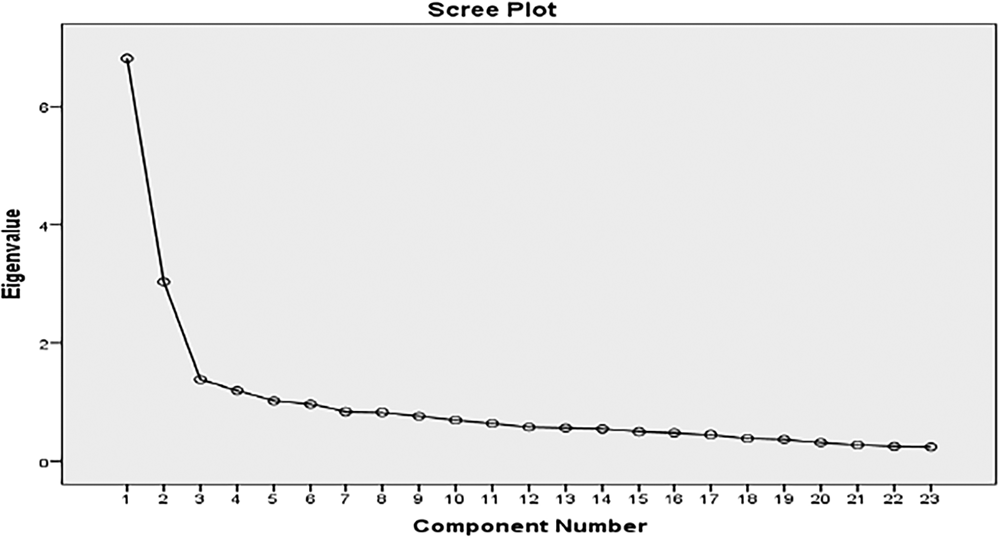
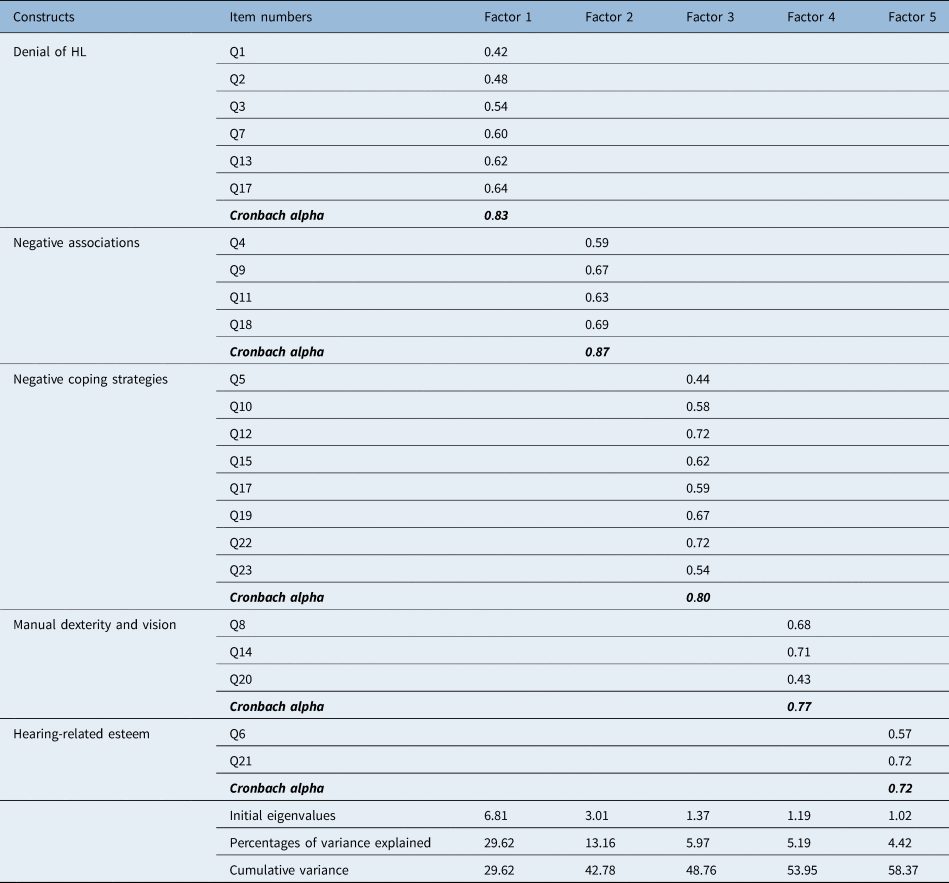
We started the validity process by conducting first: Face validity. It was checked by distributing the Arabic ALHQ to 20 patients who have HL to ensure clarity and ease of understanding of all items. Feedback by participants did not raise any comments regarding the Arabic version of ALHQ. Second: Content validity. It was performed by presenting the Arabic ALHQ to seven experts specialized in audiology, medicine and psychotherapy. The acceptance rate for the seven experts, based on Lawshe's Table, is 71 per centReference Polit, Beck and Owen26 to measure the content validity ratio (CVR). After assessing the Arabic version of ALHQ, the acceptance rate was 88 per cent, affirming its content validity. Third: Construct validity. The KMO test was 0.87, Bartlett's test was (chi-squared = 2122.7, p-value = 0.001), correlation coefficients ranged between 0.44 and 0.88, indicating proper results.Reference Awang27 The scree plot in Figure 1 and Table 1 illustrates that a total of five factors were loaded (six items in denial explained 29.62 per cent of variance, four items in negative associations explained 13.16 per cent of variance, eight items in negative coping strategies explained 5.97 per cent of variance, three items in dexterity explained 5.19 per cent of variance and two items in hearing-related esteem explained 4.42 per cent of variance) with eigenvalues greater than 1, confirming the result. The total Cronbach alpha for all items of the translated ALHQ was 0.876. All subscales were above 0.72, indicating that the required level of reliability was achieved.Reference George and Mallery28
Scree plot of the Arabic ALHQ version.

Total variance and factor loading for the dimension of the Arabic ALHQ

Note: HL = hearing loss; ALHQ = Attitudes towards Loss of Hearing Questionnaire; Factor 1 = denial; Factor 2 = negative associations; Factor 3 = negative coping strategies; Factor 4 = dexterity; Factor 5 = hearing-related esteem.
Demographic information
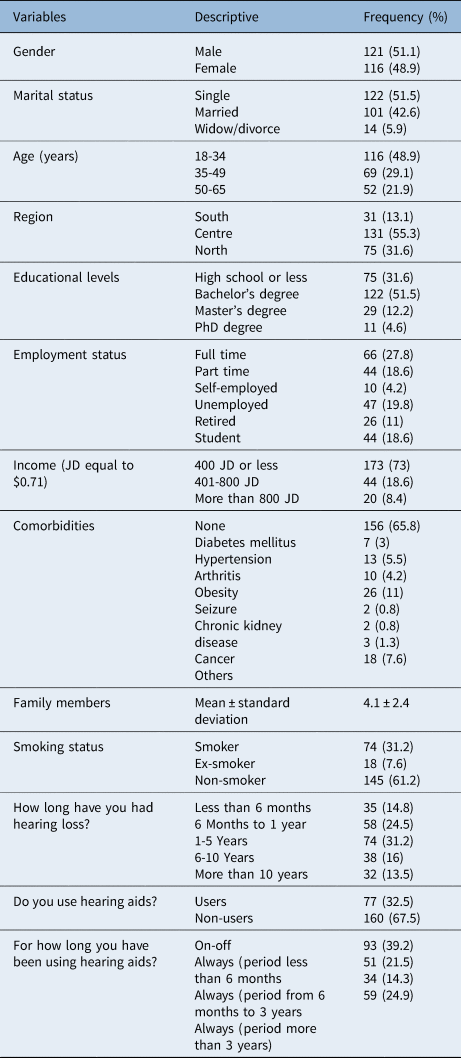
Among the 237 participating patients, more than half of them were male, single, living in the central part of the country, had a bachelor's degree, had a low income level (< 400 Jordanian dinar [JD] equal to < $550) and were non-smokers. Almost half of the participants were aged between 18 and 34 years. The average number of family members was 4.1 ± 2.4. Despite having HL, 67.5 per cent were not using hearing aids, and the highest percentage for the duration of HL was 1 to 5 years. Finally, a quarter of patients were using hearing aids for more than 3 years (Table 2).
Demographic information of participants (N = 237)

Negative coping strategies and associations were found to be the highest mean scores, indicating serious issues towards the way of coping among middle-aged adult workers. Hearing-related esteem exhibited the lowest mean score, indicating the lowest effect towards self-efficacy and confidence Table 3. We demonstrated the average score of all participants based on their use of hearing aids (N = 77) and non-use (N = 160) to explore their attitude differences in HL. Results found that no statistically significant differences were noted between the two groups (users vs. non-users) towards their attitude of HL. Non-users generally demonstrated a higher level of denial, more negative coping strategies, lower manual dexterity and vision and lower self-confidence. Negative associations were found to be higher among users of hearing aids. The average score of negative coping strategies was equal between the two groups (users vs. non-users).
Comparison between users (N = 77) and non-users (N = 160) of hearing aids

HL = hearing loss; M ± SD = mean ± standard deviation.
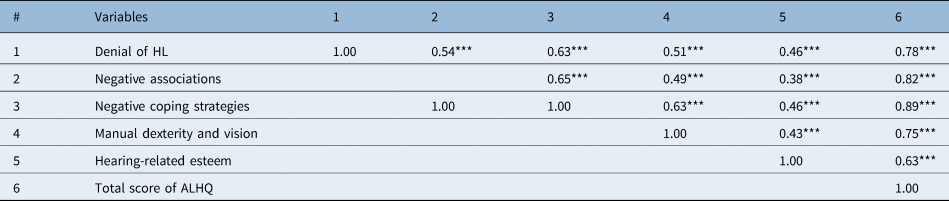
Significant positive correlations (p < 0.001) revealed between all subscales of ALHQ. Denial of HL is positively associated with negative associations (r = 0.54, p < 0.001), negative coping strategies (r = 0.63, p < 0.001), manual dexterity and vision (r = 0.51, p < 0.001) and hearing-related esteem (r = 0.78, p < 0.001). The negative associations subscale is positively associated (r = 0.65, p < 0.001; r = 0.49, p < 0.001; r = 0.46, p < 0.001) with negative coping strategies, manual dexterity and vision skills and hearing-related esteem, respectively (Table 4).
Correlation coefficient for the overall and its subscales of ALHQ (N = 237)

ALHQ = Attitudes towards Loss of Hearing Questionnaire; HL = hearing loss.
*** p < 0.001.
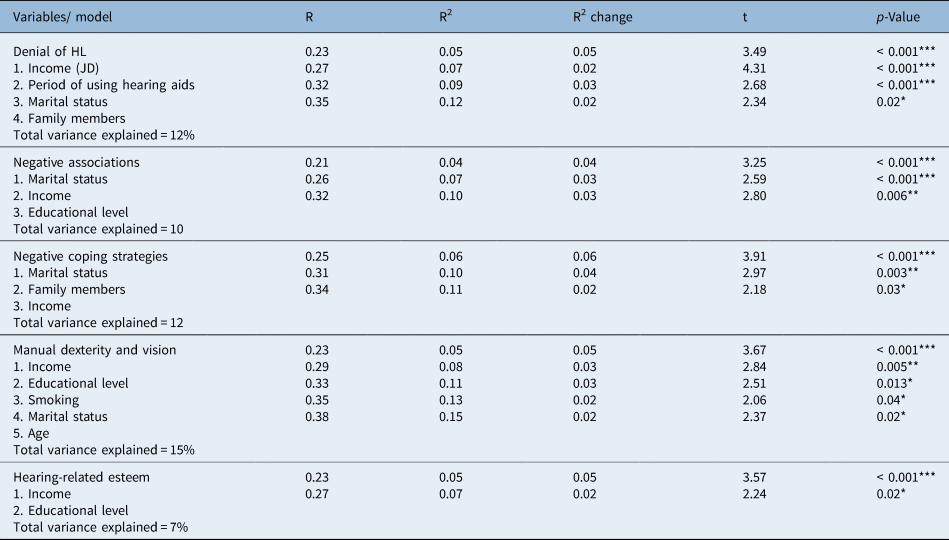
Prediction models are presented in Table 5. Dependent variables were the subscales of ALHQ, while the independent variables were demographic data including age, gender, region, educational levels, employment status, income, marital status, number living in the house, smoking status and period of HL, using the stepwise regression method. We found four predictor factors predict the denial of HL subscale, which are educational levels, income, period of HL and marital status, explaining a total of 16 per cent of the variance. Marital status, income and educational levels are predictors of negative associations, explaining 10 per cent of the variance. Regarding the negative coping strategies subscale, we found that marital status and the number of people living in the house are the main predictors, explaining a total variation of 11 per cent. Furthermore, we found five predictor factors for manual dexterity and vision, which are income, educational level, smoking, marital status and age, explaining a total variation of 15 per cent. Income and educational level account for 7 per cent of the variance in hearing-related esteem.
Predictors of attitude towards HL among middle-aged adult workers (N = 237)

Discussion
This study represents the first translation and validation of ALHQ third version from English to Arabic language. Also, it highlights the attitudes middle-aged adult workers who have HL towards using hearing aids or not. More than two-thirds of participants did not use hearing aids despite having HL for over 6 months. We noted that several demographic factors perform a major role towards the attitude of participating working adults. This study added value to international research, literature and clinical practice guidelines for middle-aged adult workers who have HL, despite a lack of previous studies among them.Reference Zuriekat, Alqudah, Semeraro, Watson, Rowan and Kirby17,Reference Zuriekat, Semeraro, Watson, Rowan and Kirby18
The validation process, including specialized experts, variance analysis and correlation coefficients, aligns with previous studies on ALHQ in different cultural contexts.Reference Heidari, Fatahi, Hoseinabadi, Rouhbakhsh, Satri and Saunders23,Reference Saunders, Cienkowski, Forsline and Fausti25,Reference Jo, Shin and Kim29,Reference Bastos, Amorim and Ferrari30 Experts added their comments without acception in all items measured, highlighting the need of such a scale among the Arabic speaking population due to lack of Arabic scales used to measure attitudes of HL. All five subscales of the ALHQ were found to be correlated and explained a percentage of 58.37 per cent, further confirming its validity. Regarding reliability, the total Cronbach alpha of 0.876 was higher than that reported in a previous study, 0.798.Reference Heidari, Fatahi, Hoseinabadi, Rouhbakhsh, Satri and Saunders23 The Arabic version produced a nuance understanding of the attitude of patients with HL in hospitals, organizations and among the Arabic researchers.
Negative coping strategies and associations were notably observed among participating middle-aged adult workers. This may be interpreted by their fear of being seen wearing hearing aids, feelings of inadequacy and excessive concerns about being perceived as elderly, foolish, or ignored. Coping strategies are needed to support middle-aged adult workers. A recent study found that a lack of coping mechanisms is associated with decreased happiness and well-being.Reference Adibsereshki, Hatamizadeh, Sajedi and Kazemnejad31
Stigma, age-related stereotypes and perceptions of disability contribute to HL denial, particularly prevalent among adults experiencing HL.Reference Wallhagen32,Reference McLaughlin, Bell and Stringer33 Unexpectedly, this study observed a higher rate of negative associations among users, possibly attributed to their negative experiences within their social and work environments due to public lack of awareness of HL and cultural influences. Up to 23 per cent of professionals with HL psycho-emotional utterance units deal with the issue of humiliation, self-consciousness or shame.Reference Rawool34,Reference Tye-Murray, Spry and Mauzé35 However, the differences between users and non-users based on their attitude of hearing aids were not observed, but non-users generally demonstrated a higher level of denial, more negative coping strategies, lower manual dexterity and vision and lower self-confidence. Negative associations and denial of HL are known issues among non-users compared to users.Reference Dell'Antônia, Ikino and Carreirão Filho20,Reference Bastos, Amorim and Ferrari30,Reference Rawool34 This investigation provides some understanding of their attitudes and coping processes among users and non-users of hearing aids, revealing that both groups have the same source of limitations, difficulties and negative coping styles towards workplace, along with diminished hearing-related esteem and manual dexterity and visual problems, consistent with existing literature.Reference Granberg and Gustafsson36
Various demographics factors and HL-related variables, influencing attitudes of middle-aged workers towards HL and hearing care seeking behaviours.Reference Barnett, Hixon, Okwiri, Irungu, Ayugi and Thompson7 Educational level, income and marital status emerged as significant predictors, with higher education associated with higher negative associations and worse hearing-related esteem. At the same time, higher income seems to be linked to less denial and potentially a greater likelihood of seeking hearing aids.Reference McKee, Choi, Wilson, DeJonckheere, Zazove and Levy37 Recent systematic review studies revealed that individuals with higher socioeconomic status are more inclined to adopt hearing aids.Reference Knoetze, Manchaiah, Mothemela and Swanepoel38,Reference Cho, Kim, Choi, Baek, Seol and Lim39 Also, workers with advanced educational levels are more inclined to have higher incomes, facilitating the affordability of hearing aids and additional expenses such as batteries.Reference Fuentes-López, Fuente, Valdivia and Luna-Monsalve40
Married workers exhibited better attitudes towards HL and hearing aids, including less denial, less negative associations and better coping strategies compared to single people. Marriage could be influential on hearing aid adoption rates, potentially influenced by communication dynamics within couples affected by HL. The compromised communication within couples due to HL, could be impacting the relational aspect significantly and constituting a motivational factor for help seeking.Reference Piercy and Piercy41 Other demographics that were not reported in this study could have bearings on adults’ attitudes towards their HL and hearing aids such as work contextual factors. Examples are work type and job demand,Reference Alfuqaha and Alsharah42 and these need to be explored in future studies.
Strength and limitation
The strength of this study is validation of the Arabic version of the ALHQA, making it available for future researchers who need to apply it among patients with HL. Furthermore, we deeply investigated the differences between two important groups: hearing aid users and non-users. Finally, we examined several factors that contribute to the attitudes of middle-aged adult workers with HL. One limitation is the selection of an online form during the distribution process. Another limitation is the lack of questions concerning work-life and hearing-related issues. Future studies utilizing mixed-method approaches, focusing on middle-aged adult workers could assist in understanding the barriers and burdens of HL.
Conclusion
This study highlights the validated ALHQ into the Arabic language, revealing attitudes towards HL in middle-aged Arabic speakers. No significant differences were found between attitudes of hearing aid users and non-users, but non-users scored higher in denial, manual dexterity and esteem. Several predictors of attitude towards loss of hearing were noted based on the selected demographic factors, including educational level, income and marital status. Addressing barriers to hearing aid use, such as psychosocial, economic and demographic factors, can improve hearing support. The underexplored demographic of middle-aged adult workers with HL warrants increased healthcare focus and collaboration among researchers, clinicians and stakeholders globally.
Financial Support
This research received no specific grant from any funding agency, commercial or not-for-profit sectors.
Competing Interests
The authors declare none.