The University of Canterbury (UC) pioneered clinical psychology training in Aotearoa New Zealand (NZ) establishing the first Postgraduate Diploma in Clinical Psychology programme in 1962. The clinical training programme has developed over time, as have opportunities for graduates, such that programme graduates’ areas of practice have broadened beyond traditional mental health services to include extensions to primary care, general medical, criminal justice, social welfare, education, research and senior administrative/management positions in related areas. The aim is to train competent clinical psychologists who can apply and adapt general conceptual and technical skills in diverse professional settings, with clients from diverse cultural backgrounds. This paper describes the development of a more biculturally responsive clinical psychology training programme (11 staff and total of 35–40 students per year) at UC. The process started in 2000 and has been an ongoing process of reflection and development, which moved from a programme initiative to the wider Department (38 staff, and approximately 1,500 students per year, of which 200 are postgraduate students).
This development process was framed within the context of the Cross, Baron, Dennis, and Isaacs (Reference Cross, Baron, Dennis and Isaacs1989) cultural inclusion continuum (Figure 1) which is applicable to tertiary organisations programmes and individuals (staff and students) as follows:
Cultural destructiveness: Engaging in behaviours (attitudes, policies and practices) to reinforce the superiority of one culture over another; actions that are destructive to a cultural group and its individuals.
Cultural incapacity: Those who have less actively destructive beliefs or behaviours, but are paternalistic and lack the capacity or skills to be effective with individuals from diverse groups.
Cultural blindness: Providing services that are equal for all; the belief that culture makes no difference (i.e., all people are, and should be treated, the same). Explicitly or implicitly encourage assimilation.
Cultural pre-competence: Recognising and acknowledging cultural difference; accepting the need for culturally competent policies and procedures, but not proactively seeking alternative solutions or only making small changes (tokenism).
Cultural competence: Accepting and respecting cultural differences and actively implementing and evaluating policies and practices that support these beliefs.
Cultural proficiency: Actively refining approaches by learning more, and continuing self-assessments of cultural awareness, knowledge and responsiveness.
The Inclusion Continuum (Cross et al., Reference Cross, Baron, Dennis and Isaacs1989).

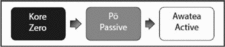
Higgins and Rewi (Reference Higgins, Rewi, Higgins, Rewi and Olsen-Reeder2014) provide a similar continuum in their ZePA model (Figure 2) for considering an individual's attitudinal and psychological position in regard to te reo Māori (Māori language). This continuum moves from Zero to Passive to Active. Higgins and Rewi maintain that when individuals are located at Zero they neither use nor are receptive to the use of te reo Māori. Individuals situated at Passive are receptive to re reo Māori, but do not have sufficient proficiency. Individuals positioned at Active; however, keenly strive to advance te reo Māori, seek out resources, and view te reo Māori as having a place in their lives or workplace. Higgins and Rewi point out that the shift from Zero through to Active signals a shift at a conscious level; from not giving any consideration to te reo Māori through to paying some attention, through to actively seeking out opportunities to learn and speak.
Right Shift in The ZePA Model (Higgins & Rewi, Reference Higgins, Rewi, Higgins, Rewi and Olsen-Reeder2014).

Drivers for Change
There were a number of drivers for the bicultural development. First, were obligations to the Tiriti o Waitangi (Treaty of Waitangi), and the Education Act (1989) that states ‘it is the duty of the council of an [tertiary education] institution, in the performance of its functions. . . . to acknowledge the principles of the Treaty of Waitangi’ (Education Act, 1989). Second, the call for clinical psychology training programmes and psychology departments in NZ to become more biculturally responsive (Abbot & Durie, Reference Abbott and Durie1987) given the dearth of Māori students and staff, and little/no course content devoted to clinical psychology practice with Māori.
The Code of Ethics for Psychologists Working in Aotearoa NZ (2002) states: ‘. . .there shall be due regard for NZ's cultural diversity and in particular for the provisions of, and the spirit and intent of the Treaty of Waitangi (p. 3) and one of its four guiding principles is ‘respect for the dignity of people and peoples’ (p. 4). Further, the NZ Psychologists Board developed cultural competencies required for psychologists registered under the Health Practitioners Competence Assurance Act (2003) and those seeking to become registered. The NZ Psychologists Board Cultural Competencies (2011) makes the distinction between cultural safety (reflecting on one's ‘own cultural identity and will recognise the impact that his or her personal culture has on his or her professional practice’ p. 3), and cultural competence (‘having the awareness, knowledge, and skill necessary to perform a myriad of professional tasks that recognised the diverse world views and practices of oneself and of clients form different ethnic/cultural backgrounds’ p. 4).
The shortage of Māori in the clinical psychology profession had also been identified as a significant problem resulting in few Māori staff in universities who can assist with bicultural training and few Māori psychologists available for clients who prefer a Māori psychologist (Abbot & Durie, Reference Abbott and Durie1987; Levy, Reference Levy2002). Several barriers to Māori entering and completing clinical psychology training have been identified. These include: Māori clinical psychology students being ‘forced to consider human dysfunction in terms which do not reflect Māori beliefs or value systems’ (Brady, Reference Brady1992, p. 59); a lack of cultural support for Māori students (Ihimaera & Tassell, Reference Ihimaera and Tassell2004); and Māori students being relied on to do ‘all the Māori things in terms of protocol and so forth’ (Barnett, Reference Barnett2004, p. 194). Waitoki (Reference Waitoki2012) states that ‘although the practice is unethical, Pākehā (New Zealanders of European descent living in Aotearoa NZ) academics often use Māori students and staff as educators so that the illusion of good bicultural standing is maintained’ (p. 54). This highlights the importance of educating non-Māori academics and teaching staff so that they are more biculturally confident and competent, and able to facilitate and support bicultural training, as well as being more responsive to Māori students.
Māori-focused psychologies are important for attracting Māori to psychology (Levy, Reference Levy2002). Levy's report for the NZ Psychologists Board describing barriers and incentives to Māori participation in psychology identified a lack in Māori focused psychologies as one barrier. Levy identified that a ‘major incentive for Māori participation in psychology is the creation of environments in which Māori wish to participate’ (p. 60), and that this involved the provision of effective support for Māori students, and ‘meaningful participation for Māori, which provides ‘actual and real opportunities to influence outcomes, directions and priorities’ (p. 6). Further, Lawson-Te Aho's (2002) study of Māori psychology staff to identify whether cultural safety principles were embedded into psychology teaching raised several considerations for training programmes. These included: consideration of how culturally-safe a practices and teaching; and understanding that consumers of psychological training and services should ultimately be the judges of cultural safety. Given these considerations and challenges, the Postgraduate Diploma in Clinical Psychology training programme at UC undertook to explore how it could become more biculturally responsive and improve the bicultural training provided to students. The following is a description of this process, the changes that were made, and a reflection on the outcome of these changes, followed by subsequent developments within the wider Department of Psychology.
The Process
The process began in 2002, with one clinical psychology programme staff member (the first author, and a Pākehā) who had moved from Passive to Active on the ZePa continuum (studied te reo Māori over a number of years at secondary school and university level, and used te reo Māori in the workplace) and who made the commitment to move the programme along the Cross et al. (Reference Cross, Baron, Dennis and Isaacs1989) continuum from Cultural Pre-competence towards Cultural Competence. While staff on the clinical psychology programme recognised and acknowledged cultural differences and accepted the need for culturally competent policies and procedures, the programme had not implemented policies and practices that supported these beliefs. There was no active demonstration of a commitment to improve.
Despite the usual concerns and fears of doing something wrong and causing offence, the first author was advised to not let these concerns inhibit change but to instead follow the words of Te Puea Herangi (a well-known name in Māoridom) who stated ‘mahia te mahi’ (i.e., get on and do the job). The first step was to consult with and establish an ongoing collaborative relationship with Māori Psychologists who were supportive of this bicultural initiative.
As a result of this consultation, the following core principles were developed as an overarching guide to the bicultural development process:
• It would be a journey: The programme, and its bicultural responsiveness, would change and evolve overtime. Students’ learning would be a process which extended beyond their time on the programme.
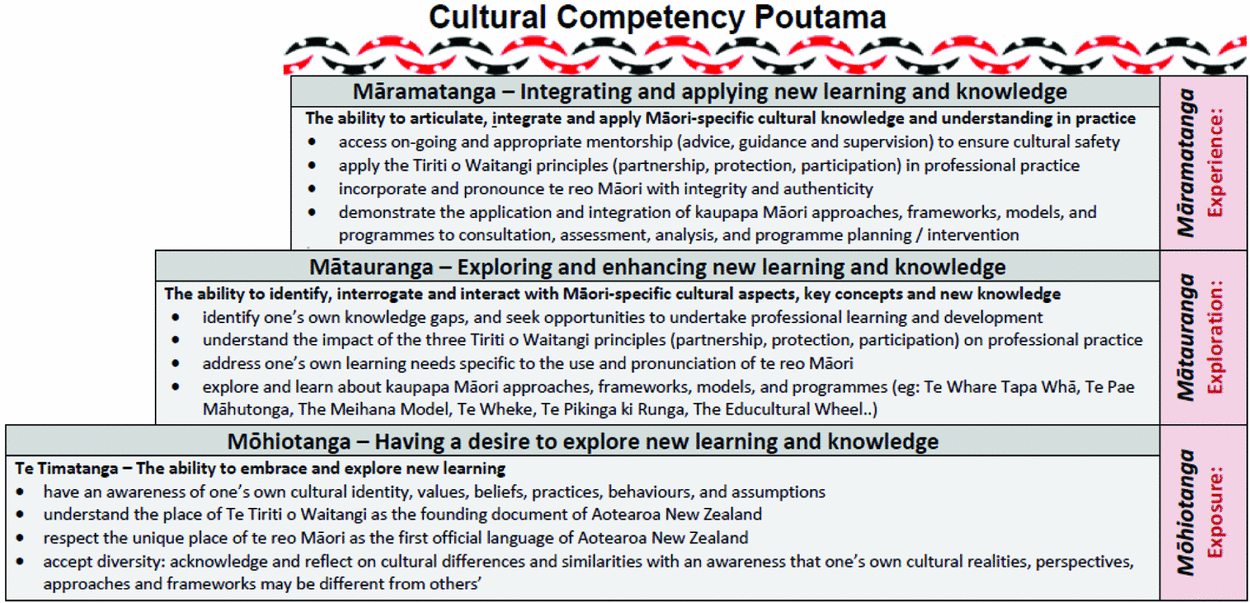
• It would adopt a graded approach: The changes in the programme would be developed over time, starting with broader and simpler to implement strategies (e.g., a Treaty of Waitangi workshop) through to incorporating Māori processes and content requiring greater skill level for staff to implement. Similarly, bicultural teaching to facilitate student learning would move from focusing on cultural safety and cultural awareness to cultural competency. This graded approach reflects a series of steps that build on each other, similar to the Macfarlane (Reference Macfarlane2011) Cultural Competency Poutama (Figure 3).
He Poutama Whakamana: A Framework to Guide Cultural Competency (Macfarlane, Reference Macfarlane2011).

Macfarlane describes how individuals initially move from Mōhiotanga (a desire to explore new learning and knowledge, through exposure), to Mātauranga (exploring and enhancing new learning and knowledge, through exploration), to Māramatanga (integrating and applying new learning and knowledge, through experience).
• Bicultural teaching would be integrated throughout the programme and across all years; bicultural knowledge and skills would be formally assessed; and cultural competence would be seen as overlapping with clinical competence.
• It would adopt a collaborative (partnership) approach so that Māori psychologists and service providers would contribute to both the development of biculturally responsive aspects, and to the provision of bicultural training.
• Bicultural training would be prioritised before training on multicultural and diversity issues.
These guiding principles are consistent with Thomas’ (Reference Thomas1993) suggestion that an add-on approach to training ‘has little or no relevance to the delivery of psychological or mental health services’ (p2), and that ‘learning can only take place over an extended period of time’ (p. 2). Similarly, a single-course or workshop (the add-on approach) - while having some benefits - is not an effective approach to developing cultural competency (D'Andrea, Daniels, & Heck, Reference D'Andrea, Daniels and Heck1991: Glover & Robertson, Reference Glover, Roberston and Whittaker1997; Ponterotto, Reference Ponterotto and Donald Pope-Davis1997). Further, when bicultural competence is an add-on, and not a training component this then creates a problematic clinical-cultural distinction (Waitoki, Reference Waitoki2012).
For bicultural teaching to be authentically integrated into a teaching programme, there needs to be assessment of student learning, just as there is for other coursework. Oftentimes, however, these ‘. . . . .suffer from a lack of systematic evaluation’ (Waitoki, Reference Waitoki2012, p. 204). Evaluation should extend beyond reaction measures (i.e., whether they liked the training) to including measures of knowledge and skill acquisition (Waitoki, Reference Waitoki2012). It has been argued that cross-cultural skills should be placed in parity with the development of other clinical skills because development of cross-cultural competence overlaps with clinical competence (Evans, Reference Evans2008; LaFromboise, Coleman, & Hernandez, Reference LaFrambroise, Coleman and Hernandez1991). This also avoids the risks of undervaluing and/or dismissing bicultural practice as the lesser practice (Durie, Reference Durie2007). Additionally, ‘the cultural–clinical distinction privileges the dominant group by enabling them to determine what is cultural and what is not’ (Waitoki, Reference Waitoki2012, p. 42). Further, non-western views of cultural competence see it as a process rather than an endpoint (Kingi-‘Ulu'ave, Feleafa, & Brown, Reference Kingi-‘Ulu'ave, Faleafa, Brown, Evans, Rucklidge and O'Driscoll2007; Smith, Reference Smith2003).
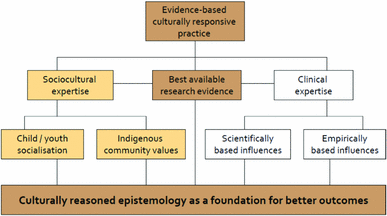
Macfarlane, Macfarlane, and Gillon (Reference Macfarlane, Macfarlane, Gillon, Macfarlane, Macfarlane and Webber2015) argue that ‘all too often Western knowledge and Indigenous knowledge are represented as two totally incongruent and oppositional knowledge systems’ (p. 55). They propose that the challenge is to ensure that ‘one world view is not prioritised at the expense of the other’ (p. 11). Two frameworks elucidate how Western and Māori knowledge and clinical and cultural practices can be blended so that ‘neither needs to concede or to sacrifice’ (Macfarlane et al., Reference Macfarlane, Macfarlane, Gillon, Macfarlane, Macfarlane and Webber2015). Tō Tātou Waka (Macfarlane, Blampied, & Macfarlane, Reference Macfarlane2011) provides a framework for blending clinical, cultural knowledge and practices within the process of psychological assessment (Figure 4) that can be generalised to other situations and other cultures (Macfarlane et al., Reference Macfarlane, Blampied and Blampied2011). Tō Tātou Waka literally means ‘our canoe’, representing a shared approach in which the process of moving forward (paddling) is carried out in a collaborative partnership, and ‘promotes the notion that the convergence of the clinical and cultural practice components in our present-day bicultural society are more powerful than either one on its own’ (Macfarlane et al., Reference Macfarlane, Blampied and Blampied2011, p. 60).
Tō Tātou Waka: A Blending of Clinical and Cultural Streams (Macfarlane et al., Reference Macfarlane, Blampied and Blampied2011).

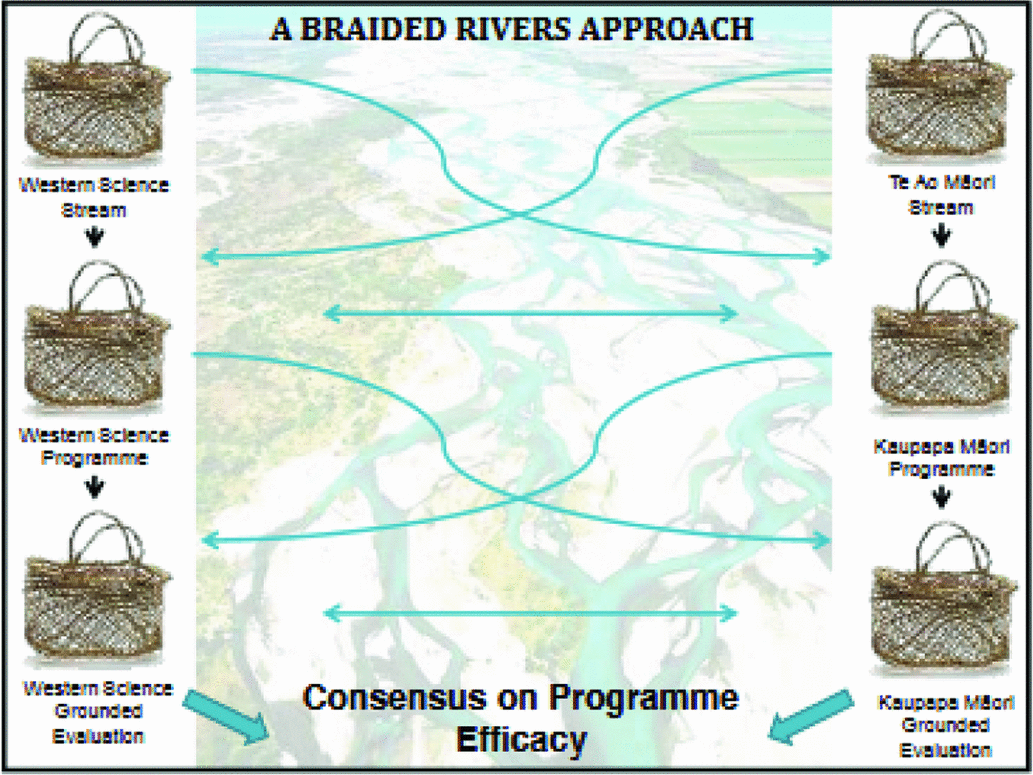
He Awa Whiria (a braided rivers) framework (Ministry of Social Development, 2011) is a framework for programme development and evaluation (Figure 5). It is based on the analogy of two streams of knowledge – Western science and Indigenous Māori – which interconnect and eventually converge. In this framework both steams are viewed as distinct, and knowledge from each stream is able to inform the other. Similarly, evaluation methodology from one stream can be applied to the other, and programme efficacy relies on evidence from both.
He Awa Whiria: A Braided Rivers Approach (Ministry of Social Development, 2011).

The prioritisation of bicultural training over multicultural or other diversity training was viewed as important in order to be consistent with Treaty of Waitangi obligations. Love and Waitoki (Reference Love, Waitoki, Evans, Rucklidge and O'Driscoll2007) caution that ‘bicultural imperatives and relationships should not be obscured by multiculturalism’ (p. 271), and there is a risk that multiculturalism may be ‘a way for Pākehā to avoid their responsibilities’ (Waitoki, Reference Waitoki2012).
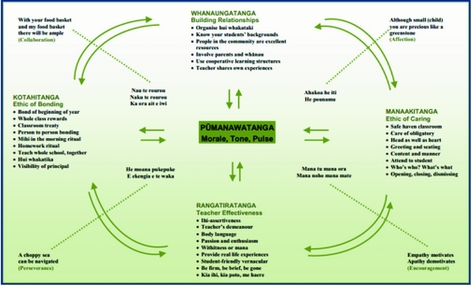
In addition to the guiding principles, the intention was to make changes consistent with tikanga Māori (Māori protocols) and Māori values. In particular values of whanaungatanga (building relationships, connections), manaakitanga (respect, reciprocal caring), and kotahitanga (bonding, inclusion, unity) were incorporated, as these core Māori values have been identified as being essential for biculturally responsive education (Macfarlane, Reference Macfarlane2004). By incorporating Māori cultural values within the programme it was hoped that this would also facilitate student learning, consistent with Dickson, Jepson and Barbee's (Reference Dickson, Jepson and Barbee2008) research which found that that the degree of ‘cultural ambience’ (p. 114), which relates to the day-to-day practices, attitudes and behaviour that contribute to the environment of the training programme was a good predictor of positive cultural attitudes in students and the development of cultural competency.
Description of Changes to the Clinical Programme
Prior to Admission
Students considering applying to the programme are advised to take a te reo Māori course prior to applying. The hope is that, they will enter with basic skills (e.g., pronouncing Māori names correctly) as well as having exposure to tikanga Māori as part of this learning. Additionally, the application form requires applicants to describe any cultural experiences which may be relevant to training as a Clinical Psychologist.
Māori Clinical Psychologists from the community are part of the selection committee, along with clinical psychology programme staff and representatives from the main local employers of the programme's graduates. The Māori Clinical Psychologists on the selection committee assess the applicants’ knowledge of the Treaty of Waitangi, and bicultural knowledge and experiences, and the applicants’ openness to consider how their own culture may shape their personal values, assumptions, judgments and biases. During the selection interviews candidates are asked to reflect on a case vignette and questions regarding culture are asked as part of this process. An inability to demonstrate the attribute of openness to considering the effect of culture, and limited or no knowledge of the Treaty of Waitangi or exposure to te ao Māori (a Māori worldview) is likely to lead to an applicant being declined.
The selection day commences with a meeting involving all short-listed applicants, the selection committee, and clinical programme staff and current students (representatives from each year of the programme). It follows the hui (gathering) process outlined by Lacey, Huria, Beckert, Gilles, and Pitama (Reference Lacy, Huria, Beckert, Gilles and Pitama2011), comprising a mihi (initial greeting), whakawhanaungatanga (making connections), kaupapa (the main purpose) and poroporoaki (closing, farewell). Applicants are welcomed in both Māori and English, followed by mihimihi (introductions) wherein everyone is able to introduce themselves, where they are from, and share their research and/or clinical interests – facilitating whakawhanaungatanga. The Clinical Programme and the selection process (interviews) are then outlined (kaupapa), and what will happen when these are finished (poroporoaki). This is then followed by morning tea (manaakitanga) before the formal selection interviews commence.
While the selection interviews are individual, applicants are able to bring a support person if they wish, which is consistent with a Māori collective world view (Durie, Reference Durie and al Issa1995; Harrington & Liu, Reference Harrington and Liu2002). The hui process also shapes the interviews when a support person is present, with brief mihi and whakawhanaungatanga, followed by the kaupapa/interview with the applicant. After that the support person has an opportunity to say something in support of the applicant if they wish, then poroporoaki where the support person's contribution is acknowledged.
After the interviews have been completed, the selection committee convenes and the external members have the opportunity to share their observations and thoughts regarding student selections. Therefore, the Māori Clinical Psychologists and other external members of the selection committee, have an opportunity to influence selection into the programme. The programme has also adopted affirmative action whereby there is an agreement if a choice is being made between selecting two applicants of similar ability, and one is Māori, then the Māori applicant will be accepted over the other applicant.
Post Admission
Processes
The first day of the academic year commences with an orientation day for the new clinical students, which again is guided by the hui process (Lacey, Huria, Beckert, Gilles, & Pitama, Reference Lacy, Huria, Beckert, Gilles and Pitama2011). At the beginning of the day the new students, all programme staff and all the second-year students gather together. There is a mihi in both Māori and English to the new students, followed by a waiata (song) by the clinical programme staff and second-year students. This is then followed by introductions where all present are able to share about themselves in more detail than during the selection day, followed by morning tea. The rest of the day involves an orientation to clinical psychology training for the new students (kaupapa), and includes the staff and students eating lunch together. Later in the day, everyone (second and first year students and staff) assembles for afternoon tea and petanque (which results in the awarding of a trophy to the winning staff or student team). This relaxed social time facilitates bonding (kotahitanga) at the beginning of the year, and the building of relationships (whakawhanaungatanga) between staff and students (within and across the two years), consistent with the values in Macfarlane's (Reference Macfarlane2004) Educultural Wheel (Figure 6).
The Educultural Wheel (Macfarlane, Reference Macfarlane2004).

The orientation day is held at the UC Staff Club, which is also the venue for a function at the end of the students’ training when they have passed their final examination. This latter celebration is jointly hosted by the clinical psychology training programme staff and the Canterbury Branch of the NZ College of Clinical Psychologists, and is also attended by, supervisors from the community who have supervised the students during their training, and other members of the clinical psychology community. This event is opened in both Māori and English, and serves as a both a farewell from the clinical programme and a welcome to the clinical psychology profession.
Content
All teaching staff are expected to consider and raise issues related to bicultural practice and working with Māori, including Aotearoa NZ research, during their teaching. In addition to, specific bicultural teaching that occurs across the programme's three years. This commences in Year 1 with a 2-hour cultural safety seminar to facilitate the students’ exploration of their own values and increase their cultural awareness and understanding of cultural safety. The seminar comprises two practical activities to facilitate this – a cultural awareness exercise (Roysircar, Reference Roysircar2004), and a values card sort exercise (Miller, C'de Bacca, & Wilbourne, Reference Miller, C'de Baca and Matthews2001). Then, later in Year 1, students attend a two-day Treaty of Waitangi workshop.
In Year 2, there is a wānanga (learning workshop) held over two days and one night, based on a marae (traditional Māori setting). During this time, students are exposed to the protocols and history of Ngāi Tahu; the South Island's main iwi (tribe), aspects of taha Māori (Māori identity), and experience first-hand tikanga Māori. They experience a pōwhiri (formal welcome) both as manuhiri (visitors) and then later (when welcoming guest speakers) as tangata whenua (hosts). The wānanga is facilitated by two kaumātua (respected senior Māori), one who leads a preparatory session prior to the wānanga, and who both are present for the entire wānanga. A variety of speakers from Māori mental health service providers and the Māori community present to the students, who learn about the pōwhiri process as a means of engagement with Māori clients, and Māori models of health/well-being. The models include Te Whare Tapa Whā (Durie, Reference Durie1985), Te Pounamu Model (Manna, Reference Manna2002), and the Meihana Model (Pitama et al., Reference Pitama, Robertson, Cram, Gillies, Huria and Dallas-Katoa2007; Pitama, Huria, & Lacey, Reference Pitama, Huria and Lacey2014). This provides an opportunity for the students to develop an awareness of Māori mental health services, connections with Māori practitioners and services in the community. Rather than learning about cultural issues in a formal classroom situation, this immersion experience provides experiential learning in which students may experience emotions, new ways of behaving, and thinking which may deepen their sensitivity to the cultural context in new or different ways (Gerstein, Heppner, & Ægisdóttir, Leung & Norsworthy, Reference Gerstein, Heppner, Ægisdóttir, Leung and Norsworthy2009). Such experiences provide the ‘opportunity for impactful growth’ in cultural competency (Wathen & Kleist, Reference Wathen and Kleist2015, p. 61).
In the final year of the programme, there is a two-day bicultural workshop provided by a Māori Clinical Psychologist. This workshop focuses on increasing students’ skills in working (assessment and intervention) with Māori clients and whānau (families). It was only after this workshop and the rest of the bicultural training was embedded into the programme, that broader culture and diversity training was added. This comprises four lectures of two hours’ duration by guest speakers on working with Pasifika, Asian, refugees and migrants and takatāpui (gender and sexuality).
Students also undertake practica in the in-house clinic (The Psychology Centre/Te Taumata Kaupapa Hauora Hinekaro), during which they are able to attend, along with clinic staff, cultural supervision by a Māori practitioner. Further, they undertake community placements in Year 2 and internships in the final year of the programme within Mental Health and Health Services at the Canterbury District Health Board, (CDHB) and the Psychological Service of the Department of Corrections. This provides them with opportunities to work with Māori clients with supervision, and have access to, and work with, the Pūkenga Atawhai (Māori Mental Health professionals) from Te Korowai Atawhai (CDHB Māori Mental Health Service), and Māori consultants in the Department of Corrections. This is written explicitly in the practica objectives.
Assessment
As a consequence of the weaving of bicultural teaching and learning experiences throughout the programme, assessment of students’ bicultural knowledge and skills occurs at various points throughout. Their performance is evaluated at mid- and end-placement using the Clinical Psychology Practicum Rating Scale for the practica. This involves the placement supervisor rating the students’ performance on core skills expected of a clinical psychologist using a 4-point scale comprising four stages – Stage 1 being ‘Beginner’ through to Stage 4 which is ‘Competent’. Within these skills are various items which specifically assess the students’ skills related to bicultural practice:
Clinical Assessment Competencies: Undertakes clinical assessments in an interpersonally engaging and in a socio-culturally sensitive manner
Case conceptualisation Competencies: Integrates cultural knowledge into case
conceptualisation.
Professionalism: Demonstrates concern for the welfare of others including the profession, organisation and community, and shows respect for cultural values and diversity
Reflective Practice: Reflection on own emotions, beliefs, values and behaviour and their effect on others. Appropriately self corrects. Actively reflects on ways in which others' cross-cultural values and perspectives influence one's own responses, and vice versa.
This means that students are regularly being assessed and receiving feedback with regards to their bicultural skills within the practica context. There are also formal assessments of students’ bicultural knowledge and skill during other courses within the programme. These comprise:
Year 1
PSYC642: Clinical Practicum I – within the clinic practicum and clinical interview examination
PSYC643: Psychometric Assessment – within the Psychometric examination (written and oral)
Year 2
PSYC654: Comprehensive Examination – students may be asked anything with regards to any course material covered, and a bicultural question is included.
Year 3
PSYC661: Oral Examination – paper case focused specifically on a Māori client
PSYC670: Diploma Examination
Other Actions
In addition to these practices becoming embedded within the clinical training programme, the programme also undertook two other bicultural initiatives. In 2009–2010 the programme successfully bid (in conjunction with the University of Otago) for Priority Programme Funding from the Tertiary Education Commission for a project titled ‘Building Cultural Competencies and Minority Participation in Clinical Psychology Training’. This aimed to promote community engagement with the programme and also increase the numbers of Māori and ethnic minority graduates. Through this project, funding was provided for a bicultural audit and programme development and two targeted scholarships per year in 2009 and 2010 for two Year 1 clinical students who identify as Māori (if insufficient numbers of Māori applied for these scholarships, it was agreed that they could be awarded to other ethnic minority students). This resulted in one scholarship in each year (2009, 2010) awarded to a Māori student and a Chinese student.
Clinical programme staff assume responsibility for increasing their own confidence and capabilities in bicultural teaching and bicultural competence. Thereby modelling to the students that bicultural competence and knowing how to work with Māori is part of one's personal and ethical responsibility (as a Clinical Psychologist in Aotearoa NZ). New programme staff who have not attended a Treaty of Waitangi workshop are encouraged to attend the workshop with the Year 1 students, and the wānanga with the Year 2 students.
The clinical psychology programme developed a mentoring programme, whereby clinical psychology students having the opportunity to be mentored by a clinical psychologist (who is not involved in evaluation or assessment of the student) in the community for the duration of their training. As part of this programme staff facilitate Māori students, who wish to do so, linking with a Māori Clinical Psychologist as their mentor.
Outcome
There have been many positive outcomes due to the changes outlined above. Short-listed applicants (both Māori and non-Māori) based on their experience of the programme's approach to selection describe the programme as warm and welcoming, and that they get a real sense of connection between programme staff, students and the community. It should be noted that these comments have been made during casual conversation on the selection day and therefore may be positively biased. Further to these comments, students (both Māori and non-Māori) after entering the programme who were offered a place in clinical psychology programmes at other universities have said that one reason they decided to accept the UC offer was because of the positive experience on selection day (i.e., warm and welcoming, and the sense of connection).
Since these actions, there has been an increase in the number of Māori applying and being accepted into the UC programme. The percentage of Māori students (8%) on the clinical training programme now reflects the demographic of the greater Christchurch area within which the university is located, (although is lower than the general national percentage of 14.6%). Several Māori and Pākehā applicants have stated that they applied for the UC clinical training programme because of its commitment to biculturalism.
Clinical students also express appreciation for the process of the first day. They report experiencing a sense of warmth and welcoming, and that it recognizes and values the significance of their first day in the programme (they have strived for many years to prepare themselves for selection into clinical psychology training). This first day also facilitates the building of connections within the first year group, and between the first and second year students and staff. The students report a similar positive experience from the function at the end of their training, which recognizes their achievement and welcomes them into the profession.
The clinical programme has also developed closer links with local Māori, Māori practitioners and Māori services. These links have extended beyond bicultural training, to research and publishing collaborations. Further, the feedback from students regarding various aspects of the bicultural training has been very positive. The following are some examples:
Cultural safety seminar.
‘The card sorting task was really useful – made me more aware of my own values.’
‘I found I learned a lot about myself.’
Treaty of Waitangi workshop.
‘Extremely interesting! A lot of information about NZ history that I either was not aware of or knew little about.’
‘. . . . .Understanding the history that is not taught in schools and digging deeper than what we hear in the media.’
Marae-based wānanga.
‘The wānanga was a rich and extremely useful experience in so many ways. . . .It was personally and professionally enriching. It has given me the opportunity to reflect on these levels and to strive to integrate the values, learning and kaupapa that were evident over the two days.’
‘Really enjoyable and culturally enriching experience’ that enhanced my learning’
Bicultural workshop.
‘A useful, open forum for discussing how to apply biculturalism in a practical setting.’
‘Great to finally integrate all the teaching on culture so far in a way that I can put directly into practice.’
The clinical psychology training programme also met the cultural competency standards for accreditation by the NZ Psychologists Board when it was accredited in 2014. The accreditation report noted that one of the strengths was that the programme has a ‘good working relationship with the local Māori community’, which is largely a function of the collaborative relationships formed in order to develop and maintain the delivery of the bicultural training.
Subsequent Developments
In late 2014 as the result of a Department of Psychology strategic planning review, a need for the whole Department to become more biculturally responsive was identified. A bicultural working group (BWG) was established comprising of academic and a general staff member (all Pākehā) and two student representatives (a Pākehā graduate and a Māori undergraduate). The group also established a consultation group comprising Māori Psychologists who were academic staff at UC, the Kaiāraihi Māori (Māori Advisor) for the College of Science, and staff from the office of the Assistant Vice-Chancellor Māori, whose role is to support a learning environment which recognises and promotes Aotearoa NZ's unique bicultural society.
The BWG developed a draft bicultural strategic plan for the Department of Psychology consistent with the College of Science Māori Development Strategy (2014) which stated five priority areas: whakapakari pūkenga – staff development; ākonga poipoia – Māori student recruitment, retention and achievement; hōtaka kounga – quality programmes; mahi rangahau – research; and taiao ako – physical environment and learning spaces reflect bicultural Aotearoa NZ. The strategic plan also included reference to Ngāi Tahu values (Te Rūnanga o Ngāi Tahu, 2015): whanaungatanga (family); manaakitanga (looking after our people); tohungatanga (expertise); kaitiakitanga (stewardship), and tikanga (appropriate action). This bicultural strategic plan was adopted by the Psychology Department as a living document with priority areas consistent with the College of Science Māori Development Strategy and the Ngāi Tahu values as its foundation, to which new actions will be added over time.
In parallel with this process, within the wider university context there were developments to bicultural responsiveness. This resulted in UC endorsing a graduate profile which aims to produce graduates who are aware of and understand the relevance of biculturalism in Aotearoa NZ to their area of study and/or degree. A bicultural competence and confidence framework (2015) was also established to support the development of curricula, activities, and experiences to facilitate the student learning consistent with the graduate profile. This added further support to the developments which had already been in progress in the Department of Psychology.
The BWG followed a similar process to that undertaken by the clinical psychology training programme, using the experiences to inform developments within the wider and much larger Department of Psychology. First, it was accepted that individuals (staff and students) in the wider Psychology Department may be on different parts of the cultural inclusion continuum (Cross et al., Reference Cross, Baron, Dennis and Isaacs1989) and that the challenge would be to establish initiates to facilitate the movement of individuals as far as possible along the following continuum. For this reason, and in attempt to minimise any resistance, it was decided to adopt a graded approach to implementing changes and the principles described earlier were adopted as an overarching guide:
• It would be a journey. The department, and its bicultural responsiveness, would change and evolve overtime.
• It would adopt a graded approach. Changes in the Department would be developed over time, starting with simple to implement strategies (activities to raise staff awareness of bicultural issues and why they might be important to consider) through to incorporating Māori processes and teaching which would require a greater skill level to implement. A graded approach would be taken to bicultural teaching to facilitate student learning.
• Changes and bicultural teaching would be integrated within courses and across all levels, from undergraduate to postgraduate courses, rather than developing a stand-alone course.
• It would adopt a collaborative (partnership) approach. This would enable developments to be guided by the Kaiārahi Māori, the Māori Development Team (a team under the Assistant Vice-Chancellor Māori who provide assistance and support for Māori students at UC), and Māori academics.
• Bicultural training would be prioritised before training on multicultural and diversity issues.
A collaborative approach meant that a key focus for the BWG was to begin to build relationships with key Māori staff. Given that it was not known where staff would lie on the cultural continuum, a survey was undertaken. The survey asked all Departmental staff (general and academic) to answer the following questions:
• Rate your own knowledge of Māori culture on a 0–7 scale, (0 = not at all, 7 = very much so)
• Would you be willing to participate in some form of bicultural training aimed at increasing your knowledge and confidence? (yes, no, maybe)
A second part to the survey asked academic staff to rate the following questions on a 0–10 scale (0 = not at all, 10 = very much so):
• How important is it for you to incorporate Māori culture into your teaching?
• How confident do you feel in your ability to include bicultural teaching in your courses should you choose to?
All staff were also asked what bicultural training offered through Staff Development they had attended. Academic staff members were asked what bicultural teaching they currently included in their courses. A list of bicultural teaching approaches was collated from these responses. In order to create a more comprehensive picture of current bicultural activity in the Department, all staff members were asked to participate in a stock-take exercise during a Departmental meeting where in small groups they identified what was currently happening in the Department within the five priority areas in the College of Science Māori Development strategy.
The results of the survey and the stock-take exercise revealed that there were a number of bicultural activities already taking place, with examples in each of the five Māori Development priority areas. There were also staff within the Department who had both knowledge and confidence, and were incorporating Māori processes and/or bicultural teaching in their courses. These findings are consistent with the Cross et al. (Reference Cross, Baron, Dennis and Isaacs1989) continuum.
The average rating of the importance of incorporating bicultural aspects into teaching was 5.57 (0 = not at all, 10 = very much so). This suggests some ambivalence with regards to staff members becoming more biculturally responsive. These findings reinforced the importance of the guiding principles, particularly the need for it to be a journey, with a graded approach, so that staff could be supported to develop at their own pace in recognition that staff members were already at different places on this journey. In responding to the survey some staff expressed an interest in receiving more resources. Consequently, the BWG compiled a variety of bicultural resources (links to te reo Māori apps, links to research and papers on Psychology and Māori) which staff were given at a Departmental meeting. The links were included in the Departmental newsletter and website.
UC had developed Tāngata Tū, Tāngata Ora workshops to support staff to contribute to the University's Rautaki Whakawhanaeke Kaupapa Māori: Strategy for Māori Development (2012). These were offered throughout the year and any university staff could elect to attend. The learning objectives of these workshops were that staff would be able to:
• Recognise their own culture and the existence of cultural difference
• Discuss the distinctions between culture, race, ethnicity and nationality
• Trace Māori society pre-1840
• Articulate what the Treaty of Waitangi was intended to achieve in 1840
• Examine the significant events in the history of the Treaty from a Māori perspective
• List three key effects of colonisation on te reo Māori
• List three key issues facing te reo Māori today
• Identify their own needs in using te reo Māori in the workplace
• Discuss the process of mihi whakatau (welcomes) within the University context
• Recognise the history of Te Waipounamu (the South Island) pre and post Treaty
• Discuss the connections between local Māori councils and the principal tribe of the southern region of Aotearoa NZ
• Articulate the University's relationships with these entities and current vehicles for these relationships
• Illustrate the significance of the University's Rautaki Whakawhanake Kaupapa Māori: Strategy for Māori Development
• Describe the UC graduate profile
• Demonstrate ways in which cultural competence can be evidenced in professional practice at individual, divisional/departmental/institutional levels.
It was decided that a Tāngata Tū, Tāngata Ora workshop for all of the Psychology Department staff together would be of benefit as it would allow staff to collectively focus on these objectives and what future bicultural developments could be undertaken as a Department. The workshop was attended by 71% of Psychology Department staff (excluding those on study leave), and was well received. Because departmental staff were together it was possible to spend the last section of the workshop reviewing the Departmental Bicultural strategic plan, leading to the generation of more ideas for action. Some of these ideas related to staff development, such as the development of bicultural skills and teaching as a component of Performance Development and Review discussions; providing opportunities to learn and practice te reo Māori; the use of Māori processes in Departmental events/meetings; a yearly Departmental meeting on a marae; and bicultural training for Teaching Assistants. Suggestions for supporting Māori students included: working more closely with the Māori Development Team; re-establishing a Departmental Māori student support group; seeking feedback from Māori students enrolled in Psychology across all levels; targeting schools with a high proportion of Māori for recruitment into psychology; and, making the environment (including the website, and newsletter) more biculturally responsive through the use of Māori language and art.
The Department also undertook a curriculum review as the result of the strategic December 2014 planning meeting, which occurred in parallel with the bicultural developments. As part of this process, consideration will be given to possible changes in the curriculum which may support bicultural learning across all levels, and how this can be assessed. Academic staff will also be supported to adapt their courses to be more biculturally responsive.
Conclusion
The Treaty of Waitangi is the foundational framework for a bicultural nation in Aotearoa NZ. Tertiary education providers should therefore give effect to the Treaty principles within the policies and practices of their institution, departments, programmes and courses. This paper describes a postgraduate programme's journey towards becoming more biculturally responsive, and how the development process is being applied to a wider Departmental change process. Importantly, this process was seen as a journey which required a graded, integrated approach, and which would be undertaken in partnership with Māori with a commitment to biculturalism before multiculturalism.
The authors do not declare that this paper provides all the answers or prescribes the only way in which increasing bicultural responsiveness can be achieved. Rather, it is hoped that this paper may provide some ideas or examples which may be useful to other courses, programmes or departments on their own journey to becoming more biculturally responsive.
Acknowledgements
We thank Liz Brown (Ngai Tahu), Kaiārahi Tuākana, College of Science, University of Canterbury, for her encouragement and support of this paper.
About the Authors
Eileen Britt is a registered Clinical Psychologist, Senior Lecturer and Chair of the Bicultural Committee, Department of Psychology at the University of Canterbury, New Zealand. Her work focuses on motivational interviewing, training and supervision, and bicultural practice. She is a co-author of Takitaki Mai: A Guide to Motivational Interviewing for Māori.
Angus Macfarlane (Ngāti Whakāue) is Professor of Māori Research at the University of Canterbury, New Zealand. He has published seven books and has been the recipient of prestigious awards for his academic achievements and contributions to Māori education. His research explores cultural concepts and strategies that influence professional practice.
Sonja Macfarlane (Ngāi Tahu; Ngāti Waewae) is an Associate Professor at the University of Waikato, New Zealand. Her work focuses on Māori education, and developmental and cultural psychology. Her research explores culturally responsive evidence based practices that enhance the social, cultural and educational outcomes achieved by Māori learners.
Katharina Naswall is Associate Professor in the Department of Psychology at the University of Canterbury. Her research focuses on employee well-being and factors which contribute to psychologically healthy workplaces. Katharina is co-leader of the Employee Resilience Research Group, and conducts research on the role of employee well-being and resilience in building resilient organisations.
Jacki Henderson is a Senior Lecturer and member of the Bicultural Committee of the Psychology Department at the University of Canterbury, New Zealand. Her research interests include the neurodevelopmental outcomes of children born to opioid addicted women on Methadone Maintenance Treatment during pregnancy, and also Pediatric sleep.