Introduction
Breast cancer is the most commonly occurring tumour in women worldwide. Reference Bray, Ren and Masuyer1 In developing nations like India, although the overall incidence is lower compared to that of developed nations, the burden of locally advanced breast cancer (LABC) is relatively high around 30 to 60%. Reference Malvia, Bagadi and Dubey2 Radiation therapy (RT) is an integral part of the multimodal management of LABC patients after surgery and systemic therapies. The rationale of RT is to improve the therapeutic ratio between tumour control probability and normal tissue (NT) complication probability. Since many of these women are young of ages 30 to 40 years Reference Malvia, Bagadi and Dubey2 and are long-term survivors, the aim is to reduce the long-term RT-related morbidity.
Hypofractionation has established itself in clinical trials as one of the factors to improve the therapeutic ratio. Clinical trials on the accelerated hypofractionated chest wall (CW) and regional nodal RT have shown promising results. Reference Badiyan, Shah and Arthur3–Reference Chitapanarux, Klunklin and Pinitpatcharalert7 Dosimetric comparison studies that utilise hypofractionated dose regimens for CW and nodal regions are sparse.
Post-mastectomy CW and nodal stations RT planning is always a difficult task due to the thin and concave shape of the CW with irregular body surface. Reference Balaji, Subramanian and Yadav8 In addition, the reduction of RT-related toxicities like lung and heart complications and secondary cancer risk in contralateral breast (CB) are highly anticipated. Three-dimensional conformal radiotherapy (3DCRT) or field-in-field (FinF) technique for the CW and supraclavicular (SCL) RT provides a reduced dose to organs at risk (OARs). However, the inclusion of internal mammary node (IMN) irradiates more volumes of heart and ipsilateral lung (IL) by the wide tangent fields of the 3DCRT plan. Reference Lang, Loritz and Schwartz9 Intensity-modulated radiation therapy (IMRT) and volumetric-modulated arc therapy (VMAT) techniques provide conformal and homogeneous doses to the planning target volumes (PTVs). These techniques reduce the high dose irradiation to NT while delivering increased low dose bath than the 3DCRT. In addition, these techniques required more monitor units (MU), thereby increases unwanted leakage and scattered radiation to out-of-field areas which might increase the risk of secondary cancer incidence to the CB. Reference Lee, Lee, Sung and Yoon10,Reference Abo-Madyan, Aziz and Aly11 In this context, the contributions of modulated beams along with the 3DCRT fields are desirable to acquire balanced results between the PTV and OARs dosimetric parameters.
A novel hybrid approach has been explored in the literature to compensate for disagreements of the conventional and advanced techniques. Reference Balaji, Yadav and BalajiSubramanian12–Reference Mayo, Urie and Fitzgerald16 The hybrid technique is a blend of 3DCRT and IMRT/VMAT with different dose ratios that simultaneously deliver in each treatment fraction. Improvement in the dosimetric parameter results of hybrid plans for the WB and CW with SCL nodal RT has been described in many articles. Reference Balaji, Yadav and BalajiSubramanian12–Reference Mayo, Urie and Fitzgerald16 While, there is a paucity of hybrid planning studies that include the CW, SCL and IMN.
Most of the hybrid studies compared hybrid plans with pure VMAT or IMRT plans. Reference Jost, Kretschmer and Sabatino14–Reference Mayo, Urie and Fitzgerald16 Publications that compared different combinations of hybrid plans together are scarce. The aim of this study is a dosimetric assessment of three different hybrid planning techniques: 3DCRT (base-dose plan) combined with IMRT (3DCRT+IMRT), 3DCRT (base-dose plan) combined with VMAT (3DCRT+VMAT) and IMRT (base-dose plan) combined with VMAT (IMRT+VMAT) for the left-sided CW with SCL and IMN nodal RT using the accelerated hypofractionated dose regimen.
Materials and Methods
Patient selection
Locally advanced post-mastectomy breast cancer patients who received adjuvant RT between 1 January 2018 and 31 December 2020 were reviewed for this study. Twenty-five patients were randomly selected as fulfilling the following inclusion criteria: (1) patients with left-sided CW, (2) patients with SCL and IMN nodal stations and (3) patients simulated in a deep inspiration breath-hold (DIBH) setting. Exclusion criteria were (1) patients with bilateral mastectomy and (2) patients with axillary nodes. The median age of these patients was 49 years. The institutional scientific and ethics board has approved this study and informed consent was obtained from each patient.
Simulation and contouring
For simulation, patients were placed in a supine position using a customised vacuum bag. A planning computed tomography (CT) scans had been generated with 2.5-mm slice thickness by Discovery IQ CT scanner (GE Healthcare, Chicago, IL, USA). Clinical target volumes (CTVs) of CW, SCL and IMN nodal regions were delineated. The CW PTV (PTVCW), SCL PTV (PTVSCL) and IMN PTV (PTVIMN) were created by giving margin to the CTVs around 5 mm. The PTVSCL was brought in 5 mm from the skin surface, while the PTVCW included the skin region. A wax bolus material of 5 mm thickness was placed on the body surface beside the PTVCW to achieve adequate dose coverage in the near skin region. The OARs delineated were the heart, left anterior descending coronary artery (LAD), right coronary artery (RCA), IL, contralateral lung, CB, spinal cord, oesophagus, trachea, coeliac plexus and gastroesophageal junction (GEJCP), and NT, defined as the body volume minus PTVs were delineated.
Treatment planning
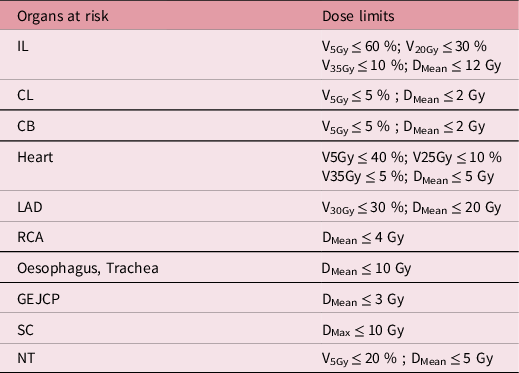
For each patient, 3DCRT+IMRT, 3DCRT+VMAT and IMRT+VMAT hybrid treatment plans were created in the Eclipse treatment planning system using 6, 10, 15 MV photon beams of Truebeam linear accelerator (Varian Medical Systems, Palo Alto, CA, USA). A hypofractionated dose prescription of 40·5 Gy (2·7 Gy per fraction) in 15 fractions was used for all PTVs. The dose weightings utilised were 70% of the prescription dose for the base-dose component and 30% of the prescription dose for the hybrid component. Reference Balaji, Yadav and BalajiSubramanian12 Table 1 presents the clinical dose constraints of OARs to be considered in planning. Both the IMRT and VMAT plan optimisations were performed by the photon optimiser (PO) algorithm. Volume dose was computed by analytical anisotropic algorithm (AAA) using a dose grid of 2·5 mm. All individual plans were normalised in such a way that the plans deliver the PTVs mean dose equal to the prescribed dose.
Clinical dose constraints for organs at risk

LAD, left anterior descending coronary artery; RCA, right coronary artery; IL, ipsilateral lung; CL, contralateral lung; CB, contralateral breast; GEJCP, coeliac plexus and gastroesophageal junction; SC, spinal cord; NT , normal tissue; Gy, Gray; VXGy, volume receiving X Gy dose; DMean, mean dose; DMax, maximum dose.
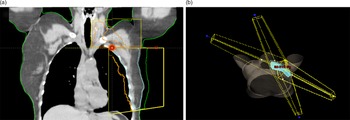
For the 3DCRT, IMRT and VMAT plans, an isocentre was positioned at the PTVCW and PTVSCL junction and axially on ribs to minimise beam divergence into the IL and heart (Figure 1). Two tangential half-beam blocked fields for the PTVCW, PTVIMN and one anterior oblique, one posterior oblique, half-beam blocked fields for the PTVSCL were used for the 3DCRT plan as shown in Figure 1. Varied X-ray photon energies were utilised for 3DCRT fields depending on the skin to PTV surface distance along the beam direction, according to Balaji et al. Reference Balaji, Yadav and BalajiSubramanian12 The 3DCRT plans were dose-computed for 1·9 Gy (approximately 70% of prescription dose). Similarly, the IMRT base-dose plans were created with the same beam arrangements as the 3DCRT plans. In the IMRT, each half-beam blocked field was allowed to over travel 1 cm beyond the isocentre for better modulation in field junction. Fixed jaw setting was enabled during optimisation.
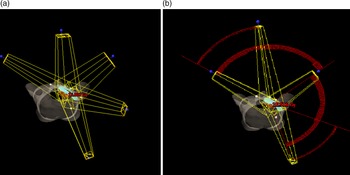
For the hybrid component, IMRT and VMAT plans were generated with the remaining prescription dose of 0·8 Gy (approximately 30% of the PTVs prescription dose). The IMRT plans consisted of five fields with equally separated gantry angles 300°, 355°, 50°, 105° and 160° as shown in Fig. 2. The collimator angles were set at ± 5°. The VMAT plans utilised two coplanar partial arcs and two tangential arcs as shown in Figure 2. Arc1 rotated clockwise from 300° to 50° with 10° collimator angle, and arc2 rotated clockwise from 50° to 160° with 350° collimator angle. The tangential arc3 rotated counterclockwise from 160° to 110° with 345° collimator angle and arc4 rotated counterclockwise from 350° to 300° with 15° collimator angle. Both the IMRT and VMAT plans employed 6 MV photon beams. While doing optimisation, the corresponding base-dose 3DCRT and IMRT plans were enabled. After dose computation and normalisation, plan sum of the 3DCRT+IMRT, 3DCRT+VMAT and IMRT+VMAT hybrid plans were created. The entire planning and dosimetric evaluation process were executed by an experienced medical physicist to avoid any planner variability.
(a) Location of isocentre and (b) field arrangements in base-dose 3DCRT and IMRT plans (four fields).

Field arrangements in (a) IMRT plan (five fields) and (b) VMAT plan (two partial and two tangential arcs).

Dosimetric evaluation
For the PTVs quality comparison, dosimetric indices like coverage index (COI) and uniformity index (UI) were calculated for PTVCW, PTVSCL and PTVIMN. Conformity index (CI) and gradient index (GI) were appraised for the combined volume of all PTVs. The COI was defined as:
 $$\;{\rm{COI}} = \;{{{{\rm{D}}_P}} \over {{{\rm{D}}_{95\% }}}},$$
where DP is the prescription dose and D95% is the dose received by 95% of the PTV. A COI value nearer to 1 indicates superior dose coverage to PTV. The UI was calculated as:
 $${\rm{UI}} = \;{{{{\rm{D}}_{2\% }}} \over {{{\rm{D}}_{98\% }}}},$$
where D2% and D98% are the doses received by 2% and 98% of the PTV, respectively. A UI value close to 1 specifies a more homogeneous dose distribution to PTV. The CI was defined as:
 $${\rm{CI}} = \;{{{{\rm{V}}_{PTV}}} \over {{{\rm{V}}_{PTVref}}}}\; \times \;{{{{\rm{V}}_{ref}}} \over {{{\rm{V}}_{PTVref}}}},$$
where VPTV is the volume of PTV, VPTVref is the reference isodose (95%) volume within the PTV and Vref is the volume of reference isodose (95%). A CI value close to 1 designates a superior conformal dose plan. Reference Nakamura, Verhey and Smith17 The GI was calculated as:
 $${\rm{GI}} = {\rm{ }}{{{{\rm{V}}_{50\% }}} \over {{{\rm{V}}_{PTV}}}},$$
where V50% is 50% isodose volume and VPTV is the volume of PTV. A GI value close to 1 specifies a better dose fall-off plan. Reference Ohtakara, Hayashi and Hoshi18 The dose-volume parameters evaluated for the OARs comparison were listed in Table 1. Reference Blom, Wennberg, Svane, Bylund and Lind19–Reference Lazzari, Terlizzi, Leo and Silvano23 In addition, total MU and treatment time (TT) were noted to assess the delivery efficiency. A simple scoring method was utilised to calculate an overall score that incorporates all dosimetric parameters evaluated. The overall score was calculated as:
 $${\rm{Overall}}\;{\rm{Score}} = {\rm{ }}{{\sum _{i{\mkern 1mu} = {\mkern 1mu} 1}^n({{{{\rm{A}}_i}} \over {{{\rm{M}}_i}}})} \over {\rm{n}}},$$
where A i is the achieved value of an ith dosimetric parameter of a particular plan and M i is the mean value of the ith dosimetric parameter of all three plans and n is the number of dosimetric parameters evaluated. The overall score close to 0 designates a superior plan.
Statistical analysis
For statistical analyses, a non-parametric Wilcoxon signed-rank test was executed for a paired group of plan comparisons. All statistical tests were two-tailed, and a threshold value of p < 0·05 indicated statistically significant results.
Results
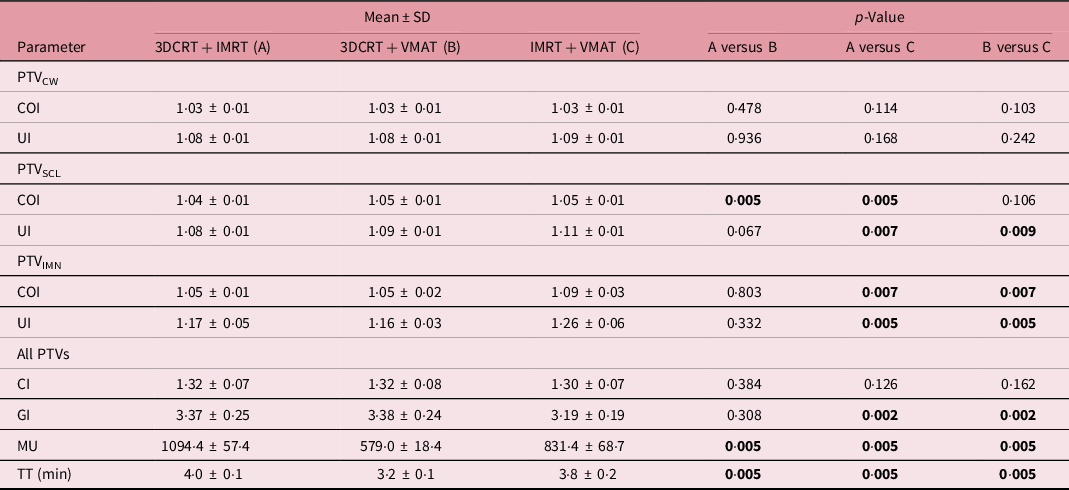
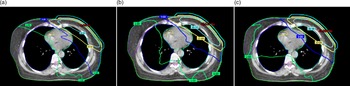
The volume of PTVCW, PTVSCL and PTVIMN were 544·5 ± 103·1, 129·1 ± 38·8 and 10·3 ± 2·8 cc respectively. The PTVs and treatment delivery parameter results for all hybrid plans are summarised in Table 2. Figure 3 displays the dose distributions comparison of all hybrid plans for a patient. All hybrid plans achieved expected coverage (COI ≤ 1·05) for the PTVCW and PTVSCL, while PTVIMN showed less coverage in the IMRT+VMAT plan. The UI of the PTVCW was comparable among all hybrid plans, while the UI of the PTVSCL and PTVIMN were slightly better in the 3DCRT+IMRT and 3DCRT+VMAT than the IMRT+VMAT plan (p < 0·01). The CI of the combined PTV had comparable results among all hybrid plans. The GI of the combined PTV was better in the IMRT+VMAT plan, related to 3DCRT+IMRT and 3DCRT+VMAT plans (p = 0·002). The MU and TT were less in the 3DCRT+VMAT plan (p = 0·005).
Dosimetric comparison results for PTVs

SD, standard deviation; PTVCW, chest wall planning target volume; PTVSCL, supraclavicular node planning target volume; PTVIMN, internal mammary node planning target volume; COI, coverage index; UI, uniformity index; CI, conformity index; GI, gradient index; MU, monitor units; TT, treatment time; min, minute; bold, statistically significant result.
Dose distributions in (a) 3DCRT + IMRT plan, (b) 3DCRT + VMAT plan and (c) IMRT + VMAT plan. Cyan line indicates 38.5 Gy dose ranges, yellow line indicates 20 Gy dose ranges, dark blue line indicates 5 Gy dose ranges and light green line indicates 1 Gy dose ranges.

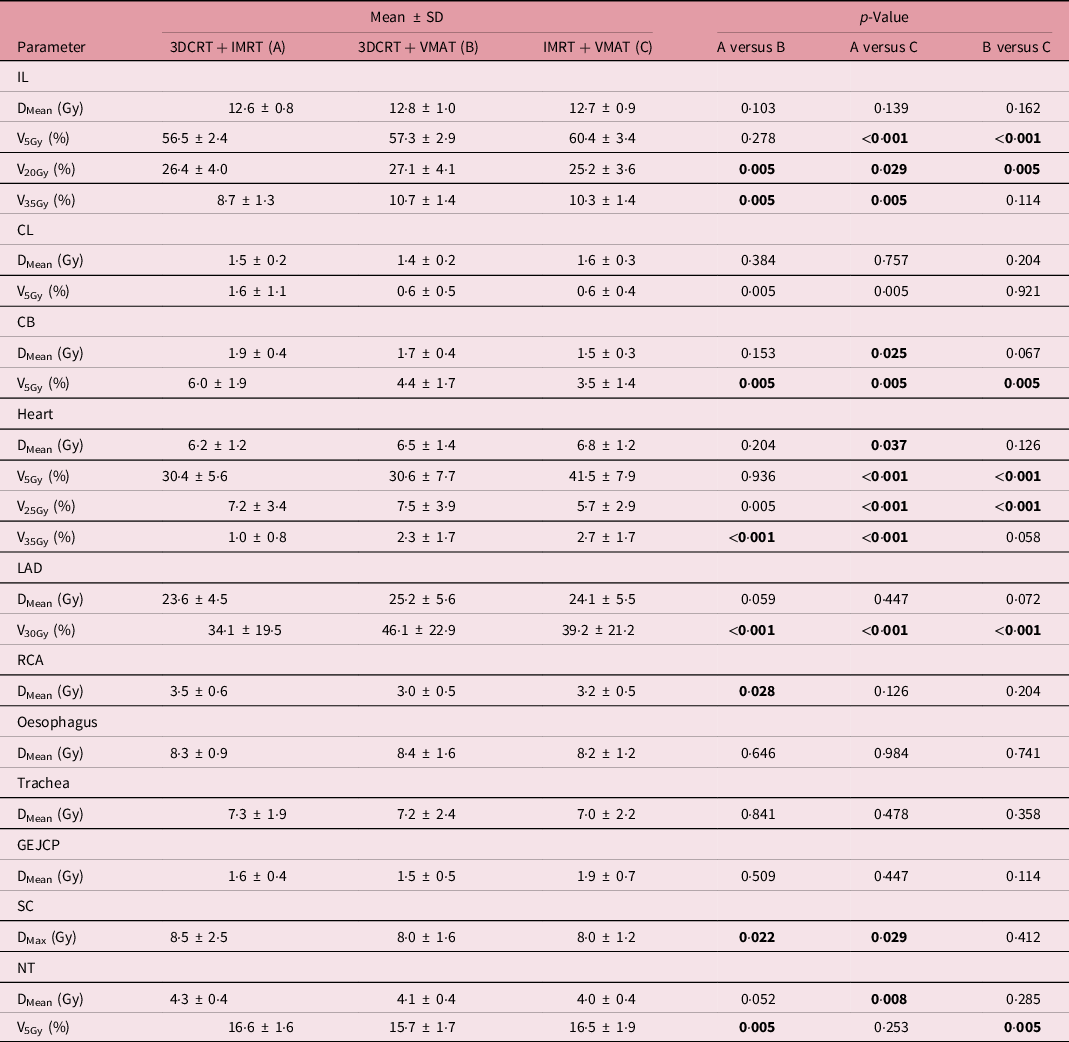
Table 3 summarises the OARs dose comparison results of all hybrid plans. The mean dose of the IL was similar for all plans, while the V5Gy was less in the 3DCRT+IMRT and 3DCRT+VMAT plan (p < 0·001). The V20Gy was less in the IMRT+VMAT plan (p < 0·03), whereas the V35Gy result was less in the 3DCRT+IMRT plan (p = 0·005). The mean dose and V5Gy of the CB were less in the IMRT+VMAT plan (p < 0·03). The mean dose to the heart was less in the 3DCRT+IMRT plan (p < 0·04), while the V5Gy was less in the 3DCRT+IMRT and 3DCRT+VMAT plan (p < 0·001). The mean doses to the oesophagus, trachea and GEJCP showed comparable results. The overall score that incorporated all dosimetric parameters (PTVs, OARs and treatment delivery) were 1·02, 0·98 and 0·99 for 3DCRT+IMRT, 3DCRT+VMAT and IMRT+VMAT plans, respectively.
Dosimetric comparison results for organs at risk

SD, standard deviation; IL, ipsilateral lung; CL, contralateral lung; CB, contralateral breast; LAD, left anterior descending coronary artery; RCA, right coronary artery; SC, spinal cord; GEJCP, coeliac plexus and gastroesophageal junction; NT, normal tissue; Gy, gray; DMean, mean dose; DMax, maximum dose; VXGy, volume receiving X dose; bold, statistically significant result.
Discussion
In this dosimetric comparison study, three different hybrid plan combinations, 3DCRT+IMRT, 3DCRT+VMAT and IMRT+VMAT, were evaluated with a hypofractionated dose regimen for left-sided CW along with SCL and IMN targets. Few studies used a mixture of the IMRT and VMAT in their hybrid study. Reference Jost, Kretschmer and Sabatino14,Reference Lin, Yeh and Yeh15 However, the present study showed that the 3DCRT plan is optimal for the base-dose plans as it utilised less planning time, demanding fewer MUs compared to the IMRT plan. In spite of the use of optimisation bolus and PTV extension, the impacts of set-up and breathing movements in the IMRT are higher than in the 3DCRT. Reference Zhou, Zhu and Zhang24 The 3DCRT beams are capable to limit these uncertainties with extended fields, along the body surface region. Reference Balaji, Yadav and BalajiSubramanian12
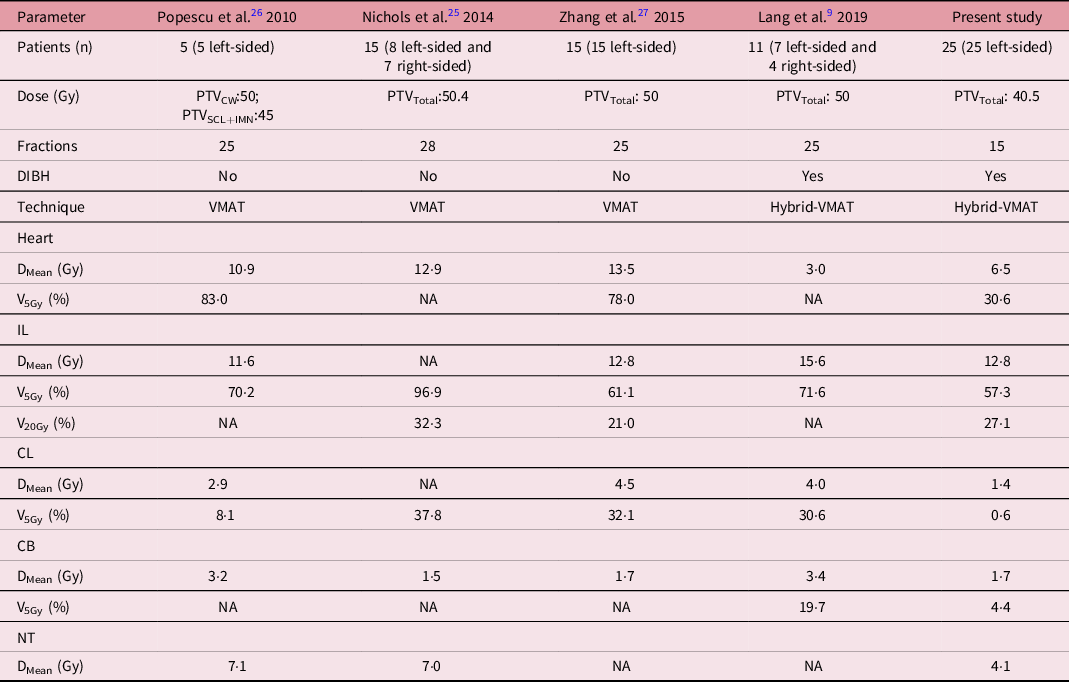
Between IMRT and VMAT, the suggested technique for the CW and nodal RT is varied in published studies. Reference Balaji, Subramanian and Yadav8 However, with 30% of dose weightings, the influence of IMRT and VMAT techniques as a hybrid component is minimal. Because of this, the hybrid plans in the present study showed almost similar results to the PTVs and OARs dosimetric parameters. Table 4 displays the dosimetric parameter appraisal of favoured technique from other published studies Reference Lang, Loritz and Schwartz9,Reference Nichols, Fontenot, Gibbons and Sanders25–Reference Zhang, Yu and Hu27 and the present study.
Comparison of dose parameters from present study and previously published studies

DIBH, deep inspiration breath hold; IL, ipsilateral lung; CL, contralateral lung; CB, contralateral breast; NT, normal tissue; Gy, gray; DMean, mean dose; DMax, maximum dose; VXGy, volume receiving X dose; NA, data not available.
The DIBH method is capable to reduce the dose to the heart, LAD and RCA. Reference Sakyanun, Saksornchai and Nantavithya28,Reference Bergom, Currey and Desai29 Nevertheless, this practice might not be achievable for all patients. Holding the breath for a few minutes is a difficult task for certain patients. The 3DCRT+VMAT plan with fewer MUs delivers the hypofractionated dose more rapidly that helps the DIBH patients regarding breath-hold constancy, less intra-fraction variation and comfort. Nevertheless, the trade-off between the DIBH and free breath needs to be evaluated in a clinical setting for each patient. Reference Gaál, Kahán and Paczona30
The exclusion of axillary node was the limitation of this study. Irradiation of axillary node does not improve the overall and cancer-specific survival. Reference Haussmann, Budach and Tamaskovics31 As a result, the axillary lymph node was not included in this study. However, further investigation including axillary node is required, which could be desirable in some clinical setting. Another limitation was the non-usage of electron beams in this hybrid setting, which might be useful for thin CW patients. Further, a prospective study on thin CW patients is warranted to find the trade-off between photon and electron beams for these patients.
Conclusion
The 3DCRT-based hybrid VMAT technique shows superior results with less MU and delivery time, thereby increasing patient comfort. It is worth mentioning that the decrease in heart dose parameters subsequently increases the IL doses and vice versa. Therefore, dose balance between the heart and IL by considering its tolerance doses is desirable. Further, considering the individuality of each patient, the choice of an optimal hybrid plan between 3DCRT+VMAT and 3DCRT+IMRT needs to be considered with regard to planning complexity and time taken for plan generation in a clinical setting.
Acknowledgements
The authors would like to thank Dr Balajisubramanian S, Dr Balasundaram V and Dr Sathiya K, Radiation Oncologists and Mr. Moorthi T, Medical Physicist of Gleneagles Global Hospitals, Chennai, for their helpful discussion and advice.
Financial Support
None.
Conflict of Interest
The authors declare no conflicts of interest.
Ethical Standards
This article does not contain any studies with human participants performed by any of the authors.
Sources of support
None