Like all of Maurice Ravel's compositions, the virtuosic violin piece Tzigane, styled rapsodie de concert by the composer, rapidly became a mainstay of the concert repertory following its premiere with piano by the Hungarian violinist Jelly d'Aranyi in April 1924 in London (her premiere of the orchestral version occurred in Paris on 30 November 1924 with Gabriel Pierné conducting the Colonne Orchestra). Yet, despite its popularity, no critic has included it among Ravel's major works. Reflections on Tzigane in the secondary musicological literature are very few indeed, which is somewhat surprising in the context of a new explosion of interest in Ravel. In his recent biography, Roger Nichols avers that ‘probably no one has ever suggested that Tzigane is great music’.Footnote 1 Robert Orledge noted in 2000 that it ‘has never been among Ravel's most successful works’,Footnote 2 a remark surely meant as a critique of the composition rather than a statement about its popularity with performers, which has been considerable. Alexis Roland-Manuel, a close friend of the composer, did not even discuss the piece in his biography of 1938.Footnote 3 The violinist Hélène Jourdan-Morhange, another close friend and consultant about the virtuoso figuration in Tzigane, confessed almost apologetically in her book on Ravel that ‘this rhapsodic piece is perhaps the only one in Ravel's oeuvre where I cannot locate – hidden in the intricacies of its tours de force – Ravel's characteristic flavour: in it, music has surrendered too much place to instrumental acrobatics’.Footnote 4 In other words, she appears to suggest that Tzigane is a mere showpiece where Ravel's personal style has been eclipsed by fireworks, with an implicit criticism of pandering to market. The Hungarian violinist Joseph Szigeti spoke of the ‘resistance I always felt towards this brilliant and (to my mind) synthetically produced pastiche of Ravel's’.Footnote 5 At the time of the premiere, the young Henri Sauguet told Francis Poulenc that ‘the aesthetic informing these pages is so antiquated that I am astonished anyone can still believe in it’.Footnote 6
But perhaps ‘believing in it’ was not the point. Drawing on a well-travelled trope in Ravel studies, I ask, in the title to this article, whether Tzigane is one of the many artful masks that Ravel wore in his creative work, now gypsy in place of, say, Viennese (La Valse), Spanish (Rapsodie espagnole), Parisian renaissance chanson (Trois chansons pour choeur mixte) or neoclassical (Le Tombeau de Couperin). Over time Ravel's style was highly variegated: he wrote both the lush textures of Daphnis et Chloé and the astringent and dry ones of the Sonata for Violin and Cello, pieces that hardly seem like the work of the same composer. Deborah Mawer subtitled her introduction to The Cambridge Companion to Ravel ‘The many masks of Ravel’, borrowing an image that Vladimir Jankélévitch had used many years before to describe a kind of carnivalesque Ravel who enjoyed deceptions and trompe-l'oeil.Footnote 7 Such masks might be understood as a distancing strategy, a way for the composer to deflect enquiry into his works as documents of self-expression, which Ravel himself saw as an unproductive approach to his own craft. The larger impulse was anti-romantic as the creator's putative sincerity was replaced by a celebration of deception and artifice.
In this article, I extend the question to broach the relevance of the aesthetic category of kitsch to Tzigane, a critical approach that is new to the literature. In the context of the critical reception of Ravel, this is in some senses an extraordinary claim because it runs against a strong tradition of reception that sees Ravel as a seeker after novel effects, a defender of artistic prestige and an artist possessed of refined sensibilities. In light of the weight of this critical tradition it is difficult to characterize anything that Ravel composed, including Tzigane, as kitsch. On the other hand, the questioning of genuineness as a parameter for value judgement by Ravel himself, as well as by his acolytes, intersects in several ways with traits identified as kitsch by art historians and literary critics. His often-cited celebration of surface perfection and craft is certainly not dissonant with the concept of kitsch, as we shall see.Footnote 8 One might, then, follow up on an unspoken invitation to explore this angle further by suggesting that among all Ravel's compositions, Tzigane flirts most conspicuously with this cultural phenomenon. What is important for the present purpose is not a definitive answer as to whether Tzigane is kitsch but rather the question itself, and what it says about Ravel's aesthetics and the kinds of compositional risks he took. Indeed, Jankélévitch argued that risk-taking was a conspicuous component of Ravel's art, though later we will need to adjust his parameters somewhat for the critical issues I raise.Footnote 9
Kitsch
Ostensibly derived from the German verb verkitschen (to make cheap) and first used at the end of the nineteenth century, kitsch resists stable application to cultural matter because it depends on the operation of value judgement. Traditionally, the primary connotation has been of bad taste in art, a verdict typically rendered from a supercilious perspective.Footnote 10 (A more celebratory attitude towards bad taste points to the aesthetic category of camp. The intersection between kitsch and camp will not be of concern in this article, as, notwithstanding its emergence from a queer space, in my view that intersection is neither critically productive for Tzigane nor for Ravel's music in general.Footnote 11) A related, though not completely homologous, attribute is that kitsch is a product of the burgeoning urban marketplace for art in nineteenth-century courtly or religious art where the premise of mass consumption was not present. For the Austrian writer Hermann Broch, in a frequently cited essay about the term first drafted in 1933, early kitsch was a quintessentially romantic product, a kind of alter-ego to romanticism that catered to an urban bourgeois desire for security.Footnote 12 Romantic exaltation of the infinite, discomfort with the dark impulses of the psyche, and liberal political aspirations all were met by a conservative reaction that repackaged the constituent elements of romanticism into safer vehicles; for example, a historical world relived as a series of prefabricated clichés or the infinite refashioned as conventional religious symbols. In a conventional view, the kitsch consumer inhabits the social space that German intellectuals have derided as Kleinbürgertum (the petty bourgeoisie), though Carl Dahlhaus has rightly warned of the difficulty in defining that space.Footnote 13 As a component of its conservative orientation, still according to Broch, kitsch drained the ethical component from romantic art to settle for a hollow shell of beauty and mere effect.
Though many of the same images circulated through both genuine romantic art and kitsch, Broch outlined a sharp divide in values between them, a binary analysis that the art critic Clement Greenberg transplanted to twentieth-century art in a short, but influential, essay of 1939 entitled ‘Avant-Garde and Kitsch’.Footnote 14 Taking aim at socialist realism, Greenberg argued that a pre-condition for kitsch is the presence of genuine modernist culture which it shamelessly pillages. Whereas avant-garde art turns inward and reflects on its own means and processes, kitsch is concerned only with creating superficial effects that require little effort on the part of the consumer. By extension, Greenberg meant that all attempts to combine traditional art with modern syntax constituted base catering to a marketplace that had little tolerance for challenging works. For Adorno, in the same spirit, kitsch signified cheap imitation and formulaic culture that aimed to carve commercial success and prestige out of its parasitic association with high art.Footnote 15 We might add that such an association often betrayed a desire for a more elevated social status.
Studies that have harnessed kitsch to music criticism have been rare. Robin Holloway has written of Richard Strauss's Salome as a work that tests the boundaries between high art and kitsch. He targets its putative sensationalism, the composer's business-like efficiency and the ‘triumphant banality’ of waltz tunes in the Dance of the Seven Veils.Footnote 16 ‘Scratch the modernity and you have the Liebeslieder waltzes’, he writes, bringing to mind Greenberg's critique of superficial modernisms in kitsch. Holloway certainly does not gainsay Strauss's craft and technical skill, but his positioning of Salome as a ‘crucial work historically’ would seem to undermine its status as kitsch. This is because to open a path to Berg's Wozzeck and Lulu suggests a level of challenge to audience expectation uncharacteristic of the concept. With more secure theoretical footing, Wayne Heisler has noted that high/low and progressive/reactionary dichotomies involving kitsch seem overly facile and counter-intuitive given ‘the cross-fertilization that defined many modernist movements’, in particular the integration of elements of popular culture in high art.Footnote 17 As the philosopher Roger Scruton wrote in a short piece for the popular press, current artists knowingly produce ‘kitsch’ (instead of mere kitsch, without scare quotes) for ironic, ludic or critical purpose.Footnote 18 That said, it is important to remember that kitsch in itself does not engage with irony, or really anything that appeals to the intellect. What Scruton references is the use to which kitsch might be put within a larger framework. Excoriation of kitsch can certainly be understood as a self-serving strategy of modernists (and romantic artists, if the word had been around then) to validate their project, but Adorno once hinted at a more nuanced view by pointing out that kitsch manifests itself to different degrees and that not all falseness deserves to be dismissed out of hand.Footnote 19 One might justifiably admire skilfully wrought fakes for their (re)production values provided that they self-consciously foreground their kitschiness. As we shall see, that was Ravel's own perspective with regards to his home decorating choices. The paradoxical construct of authentic kitsch lies in that very self-consciousness. Umberto Eco also argued for a more fine-grained parsing of kitsch than Greenberg, starting from a premise that it plays out in the context of a distinction between ‘masscult’ (say, the sign for a fast-food restaurant) and ‘midcult’ (say, a designer telephone).Footnote 20 In midcult (we might today call it middlebrow) the cultural object is almost able to pass itself off as high art and satisfies the average consumer by convincing him or her of an experience of something genuine.Footnote 21 Eco does not avoid a supercilious attitude here, but, then, few of us can claim to be untarnished in this respect. It is also worth remembering, as Eco points out, that there is a bit of the average consumer in each of us when it comes to unfamiliar cultural matter. In a similar spirit to Eco and Adorno, the philosopher Robert Solomon has identified and explored the concept of ‘high kitsch’ – professional, well made and expensive.Footnote 22 This evokes Dahlhaus's admonition with respect to music that kitsch does not necessarily mean poorly composed and that not all poorly composed music is kitsch.Footnote 23 For Solomon, an object nonetheless remains kitsch by exhibiting maudlin sentimentality, often a cloying quality that projects an idealized view of its subject and deals in false and formulaic emotions: ‘sweet kitsch’, to reference another term coined by Solomon.
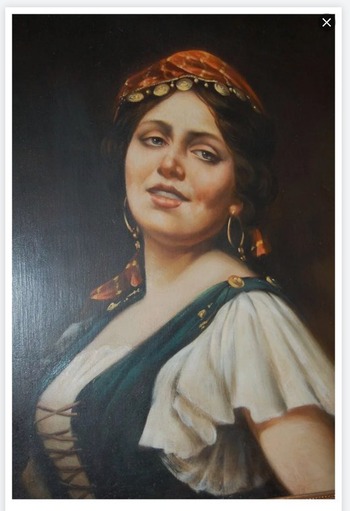
Solomon posits the style and subject matter of the French realist academic painter William Bouguereau as an example of kitsch, both high and sweet. Of course, not everyone will agree – this illustrates the notoriously wide range of the concept and underlines the fact that kitsch has been associated with highly accomplished and respected works of art. As literary critic Matei Calinescu notes, pompier academicism did not fare well in the face of the putative imperatives of modernism.Footnote 24 The Impressionists reviled Bouguereau; but even they could not deny his technical perfection. Closer to the subject matter to hand in this article is an oil on wood painting of a gypsy by an anonymous artist offered for sale in 2017 by a gallery called ‘Kitsch and Couture’ in Charlotte, North Carolina and publicly available for perusal on the internet (Figure 1).
(Colour online) Anonymous, [Gypsy], oil on wood.

The gold gilt frame around the image suggests packaging as high art, as does its price of $4,200 for a work that is not even two feet high. The image itself does not appear to go beyond a sentimental, facile rendition of its subject that traffics in clichés, complete with headscarf and hoop earrings that adorn a figure ostensibly in robust good health. It would seem to exemplify Solomon's ‘sweet kitsch’. The gallery listing is telling, redolent of Eco's claim that kitsch as midcult attempts to persuade the consumer of her elevated taste. The description reads:
At first glance, the gypsy appears to be a strong seductive woman, but after careful examination of her beautiful blue eyes, you will sense her fatigue and weariness. Absolutely stunning. The first time we laid eyes on her, it was hard to believe that she was an actual painting. The artist of this piece was clearly a skilled master.
The claim here is for the presence of a kind of romantic spleen brilliantly incorporated into an image that modulates skilfully between defiance and Weltschmerz. Subtlety seems overstated, as one might also well imagine this picture as part of a mass-market advertising campaign for goulash or paprika. It does appear to correspond to criteria that the philosopher Tomas Kulka has attributed to kitsch in the visual arts, namely a traffic in stock emotions, realism and a narrow field of signification.Footnote 25 Like other critics, Kulka points to the varieties of kitsch and includes many examples where bad taste is not an issue. Such, one could well argue, is the case of our anonymous gypsy, which seems on the higher end of the kitsch taste spectrum.
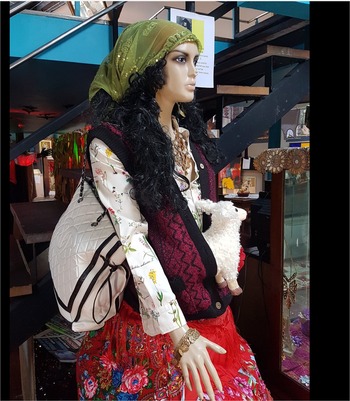
It is certainly ‘higher’ than the offerings at the recently opened Romanian Kitsch Museum in Bucharest, where a category called ‘gypsy kitsch’ shares space with interior design kitsch, religious kitsch, communist kitsch and Dracula kitsch. A plastic mannequin of a gypsy on display in the museum wears a seemingly traditional flowing red skirt, purple bead vest, green headscarf and gold baubles (Figure 2). But she also carries a white designer shoulder bag and a stuffed toy lamb. There is an exaggerated and over-the-top quality to the item: the mixture of objects and the colour scheme are outrageously random. The operation of bad taste here seems beyond question. As a foil for the anonymous painting, this gypsy mannequin underlines the point that kitsch can inhabit a low register indeed. This is not the level at which Tzigane operates.
(Colour online) Romanian Kitsch Museum, [Gypsy mannequin].

Style hongrois
Ravel's Tzigane owes its origins to a private musical soirée in London in 1922 where Ravel asked the brilliant Hungarian violinst Jelly d'Aranyi – the niece of the Hungarian violinist and friend of Brahms, Joseph Joachim – to play some gypsy tunes. He remained enthralled until five in the morning, the story goes, and became determined to compose a piece for her.Footnote 26 In a later interview about the genesis, Ravel changed the emphasis, explaining that his intent was merely to write a virtuoso piece and that ‘a composition of this class could not be anything but Hungarian’. Essentializing a trait of putative native Hungarian genius in this way would not have been out of place in the toolbox of the run-of-the-mill kitsch artist. We know that Ravel consulted extensively with his friend the violinist Hélène Jourdan-Morhange as well as Jelly d'Aranyi herself about virtuoso figuration, and that he also studied the Paganini caprices to learn about extended techniques on the violin. But even more significant was Ravel's request on 10 March 1924 to his friend Lucien Garban to send him a copy of Liszt's Hungarian Rhapsodies for piano.Footnote 27
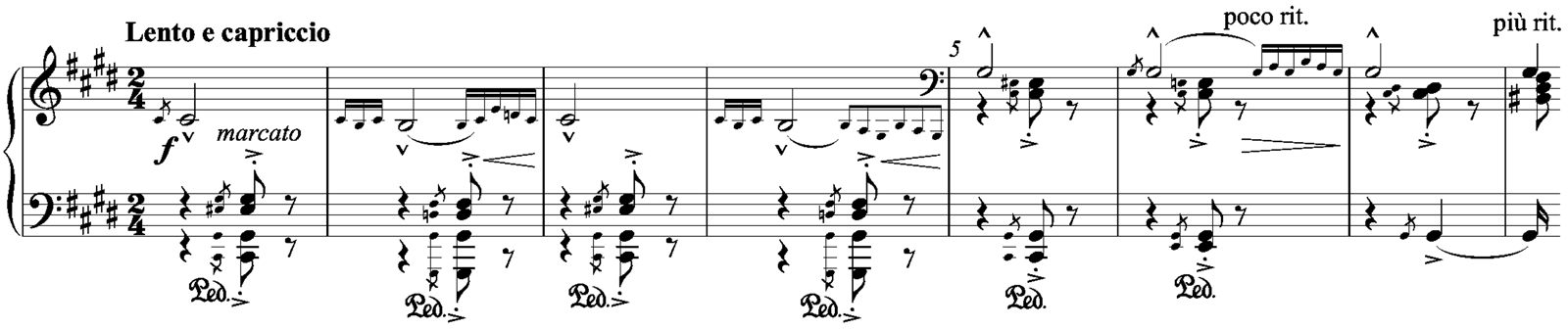
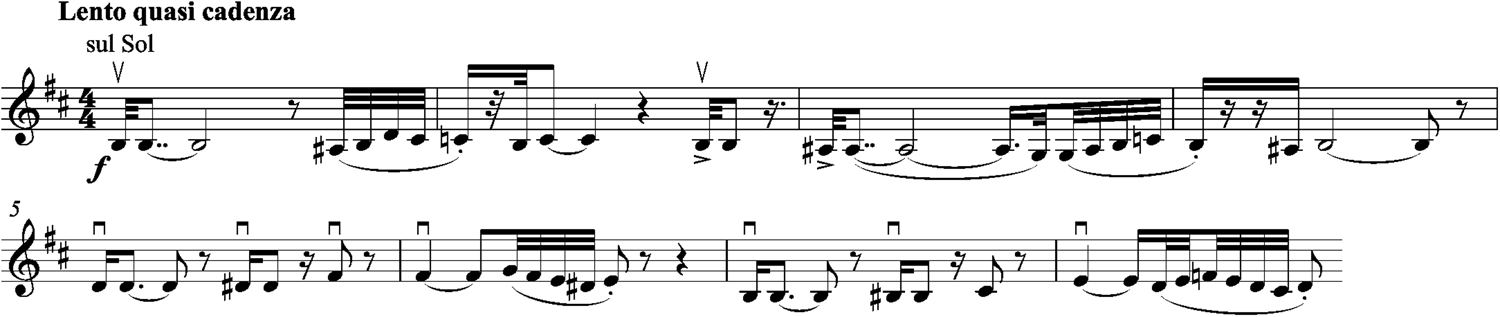
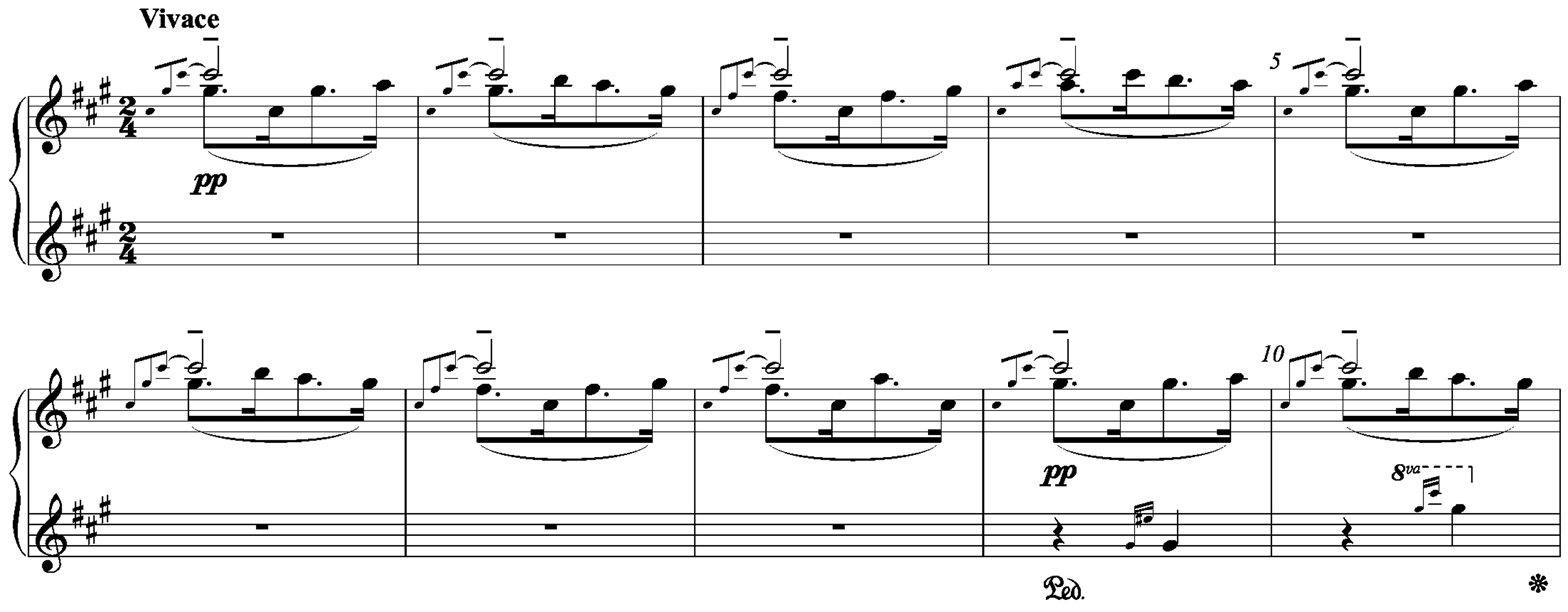
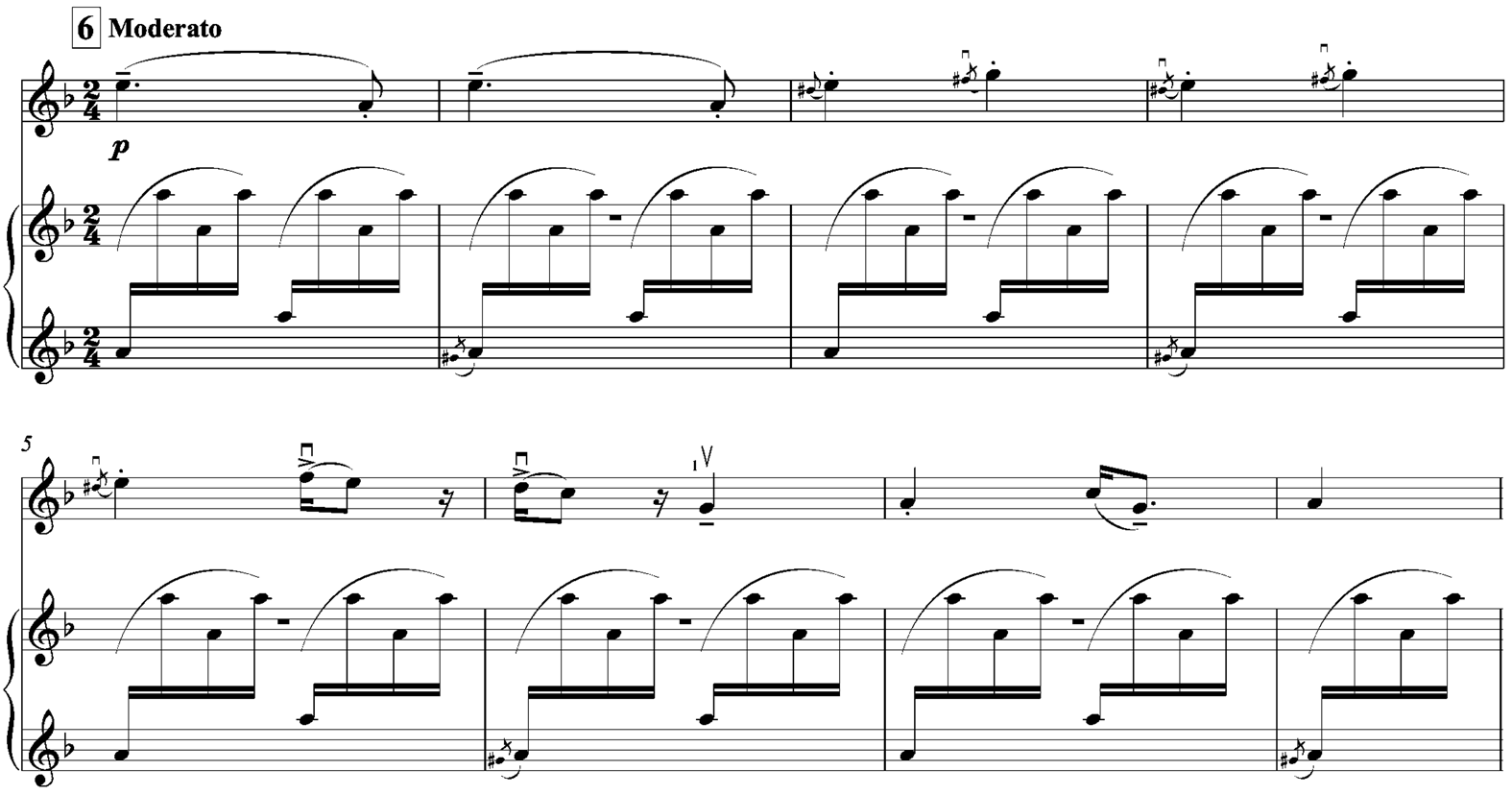
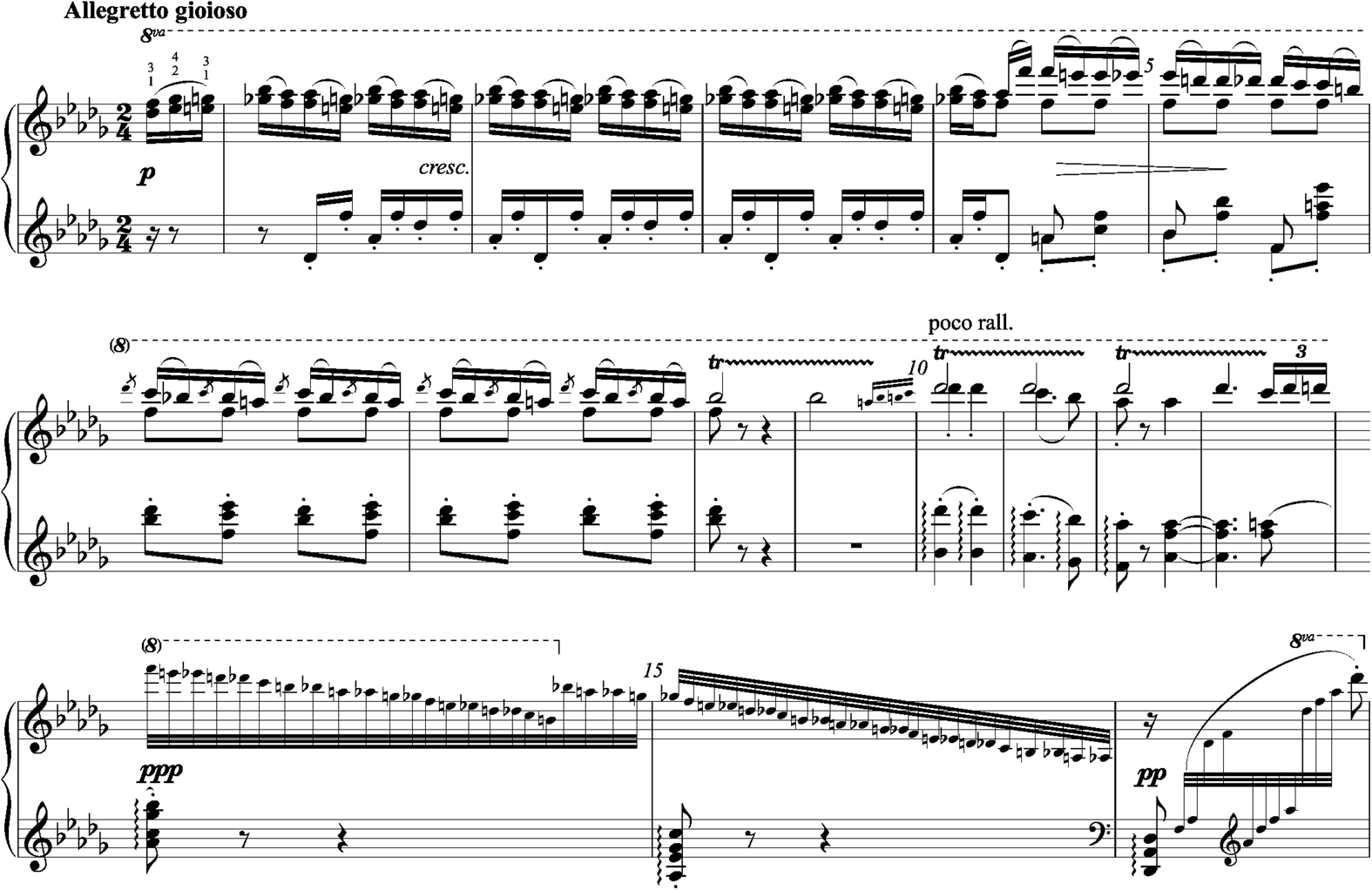
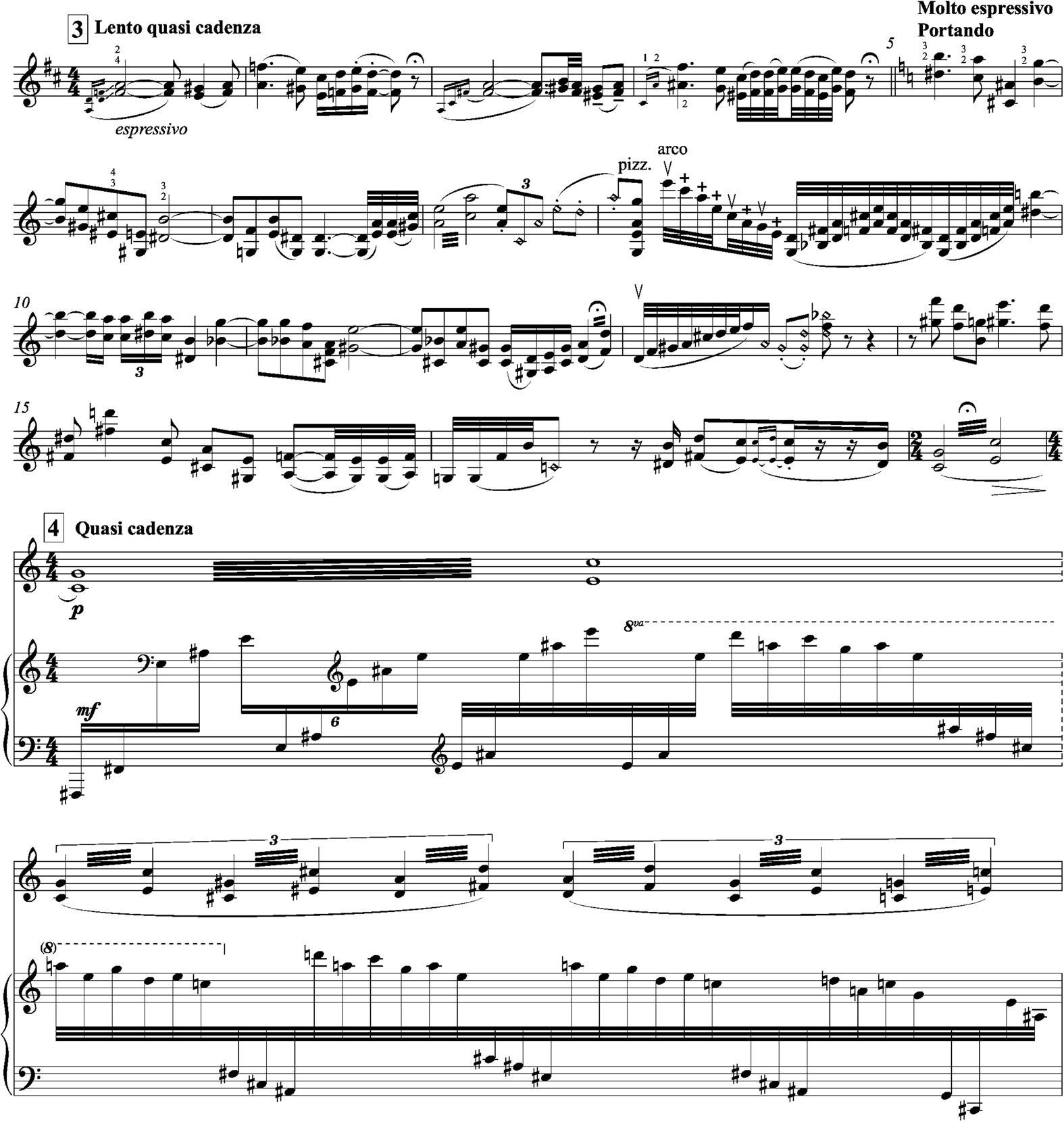
As it turned out, Tzigane owes a considerable amount to the Liszt collection. Just how much is difficult to gauge given the overlap between the gypsy resources that Liszt used and a wider pool of style hongrois topics in European musical culture derived from the verbunkos into which Ravel might have dipped independently.Footnote 28 (For our purposes, verbunkos will refer to a native Hungarian genre that spawned the style hongrois in wider European musical culture.) Ravel and Liszt share the typical slow/fast (lassú, friss) design of gypsy pieces. Ravel's initial lassú takes the form of a five minute cadenza, the very beginning of which has an unmeasured improvisatorial feel (marked Lento quasi cadenza before a tempo in bar 14) that is characteristic of the hallgató style in the verbunkos. Several of the Liszt rhapsodies (1, 2, 8, 10, 13) also begin with music that gives the impression of written out improvisation. Ravel's initial music certainly bears a family resemblance to the beginning of Liszt's second rhapsody (marked Lento e capriccio) (Examples 1a, 1b). Here the similarity lies in sharp dotted rhythms on the same pitch (expressed as downbeat demisemiquavers in the Ravel, grace notes in the Liszt) interspersed with quick gruppetti. Liszt goes on to plant a melody in the hallgató slow introduction that gets taken up again at faster tempo later, at which point he subjects it to a series of variations. Ravel uses the very same compositional strategy of slipping a melody into his initial slow section that is later treated in fast variations. At the exposition of the melody in quick tempo, both composers offset it with a sparkling high tonic pedal so that it occurs in the middle of the texture (Examples 2a, 2b). Moreover, the two melodies even resemble each other. Both begin with downward fifth leaps in implied dominant harmony (two leaps in the Ravel) followed by a leap from scale degree 2 to scale degree 4. Ravel goes on to spin three virtuoso variations on this melody, a compositional technique that Liszt often exploits.
Liszt, Hungarian Rhapsody no. 2, 1–8.

Ravel, Tzigane, 1–8.

Liszt, Hungarian Rhapsody no. 2, 118–27.

Ravel, Tzigane, 71–8.

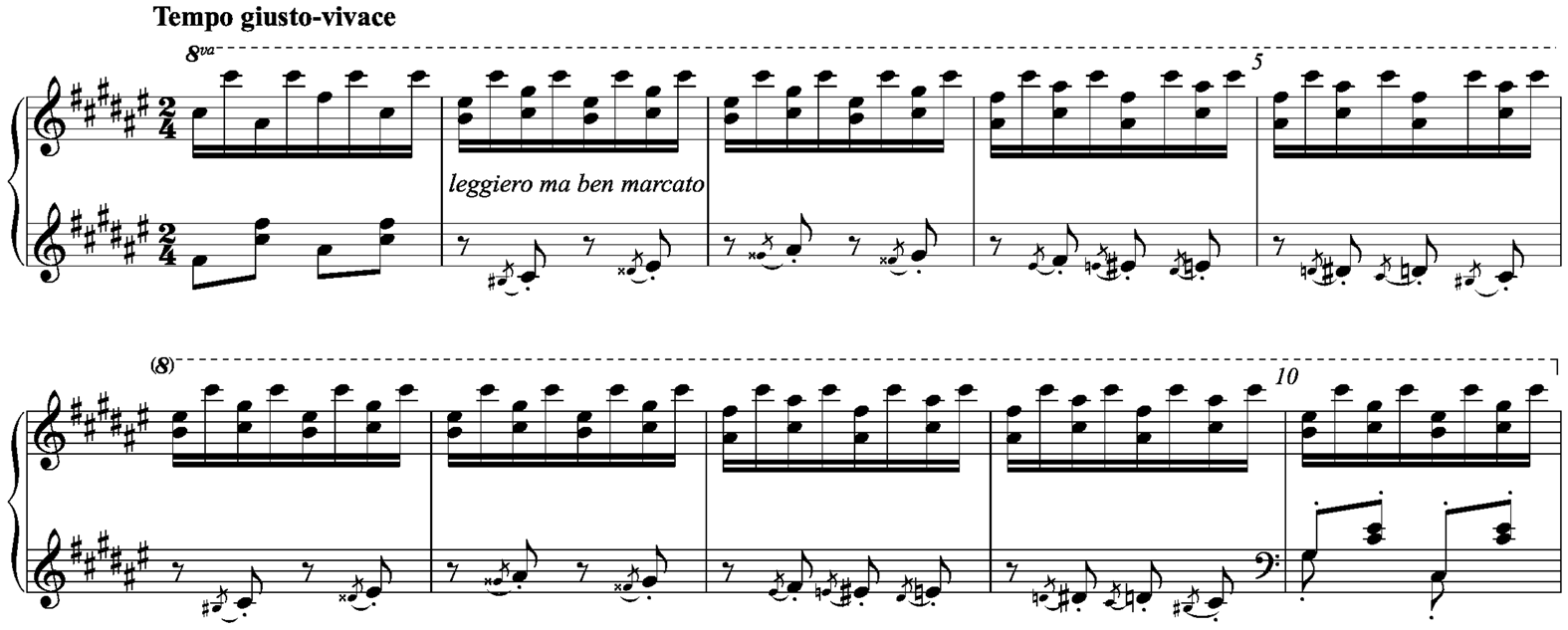
Other stereotypical verbunkos effects populate both the Liszt and the Ravel. Liszt often enjoys crushed grace notes in the rhapsodies and Ravel takes up this kind of figuration as well in the new theme that he introduces after the initial sequence of variations (Examples 3a, 3b). In this example, Ravel also initiates both phrases with a typical verbunkos short–long–short rhythm, which he deploys in every second bar in the score following the end of the example (rehearsal 18 in the score). The ‘crude’ open fifths in the left hand of the piano in Example 3b are also redolent of verbunkos practice. Another salient colour is one that might be called a gypsy skipping figure, perhaps meant as an imitation of characteristic cimbalom passagework: a string of four semiquavers where the second and third notes repeat. One also imagines a cimbalom at those moments when Liszt's textures melt into rapid notes and cadenza-like flourishes. Example 4a shows both the skipping figure and a spontaneous flourish from the Twelfth Rhapsody, and Example 4b has a strikingly similar moment in Tzigane. Here Ravel works with the augmented second characteristic of the gypsy scale.
Liszt, Hungarian Rhapsody no. 2, 217–26.

Ravel, Tzigane, 202–9.

Liszt, Hungarian Rhapsody no. 12, 152–68.

Ravel, Tzigane, 119–33.

As a sidebar to such passages it is worth calling attention to the fact that, not content merely to imitate the cimbalom on the piano like Liszt, Ravel sanctioned a version of Tzigane for a piano fitted with a metal mechanism called a luthéal. Invented by the Belgian organ maker Georges Cloetens, the piano luthéal provided low and high register stops imitating the harpsichord and harp that when used in combination could also approximate the timbre of a cimbalom.Footnote 29 Ravel produced a score with careful indications of the stop combinations and changes he wanted, and the American artists violinist Samuel Dushkin and pianist Beveridge Webster premiered this version on 15 October 1924, before the orchestral version was heard. But lack of interest in Cloetens's mechanism meant that Ravel's experiment with a putatively more authentic sound did not enter the repertoire.
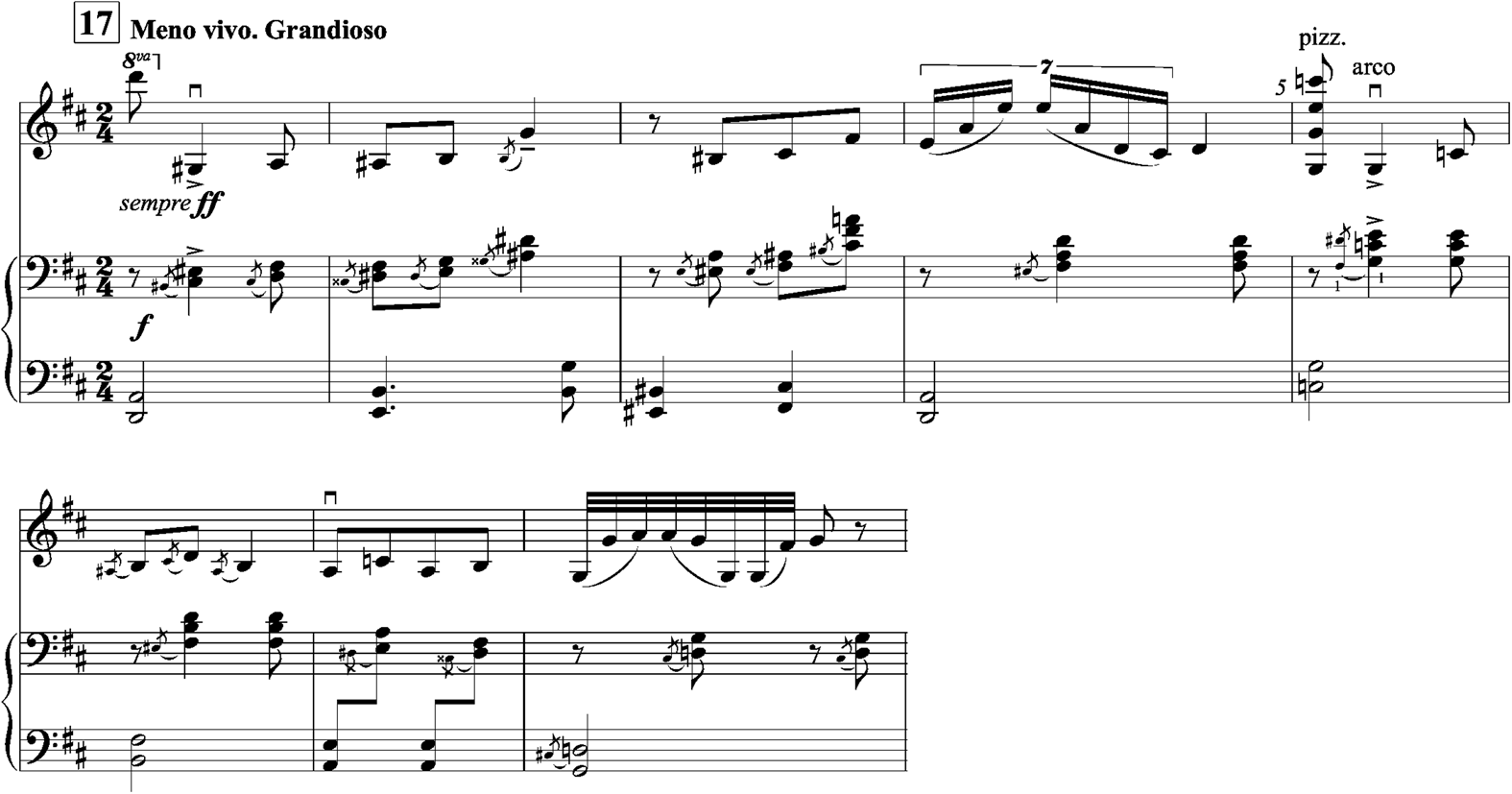
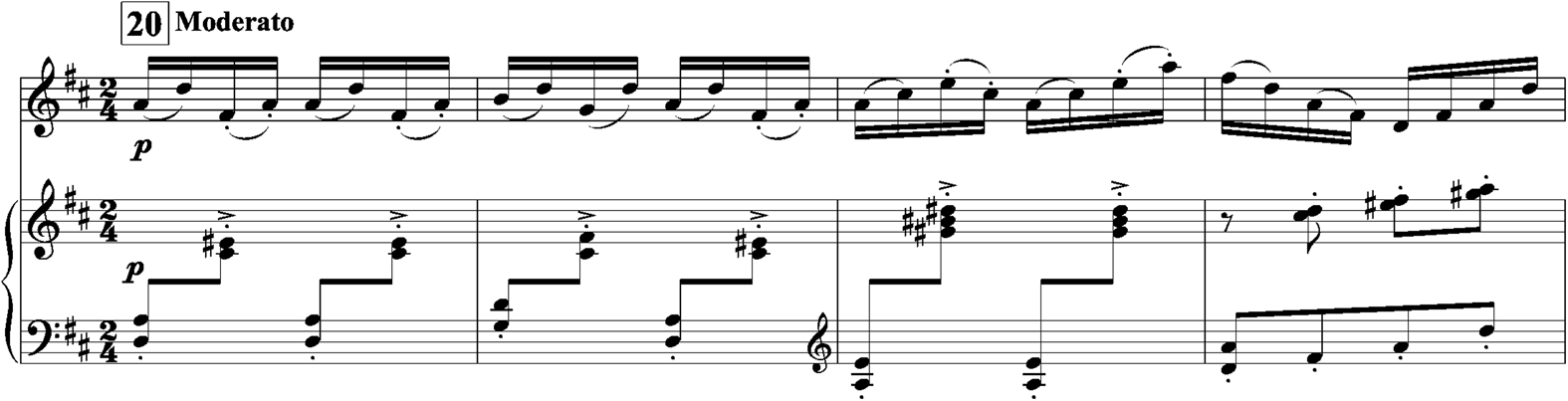
Many of the Liszt rhapsodies contain a fast section with an ‘oom-pah’ accompaniment. The famous tune from the Sixth Rhapsody (containing both the characteristic skipping figure and the short–long–short rhythm) shown in Example 5a is typical and feeds several variations. Ravel introduces his oom-pah figure at rehearsal 20 (Example 5b), also carrying the tune through to a series of variations (including one that superimposes Example 4b) and then to a blazing accelerando finish. Liszt favours driving to a frenetic conclusion in his rhapsodies and sometimes enhances the final rush with colourful harmonic shifts, as in the Ninth Rhapsody in E♭ where in the last gambit of the piece he leaps from tonic E♭ to successive tonicizations of B major and G major before returning to E♭ in a typical Lisztian rotation downwards through major thirds. The conclusion to Tzigane also features a striking harmonic progression. It first settles on the dominant (pitch class A in the bass, rehearsal 32) and then traces what sounds like it is going to be a Phrygian bass descent: A–G–F–E♭–[D]. But instead of ending on tonic D (at 5 after rehearsal 33), the bass leapfrogs over this pitch to continue the descent from C♮ to B♭ to G♯. In short, Ravel deflects the bass movement to land on a chord a tritone away from tonic D. It is a Ravelian paradox: the music dashes madly to that G♯ minor chord, but then employs a standard tonal punctuation mark to conclude the piece with foot-stomping root movement by fifth: E to A to D.
Liszt, Hungarian Rhapsody no. 6, 96–102.

Ravel, Tzigane, 237–40.

Jonathan Bellman holds the Liszt rhapsodies as exemplary of a style hongrois fed by ‘a combination of Hungarian popular song and dance repertories with the performance style and interpretive traditions of the Gypsies’.Footnote 30 For Bellman, Brahms was the ‘the last great composer to speak this musical dialect as a mother tongue’. He continues: ‘By the end of Brahms's life, the style hongrois was ubiquitous as entertainment music of the café type and through familiarity had lost much of its quality of strangeness.’Footnote 31 Bellman reminds his readers of gypsy operettas by Franz Lehar and Emmerich Kálmán composed after the turn of the century. Shay Loya, for his part, identifies different strands in the dissemination of verbunkos idioms, including a Hungarian national tradition of art music, opera and sacred music, a Viennese tradition of middle and high-brow genres and European traditions of style hongrois music for popular venues, exoticist representations of gypsies in stage works and virtuoso works.Footnote 32
Ravel's Tzigane falls of course squarely in the virtuoso tradition, and its most prominent violin and orchestra forebear is Pablo Sarasate's Zigeunerweisen (1878). Like Tzigane, Sarasate's work looks back to Liszt, this time by actually replicating the friss of the Thirteenth Rhapsody. The lassù is made up of a succession of slower tunes festooned with a panoply of virtuoso figuration. Ravel deploys variation strategies much more than Sarasate but shares a propensity of the melodic line to evaporate into cadenza-like flourishes. Sarasate makes an appeal to an authentic experience by indicating on the score to execute the piece ‘presque ad libitum, according to individual taste, but nonetheless duplicating as much as possible the manner of gypsies’. One is reminded of d'Aranyi's regaling of Ravel with gypsy-like violin playing; presumably it was her style and manner as much as her musical substance that he found attractive and inspirational. Yet for all its virtuosic brilliance, Zigeunerweisen is filled with shop-worn figuration considering when it was written, ushering in a time when, as I have already noted, the style hongrois became thoroughly absorbed into light music, including Vittorio Monti's accessible, ever-popular and less challenging Czárdás (1904) for violin and orchestra. Gypsy bands were a long-standing fixture in the Parisian entertainment industry, staffed by Roma and non-Roma musicians alike at cafés, at clubs and in the street.Footnote 33 Written in 1924, Tzigane is a very late manifestation of the violin virtuoso gypsy tradition indeed, at once sharing popular music traditions by virtue of its bricolage of clichés and resisting them through sheer difficulty of execution.
By the early twentieth century, substantial pressure had mounted against the Liszt rhapsodies as genuine manifestations of Hungarianness. Although the suggestion that Liszt's rhapsodies were merely clichés strung together was overly reductive in view of the period in which he wrote them, the argument resonated in the context of an increasing commodification of gypsy culture. The charge of empty virtuosity was also frequently made, sometimes gratuitously. Charles Rosen noted the difficulty in shaking the impression that ‘the least respectable side of Liszt is to be found in the Hungarian Rhapsodies’.Footnote 34 Béla Bartók famously disparaged the Liszt rhapsodies with an argument cast in terms related to authenticity, modernism and anti-Germanism. The debate revolved around nothing less significant than Hungarian cultural identity. Truly authentic Hungarian music lay in the peasant voice, Bartók said, which was to be the basis of a modernist music language independent of the Germanic line in which Liszt himself was imbricated.Footnote 35 Verbunkos-related music had been contaminated by the urban marketplace and, as Loya as shown, for the politically left-leaning Bartók was tainted by the cultural predilections of conservative landed-gentry.Footnote 36 Later Hungarian critics attempted to rehabilitate the Liszt rhapsodies, and Loya has redoubled these efforts on the premise that the appreciation of Liszt's rhapsodies has been conducted within too narrow an understanding of musical progress in the second half of the nineteenth century. Drawing on the critical construct of transnationalism in order to cast modernism in a broad vein, he maintains that the gyspy idiom is no mere picturesque window-dressing in the rhapsodies, and describes a genuine – and often experimental – dialogue between that idiom and Western European elements, frequently at deeper structural levels.
Tzigane as parody
Ravel met Bartók on at least two occasions in the 1920s and was certainly aware of his music and orientation (although not necessarily his specific critique of the Liszt rhapsodies as sentimental and backward looking). Somewhat ironically, it was Ravel's attendance at Jelly d'Aranyi's performance of Bartók's first sonata for piano and violin in 1922, with the composer at the piano, that triggered his professional interest in the violinist and desire to write a piece for her. Although in an often-cited lecture given at Rice University in 1928 Ravel praised both Liszt and Bartók for their nationalist credentials, the latter received more extended and admiring remarks.Footnote 37 Liszt's works ‘offer up the rich flavour of Hungarian folklore’ he opined, before going on to praise Bartók and Zoltán Kodály for their industrious collection of peasant music and their use of recordings to capture nuances that escaped notation. Implicit in Ravel's praise is a strong valuation of authenticity, so it remains striking that in fashioning a gypsy piece he consulted a source deemed outmoded and cliché-ridden, even a little frivolous, in many modernist quarters.
But that may have been the aim. In a reading au premier degré at face value, Liszt himself was often perceived as sentimental and conservative within his nineteenth-century frame. But in one au second degré acknowledging that Tzigane was written in 1924, we might add scare quotes to suggest that Ravel was ‘sentimental’ in his context, as refracted through Liszt. The scare quotes are generated here by the construct of the artful mask, the second degré, which I understand as artificial and disengaged expression that embraces parody in contradistinction to pastiche which is more obviously imitative in character, more au premier degré.Footnote 38 In the sense developed by Linda Hutcheon, parody implies a marked critical distance between the parody and its model (whether that model is an antecedent work or style) and without regard for the tone of the transformation.Footnote 39 In his well-known typology of intertextuality, Gérard Genette places greater weight on tone; he positions parody as a minimal transformation (of a single text) in a playful spirit (as opposed to the satirical aims of ‘travesty’ and the serious aims of ‘transposition’).Footnote 40 Hutcheon's ‘critical distance’ is not necessarily homologous with ‘minimal’ transformation and does not necessarily have a ludic dimension. Contrary to Hutcheon, Margaret Rose follows a venerable critical line in accentuating humour more than Genette in the transformation and difference of parody.Footnote 41 To look for an example of parody in Ravel's compositions from the period of Tzigane within these wide parameters, one could say that the range of references in L'Enfant et les sortilèges (1925) has a strong element of parody – with models that range from ragtime, Boston waltz and minuet to polka and the style of the composer Massenet. Though one might imagine kitschy parody, for our purposes the artful mask of parody is distinct from kitsch in its irony and appeal to the intellect. Within the frame of L'Enfant et les sortilèges, the eighteenth-century minuet and polka delight the audience but (ironically) terrorize the boy on stage. And, to understand critical distance in another way, Ravel's own harmonic language emerges regardless of the generic mask to hand.
Notwithstanding all the parallels to Liszt's rhapsodies, there are a number of modern, striking and ingenious effects in Tzigane that elevate it above the world of our gypsy painting, moments for which the rational construct of parody-as-critical-distance seems more apposite. Bellman identifies series of ‘crying, heavily doubled parallel thirds and sixths’ as a trait of style hongrois where neither pitch is really heard as the ‘melody’. We do hear these in Tzigane, especially in the opening cadenza. But as the cadenza unwinds towards its conclusion, the parallel sixths, at first conceived within a syntactical tonal framework and attached to stereotypical melodic gambits (such as the skipping figure mentioned earlier) get stranger and stranger. This transformation is succinctly illustrated in Example 6. Thirds and sixths alternate in the first two bars of the example and they strongly evoke a gypsy scale through modal mixture and the raised fourth degree of the scale (G♯) in D major. The third and fourth bars bring an intensified chromaticism without losing sight of tonic D. In bars 5–8 a volley of sixths launched from the dyad D♯–B heads towards a tremolo on dominant A in bar 8, and then in the next four bars a loose variation of this settles on a tonic tremolo in bar 12. Within these eminently tonal anchors, however, the sixths careen unpredictably and atonally through these bars. A gypsy scale on D produces a return to a more conventional sound world in bar 13, but this is followed immediately in the next bar by more wandering sixths. Yet as syntactically challenging as the succession of sixths in bars 14 and 15 is, it leads to the conventional gypsy skipping figure on the last beat of bar 15, which then gets elongated in bar 16. Rubbing against the conventionality of this gesture, the violin abandons the dominant–tonic polarity in D that it had previously articulated and ends the cadenza on a tremolo C major triad. The piano drifts in by superimposing an F♯ major seventh chord on this harmony, making for an aggregate that is the ‘Petrushka chord’ familiar from octatonic practice and that Ravel had already used to great effect himself as a climactic burst of water in Jeux d'eau over 20 years before. In short, in this passage figuration that stretches back to nineteenth-century style hongrois mixes freely with more personal and up-to-date harmonic language.
Ravel, Tzigane, 42–59.

Another example of more modern vocabulary (without a notated music example here) are progressions towards the end of the piece starting at rehearsal 28. This passage occurs before the long dominant on A at rehearsal 32 that sets up the concluding passage discussed earlier. At rehearsal 28, the oom-pah figure shown in Example 5b unspools as the harmonies drive upwards along a chain of thirds (D–F♯–A–C–E–G♯). The final G sharp slips up to A to trigger a new chain of rising thirds (A–C♯–E–G–B♭) with a quicker harmonic rhythm. In its cataclysmic rush forward the passage recalls the end of La Valse.
Beyond the juxtapositions of musical modernisms with conventional verbunkos clichés that I have described, where else might we locate the operation of parody in Tzigane, that is, the signs of transformation of an original, suggesting a ludic orientation that forces up the edges of our lips into a knowing smile and that drains the kitsch (or plays up the ‘kitsch’ with scare quotes)? Is it in the move of having the piano follow upon the heels of the initial violin cadenza with a cadenza of its own, even though it is not the solo instrument in the piece? Is it in a perception of the opening cadenza as maybe just a bit too long, and hence overdone? Is it in that drive to the G♯ minor chord a tritone away from the tonic at the very end of the piece, a passage we discussed earlier, only to be followed by a standard root-movement-by-fifth bass. The answers lie less in the music itself than in listeners’ predilections. Some might say, then, that such musical modernisms pull Tzigane back from the precipice of kitsch. Others, however, will feel that the verbunkos clichés are so plentiful and that the work is so dominated by pastiche that (following the position of Clement Greenburg) a few modernisms do not alter its fundamentally hidebound character.
The issue of Ravel's authenticity, be it as a modernist or as a writer of style hongrois, was raised by two early critics and neither path sits very well with kitsch. An anonymous reviewer for The Times was unsure about whether to adopt a first or second degree reading:
One is puzzled to understand what M. Ravel is at. Either the work is a parody of all the Liszt-Hubay-Brahms-Joachim school of Hungarian violin music, and falls into the class of La Valse; or it is an attempt to get away from the limited sphere of his previous compositions, to infuse into his world a little of that warm blood it needs.Footnote 42
The critic here leaves the door open for a perception of Tzigane as genuinely infused with ‘warm blood’, that is, sincerity that seems incompatible with kitsch. The same critic also proposes that the work might be heard as a parody of a certain tradition of writing for the violin, to which we might add Sarasate's Ziguenerweisen. As I have already argued, parody is also not characteristic of kitsch, at least when understood as a technique, because the critical distance and irony integral to most forms of parody create a kind of double-voiced discourse (model-parody) that seems too sophisticated and rational to be kitschy. Kitsch is more amenable to literal readings. Yet this is not to deny that the particular elements that are parodied – the elements that appear within quotation marks within the larger work of parody – may indeed be kitsch in their original form. Like the reviewer from The Times, Henri Prunières's assessment for La Revue musicale also suggests two levels of discourse:
Tzigane is the direct inheritor of concertos by Paganini and Vieuxtemps, but these musicians took their job seriously and as a consequence bored us: Ravel, for his part, set himself a difficult challenge and accomplished it like a good acrobat with a smile on his lips for our greater pleasure. The wild and nostalgic themes of the piece are treated with an ironic verve that seems to take pleasure in its challenges and successes.Footnote 43
Prunières here is very much in tune with the discourse around Ravel's music in general spun by his supporters. On one level, the nuance of ironic distance stands in opposition to the manufactured sentimentality of kitsch. On another level, such sentimentality can in itself be the object of a send up. Prunières seems to propose that virtuosity itself is the object of play in Tzigane, the work of an ‘acrobat’ with ‘an ironic verve’. Paganini and Vieuxtemps (and perhaps we can add Liszt and Sarasate here) remained too committed to virtuosity in the first degree (and to conventional sentimental frames for that virtuosity, we might extrapolate) to be truly interesting. The critic Suzanne Demarquez argued something similar a few years later in an article about what she perceived as the new simplicity in French music in the 1920s.Footnote 44 There can be little argument about Demarquez's point that in Tzigane the piano part avoids complication. But she extends her remarks about simplicity by noting that the violin – ironically – only gives an appearance of complexity, for its virtuosity is ‘naïve in the fashion of an earlier time’. Take away the claim for irony or that the piece is a stylized send up of virtuosity and outmoded naiveté can turn to kitsch.
Tzigane as kitsch
Without gainsaying the perception that some listeners may have of a parodic side to Tzigane we might also add to the mix Ravel's privileging of craft in composition, which he saw as a matter of conscience nationale. In his Rice University lecture, he noted that although he used blues syntax in the second movement of his Sonata for Piano and Violin, its pedigree as French music could still not be questioned. In such moments he accented objective and crafty manipulation of authentic source matter from elsewhere instead of replication of it. To the interviewer Georges Jean-Aubry, he explicitly stated that Tzigane was not meant to bring Hungary to mind: ‘[it]is not to Budapest what, among my other works, La Valse is to Vienna or La Rapsodie espagnole is to Spain. It is merely a piece for violin.’Footnote 45 Here a strong generic sense accrues to the title itself: a tzigane is analogous to a polonaise or a habanera, but without an expressive, descriptive or even parodic purpose – in short, a self-conscious exercise in stylization. ‘It is merely a piece for violin’: impersonal stylization overrides any hint of complicated, dark, ambiguous utterance, or the ‘warm blood’ that one might associate with romanticism au premier degree. And it also overrides a sense of parody that is often generated by a mixture of personal and borrowed style. As Jourdan-Morhange remarked, there are large passages of the piece where Ravel's characteristic language cannot be detected at all, passages that are, in other words, pastiche.
This does, however, lend itself to appreciation as kitsch, especially in view of the many traditional verbunkos elements that occupy most of the running time of Tzigane. If one were to choose to characterize the verbunkos practised by Liszt and then Ravel as conservative, sentimental and commodified in a first degree reading, as Bartók did looking back at Liszt from the context of early twentieth-century modernist styles, one might readily identify a visual analogue in the rosy cheeks of that excessively cheerful image of the gypsy in the anonymous painting considered above, Solomon's sweet kitsch. From a modernist point of view that champions the re-articulation of peasant vocabularies with new syntax, Ravel's piece could be critiqued as facile, inauthentic, literal and infested with tired musical figures. Or to return to the perspective of a critic such as Clement Greenberg, we might argue that Ravel occasionally loots modernist vocabulary in order to give his work an up-to-date sheen that is merely ancillary to its fundamental kitschy content. Solomon, as we have seen, also argues for a view of kitsch as an undemanding and consumer-friendly aesthetic space inflected with a patina of high art. Henri Sauguet leapt on this aspect of Tzigane in his report to Poulenc cited at the beginning of this article, remarking that the success in performance was great among all the ‘dames with their opera-glasses and fat-bellied messieurs’. In this spirit, Ravel's variation form serves the purpose of a virtuoso vehicle that partakes of the institutions of high art but does not have higher ambitions than to delight with a set of well-travelled verbunkos topics that had run their course in art music of the previous century. In this it was no different than Sarasate's Zigeunerweisen, but all the more kitschy for having been written in 1924 and not 1878.
Eco's idea of kitsch as midcult also springs to mind, where the artistic trend exemplified has previously experienced a cycle of maturity and decline as a high art form. Listening in this way one might identify the Liszt rhapsodies as the pinnacle of maturity followed by decline, where, following Bellman, Brahms was the last native speaker. Ravel may not have been ‘native’ but he was able closely to emulate that discourse. Taking a related approach towards Tzigane, one might marshall Adorno's category of light-classical kitsch that fulfils a social function as accompaniment to conversation in the public sphere and where authenticity of any kind is of no issue. This would be persuasive with respect to Ravel's adroit manipulation of verbunkos clichés. Kitsch in Adorno's sense also suggests itself because of the crossover in Tzigane with light classical and popular music infused with gypsy commonplaces in the early twentieth century. Yet Ravel's piece of course remains packaged as concert music (he even calls it rapsodie de concert) enjoyed in respectful silence, not to mention that its virtuoso element is so riveting that it can scarcely serve as a mere backcloth for other social activities. As we have seen, kitsch can manifest itself in different registers, and the polished brilliance of the piece seems most suggestive of a kind of high kitsch that Adorno may not have been willing to admit into his critical scheme.
It happens that kitsch does lurk in Ravel's own apparent tastes, as reported by others. Alma Mahler fondly remembered that
[Ravel] took noticeable pleasure in kitsch. It was a highly perverted mask worn at that time everywhere in Paris by highly cultivated young musicians, for example Darius Milhaud. But only for amusement, which was evidently also the case with Ravel. This is because he was a man of refined and sensitive culture – just like Milhaud, Poulenc and all the friends of the modern French music group.Footnote 46
Alma Mahler suggests that Ravel's enthusiasm for kitsch was put on, a ludic posture, and implicitly asserts that when it came to his own art Ravel aimed high – though, as already pointed out, a high status of artistic discourse is not dissonant with the use of materials that might also serve mass market ends elsewhere. Hélène Jourdan-Morhange remembered something analogous:
Ravel's living room, no larger than a bird's nest, was filled with Japanese knick-knacks, but one's impression was complicated by the utter sham of it all. For all of these objects were blatantly counterfeit: large vases from department stores, flowers in spun glass, oriental cups from flea markets.
And how Ravel amused himself when a polite visitor expressed wonder!
‘But it's all fake!’ he would exclaim like a triumphant child.
Fake things amused him to the same degree as a musical gamble [gageure musicale].
A fake Renoir and a fake Monticelli that adorned his dining room gave rise to many discussions.
– Ravel, I told him, it isn't worthy of you to hang these horrible things on your walls.
– But I know they're fake and it amuses me, he answered indignantly.Footnote 47
Fake objets d'art – fake gypsy music: the parallel seems irresistible. Ravel playfully profited from what Calinescu has called the curious ‘semiotic ambiguity’ of kitsch objects that are ‘intended to look both genuine and skillfully fake’.Footnote 48 Of the supposedly kitschy orientalism in Salome, Holloway writes: ‘scratch the exoticism and it is made in Birmingham’.Footnote 49
Jourdan-Mohrange places Ravel's delight in fake objects in the same category as delight in musical risk taking, the gageure musicale. This is suggestive as far as Tzigane goes, as we will see, but for the moment let us acknowledge that the frames between concert music and home decoration are different. Objets d'art fill domestic space customarily populated with mass-produced consumer items. Tzigane belongs to a high art tradition where kitsch would be negatively marked within the cultural pretensions of many of its consumers.
Risk
Ravel's acolyte Roland-Manuel was the chief creator of the critical vocabulary around the composer.Footnote 50 In conclusion, let us allow him to provide some context for the problem in criticism that I am outlining. Roland-Manuel wrote frequently of Ravel's love of artifice and dispassionate manipulation of musical materials as an alternative to romantic subjectivity. We might extend Roland-Manuel's position to argue that evacuation of personal expression meant that models from the past could be assimilated without anxiety. Roland-Manuel wrote: ‘Ravel installs himself before a Mozart sonata or a Saint-Saëns concerto like a landscape painter before a grove of trees. But when the work is finished it is generally impossible to find a trace of the model.’Footnote 51 In effect, the model became sublimated in the style of the composer.
But here I want to suggest that there is a risk in this. For Tzigane, the model was the Liszt Hungarian Rhapsodies. Despite Ravel's originality, Tzigane presents a case where the model did not disappear, where it lies very close to the surface and where Ravel's style is often difficult to detect. On the one hand, we might note that Ravel often used parody in an imaginative and original way. He demonstrated on many occasions that the artful mask could be worn without risk of appearing tired, faded and repetitive, a mask synthetically combined with his personal style. If, in addition to this, we side with Shay Loya in observing that the Liszt rhapsodies call for a more serious critical response than has frequently been offered, we might argue that their presence in Tzigane similarly calls for reflection appropriate to a work of high art, a piece of clever parody, instead of as a piece of kitsch. On the other hand, the Liszt rhapsodies have also received a lot of negative press related to their putative inauthenticity, showiness and conventionality. If one subscribes to a perspective emphasizing this more negative view of the artistic lineage in which Tzigane is situated, then the piece would seem to rub shoulders with kitsch more closely. It is hard to deny that there are a great many gypsy clichés in Ravel's piece: a risky number of them, one is tempted to observe. One could say that a lot more of the piece is blandly imitative than creatively rearticulated, despite its various peculiar and idiosyncratic features. To reiterate: just how much weight one accords cliché versus innovation will vary from listener to listener. The limited critical tradition around the piece so far implicitly appears to favour the former.
Jankélévitch called Ravel's risk-taking an ‘esthétique de la gageure’ and located these risks in artificial constraints that the composer placed on himself: the incessant repetition of a 16-bar phrase in Boléro, a song accompaniment made out of consecutive fifths for an entire piece in Ronsard à son âme, a concerto for the left hand alone, the setting of prose texts to music.Footnote 52 In this spirit it seems reasonable to perceive the risk in Tzigane not in various technical procedures, as discussed by Jankélévitch, but as an engagement with kitsch, especially as we bear in mind Ravel's personal enthusiasm for kitschy objects. Is Tzigane kitsch? A definitive answer is not warranted – it is the possibility that produces aesthetic pleasure.