Introduction
Societal concerns about pig production have been increasing for a number of years in many countries. The conventional production system is generally thought to be associated with a negative environmental impact (pollution, offensive odours) and poor animal welfare due to high animal densities and bad housing conditions, and is perceived to result in reduced meat quality (Rainelli, Reference Rainelli2001; Kanis et al., Reference Kanis, Groen and de Greef2003).
Different alternative pig rearing systems have been proposed in the literature in order to improve either, the environmental impacts, the animal welfare or the quality of pork and pork products (Stern et al., Reference Stern, Sonesson, Gunnarsson, Öborn, Kumm and Nybrant2005). The environmental impacts of these alternative systems have been evaluated in comparison to the conventional system, often using the life cycle assessment (LCA) methodology (Basset-Mens and van der Werf, Reference Basset-Mens and van der Werf2005; Dalgaard and Halberg, Reference Dalgaard and Halberg2005; Stern et al., Reference Stern, Sonesson, Gunnarsson, Öborn, Kumm and Nybrant2005). These evaluations are generally based on scenarios analyses, and the inventories and emission factors used are most often estimated from literature values or from expert panels. However, in the case of alternative production systems, it is often difficult to obtain precise information about nutrient balances and emissions, because no or only a very limited number of studies are available.
Within this context, the aim of this study was to evaluate animal performance and nutrient balances and gaseous emissions of two contrasted rearing systems for fattening pigs. A conventional system, with indoor rearing of pigs on fully slatted floor, was compared with an alternative system in which pigs have more space (×4) and free access to an outdoor area, and are raised on a litter bedding allowing the expression of the animal flooring behaviour (Brake et al., Reference Brake, Zonderland, Lenskens, Schouten, Vermeer, Spollder, Hendriks and Hopster2006). The alternative rearing system was chosen for agreeing with the standards for organic pig farming in France, and is close to the ‘welfare ‘scenario described by Stern et al. (Reference Stern, Sonesson, Gunnarsson, Öborn, Kumm and Nybrant2005).
Material and methods
Animals and husbandry
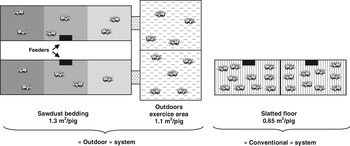
The experiment included 200 pigs (castrated males and females) from 50 litters and was conducted in five replicates, with 40 pigs in each replicate. In replicates 1 to 3, pigs were crossbred synthetic line × (Large White × Landrace). In replicates 4 and 5, half of the pigs were from the previous genotype and half were crossbred Duroc × (Large White × Landrace). At the average body weight (BW) of 36 kg, two castrated males and two females from each litter were chosen on the basis of their BW. They were allocated within litter and gender to two housing systems: a conventional housing system (CON) with fully slatted floor (0.65 m2/pig) and controlled ambient temperature (minimum 22°C) considered as the control system, and an alternative indoor–outdoor system (OUT) with an indoor sawdust bedding area (1.3 m2/pig) with fluctuating ambient temperature, and with free access to an outdoor area made of a concrete floor (1.1 m2/pig). The outdoor area was covered with a plastic roof in order to avoid slurry dilution with rainwater. Pigs were reared in two rooms (one per system) of the same building. In each room, two pens of 10 pigs (five castrated males and five females) were used in each replicate. A schematic description of the housing systems is given in Figure 1. Trials were undertaken in spring (replicates 1 and 4), summer (replicate 2) and winter (replicates 3 and 5) (Table 1).
Description of the experimental design.

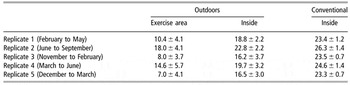
Average ambient temperature ± s.d. (°C) in the two rearing systems

Pigs had ad libitum access (one feeder by pen) to a growing diet (2.35 Mcal of net energy (NE/kg), 17.0% CP, 0.85% digestible lysine) until 70 kg of BW, and to a finishing diet thereafter (2.35 Mcal/kg of NE/kg, 15.0% CP, 0.72% digestible lysine). Animals had free access to water in the feeder. Pigs were weighed weekly. Feed and water consumptions (by pen) were recorded daily.
The experiment was conducted following French guidelines for animal care and use. All people involved in the experiment had an agreement for conducting experimental procedures on animals, delivered by the Veterinary Services of French Ministry of Agriculture.
Collection of manure
In the CON system, manure was stored as slurry below the slatted floor during the entire fattening period. At the end of the fattening period, the volume of slurry was determined and a representative sample was taken after mixing.
In the OUT system, a sawdust litter was installed in the inside area before the arrival of the pigs. The amount of sawdust (87.5% dry matter (DM)) differed between replicates 1 to 3 (SH, High Sawdust: 102 kg/pig, 36 cm depth) and replicates 4 to 5 (SL, Low Sawdust: 51.5 kg pig, 18 cm depth). No additional sawdust was added during the fattening period. At the end of the fattening period, the litter area was divided into three zones corresponding to the dunging, the feeding and the resting areas, respectively (Figure 1). The volume and weight of the litter in each zone were determined and representative samples were taken after mixing. The outdoor area was cleaned manually per week without using water and the collected slurry was weighted and sampled after mixing. The liquids drained from the outdoor area were collected in a tank. The volume stored was determined at the end of the fattening period and a representative sample was taken after mixing. In the OUT system, the amount of manure was calculated as the sum of litter collected indoor, and slurry and liquids collected outdoor.
Manure samples were divided in three sub-samples: two were oven-dried (102°C for 48 h) for DM determination and one was freeze-dried and stored at 4°C until analysis.
Measurements of ambient temperature, air flow, gaseous and odour emissions
Both rooms were mechanically ventilated. Air was extracted in the ambiance at about 2 m above the floor through four calibrated holes of 10 cm diameter. Air speed through the four holes was measured five times per week using an anemometer (air flow, 0.15 to 12.0 m/s). The rate of ventilation was fixed and adapted according to pig BW. In the CON system, supplemental heat was provided by electric heaters when necessary, to reach the minimal temperature of 22°C. No heating was provided in the OUT system.
Ammonia concentration in the outgoing air was measured continuously from each room. Air was pumped in the extraction column at a rate of about 0.5 l/min and passed though an impinger containing about 300 ml of a sulphuric acid solution (3.6 N H2SO4). The impingers (one per room) were changed weekly and the volume of the liquid and the ammonia concentration in the solution were determined. The mean ammonia concentration in the outgoing air was calculated by dividing total ammonia in the impinger with the cumulated air volume passed through the impinger. Ammonia emission from the room was then obtained by multiplying the NH3 concentration in the outgoing air with the ventilation rate. In replicate 3, concentrations of NH3, NO2, CH4, CO2 and H2O in the incoming and outgoing air were also measured after each new setting of the ventilation rate on days 15, 30, 54 and 72 of fattening, using a photo-acoustic infrared (IR) multi-gas analyser (Innova 1312, Air Tech Instruments, Ballerup, Denmark).
Odour concentration was measured in the outgoing air in replicates 1 and 2. Odour samples were collected and odour concentration measured by olfactometry according to the European standard (CEN Standard 13725, 2003). It was expressed in European odour units (OuE)/m3. Net odour emission per time, defined as the number of odour units emitted from the room per time unit, was obtained by multiplying the ventilation rate with odour concentration. It was expressed per pig and per day. Two measurements were performed in each replicates at about 30 and 60 days of fattening.
Dust concentration in the room ambiance was determined in replicates 1 and 2 according to the AFNOR (NF×43-261) standards, by gravimetric measurements of the amount of total dust in the air. The air was sampled during 1 h (28 l/min) and dust was collected on a 47-mm-diameter glass fibre dust filter (PALL-61631, New York, USA) located in the middle of the room at 1 m height. Results were expressed in milligram (mg) total dust per m3. Four measurements were performed in each replicate on the same day as for odour measurements.
Laboratory analysis
Feed, slurry and sawdust samples were analysed for DM, ash and N according to the Association of Official Analytical Chemist (AOAC, 1975) methods. Samples of diets and lyophilised manure were ashed at 550°C for 8 h in a muffle furnace. Diet and manure ashes were wet-ashed with 70% HNO3 and 30% H2O2 on a digestion block until dry and diluted in 0.4 mol/l HNO3. Analyses for determination of calcium, zinc and copper concentrations were performed by flame atomic absorption spectrophotometry (SpectrAA 220 FS, Varian, Springvale, Australia). Phosphorus was analysed by means of the Vanadate colorimetric method using a Cobas Mira apparatus (Hoffman-LaRoche, Nutley, NJ, USA).
Calculation and statistical analysis
The Statistical Analysis System (SAS) software (SAS Institute, Inc., Cary, NC, USA) was used in all statistical evaluations. Data of growth performance and carcass traits were submitted to an analysis of variance (ANOVA) (GLM procedure) considering the effects of rearing method (R), season (S), gender (G) and their interactions (first level) as fixed effects in the model. When no significant interactions were found (P > 0.05), the model was reduced to main effects only. The experimental units were pens for feed intake and feed conversion ratio (FCR), and animals for live weights and growth rate. Data of manure traits and ammonia emission were submitted to an ANOVA (GLM procedure) including the effects of rearing method (R) and season (S). The experimental units were rooms. An ANOVA was used with the pen as experimental unit to evaluate the effect of litter management on manure composition. Data obtained from the IR multi-gas analyser in replicate 3 were submitted to an ANOVA including the effects of day of sampling and location (incoming air, outgoing air CON and outgoing air OUT).
Results
Housing conditions
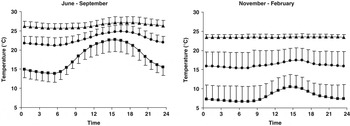
Ambient temperatures measured at different locations in the two housing systems are presented in Table 1. Temperature in the outdoor exercise area was highly dependent on season. The highest average temperature was measured in replicate 2 (18.0 ± 4.1°C), during summer, and the lowest in replicates 3 and 5 (7.5 ± 3.9), during winter. The effect of season was also significant in the indoor area of the OUT rearing system, although differences were less marked than outdoor (average temperatures in the indoor area of 22.8°C and 16.3°C in summer and winter, respectively). The effect of season on average ambient temperature was still significant in the CON room but with much less differences than in the OUT system. Diurnal variations in ambient temperature were also highly affected by season and location as illustrated in Figure 2 for replicates 2 (summer) and 3 (winter).
Diurnal variations of ambient temperature in the outdoor exercise area (▪), and indoors, above the sawdust bedding (●), or the slatted floor (▴), during summer (replicate 2) and winter (replicate 3).

Average ventilation rate tended to be slightly higher in the CON than in the OUT room (57.0 v. 53.6 m3/h per pig, P < 0.06). It increased between the beginning and the end of the fattening period, from 41 m3/h per pig (week 1) to 62 m3/h per pig (week 14). Ventilation rate was higher (P < 0.05) in replicate 2, during summer (61.7 m3/h per pig), than in the others replicates (53.7 m3/h per pig, on average).
Growth performance
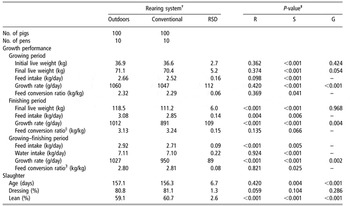
The rearing system significantly influenced the growth performance of the pigs. Compared with the CON pigs, the OUT pigs exhibited a greater (P < 0.001) average daily feed intake during the growing–finishing period, mainly due to differences during the finishing period (Table 2). Daily water intake by pigs did not differ between rearing systems. This resulted in a higher water : feed ratio (P < 0.05) in the CON system (2.63 l/kg) than in the OUT system (2.45 l/kg). The OUT pigs grew faster (P < 0.001) than CON pigs during both growing and finishing periods. Season influenced (P < 0.001) the average growth rate of pigs, which was the greatest in winter, the lowest in summer and intermediate but not different from the other seasons, in spring. The rearing system did not affect the FCR either in the growing or in the finishing periods. However, an interaction between rearing conditions and season was found (P < 0.05). FCR tended to be higher for OUT pigs during winter whereas the opposite was found during the other seasons.
Growth performance of pigs reared with outdoors access or in the conventional system

†Least squares means. Experimental units = pen for feed intake and feed conversion ratio, animals for live weights and growth rate.
‡P-values for rearing conditions (R), season (S) and gender (G); RSD = residual standard deviation.
§Interaction between rearing conditions and season was found (P < 0.05).
The faster growth rate of the OUT compared with the CON pigs led to a heavier (+7.3 kg, P < 0.001) BW at slaughter at the same age for OUT pigs. Carcass dressing tended to be higher (P < 0.06) in pigs from the CON system. The OUT pigs exhibited heavier hot carcass weight (P < 0.001) in connection with their heavier live weight at slaughter. They showed a higher mean backfat depth (20.9 mm v. 19.9 mm, P < 0.001) whereas muscle depth was not significantly modified. This gave rise to a lower lean meat content of the OUT compared with CON carcasses (−1.6 percentage points, P < 0.001). The difference in lean content remained significant (−1.1 percentage points, P < 0.002) when data were adjusted by covariance analysis for the same pig BW at slaughter.
Amount and composition of manure
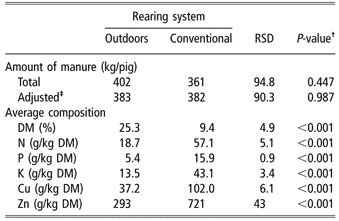
Total amount and average composition of manure collected in the two rearing systems are presented in Table 3. The amount of manure produced per pig was numerically higher in the OUT system, but when adjusted for the same BW gain of pigs (78 kg, 36.7 to 114.7 kg BW), the values were more similar in both treatments (383 kg/pig). The average composition of manure was highly affected by the rearing system. DM content was higher (P < 0.001) and DM concentrations in N, P, K, Cu and Zn were lower (P < 0.001) in manure from the OUT than from the CON system.
Effect of rearing system on total amount and average composition of manure

RSD = residual standard deviation; DM = dry matter.
†P-values for manure management system.
‡Adjusted for the same BW gain (78 kg) per pig.
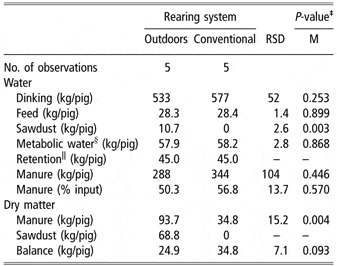
The amount of DM, adjusted for the same BW gain, was higher (P < 0.01) in manure from the OUT system (Table 4). This was mainly due to the contribution of DM from sawdust. In fact, when the contribution of sawdust was removed to evaluate DM accumulated in manure, the amount of DM tended to be higher in the CON system. Data on water balance were not significantly affected by the rearing system (Table 4). However, the amount of water accumulated in manure per pig was numerically lower and water evaporation was higher in the OUT than in the CON system. On average, water in effluent represented 56.8 (±3.5)% and 50.3 (±18.2)% of water input in the CON system and the OUT system, respectively.
Effect of rearing system on balance of water and DMFootnote †

RSD = residual standard deviation; M = manure management system.
† All data are adjusted for the same BW gain (78 kg/pig).
‡ P-values for manure management system.
§ Calculated from heat production (Noblet et al., Reference Noblet, Sève and Jondreville2004) assuming that one molecule of H2O is produced per molecule of CO2 produced (Oliveira et al., Reference Oliveira, Souloumiac, Robin and Kermarrec1999).
‖ Calculated from de Greef (Reference de Greef1995).
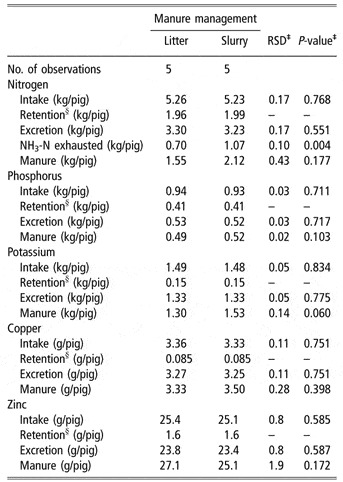
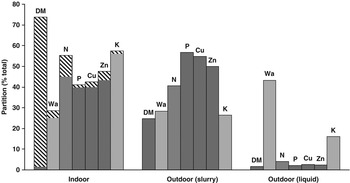
Intake, retention and excretion by pigs, and manure contents in N, P, K, Cu and Zn are presented in Table 5. When adjusted for the same BW gain, intake, retention and excretion of these nutrients and their contents in manure were not affected by the rearing system (Table 5). The partition of water, DM and nutrients among indoor and outdoor manure in the OUT system is shown in Figure 3. More than 70% of manure DM was collected indoor, corresponding mostly to the contribution of sawdust. Most of manure water (70%) was collected outdoor, and especially in the liquid phase drained from the exercise area (45%). About half of the N was collected in the sawdust litter, most of the remaining being found in the slurry collected from the exercise area. More than 50% of P, Cu and Zn were collected outdoor, mainly in the slurry from the exercise area. The liquid phase drained from the exercise area had a very limited contribution to most nutrients, except K for which it contributed to about 16% of the total amount.
Effect of manure management on balance of N, P, K, Cu and ZnFootnote †

RSD = residual standard deviation.
† All data are adjusted for the same BW gain (78 kg/pig).
‡ P-values for manure management system.
§ Calculated according to Corpen (2003).
Partition of dry matter (DM), water (Wa), N, P, Cu Zn and K among indoor and outdoor manure in the OUT system. The contribution of the sawdust is cross-hatched for the indoor manure.

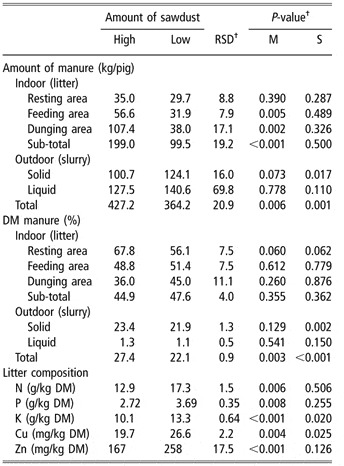
The effect of litter management on the amount and composition of manure in the OUT system is presented in Table 6. Total weight of manure collected indoor was much heavier when more sawdust was used (SH strategy) for preparing the litter (199 v. 99 kg manure per pig, P < 0.001), this effect being more marked in the dunging area. Conversely, the amount of manure collected outdoor tended to be lower with SH strategy. As a result, total manure weight and DM content were higher (P < 0.01) with the SH than with the SL strategy.
Effect of litter management on the amount and composition of manure in the outdoors system

RSD = residual standard deviation; DM = dry matter.
†P-values for manure management system (M) and season (S).
It is possible from our data to estimate the partition of excretion between indoor and outdoor areas. For this, we made the assumption that 95% of K was excreted in urine and 95% of Cu, Zn and P were excreted in faeces, and we adjusted the partition of urine and faeces excretion between indoor and outdoor in order the minimise the difference between predicted and measured values of partition of K, Cu, Zn and P between indoor and outdoor areas. This was obtained for a proportion of indoor urine and faeces excretion of 60% and 40%, respectively.
Gases and odour concentrations
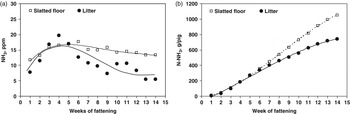
The rearing system affected weekly average ammonia concentration in the outgoing air (14.3 and 10.0 p.p.m. NH3 for CON and OUT, respectively; P < 0.01) and cumulated N-NH3 exhausted from the building (1.07 and 0.7 kg for CON and OUT, respectively; P < 0.05) (Figure 4 and Table 5), this effect being more marked in the finishing than in the growing period (Figure 4).
NH3 concentrations in the outgoing air (a) and cumulated N-NH3 emission (b) from the CONV (slatted floor, □) and OUT (sawdust litter, ●) rooms.

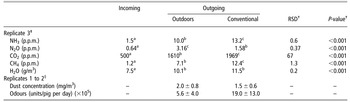
The results obtained on gas concentrations, using the IR multi-gas analyser in the incoming and outgoing air in replicate 3, are presented in Table 7. For all gases, concentrations were higher in the outgoing than in the incoming air. Ammonia was more concentrated in the air extracted from the CON room, in good agreement with the measurements obtained using the ‘impinger’ technique (Figure 4). Nitrous oxide was more concentrated in the air from the OUT room, whereas CH4 and CO2 were more concentrated in the air from the CON room. Dust concentration was similar for both systems, whereas odours’ emission in the exhausted air was higher in the CON than in the OUT system (Table 7).
Gas and dust concentrations in incoming and outgoing air and production of odours in rooms of outdoors and conventional systems

RSD = residual standard deviation.
†P-values for manure management system.
‡Average of four series of measurements on d-15, 30, 54 and 72 of fattening.
§Average of two measurements (growing and finishing periods) for each replicate.
aMeans with different subscripts differ significantly (P < 0.05).
Discussion
Growth performance
Pigs reared in the alternative husbandry system exhibited better performance, in particular a higher average daily feed intake, especially during the finishing period, giving rise to higher growth rates during the finishing (+14%) and growing–finishing (+8%) periods, compared with pigs reared in the conventional system. The lower ambient temperature in the OUT system may explain the higher feed intake of these animals and, consequently, their faster growth rate, in accordance with the well-established effects of ambient temperature on the growth performance of ad libitum fed pigs (Le Dividich et al., Reference Le Dividich, Noblet, Herpin, Van Milgen and Quiniou1998). Another explanation is the larger floor space in the OUT system compared with the CON system that provides an easier access to the feeder, in particular at the end of the fattening period, thus giving rise to higher growth rates (Hamilton et al., Reference Hamilton, Ellis, Wolter, Schinckel and Wilson2003; DeDecker et al., Reference DeDecker, Ellis, Wolter, Corrigan, Curtis, Parr and Webel2005). Higher feed intake and growth rate of pigs finished in enriched (straw, 3.5 m2/pig) compared with barren (slatted floor, 0.76 m2/pig) environments have been reported by Beattie et al. (Reference Beattie, O’Connell and Moss2000), in agreement with the present results. Compared with the conventional, the alternative husbandry system evaluated here led to fatter carcasses, independent of the increase in carcass weight. In agreement with this result, increased backfat thickness and/or decreased carcass lean meat content of pigs reared in enriched (extra space, straw, Beattie et al., Reference Beattie, O’Connell and Moss2000; Gentry et al., Reference Gentry, McGlone, Blanton and Miller2002) or with free access to an outdoor courtyard (Van der Wal et al., Reference Van der Wal, Matelman, De Vries, Vonder, Smulders, Geesink and Engel1993) compared with conventional environments have been reported, whereas Lebret et al. (Reference Lebret, Massabie, Granier, Juin, Mourot and Chevillon2002) did not show any significant effect of the housing system on carcass muscle percentage.
Amount and composition of manure
When data are adjusted for the same BW gain of 78 kg, total amount of manure produced (383 kg on average) did not differ between the two rearing systems. The value measured for the slatted floor system is slightly higher than the average value of (345 ± 45 kg) reviewed by Dourmad et al. (Reference Dourmad, Pomar and Massé2002) from 55 measurements in 17 publications, but most of these studies were conducted with mash feeding and restricted water supply. The amount of manure produced by pigs reared on straw or sawdust bedding has been reviewed by Corpen (Comité d’orientation pour des pratiques agricoles respectueuses de l’environnement) (2003). In that study, the amount of manure produced per pig was highly variable and higher with straw (202 ± 52 kg, n = 14) than with sawdust bedding (141 ± 44 kg, n = 21). In our study, we collected on average 199 and 99 kg solid manure per pig for an initial amount of sawdust of 102 (SH) and 51 (SL) kg/pig, respectively. The average amount of sawdust used in the SL strategy is close to the value estimated by Corpen (2003), i.e. 46 ± 12 kg. The difference in the final amount and DM content of litter between our study and Corpen (2003) may be explained by the fact that in our study, an important fraction of faeces and urine was excreted on the outdoor area.
Emission of N compounds
Ammonia concentration in the outgoing air was measured continuously using the ‘impinger’ technique. In replicate 3, it was also measured together with N2O and CH4 after each new setting of the ventilation rate, using a photo-acoustic IR multi-gas analyser. For NH3, the values measured by the two techniques were similar. This good agreement can be related to the fact that in our study the ventilation rate was maintained constant over many days whereas most often ventilation is regulated according to ambient temperature, resulting in drastic changes of concentration in the air over the day or between days, which was not the case here. Nevertheless, because these measurements using the multi-gas analyser were performed in one replicate only, the results must be taken with caution especially for N2O and CH4.
The accumulation of N in manure represented 66% and 47% of N excretion for the CON system and the OUT system, respectively, indicating that about 34% and 52% of N was emitted in the atmosphere. From a literature review, Dourmad et al. (Reference Dourmad, Pomar and Massé2002) estimated an average N loss of 25% for pigs raised on slatted floor. However, many factors are known to affect gaseous emissions. In particular, ammonia emission increases with ventilation rate, ambient temperature and ammonia concentration in manure (Granier et al., Reference Granier, Guingand and Massabie1996; Aarnink, 1997; Portejoie et al., Reference Portejoie, Dourmad, Martinez and Lebreton2004). In the present study, ventilation rate did not fluctuate according to ambient temperature, in order to be able to measure precisely the air flow. This resulted in a higher average ventilation rate (57 m3/pig) than usually found in practice, which could have contributed to higher N loss. Average ambient temperature (24.2°C) was also quite high although within the range of temperature generally found in practice. DM and N content of the slurry were high in connection with a low water : feed ratio, due to the type of feeder and the high ambient temperature favouring water evaporation. Ammonia emission from the CON room can be calculated from the air flow and the difference in NH3 concentration between incoming and outgoing air, assuming that NH3 concentration in the incoming air was the same in all replicates as measured in replicate 3. Thus, the measured NH3 emission corresponded to 90% of total N emission and amounted to 12.0 g N-NH3/pig per day. It is generally assumed that in liquid systems, most of the N is emitted as NH3. For instance, the emission factor proposed by the Intergovernmental Panel on Climate Change (IPCC, 2006) for N2O is only 0.2% of N excretion. A higher N-NO2 emission was measured in our study, corresponding to about 3.9% of N excretion, 10% of total N emission and 1.6 g N-N2O/pig per day. Only few results are available in the literature about N2O emission from liquid slurry in the livestock building. In fattening pigs raised on fully slatted floor, Fitamant et al. (Reference Fitamant, Quillien, Callarec, Morvan, Lemasle and Laplanche1999) and Kermarrec and Robin (Reference Kermarrec and Robin2002) measured N-N2O emissions corresponding to about 4.0% and up to 2.6% of N excretion, respectively. In the study of Osada et al. (Reference Osada, Rom and Dahl1998) on fattening pigs, N2O emission represented about 4% of total N emitted as N2O or NH3, which means about 1% of N excretion. In the same way, in the study from Amon et al. (Reference Amon, Amon, Boxberger and Alt2001) in dairy cows, the share of N2O in total nitrogen emissions was between 5% and 10%. The results from the present study and from the literature suggest a great variability in N2O emissions from slatted floor systems. This can be related to differences in technology of slurry collection and management, time of sampling or analytical procedures as suggested by Osada et al. (Reference Osada, Rom and Dahl1998). Nevertheless, although obtained from a limited number of measurements, the results from the present study, in agreement with most of the published values, would indicate that N2O emissions exceed the 0.2% value proposed by IPCC (2006) for liquid slurry.
The nitrogen loss in litter systems has been reviewed by Corpen (2003) and Hassouna et al. (Reference Hassouna, Robin, Texier and Ramonet2005). In the Corpen (2003) study, N emissions, calculated as manure N minus N excretion, amounted to 72 ± 7% and 57 ± 13% of N excretion with sawdust (n = 24) and straw litters (n = 15), respectively. In the present study, 52% of excreted N was lost in the OUT rearing system, which is intermediate between the values found in the literature for sawdust bedding and slatted or concrete floor. This is consistent with the floor design of the OUT rearing system, with 54% of the area as litter bedding indoor and 46% as concrete floor outdoor. Ammonia and N2O emissions from the rearing room were 8.1 g N-NH3/pig per day and 4.6 g N-N2O/pig per day, respectively. Robin et al. (Reference Robin, Hassouna and Texier2004) and Hassouna et al. (Reference Hassouna, Robin, Texier and Ramonet2005) reported great variations in ammonia emissions from litter systems depending on type of litter, litter management, season and animal density with values varying between 2.0 and more than 20 g N-NH3/pig per day. In the same way, N2O emission varied widely among studies between less than 1.0 and more than 10 g N-N2O/pig per day. With a sawdust bedding, Groenestein and Van Faassen (Reference Groenestein and Van Faassen1996) measured N emissions, as NH3 and N2O, of 2.9 to 4.8 and, 4.8 to 7.2 g/pig per day, respectively. A higher NH3 emission (12.5 g/pig per day) and a lower N2O emission (0.80 g/pig per day) were measured by Philippe et al. (Reference Philippe, Laitat, Canart, Farnir, Massart, Vandenheede and Nicks2006) for straw bedding. Ammonia emission from the outdoor exercise area was not measured in the present experiment. For an outdoor concrete pig loading yard, Misselbrook et al. (Reference Misselbrook, Webb, Chadwick, Ellis and Pain2001) measured 3.4 g N-NH3/m2 per day and 0.14 mg N-N2O/m2 per day, respectively, suggesting that N2O emission could be neglected. From our results, if we assume that all outdoor N losses occur as NH3, the emission rate is 6.6 g N-NH3/m2 per day, which represents about 40% of N excreted outdoor. This value is higher than the value measured by Misselbrook et al. (Reference Misselbrook, Webb, Chadwick, Ellis and Pain2001), but that study was conducted on a pig loading area, probably with fasted pigs excreting less than fed pigs. As a whole, total (inside + outside) NH3 emission from the OUT system (14.1 g N-NH3/pig per day) tended to be higher than from the CON system (12.0 g N-NH3/pig per day).
Emission of methane
The estimation of methane emission from the results obtained in replicate 3 indicated that the emission was higher from the room with slurry (CON) than from the room with sawdust litter (OUT) (960 v. 470 g/pig, respectively). From Noblet et al. (Reference Noblet, Sève and Jondreville2004) and the composition of diets, it can be calculated that CH4 production from enteric fermentation is about 200 and 215 g/pig for CON and OUT pigs, respectively. This indicates that CH4 emission from manure is much higher with liquid than with solid manure, in agreement with the anaerobic conditions required for CH4 production. Nicks et al. (Reference Nicks, Laitat, Farnir, Vandenheede, Désiron, Verhaeghe and Canart2004) measured a methane emission of 7.4 and 5.0 g/day per pig reared on deep litters based on straw and sawdust, respectively, which is well comparable with the 5.9 g/day per pig measured in the present study with sawdust bedding. In fattening pigs raised on slatted floor over an 8-week fattening period, Osada et al. (Reference Osada, Rom and Dahl1998) measured a CH4 emission of 5.4 g/m3 per day, which was reduced to 4.8 g/m3 per day with a weekly discharge of slurry. This is lower than the value measured in our study (12.3 g/m3 per day and 9.7 g when production from enteric fermentation was removed) but storage time and consequently volume of stored slurry in our experiment were much longer than in the study of Osada et al. (Reference Osada, Rom and Dahl1998). Most of the studies about CH4 emission from pig slurry concerned the outdoor storage. Vedrenne (2007) reviewed the literature data available on methane emission from pig slurry during storage. The emissions measured from on-farm and laboratory studies were consistent with an average emission of 33 g/m3 per day, but with a high variability from 0.4 to 58 g/m3 per day for on-farm results, and from 3 to 77 g/m3 per day for laboratory studies. Methane production depends on storage time temperature and methane conversion factor (MCF) (IPCC, 2006). The MCF recommended by IPCC (2006) in temperate climate for pit storage below animal confinement is only 3%, for a storage duration shorter than 1 month, and 30% to 60% for durations longer than 1 month, in agreement with the results of Møller et al. (Reference Møller, Sommer and Ahring2004). If we consider a maximum methane-producing capacity (B0) of pig slurry of 450 l CH4/kg volatile solid (IPCC, 2006), we can calculate an MCF value of 9.7% in our study, which is intermediate between the values proposed by IPCC (2006) for short and long storage.
Odours and dust concentration
The odour emission measured in the slatted floor system (19.0 × 10⁵ OuE/pig per day) is in agreement with the values found by Guingand (Reference Guingand2003 and Reference Guingand2007) with a similar floor and the same methodology (12 to 30 × 105 OuE/pig per day). Odour emission is reduced by about 70% in the OUT system. However, that reduction may be overestimated because the outdoor odour production from the exercise area was not considered. This is in agreement with the results obtained by Begnaud et al. (Reference Begnaud, Pérès and Berdagué2003 and Reference Begnaud, Pérès, Murat, Lebost and Berdagué2004) who measured, with a different methodology, a strong difference in odour nuisance between piggeries on slatted floor compared with straw bedding. The dust concentration measured in the air from the CON system (1.5 mg/m3) is in agreement with the value measured by Robertson et al. (Reference Robertson, Wilson and Smith1990) and Guingand (Reference Guingand2007). Dust concentration was similar in both systems, whereas Gustafsson (Reference Gustafsson1999) measured a lower dust concentration in piggeries with straw bedding. He suggested that this lower concentration was due to a higher ventilation rate and humidity, which was not the case in our study.
Conclusion
Compared with the conventional system, the alternative system, which was mainly designed to improve animal welfare, reduced odour production and resulted in improved animal performance. Total amount of manure produced was not different between systems. Different types of manure with specific compositions were produced in the alternative system as the consequence of the excretion behaviour of the pigs, the presence or absence of sawdust and air emissions. Total ammonia emission tended to be higher with the alternative system although emission from the room was significantly lower. Although obtained from a limited number of observations, the results indicated that methane emission decreased and nitrous oxide emission increased, for the alternative system, resulting in about 90% more greenhouse gas emissions (eq-CO2).
Acknowledgements
The authors gratefully acknowledge P. Touanel, C. Cornée, H. Demay, B. Carissant and B. Fontaine for taking care of the animals and for manure sampling, G. Guillemois for diets preparation, P. Bodinier, A. Pasquier and S. Hillion for the laboratory analyses and D. Loiseau for measurements of odours and dust concentrations. This study was supported by the ‘Green Piggery’ (INRA – France and WUR – The Netherlands) and the ‘Porcherie Verte’ (French research initiative) programmes.