Frequent financial crises in emerging markets during the past two decades have driven economists and investors to understand their nature, causes, and consequences. These episodes are often characterized by volatile capital flows, unsustainable or noncredible commitments to fixed exchange rates, currency mismatches, liquidity mismatches, and weak regulation and supervision of banking systems. Some studies have emphasized the role of contagion, the process through which a shock in one country can lead to a price movement in another country in excess of the underlying fundamentals.Footnote 1 For example, some research has pointed to the role of asymmetric information, informed and uniformed investors, and political variables in the transmission of the Asian financial crisis.Footnote 2 Others have stressed the importance of common creditors in propagating crises. To reduce overall portfolio risk, financial institutions in the common-creditor country (one with large holdings of emerging market debt) reduce or sell off their assets in the entire region, especially in countries that have characteristics similar to the crisis country.Footnote 3 The significant real-side effects of recent financial crises have in turn prompted some policymakers to call for a reform of the international financial architecture.Footnote 4
To provide some historical insight into the global and regional effects of financial crisis, this article turns back the clock and examines the most famous sovereign debt default of the nineteenth century—the Baring Crisis of 1890.Footnote 5 The crisis originated in Argentina, and was then transmitted back to London via the House of Baring (an investment bank in London that held large amounts of Argentine debt which could not be placed in the London market).Footnote 6 Most previous studies have examined the effect of the crisis on Argentina or the Bank of England's rescue operation of the House of Baring. We break new ground by thoroughly examining the global effects of the Baring Crisis on a sample of 41 emerging market borrowers. Using a new database of over 15,000 weekly sovereign debt prices collected from the Economist, the empirical analysis of sovereign yield spreads suggests that the Baring Crisis was primarily a regional crisis. The country risk premium for Latin American countries increased by more than 840 basis points between 1890 and 1891, and more than 1,600 basis points between 1890 and 1895. In contrast, yield spreads for non-Latin emerging markets and “core” countries (high income European countries and the United States) were generally flat or unchanged during this period.
We next construct a panel data set consisting of annual data for 35 sovereign borrowers, which includes macroeconomic indicators, trade variables, political and institutional factors, and other country-specific controls. The results from the fixed-effect regressions suggest that bond yields in Latin-American countries were more than 200 basis points higher as a direct result of the Baring Crisis—even after we control for macroeconomic fundamentals (such as its debt burden, budget deficit, and trade balance) and other country-specific effects (including gold-standard membership and whether a country was involved in a conflict). This finding is consistent with the literature on modern crises and contagion that emphasizes their regional nature.Footnote 7 We also find some evidence that the crisis may have spread through trade. Finally, we discuss why European investors may have sold off or reduced their holdings of Latin American securities in the wake of the Baring Crisis.
THE BARING CRISIS OF 1890
To understand the events leading up to the Baring Crisis, we begin our account in the early 1880s—after Argentina and Latin America had finally shaken off the long-lasting effects of the world debt crisis of 1873. With the election of Julio Roca as president, Argentina witnessed a resurgence of foreign trade and capital flows from Europe. The funds were used to construct railroads and public works and modernize Buenos Aires.Footnote 8 Roca's first major loan was a railway issue that completed two major trunk lines. The construction of a transportation network throughout the country further consolidated the central government's power and stimulated economic activity by opening up the market for commercial agriculture. Roca also transformed Buenos Aires into the “Paris of South America” by constructing broad avenues, spacious parks, a well-functioning water supply and drainage system, and a modern port. Between 1880 and 1886 the national authorities and the government of the province of Buenos Aires carried out a series of unprecedented state-run development projects in Latin America.Footnote 9
As a result of the open capital markets that prevailed in the nineteenth century, Argentina was able to borrow extensively abroad. It was the fifth largest sovereign borrower in the world. It absorbed roughly 11 percent of all new issues in the new London market between 1884 and 1890 and 40 to 50 percent of all lending that occurred outside the United Kingdom in 1889. (In contrast, North America had a population 20 times Argentina's and floated only 30 percent of the new issues in London.)Footnote 10 Alan Taylor suggests that “the 1880s stand out as a period of totally unprecedented capital inflows into an emerging market at any time in history.” The current account deficit, as a percent of GDP, averaged 20 percent from 1884 to 1889.Footnote 11
Although the economic policies of the 1880s stimulated short-run economic activity in Argentina, they posed potentially serious long-run financing challenges. The financing of railroads and land improvement projects was aimed at promoting internal development, exports, and economic growth. But the slow maturation of the development projects could impede the country's ability to service its debts creating a maturity mismatch problem. The expanding national debt could only be serviced if the country had sufficient tax revenues for debt service. Unfortunately, it would take years before the government would realize significant revenues from commercial activity stimulated by the infrastructure investments.Footnote 12 In addition, Argentina issued bonds in sterling or gold on European capital markets while the country operated on a paper standard (following several failed attempts in the early-to-mid 1880s to adopt a gold or bimetallic standard). The currency mismatch problem meant that a depreciation of the paper peso could impair the country's ability to service its gold debts.Footnote 13
When President Roca's brother-in-law, Miguel Celman, succeeded him as president of Argentina in 1886 in a fraudulent election, the newly elected leader sold the Central Norte and Andino railways (two of the country's most important railways) to British capitalists with the intention of reducing the country's rising debt level. Even though the government stopped borrowing funds to finance new railway projects, it did not restore fiscal discipline; instead, it began issuing additional debt through state banks. From 1886 to 1890 Argentina passed a series of “banking reforms” that fueled the expansion of credit and paper money issues.Footnote 14 National and Provincial Banking authorities ratified a Free Banking Law in 1887 that authorized any banking association to issue notes provided it purchased gold bonds to the full amount of the notes issued. As noted by Gerardo della Paolera and Taylor, there were several problems with the law even though it was modeled along the lines of what was used in the United States under the National Banking Acts.Footnote 15 The bank notes were not redeemable in gold, and because the gold bonds were new issues, they constituted a new liability on the government's balance sheet. The banks that participated in the note issuance scheme floated loans in Europe to finance the purchase of the domestic gold bonds that backed note issuance. This scheme worked as long as foreign investors agreed to purchase the Argentine bonds and as long as additional note issuances were backed 100 percent by specie. Foreign investors, however, essentially were backing a credit boom in Argentina, financed by the issuance of new paper currency.Footnote 16 By 1890 Argentine provincial banks had issued more than 30 million pounds of debt on foreign capital markets.
Beginning in the mid-1880s, loose monetary and fiscal policies substantially worsened macroeconomic conditions in Argentina. The monetary base grew at an annual average rate of 18 percent (driven by the issuance of paper currency emissions), inflation averaged 17 percent, and the paper peso depreciated at an average rate of 19 percent between 1884 and 1890.Footnote 17 Argentina was also running a substantial budget deficit. The Argentine economy worsened towards the end of the decade, with as much as 40 percent of foreign borrowing going towards debt service and 60 percent of imports going towards the purchase of consumption goods. Railway net profits were declining and gold pesos were trading at a large premium (94 percent) relative to paper pesos.Footnote 18 The former finance minister Jose Terry suggested that, “until the end of 1887, it was possible to save the patient: in 1888, it already was no longer possible.”Footnote 19
By the end of the decade, it was becoming clear to the financial community that paper pesos were inadequate to cover the normal service on the internal and external debt. In 1889 the government broke its promise and paid off some of its gold-denominated liabilities with paper currency. In response, primary issues on the London market were met with a tepid response, and investors dumped paper pesos in anticipation of a further decline in its value. The government used the gold that backed the note issues to defend the exchange rate, but by December 1889, the stock of gold at the Banco Nacional had dwindled such that it could no longer carry out this intervention in the currency market. Strikes, demonstrations, and a failed coup by military leaders erupted in 1889–1890 as the real wage of Argentine workers declined with the rising price level. Domestic political strife further reduced the willingness of foreign investors to hold Argentine securities. The questionable fiscal and monetary policies drained the banking system of specie, provoked multiple banks to experience runs beginning in 1890, and thus ushered in a financial crisis. A series of last-minute tax and fiscal reforms in the summer of 1890 slowed down the economic decline, but did not prevent the ensuing financial crisis.
Even though the Baring Crisis had its origins in Argentina, its effects were quickly felt in other parts of the world, including London.Footnote 20 Baring Brothers, the firm that underwrote most of Argentina's foreign debt issues, could not escape the country's problems. The investment bank was saddled with the Buenos Aires Water Supply and Drainage Loan, a new debt issue that if could not sell on the London market.Footnote 21 On the verge of bankruptcy and unable to meet its debt obligations, the House of Baring notified the Bank of England of its financial problems in early November 1890. The central bank pooled resources from the Bank of France, Russia's central bank, and British financial institutions to form a rescue fund to save Baring, whose troubles threatened to bring down British financial markets. The rescue operation succeeded and prevented a general financial collapse on European markets, although actions by the Bank of England did little to help debt-ridden Argentina.
Argentina defaulted on nearly ₤48 million of debt in 1890, which ended up constituting nearly 60 percent of the world's defaulted debt in the 1890s. After the Argentine government and the House of Baring failed to come to an agreement, Nathan Rothschild formed a committee of leading financiers to restructure the country's debt obligations. The committee demanded that the Banco Nacional transfer funds to service the country's short-term debt obligations.Footnote 22 In exchange, the committee agreed to underwrite a bond issue that could meet Argentina's remaining debt service for a period of three years. Argentina subsequently experienced a severe banking crisis (in January 1891) brought on, in part, because Banco Nacional's financial position was weakened when it transferred assets to British creditors. As the financial crisis worsened, the Bank of London and River Plate was the only bank that did not close its doors. Meanwhile, Argentina suffered a deep recession, with its real GDP falling by 11 percent between 1890 and 1891. The country did not fully recover from the crisis until the turn of the century, after more than a decade of monetary and fiscal reforms.
There is some evidence that the Argentine crisis may have spilled over to other countries in the region. Gail Triner and Kirsten Wandschneider suggest that the Baring Crisis had significant effects on Brazil.Footnote 23 Michael Bordo and Antu Murshid examine cross-country correlations in weekly sovereign bond prices for seven countries in the year 1890 and find some evidence of regional contagion.Footnote 24 Most studies, however, are not very clear as to whether the decline in sovereign debt prices was global in nature or confined to Latin America. For example, Albert Fishlow noted that, “Not only did Argentine issues immediately move to substantial discounts on the London market, so also did those of other peripheral countries. Many were forced to reduce their debt service in the years that followed.”Footnote 25 He also suggests that other emerging market borrowers may have experienced a slower recovery from the crisis in comparison to Argentina. Christian Suter suggests that the Argentine default may have been part of a broader episode of defaults in the 1890s.Footnote 26 Charles Kindelberger argues that the crisis spread to other Latin American debtors and emerging market borrowers in the European periphery, and Ian McLean suggests that the crisis was international and spread from Argentina to Australia.Footnote 27 Given that previous research has not systematically analyzed the effects of the Baring Crisis on other emerging-market economies, this article focuses on determining whether the Baring Crisis was a regional or global emerging-market crisis.
MOVEMENTS IN EMERGING MARKET YIELD SPREADS
Time Series Evidence
To gain some insight into the Baring Crisis, we collected weekly prices on long-term government bonds from the Economist with maturities greater than ten years.Footnote 28 The database contains over 15,000 weekly observations of bond price data from the London Stock Exchange for 41 countries and British colonies, for the period 1887–1895.Footnote 29 Unlike Niall Ferguson and Moritz Schularick's database of annual sovereign yield spreads, our sample of emerging market borrowers employs the same long-term bonds for the entire sample period.Footnote 30 In contrast, the Ferguson and Schularick sample of interest rates splices two different bond series for many countries in 1889 and 1890, making it difficult to analyze the effects of the Baring crisis on sovereign risk.Footnote 31
To measure the economic effects of the Baring Crisis, our analysis focuses on the sovereign debt market. It does so for several reasons. First, looking at the impact of the crisis on GDP is impossible. Annual GDP estimates and other macroeconomic data (such as investment spending) are only available for high-income countries and a handful of emerging markets for the gold standard period, including Latin America. Moreover, many scholars have questioned the quality of nineteenth-century GDP estimates, especially for the emerging market sample, because the figures are often constructed by back-casting and interpolation between decadal benchmarks.Footnote 32 In contrast, the sovereign debt market was very liquid during the gold standard period and data are available at the weekly frequency for most emerging market countries. Such high-frequency data can be used to identify the effects of important events and policies on sovereign debt markets and to measure the overall impact of the crisis on country risk during this turbulent period. Given its wide coverage, high frequency, and high quality, data from the sovereign debt market likely provides us with the best way to gain insight into the regional and global effects of the Baring Crisis.
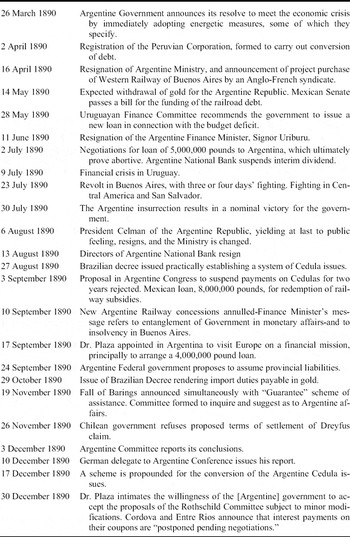
We constructed a yield spread—or a country risk premium—for each country or colony, which is defined as the current yield on a sterling bond for country or colony i minus the yield on the “risk-free” British consol at time t.Footnote 33 To quantify the regional effects of the crisis, Figures 1–5 show yield spreads for the 12 Latin American countries in our sample. Each figure contains a vertical line, denoting the outbreak of the crisis in Argentina. We dated the onset of the crisis to the summer of 1890 based on our reading of the secondary literature and the Investor's Monthly Manual (IMM)—a widely read British financial publication that provides a weekly summary of important events affecting the London money market. Although one might choose a slightly different date to mark the genesis of the crisis, as shown in Table 1, the IMM reported a cluster of economic and political events that occurred in July and early August 1890—evidence that British investors were becoming particularly concerned with the situation in Argentina at this time. The Banco Nacional, a major Argentine national bank, informed Baring Brothers in July that it would suspend service on its foreign debt obligations, a sign that a deeper banking and debt crisis was emerging. Finance Minister Francisco Uriburu needed to pass a broad-based fiscal reform package so that the note issues used to prop up the banking system were not seen as the sole means for dealing with the economic crisis. His reform package failed, and he resigned in early July. The government tried to lend to note-issuing banks to prevent a liquidity crisis, but without the reform package, bank runs began. A few weeks later, a group of military officers unsuccessfully tried to overthrow the Argentine government. President Miguel Juarez Celman then resigned on 6 August 1890, in response to public discontent over his decision to pursue policies of open inflation and acceptance of external default rather than liquidation of the “official” banks.Footnote 34
CENTRAL AND SOUTH AMERICAN EVENTS REPORTED IN THE INVESTOR'S MONTHLY MANUAL

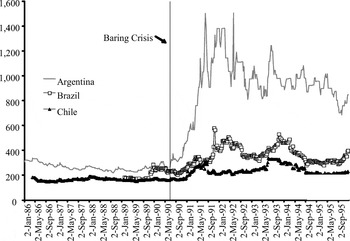
The events highlighted by the financial press seem to have signaled to the London bond market that Argentina had entered into a serious financial crisis in July and August 1890, and that foreign investors were reassessing Argentina's credit risk. Figure 1 shows the country risk premium for Argentina. Yield spreads for Argentine sterling bonds declined from 1887 until 1889 before dramatically increasing from the summer of 1890 until early 1892. They reached 1,400 basis points in 1892 and were still at 800 basis points in 1896.
Yield Spreads for Argentina, Brazil, and Chile, 1886–1896

It also appears that the financial press was reconsidering credit risk in other Latin American emerging market borrowers. Figure 1 also shows the country risk premia for Brazil and Chile. The country risk premium for Brazil rose from 200 basis points in the late summer of 1890 until it reached its peak at more than 550 basis points in late 1892, which in part might partially reflect news about domestic political instability in the country. The Brazilian yield spread then declined in 1892, briefly rose in 1894, and then fell for the remainder of the sample period. As for Chile, its risk premium was quite stable until the outbreak of the Baring Crisis. The yield spread for Chile increased in 1890/91 following the outbreak of a brief civil war, before stabilizing at 225 basis points in 1892. The country risk premium rose again in late 1893 and then declined to about 210 basis points.
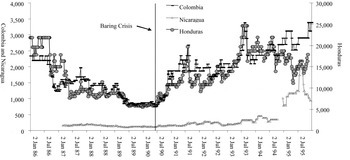
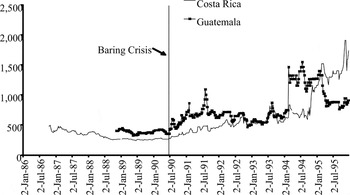
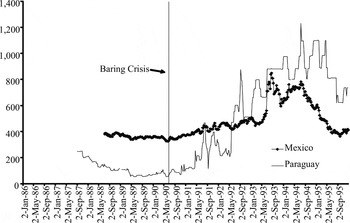
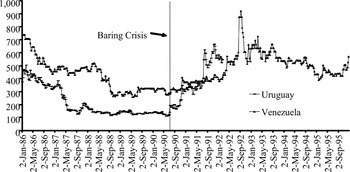
Figures 2–5 shows yield spreads for other Latin American borrowers in our sample.Footnote 35 As Figure 2 indicates, country risk for Colombia and Honduras rose sharply after the onset of the Baring Crisis, while Nicaragua's increased gradually. Figure 3 indicates that country risk for Costa Rica increased after the onset of the crisis and then jumped to more than 1,500 basis points when it defaulted on their external debts in 1895. The country risk premium for Guatemala fluctuated by around 400 basis points until the summer of 1890 when the yield spread increased to more than 1,000 basis points (Figure 3). After a short period of decline, interest-rate differentials for Guatemala increased in 1894 to more than 1,000 basis points after the country defaulted on its foreign debt obligations. The spread then fell to a level of 900 basis points in 1896 after the country agreed to a debt workout with bondholders. Figure 4 shows that the yield spread on Mexican bonds gradually rose from 360 to 500 basis points between July 1890 and June 1892 while the yield spread for Paraguay declined in the early part of the sample and then increased from 100 basis points to more than 1,000 basis points following a debt default that lasted until 1897. Country risk for Uruguay followed a U-shaped pattern prior to the onset of the Baring Crisis, and then climbed from around 100 basis points to over 600 basis points by 1892 (Figure 5). The rise in the country risk premium may reflect, in part, news of a banking and commercial crisis in Montevideo that helped lead to a severe recession. Uruguayan debt prices are then not quoted on the London market after the country briefly defaulted on its debt obligations. Figure 5 also shows that yield spreads in Venezuela rose to over 900 basis points in 1892 before declining to a level of 500 basis points by the end of the sample.
YIELD SPREADS FOR COLOMBIA, NICARAGUA, AND HONDURAS, 1886–1896 (weekly intervals, basis points)

YIELD SPREADS FOR COSTA RICA AND GUATEMALA, 1886–1896 (weekly intervals, basis points)

YIELD SPREADS FOR MEXICO AND PARAGUAY, 1886–1896 (weekly intervals, basis points)

YIELD SPREADS FOR URUGUAY AND VENEZUELA, 1886–1896 (weekly intervals, basis points)

Consistent with the graphical evidence, the weekly record of the sovereign bond market from the financial press suggests that, in addition to any country-specific events that moved sovereign spreads, the Baring Crisis may have been a common factor driving Latin American securities in the early 1890s.Footnote 36 Indeed, the newspaper clippings of the Corporation of Foreign Bondholders (a British entity representing the interests of sovereign debt holders) indicate that the Argentine crisis may have had real economic effects on other Latin American countries. For example, the Star and Herald (Panama City) commented on how the banking and merchant relationships between Argentina and Paraguay transmitted the financial crisis to the landlocked South American country,Footnote 37 and The Bullionist (London) wrote:
Paraguay, like Argentina, Uruguay, and Brazil, is undergoing a financial crisis, and this crisis was recently described by the Finance Minister to Congress in the form of a report . . . They were traceable, without a doubt, to the condition in the Argentine. There has been a general falling-off in trade, which has given rise to a feeling of uneasiness and want of confidence, and since the beginning of 1890 things have been getting worse.Footnote 38
The Buenos Aires Standard discussed the economic effects of the Argentine crisis on Uruguay, a country with close financial and merchant ties to the South American country:
It must be borne in mind that such is the intimate connection between both countries that as long as Argentines suffer from crises, Orientales [The Oriental Republic of Uruguay] cannot expect to flourish. Footnote 39
In January 1891 the South American Journal (London) called the “the violent economic crisis, which overtook the country last July . . . a logical repercussion of the Argentine crisis and the English crisis.”Footnote 40
The events in Barings seem to have also affected Central American borrowers. The South American Journal wrote the following about Costa Rica in 1891:
The fall in Costa Rica “A” and “B” bonds was not in any way due to the internal affairs of the country, but due to the disturbances in July last between Guatemala and Salvador, followed by the troubles in the Argentine Republic, producing a depression of all stocks.Footnote 41
It appears that financial markets may have also been reassessing the debt of the region en masse. The reassessment may be due to a “wake-up” call (where other countries in the region were seen as having economic characteristics similar to Argentina) or a common creditor channel (where one particularly influential lender, such as England, shifts its portfolio out of the region), two explanations given for contagion during the Asian financial crisis.Footnote 42 The Economist, for example, frequently commented on the effects of events in Argentina on the sovereign debt prices of other countries in Latin America. The Economist referred to Central and South American securities in the early 1890s as a group distinct from other countries and regions of the world (while at the same time noting the importance of country-specific events for all securities). Consider the following report from the 5 July 1890 Foreign Securities Section of the Economist:
The feature in South American descriptions has been the heavy fall in Argentine Cedulas, which close about 3 percent lower all round, although the final prices are somewhat above the usual. The fall has been due to the great rise in the gold premium at Buenos Ayres-which has resulted from the passing by the National Bank of its demand. This action of the Bank has raised anew great doubts as to its stability and its ability to get through the present difficulties without shipwreck. All other issues such as Uruguay, Brazilian, & c., have given way sympathetically.
For the Economist then, the prices of other Latin American bonds were moving in unison with Argentina's. The Times of London also frequently noted that Latin American securities fell together, even though debt prices for other emerging markets were generally flat:
Business has been quiet in the Foreign Market, but the tone was fairly steady, and except in the case of South American issues, which were again weak on very discouraging news from Buenos Ayres, there are not many changes to report.Footnote 43
The financial press also reported that investors had difficulty in pricing Latin American bonds. This lends credence to the notion that asymmetric information may have played a role in the sell off of Latin American securities. On the eve of the financial crisis, 5 June 1890, the Financial News remarked on the lack of information about Latin American securities available to bond market investors.
The market for South American securities is much more extensive than is generally supposed, and in it you get a large variety . . . Of course, most people know something—usually rather too much—about Argentina, Brazilians and Uruguays; but when they get to such securities as Paraguayan and Colombian bonds, or to the issues of such States as Nicaragua and Salvador, they feel, to say the least of it, that, unlike the dyer, their hand is not accustomed to that which it works . . . The whole market, as we have shown, abounds in anomalies.Footnote 44
The Economist described a similar problem in assessing the value of Latin American securities:
Amidst the mass of literature which has seen the light during the past few years concerning the River Plate, Brazilian, Chilian, Peruvian, and other South American Republics and their finances, comparatively little has been forthcoming to show the British investor what the liabilities of those States really amount to . . . And beyond this, almost the whole of them are weighted down by inconvertible and greatly depreciated currencies, in which their revenue and expenses are calculated and in which their internal liabilities are expressed; and those internal liabilities, direct, contingent, and provincial, are so numerous and difficult to measure that in such a state as the Argentine Republic it appears almost hopeless to make order of to them.Footnote 45
According to the financial press, it was perhaps easier for investors to be indiscriminate rather than try to accurately determine which countries would weather the storm. (A similar assessment may have occurred during the early stages of the East Asian crisis.)Footnote 46 As the New York Times wrote three years after the start of the Baring Crisis:
It must be borne in mind that Brazil has always punctually met all its obligations and therefore its credit ought to be reasonably good. Moreover, the Oest de Minas Railway is a fairly good property, and the proposed extension will develop a region of the country rich in minerals and of wonderful agricultural capabilities . . . But the public does not discriminate—or rather, in times like the present, refuses to be attracted by probabilities. South Americans are in general disrepute, and it must be admittedly, deservedly.Footnote 47
The Financial News made similar remarks:
Then the distrust produced by the financial catastrophe in the Argentines and Uruguay has naturally reacted on Brazil, and led most people of ordinary caution to withdraw their money from the country, as being tarred with the same brush as other South American republics. Under such conditions, nothing but the most conservative financial policy could prevent Brazil from suffering severely from the withdrawals of gold and restriction on foreign business which were inevitable.Footnote 48
The qualitative accounts found in period newspapers and financial publications and the individual country plots indicate that the Baring Crisis likely affected borrowers throughout Latin America. We now broaden our analysis to consider whether the crisis affected all emerging market borrowers and not just those located in the region. To determine if the Baring Crisis had differential effects on countries based on their location or level of development, we divided our entire sample of countries and colonies into three groups: Latin American countries, non-Latin Emerging markets, and core or high-income European countries and the United States. Our unweighted yield index for Latin America consists of 11 countries: Argentina, Brazil, Chile, Colombia, Costa Rica, Guatemala, Mexico, Nicaragua, Paraguay, Uruguay, and Venezuela.Footnote 49 We construct an unweighted yield index of non-Latin American emerging markets using 22 countries: Austria, British Guiana, Canada, the Cape of Good Hope, Egypt, Greece, India, Italy, Jamaica, Japan, Natal, New South Wales, New Zealand, Norway, Queensland, Russia, South Australia, Sweden, Tasmania, the Ottoman Empire (Turkey), Victoria, and Western Australia.Footnote 50 The core country index consists of four high-income European countries (Belgium, France, Germany, Netherlands) and the United States.
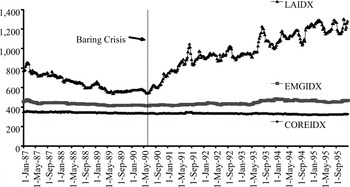
Figure 6 graphs the average interest rate for Latin and non-Latin emerging markets as well as the core countries in our sample. As shown in the figure, interest rates are generally quite flat over the sample period for the non-Latin Emerging markets and the core countries. The small increase in interest rates for the non-Latin Emerging Market Index can be completely attributed to Greece and its debt default in 1893. Bond yields are flat for the non-Latin emerging markets over the sample period if Greece is excluded.
BOND YIELD INDICES, 1887–1895 (weekly intervals, basis points)

Interest rates for Latin American emerging markets, however, display a very different pattern, rising from about 600 basis points in 1890 to more than 1,200 basis points by the end of 1895. One reason that rates continued to rise in other Latin American countries several years after the onset of the crisis may have been related to the ongoing failure of Argentina to fully renegotiate its debt and establish a stable monetary environment. (No agreement for defaulted provincial debt and railway guarantees was concluded until after 1897.) Alternatively, European investors may have been unable to assess the severity of the crisis due to lack of information. Because Argentina may have been seen as a bellwether economy that was used by investors to gauge the fiscal and monetary health of other borrowers in the region, the delay over a full debt settlement may have raised concerns among foreign investors that other less-developed countries in the region would face even greater challenges in restoring fiscal and monetary order to their economies after the crisis. The financial press did continue to report, some three years after the onset of the crisis, how economic and political events in Argentina had a significant effect on bond prices throughout the region.
Summary Statistics of Changes in Yield Spreads
The time series graphs of yield spreads and the interest-rate indexes intimate that the Baring Crisis had a larger effect on Latin America than on other emerging markets and core countries. To complement these figures, Tables 2–4 present summary statistics of changes in yield spreads between 1890 and 1894 for Latin American borrowers, non-Latin American emerging market countries, and the core countries in our sample. We examine the performance of emerging-market, interest-rate differentials by analyzing the one-year, two-year, and four-year horizons after the onset of the Baring crisis: July 1890–June 1891, July 1890–June 1892, and July 1890–June 1894.Footnote 51
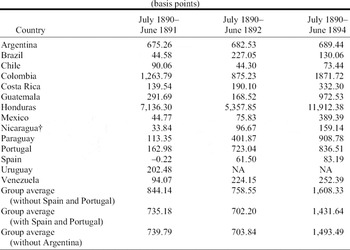
Table 2 shows that yield spreads for most Latin American countries climbed dramatically during the early 1890s. Interest-rate differentials for Argentina, Colombia, and Honduras rose by more than 670 basis points in the first year of the crisis. The average yield spread for Guatemala, Paraguay, and Uruguay went up by more than 190 basis points in the one-year window. The spread for Chile, Costa Rica, Venezuela, Mexico, and Nicaragua increased approximately 81 basis points in the year following the outbreak of the financial crisis in Argentina. Overall, Latin American yield spreads rose an average of 844 basis points in the first year after the onset of the crisis. As Table 2 shows, yield spreads for Latin America remain large, even when Argentina is excluded from the sample (or when we include Spain and Portugal).
AVERAGE CHANGES IN LATIN AMERICAN YIELD SPREADS, 1890–1894

† Nicaragua unilaterally reduced its interest rates on the interest on its bonds from 4 to 6 percent beginning in December 1894.
Note:
The yield spread, or country risk premium, for each country is defined as the current yield on a sterling bond for country i minus the yield on the “risk-free” British consol at time t.
Table 2 shows that average yield spread for the Latin American sample increased 759 and 1,608 basis points in the two- and four-year periods after the onset of the financial crisis. The large decline in the value of Latin American securities for the two- and four-year crisis periods are robust to including Spain and Portugal as part of the Latin American sample or dropping Argentina from the analysis.
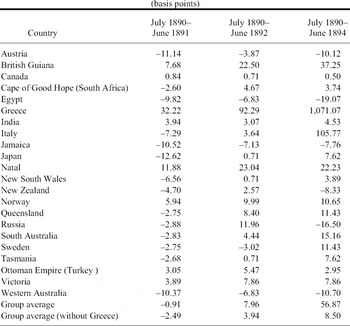
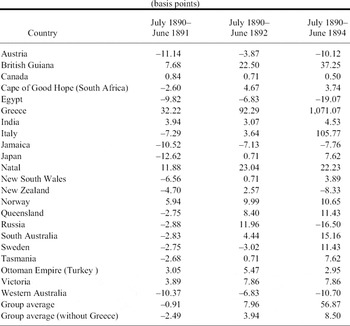
A very different picture emerges if we examine the time-series and cross-sectional behavior of non-Latin American emerging market borrowers. As column (1) of Table 3 shows, the average yield spread for non-Latin American emerging markets decreased by roughly 1 basis point in the first year after the onset of the crisis. With the exception of Greece, yield spreads did not rise or fall more than 13 basis points for the non-Latin Emerging market sample. Column (2) reports summary statistics for yield spread changes for the non-Latin American emerging markets between July 1890 and June 1892. The results largely resemble the findings in column (1) with yield spreads increasing about eight basis points over this period. The increase in country risk is almost entirely driven by Greece, whose interest-rate differential rose more than 92 basis points in the two-year window. If Greece is excluded from the sample, then yield spreads increased by almost four basis points.
AVERAGE CHANGES IN EMERGING MARKET YIELD SPREADS, 1890–1894
Note:
The yield spread, or country risk premium, for each country or colony is defined as the current yield on a sterling bond for country or colony i minus the yield on the “risk-free” British consol at time t.
In the four-year window (column 3), yield spreads increased by nearly 57 basis points for our sample of non-Latin American emerging markets. The result is driven again by Greece, which defaulted on its debts in 1893. Yield spreads only rise by eight and a half basis points if Greece is excluded from the sample. Nevertheless, even if Greece is included in the sample, the average yield spread in Latin American countries increased more than 1,600 basis points in the four-year window compared to an 57 basis point increase in country risk in the non-Latin Emerging market sample.Footnote 52
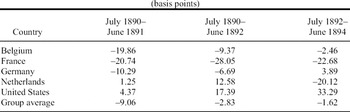
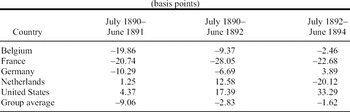
Table 4 reports summary statistics for the five core countries in the sample. Yield spreads were generally flat for the core countries in the one-year window. The country risk premium moved less than 21 basis points for all of the core countries. As a group, interest-rate differentials declined by approximately nine basis points. As shown in columns (2) and (3), the summary statistics for the two-year and four-year windows moved less than four basis points for the high-income/core countries in our sample. Overall, yield spreads were generally very flat in the core countries during the early 1890s.
AVERAGE CHANGES IN CORE MARKET YIELD SPREADS, 1890 1894
Note:
The yield spread, or country risk premium, for each country is defined as the current yield on a sterling bond for country i minus the yield on the “risk-free” British consol at time t.
WHAT FACTORS ACCOUNT FOR THE MOVEMENT IN BOND YIELDS DURING THE CRISIS?
Panel Model and Data
To analyze why yield spreads moved during the crisis, we construct a panel data set consisting of annual data for our sample of 35 emerging market borrowers, which includes macroeconomic indicators, trade variables, institutional arrangements and political factors, and country-specific controls.Footnote 53 In an ideal world, we would include modern macroeconomic variables such as gross domestic product to measure the economic effects of the crisis; however, because data of this nature are available for only three out of ten Latin American countries in our annual panel sample (Brazil, Chile, and Uruguay), we instead employ a variety of indicators that were readily available and widely used by emerging market investors in the late nineteenth century to assess country-specific financial risk.Footnote 54 This empirical strategy enables us to construct a data set with the largest possible number of potential determinants of yield spreads and is a similar approach to what Ferguson and Schularick and Marc Flandreau and Frederic Zumer employ in other studies on the classical gold standard era.Footnote 55
To capture how investors viewed the macroeconomic conditions of emerging market borrowers, we employ seven measures: a variable that measures interest-rate movements in emerging markets; the budget deficit (expenditures-revenues) as a share of revenue; the ratio of total public debt (internal and external) as a share of government revenue; a dummy variable indicating whether the country is in default and has stopped servicing its foreign debt; the natural logarithm of the British wholesale price index; the trade balance (exports minus imports) scaled by exports; and the sterling value of exports per capita. To capture general fluctuations in interest rates, we include an emerging market control that is the unweighted average interest rate of 22 non-Latin American emerging market borrowers minus the interest rate on “risk-free” British consol. As for the other macroeconomic variables, a country with sound fiscal policy (as reflected by a small or negative ratio) should have lower sovereign risk and a lower probability of default as it would have a better capacity to service its debt obligation out of revenue or a greater ability to respond to other exogenous shocks that otherwise might make debt repayment more difficult. A country with a lower debt-to-revenue ratio should have a greater ability to repay its debts, suggesting, ceteris paribus, less sovereign risk and a lower probability of default. A sovereign debt default is a strong signal to the bond market that the country has serious financial problems and is a high credit risk. The price-level variable is included to capture the effects of general deflation, which may have increased the real debt burden of sovereign borrowers.
Trade statistics were also important for assessing the macroeconomic circumstances of emerging market borrowers because measures such as gross domestic product (GDP) had not been developed, because taxes on trade were a major source of revenue, and because exports provide a means for generating foreign currency to service debt denominated in sterling or gold. Annual import and export figures were regularly reported in investment manuals such as the Statement's Yearbook and Fenn on the Funds. First, countries with a current account surplus were generally regarded as having a greater ability to service their foreign debts by emerging market investors. Second, because nineteenth-century investors did not have GDP per capita at their disposal (to indicate the degree of institutional and economic development of a country), they used exports per capita as an alternative measure to proxy for the risk-reducing factors associated with economic development.Footnote 56
Institutional and political factors may also have been used by investors to price sovereign debt during the late nineteenth century. Ferguson and Schularick argue that membership in the British Empire lowered the risk associated with holding colonial bonds because Her Majesty's government guaranteed debt repayment.Footnote 57 We therefore code a dummy variable that takes a value of one if the borrower was a member of the British Empire. Bordo and Hugh Rockoff maintain that the gold standard was a “good housekeeping seal of approval,” which lowered sovereign risk for emerging market borrowers during the gold standard period.Footnote 58 The gold standard was a contingent rule that solved the classic time inconsistency problem by tying the hands of the monetary and fiscal authorities, but as Bordo and Murshid point out, it might also have facilitated the transmission of shocks or contagion.Footnote 59 Finally, Barry Eichengreen and Jeffrey Sachs claim that strict adherence to the gold standard might have made it more difficult to pursue the beggar-thy-neighbor policy of devaluation.Footnote 60 We thus code a dummy variable that takes a value of one if a country was a member of the gold club.Footnote 61 As for the political variables, we code international and civil conflict variables to capture the effects of local and interstate conflicts on sovereign risk.Footnote 62 The inclusion of these conflict variables is motivated by the frequent discussion of the effects of coups d'etat and wars on bond prices in the Foreign Government Securities Section of the Economist.
We use a number of variables to test for the presence of a regional effect in Latin America after the onset of the Baring Crisis. First, we code a crisis variable that takes a value of one beginning in 1890 until the end of the sample period (1896), when it is generally agreed that Argentina had recovered from the crisis. This variable potentially captures the overall effect of the crisis on all emerging market borrowers. Second, we interact the crisis indicator variable with a Latin American indicator variable to test if, ceteris paribus, yield spreads in Central and South America increased following the outbreak of the financial crisis.
We also included some measures to capture potential channels through which the crisis may have spread. First, we coded the emerging market borrower's trade share: exports and imports to the United Kingdom as a share of total trade. We use this measure to examine whether changes in trade affected bond spreads. Second, we interacted the U.K. trade share variable with the Latin American dummy to analyze the effect of British trade on Central and South American yield spreads. Third, given England's role in the Baring Crisis, we added an interaction term between the U.K. trade share variable and the crisis dummy to see if the crisis spread globally through trade ties with England. Finally, we interacted the crisis variable with an indicator variable for being on the gold standard in order to test whether countries that had fixed exchange rates experienced the Baring Crisis in a different way.
The empirical model can be written as:

where YLDSPREADit is the average current yield on a sovereign sterling (or gold) bond for country i at time t minus the current yield on the British consol and βi is a country-specific intercept. The independent variables are defined as:
EMGCONTROLt is an unweighted index of the average current yield of 14 non-Latin emerging markets minus the current yield on “risk-free” British consols at time t;Footnote 63
DEFAULTit is a binary variable which is unity if country i is in default at time t;
BUDGET BALANCEit is revenues minus expenditures for country i at time t;
DEBT/REVENUEit is ratio of total public debt to government revenue for country i at time t;
TRADEBALANCEit is the current account position of country i at time t;
EXPORTSPCit is the ratio of exports to population for country i at time t;
EMPIREi is a binary variable which is unity if country i is a member of the British Empire (a time-invariant covariate in our sample period);
GOLDit is a binary variable which is unity if country i is on the gold standard at time t;
GOLD*CRISISit is an interaction term that is defined as country i being on the gold standard and in the crisis period at time t;
INTERSTATEit is a binary variable which is unity if country i is involved in an interstate war at time t;
CIVILit is a binary variable which is unity if country i is involved in a domestic war at time t;
PRICELEVELit is the natural logarithm of the U.K. wholesale price index
LATINi is a binary value if country i is part of Latin America;
CRISISit is a binary variable which is unity for country i after the onset of the Baring Crisis in 1890;
LATINit*CRISISit is an interaction term which is unity if country i is located in Latin America and the year is 1890 or later;
UKTRADESHAREit is country i's share of total trade with the United Kingdom at time t;
CRISISit*UKTRADESHAREit is an interaction term between the crisis variable and a country's total share of trade with the United Kingdom at time t;
LATINit*UKTRADESHAREit is an interaction term between the Latin American dummy and a country's total share of trade with the United Kingdom at time t;
β are estimated coefficients;
and ε is a white noise error term capturing other influences on yield spreads.
For the dependent variable, we constructed annual yield spreads by averaging the weekly data used in the time series analysis discussed earlier. We primarily rely on data from Ferguson and Schularick for the construction of various macroeconomic and trade indicators.Footnote 64 In order to increase the sample size, we gathered additional trade data from British Board of Trade Publications, Fenn's Compendium, the Statesman Yearbook, and the Annual Reports of the Corporation of Foreign Bondholders. We calculated country trade shares with the United Kingdom using these same sources.
Empirical Results of Panel Analysis
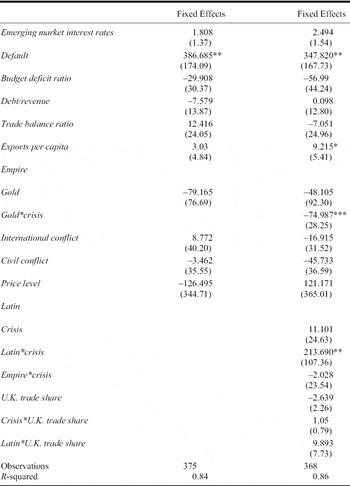
The empirical results for our sample of 35 sovereign borrowers appear in Table 5.Footnote 65 All models are estimated with country fixed effects in order to capture unobserved differences across countries, including other country-specific macroeconomic determinants that may have affected yield spreads. To control for correlation across countries in a given year, we clustered the standard errors on a group-year fixed effect.Footnote 66 The group-year variable is constructed by dividing the sample into three sub-groups—Latin, non-Latin, or core countries/colonies—and then multiplying the regional indicator by the year.Footnote 67 We specified a dummy variable to measure the effect of the Baring Crisis on yield spreads given that there is statistical evidence of a trend break in the
ANALYSIS OF YIELD SPREADS AND THE BARING CRISIS, 1886 1896

* significant at 10 percent.
** significant at 5 percent.
*** significant at 1 percent.
Note:
The dependent variable is the average annual current yield on a sovereign sterling (or gold) bond for a given country or colony minus the current yield on the British consol. Robust standard errors are reported in parentheses.
Latin American bond yields in 1890.Footnote 68 The break in yield spreads fits better with the “fast and furious” view of contagion of Graciela Kaminsky, Carmen Reinhart, and Carlos A. Vegh than the interpretation of Kirsten Forbes and Roberto Rigobon, who suggest that shifts in coefficients are the way to test for contagion.Footnote 69 Column (1) reports baseline results without the controls for the effects of the crisis. The baseline model captures roughly 84 percent of the variation in yield spreads. The country risk premium, ceteris paribus, is positively correlated with general movements in emerging-market interest rates, although the effect is only weakly statistically significant (at the 20 percent level). All else equal, a country in debt default has yield spreads that are more than 387 basis points higher than a sovereign borrower that is servicing its debt. An improved budget-deficit ratio reduces the country risk premium by nearly 30 basis points, but the effect is not statistically significant. The other macroeconomic and trade variables (the debt-revenue ratio, the trade-balance ratio, and exports/population) do not have statistically or economically significant effects on sovereign yield spreads. Adherence to the gold standard, the price level, and the conflict variables also do not have statistically significant effects on the country risk premium.Footnote 70 The Latin and empire variables are dropped from the analysis because they are time-invariant covariates.
The second column of Table 5 presents results that include the Baring Crisis indicator variable as well as the proxies used to examine the potential channels through which the crisis operated. Debt default continues to have a large economic and statistically significant, positive effect on bond spreads. Yield spreads are positively correlated with the emerging-market interest-rate variable, although the effect is not statistically significant.Footnote 71 Consistent with the baseline specifications, the macroeconomic and trade variables generally do not have a statistically significant effect on country risk. The only exception is exports per capita, which is significant at the 10 percent level. Membership in the gold standard and the conflict variables do not lower sovereign risk, but countries with a larger share of trade with the United Kingdom may have lower sovereign yields, although this effect is not economically or statistically significant. The price-level variable fails to have a statistically significant effect on country risk, implying that deflation does not contribute once other factors are taken into account.
If we turn to the variables specific to the crisis, we see that the Baring Crisis does not seem to have affected all sovereign borrowers given that the crisis indicator variable is not statistically significant at conventional levels. But its interaction with the gold standard is statistically significant, lending support to the hypothesis that the gold standard lowered sovereign risk during the crisis. Bond market investors may have viewed gold adherence as a signal that a country would pursue prudent monetary and fiscal policies during a period of financial turbulence.Footnote 72
Consistent with the summary statistics and graphical evidence presented earlier, the Latin-crisis variable (the interaction between a Latin America indicator variable and the Baring Crisis indicator) has a large positive and significant effect on yield spreads. According to the point estimate, the crisis increased yield spreads in Central and South America by 214 basis points. Trade may have been a channel through which the crisis spread. The U.K. trade share variable interacted with the crisis dummy increases country risk by roughly 20 basis points (evaluating the point estimate of one at the mean U.K. trade share of 20), although the effect is not statistically significant at conventional levels (19 percent level of significance).Footnote 73 The U.K. trade share variable interacted with the Latin American raises country risk by approximately 80 basis points (evaluating the point estimate of ten at the mean U.K. trade share in Latin America of eight), although the effect is significant at only the 20 percent level.Footnote 74 To test the joint significance of the crisis variables, we took the partial derivative of yield spreads with respect to the crisis dummy variable. The three variables raise country risk by nearly 240 basis points for Latin American countries and are jointly significant at the 1 percent level.Footnote 75
Discussion
The two variables driving the results are clearly debt default and the Latin American–crisis interaction effect. The economic interpretation of the debt default variable is relatively straightforward: countries with a history of defaults borrowed at higher rates. The Latin American–crisis interaction term is open to multiple interpretations. One is that the interaction simply captures some omitted effect common to all Central American and South American borrowers. Another interpretation is that European investors sold off Latin American bonds following revelations of Argentina's economic problems. This latter interpretation is consistent with two possible explanations of what was happening: investors experienced a wake-up call and withdrew their funds from countries similar to Argentina, or a common creditor (British investors) reallocated its portfolio away from Latin American debt.
A “wake-up call” would suggest that Argentina's default signaled the potential for crises to occur in other countries; given this new information and the belief that other Latin American countries had characteristics that were broadly similar to those of Argentina, emerging market investors then sold their Latin American securities.Footnote 76 This interpretation is similar to what some economists suggested occurred during the East Asia crisis.Footnote 77 The fact that the bond spreads did not rise for the Latin American countries in the months preceding the crisis is consistent with a wake-up call interpretation of the Baring Crisis and similar to what has been observed during the East Asian Crisis.Footnote 78
Incomplete information about the financial health and growth prospects of particular Latin American countries might have made it difficult for investors to assess risk on a country-by-country basis prior to Argentina's default, and might help explain why a wake-up call and a sell off Latin American debt by British investors occurred.Footnote 79 The fact that European investors lacked all the information they desired is well documented by the Corporations of Bondholders (CFB), which represented British lenders, and which was created, in part, to give them better information on sovereign borrowers.Footnote 80 The records of this organization (the Annual Reports of the CFB) reveal the constant frustration of bondholders who could not get accurate and timely reports on fiscal balances, monetary emissions, and tax receipts of debtor nations.
Although it would be difficult to design a definitive test of the role of asymmetric information during our sample period, we carried out some sensitivity analysis that sheds some light on problems of asymmetric information. We estimated a model that uses available information on country-specific macroeconomic and financial characteristics to explain yield spreads, but excluded Latin American debtors from the sample. We find that the macroeconomic and trade variables (as well as the conflict variables) generally have a statistically significant effect in the explaining the cross-sectional behavior of yield spreads for non-Latin emerging market borrowers.Footnote 81 The fact that a regression model can explain non-Latin yield spreads, but not Latin American ones, provides some statistical evidence that asymmetric information may have played a role in the financial crisis. Even if such information had predictive power, it was not available for many countries of interest in the region. Several Central and South American countries, which we would have liked to have included in our full panel specification, lacked adequate financial and trade data from sources available to contemporary investors (such as the Investor's Monthly Manual and the Statesman's Yearbook). The paucity of data for the region made it a more challenging environment for investors to distinguish good risk from bad risk, and might help explain the sell-off of Latin American debt.
The presence of a common creditor could also play a role here.Footnote 82 Investment banks that lent to Argentina were largely concentrated in London. Burned by the Argentine default, British investors might have cut back their Latin American lending to reduce their exposure to similar risks. The decision by these investors to adjust their portfolios and shift funds to other emerging markets or to British colonies could have been based on the belief that countries in the region had trade patterns, fiscal histories, and corporate governance similar to Argentina's. The unwinding of their positions would not necessarily proceed at a rapid pace, and it might thus help explain why bond spreads continued to rise more than a year after the crisis.
To test the common creditor hypothesis, we re-estimated the empirical model in column (2) of Table 5, adding two interaction terms to measure the effects of the Baring Crisis outside of Latin America. First, we interacted the empire indicator variable with the crisis dummy to see whether European investors reduced their holdings of Latin American securities and replaced them with “British-guaranteed” colonial bonds or debt in non-Latin emerging markets. Then, we interacted a non-empire emerging market variable with the crisis dummy to capture the effect of the Baring Crisis on British colonies and developing countries outside of Latin America. Although the empire interaction variable is not statistically significant, we find some evidence that yield spreads in non-Empire, non-Latin emerging markets actually declined about 42 basis points following the outbreak of the crisis.Footnote 83 The falling yield spreads (and hence rising prices of non-Latin emerging market debt) provide some evidence that U.K. investors shifted some of their funds to non-Latin emerging markets during the early 1890s.
CONCLUSION
This article examines quantitative evidence of the effects of the Baring Crisis on a global sample of emerging market borrowers. Using a new database of more than 15,000 bond prices collected from the Economist, we find that the Baring Crisis was largely a regional phenomenon. The average sovereign yield spread for Latin American countries in our sample increased by 844, 759, and 1,608 basis points in the one-year, two-year, and four-year periods after the onset of the financial crisis. Yield spreads in non-Latin emerging markets and core countries were generally flat during the same period.
We then analyzed the determinants of sovereign yield spreads between 1886 and 1896 in a panel framework to understand why the crisis was regional. We were particularly interested in determining whether the Latin American effect could be explained by macroeconomic fundamentals (a budget deficit ratio, a ratio of debt-to-revenue, a default indicator variable), trade indicators (trade balance, exports per capita), political variables (interstate and domestic conflict), and institutional variables (such as being on the gold standard)—information available to emerging market investors in the late nineteenth century. The empirical analysis of sovereign yield spreads pointed to several conclusions. Political variables and macroeconomic indicators such as the debt burden, the budget deficit, and the trade deficit were not very important for pricing sovereign debt during this turbulent period. On the other hand, countries that suspended debt service did subsequently pay higher interest rates in financial markets. The results also suggest that the gold standard offered safe haven for borrowers who committed to its regime during the crisis of the 1890s, trading more with the United Kingdom, however, increased country risk.
Finally, and perhaps most importantly, the results highlight a large Latin American effect. Yield spreads were more than 200 basis points higher for Latin American countries during the crisis, even we after we control for differences across countries. Statistical and historical evidence suggests that European investors were selling off or reducing their holdings of Latin American bonds. They also re-assessed sovereign risk in Latin America and reduced their holdings of the region's government bonds, perhaps because of informational problems and perhaps in order to diversify away from region-specific risk. Although it is difficult to identify a single explanation that accounts for the dramatic decline in Latin American bond prices in the early 1890s, the phenomenon was largely confined to Latin America and had little effect on other emerging markets. As more financial and macroeconomic data from the area become available, future research will undoubtedly shed more light on the regional nature of the Baring crisis.
Appendix 1: Interest Rate Database
CORE COUNTRIES
Belgium (1874), 3 percent, perpetuity bonds
French Rentes, 3 percent, perpetuity bonds
Netherlands, 2.5 percent, perpetuity bonds.
Prussian Consols, 3 percent, perpetuity bonds
United States 4 percent, due 1907
LATIN AMERICAN COUNTRIES
Argentina (1884), 5 percent, final redemption 1921
Brazil (1888), 4.5 percent, redemption by sinking-fund of 1 percent per annum
Chile (1885), 4.5 percent, redeemable by a sinking-fund of ½ percent per year
Colombia (1873), 4.75 percent, in default
Costa Rica A, 5 percent, sinking-fund commences in 1898 to begin redeeming the bonds
Guatemala, 4 percent
Honduras (1867), 10 percent, in default
Mexico (1888), 6 percent, irredeemable after 1892
Nicaragua (1886), 4 percent-begin 6 percent December 29, 1894
Paraguay (1886), 1.5 percent, redeemable by sinking-fund beginning in 1896
Portugal, 3 percent, change to 1 percent in November, 1895
Spain, 4 percent, perpetuity bonds
Uruguay Consol, 3 percent
Venezuela (1859), 3 percent, redeemable by semi-annual sinking-fund
NON-LATIN EMERGING MARKETS
Austrian Gold Bonds (consols), 4 percent, perpetuity bonds
British Guiana, 4 percent, 1935
Canada, 4 percent, due 1904-08
Cape of Good Hope (1881), 4 percent, final redemption in 1922
Greece (1881), 5 percent, final redemption in 1921
India, 3 percent, due October 5, 1948
Italy (ex 25f), 5 percent, perpetuity bonds
Jamaica, 4 percent, Inscribed, 1934
Japan (1873), 7 percent, final redemption in 1898
New South Wales, 4 percent, due 1903-5-8-9-10
New Zealand Inscribed Stock, 4 percent, final redemption in 1929
Norway, 3 percent, final redemption in 1965
Queensland, 4 percent, due 1913
Russia (1822), 5 percent, perpetuity bonds
South Australia, 4 percent, due 1929
Sweden (1880), 4 percent, final redemption in 1930
Tasmania, 4 percent, due July 8, 1908
Turkey (1854, Egyptian Tribute), 5 percent, final redemption in 1927
Victoria, 4.5 percent, due 1904
Western Australia, 4 percent, due 1927
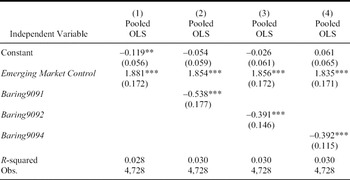
Appendix 2: The Baring Crisis and Latin American Bond Returns, 1887–1895
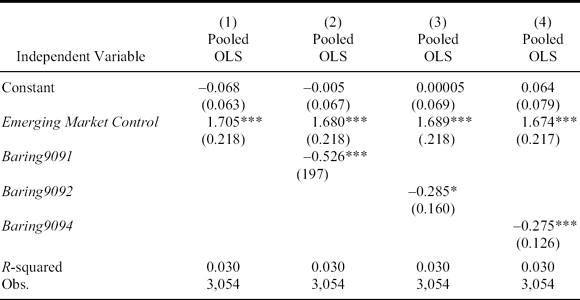
The following model is employed to estimate the effect of the Baring Crisis on weekly Latin American bond returns:

where LATINBRETit is the return on a “representative” sovereign bond for Latin American country i at time t. The return for Latin American country i's representative bond is measured as the first difference of the natural logarithm of the price at time t. αi is a time-invariant constant for each country. EMGRETt is the emerging market control, which is computed as the first difference of the natural logarithm of the (unweighted) average price of the 14 non-Latin American emerging market bonds in our sample. We include CRISISt to measure the differential impact of the Baring Crisis on Latin American bond returns at three different time horizons: 1890–1891, 1890–1892, and 1890–1894. These indicator variables allow us to test whether bond returns in Latin America were significantly lower than bond returns for core-country securities one-year, two-years, and four-years after the onset of the financial crisis.
DEPENDENT VARIABLE: BOND RETURN FOR LATIN AMERICAN COUNTRY i, EXCLUDING ARGENTINA

DEPENDENT VARIABLE: BOND RETURN FOR LATIN AMERICAN COUNTRY i, EXCLUDING ARGENTINA, PORTUGAL, AND SPAIN, AND COUNTRIES THAT INITIALLY DEFAULTED ON THEIR DEBTS BETWEEN 1890 AND 1895

* denotes significance at the 10 percent level.
** denotes significance at the 5 percent level.
*** denotes significance at the 1 percent level.
Notes:
Panel corrected standard errors (PCSE) are in parentheses. The regressions were estimated for the period January 1887 through December 1895 using weekly bond price data collected from the Economist.