Introduction
Human epidemiological and animal studies have shown that poor maternal nutrition has adverse consequences on offspring.Reference Ashton 1 The ‘fetal origins of adult disease’ hypothesis proposes that the maternal nutritional status during pregnancy and lactation plays a critical role in the postnatal growth and development of the offspring, often leading to permanent changes with lifelong health consequences.Reference Edwards, Coulter, Symonds and McMillen 2 , Reference Langley-Evans, Gardner and Welham 3 Studies correlating poor maternal nutrition effects and male sexual development and reproductive function are limited.Reference Rae, Kyle and Miller 4 – Reference Zambrano, Rodriguez-Gonzalez and Guzman 6
In sheep, maternal dietary restriction impairs the lifetime reproductive performance of female offspring, and studies support a direct effect on delayed fetal germ cell apoptosis, oogonial meiosis and follicular development.Reference Rae, Palassio and Kyle 7 In female rats, malnutrition during the perinatal developmental stage leads to a delay in sexual maturation, decrease in reproductive capacity and premature aging of reproductive capacity.Reference Rhind, Rae and Brooks 5 , Reference Guzman, Cabrera and Cardenas 8 Results are less clear with respect to male testicular development. Genovese et al. 10 as well as KotsampasiReference Kotsampasi, Balaskas, Papadomichelakis and Chadio 9 reported reduced Sertoli cell (SC) numbers in adult rats exposed to malnutrition during fetal and prepubertal life. Male offspring of maternal protein restriction (MPR) in pregnancy and/or lactation, but fed a control diet after weaning, show delayed sexual development, low luteinizing hormone and testosterone serum levels and reduced sperm count and impaired reproductive capacity.Reference Zambrano, Rodriguez-Gonzalez and Guzman 6
Maternal undernutrition disrupts the normal ontogeny of gonadal development and function.Reference Rhind, Rae and Brooks 5 In male rats, the neonatal and prepubertal stages are crucial to spermatogenesis and future reproductive capacity. During these stages, testicular cell lines differentiate, proliferate and mature; deviations in any of these processes will impact future fertility.Reference Olaso and Habert 11 The SC maturation and germinal epithelium development windows are: 12 (1) neonatal, from postnatal days (PNDs) 1 to 7; (2) infantile, from PNDs 8 to 21; (3) juvenile, from PNDs 22 to 35; and (4) peripubertal, from PNDs 36 to 60.
Little is known on the effects of poor maternal nutrition on rat testicular development. On the basis of the relationship between malnutrition and programming of the male reproductive system, we aimed to evaluate the effects of MPR during pregnancy and/or lactation on SC maturation and germinal epithelium development of male rat offspring during male postnatal sexual development (PNDs 14, 21 and 36). We hypothesized that MPR during pregnancy and/or lactation would affect offspring testicular development, especially SC and germ cell maturation.
Methods
Details of the maternal diet, breeding and management of the experimental groups of offspring have been published in detail.Reference Zambrano, Rodriguez-Gonzalez and Guzman 6 Briefly, mothers were virgin female albino Wistar rats between 14 and 16 weeks of age and weighing 220 ± 20 g, obtained from the Instituto Nacional de Ciencias Médicas y Nutrición Salvador Zubirán (INNSZ), Mexico City, Mexico. Rats were maintained under controlled lighting (lights on from 07:00 am to 07:00 pm at 22–23°C). All procedures were approved by the Animal Experimentation Ethics Committee of the INNSZ and were in accordance with guidelines of Mexican law on animal protection (NOM-062-ZOO-1999).
Female rats were mated overnight with male breeders and the day spermatozoa were present in a vaginal smear was designated as the day of conception, day 0. Pregnant rats were allocated at random to one of two groups to be fed either a 20% casein (control diet – C) or a 10% casein isocaloric diet (restricted diet – R) during the entire gestation period. Food and water were available ad libitum for all animals. Lactating pups were weighed daily. Delivery occurred on post-conceptual day 22. The day of delivery was considered as PND 0. We report on male offspring only. All rats delivered vaginally. The ano-genital distance was measured using calipers. Our published data indicate that female pups have an ano-genital distance of 1.67 ± 0.13 mm and males 3.26 ± 0.22 mm.Reference Zambrano, Bautista and Deas 13 To ensure homogeneity of the study subjects, litters of over 14 pups were not included in the study. At PND 2, litters of 12–14 pups were adjusted to 12 pups to maintain a similar number of males and females. The pups excluded were chosen according to their body weight (higher of lower) to maintain the original pup mean weight in the litter. A total of four groups were established: CC, RR, CR and RC (first letter diet receiving during pregnancy and second during lactation). After weaning, all pups received the C diet.
At PNDs 14, 21 and 36, which correspond to critical periods of proliferation and maturation of SC and germ cells, male offspring were euthanized by guillotine (Thomas Scientific, NJ, USA). Both testes were dissected and cleaned of fat. The right testes were frozen for Western blot quantification and the left testes were processed for histology.
Histological evaluation
Testes were fixed in a modified Karnovsky solution without calcium. Samples were then post-fixed in 1% OsO4 (Merck, Germany) and included in Epon 812. Tissue blocks were sectioned (1 μm thick, Reichert Ultracut UCT ultramicrotome, Austria) and stained by flotation using 0.5% toluidine blue. Tissue was mounted on slides with the tubules cut transversally to evaluate the germinal epithelium and seminiferous tubule diameter. From one tissue section, at least 50 transversal seminiferous tubules per animal were photographed with an Olympus BX51 light microscope using image analysis software (Image-Pro Plus Version 3.1., Media Cybernetics, USA). To avoid overlapping during observation and cell counting, only one section per animal was examined.Reference Vigueras-Villasenor, Moreno-Mendoza and Reyes-Torres 14
Measurement of androgen receptor (AR) protein expression
Western blot
Samples (50 μg protein) were separated by 10% SDS-PAGE (sodium dodecyl sulfate polyacrylamide gel electrophoresis) and transferred to a nitrocellulose membrane (BioRad, CA, USA). Membranes were incubated with anti-AR antibody N-20 or anti-gamma-tubulin antibody (diluted 1:1000, Santa Cruz, CA, USA). Gamma-tubulin was chosen as a housekeeping protein because it does not change with respect to treatment. Primary antibodies were diluted in phosphate-buffered saline with tween (PBST; Tris-buffered saline tween). The secondary anti-rabbit immunoglobulin (Ig)G antibody conjugated with horseradish peroxidase (HRP;diluted 1:3000, Santa Cruz) was applied after washing in PBST and incubated for 1 h. The relative protein expression was determined by scanning the optical density of the corresponding signals of the autoradiographic film with the Bioimaging Systems software and normalized with the signal of anti-gamma-tubulin.
Immunohistochemistry
Testicles were fixed in 4% paraformaldehyde and included in paraffin; 4-μm-thick cuts were placed on slides with poly-l-lysine (Sigma Aldrich, MO, USA). From each testicle, one section was used for the immunohistochemistry. Slides were incubated with the primary antibody. To determine AR, a rabbit-produced primary polyclonal antibody N-20 (Santa) was used at 1:500. Thereafter, the sections were incubated with anti-rabbit IgG conjugated with HRP (Santa Cruz). The antibody linking sites were shown using diaminobenzidine. The slides were contrasted with hematoxylin–eosin, dehydrated, clarified and mounted. The AR expression was observed in SC under a light microscope within the seminiferous cord in transversal cuts. AR immunohistochemistry was used as a marker for SC.
SC number was counted at PND 21. This quantification was only carried out at this PND because around this age, SC ceased proliferation.Reference Yang, Wreford and de Kretser 15 At PND 14, SCs were not counted because not all the SCs from the restricted groups were AR positive. At least 50 transverse tubules per animal were assessed.
Statistical analysis
Two independent studies were performed: one for the PND 14 and the second for PNDs 21 and 36. Litter sizes were normalized to 12 pups per litter on PND 2 and all assessments were performed in two randomly selected males per litter; data from the same litter were averaged for analysis to provide an n = 5 litters per group. All data are presented as mean ± s.e.m. Statistical analysis was performed using multiple analysis of variance, followed by the Tukey test; P < 0.05 was considered significant.
Results
Body weight
There was no effect on birth weight of the male offspring. Pups of mothers fed the control diet weighed 5.3 ± 0.1 g (n = 20 litters) and pups of the restricted mothers weighed 5.2 ± 0.1 g (n = 20).
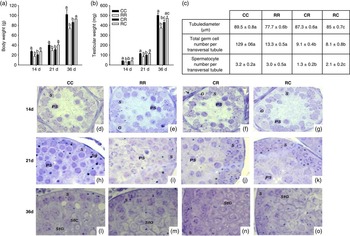
At PNDs 14, 21 and 36, the body weights of the RR and CR pups were lower than the body weights of the CC and RC pups (Fig. 1a).
Male offspring body weight (a); testicular weight (b); table showing: tubule diameter, total germ cell number and spermatocyte number per transversal tubule (c). Representative photographs of germ cell organization in the seminiferous tubule at postnatal day 14 (d–g), 21 (h–k) and 36 (l–o). Magnification 100×. S, Sertoli cells; G, gonocytes; Sg, spermatogonia; PS, primary spermatocytes; StG, golgi-phase spermatids; StC, cap-phase spermatids. Control (C = 20% casein) or a restricted (R = 10% casein) diet during pregnancy (first letter) and lactation (second letter). Mean ± s.e.m., n = 5 litters. Groups not sharing a letter are statistically different, P < 0.05.

Testicular weight
At PNDs 14 and 21, the RR and CR testicular weights were lower than CC and RC; at PND 36, the RR and CR testicular weights were lower than CC (Fig. 1b). Testicular weight relative to body weight did not differ in any group at any age.
Testis histology
At PND 14, male offspring from all groups showed germinal epithelium development to the first meiotic stages (Fig. 1d–1g). Tubule diameter was smaller in RR and RC in comparison with CC (Fig. 1c). The total germ cell number per transversal tubule was lower in CR and RC compared with CC and RR (Fig. 1c) and spermatocyte number per transversal tubule was lower in CR and RC in comparison with CC (Fig. 1c). At PND 14, gonocytes were not observed in CC, but were still present in RR, CR and RC (Fig. 1d–1g).
At PND 21, CC offspring presented the typical germ cell (spermatogonia) layer organization adjacent to the tubular basal lamina, SCs were located next to the spermatogonia layer and finally more mature primary spermatocytes at the center of the tubule (Fig. 1h). This cellular distribution and maturation was not observed in RR, CR and RC offspring at this PND. In these groups, spermatogonia do not touch the basal lamina and do not form a layer. In addition, SC do not surround the spermatogonia close to the basal lamina and some of the primary spermatocytes closest to the lumen had lost the integrity of their nuclear membrane (Fig. 1i–1k). Further studies are needed to support these findings.
At PND 36, spermatids of CC offspring had reached the cap and the early acrosome phase of spermiogenesis. Spermatids were orientated toward the basal lamina of the tubule and the spermatid nucleus began to lose its spherical shape (Fig. 1l). In contrast, at this age, the spermatids of male offspring from RR, CR and RC groups had only reached the Golgi phase of spermiogenesis. In addition, the restricted groups presented more immature germ cells (abundant spermatocytes and early spermatids) in the seminiferous tubule, which were less abundant in the CC group (Fig. 1m–1o).
AR expression
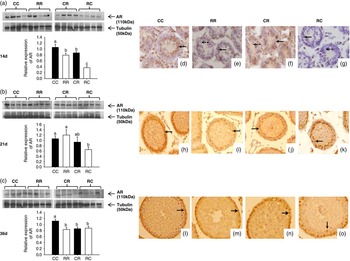
At PND 14, on the basis of Western blot, testicular AR expression was lower in the three restricted groups, with the lowest expression in RC. By PND 21, only RC offspring showed decreased AR, but by PND 36, AR in all restricted groups was less than CC (Fig. 2a–2c).
Androgen receptor (AR) expression at PNDs 14, 21 and 36. Western blot (a–c). Representative slide of AR by immunohistochemistry (d–o). Magnification 60×. The arrow shows an example of AR-positive Sertoli cells (SCs) and the dashed arrow shows an example of AR-negative SCs. Control (C = 20% casein) or a restricted (R = 10% casein) diet during pregnancy (first letter) and lactation (second letter). Mean ± s.e.m., n = 4 pups from different litters. Groups not sharing a letter are statistically different, P < 0.05.

The western protein data were confirmed by immunohistochemistry. At PND 14, all SCs from CC offspring were AR positive (Fig. 2d); in contrast, only some SC from the restricted groups were AR positive (Fig. 2e–2g). AR is specifically located in SC; thus, immunohistochemistry allows the identification of SC numbers and localization. In CC offspring at PND 14, the SCs were observed surrounding the germ cells located touching the basal lamina and the SC–SC unions started to be established. SC distribution differed from CC in all restricted offspring that showed no clear SC–SC interactions between cells and were not surrounding germ cells (Fig. 2e–2g).
At PNDs 21 and 36, AR was present in SC of all groups (Fig. 2h–2o), but the signal was lower in the cytoplasm of restricted offspring. Similar to PND 14, during PNDs 21 and 36, the SC junction of the restricted groups was not completely established and the localization was not close to the basal lamina. At PND 21, the number of SC per transversal tubule was lower in the RR, CR and RC groups (CC: 43.4 ± 0.8a, RR: 36.1 ± 0.5b, CR: 34.0 ± 0.4c, RC: 35.9 ± 0.5bc cells per transversal tubule; n = 5, P < 0.05).
Discussion
We have reported changes in male reproductive function with age in these same groups.Reference Zambrano, Rodriguez-Gonzalez and Guzman 6 The RC group showed the lowest fertility rate and more metabolic disorders that could affect the reproductive performance.Reference Zambrano, Rodriguez-Gonzalez and Guzman 6 , Reference Zambrano, Bautista and Deas 13 , Reference Zambrano, Martinez-Samayoa and Bautista 16 Here, we demonstrate that MPR exerts very early effects on testicular weight in the groups restricted during lactation. The absolute and relative weights of organs such as testicles are useful parameters to evaluate the risks to the male reproductive system. The normal weight of the testis varies little among individuals of the same species, 12 which suggests that its absolute weight is an accurate indicator of gonadal injury, although this parameter may not indicate the nature of the effect. The reduced absolute testicular weight can be partly explained by the lower body weight of these animals as, when analyzed in relative terms, the same parameters did not differ between experimental groups. Similar to our results, body and testicular weights in the rat male offspring from MPR and from maternal energy restriction during lactation were lower at PND 21, with no significant differences in the testicular weight relative to body weight.Reference Teixeira, Silandre and de Souza Santos 17
Maternal undernutrition experiments with other species have also found a reduction in testicular weight. Pregnant ewe fed a hypocaloric diet (70% of requirements) during gestation showed reduced testicular weight and the number of SCs in the newborn male lamb.Reference Alejandro, Perez and Pedrana 18
In the present study, MPR during pregnancy, lactation or both affected the germinal epithelium in two ways: diminishing the number of cells progressing through spermatogenesis and delaying spermatid differentiation. The lower number of tubular primary spermatocytes observed in the germinal epithelium from RR, CR and RC offspring and the presence of early spermatids at PND 36 support these conclusions. In normal development, Golgi-phase spermatids appear at PND 26 and acrosome-phase spermatids at stage 7 emerge at PND 33.Reference Clermont and Perey 19 It is important to point out that in the rat, the first week of postnatal life is crucial for the start of spermatogenesis. On the third PND, 7.5% of gonocytes proliferate and migrate toward the basal lamina. Adequate proliferation and migration ensure that gonocyte progeny become type A spermatogonia; if for any reason this maturation does not take place, gonocytes degenerate.Reference Vigueras-Villasenor, Moreno-Mendoza and Reyes-Torres 14 In addition, we have preliminary data (unpublished) that show that this process is delayed in the CR and RC groups; this might partially explain the presence of gonocytes at PND 14 in both groups. Further studies are needed to support these findings. Similar to the results found in the present study, in which RR has less negative consequences in terms of germ cell number in comparison with CR and RC due to the MPR, previous data from our group, using the same experimental animal model, have shown that the RR female offspring group survived longer at 22 months of age than the CR and RC groupsReference Guzman, Cabrera and Cardenas 8 and that the male and female RC groups presented higher insulin resistance in adult life than the RR group.Reference Zambrano, Bautista and Deas 13 Each of the three restricted groups studied addresses the effects of a different challenge to the developing rat compared with the control group. The less severe phenotype of RR in comparison with CR and RC might be a result of the similar nutritional status in the perinatal window, which lead offspring to show a predictive adaptive response that confers a survival advantage.Reference Lau and Rogers 20 We only studied part of the first wave of spermatogenesis and future work is required to determine whether the differences in the timing observed between the control and the experimental animals persist and, if so, whether they can be reversed. The number of SCs was reduced at PND 21 in all restricted groups. SCs play a fundamental role in mammalian testicular development and function. In rats, their active proliferation starts during the fetal period and finishes between 2 and 3 weeks after birth.Reference Sharpe, McKinnell, Kivlin and Fisher 21 One of the main functions of the SC is to generate a suitable environment for the proliferation and maturation of germ cells. The number of SCs is a major determinant of maximum adult sperm production.Reference Griswold 22 Thus, changes in the number, structure and/or function of this cell type may affect the germ cell development and compromise spermatogenesis.
Our preliminary report shows that the RC group had the lowest sperm count at two different adult ages: PNDs 130 and 270.Reference Zambrano, Rodriguez-Gonzalez and Guzman 6 The present study supports our previous findings, as the RC group has less germ cells and also showed a reduction in the number of SCs, which resulted in the reduced production of spermatozoa in adult life.
Other dietary deficiencies during gestation and lactation affect germ cell development such as maternal dietary vitamin B12 or vitamin E deficiency.Reference Bensoussan, Morales and Hermo 23 , Reference Watanabe, Ebara and Kimura 24
It has been published that AR expression (both mRNA and protein) was significantly enhanced and the estrogen alpha receptor was significantly lower in rat testes from MPR and from maternal energy restriction during lactation; the authors proposed that maternal undernutrition during lactation changes pups’ steroid status, which might be harmful for germ cell development and reproductive function of the male offspring.Reference Teixeira, Silandre and de Souza Santos 17 Our study did not show any AR protein differences between the CC group and the group restricted during lactation (CR) at PND 21. At this postnatal age, only the RC group presented lower AR expression.
We studied the SC number and maturation by AR protein expression; we found that AR expression was lower in all restricted groups at PNDs 14 and 36. These results suggest that SCs are also affected by MPR, which could compromise the germinal epithelium development. It remains to be established whether the assembly of the tight junctions could also be delayed by MPR during pregnancy and lactation. This question could be crucial to determine the extent and direction of fluid and substrate transport toward spermatogenic cells.
In our previous study, we have reported that in comparison with the CC, the three maternal restricted groups showed a delay in testes descent, which is a sexual development marker.Reference Zambrano, Rodriguez-Gonzalez and Guzman 6 In the present study, interestingly, it was found that at PNDs 14 and 36, all restricted groups had lower AR expression, which corresponds to the window of testes descent.
Although the mechanism responsible for these changes remains to be determined, we have preliminary data showing that there is an increase in reactive oxygen species in the fetal and neonatal testes of offspring exposed to MPR. Reactive oxygen species have been shown to cause damage to sperm.Reference Aitken, De Iuliis, Finnie, Hedges and McLachlan 25
Conclusion
The results presented above suggest that MPR delay SC maturation and germ cell differentiation, and affects intratubular organization during the stages that are crucial for the proper establishment of spermatogenesis and future fertility. RC offspring showed the greatest morphological and functional changes. Therefore, these alterations could lead to a decrease in sperm production and fertility in adult life.
Acknowledgments
G.L. Rodriguez-Gonzalez is a graduate student from Doctorado en Ciencias Biomédicas, Facultad de Medicina, Universidad Nacional Autónoma de México, and is a recipient of CONACyT fellowship. This work was partially supported by Consejo Nacional de Ciencia y Tecnología (CONACyT–155166) México. The authors wish to thank Pedro Medina Granados for technical assistance during this study.