INTRODUCTION
Breast cancer treatment involving surgery, chemotherapy, or radiotherapy—often in combination—may result in substantial changes in patients' appearance (Montazeri et al., Reference Montazeri, Vahdaninia and Harirchi2008). Patients may experience partial or complete loss of one or both breasts, lymphedema, and possible limb mobility limitation following surgery (Brunault et al., Reference Brunault, Suzanne and Trzepidur-Edom2012). Chemotherapy, radiotherapy, and hormone therapy may involve hair loss, weight fluctuation, and skin and fingernail discoloration (Stan et al., Reference Stan, Loprinzi and Ruddy2013). Patients often feel ashamed, lose confidence, and experience negative self-image because of their altered appearance. Moreover, patients experience deterioration of body image, poor health, loss of normal functioning, and impaired sexuality (Fobair et al., Reference Fobair, Stewart and Chang2006), which is likely to result in depression and poor quality of life (Collins et al., Reference Collins, Liu and Schootman2011; Lemieux et al., Reference Lemieux, Maunsell and Provencher2008; Ra et al., Reference Ra, Shin and Kim2013).
While many changes in appearance due to cancer treatment are considered temporary, women with breast cancer report distress and body-image disturbance several years after treatment (Collins et al., Reference Collins, Liu and Schootman2011; Choi et al., Reference Choi, Kim and Chang2014; Falk Dahl et al., Reference Falk Dahl, Reinertsen and Nesvold2010), and high levels of distress are associated with poor body image and impaired psychosocial well-being (Kim et al., Reference Kim, Cho and Choi2012; Choi et al., Reference Choi, Kim and Chang2014). However, most studies have focused on altered appearance during cancer treatment and did not consider the long-term effects of altered appearance during survivorship. In addition, while some studies have compared changes in quality of life between breast cancer patients and members of the general population (Lee et al., Reference Lee, Lee and Kim2011; Hsu et al., Reference Hsu, Ennis and Hood2013), no study has compared altered appearance and related distress between these groups.
The present study aimed to evaluate treatment-induced altered appearance, related distress, and body-image disturbance in posttreatment breast cancer patients, patients undergoing active treatment, and general population controls. Our first and main hypothesis was that posttreatment patients would experience similar levels of treatment-induced altered appearance, related distress, and poor body image compared with patients undergoing active treatment. Our second hypothesis was that posttreatment patients would experience higher levels of altered appearance relative to that experienced in general population controls as a result of aging. Finally, we hypothesized that patients would experience greater distress relative to that experienced by members of the general population with similar levels of altered appearance because of the various physical and psychological challenges that arise due to breast cancer and its treatment.
MATERIALS AND METHODS
Study Population
Breast cancer patients were recruited from 23 Korean hospitals between May and December of 2010 during breast-cancer advocacy events entitled “Make Up Your Life.” These events—supported by the Korean Breast Cancer Foundation, the Korean Breast Cancer Society, the Korean Society of Oncology Nursing, and the Korea Foundation for Women—were designed to help cancer patients overcome psychosocial distress resulting from treatment-induced altered appearance. Hospitals participated in the events voluntarily, and they were open to all cancer patients free of charge. Each event included two sessions. At the first session, oncology nurses provided information concerning breast cancer and its treatment, while the second session involved trained volunteers sharing tips on managing altered appearance.
Women with breast cancer were eligible to participate in the study if they were 18 years of age or older and had histologically confirmed breast cancer with no evidence of recurrence or metastasis. Participants were asked to complete the survey questionnaire prior to attending the event. There was no specific incentive offered for participation. Of the 399 breast cancer patients who attended the events, 308 (77.2%) agreed to participate in our study. Following the exclusion of 36 participants with no clinical data and 6 participants who had been diagnosed with psychological problems or prescribed psychological medication, the analysis ultimately included 266 patients. Breast cancer patients were divided into two groups. Women who were undergoing active treatment (chemotherapy or radiation therapy) or who had completed active treatment within the preceding 6 months were defined as active-treatment patients (n = 128); women who had completed active treatment more than 6 months prior to the study were defined as posttreatment patients (n = 138).
Women without a history of breast cancer were recruited from the general population as control participants. We recruited 343 such women aged 18 years or older age-matched with patients from the same region and period in which each event was hosted. We advertised the study via community events (town-hall meetings, community health fairs, and local markets). We provided participants from the general population a moisturizer worth $5.00 as an incentive to participate. After excluding 14 women with psychological problems and 14 with histologically diagnosed cancer, the final sample of general population controls comprised 315 women. The study was approved by the institutional review board of the Samsung Medical Center, and all study participants provided written informed consent.
Measurements
Altered appearance was assessed using visual analogue scales (VASs) developed based on the Common Toxic Criteria for Adverse Events, Version 2.0 (National Cancer Institute, 1999). Participants were asked to quantify the extent of alteration experienced in terms of breast and skin changes and hair loss. Each response was assigned a numeric score ranging from 0 to 10, with higher scores indicating greater change in appearance. Altered appearance-related distress was also assessed using a VAS with items concerned about how much distress patients experienced because of breast changes, hair loss, skin dryness, and pigmentation. VASs have demonstrated good validity, excellent reliability, moderate distribution-based responsiveness, and good anchor-based responsiveness relative to that of multi-item questionnaires (de Boer et al., Reference de Boer, van Lanschot and Stalmeier2004), and they have undergone pilot testing prior to the study to assess comprehensiveness. We categorized VAS scores for breast and skin changes and hair loss into three groups: none (0–1), moderate (2–5), and severe (>5).
Body image was measured using four questions from the Korean version of the European Organisation for Research and Treatment of Cancer's Breast Cancer-Specific Quality-of-Life Questionnaire (EORTC QLQ–BR23), which was validated in another study (Yun et al., Reference Yun, Bae and Kang2004). It included items concerning feeling physically attractive and feminine, finding it difficult to look at oneself naked, and being satisfied with one's body during the preceding week. Responses were measured on a 4-point Likert-type scale: 1 (not at all), 2 (a little), 3 (quite a bit), and 4 (very much). We scored each body-image questionnaire item according to the EORTC scoring manual (Fayers et al., Reference Fayers, Aaronson and Bjordal2001) and performed a linear transformation of body-image data to yield scores ranging from 0 to 100, with higher scores indicating a more positive body image. The values of Cronbach's alpha for the EORTC QLQ–BR23 body-image subscale were 0.88, 0.92, and 0.86 for posttreatment patients, patients undergoing active treatment, and general population controls, respectively. Patients' interest in appearance was also assessed, as it could affect distress via altered appearance and body image.
The patient and control groups underwent assessment using the same scales. In addition, sociodemographic information—including marital status, education, job status, and monthly family income—were recorded via the survey. For patients, we obtained clinical information—including date of diagnosis, stage at diagnosis, type of surgery, receipt of other cancer treatment, and current treatment status—from hospital medical records. For members of the general population, we asked whether they had been diagnosed with any type of cancer or had mental problems at the time of the survey.
Statistical Analysis
We recruited a convenience sample of breast cancer patients who participated in community events and a similar number of non-cases from the general population. The sample size was limited by the number of available cases attending the community events. For a comparison of patients undergoing active treatment (n = 128) or of survivors who completed treatment (n = 138) with general population controls (n = 315), our study had 80% power to detect an effect sizes >0.35 in both cases.
We used linear regression to estimate average differences with 95% confidence intervals (CI 95%) in altered appearance and body-image scores comparing posttreatment patients, patients undergoing active treatment, and general population controls. To assess the impact of altered appearance on distress in the three groups, we compared the distress between the groups according to severity of altered appearance, adjusted for age and interest in appearance. To identify factors associated with poor body image among patients, we performed univariate and multivariable linear regression analyses adjusted for sociodemographic factors (age, marital status, employment status, monthly family income), clinical factors (survival time, disease stage at diagnosis, surgery type, current treatment status), and interest in appearance and distress due to altered appearance. All statistical analyses were performed using Stata (v. 12.0; College Station, Texas, USA), and p values of < 0.05 were considered statistically significant.
RESULTS
Characteristics of the Study Population
The mean ages of posttreatment patients, patients undergoing active treatment, and general population controls were 50.2, 47.1, and 48.1 years, respectively (Table 1). Patients were less likely to have a college education (p < 0.01), less likely to be employed (p < 0.001), and significantly more interested in appearance relative to the general population controls (average scores 6.7, 6.6, and 6.0 out of 10, in the active treatment, posttreatment, and general population groups, respectively; p = 0.001). In terms of clinical characteristics, posttreatment patients were more likely to have been diagnosed with stage 1 cancer relative to patients undergoing active treatment (p = 0.01), but cancer treatment did not differ between the groups.
Participant characteristics (N = 581)

IQR = interquartile range; SD = standard deviation.
Treatment-Induced Altered Appearance
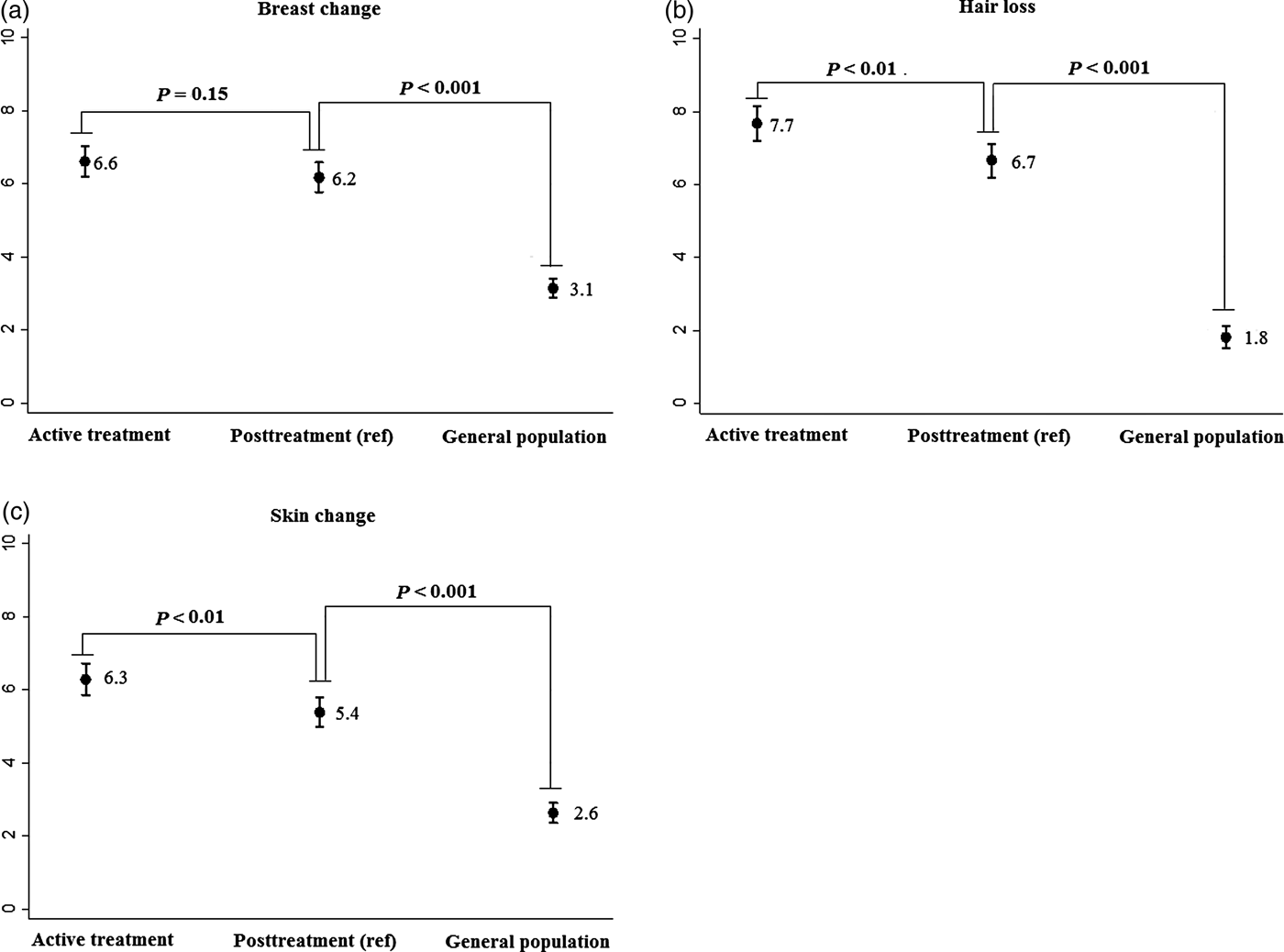
Breast changes reported by posttreatment patients were similar to those reported by active-treatment patients (means = 6.2 and 6.6, respectively, p = 0.15; Figure 1a). Breast changes in both patient groups, however, were significantly more severe than in general population controls (mean = 3.1, p < 0.001). Patients undergoing active treatment reported significantly higher levels of hair loss compared to posttreatment patients (means = 7.7 and 6.7, respectively, p < 0.01) and to general population controls (mean = 1.8, p < 0.001) (Figure 1b). Similarly, patients undergoing active treatment reported significantly higher levels of skin changes compared to posttreatment patients (means = 5.8 and 5.4, respectively, p < 0.01) and to general population controls (mean = 2.6, p < 0.001) (Figure 1c).
Changes in breast (a), hair loss (b), and skin (c) scores in patients undergoing active treatment (n = 128), posttreatment patients (n = 138), and general population controls (n = 315). Values are mean scores and 95% confidence intervals.

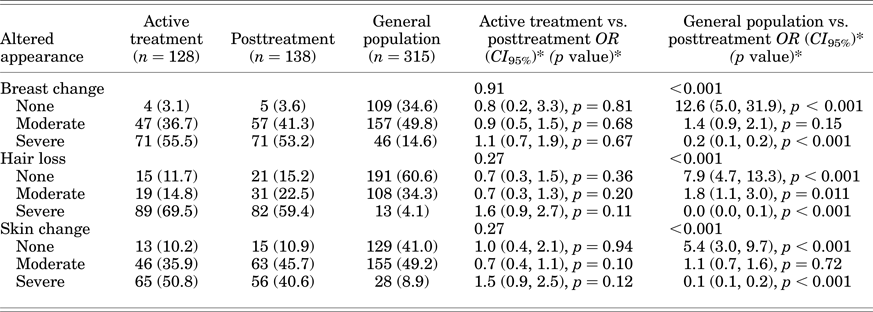
The proportion of active-treatment patients reporting severe breast changes (55.5%), hair loss (69.5%), and skin changes (50.8%) did not differ significantly from those of posttreatment patients (53.2, 59.4, and 40.6%, respectively) but were markedly higher than in general population controls (14.6, 4.1, and 8.9%, respectively; Table 2).
Changes in breast, hair loss, and skin appearance in study participants

Values are expressed as proportions (%). CI 95% = 95% confidence interval; OR = odds ratio.
* Adjusted for age and interested in appearance.
Distress According to Severity of Altered Appearance
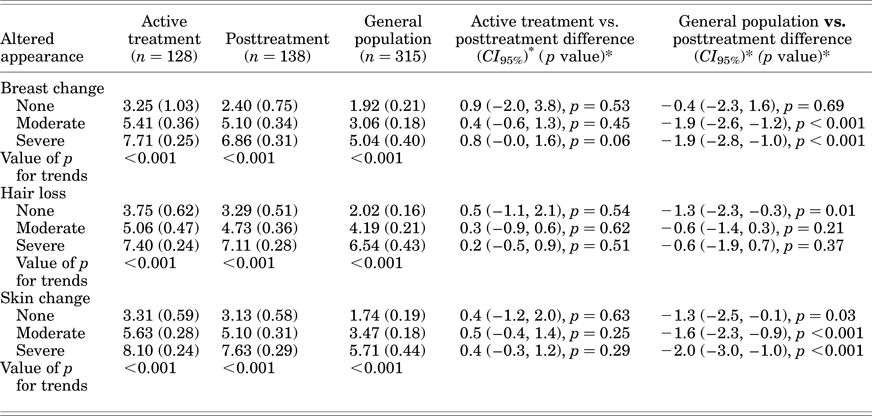
Higher levels of altered appearance were associated with higher levels of distress in the three groups (Table 3). With severe breast change, patients who were undergoing active treatment reported similar levels of distress compared to posttreatment patients (p = 0.06), but the general population controls exhibited significantly lower levels of distress relative to those of posttreatment patients (p < 0.001). Similarly, among participants with severe levels of skin changes, distress levels were similar between posttreatment and active-treatment patients (p = 0.29), but the general population controls had significantly lower levels of distress than posttreatment patients (p < 0.001).
Distress by changes in appearance in study participants

Values are expressed as mean (standard error). CI 95% = 95% confidence interval.
* Adjusted for age and interested in appearance.
Factors Associated with Worse Body Image
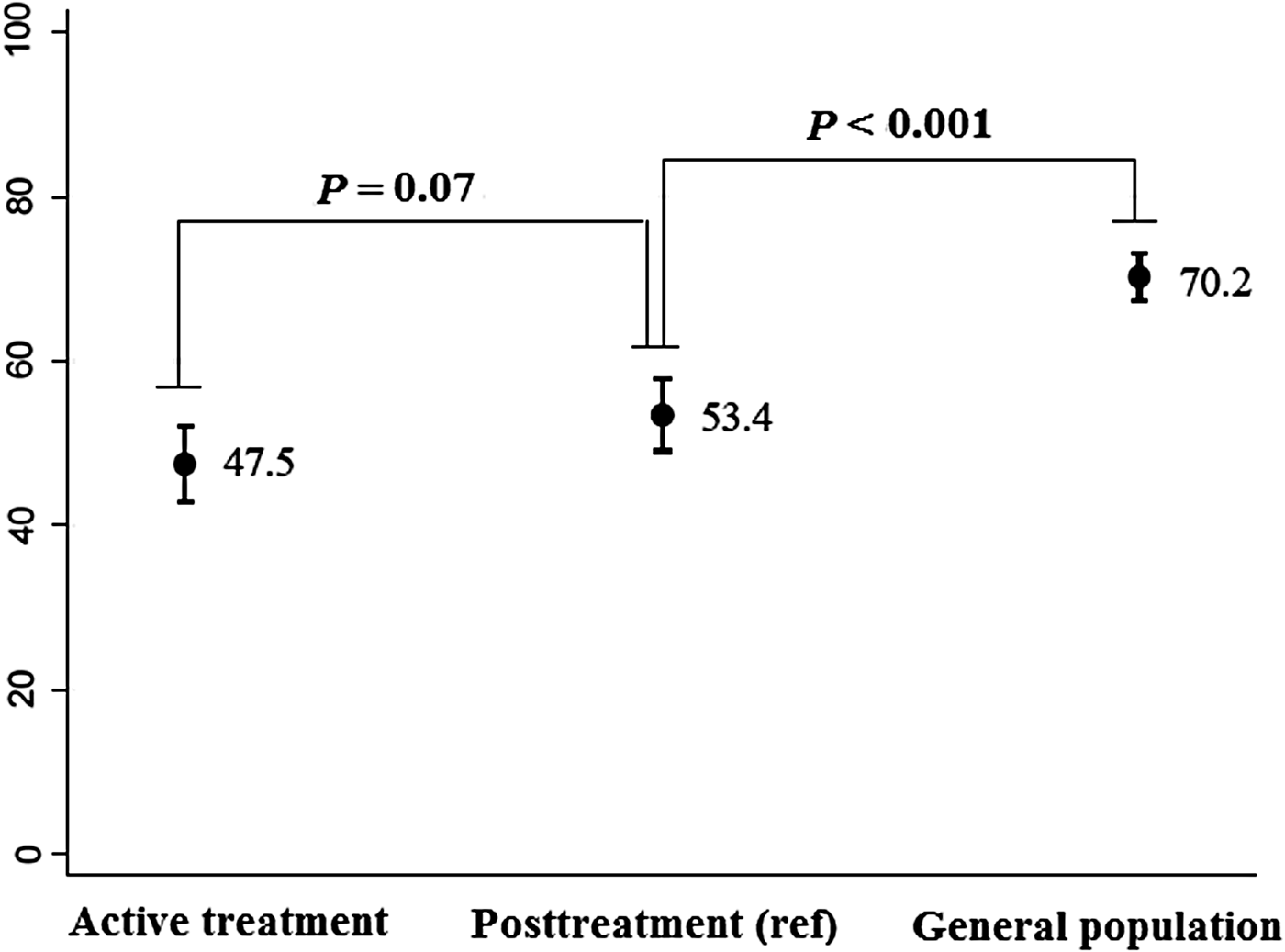
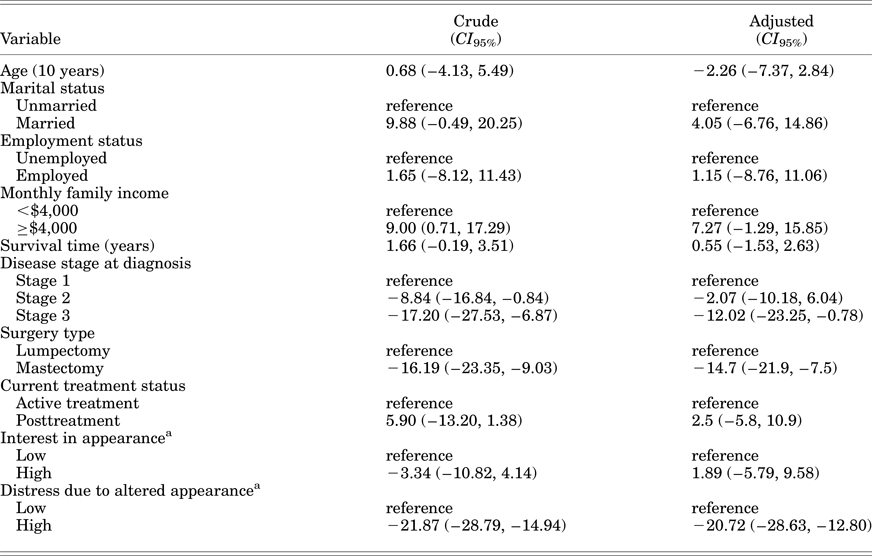
Body image was similar in posttreatment patients compared to active-treatment patients (means = 53.4 and 47.5, respectively, p = 0.07), and both groups reported significantly worse body image than general population controls (mean = 70.2, p < 0.001; Figure 2). In multivariable analysis, patients with stage 3 (vs. stage 1) cancer, those who had a mastectomy (vs. lumpectomy), and those with high altered appearance distress (vs. low distress) experienced significantly worse body image when adjusting for age, marital status, current job status, income, current treatment status, and interest in appearance (Table 4). Neither survival time nor current treatment status was associated with body image in breast cancer patients.
Body image scores in patients undergoing active treatment (n = 128), posttreatment patients (n = 138), and general population controls (n = 315). Values are mean scores and 95% confidence intervals.

Average differences in body-image scores for specific characteristics of women with breast cancer (N = 266)

The coefficient of body image calculated via univariate (crude) and multivariate analysis, which is adjusted for all covariates. CI 95% = 95% confidence interval.
a Divided by median.
DISCUSSION
Breast cancer patients in the posttreatment period and those undergoing active treatment experienced similar levels of altered appearance and distress, and both groups had significantly higher levels of altered appearance and distress than the general population controls. Moreover, for similar levels of altered appearance, breast cancer patients showed significantly higher levels of distress and poorer body image relative to those of general population controls.
While breast changes are permanent if patients do not undergo reconstructive surgery, hair and skin alterations should return to normal within a few months of treatment completion (Mols et al., Reference Mols, van den Hurk and Vingerhoets2009). In our study, however, patients who had completed treatment more than 6 months prior to the study reported persistent hair loss and skin changes. About 60 and 40% of posttreatment patients experienced severe hair loss and skin changes, respectively, comparable to patients undergoing active treatment. Since 2009, case reports of permanent irreversible scalp alopecia related to breast cancer chemotherapy have been described (Prevezas et al., Reference Prevezas, Matard and Pinquier2009; Tallon et al., Reference Tallon, Blanchard and Goldberg2010). Indeed, a qualitative study of Korean women with breast cancer reported that treatment-related hair and skin changes never improved and remained visible several years after treatment (Kim et al., Reference Kim, Cho and Choi2012). Survivors were particularly concerned about hair growth and skin pigmentation, dryness, or looseness following cancer treatment (Nozawa et al., Reference Nozawa, Shimizu and Kakimoto2013) and experienced poor body image and depression due to altered appearance, which reduced their quality of life (Choi et al., Reference Choi, Kim and Chang2014; Begovic-Juhant et al., Reference Begovic-Juhant, Chmielewski and Iwuagwu2012). Therefore, long-term assessment and supportive care for treatment-related hair loss and skin changes are necessary to prevent distress and the associated psychological problems in breast cancer patients (Choi et al., Reference Choi, Kim and Chang2014).
A recent cohort study found that chemotherapy-induced skin changes such as lower sebum content did not recover even 6 months after completion of chemotherapy (Kang et al., Reference Kang, Kim and Im2015). Yet, the pathophysiology of chemotherapy-related permanent alopecia remains unknown. It might be associated with toxic damage to the stem cells and hair matrix cells of the hair bulb or to disturbances of the signaling pathways for secondary hair development (Prevezas et al., Reference Prevezas, Matard and Pinquier2009; Tallon et al., Reference Tallon, Blanchard and Goldberg2010; Kluger et al., Reference Kluger, Jacot and Frouin2012). Basic science research should evaluate mechanistic pathways and potential interventions to prevent permanent hair loss after breast cancer treatment.
Our breast cancer patients experienced significantly higher levels of distress associated with severe skin changes compared to general population controls. In previous studies, breast cancer patients experienced distress as a result of skin changes partly because they did not anticipate dermatological changes, such as loss of breast or alopecia, prior to undergoing cancer treatment (Gandhi et al., Reference Gandhi, Oishi and Zubal2010). While physicians often consider skin reactions as relatively minor problems compared to other side effects, patients report increasing concern about dermatological toxicity from chemotherapy (Ra et al., Reference Ra, Shin and Kim2013). Patients reported that skin changes sometimes had a greater negative impact on daily living compared to other side effects (Gandhi et al., Reference Gandhi, Oishi and Zubal2010) and expressed a lack of resources for managing treatment-induced altered appearance (Gandhi et al., Reference Gandhi, Oishi and Zubal2010). It is therefore important to provide pretreatment information, counseling, and management resources concerning possible treatment-related skin alterations for breast cancer patients (Gandhi et al., Reference Gandhi, Oishi and Zubal2010; Nozawa et al., Reference Nozawa, Shimizu and Kakimoto2013).
According to the systematic review conducted by Falk Dahl et al. (Reference Falk Dahl, Reinertsen and Nesvold2010), 15–33% of breast cancer patients experienced problems with body image. In our study, patients with high levels of altered appearance-related distress reported a large difference in body-image scores (21 points on a 100-point scale) than patients with low levels of altered appearance-related distress, regardless of survival time. This difference is very important, as mean differences of 10 points or more have been considered clinically meaningful (Cocks et al., Reference Cocks, King and Velikova2008). Breast cancer patients continue to experience poor body image due to long-term altered appearance and related distress. Considering that body image is significantly correlated with adverse psychosocial consequences, such as depression (Choi et al., Reference Choi, Kim and Chang2014) and poor quality of life (Begovic-Juhant et al., Reference Begovic-Juhant, Chmielewski and Iwuagwu2012), oncology health professionals should monitor altered appearance-related distress and help breast cancer patients cope with related problems not only during the treatment period but beyond.
There are several limitations of this study. First, altered appearance was based on self-report, and there could be discrepancies between actual and perceived appearance. Some patients may be more sensitive to altered appearance and perceive greater changes relative to women in the general population (Moreira et al., Reference Moreira, Silva and Canavarro2010). We asked participants to report the extent of their interest in appearance and adjusted for it during the analysis, but we cannot exclude the possibility of information bias. Second, several characteristics were significantly different between patients and members of the general population in spite of age- and area-matched sampling. While we adjusted for several factors in our analyses, we also cannot exclude the possibility of residual confounding. Third, the study was conducted at community events, and it is possible that patients who participated in the events were more interested in altered appearance compared to those who did not participate. However, the response rate was relatively high, and the characteristics of the study patient population were similar to those of Korean breast cancer patients in general. Fourth, the results of the study may not be generalizable to other populations with different sociocultural perspectives regarding cancer, appearance, and body image.
This was the first study comparing breast cancer treatment-induced altered appearance and its impact on distress and body image in posttreatment patients, patients undergoing active cancer treatment, and general population controls. We found that both patient groups experienced higher levels of altered appearance relative to members of the general population, indicating that cancer treatment-induced altered appearance and related distress are long-term problems in cancer survivors. Moreover, breast cancer patients experienced higher levels of altered-appearance-related distress and poorer body image compared to general population controls with similar levels of altered appearance. Further prospective studies should evaluate the impact of altered appearance on psychological health and quality of life in breast cancer patients. In the meantime, healthcare professionals should educate breast cancer patients on the possible long-term alterations in appearance caused by cancer treatment, including dermatological side effects, and help them manage the physical and psychological consequences of altered appearance.
DISCLOSURES
The authors hereby declare that they have no conflicts of interest to disclose.
ACKNOWLEDGMENTS
This work was supported by the Korean Breast Cancer Foundation and the Faculty Research Fund of Sungkyunkwan University.