1 Introduction
Rotation of particles at finite particle shear Reynolds number (
 $Re_{p}$
), which is essential to understanding the hydrodynamics of particle–fluid systems in many industrial and natural processes, has been the subject of a variety of theoretical (Lin, Peery & Schowalter Reference Lin, Peery and Schowalter1970; Robertson & Acrivos Reference Robertson and Acrivos1970), experimental (Poe & Acrivos Reference Poe and Acrivos1975; Zettner & Yoda Reference Zettner and Yoda2001; Bluemink et al.
Reference Bluemink, Lohse, Prosperetti and van Wijngaarden2008), and numerical studies (Kossack & Acrivos Reference Kossack and Acrivos1974; Ding & Aidun Reference Ding and Aidun2000; Ku & Lin Reference Ku and Lin2009; Mao & Alexeev Reference Mao and Alexeev2014). Moreover, several advancements have been made recently on detecting and tracking particle rotation (Zimmermann et al.
Reference Zimmermann, Gasteuil, Bourgoin, Volk, Pumir and Pinton2011; Klein et al.
Reference Klein, Gibert, Bérut and Bodenschatz2013; Byron et al.
Reference Byron, Einarsson, Gustavsson, Voth, Mehlig and Variano2015; Wu et al.
Reference Wu, Wu, Yao, Brunel, Coetmellec, Lebrun, Grehan and Cen2015; Mathai et al.
Reference Mathai, Neut, van der Poel and Sun2016). These studies exclusively focused on impermeable particles. In practice, however, porous and permeable particles are frequently encountered. Examples include coal particles in power stations, suspended sediment in coastal waters, and catalyst clusters in fluidized bed reactors. The permeability of the particle can affect the flow pattern as well as particle–fluid interactions to various extents (Chen & Cai Reference Chen and Cai1999; Bhattacharyya, Dhinakaran & Khalili Reference Bhattacharyya, Dhinakaran and Khalili2006; Shahsavari, Wardle & McKinley Reference Shahsavari, Wardle and McKinley2014). Nonetheless, there have been no investigations about the rotation of porous particles in fluid flow, apart from a very recent theoretical analysis by Masoud, Stone & Shelley (Reference Masoud, Stone and Shelley2013) on the rotation of porous ellipsoids in an unbounded simple shear flow. Their analysis was based on the coupled Brinkman–Stokes model (Debye & Bueche Reference Debye and Bueche1948). They found that the permeability has little effect on the rotation of porous particles in the absence of fluid inertia, and Jeffery’s prediction (Jeffery Reference Jeffery1922) remains an excellent approximation for the angular velocity of porous ellipsoids in simple shear flow without fluid inertia. Previous studies showed that the effect of fluid inertia, which increases with
 $Re_{p}$
, leads to a reduction of angular velocity for a solid impermeable particle in shear flow (Lin et al.
Reference Lin, Peery and Schowalter1970; Poe & Acrivos Reference Poe and Acrivos1975; Ding & Aidun Reference Ding and Aidun2000; Zettner & Yoda Reference Zettner and Yoda2001). Therefore, the natural question is how the permeability affects the rotation of porous particles in shear flow with fluid inertia.
In order to describe fluid flow through a porous medium, models based on either Darcy’s law or the Brinkman equation have been widely employed (Brinkman Reference Brinkman1949; Neale & Epstein Reference Neale and Epstein1973; Michalopoulou, Burganos & Payatakes Reference Michalopoulou, Burganos and Payatakes1993; Ollila, Ala-Nissila & Denniston Reference Ollila, Ala-Nissila and Denniston2012; Dalwadi et al.
Reference Dalwadi, Chapman, Waters and Oliver2016). Compared to Darcy’s law, the Brinkman equation includes a viscous term in the momentum equation to account for the boundary layer occurring in porous medium flow, and thus the continuity of fluid velocity and shear stress is fulfilled at the interface between the porous region and the free flow. Many researchers have used the Brinkman equation to study the flow past moving porous media (Debye & Bueche Reference Debye and Bueche1948; Roy & Damiano Reference Roy and Damiano2008; Masoud et al.
Reference Masoud, Stone and Shelley2013). However, these studies were limited to fluid flows with low enough Reynolds number, such as creeping flow, because no nonlinear inertial term has been included in the Brinkman equation. The inertial effect on the fluid flow of a moving porous medium is not minute in practical applications (Wood Reference Wood2007). Recently, Wang et al. (Reference Wang, Wang, Guo and Mi2015) presented a volume-averaged macroscopic momentum equation in terms of the intrinsic phase-average velocity for fluid flow passing the porous medium, in which they included the inertial terms; thus, this equation is suitable for fluid flow with finite
 $Re_{p}$
.
In this work, we study the rotation of a circular porous particle in a simple shear flow with
 $Re_{p}$
up to 108. The general volume-averaged macroscopic governing equations of Wang et al. (Reference Wang, Wang, Guo and Mi2015) are used to formulate the fluid flow around and inside the porous particle. A lattice Boltzmann model is adopted to numerically solve the general macroscopic equations. The effects of fluid inertia, confinement by the boundary walls, and permeability of the particle are investigated. Our results reveal that the fluid inertia and confinement of the bounding walls affect the rotation of a porous particle in shear flow in a similar way to that of a solid impermeable particle. Although the permeability has a negligible effect on the angular velocity of a porous particle in unbounded shear flow at very low
 $Re_{p}$
, as found by Masoud et al. (Reference Masoud, Stone and Shelley2013), our results suggest that the permeability is of paramount importance in porous particle rotation in shear flow with either a significant confinement effect or a finite particle shear Reynolds number.
2 Method
2.1 Governing equations
Here, we consider one single, circular, neutrally buoyant, porous particle rotating in a simple shear flow. The particle is placed in the centre of a rectangular channel of length
 $L$
and width
 $H$
. The fluid flow is driven by two bounding walls (located in the width direction) moving at the same speed
 $U$
, but in opposite directions. The particle shear Reynolds number is defined as
 $Re_{p}=GD^{2}/\unicode[STIX]{x1D708}$
, where
 $D$
is the particle diameter,
 $G=2U/H$
is the shear rate, and
 $\unicode[STIX]{x1D708}$
is the fluid kinematic viscosity. We adopt the volume-averaged macroscopic equations in terms of the intrinsic phase-average velocity to formulate the porous particle–fluid system (Wang et al.
Reference Wang, Wang, Guo and Mi2015). The macroscopic equations consist in averaging the microscopic equations over a representative element volume (REV), where the REV scale is much larger than the characteristic size of pore structures, such that it includes sufficient pores for the averaging. On the other hand, however, it should be much smaller than the particle such that the volume-averaged macroscopic equation can be applied in the porous domain of the particle. Therefore, the fluid flow is governed by the following macroscopic equations
 $$\begin{eqnarray}\unicode[STIX]{x1D735}\boldsymbol{\cdot }\langle \boldsymbol{u}_{f}\rangle ^{f}=0\text{ and }\frac{\unicode[STIX]{x2202}\langle \boldsymbol{u}_{f}\rangle ^{f}}{\unicode[STIX]{x2202}t}+\langle \boldsymbol{u}_{f}\rangle ^{f}\boldsymbol{\cdot }\unicode[STIX]{x1D735}\langle \boldsymbol{u}_{f}\rangle ^{f}=-\frac{1}{\unicode[STIX]{x1D70C}_{f}}\unicode[STIX]{x1D735}\langle p_{f}\rangle ^{f}+\unicode[STIX]{x1D708}\unicode[STIX]{x1D6FB}^{2}\langle \boldsymbol{u}_{f}\rangle ^{f}+\boldsymbol{F}_{m},\end{eqnarray}$$
where
 $\unicode[STIX]{x1D70C}_{f}$
is the fluid density, and
 $\langle \boldsymbol{u}_{f}\rangle ^{f}$
and
 $\langle p_{f}\rangle ^{f}$
are the intrinsic phase-average velocity and pressure of fluid phase, respectively. The total body force
 $\boldsymbol{F}_{m}$
is calculated via
 $$\begin{eqnarray}\boldsymbol{F}_{m}=-\frac{\unicode[STIX]{x1D700}\unicode[STIX]{x1D708}}{K}(\langle \boldsymbol{u}_{f}\rangle ^{f}-\langle \boldsymbol{u}_{s}\rangle ^{s})-\frac{\unicode[STIX]{x1D700}^{2}F_{\unicode[STIX]{x1D700}}}{\sqrt{K}}(\langle \boldsymbol{u}_{f}\rangle ^{f}-\langle \boldsymbol{u}_{s}\rangle ^{s})|\langle \boldsymbol{u}_{f}\rangle ^{f}-\langle \boldsymbol{u}_{s}\rangle ^{s}|+\boldsymbol{G},\end{eqnarray}$$
where
 $\langle \boldsymbol{u}_{s}\rangle ^{s}$
is the intrinsic phase-average velocity of particle, and
 $\unicode[STIX]{x1D700}$
the porosity of particle. In the limit of
 $\unicode[STIX]{x1D700}=0$
, the porous particle reduces to a solid impermeable particle, whereas as
 $\unicode[STIX]{x1D700}$
approaches 1, the porous regime would be filled by fluid and
 $\boldsymbol{F}_{m}$
vanishes in (2.1).
 $K$
is the permeability of particle, which qualifies the ability of the porous medium to transmit fluids, which is denoted by the Darcy number,
 $Da=K/D^{2}$
, in this work. The geometric function
 $F_{\unicode[STIX]{x1D700}}$
follows Ergun’s correlation (Ergun Reference Ergun1952),
 $F_{\unicode[STIX]{x1D700}}=1.75/\sqrt{150\unicode[STIX]{x1D700}^{3}}$
. Note that the porous structure inside the porous particle is described by the permeability and the porosity. In this work, for simplicity, we associate the permeability
 $K$
with the porosity
 $\unicode[STIX]{x1D700}$
via
 $K=\unicode[STIX]{x1D700}^{3}d_{p}^{2}/[150(1-\unicode[STIX]{x1D700})^{2}]$
, where
 $d_{p}$
stands for the characteristic diameter of filling grains within the porous particle, which is taken as
 $100~\unicode[STIX]{x03BC}\text{ m}$
here, following Bhattacharyya et al. (Reference Bhattacharyya, Dhinakaran and Khalili2006). The total body force
 $\boldsymbol{F}_{m}$
includes the resistance arising due to the porous medium, and the external body force
 $\boldsymbol{G}$
. On the right-hand side of (2.2), the first and the second terms represent the linear and nonlinear drag force, respectively. Under creeping flow conditions, i.e., steady flow with a sufficiently low flow velocity, the nonlinear resistance can be neglected because of its quadratic nature. Thus, the inertial term in (2.1) can be omitted. The macroscopic equations (2.1) reduce to the coupled Brinkman–Stokes model (Debye & Bueche Reference Debye and Bueche1948) in the absence of an external body force. The net force
 $\boldsymbol{F}_{p}$
and torque
 $\boldsymbol{T}_{p}$
on the particle are calculated using Newton’s equations:
 $$\begin{eqnarray}\boldsymbol{F}_{p}=M_{p}\frac{\text{d}\boldsymbol{V}_{p}}{\text{d}t}=-\int _{S}\boldsymbol{n}\boldsymbol{\cdot }\unicode[STIX]{x1D748}\,\text{d}s\quad \text{and}\quad \boldsymbol{T}_{p}=I_{p}\frac{\text{d}\unicode[STIX]{x1D74E}_{p}}{\text{d}t}=-\int _{S}(\boldsymbol{r}_{b}-\boldsymbol{R})\times (\boldsymbol{n}\boldsymbol{\cdot }\unicode[STIX]{x1D748})\,\text{d}s,\end{eqnarray}$$
where
 $M_{p}$
is the particle mass,
 $I_{p}$
the moment of inertia of particle, and
 $S$
the boundary of the particle. Note that
 $\boldsymbol{r}_{b}$
represents the position vector of boundary node,
 $\boldsymbol{R}$
the position vector of particle centre,
 $\unicode[STIX]{x1D748}$
the stress tensor,
 $\boldsymbol{n}$
the unit outward normal vector,
 $\boldsymbol{F}_{p}^{drag}=\int _{S}\boldsymbol{n}\boldsymbol{\cdot }\unicode[STIX]{x1D748}\,\text{d}s$
the hydrodynamic drag force experienced by particle,
 $\unicode[STIX]{x1D74E}_{p}$
the angular velocity of particle, and
 $\boldsymbol{V}_{p}$
the simple expression of
 $\langle \boldsymbol{u}_{s}\rangle ^{s}$
. The velocity of particle
 $\boldsymbol{u}_{s}$
is defined as
 $\boldsymbol{u}_{s}=\boldsymbol{U}_{p}+\unicode[STIX]{x1D74E}_{p}\times (\boldsymbol{r}-\boldsymbol{R})$
, with
 $\boldsymbol{U}_{p}$
and
 $\boldsymbol{r}$
being the translation velocity and position vector of the particle, respectively.
2.2 Numerical approach
The lattice Boltzmann method has been successfully applied to simulate complex fluid flows because of its easy implementation of boundary conditions, short codes, and natural parallelism compared to conventional computational methods based on the Navier–Stokes equations (Ladd Reference Ladd1994; Zou & He Reference Zou and He1997; Chen & Doolen Reference Chen and Doolen1998; Ding & Aidun Reference Ding and Aidun2000; Ollila et al. Reference Ollila, Ala-Nissila and Denniston2012; Mao & Alexeev Reference Mao and Alexeev2014; Wang et al. Reference Wang, Wang, Guo and Mi2015). In this work we use a modified single relaxation time lattice Boltzmann equation (SRT-LBE) model to solve equations (2.1). The corresponding lattice Boltzmann evolution equations are given as
 $$\begin{eqnarray}f_{\unicode[STIX]{x1D6FC}}(\boldsymbol{x}+\boldsymbol{e}_{\unicode[STIX]{x1D6FC}}\unicode[STIX]{x1D6FF}t,t+\unicode[STIX]{x1D6FF}t)-f_{\unicode[STIX]{x1D6FC}}(\boldsymbol{x},t)=-\frac{1}{\unicode[STIX]{x1D70F}}[f_{\unicode[STIX]{x1D6FC}}(\boldsymbol{x},t)-f_{\unicode[STIX]{x1D6FC}}^{eq}(\boldsymbol{x},t)]+\unicode[STIX]{x1D6FF}tF_{\unicode[STIX]{x1D6FC}},\end{eqnarray}$$
where
 $\unicode[STIX]{x1D70F}$
is the relaxation time,
 $f_{\unicode[STIX]{x1D6FC}}(\boldsymbol{x},t)$
the particle distribution function (PDF),
 $f_{\unicode[STIX]{x1D6FC}}^{eq}(\boldsymbol{x},t)$
the equilibrium PDF and
 $F_{\unicode[STIX]{x1D6FC}}$
the force term. In our simulations, the two-dimensional nine velocities (D2Q9) model is used. The lattice speed
 $c$
is given by
 $c=\unicode[STIX]{x1D6FF}x/\unicode[STIX]{x1D6FF}t$
, where
 $\unicode[STIX]{x1D6FF}x$
is the lattice size, and
 $\unicode[STIX]{x1D6FF}t$
the time step. The equilibrium PDF and the force term are defined as
 $$\begin{eqnarray}\displaystyle & \displaystyle f_{\unicode[STIX]{x1D6FC}}^{eq}(\boldsymbol{x},t)=\unicode[STIX]{x1D70C}_{f}\unicode[STIX]{x1D714}_{\unicode[STIX]{x1D6FC}}\left[1+\frac{\boldsymbol{e}_{\unicode[STIX]{x1D6FC}}\boldsymbol{\cdot }\boldsymbol{u}}{c_{s}^{2}}+\frac{(\boldsymbol{e}_{\unicode[STIX]{x1D6FC}}\boldsymbol{\cdot }\boldsymbol{u})^{2}}{2c_{s}^{4}}-\frac{\boldsymbol{u}^{2}}{2c_{s}^{2}}\right], & \displaystyle\end{eqnarray}$$
 $$\begin{eqnarray}\displaystyle & \displaystyle F_{\unicode[STIX]{x1D6FC}}=\unicode[STIX]{x1D70C}_{f}\unicode[STIX]{x1D714}_{\unicode[STIX]{x1D6FC}}\left(1-\frac{1}{2\unicode[STIX]{x1D70F}}\right)\left[\frac{\boldsymbol{e}_{\unicode[STIX]{x1D6FC}}\boldsymbol{\cdot }\boldsymbol{F}_{m}}{c_{s}^{2}}+\frac{\boldsymbol{e}_{\unicode[STIX]{x1D6FC}}\boldsymbol{\cdot }\boldsymbol{u}}{c_{s}^{4}}(\boldsymbol{e}_{\unicode[STIX]{x1D6FC}}\boldsymbol{\cdot }\boldsymbol{F}_{m})-\frac{\boldsymbol{u}\boldsymbol{\cdot }\boldsymbol{F}_{m}}{c_{s}^{2}}\right], & \displaystyle\end{eqnarray}$$
where
 $\unicode[STIX]{x1D714}_{\unicode[STIX]{x1D6FC}}$
is the weight parameter, defined as
 $\unicode[STIX]{x1D714}_{0}=4/9,\unicode[STIX]{x1D714}_{1-4}=1/9,\unicode[STIX]{x1D714}_{5-8}=1/36$
,
 $c_{s}$
is the lattice sound speed, and
 $\boldsymbol{u}$
is the intrinsic phase-average velocity of fluid phase
 $\langle \boldsymbol{u}_{f}\rangle ^{f}$
. The macroscopic density
 $\unicode[STIX]{x1D70C}_{f}$
and velocity
 $\boldsymbol{u}$
are calculated using
 $$\begin{eqnarray}\unicode[STIX]{x1D70C}_{f}=\mathop{\sum }_{\unicode[STIX]{x1D6FC}=0}^{8}f_{\unicode[STIX]{x1D6FC}}\quad \text{and}\quad \unicode[STIX]{x1D70C}_{f}\boldsymbol{u}=\mathop{\sum }_{\unicode[STIX]{x1D6FC}=0}^{8}\boldsymbol{e}_{\unicode[STIX]{x1D6FC}}f_{\unicode[STIX]{x1D6FC}}+\frac{1}{2}\unicode[STIX]{x1D6FF}t\unicode[STIX]{x1D70C}_{f}\boldsymbol{F}_{m}.\end{eqnarray}$$
The macroscopic velocity equation in (2.7) is nonlinear in the velocity
 $\boldsymbol{u}$
, since the total body force term
 $\boldsymbol{F}_{m}$
includes
 $\boldsymbol{u}$
. The quadratic equation is solved by introducing (2.2) into (2.7), and then the velocity
 $\boldsymbol{u}$
is computed using
 $$\begin{eqnarray}\boldsymbol{u}=\frac{\boldsymbol{v}}{d_{0}+\sqrt{d_{0}^{2}+d_{1}|\boldsymbol{v}|}}+\boldsymbol{V}_{p}\quad \text{and}\quad \unicode[STIX]{x1D70C}_{f}\boldsymbol{v}=\mathop{\sum }_{\unicode[STIX]{x1D6FC}=0}^{8}\boldsymbol{e}_{\unicode[STIX]{x1D6FC}}f_{\unicode[STIX]{x1D6FC}}+\frac{1}{2}\unicode[STIX]{x1D6FF}t\unicode[STIX]{x1D70C}_{f}\boldsymbol{G}-\unicode[STIX]{x1D70C}_{f}\boldsymbol{V}_{p},\end{eqnarray}$$
where
 $\boldsymbol{v}$
stands for the temporal variable and the two parameters
 $d_{0}$
and
 $d_{1}$
are
 $d_{0}=(1+(1/2)\unicode[STIX]{x1D6FF}t(\unicode[STIX]{x1D700}\unicode[STIX]{x1D708}/K))/2$
and
 $d_{1}=\unicode[STIX]{x1D6FF}t(\unicode[STIX]{x1D700}^{2}F_{\unicode[STIX]{x1D700}}/\sqrt{K})/2$
.
The periodic boundary conditions are implemented in the flow direction (length direction), and the Zou–He boundary condition based on the bounceback of the non-equilibrium part of the distribution function (Zou & He Reference Zou and He1997) is applied for the bounding walls (width direction). No explicit boundary condition is used for the interface between the porous particle regime and free flow, since a second-order viscous term is already included in the macroscopic governing equations. The fluid density
 $\unicode[STIX]{x1D70C}_{f}$
and particle density
 $\unicode[STIX]{x1D70C}_{p}$
are set to
 $\unicode[STIX]{x1D70C}_{f}=\unicode[STIX]{x1D70C}_{p}=1.0$
. We use both the stress integration method (Li et al.
Reference Li, Lu, Fang and Qian2004) and the momentum exchange method (Mei, Yu & Shyy Reference Mei, Yu and Shyy2002) to compute the hydrodynamic drag force
 $\boldsymbol{F}_{p}^{drag}$
acting on the particle. After
 $\boldsymbol{F}_{p}$
and
 $\boldsymbol{T}_{p}$
are obtained, the translational and angular velocity, as well as the position, can be updated via (2.3). We find that the angular velocities at steady state based on two force evaluation methods, in the current work, are almost the same. The grid independence is also checked by the simulations of particle rotation in shear flow with
 $Re_{p}=39.168$
and
 $Da=4.25\times 10^{-12}$
, in which we consider relaxation times
 $\unicode[STIX]{x1D70F}=0.58,0.60,0.65,0.70$
, particle diameters
 $D=40,50,60$
lattice size, and aspect ratios
 $W/H=4,6,8$
. The computed angular velocities at steady state for all the cases are very close to 0.3807(
 $\pm \%0.03$
), and thus
 $W/H=6$
,
 $\unicode[STIX]{x1D70F}=0.58$
and
 $D=50$
lattice size are chosen in the rest of this work.
3 Results and discussion
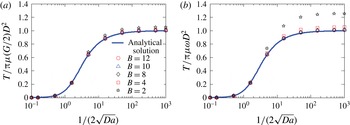
Dimensionless torque acting on a circular porous particle as a function of
 $1/(2\sqrt{Da})$
for various confinement ratios
 $B$
at
 $Re_{p}=0.08$
: (a) the particle is stationary in simple shear flow of shear rate
 $G$
; (b) the particle has no translational motion but rotates with an angular velocity
 $G/2$
in a quiescent fluid.

To validate our model, we first examine the torque acting on the porous particle at a near-zero particle shear Reynolds number (
 $Re_{p}=0.08$
) in two scenarios: (i) the particle is stationary in shear flow of shear rate
 $G$
, and (ii) the particle has no translational motion but rotates with an angular velocity
 $\unicode[STIX]{x1D714}=G/2$
in a quiescent fluid. For such a small
 $Re_{p}$
, the effect of fluid inertia is negligible. Various confinement ratios
 $B$
(
 $=H/D$
,
 $2\sim 12$
) and
 $Da$
(
 $2.5\times 10^{-7}\sim 25$
) are considered. The results are compared to the analytical solutions by Masoud et al. (Reference Masoud, Stone and Shelley2013), which are given by
 $T=-\unicode[STIX]{x03C0}\unicode[STIX]{x1D707}\unicode[STIX]{x1D714}D^{2}(I_{2}(1/\sqrt{4Da})/I_{0}(1/\sqrt{4Da}))$
. Note that
 $T$
is the magnitude of the torque,
 $\unicode[STIX]{x1D707}$
is the dynamic viscosity, and
 $I_{2}$
and
 $I_{0}$
are modified Bessel functions of the first kind. Figure 1 shows that the curves of dimensionless torque on the porous particle for
 $B=10$
and 12 practically overlap, which means that the confinement effect due to the bounding walls can be neglected when
 $B\geqslant 10$
. We also notice that the dimensionless torque for
 $B\geqslant 10$
agrees very well with the analytical solutions by Masoud et al. (Reference Masoud, Stone and Shelley2013), thus confirming the accuracy of our model. By comparing figures 1(a) to 1(b), we find that the torque experienced by the particle rotating with an angular velocity of
 $G/2$
in scenario (ii) matches very well with the torque exerted by shear flow with shear rate of
 $G$
on a stationary particle in scenario (i) in the absence of a confinement effect (i.e.
 $B\geqslant 10$
). However, with an enhanced confinement effect (i.e.
 $B$
decreasing from 10 to 2), the torque on the particle rotating in a quiescent fluid departs gradually from that for a stationary particle in shear flow with a shear rate of
 $G$
. This suggests that the confinement ratio has an impact on the particle dynamics.
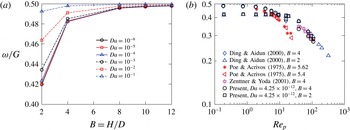
Dimensionless angular velocity
 $\unicode[STIX]{x1D714}/G$
(a) as a function of the confinement ratio
 $B$
for various
 $Da$
at
 $Re_{p}=0.08$
, and (b) as a function of
 $Re_{p}$
for various
 $B$
at
 $Da=4.25\times 10^{-12}$
, compared with results for a solid impermeable particle in the literature.

Then we study a porous particle freely rotating in shear flow between two bounding walls (with confinement ratio
 $B=2\sim 12$
) at near-zero particle shear Reynolds number
 $Re_{p}=0.08$
. Here
 $Da=10^{-6}\sim 10^{-1}$
. Figure 2(a) shows the effect of
 $B$
on the dimensionless angular velocity
 $\unicode[STIX]{x1D714}/G$
(normalized by the shear rate
 $G$
). It is noted that
 $\unicode[STIX]{x1D714}/G$
increases with
 $B$
, and converges to approximately 0.5 when
 $B\geqslant 10$
, regardless of
 $Da$
. For large
 $B$
(
 ${\geqslant}10$
), whereas the confinement effect is minute, we obtain
 $\unicode[STIX]{x1D714}/G=0.49710\sim 0.4996$
for
 $B=10$
and
 $0.4978\sim 0.4997$
for
 $B=12$
when
 $Da$
varies from
 $10^{-6}$
to
 $10^{-1}$
, which is in good agreement with the results for a solid impermeable particle in simple shear flow, i.e., the exact analytical solutions (
 $\unicode[STIX]{x1D714}/G=0.5$
in unbounded domain by Jeffery (Reference Jeffery1922)) and numerical results (
 $\unicode[STIX]{x1D714}/G=0.4982$
by Ding & Aidun (Reference Ding and Aidun2000) and
 $\unicode[STIX]{x1D714}/G=0.4971$
by Ku & Lin (Reference Ku and Lin2009) for
 $Re_{p}=0.08$
and
 $B=10$
). This supports the conclusion by Masoud et al. (Reference Masoud, Stone and Shelley2013) that the permeability has little effect on the rotational behaviour of a porous particle at negligible particle shear Reynolds number in unbounded shear flow, where the Jeffery’s prediction (Jeffery Reference Jeffery1922) remains an excellent approximation for the angular velocity of porous particles. For smaller
 $B$
(
 ${<}10$
), where the confinement effect of the two bounding walls plays a role, we identify that
 $\unicode[STIX]{x1D714}/G$
is suppressed to below 0.5. Ding & Aidun (Reference Ding and Aidun2000) found that for low
 $Re_{p}$
the angular velocity of an impermeable solid particle in shear flow decreases when the width of the channel decreases. As shown in figure 2(a), we can draw a similar conclusion for a porous particle. However, the suppressing effect for the rotation of a porous particle is also dependent on
 $Da$
when
 $Re_{p}$
is low. The smaller
 $Da$
, the lower
 $\unicode[STIX]{x1D714}/G$
. At
 $B=2$
, for instance, we find that
 $\unicode[STIX]{x1D714}/G$
for
 $Da=10^{-6}$
is 15% lower than that for
 $Da=10^{-1}$
. This indicates that the effect of permeability on the rotation of a porous particle should not be neglected when the confinement ratio is small, even if the fluid inertia can be neglected.
Next we investigate the effect of fluid inertia on the rotation of a porous particle in shear flow with
 $Re_{p}$
up to 108. Here we limit
 $B$
to 2 and 4 to illustrate the influence of confinement. First
 $Da$
is fixed at
 $Da=4.25\times 10^{-12}$
. Thus, the porous particle approximates its solid impermeable counterpart, and a comparison with results available in the literature for a solid impermeable particle can be made. As depicted in figure 2(b), we observe that the angular velocity of the particle decreases with increasing
 $Re_{p}$
, as reported in many previous works (Kossack & Acrivos Reference Kossack and Acrivos1974; Poe & Acrivos Reference Poe and Acrivos1975; Ding & Aidun Reference Ding and Aidun2000; Zettner & Yoda Reference Zettner and Yoda2001). Quantitatively, our results for the angular velocity
 $\unicode[STIX]{x1D714}/G$
are in good agreement with the simulation results by Ding & Aidun (Reference Ding and Aidun2000) for the whole range of
 $Re_{p}$
studied in this work, which further demonstrates the accuracy of the current model. In particular, for low
 $Re_{p}$
we find that
 $\unicode[STIX]{x1D714}/G$
reaches a plateau of 0.48 for
 $B=4$
and 0.42 for
 $B=2$
, and the width of plateau varies with the confinement ratio
 $B$
, which is
 $Re_{p}=0\sim 3$
for
 $B=4$
and
 $Re_{p}=0\sim 20$
for
 $B=2$
. This was also well documented by Ding & Aidun (Reference Ding and Aidun2000). For high
 $Re_{p}>39$
we notice that the simulation results in this work agree well with the experimental results by Zettner & Yoda (Reference Zettner and Yoda2001) and numerical results by Ding & Aidun (Reference Ding and Aidun2000), where
 $\unicode[STIX]{x1D714}/G$
decays rapid with
 $Re_{p}$
.
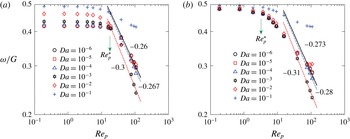
Comparison of the simulation results on the angular rate of a circular porous particle in a simple shear flow with various Darcy numbers at the same confinement ratio, (a)
 $B=2$
, (b)
 $B=4$
. Lines of slope
 $-0.26$
,
 $-0.267$
and
 $-0.3$
at
 $B=2$
, and slope
 $-0.273$
,
 $-0.28$
and
 $-0.31$
at
 $B=4$
are also shown.

We extend the range of
 $Da$
to
 $10^{-6}\sim 10^{-1}$
, and further examine the effects of fluid inertia and confinement on the rotation of a porous particle in shear flow. As shown in figure 3, the trend of
 $\unicode[STIX]{x1D714}/G$
decaying with increasing
 $Re_{p}$
, similar to that for a solid impermeable particle, as shown in figure 2(b), is observed for both
 $B=2$
and
 $B=4$
. A plateau of
 $\unicode[STIX]{x1D714}/G$
is also identified in figure 3 for various
 $Da$
at low
 $Re_{p}$
. Therefore, we argue that a critical
 $Re_{p}$
, hereafter referred to as
 $Re_{p}^{\ast }$
, can be defined to illustrate the importance of the effect of fluid inertia. In the case of
 $Re_{p}<Re_{p}^{\ast }$
,
 $\unicode[STIX]{x1D714}/G$
remains almost constant with increasing
 $Re_{p}$
, indicating that the Reynolds number has little effect on the rotation of the particle. For
 $Re_{p}$
larger than
 $Re_{p}^{\ast }$
,
 $\unicode[STIX]{x1D714}/G$
is significantly influenced by the Reynolds number, and decays rapidly with
 $Re_{p}$
. From figure 3, we find that
 $Re_{p}^{\ast }$
is 3 for
 $B=4$
and 20 for
 $B=2$
, and
 $Re_{p}^{\ast }$
is reduced when
 $B$
increases, which suggests that the effect of Reynolds number on particle rotation must be considered even for very small
 $Re_{p}$
in a wider channel. In fact, Kossack & Acrivos (Reference Kossack and Acrivos1974) found that fluid inertia already plays a significant role for a solid impermeable particle in an unbounded shear flow with
 $Re_{p}=1$
. Comparison between figures 3(a) and 3(b) also shows that the confinement of two bounding walls suppresses
 $\unicode[STIX]{x1D714}/G$
to below 0.5. The smaller the confinement ratio
 $B$
, the lower the angular velocity
 $\unicode[STIX]{x1D714}/G$
. This observation is in accordance with our results for
 $Da=4.25\times 10^{-12}$
, as discussed above, and the results by Ding & Aidun (Reference Ding and Aidun2000) and Zettner & Yoda (Reference Zettner and Yoda2001) for a solid impermeable particle. To summarize, the fluid inertia and the confined walls have similar effects on the rotation of a circular porous particle in shear flow as on a solid impermeable particle. In addition, we found there is a power law between
 $\unicode[STIX]{x1D714}/G$
and
 $Re_{p}$
at smaller
 $Da$
(
 $10^{-6}\leqslant Da\leqslant 10^{-3}$
) when
 $Re_{p}$
is larger than
 $Re_{p}^{\ast }$
, but the power law is absent for
 $Da=10^{-2}$
and
 $10^{-1}$
(as shown in figure 3). The power reduces (for example, from
 $-0.26$
to
 $-0.3$
for
 $B=2$
) when
 $Da$
increases from
 $10^{-6}$
to
 $10^{-3}$
, indicating a more rapid decay of
 $\unicode[STIX]{x1D714}/G$
with
 $Re_{p}$
. The trend could be extrapolated to larger
 $Re_{p}$
, but the results should be verified by further numerical work or experiments.
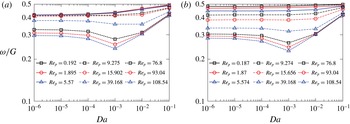
Dimensionless rotational angular velocity as a function of
 $Da$
at various
 $Re_{p}$
at the same confinement ratio (a)
 $B=2$
, (b)
 $B=4$
.

We also evaluate the effect of permeability on the rotation of a porous particle in shear flow at finite
 $Re_{p}$
. For low
 $Re_{p}$
(
 ${<}20$
), as shown in figure 4, the angular velocity
 $\unicode[STIX]{x1D714}/G$
increases with
 $Da$
. It is also seen that
 $\unicode[STIX]{x1D714}/G$
demonstrates the largest deviation from 0.5 (the theoretical value of
 $\unicode[STIX]{x1D714}/G$
for an impermeable particle rotating in an unbounded shear flow at
 $Re_{p}=0$
by Jeffery (Reference Jeffery1922)) when
 $Da=10^{-6}$
, and the deviation is reduced with increasing
 $Da$
. Thus, the suppression of the angular velocity
 $\unicode[STIX]{x1D714}/G$
due to the confinement of bounding walls is enhanced by reducing the permeability of the particle. We observe that the rate of increase of
 $\unicode[STIX]{x1D714}/G$
with
 $Da$
at
 $B=2$
is higher than that at
 $B=4$
. Masoud et al. (Reference Masoud, Stone and Shelley2013) found that
 $Da$
has a negligible effect on
 $\unicode[STIX]{x1D714}/G$
in shear flow with a vanishing confinement effect and fluid inertia. Based on our results, together with the findings of Masoud et al. (Reference Masoud, Stone and Shelley2013), we expect that the increasing rate of
 $\unicode[STIX]{x1D714}/G$
with
 $Da$
at low
 $Re_{p}$
(
 ${<}20$
) may reduce to a negligible amount when the confinement effect vanishes. Therefore, for low
 $Re_{p}$
(
 ${<}20$
), we argue that the rotation of the porous particle increases with
 $Da$
in a bounded shear flow, and the rate of increase of angular velocity with
 $Da$
diminishes when the confinement effect reduces. In the limit of unbounded flow, the increasing rate of angular velocity over
 $Da$
becomes negligible, and
 $Da$
has little effect on the rotation of a porous particle. For large
 $Re_{p}$
(
 ${>}20$
),
 $\unicode[STIX]{x1D714}/G$
is influenced by
 $Da$
in a more complicated way, as shown in figure 4. With increasing
 $Da$
,
 $\unicode[STIX]{x1D714}/G$
first drops slowly to a minimum, then rises rapidly. We observe the minimum of
 $\unicode[STIX]{x1D714}/G$
occurs at
 $Da=10^{-3}$
for both
 $B=2$
and
 $B=4$
in our simulations.
Streamlines for shear flow past a freely rotating circular porous particle with various
 $Da$
and
 $Re_{p}$
at
 $B=4$
, (a–d) for
 $Re_{p}=5.574$
, (e–h) for
 $Re_{p}=76.8$
.
 $B=2$
presents similar results (not shown here).

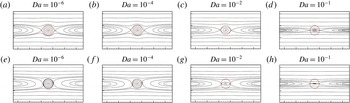
To understand better the flow field inside and around the rotating porous particle, we plot typical results of the streamlines for the shear flow in figure 5. The streamlines for
 $B=2$
and
 $B=4$
are quite similar, so we show only the results for
 $B=4$
in figure 5. We find that a particle with higher
 $Da$
is effectively more permeable, indicating that the permeability has a strong influence on the flow field interior and exterior to the rotating particle in the shear flow at finite
 $Re_{p}$
, as in the results without inertia given by Masoud et al. (Reference Masoud, Stone and Shelley2013). In addition, the flow pattern in figure 5 is similar to that of a solid particle freely rotating in shear flow given by Ding & Aidun (Reference Ding and Aidun2000) and Zettner & Yoda (Reference Zettner and Yoda2001). For a solid impermeable particle, it is argued that the particle rotation is determined by a positive torque exerted by fluid flows adjacent to the two bounding walls moving in opposite directions, and a negative torque due to the recirculation of fluid flow in the middle of the channel (Ding & Aidun Reference Ding and Aidun2000; Zettner & Yoda Reference Zettner and Yoda2001). Besides these two contributions, a third fluid layer moving near and around the particle at the surface exists, and transfers momentum from the moving walls and the recirculating flow to the particle, but the net effect of the fluid layer around the particle plays a minor role in reducing the particle rotation. For a porous particle, however, the flow that penetrates the particle plays an important role in the particle behaviour, i.e., many streamlines (which are dependent upon the permeability) can penetrate and pass through the particle, reducing the contribution to the angular velocity of the particle from the recirculation region. Thus, we examine the effect of fluid inertia and permeability on the flow rate through the particle. Since the flow rate through the entire particle is zero, based on the symmetrical flow field, we calculate the flow rate passing the top-half of the porous particle at steady state
 $Q_{porous}=U_{aver}D/2$
for all the cases, where
 $U_{aver}$
stands for the average velocity along the top radius in the
 $y$
-direction of the particle. To compare with the flow rates with various
 $Re_{p}$
and
 $Da$
,
 $Q_{porous}$
is normalized by the flow rate through the top-half of an infinitely permeable particle (the porosity
 $\unicode[STIX]{x1D700}=1$
),
 $Q_{tp}$
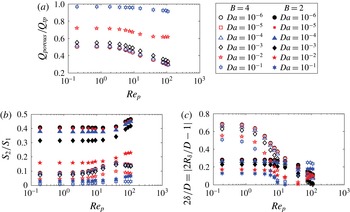
. In figure 6, we find that the normalized flow rate decreases with increasing
 $Re_{p}$
at the same
 $Da$
with
 $B=4$
, and there also exists a critical Reynolds number
 $Re_{p}^{\ast }$
. For
 $Re_{p}<Re_{p}^{\ast }$
, the flow rate remains almost constant with increasing
 $Re_{p}$
, and when
 $Re_{p}>Re_{p}^{\ast }$
, the flow rate decays rapidly with
 $Re_{p}$
. The reason may be that the normalized flow rate depends on the particle rotation at steady state, and the value of
 $\unicode[STIX]{x1D714}/G$
decreases with
 $Re_{p}$
. We also find that the normalized flow rate increases with
 $Da$
at various
 $Re_{p}$
, indicating that the permeability strongly affects the flow rate through the particle. Additionally, the curves of normalized flow rates for
 $B=2$
with various
 $Re_{p}$
and
 $Da$
present a similar trend.
(a) Dimensionless flow rate at steady state
 $Q_{porous}/Q_{tp}$
through the top-half of a porous particle as a function of
 $Re_{p}$
at various
 $Da$
with
 $B=4$
; (b) value of
 $S_{2}/S_{1}$
as a function of
 $Re_{p}$
at various
 $Da$
and
 $B$
; (c) locations of the stagnation points as a function of
 $Re_{p}$
at various
 $Da$
and
 $B$
,
 $R_{\unicode[STIX]{x1D6FF}}$
is the distance between the stagnation point and the centre of the particle.

Figure 5 shows that the location of the stagnation point and the area of recirculating flow change with
 $Re_{p}$
,
 $Da$
and
 $B$
. Following Zettner & Yoda (Reference Zettner and Yoda2001), therefore, we present a simple scaling argument based on the balance of torque exerted by the fluid flow to explain the effects of
 $B$
,
 $Re_{p}$
and
 $Da$
on
 $\unicode[STIX]{x1D714}/G$
. Similarly, one circular porous particle of diameter
 $D$
rotating steadily at angular velocity
 $\unicode[STIX]{x1D714}$
in a channel of height
 $H$
and the maximum shear velocity
 $U$
on the wall is considered. We assume that the velocity profiles near the particle surface are roughly linear; thus, the positive torque contributed by the movement of the bounding walls is
 $T^{+}\sim \unicode[STIX]{x1D707}(\unicode[STIX]{x0394}u_{r}/\unicode[STIX]{x0394}r)\unicode[STIX]{x0394}S\sim \unicode[STIX]{x1D707}((U-0.5\unicode[STIX]{x1D714}D)/0.5(H-D))S_{1}\sim \unicode[STIX]{x1D707}((B-\unicode[STIX]{x1D714}/G)/(B-1)/G)S_{1}$
, and the negative torque due to recirculation of fluid flow is
 $T^{-}\sim \unicode[STIX]{x1D707}(\unicode[STIX]{x0394}u_{r}/\unicode[STIX]{x0394}r)\unicode[STIX]{x0394}S\sim \unicode[STIX]{x1D707}(0.5\unicode[STIX]{x1D714}D/\unicode[STIX]{x1D6FF})S_{2}\sim \unicode[STIX]{x1D707}(\unicode[STIX]{x1D714}/G/(2\unicode[STIX]{x1D6FF}/(GD)))S_{2}$
, where
 $\unicode[STIX]{x1D6FF}$
is the distance between the stagnation point and the centre of the particle surface, i.e.,
 $\unicode[STIX]{x1D6FF}=|R_{\unicode[STIX]{x1D6FF}}-D/2|$
, and
 $R_{\unicode[STIX]{x1D6FF}}$
is the distance between the stagnation point and the centre of the particle.
 $S_{1}$
and
 $S_{2}$
are the effective areas of the flow imposing the positive and negative torques on the particle, respectively. Noting that the steady
 $\unicode[STIX]{x1D714}/G$
in shear flow is actually a balance of the aforementioned positive and negative torque, we can estimate the angular velocity of the porous particle from the following simple scaling argument:
 $$\begin{eqnarray}\unicode[STIX]{x1D714}/G\sim \frac{1}{\displaystyle 0.5\frac{S_{2}}{S_{1}}\frac{D}{\unicode[STIX]{x1D6FF}}+\left(1-0.5\frac{S_{2}}{S_{1}}\frac{D}{\unicode[STIX]{x1D6FF}}\right)\frac{1}{B}}\sim \frac{B}{\displaystyle 0.5\frac{S_{2}}{S_{1}}\frac{D}{\unicode[STIX]{x1D6FF}}(B-1)+1}.\end{eqnarray}$$
The values of
 $S_{2}/S_{1}$
and the dimensionless distance between the stagnation point and the particle surface are shown in figures 6(b) and 6(c), respectively, as a function of
 $Re_{p}$
for various
 $Da$
and
 $B$
. In figure 6(b,c), we find that the value of
 $S_{2}/S_{1}$
is reduced as
 $B$
increases, and thus the stagnation point moves gradually away from the particle surface, resulting in an increase of
 $\unicode[STIX]{x1D714}/G$
based on (3.1). When
 $B$
is larger than 10, the confinement effect can be omitted in (3.1). This explains the effect of the confinement ratio on the particle rotation. The explanation of the effect of
 $Re_{p}$
is not as straightforward. However, Poe & Acrivos (Reference Poe and Acrivos1975) and Zettner & Yoda (Reference Zettner and Yoda2001) found that the influence of
 $Re_{p}$
can be related to
 $\unicode[STIX]{x1D6FF}$
, the distance between the stagnation point and the particle external surface. For a particle with very small
 $Da$
, i.e. fluid flow is hard to penetrate or pass through the particle, the ratio
 $S_{2}/S_{1}$
increases and the stagnation points of the recirculation flow become closer to the particle surface when
 $Re_{p}$
increases (figure 6
b,c), which in turn leads to a reduction of
 $\unicode[STIX]{x1D714}/G$
based on (3.1), resembling that for a solid impermeable particle (Ding & Aidun Reference Ding and Aidun2000; Zettner & Yoda Reference Zettner and Yoda2001). This can be evidenced by comparing the streamlines in figures 5(a) and 5(e) or figures 5(b) and 5(f). For large
 $Da$
, even though more fluid can penetrate the particle due to the effect of permeability (figures 6
d and 6
h), the value of
 $S_{2}/S_{1}$
also increases with
 $Re_{p}$
. The combined effects of
 $\unicode[STIX]{x1D6FF}$
and
 $S_{2}/S_{1}$
with increasing
 $Re_{p}$
eventually lead to a slow decrease of
 $\unicode[STIX]{x1D714}/G$
for a highly permeable particle (
 $Da=10^{-1}$
), as demonstrated in figure 3. The effect of
 $Da$
can also be explained. Figure 4 depicts that
 $\unicode[STIX]{x1D714}/G$
increases with
 $Da$
for low
 $Re_{p}$
. As seen in figure 5(a–d), for
 $Re_{p}=5.574$
, the stagnation points stay outside of the particle, but when
 $Da$
rises from
 $10^{-6}$
to
 $10^{-1}$
, more and more streamlines penetrate or pass through the particle. Thus,
 $S_{2}/S_{1}$
decreases as the recirculation area is gradually reduced, and we can expect a higher
 $\unicode[STIX]{x1D714}/G$
at steady state following (3.1). At high
 $Re_{p}$
, with increasing
 $Da$
, the stagnation points can move from outside to inside the particle, crossing the external surface of the particle, as shown in figure 5(e–h). In figure 6(c), we find that
 $\unicode[STIX]{x1D6FF}$
first drops and then increases after the stagnation points crossing the external surface of particle at high
 $Re_{p}$
. This explains the existence of a minimum of
 $\unicode[STIX]{x1D714}/G$
when
 $Da$
changes from
 $10^{-6}$
to
 $10^{-1}$
. For high
 $Da$
, the reduction of the recirculation area results in a rapid increase of
 $\unicode[STIX]{x1D714}/G$
, as shown in figure 4.
4 Conclusions
We investigate the rotation of a circular porous particle in a shear flow with
 $Re_{p}$
up to 108 by numerical simulations. The volume-averaged macroscopic momentum equation is used to formulate the fluid flow of a moving porous particle, and a modified single relaxation time lattice Boltzmann method is implemented to solve the macroscopic equation. The code is validated with the analytic solutions given by Masoud et al. (Reference Masoud, Stone and Shelley2013) for the rotation of a porous particle in unbounded shear flow at near-zero
 $Re_{p}$
, and simulation and experimental data given by Ding & Aidun (Reference Ding and Aidun2000), Zettner & Yoda (Reference Zettner and Yoda2001) for a solid impermeable particle with
 $Re_{p}$
up to 108. The effects of fluid inertia, confinement ratio, and permeability are studied. Our results confirm the conclusion by Masoud et al. (Reference Masoud, Stone and Shelley2013) that the permeability has little effect on the rotation of a porous particle in unbounded shear flow without fluid inertia, but also suggest that the role of permeability cannot be neglected when the confinement effect is significant, or the fluid inertia cannot be neglected. The fluid inertia and the confining walls have similar effects on the rotation of a porous particle as they have on a solid impermeable particle. The angular velocity
 $\unicode[STIX]{x1D714}/G$
decays with increasing
 $Re_{p}$
, and the confinement effect suppresses
 $\unicode[STIX]{x1D714}/G$
to below 0.5. The smaller the confinement ratio
 $B$
, the lower the
 $\unicode[STIX]{x1D714}/G$
. The effect of fluid inertia on the rotation of particle is significant for
 $Re_{p}>Re_{p}^{\ast }$
, where the critical
 $Re_{p}^{\ast }$
decreases with the width of channel, and becomes minute when
 $Re_{p}\leqslant Re_{p}^{\ast }$
. The permeability impacts the rotation of a porous particle in a more complicated way in bounded flow. For low
 $Re_{p}$
,
 $\unicode[STIX]{x1D714}/G$
increases with
 $Da$
. For large
 $Re_{p}$
,
 $\unicode[STIX]{x1D714}/G$
as function of
 $Da$
first drops slowly to a minimum, then rises rapidly. Following Zettner & Yoda (Reference Zettner and Yoda2001), we find that a simple scaling argument based on the balance of a positive torque exerted by fluid flows adjacent to the two bounding walls and a negative torque due to the recirculation of fluid flow in the middle of the channel can explain our results.
Acknowledgement
This work is funded by the National Natural Science Foundation of China (grant no. 91334205).