Introduction
Reliable diagnosis of drive fed induction motor (IM) faults becomes a difficult task, covering the vast operational range. The fault-related frequency and amplitudes of the fault signals become uncertain with a wide change in speed (Nandi et al., Reference Nandi, Toliyat and Li2005; Konar and Chattopadhyay, Reference Konar and Chattopadhyay2011; Garcia-Ramirez et al., Reference Garcia-Ramirez, Osornio-Rios, Granados-Lieberman, Garcia-Perez and Romero-Troncoso2012). The relationship between the fault signals and the speed (or load) is, therefore, too complex to be formulated in strict analytical equations. Further, the additional converter system pollutes the current frequency spectrums. The characteristic frequency components for a specific faulty motor may be obscured by the noise. Thus, because of the failure of theoretical approach and mathematical (cause effect) model-based approach, a data-driven approach can be used as an alternative for fault diagnosis of drive fed IM.
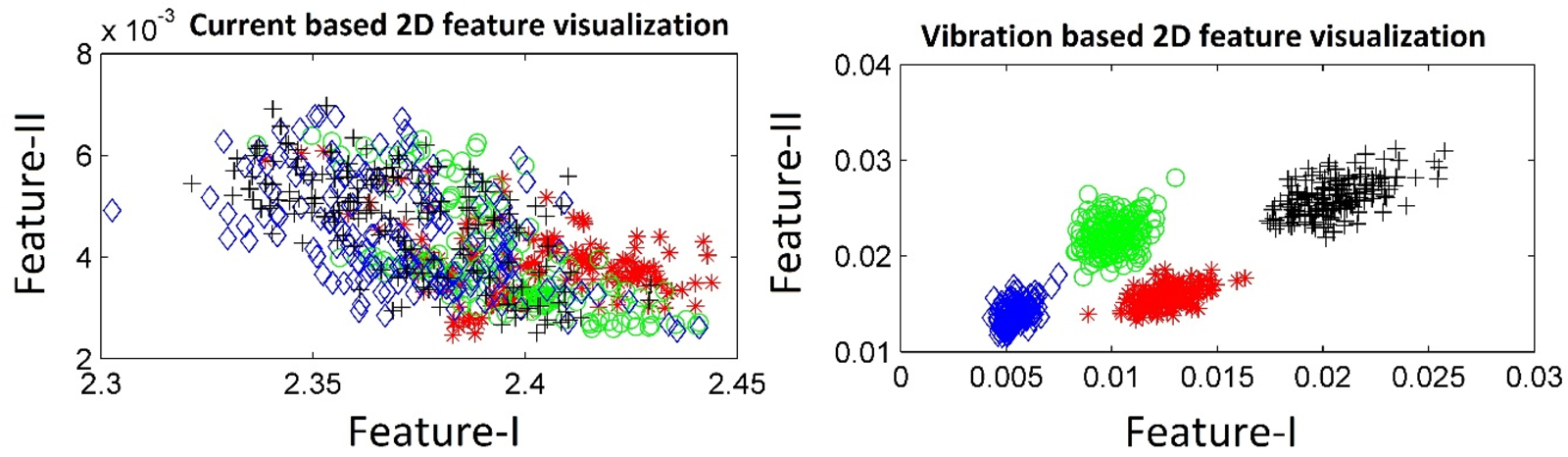
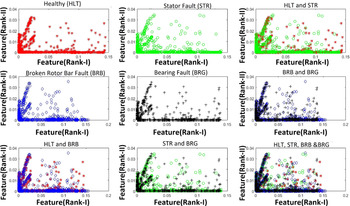
The data-driven approaches for fault diagnosis of IM are based on classifiers like multilayer perceptron (MLP), radial basis function network (RBF), support vector machine (SVM), and k-NN. However, these machine learning techniques have mainly explored the area of vibration-based data-driven approaches (Alag et al., Reference Alag, Agogino and Morjaria2001; Liu and Wang, Reference Liu and Wang2001; Wang and Vachtsevanos, Reference Wang and Vachtsevanos2001; Konar and Chattopadhyay, Reference Mallat2011; Konar et al., Reference Konar, Panigrahy, Chattopadhyay, Prasath, Vuppala and Kathirvalavakumar2015) where the data pattern is relatively less complex in nature. In the data-driven approach, raw vibration signals having complex waveform produce good quality data in the feature space. However, the vibration-based monitoring fault diagnosis method is very sensitive to noise and, hence, not suitable for the industrial environment. On the other hand, the motor current signature analysis is considered as comparatively worthy because of its simplicity, availability of cheap and qualitative sensors and less sensitivity to noise. Motor current signature analysis (MCSA) based motor fault detection methods depend on either transient start-up (Ordaz-Moreno et al., Reference Ordaz-Moreno, Romero-Troncoso, Vite-Frias, Rivera-Gillen and Garcia-Perez2008; Garcia-Perez et al., Reference Garcia-Perez, Romero-Troncoso, Cabal-Yepez, Osornio-Rios, Rangel-Magdaleno and Miranda2011; Cabal-Yepez et al., Reference Cabal-Yepez, Garcia-Ramirez, Romero-Troncoso, Garcia-Perez and Osornio-Rios2013) or steady-state currents (Knight and Bertani, Reference Knight and Bertani2005; Zhang et al., Reference Zhang, Du, Habetler and Lu2011). It has been surveyed that most research papers have primarily addressed rotor-related faults, followed by stator-related faults, and finally, with bearing faults using MCSA (Nandi et al., Reference Nandi, Toliyat and Li2005; Zhang et al., Reference Zhang, Du, Habetler and Lu2011)-based approach. The most frequently occurred faults such as bearing faults are less investigated by the research community. Identification of such defects play a crucial role when a converter comes in the scenario and the raw current signal is used, as it yields the overlapping region among the various fault classes with the complex data pattern in the feature space. This makes the crucial challenge in the area of stator current-based fault classification of IMs. The typical data pattern of current and vibration signals in their best two-dimensional (2D)-feature space for one operating condition of the motor are presented in Figure 1, respectively.
Feature visualization in best 2D space.

The classification of raw data often involves the problem of selecting the appropriate set of features to represent the input data. In general, various features can be extracted from the input dataset, but only some of them are relevant for the classification process. Since relevant features are often unknown in real-world problems such as present work where the complex data pattern is dealt, many candidate features are usually introduced (Liu and Wang, Reference Liu and Wang2001; Jawadekar et al., Reference Jawadekar, Paraskar, Jadhav and Dhole2014; Tyagi and Panigrahi, Reference Tyagi and Panigrahi2017). This degrades the predictive accuracy of many frequently used classifiers due to the presence of irrelevant and redundant features in the main feature pool. So, as an additional task, the feature selection (FS) method are widely used in several applications to remove such irrelevancy. Further, in this regard, an efficient classifier, embedded with the inherent feature selection (FS) scheme is encouraged.
Random forest (RF) is an emerged machine learning technique used in different fields and less explored in the area of motor fault diagnosis. In this paper, the worthiness of RF classifier has been exploited for the multiple fault detection of IM in the vast complex scenario raised by the drive system. Discrete wavelet transform-inverse discrete wavelet transform (DWT-IDWT) algorithm-based statistical features are extracted from stator current, and the performances of a large variety of machine learning approaches, targeting the drive operated wide frequency ranges, have been studied. The novelty of the paper lies on the intelligent use of inherent feature selection and ensemble process of RF classifier to solve the complex data pattern without compromising with computational complexity, making the system suitable for industrial applications.
Proposed scheme and data acquisition
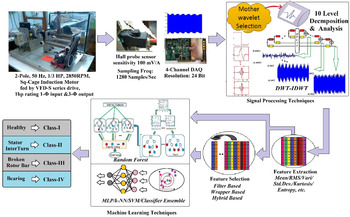
In the present investigation, the advantages of RF over other machine learning tools have been exploited to resolve the bottlenecks of stator current-based multiclass fault diagnosis of IM using data-driven approaches. The schematic representation of different approaches is shown in Figure 2.
The schematic representation of the algorithm.

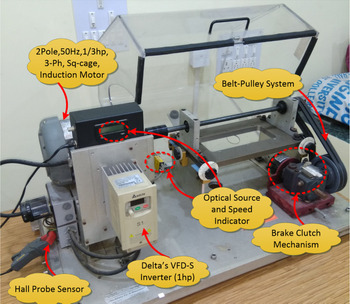
Validation of data-driven algorithm on a device that emulates real-world machinery is truly necessary. So, the experimental investigations were carried out on Machinery Fault Simulator (MFS), a laboratory prototype from Spectra Quest to emulate different IM faults (Konar and Chattopadhyay, Reference Konar and Chattopadhyay2011; Konar et al., Reference Konar, Panigrahy, Chattopadhyay, Prasath, Vuppala and Kathirvalavakumar2015; Panigrahy et al., Reference Panigrahy, Mitra, Konar and Chattopadhyay2016). One healthy motor and three faulty motors of the identical specification were kept on the testbed individually and stator current was recorded at a sampling frequency of 1.28 kHz for every operational condition. Three faulty motors were Bearing Fault: motor with inner and outer raceway fault; Stator inter-turn fault: motor with inter-turn fault by using an appropriate series resistance in the available path; and Broken rotor bar fault: motor with three broken rotor bars out of 34. The rating of each motor was 1/3 H.P., 190 V, 50 Hz, and 2980 rpm. The setup has the provision to vary the mechanical loading using a magnetic clutch gear mechanism. Each type of motor was operated under 6 loading conditions at every supply frequency. These load variations refer to no-load (0.05649 Nm), 1-unit load (0.22596 Nm), 2-unit load (0.45193 Nm), 3-unit load (0.67790 Nm), 4-unit load (0.90387 Nm), and 5-unit load (1.129848 Nm). The whole experimental setup is shown in Figure 3.
The experimental setup for motor fault analysis.

Feature extraction
In any classification problem, the extraction of features from a raw signal plays a vital role. Various features can be extracted from frequency domain information. However, the main drawback in frequency domain analysis is that the fault signature confirms their existence only in the intense resolution domain (Panigrahy and Chattopadhyay, Reference Panigrahy and Chattopadhyay2018). In turn, a huge dataset accounting for large acquisition time is required. So, in the present work, time-domain features are extracted from different sub-bands of discrete wavelet transform (DWT)-inverse DWT (IDWT) algorithm (Garcia-Perez et al., Reference Garcia-Perez, Romero-Troncoso, Cabal-Yepez, Osornio-Rios, Rangel-Magdaleno and Miranda2011; Romero-Troncoso et al., Reference Romero-Troncoso, Saucedo-Gallaga, Cabal-Yepez, Garcia-Perez, Osornio-Rios, Alvarez-Salas, Miranda-Vidales and Huber2011; Panigrahy et al., Reference Panigrahy, Mitra, Konar and Chattopadhyay2016). DWT is a dyadic process of orthogonal decomposition of the signal information by using an appropriate low- and high-pass filter. The decomposition process can be represented in terms of dilation equations of selected basis function, where the coefficient sequence represents the impulse response of the filter bank. Therefore, the relationship of scaling function Φ(t) and wavelet function ψ(t) with filters can be written as follows:
 $${\varphi }_L = \sum\limits_k {h\lpar k\rpar 2^{\lpar {L + 1/2} \rpar }} {\varphi }\lpar {2^{L + 1}t-k} \rpar, $$
 $${\psi }_L = \sum\limits_k {g\lpar k\rpar 2^{\lpar {L + 1/2} \rpar }} {\varphi }\lpar {2^{L + 1}t-k} \rpar, $$
where h(k) and g(k) are the impulse response of low- and high-pass filters, respectively, and these filters are called as analysis filters.
 $$G_0\lpar z \rpar H_0\lpar {-z} \rpar + G_1\lpar z \rpar H_1\lpar {-z} \rpar = 0,$$
 $$G_0\lpar z \rpar H_0\lpar z \rpar + G_1\lpar z \rpar H_1\lpar z \rpar = k\lpar D\rpar,$$
 $$k\lpar D\rpar = 2C_0Z^{{-}D}.$$
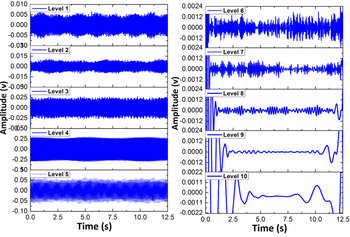
In the whole process of DWT-IDWT, the utilized filters satisfy two prime conditions given in Eqs (3)–(5) aiming the cancelation of aliasing and perfect reconstruction, respectively. H 0(z) and H 1(z) are, respectively, the z-domain response of low- and high-pass filters at analysis section, and similarly, G 0(z) and G 1(z) are at synthesis section. C 0 and D are constant and delay, respectively. The collected discrete data samples are processed through 10-level DWT-IDWT architecture where filtered data at different levels are used for feature extraction. A typical 10-level decomposition of the raw stator current signal at 50 Hz operational frequency is presented in Figure 4. In this study, a novel mother wavelet selection criterion is applied which is discussed in the following subsection and it is found that Daubechies-10 (db10)-based mother wavelet has been found effective among db1–db20 mother wavelets.
Reconstructed details of 10-level DWT-IDWT.

Eight different statistical features (Mean – average, RMS – energy, Variance – random variability w.r.t average, standard deviation – mean-square deviation w.r.t average, Kurtosis – peakness w.r.t normal distribution, Crest – ratio of peak values to the effective value, entropy – randomness, and Skewness – degree of asymmetrical property w.r.t average of set data points) are evaluated from each of the detailed filtered signals to extract knowledge. So, the total of 80 features (10-level * 8 features) are extracted for each instance and used as attributes to the machine learning algorithm to classify various motor conditions.
The typical pattern of the data in 2D feature spaces is furnished in Figure 5. To measure the compactness and separation ability of the fault classes, Davies–Bouldin index (DBI) (Arlot and Celisse, Reference Arlot and Celisse2010; Xue et al., Reference Xue, Zhang, Browne and Yao2016) was calculated, which yields a value of 69.8530. Such a high value of DBI represents large overlapping data, which is also reflected from the pictorial representation of the data distribution as shown in Figure 5.
Typical data distribution of stator current in 2D feature space.

Mother wavelet selection
In the area of motor fault diagnosis, many researchers have applied various higher-order Daubechies filters in view of the less overlapping region between the dyadic frequency bands by which the computational complexity becomes huge without any proper justification (Antonino et al., Reference Antonino, Riera, Roger-Folch and Molina2006; Rafiee et al., Reference Rafiee, Rafiee and Tse2010; Mehrjou et al., Reference Mehrjou, Mariun, Karami, Noor, Zolfaghari, Misron, Kadir, Radzi, Marhaban and Baleanu2015). It is found that a proper investigation accounting for a suitable wavelet selection in this field is still at infancy. A rigorous study using various mother wavelet selection is carried out in this work where the effects of different orders of Daubechies family (Mallat, Reference Mallat2009), such as db1, db2, db3…db20, are investigated.
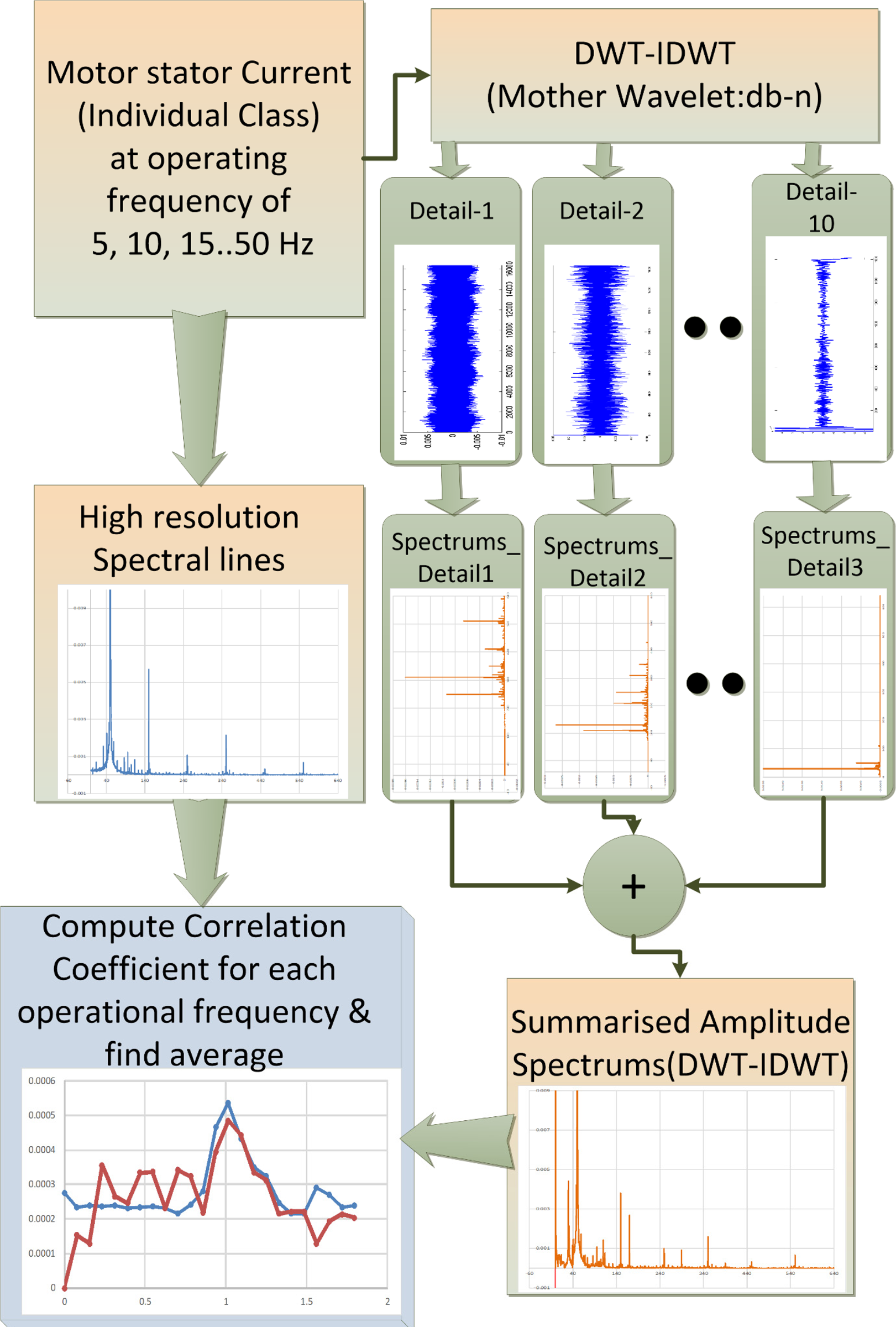
Applying DWT-IDWT algorithm, various reconstructed signals related to different frequency bands are analyzed where the unique fault patterns are highlighted effectively depending upon the selected mother wavelet in DWT-IDWT architecture. These fault signatures can also be pronounced effectively in high-resolution spectral lines and could not be noticeable in low resolution. However, high resolution in frequency analysis, accounts for large measurement time (T M) as Δf = 1/T M which is the drawback of the frequency domain fault detection method. Hence, the feature extraction process in this work is applied over time-domain data coming from DWT-IDWT where the application of suitable mother wavelet plays a vital role in underlining the anomaly pattern in various details. So, realizing all above facts, the selection procedure of appropriate mother wavelet is studied by investigating the frequency spectrums in each dyadic band in good resolution. These amplitude spectrums are superimposed, and a final summarized spectral information is developed from reconstructed signals of DWT-IDWT. Finally, these DWT-based frequency spectrums are correlated with that of original data, keeping both in the same and high-resolution domain. The correlation coefficient (CC) (Mallat, Reference Mallat2009; Panigrahy and Chattopadhyay, Reference Panigrahy and Chattopadhyay2018) decides the similarity index between these two sets of frequency information. The whole procedure is depicted in Figure 6.
Algorithm for mother wavelet selection.

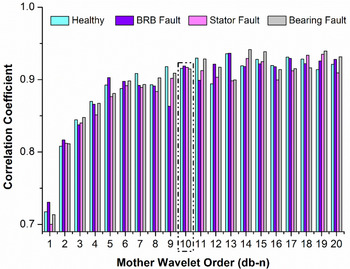
A rigorous study using various mother wavelet selection is carried out where the effects of different orders of Daubechies family, such as db1, db2, db3…db20, are investigated. For each mother wavelet, the CC values are computed for 10 sets of current data accounting for 10 operational frequencies and the average of all CC values is evaluated. Every individual class of motor is analyzed in such a way. The average CC values for each class can be realized from Figure 7 for all investigated mother wavelets.
Class-wise CC analysis for different mother wavelets.

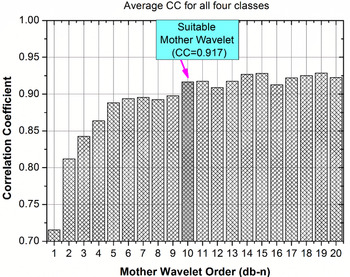
Finally, the average CC values covering all four classes are also obtained as shown in Figure 8 and based on such an average value of all class, a suitable mother wavelet is selected. It is observed from Figure 8 that similarity factor or CC values are found to be increasing from db1 to db9 and almost steady after the use of db10 mother wavelet. Further, the order of the mother wavelet influences the computational burden of the whole algorithm such as db20 mother wavelet uses 40 coefficients whereas algorithm complexity is reduced to 50% using db10 mother wavelet as it uses only 20 coefficients (Antonino et al., Reference Antonino, Riera, Roger-Folch and Molina2006).
Overall analysis (four class) for optimum mother wavelet selection.

Accounting above facts db10 mother wavelet is considered as the most suitable mother wavelet in this work. The investigation affirms of selecting the optimum or suitable mother wavelet of db10 without compromising the accuracy level in shape matching and restricts the application of higher-order wavelet which unnecessarily creates a complex hardware platform.
Data preparation
With reference to the MFS and data acquisition system in the section “Proposed scheme and data acquisition”, the VFD (Variable Frequency Drive)-S series drive of 1 hp rating with 1-Φ input and 3-Φ output has been used in the setup. Each motor was run for 10 supply frequencies which were changed at a step of 5 Hz covering 5–50 Hz and six motor loading conditions were dealt at every operating frequency. So, there were total of 60 operating conditions (10 supply frequencies × 6 loading condition) attained for each of the four motors. In every operating condition, 32 instances were investigated where an instance represents a single time window of duration 0.4 s with a sampling frequency of 1.28 kHz. Thus, for each motor case, 1920 total instances (60 operating condition × 32 instances) were investigated. The total 80 features as described in the section “Feature extraction” were synthesized from 7680 instances associated with four motor cases (1920 instances × 4 motor case) and used as training set data. Statistically independent testing dataset was also collected by running the motors at different times with completely dissimilar supply frequencies and speed (slip), which were not used in the training set. However, for preparing both training and testing datasets, a time window of 0.4 s was selected with a sampling frequency of 1.28 kHz. These training and testing datasets are referred to as original datasets.
Performance analysis
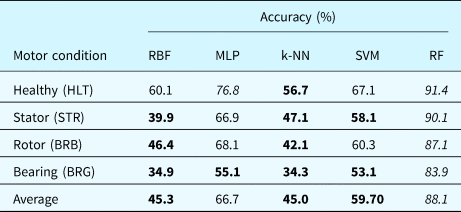
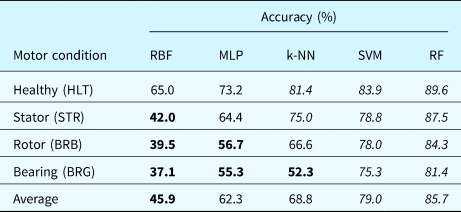
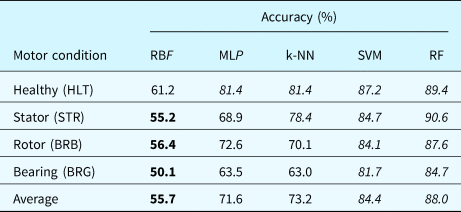
The performances of diverse classifiers with different machine learning algorithms have been evaluated for detecting motor faults using the experimental dataset obtained from the stator current signals as discussed in the earlier section. At first, the chosen architecture of each classifier has been trained by using 80 features extracted from the original training dataset. Once the model was built, it was tested with the statistically independent original testing dataset, which was obtained by running the motors completely at different speeds (slip) and at different times. With proper hyperparameter tuning, the optimum classification accuracies of the individual classifiers with the original 80 features are furnished in Table 1.
Performance of the classifier without applying FS

The bold and italic numerics refers to the category of ‘less than 60%’ and ‘more than 70%’ respectively. Table shows, how the RF shows noticeable classification accuracy with out FS.
It is noteworthy that the performance of the other classifiers including SVM underperform in comparison to the RF approach as shown in Table 1. Particularly, stator winding fault and bearing fault are very badly classified by other classifiers as depicted from Table 1. In the next section, the performance analysis of the various classifiers would be done with relevant feature sets picked up from original 80 features. Various feature selection techniques have been used for this purpose.
Feature selection and analysis
Real-world data are often vague and redundant, creating a lot of problems for powerful machine learning techniques to take decision accurately. This limits the applicability of intelligent techniques to real-world application. During modeling any intelligent system, many more attributes than needed are used to ensure all the necessary information is present which increases the complexity of the system. Moreover, redundant and useless features contained by the large feature set can undermine the classification accuracy. Hence, the performance of the classifiers and optimum size of the feature set are two vital aspects in any data-driven approach. The feature selection techniques help to identify the significant features which can efficiently describe the input–output relationship of data discarding the irrelevant variables.
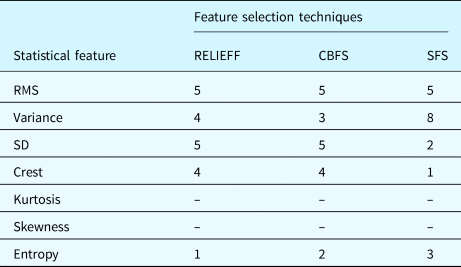
In the present investigation, popular FS methods (Kantardzic, Reference Kantardzic2011; Khalid et al., Reference Khalid, Khalil and Nasreen2014; Mukhopadhyay et al., Reference Mukhopadhyay, Maulik, Bandyopadhyay and Coello2014; Hira and Gillies, Reference Hira and Gillies2015) such as sequential linear forward (SFS), RELIEFF, and class-based feature selection (CBFS) have been used. The most relevant 19 attributes picked up by the various feature selection techniques and are presented in Table 2.
The most relevant attributes

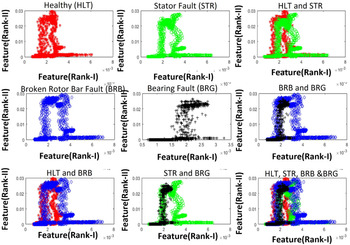
The pictorial representation of the corresponding data distribution in best 2D feature space selected by the SFS-based method is presented in Figure 9 where the DBI (Arlot and Celisse, Reference Arlot and Celisse2010; Xue et al., Reference Xue, Zhang, Browne and Yao2016) is found to be 28.71. Due to the removal of irrelevant features, the clustering quality of data among the fault classes has been improved as indicated by the DBI which is further strengthened by the performance of various classifiers as discussed below.
Data distribution of stator current in best 2D feature space.

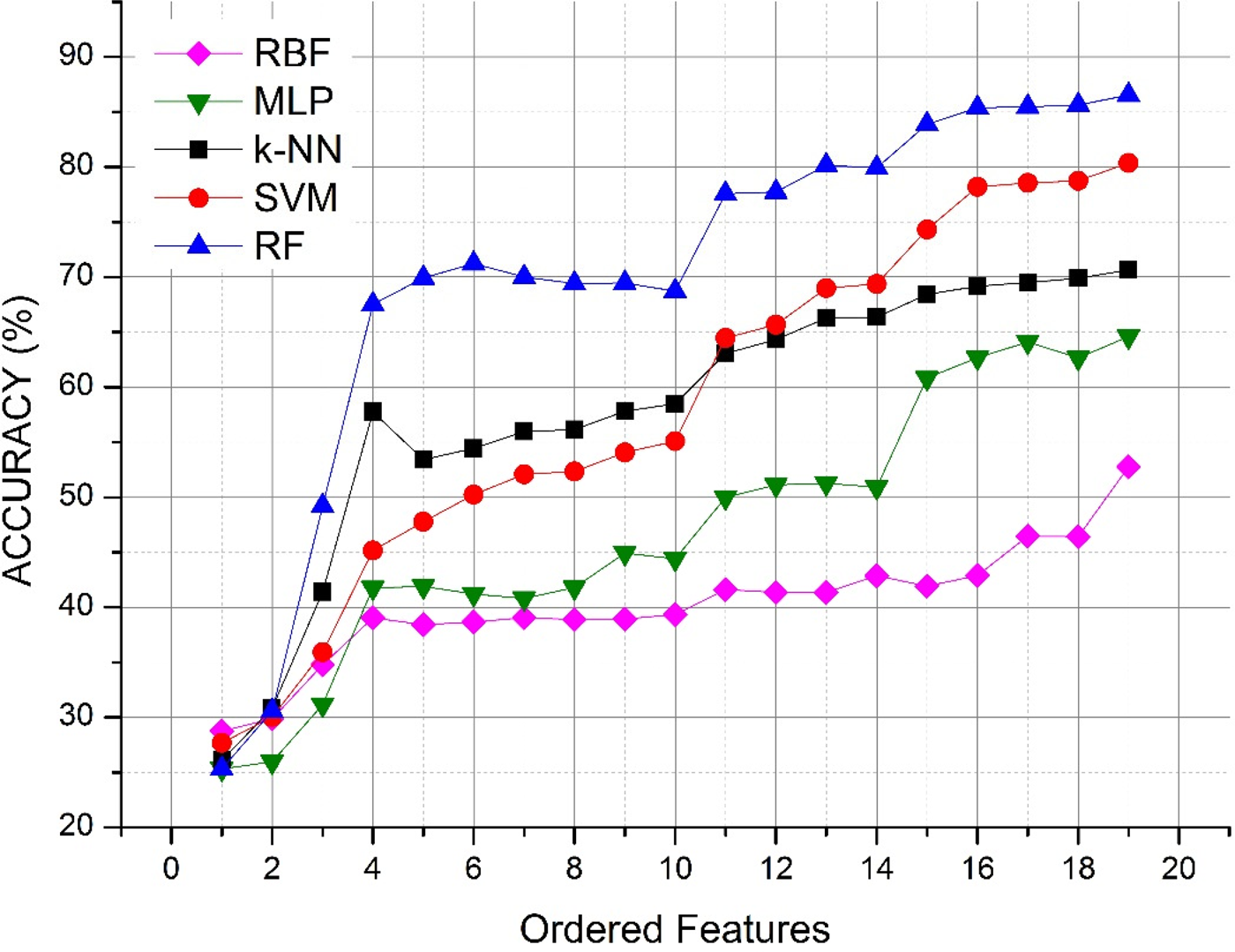
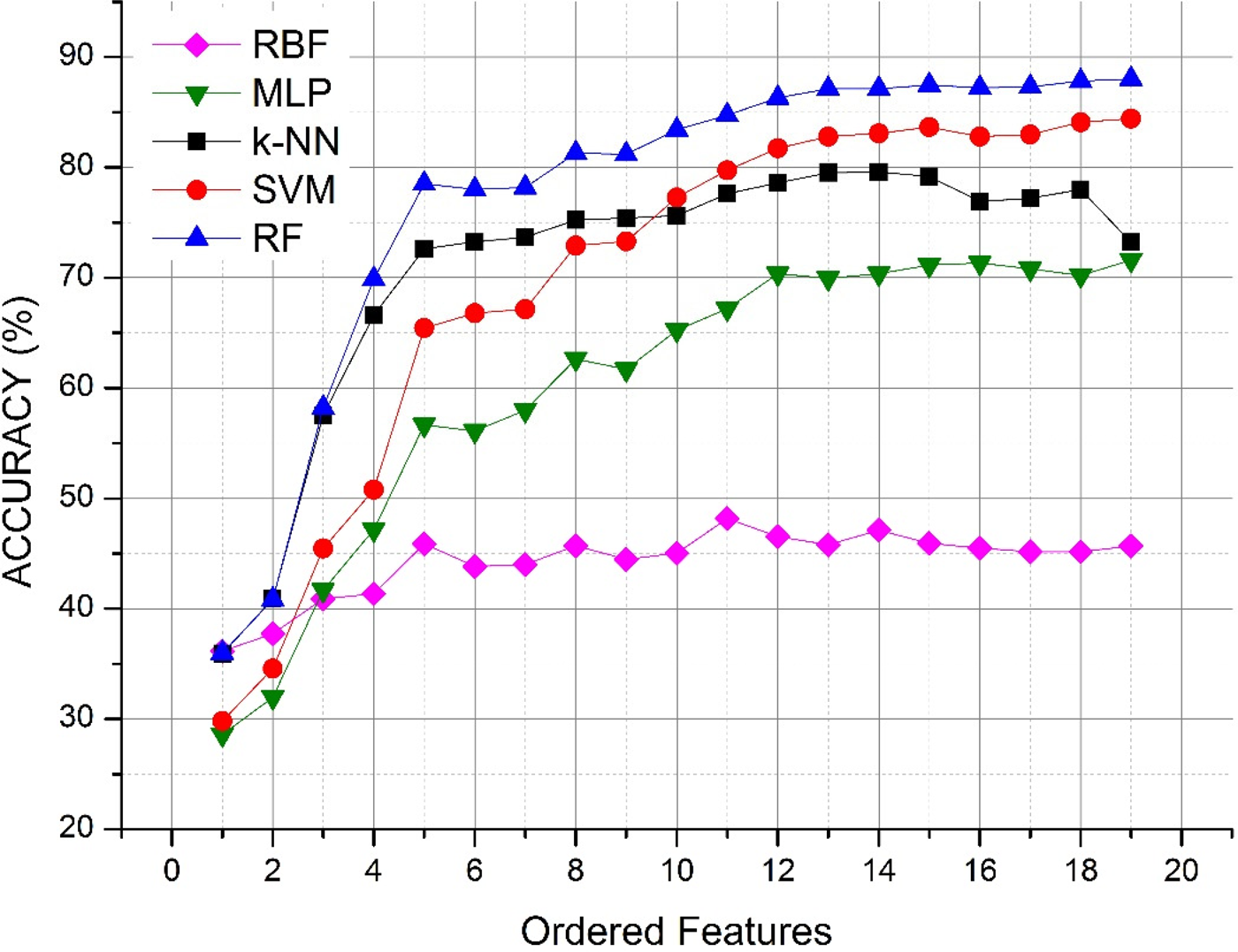
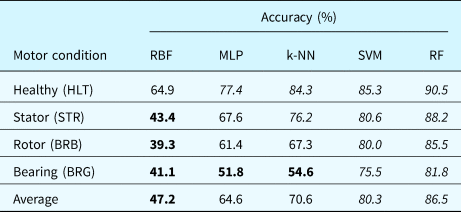
The performances of various classifiers with selected 19 features from each of the FS techniques are presented in Tables 3–5. Correspondingly, the relevant feature subsets picked up by different FS techniques and their performances are furnished in Figures 10–12.
Performance of ranked feature subsets using RELIEFF.

Performance of ranked feature subsets using CBFS.

Performance of ranked feature subsets using SFS.

Performance of classifiers using RELIEFF

The bold and italic numerics refers to the category of ‘less than 60%’ and ‘more than 70%’ respectively. Table shows its consistency with corresponding FS methods.
Performance of classifiers using CBFS

The bold and italic numerics refers to the category of ‘less than 60%’ and ‘more than 70%’ respectively. Table shows its consistency with corresponding FS methods.
Performance of classifiers using SFS

The bold and italic numerics refers to the category of ‘less than 60%’ and ‘more than 70%’ respectively. Table shows its consistency with corresponding FS methods.
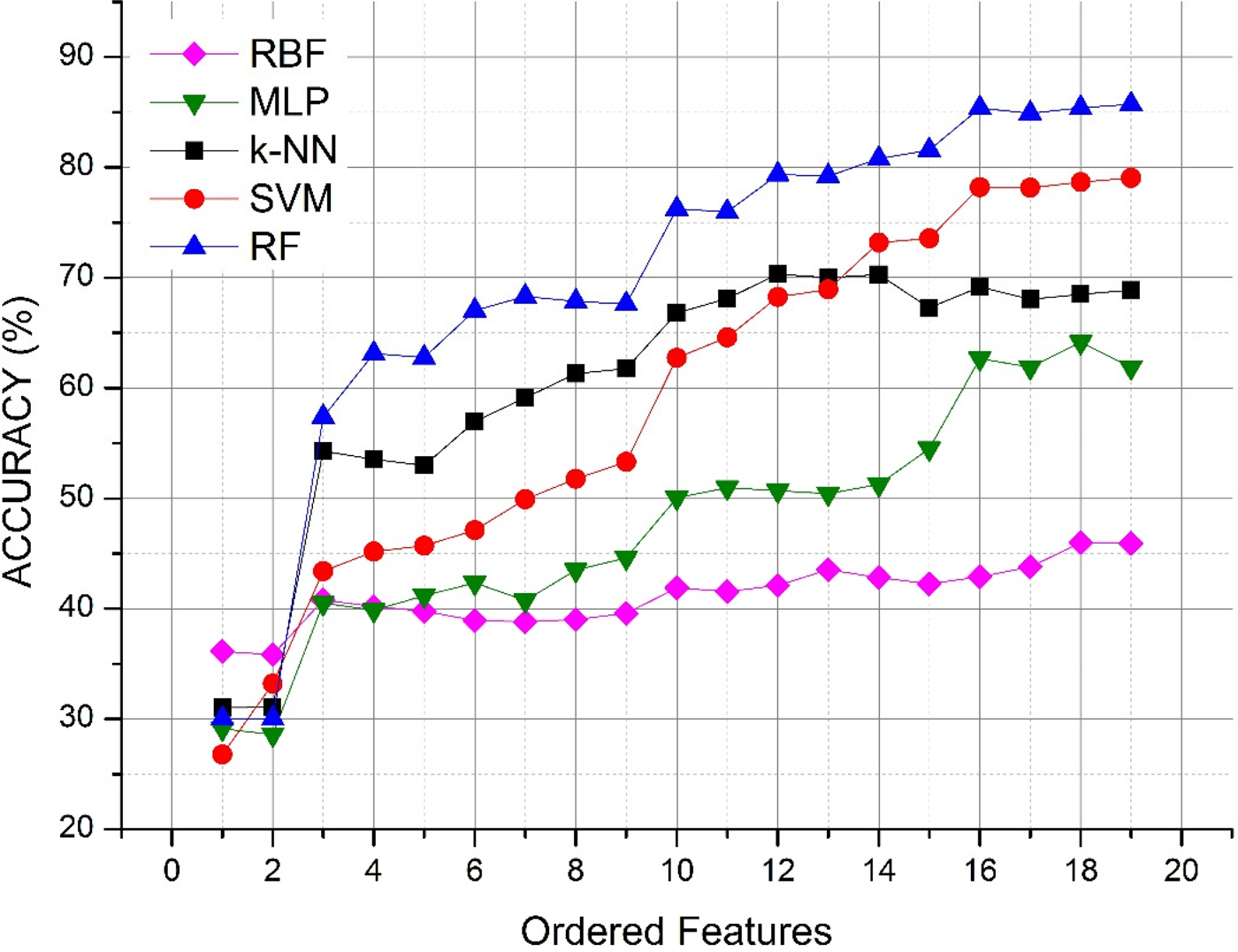
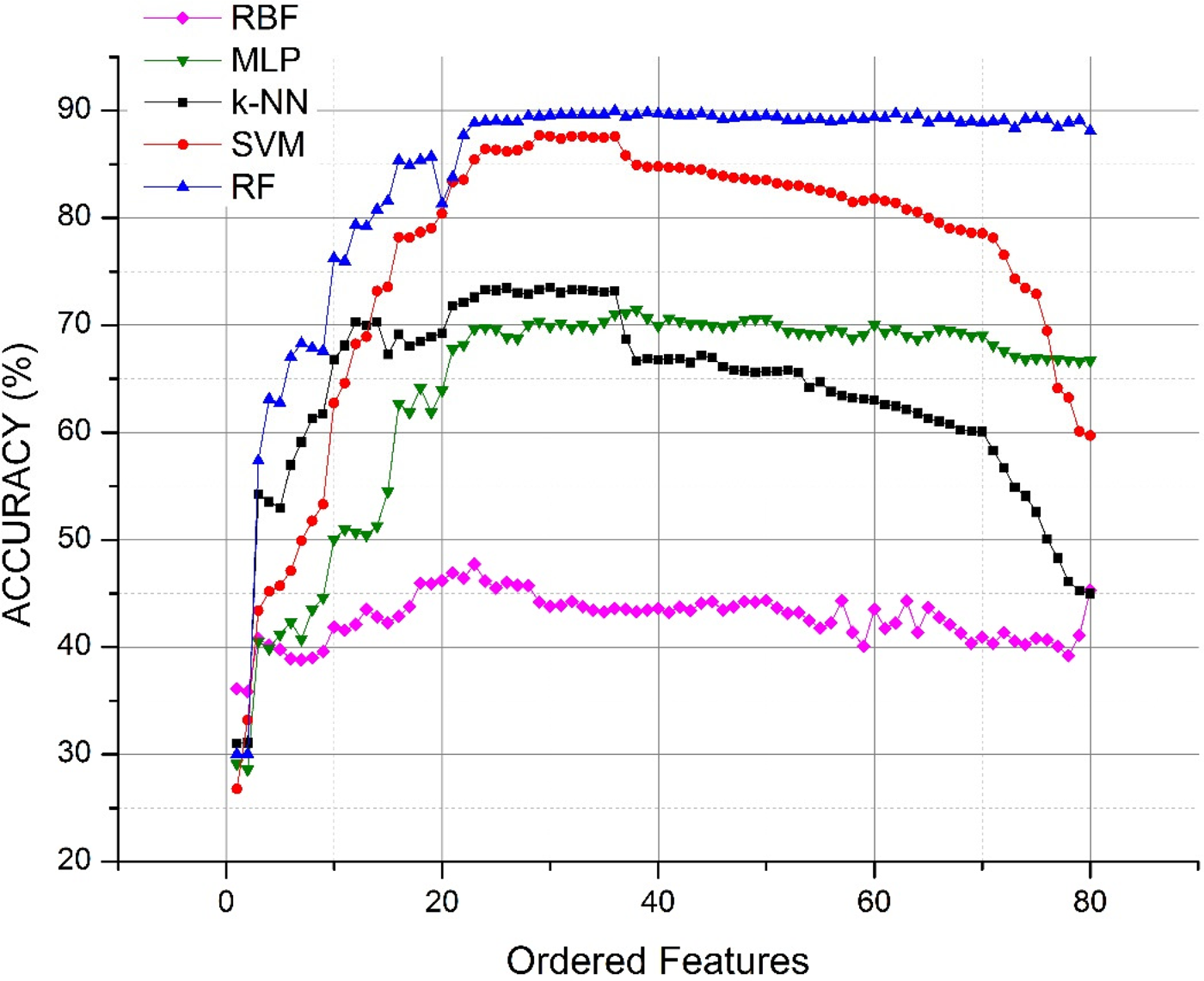
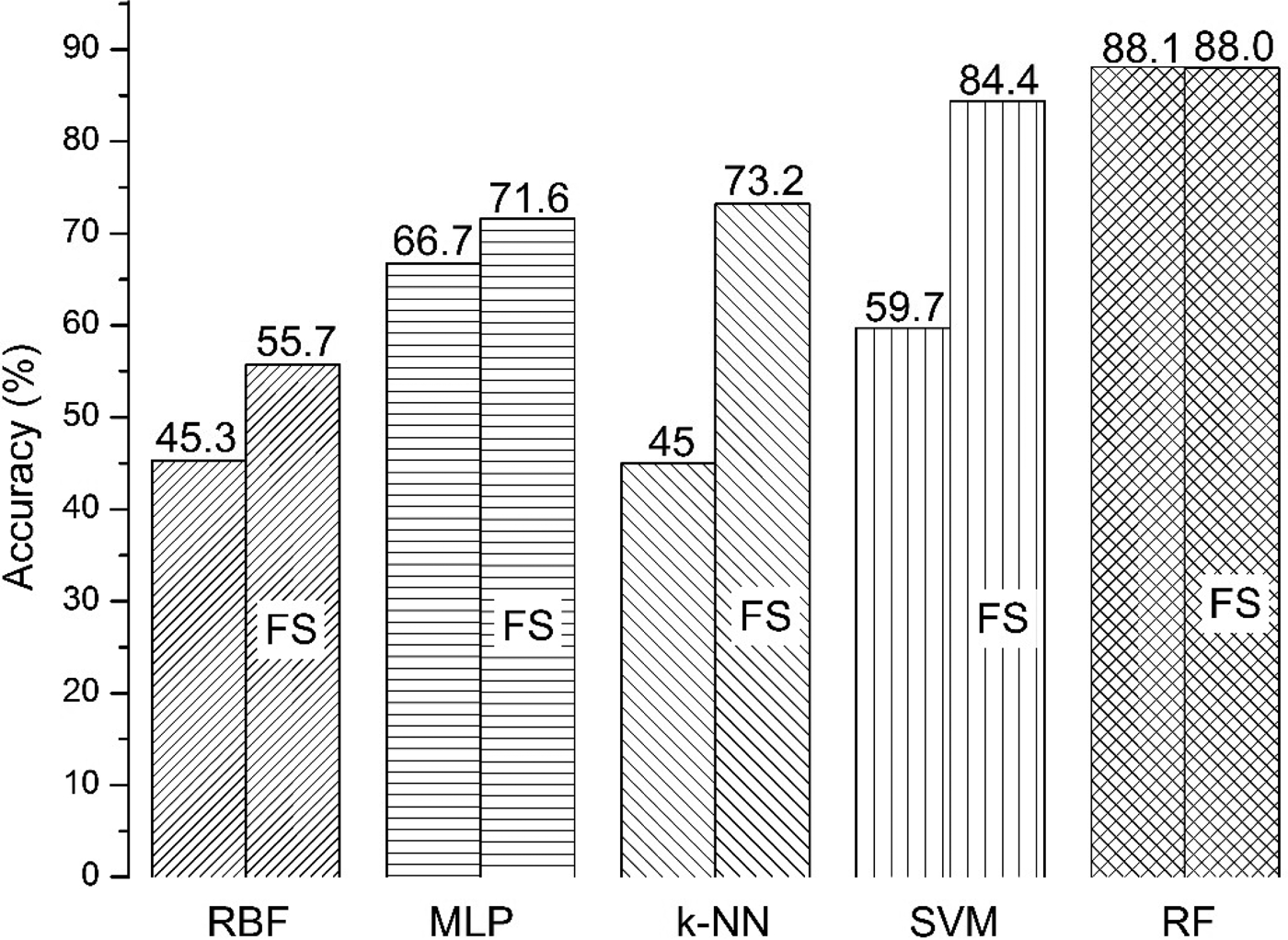
By comparing the obtained classification accuracies of Tables 3–5 with Table 1, it is self-explanatory that the FS techniques are capable of mining good and informative features from the original feature pool. Hence, with the selected feature sets, the performances of all most all the classifiers have been improved to some extent. Particularly, the performance of SVM has boosted up significantly. The only exception is RF. It is evident from Figure 13 that the performances of the classifiers are drooping in nature in the presence of irrelevant features. On the contrary, RF performs consistently even with the inclusion of irrelevant features. The applicability of FS for different classifiers except RF can be realized from achieved improvements in classification accuracies as shown in Figure 14. It is true that after preprocessing the original dataset with the appropriate feature selection technique, SVM is the good competitor of RF. However, in most of the real-life applications, the selection of relevant features is a great challenge and many powerful classifiers underperform in presence of redundant and irrelevant features. In that context, RF is a promising and reliable classifier over others with good generalization.
Performance analysis of classifiers in high-dimensional noisy feature space.

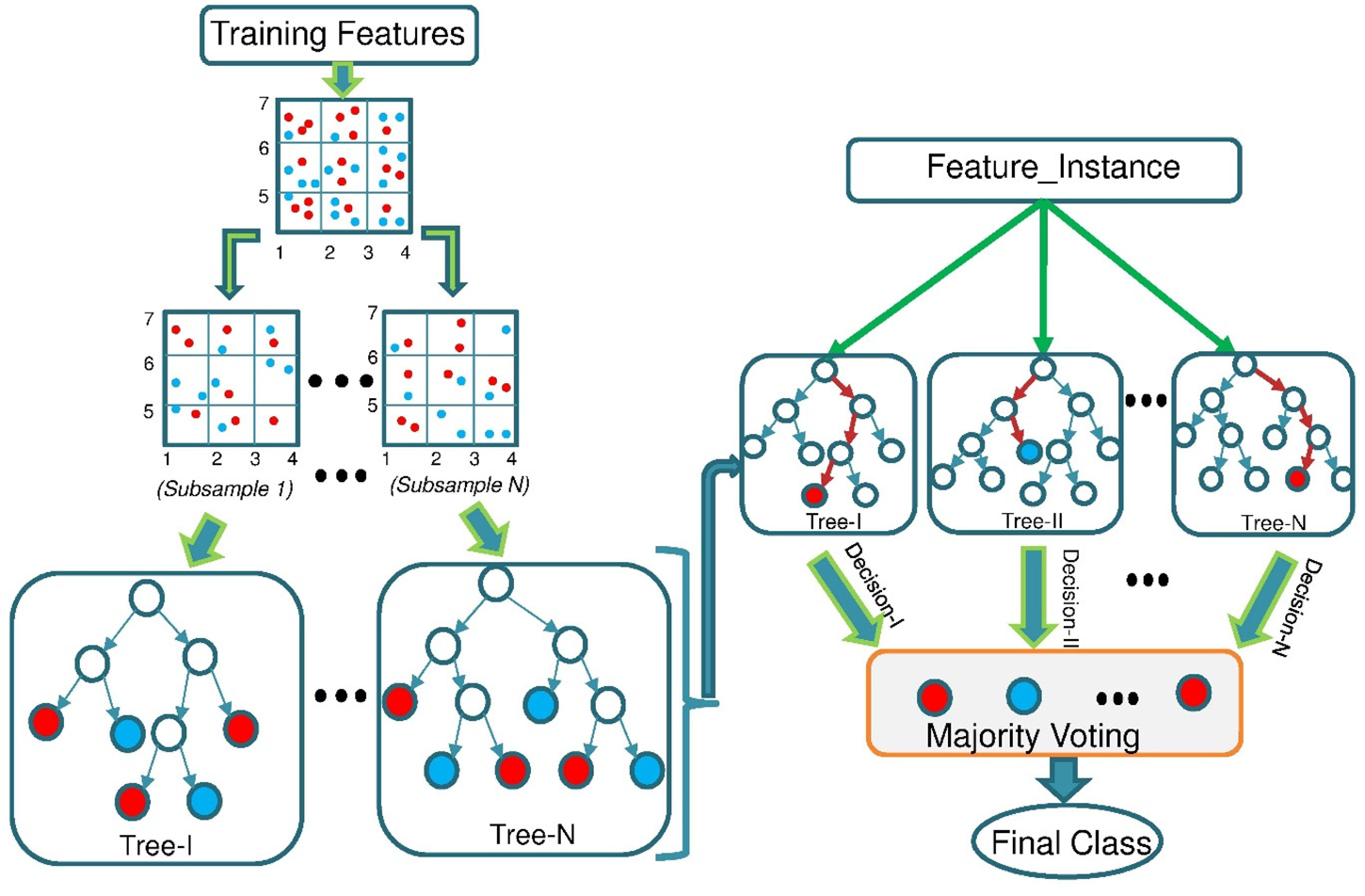
Pictorial representation of RF algorithm.

The robust and consistent performance of RF, even in presence of irrelevant features, can be explained with its built-in feature selection technique and ensemble properties. RF classifier was developed with the belief that the majority must be granted (Zhang et al., Reference Zhang, Li, Liu, Shang, Du, McNairn, Champagne, Dong and Liu2017). RF learning algorithm decomposes a bulky decision tree into a large number of small decision trees, called “forest”, trained with randomly selected feature subset of same training data. The pictorial representation of the RF algorithm is presented in Figure 15. The main motive of creating “forest” is to reduce the variance. If a single decision tree is developed with large number attributes, then the tree becomes outsized, complicated, and greatly affected by the irrelevant features.
Improved performance of classifiers with feature selection.

In this method, the result of the individual tree gets equal weightage and the class which gains the maximum probability is selected as the final class. RF uses a majority voting-based ensemble process by combining the learning models of the same family, with randomly exploited features. So, bootstrapping which requires identically distributed subsamples work nicely for RF (Zhang et al., Reference Zhang, Li, Liu, Shang, Du, McNairn, Champagne, Dong and Liu2017). Thus, the built-in feature selection and ensemble process of RF have helped to perform better over other classifiers including SVM and k-NN.
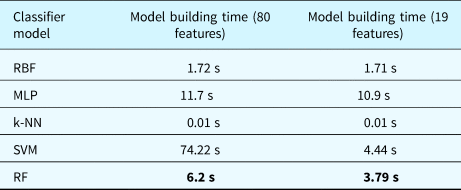
Finally, the average model building times for various machine learning algorithms in the context of multiclass fault diagnosis of variable speed drives are presented in Table 6. By observing Figure 14 and Table 6, it is clear that RF is very much suited for high dimensional and complex feature space associated with present fault diagnosis application. It is capable of filtering the ill effects of irrelevant features on classification, making it suitable for handling the complex data pattern in noisy feature space.
Complexity analysis of machine learning algorithms

The bold and italic numerics refers to the category of ‘less than 60%’ and ‘more than 70%’ respectively. Table shows, how the RF shows noticeable classification accuracy with out FS.
Conclusion
The stator current-based fault diagnosis of IM with a wide range of speed control is a complex pattern classification problem. The conventional machine learning techniques are unable to classify the fault classes with good accuracy level. In this paper, the built-in feature selection and ensemble properties of RF have been exploited with descent classification accuracies for VFD IM. Particularly, RF classifier has shown extraordinary learning ability in the noisy feature space because of its distributive feature model. Hence, RF is the optimum choice for industrial application for stator current-based data-driven fault diagnosis of IM. The investigation in this work explores DWT-IDWT algorithm with a novel criterion for mother wavelet selection and justifies the originality of the work. However, in future to achieve a high level of generalization, deep learning-based self-synthesized feature extraction would be our motivation instead of hand-crafted statistical feature-based feature engineering.
Dr. Parth Sarathi Panigrahy received the B.Tech degree in Electrical and Electronics Engineering from Biju Patnaik University of Technology, Odisha, India, in 2007. Dr. Panigrahy obtained his M.E. and PhD degrees in Electrical Engineering from the Indian Institute of Engineering Science and Technology, Shibpur, India, in 2013 and 2018, respectively. Presently, he is working as a Senior Assistant Professor in the Department of Electrical and Electronics Engineering at Madanapalle Institute of Technology & Science, Madanapalle, Andhra Pradesh, India. His research interest includes application of advanced signal processing techniques and applied soft computing technique in condition monitoring of electrical machines.
Deepjyoti Santra completed the Bachelor of Electrical Engineering degree from Kalyani Government Engineering College, W.B., India, in 2015 and the M.Tech degree in Electrical Engineering from IIEST, Shibpur, India, in 2017. Presently, he is working as an assistant professor in the Global Institute of Management and Technology, West Bengal. His research interests include machine learning, data mining, application of artificial intelligence in the area of electrical engineering, and condition monitoring.
Dr. Paramita Chattopadhyay received her B.E., M.E., and PhD degrees in Electrical Engineering from Bengal Engineering College, Shibpur (Calcutta University) and BESU, Shibpur, India, in 1993, 1996, and 2002, respectively. Presently, she is an Associate Professor in the Department of Electrical Engineering, Indian Institute of Engineering Science and Technology, Shibpur, India. She has published more than 60 research papers in various international journals and prestigious conferences. She has expertise in the area of intelligent signal processing, condition monitoring, intelligent controller, smart grid and energy informatics. Recently, she is exploring application of nanomaterials in the power and energy sector.