


Numerous studies have shown that the dietary patterns and eating behaviours of immigrants residing in Western countries change according to the duration of residence and degree of acculturation in the host country( Reference Satia-About, Patterson and Neuhouser 1 – Reference Redstone Akresh 3 ). Studies on Latino immigrants residing in the USA have shown an association between various measures of acculturation and increased consumption of both healthy and unhealthy foods. More acculturated individuals have been found to consume more fast foods, fatty snacks and sugary beverages and also more fibre and low-fat foods and to more likely engage in fat-avoidance behaviours( Reference Ayala, Baquero and Klinger 4 – Reference Van Rompay, McKeown and Castaneda-Sceppa 8 ). Studies on Chinese and South Asian immigrants residing in North America have also generally found a progressive ‘Westernisation’ of the diet with the duration of residence in the host country and also increased consumption of fibre and vegetables( Reference Rosenmöller, Gasevic and Seidell 9 – Reference Lesser, Gasevic and Lear 11 ). Moreover, a review of studies on changes in dietary patterns after the migration of South Asians to Europe has shown an increased intake of fat and energy and a reduced intake of fibre, fruits and vegetables( Reference Holmboe-Ottesen and Wandel 12 ). Lastly, two reviews of studies on the dietary patterns of the major ethnic groups of immigrants residing in European countries found diverse changes in dietary patterns after migration, which were generally characterised by an increased intake of processed and energy-rich foods and a reduced intake of fibre, as well as preservation of dietary habits characterised by a higher intake of fruits and other elements of their traditional diets( Reference Gilbert and Khokhar 13 , Reference Wandel 14 ).
To date, most of the studies have been conducted among immigrants from countries in nutritional transition who had moved to countries with Westernised diets. However, very few studies have investigated individuals migrating to countries with a high-quality, healthy diet, such as the Mediterranean diet (MD)( Reference Skreblin and Sujoldzic 15 – Reference Delisle, Vioque and Gil 19 ), and none has yet examined this phenomenon in Latin-American immigrants. This type of investigation would be able to help directly assess whether the food environment of the host country can improve the dietary patterns of immigrants.
Thus, the objective of the present study was to examine the association of the duration of residence with obesity-related eating habits (OREH) and dietary patterns among Latin-American immigrants residing in Spain.
Methods
Study design and participants
Data from the ENRICA study (study on nutrition and cardiovascular risk in Spain) were used in the present study; details regarding the ENRICA study have been reported elsewhere( Reference Rodríguez-Artalejo, Graciani and Guallar-Castillón 20 ). Briefly, ENRICA is a cross-sectional study conducted between June 2008 and October 2010 among 12 948 individuals representative of the non-institutionalised population of Spain aged ≥ 18 years. The study participants were selected by stratified cluster sampling. The sample was first stratified by province and size of municipality. Then, clusters were randomly selected in two stages: municipalities and census sections. Finally, the households within each section were selected by random telephone dialling using the directory of telephone landlines as the sampling frame. Individuals within the households were selected proportionally to the distribution of the population of Spain by sex and age group. The sample size of the ENRICA study allows estimation of the prevalence of a risk factor with 95 % CI of ± 1 % assuming a risk factor prevalence of 50 % (worst case) and a sampling design effect of 1·3( Reference Rodríguez-Artalejo, Graciani and Guallar-Castillón 20 , Reference Johnson, Dohrmann and Burt 21 ). The study included structured interviews, physical examination and collection of biological samples. Specifically, information on sociodemographic variables was collected by telephone interviews and that on eating habits and dietary patterns by face-to-face interviews using a diet history( Reference Guallar-Castillón, Sagardui-Villamor and Balboa-Castillo 22 ). The response rate was 51 %, which is similar to or even higher than that in comparable studies carried out in Europe( Reference Aromaa, Koponen and Tafforeau 23 ). A total of 419 Latin-American immigrants residing in Spain were included in the present study.
The participants gave written informed consent. The study protocol was approved by the ethics committees of ‘La Paz’ University Hospital in Madrid and the Hospital Clinic in Barcelona.
Study variables
Duration of residence in Spain
The main independent variable was the duration of residence in Spain, calculated as the difference between the date of arrival to Spain and the date of the interview. The duration of residence was classified into the following categories: < 5; 5–9; ≥ 10 years.
Obesity-related eating habits
The study participants were questioned about the following eight variables, associated with excess weight( Reference Mesas, Muñoz-Pareja and López-García 24 ) and a poor quality of diet( Reference Mesas, Guallar-Castillón and León-Muñoz 25 , Reference Muñoz-Pareja, Guallar-Castillón and Mesas 26 ): (1) eating at fast-food restaurants; (2) purchasing chocolates, candy bars and other snacks from vending machines; (3) eating lunch away from home; (4) consuming pre-cooked foods (for these four variables, a frequency ≥ 1 time/week was considered to represent a risk behaviour); (5) trimming visible fat from meat before eating; (6) removing the skin from chicken before eating; (7) choosing low-energy foods (for these three variables, a frequency of never or almost never was deemed to be a risk behaviour); (8) the time spent having breakfast (for this variable, a risk behaviour was defined as ≤ 5 min). Finally, a risk score was developed using all these variables, which ranged from 0 (optimum) to 8 (highest risk).
Habitual food consumption
Habitual food consumption during the previous year was assessed using a computerised diet history developed from that used in the European Prospective Investigation into Cancer and Nutrition (EPIC) cohort study carried out in Spain( Reference Guallar-Castillón, Sagardui-Villamor and Balboa-Castillo 22 ). The diet history comprised questions on foods consumed in a typical week; only foods that were consumed relatively frequently were taken into account, so information on foods consumed less than once every 2 weeks was not collected. The diet history automatically converts the foods into nutrients using the Spanish food composition tables( Reference Ferrán, Zamora and Cervera 27 , Reference Moreiras, Carvajal and Cabrera 28 ). In this analysis, information on the intake of energy (kJ/d), total sugars (g/d), Na (mg/d), saturated fat (g/d) and fibre (g/d) as well as on the consumption of olive oil (g/d), vegetables (g/d), fruits (g/d), fish (g/d) and sugary beverages (g/d) was used.
Adherence to the MD was evaluated using the MD Adherence Screener (MEDAS)( Reference Schröder, Fitó and Estruch 29 ), which was developed to measure compliance with the dietary intervention in the PREvención con DIeta MEDiterránea (PREDIMED) trial( Reference Estruch, Martínez-González and Corella 30 ). The MEDAS consists of fourteen questions about the achievement of targets of consuming twelve foods and two eating habits that are part of the typical Spanish diet. One point is given for each target achieved, and a score is calculated by summing the points across all targets (range 0–14); a higher score indicates greater adherence to the MD. A score ≥ 7 was considered to indicate good adherence to the MD and a score ≥ 9 strict adherence( Reference Sánchez-Taínta, Estruch and Bulló 31 ).
Furthermore, a factor analysis was conducted to group the foods according to their similarities in nutrient profile and culinary preferences. A total of 900 foods were categorised into thirty-six different groups. Factor loadings were obtained for each food group, making it possible to identify the groups most highly correlated with the dietary pattern; in this way, two a posteriori dietary patterns were identified( Reference León-Muñoz, Guallar-Castillón and Graciani 32 ). The factors were rotated by orthogonal transformation (Varimax rotation) to facilitate their interpretation. The first of these two a posteriori dietary patterns was named the ‘Mediterranean pattern’ because it was characterised by a high intake of olive oil, vegetables, fish, and legumes; the second was named the ‘Westernised pattern’ because it was characterised by a high intake of red and processed meat, French fries, refined bread products, whole-fat dairy products, pasta and sweetened beverages, as well as a low intake of fresh fruits and fruit juice, low-fat dairy products and whole-grain products. For each pattern, each participant received a score that was calculated as the sum of intakes of items in each food group weighted by the corresponding factor loading. A higher score indicated greater adherence to the respective dietary pattern. Finally, scores equal to or greater than the sex-specific sample median were deemed to represent adherence to these dietary patterns.
Other variables
The following variables were considered to possibly act as potential confounders of the association under investigation: sex; age; educational level (primary or less, secondary, or university).
Statistical analyses
Data obtained from 419 Latin-American immigrants aged 18–64 years who had complete information on the country of origin, date of interview, date of arrival to Spain, eating habits and food consumption patterns were included in the analyses.
The association between the duration of residence in Spain and the frequency of each OREH, MEDAS-based MD adherence, and adherence to the a posteriori dietary patterns is summarised with the prevalence ratio and its 95 % CI obtained from binomial regression. The association between the duration of residence and the number of OREH, nutrient and food intakes, and the MEDAS score was analysed by linear regression and summarised with the β-regression coefficient and its 95 % CI.
Immigrants residing in Spain for < 5 years were taken as the reference group in the regression models. The models were adjusted for age, sex and educational level. The P value for linear trend was calculated by modelling the duration of residence as a continuous variable. Given that no sex interactions were found, the results are presented for the entire sample.
Statistical significance was set at a two-sided P value < 0·05. The analyses were performed using the survey procedure in Stata version 11 (Stata Corp LP) to account for the complex sampling design.
Results
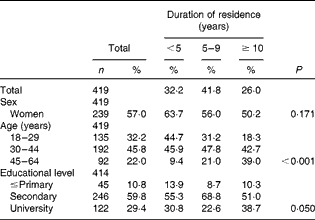
Among the 419 Latin-American immigrants, 85 % were born in South America, mainly in Colombia, Ecuador and Argentina. With an increase in the duration of residence in Spain, the percentage of women decreased, but the percentage of individuals aged ≥ 45 years and of those with university education increased (Table 1).
Characteristics of Latin-American immigrants according to the duration of residence in Spain (n 419) (Number of participants and percentages)
In the crude analysis, the percentage of immigrants who habitually ate at fast-food restaurants and bought snacks from vending machines was found to decline with an increase in the duration of residence (Table 2). The number of most other OREH was also found to decrease, although the P value for linear trend did not reach statistical significance. As a result, the mean number of OREH decreased significantly with the duration of residence, from 1·9 in immigrants residing in Spain for < 5 years to 1·5 in those residing for ≥ 10 years (P value for linear trend = 0·05; Table 2).
Association between duration of residence in Spain and obesity-related eating habits among Latin-American immigrants (Number of participants and percentages; prevalence ratios (PR) and 95 % confidence intervals)
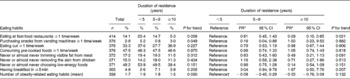
* PR was obtained from binomial regression models adjusted for sex, age and educational level.
† For the number of eating habits, the β-coefficient reported was obtained by linear regression adjusted for sex, age and educational level.
In the multivariable regression analysis, habitually eating at fast-food restaurants was found to be inversely associated with the duration of residence: compared with immigrants residing in Spain for < 5 years, those residing for ≥ 10 years had a prevalence ratio of 0·29 (95 % CI 0·10, 0·85). Furthermore, the variables never or almost never trimming visible fat from meat, never or almost never removing the skin from chicken, and choosing low-energy foods were found to exhibit a similar association with the duration of residence, but the association did not reach statistical significance. Accordingly, the number of OREH also declined with an increase in the duration of residence, although it failed to achieve statistical significance (Table 2).
The intake of energy, Na, vegetables and fish exhibited a significant direct association with the duration of residence in both the crude and multivariable regression analyses. By contrast, the intake of sugary beverages was inversely associated with the duration of residence. The intake of saturated fat and fibre also exhibited a significant direct association with the duration of residence, but this association disappeared when these nutrients were considered in relation to energy intake (Table 3).
Association between duration of residence in Spain and nutrient and food intakes among Latin-American immigrants (Number of participants and mean values; β-coefficients and 95 % confidence intervals)

* The β-coefficient was obtained by linear regression adjusted for sex, age and educational level.
As regards dietary patterns, MEDAS-based MD adherence was found to increase significantly with the duration of residence in the crude analysis, so that the percentage of immigrants exhibiting good and strict MD adherence increased from 23·0 to 37·7 % when the duration of residence was < 5 years and from 2·9 to 13·9 % when it was ≥ 10 years (Table 4). Adherence to the a posteriori Mediterranean pattern also increased with the duration of residence, from 29·3 % among immigrants residing in Spain for < 5 years to 44·5 % among those residing for ≥ 10 years. In the multivariable regression analysis, the MEDAS mean score and strict adherence to the MD were found to exhibit a significant direct association with the duration of residence. Lastly, the frequency of adherence to the a posteriori Westernised pattern did not exhibit substantial variations with respect to the duration of residence (Table 4).
Association between duration of residence in Spain and dietary patterns among Latin-American immigrants (Number of participants and percentages; prevalence ratios (PR) and 95 % confidence intervals)

MEDAS, Mediterranean Diet Adherence Screener.
* PR was obtained from binomial regression models adjusted for sex, age and educational level.
† For the mean MEDAS score, the β-coefficient reported was obtained by linear regression adjusted for sex, age and educational level.
Discussion
Compared with Latin-American immigrants residing in Spain for < 5 years, those residing for ≥ 10 years reported less frequency of habitual eating at fast-food restaurants, as well as a lower intake of sugary drinks. Moreover, they reported a higher intake of fibre, olive oil, vegetables and fish and also a higher intake of Na and saturated fat. Furthermore, the percentage of immigrants who strictly adhered to the MD increased with the duration of residence, reaching 13·9 % for those residing in Spain for ≥ 10 years, which is similar to the value for the whole Spanish population( Reference León-Muñoz, Guallar-Castillón and Graciani 32 ).
Although these findings indicate both healthy and unhealthy changes in the dietary patterns of Latin-American immigrants residing in Spain, and given that comparisons with findings from other studies are difficult because of the heterogeneity in the measurement of dietary habits and eating habits, some of the healthy changes observed after migration to Spain were found to differ from the main results of many studies on this issue conducted in other Western countries in which a ‘Westernisation’ of the diet and an increased frequency of some OREH were observed.
Studies carried out on Hispanic immigrants residing in the USA have demonstrated some unfavourable changes in dietary patterns after migration, such as increased consumption of fast foods, fatty snacks and sugar, including sugary drinks( Reference Ayala, Baquero and Klinger 4 ). In addition, among Mexican immigrants residing in the USA, Batis et al. ( Reference Batis, Hernandez-Barrera and Barquera 5 ) found a mixture of beneficial and harmful changes in dietary patterns, including increased consumption of saturated fat, sugar, salty snacks, pizza and French fries. Moreover, compared with Mexican-Americans born in the USA, those born in Mexico have been found to have a lower intake of fat and a higher intake of fibre and to exhibit greater adherence to nutritional guidelines( Reference Dixon, Sundquist and Winkleby 33 ), and being born in Mexico or Central America and longer US residency have been found to be associated with higher odds of consuming ≥ 5 daily fruit/vegetable servings( Reference Matias, Stoecklin-Marois and Tankredi 7 ). In Puerto Rican adults residing in Boston area, the association of acculturation with dietary quality was mixed, but tended towards better carbohydrate quality( Reference Van Rompay, McKeown and Castaneda-Sceppa 8 ). As regards other ethnic groups, Rosenmöller et al. ( Reference Rosenmöller, Gasevic and Seidell 9 ) reported a direct association between the duration of residence of Chinese immigrants in Canada and the size of food portions, the frequency of eating out and the consumption of convenience foods. Another study on Chinese immigrants residing in the USA and Canada has also demonstrated an association between various indices of acculturation and higher frequency of eating at fast-food restaurants and between meals( Reference Satia, Patterson and Kristal 10 ). Lesser et al. ( Reference Lesser, Gasevic and Lear 11 ) found that the majority of South Asians reported an improvement in dietary practices including an increase in the consumption of fruits and vegetables and a reduction in the consumption of high-fat/fried foods after immigration to Canada. Moreover, studies on Asian immigrants residing in European countries have also reported complex and varied changes after migration that, in general, resulted in a ‘Westernisation’ of the diet: reduced fibre intake; increased energy and fat intake; replacement of complex carbohydrates with refined carbohydrates( Reference Holmboe-Ottesen and Wandel 12 ). Finally, the review by Gilbert & Khokhar( Reference Gilbert and Khokhar 13 ) on changes in dietary patterns in various ethnic groups that emigrated to European countries again demonstrated a common pattern characterised by the maintenance of certain aspects of their traditional diets and the incorporation of some processed foods, sugary drinks and fast foods.
Very few studies have investigated changes in food consumption patterns among individuals who migrated to Mediterranean countries. Méjean et al. ( Reference Mèjean, Traissac and Eymard-Duvernay 16 ) found an increase in the percentage of energy intake from sugar/sweets and meat in Tunisian immigrants residing in France; however, the fact that both the country of origin and the country of destination were in the Mediterranean basin may complicate the interpretation of the results of their study. Another study on adolescent immigrants in Croatia coming from nearby areas demonstrated that these adolescents quickly adapted their dietary patterns to the Mediterranean dietary pattern predominant in the region( Reference Skreblin and Sujoldzic 15 ). The results of some studies carried out in Spain are consistent with those of the present study. The acculturation of Moroccan immigrants has been found to be associated with better eating habits and dietary patterns, specifically greater food variety and increased consumption of vegetables, fish and legumes( Reference Montoya Sáez, Torres Cantero and Torija Isasa 18 ). Favourable changes in dietary patterns have also been reported by two studies carried out among African immigrants residing in Madrid. In one study, the first generation of immigrant Bubis, the main ethnic group in the Bioko Island (Equatorial Guinea), had food and nutrient intakes similar to those derived from the prevalent diet in Madrid than to those derived from the diet of their native land( Reference Gil, Vioque and Torija 17 ). A subsequent study demonstrated a direct association between the duration of residence of West-African immigrants in Madrid and a healthier dietary pattern, with higher consumption of dairy products, fish, vegetables, fruits and legumes( Reference Delisle, Vioque and Gil 19 ).
Several factors could influence the eating behaviours of immigrants, including the country of origin and ethnicity, knowledge of the language of the host country, beliefs and cultural factors as well as individual characteristics such as socio-economic status( Reference Batis, Hernandez-Barrera and Barquera 5 , Reference Gilbert and Khokhar 13 ). However, our findings support the role of the food environment of the host country. Given that the analyses carried out in the present study were adjusted for educational level, its influence on the results was reduced. Moreover, the fact that, regardless of the immigrant group investigated, the results of the studies carried out in Spain show a progressive adoption of the Mediterranean dietary pattern, while those of studies carried out in the USA and Northern Europe show a ‘Westernisation’ of the diet illustrates the importance of food availability and prevailing food habits in the host country.
The results of the present study could be partly explained by a period effect. Given that the process of immigration is quite recent in Spain( Reference Martínez Bujan and Golías Pérez 34 ) and that many Latin-American countries are experiencing rapid urbanisation and nutritional transition, immigrants from these countries may have already been exposed to many diet-related risk behaviours before reaching Spain( Reference Uauy, Albala and Kain 35 , Reference Rivera, Barquera Simón and González-Cossío 36 ). Thus, the process of acculturation in Spain could lead to a certain improvement in eating patterns, as indicated by the results of the present study.
Among the limitations of the present study is the cross-sectional design, which did not allow for separating the effect of the duration of residence of the immigrants from a cohort effect linked to their age at arrival to the host country( Reference Lauderdale and Rathouz 37 ). However, there were no changes in the results after adjustment for or stratification by the immigrants’ age at arrival to Spain. Another limitation is the relatively small sample size, which precluded the examination of changes in dietary patterns according to the specific country of origin. Finally, although the duration of residence in a country does not fully capture the acculturation process, and individuals may vary in their level of acculturation even though they have resided in Spain for the same number of years, this variable is considered a reasonable proxy and has been used in many studies( Reference Alegria 38 , Reference Sanou, O'Reilly and Ngnie-Teta 39 ). The main strength of the present study is the variety and depth of information obtained on the eating habits and dietary patterns of immigrants residing in Spain.
Studies on immigrants groups are important because they offer an opportunity to witness the ‘natural experiment’ of the effect of a new environment on immigrants. This is the first study to investigate the changes in the eating habits and dietary patterns of the Latin-American population residing in Spain, which comprises the largest group of immigrants in this country. Although the culture of both the host country and country of origin surely influences eating behaviours and may determine the effect of environment on dietary patterns, the consistency of the results of the present study with those of other studies carried out in Spain and in the international literature on immigrants from different cultures supports the important role of the food environment of the host country in the modification of the dietary patterns of immigrants.
Acknowledgements
The present study was supported by grant PI/12/1166 from the Instituto de Salud Carlos III.
The funding body had no role in data extraction and analysis, writing of the manuscript, or the decision to submit the article for publication.
The authors’ contributions are as follows: J. L. G.-F. designed the study and coordinated the writing of the article; A. C. M.-G. contributed to the analysis of the data and to the drafting of the manuscript; P. G.-C., E. L.-G. and F. R.-A. contributed to the interpretation of the results and to the drafting of the manuscript. All authors contributed to the final version of the article.
None of the authors has any conflicts of interest to declare.



