On April 20, 1988, 1,200 Detroit Tigers fans gathered at Tiger Stadium to celebrate the baseball park's 76th anniversary. These Tiger faithful, who joined hands in a massive circle around the stadium and gave it a collective “birthday hug,” had more in mind than paying homage to the structure that had nurtured their fandom for decades (Zagaroli Reference Zagaroli1988). They intended the embrace as a statement of their opposition to plans by Tigers ownership and Detroit city officials to demolish the stadium and replace it with a state-of-the-art facility packed with “premium seating” options like luxury boxes and high-priced “club seats.” Members of the Tiger Stadium Fan Club, the group that organized the hug, cherished the existing park's “egalitarian spirit,” allegedly fostered by the large number of cheap bleacher seats and absence of premium seating (deMause and Cagan Reference deMause and Cagan2008: 91). For them, this “paradise for the everyday fan” represented something worth defending (Bock Reference Bock1988: 5). Frank Rashid, a Fan Club member, outlined the group's main concern to the New York Times: “The pattern we have seen in stadium construction and renovation has been a rather drastic removal of lower-cost seats and good vistas in favor of skyboxes” (LaPointe Reference LaPointe1989: C1).Footnote 1
While Rashid and the rest of the Tiger Stadium Fan Club ultimately failed to thwart the planned demolition, their efforts coincided with a growing public outcry around “stadium gentrification” (LaPointe Reference LaPointe1989; Lisle Reference Lisle2010). Sympathetic journalists railed against “lawyers, bankers, publishing powerbrokers, and various and sundry CEOs. . . eating key lime pie” in their luxury suites in new or newly renovated stadiums (Cohn Reference Cohn1991: 31). They warned that the rise of premium seating was “undermining one of the last bastions of democracy in America: sports,” lamented that “the essential egalitarian character of sport has been stripped away by money madness,” and offered sarcastic gratitude to team owners for the “handful of standing-room spaces left over for normal people” (Cohn Reference Cohn1991: 32; Underwood Reference Underwood1993: A9; Wulf Reference Wulf1995: 52). For their part, team officials and the stadium architects in their employ argued that these critics misunderstood the economics of luxury seating. According to them, skyboxes and club seats actually helped regular fans weather the increasing costs of live sports spectatorship by “pass[ing] more of that burden onto companies. . . buying tickets for corporate entertainment” (Team Marketing Report 1996: 8).
That conspicuous consumption at major league sporting events in the United States has proliferated in recent decades is not in doubt. Anyone who has attended games since the 1980s will attest to the increased visibility—some might say dominance—of exclusive club levels and decadent luxury suites, some of which now carry a price tag of more than $1 million for an annual lease (Lombardo and Muret Reference Lombardo and Muret2010). Moreover, economists such as James Quirk and Rodney Fort (Reference Quirk and Fort1992), Robert Baade (Reference Baade1996), and Roger Noll and Andrew Zimbalist (Reference Noll, Zimbalist, Noll and Zimbalist1997) have discussed at length the myriad reasons why, at the end of the twentieth century, pro sports teams looked increasingly to premium seating as a revenue source.
Social scientists, however, have yet to analyze systematically how and to what degree this trend has affected nonaffluent fans’ ability to access major league sporting events. Many observers assume, in line with the outlook of the aforementioned Tiger Stadium Fan Club, that newer stadiums have emphasized luxury to the detriment of accessibility for working-class fans. Alternative interpretations exist, however. Given the fact that pro sports facilities constructed since the mid-1980s have tended to be much larger than the venues they replaced, it is conceivable that teams have added premium seating in a way that preserves less expensive seating options.
Submitting these conflicting interpretations to historical scrutiny matters a great deal for urban policy makers who continue to confront demands for public stadium subsidies. If, as critics suggest, the handful of elites who can afford luxury suites and club seats have displaced fans of more modest means, then cities have even more reason to rebuff teams who justify requests for public stadium financing with the logic that professional sports facilities constitute a legitimate public good.
This study draws on quantitative and qualitative sources to trace how changes in the growth model of the sports business after World War II—namely, changes in stadium design and ticket sales strategies—have transformed the accessibility of major league stadiums and the class composition of the fans inside. My argument develops in three parts. The first part is methodological, and suggests that the handful of attempts by social scientists to describe the socioeconomic makeup of live sports spectators at the end of the twentieth century, most of which depend on cross-sectional surveys that asked respondents about event attendance, offer little insight into change over time. At first glance, they may appear to vindicate widespread anxieties about the increasing dominance of economic elites at sporting events during the 1980s and 1990s. However, these analyses ultimately fail to clarify whether or not the data describe a new phenomenon, or simply confirm the continuation of a long-standing one. I contend that looking at data dealing with changes in stadium design and seating options lends itself more readily to comparing accessibility across eras.
The second part uses descriptive statistical data to build upon existing scholarship which argues that, despite nostalgic odes by both fans and scholars to the alleged egalitarianism of major league venues constructed during the 1950s, 1960s, and 1970s, it was during these decades that the widespread displacement of working-class fans by more moneyed ones actually emerged. I show that in this era, well before stadiums filled with skyboxes became the norm, the expansion of season-ticket sales—that is, the sale of relatively costly year-long ticket packages—emerged as the primary mechanism through which wealthy spectators increasingly crowded out the rest of the fan base. As a result, by the end of the 1970s, attendance at major league games was already moving decidedly out of the realm of mass consumption, and into the realm of elite leisure.
The final part of this study draws on an original database containing information on the size and seating arrangements of both the current and previous facilities occupied by active Major League Baseball (MLB), National Basketball Association (NBA), and National Football League (NFL) franchises. It reveals that over the last quarter century, the dramatic proliferation of skyboxes and club seats has ushered in a new era of stadium gentrification: one in which teams have rushed to reduce the number of relatively accessible seats in order to make way for premium seats. Despite the fact that stadiums have continued to grow in overall size over the last 30 years, the absolute number and proportion of nonpremium seats—that is, seats not in luxury suites or club sections—has dropped significantly as franchises have transitioned to new facilities. These findings provide the first systematic corroboration of the claim that, more than ever, new stadiums have become “playgrounds for the rich” (Herbert Reference Herbert2004: A21).
Taken together, the dramatic upsurge in season-ticket sales that began at least as early as the 1950s and the boom in premium seating that took off three decades later constitute a protracted history of intensifying (and ongoing) gentrification inside stadiums and arenas over the last 60 to 70 years. This history deepens our understanding of the role of the professional sports business in larger efforts by real estate capital in recent decades to supplant public space with “enclaves” of conspicuous consumption for urban elites (Davis Reference Davis1990).
Before proceeding, the reader deserves a brief explanation of what I mean when I use the label working class to describe fans displaced by stadium gentrification. On the most basic level, it signals membership in a demographic made up mostly, but not exclusively, of wage earners and characterized primarily by its lack of “power and authority” in the workplace (Zweig Reference Zweig2000: 3). Social scientists who have conceptualized class structure along these lines agree that the working class has represented a solid majority of the American population for most, if not all, of the postwar period. For, example, economist Michael Zweig's (Reference Zweig2000) snapshot of the American labor force pegs this “working-class majority,” which he defines (with some caveats) as everyone other than “big-business” capitalists, small business owners, supervisors, managers, and professionals, at upward of 60 percent as of 1996. Using different data and methodology, sociologist Erik Olin Wright (Reference Wright1997: 99) estimates that between 1960 and 1990, the percentage of the US labor force made up of “workers” and “skilled workers” ranged from a low of 54 percent (1990) to a high of 59 percent (1970).Footnote 2 Belonging to the working class means belonging to the largest socioeconomic strata in the postwar United States.
By extension, in claiming that club seats, luxury suites, and season-ticket packages have developed to the exclusion of the working class, I argue that they emerged at the expense of more than just a handful of American sports fans. They emerged at the expense of most fans.Footnote 3
Class, Spectatorship, and Access: Methodological Considerations
That class has mediated access to sporting events in the United States is old news. Popular nostalgia for the “American pastime” notwithstanding, histories of early baseball invariably mention the advent of ball field enclosure (i.e., “fencing-in”) and admissions fees after the Civil War. Professional team owners during this period used these innovations to “screen out” the poor, and by the end of the century tiered fee structures divided parks internally by virtue of fans’ ability to pay for preferred sections (Goldstein Reference Goldstein1989: 81). Historian George Kirsch (Reference Kirsch1989: 181–82) points out that charging admission did not preclude crowds consisting of “a wide variety of social groups,” as admission fees on the low end remained affordable enough for many workers and recent immigrants to attend baseball games with some regularity. But even if these early parks supported some level of democratic spectatorship, they also fostered a certain degree of class-based exclusion.
This early history of class and spectatorship complicates efforts to interpret social scientific research on the demographics of fans at sporting events in the United States at the close of the twentieth century. Analyses of cross-sectional survey data from the 1990s show a strong, positive correlation between socioeconomic status—namely, income and years of education—and the likelihood of having recently attended a sporting event. For example, examining data from the 1993 General Social Survey (GSS), which asked respondents whether or not they had attended a sporting event in the past year, sociologist Thomas Wilson (Reference Wilson2002) found that men belonging to the highest household income category ($75,000 or more) proved 2.5 times as likely to have answered in the affirmative as those from the lowest category (≤$9,999). Moreover, males with a postgraduate degree were 1.4 times as likely to have attended a sporting event as those with only a high school diploma.Footnote 4 The numbers support Wilson's (ibid.: 13) conclusion that “economic capital and cultural capital promote attendance at sporting events,” and it is tempting to read them as confirmation of popular claims that stadiums became refuges of the rich as the twentieth century came to a close. But such an assumption falters in the face of the long history of “screening out” less affluent fans from stadiums. Nothing in Wilson's analysis, which deals with a single year of data, indicates that the overrepresentation of wealthier fans was more intense at the end of the twentieth century than at its outset.
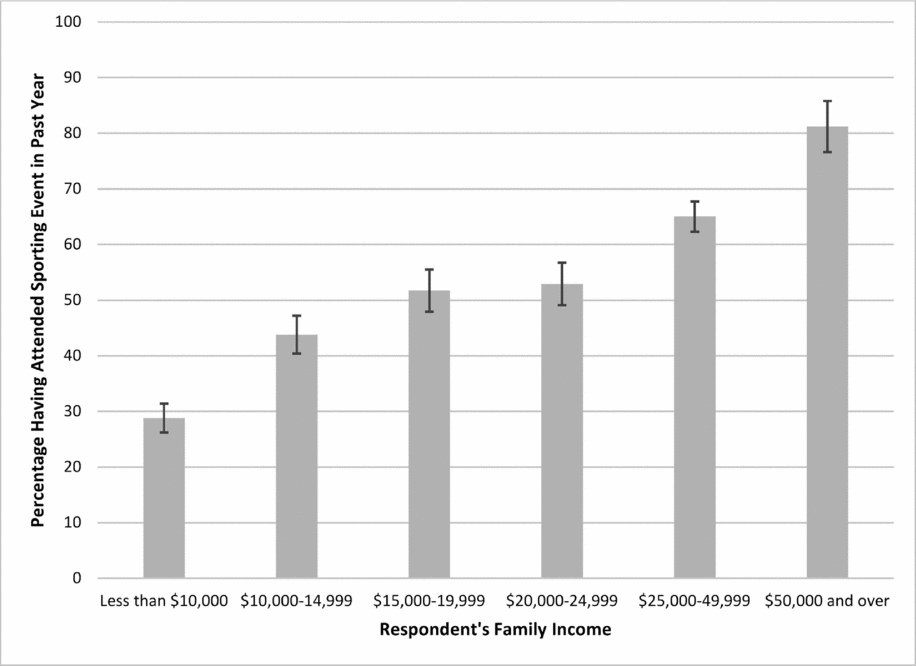
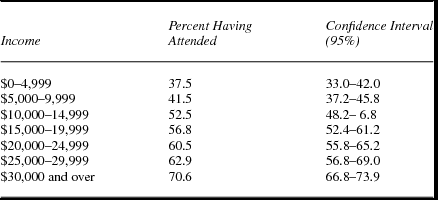
Indeed, data from earlier surveys suggest that the relationships described by Wilson were anything but new. While 1993 was the first and only year that the GSS asked respondents about their spectatorship habits, the 1982 Survey of Public Participation in the Arts asked respondents if they had gone to a sporting event in the past year. As figure 1 shows, the proportion who reported having attended a game was significantly higher in higher income groups (the same held true among those with more education). In 1981, a survey conducted by researchers at the University of Cincinnati asked local residents whether or not they had recently attended an event at Riverfront Stadium, then home to the Cincinnati Reds and Bengals. Table 1 reveals the same pattern: residents with higher earnings proved much more likely to have taken in a game at Riverfront.
Percentage of respondents in nationally representative sample having attended a sporting event in last year, by family income, 1982.

Attendance at an event at Cincinnati's Riverfront Stadium in the last 12 months, by respondent income, 1981

Source: University of Cincinnati Behavioral Sciences Laboratory 1981.
Note: Random sample of Cincinnati residents 18 years of age and older (n = 3,132). Confidence intervals computed by author per the methodological note in original survey documentation.
Ideally, this data would allow for some sort of longitudinal comparison to gauge whether or not this phenomenon intensified over the course of the 1980s. Unfortunately, variations in survey design and variable definition across the different data sets make this unrealistic. For example, while both the GSS and Survey of Public Participation in the Arts asked about attendance at sporting events regardless of whether or not the organizers charged admission, the study on Riverfront Stadium dealt only with events charging admission.
Economists John Siegfried and Timothy Peterson (Reference Siegfried, Peterson and Kern2000) developed a partial corrective to the problem of tracking change in the class composition of spectators over time by using the Bureau of Labor Statistics Consumer Expenditure Survey (CES). Taking advantage of CES questions dealing with expenditures on tickets to sporting events, they report that in 1994, the “median income level of consumers of sporting event tickets [was] 84 percent above the overall median income level” (ibid.: 62). Moreover, they note that this signals an expansion of the income gap between ticket buyers and the wider public because data from the 1972–73 CES indicates that the median incomes of consumers of season tickets and single-game tickets sat at 58 and 10 percent above the overall median, respectively.Footnote 5
The CES data appear to show that moneyed fans became more prominent at stadiums at the end of the twentieth century. Some statisticians will cringe at the comparison of data from the 1972–73 and 1994 CES surveys because they do not share common variable definitions or sampling methodology. Moreover, the CES likely underestimates the degree of transformation because it has never asked about spending on luxury suites. Nevertheless, Siegfried and Peterson's analysis is the closest thing we have to survey-based evidence of an actual demographic transformation of crowds at American sporting events.
However informative, comparing the incomes of typical spectators from these different eras reveals little about potential changes in accessibility for nonelites. Given the fact that stadiums and arenas currently in use by major league teams tend to be much larger than the facilities they replaced, one could imagine them accommodating new wealthier patrons in addition to working-class fans. The average incomes of attendees would have increased even if the number of working-class attendees held steady in the face of a surge in the number of affluent ones. Moreover, team officials have argued that building premium seats for upscale clientele effectively subsidizes the maintenance of more conventional seating options at relatively affordable prices. To test the hypothesis that increasingly upscale fan bases have actually displaced the working-class majority, we need a different type of evidence.
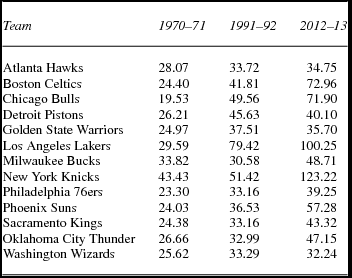
One place to look for this evidence is in data on the history of ticket prices. Table 2 shows figures from a data set assembled by economist Rodney Fort (Reference Fort2013) that contains information on average, single-game ticket prices to games for select NBA franchises for the 1970–71, 1991–92, and 2012–13 seasons. The trend in the real, average NBA ticket price for these teams has been decidedly upward during the last 40 years. In high-demand markets like Boston, Chicago, Los Angeles, and New York it jumped anywhere from 184 to 268 percent between the 1970–71 and 2012–13 seasons. Moreover, the rise in prices for all of the listed franchises over this period easily outpaced the rate of growth in real median household income in the United States, which rose by only 11 percent (US Census Bureau 2014). Working-class NBA fans, then, have had to attend fewer games or stop attending altogether, or shift other expenditures to tickets. The NBA has been far from unique in this regard. In 2000, Sports Illustrated reported that “since 1991 [nominal] ticket prices for the four major pro sports have increased an outrageous 80%—four times faster than the Consumer Price Index” (Swift Reference Swift2000: 73).
Real average ticket prices for select National Basketball Association franchises, 1970–71, 1991–92, 2012–13

Source: Fort Reference Fort2013.
Note: All figures in constant 2012 dollars. Inflation adjustments use the Consumer Price Index (CPI) for base year of season (i.e., CPI for 1970 used to adjust prices for 1970–71 season). Averages weighted by number of seats at each price level. Excludes prices for luxury suites. Pre-2012 data for the Oklahoma City Thunder corresponds to the Seattle Supersonics (the previous iteration of the same franchise).
While ticket price data supports the conclusion that, by the end of the century, “Joe Fan, that poor abused sucker. . . [was] being priced right out of his seat,” it too provides an incomplete picture of this process (ibid.). Like the CES, trade publication data on ticket prices typically fail to incorporate the cost of premium seating options like luxury suites into the calculations. This neglects the fact that the greatest price inflation at pro sports venues in recent decades has occurred in the context of the most expensive seating options. For example, in 1963 the Kansas City Chiefs (then of the American Football League) sold their most expensive seat at Municipal Stadium for $7. By 2010, some private suites offered by the Chiefs (now of the NFL) at Arrowhead Stadium leased for $350,000 a year, or more than $20,000 per game (Frank Reference Frank2010: 21).
One way to supplement and refine the conclusions suggested by survey and ticket cost data involves an analysis of the history of seating arrangements at major league sports facilities. Stadiums and arenas have generated large archives of material that provide clues about the types of access offered, be it premium seating, season-ticket plans, or general admission. Planning documents, architectural records, journalistic descriptions, and team press releases provide a wealth of information on the transformation of accessibility as teams transitioned from their previous facilities to their current ones. In the final section of this study, I draw on a data set assembled from these archives in order to show that the last quarter century has witnessed an unprecedented intensification of the process by which wealthy fans have crowded out the working-class majority.
However, before delving into the details of how this played out over the past 25 years, it is worth considering how, in the immediate postwar period, working-class fans were already losing serious ground in terms of their ability to attend major league games. The next section reveals that while the specific mechanisms of displacement have changed since then, the narrowing of in-stadium demographics in the United States to a thin sliver of American elites is best thought of as a long-running, cumulative process encompassing most of the last 60 to 70 years.
Post–World War II Spectatorship and the Rise of the “Privileged Few Thousand”
A common thread runs through most of the journalistic comparisons of the current era of major league venues with the concrete, multipurpose stadiums constructed in the 1950s, 1960s, and 1970s. The newer venues, so the story goes, have corrupted the “democratic” spirit of their predecessors by emphasizing visible class distinctions. These accounts never claim that rich people were absent from sporting events in earlier periods. Instead, they argue, to borrow from one typical commentary from the early 1990s, that at the previous generation of stadiums “the powers-that-were shifted foot to foot in the same nasty bathroom lines as the pressmen and their 10-year-old sons” (Cohn Reference Cohn1991: 32). A 2000 issue of Sports Illustrated forwarded the same idea, asserting that “the infernal skybox creates a gap more dispiriting than box seats ever did. The luxury boxes’ glass barriers divide the crowd into people who want to see the game and people who want to be seen at the game” (Farber and Mravic Reference Farber and Mravic2000: 25).
Some academics have echoed this interpretation. Historian Daniel Rosensweig (Reference Rosensweig2005: 84–86) insists that facilities like Baltimore's Memorial Stadium and Milwaukee's County Stadium fostered an “inadvertent classlessness” and “unprecedented degree of fan diversity and mixing.” According to Rosensweig, this alleged leveling owed to a plentiful supply of cheap tickets, wide concourses accessible to fans from all seating sections, relatively inexpensive concessions, and an absence of premium seating areas. Indeed, between the early 1950s and early 1970s, major league sports stadiums grew dramatically in terms of overall seating capacity, and the increased supply of seats probably placed downward pressure on ticket prices (Lowry Reference Lowry2006).
Adherents of Rosensweig's perspective might also point to the fact that price differences and spatial divides between coveted box seats—a term distinct from luxury box used to denote conventional seats with closer and better views of the field—remained rather modest well into the 1970s. For example, in 1966, box seats at Orioles games at Baltimore's Memorial Stadium sold for $2.90, “general admission” cost $1.20, and bleacher seats went for 75 cents (Los Angeles Times 1966). Box seats and general admission tickets for New York Mets games at Shea Stadium cost $3.50 and $1.30, respectively, in 1969 (New York Times 1970). And in 1975, Pittsburgh Pirates fans could nab box seats at Three Rivers Stadium for $4.50 and general admission entry for $2.00 (Los Angeles Times 1976). Moreover, while box seats were spatially segregated from general admission areas, teams typically demarcated them with little more than special handrails (i.e., they were not totally enclosed).
However, odes to the halcyon days of these stadiums obscure how their design exacerbated socioeconomic stratification within stadiums and reduced access to stadiums for working-class fans. Historian Benjamin Lisle (Reference Lisle2010) has shown that larger overall capacities at many stadiums built in the immediate postwar period masked the fact that teams packed them so full of box seats that the number of general admission or bleacher tickets actually declined relative to their previous facilities. The figures cited in the previous paragraph suggest the price differential between box seats and general admission tickets before 1980 remained rather small. In 2014 dollars, typical box seats sold for about $20 and general admission seats for about half of that. Nevertheless, Lisle has identified an important example of how stadium development strategies in the decades following the war increased barriers to entry for the working class.
As Lisle (ibid.) also documents, contrary to popular belief the advent of the “luxury” experience at major league venues dates back at least to the mid-1940s. It was right after the war that Yankee Stadium debuted multiple, “exclusive Stadium Club” bars for use by those who held box-seat season tickets (Daley Reference Daley1946; Lisle Reference Lisle2010: 148–49).Footnote 6 Moreover, many stadiums that opened during the 1950s, 1960s, and 1970s did feature enclosed luxury boxes and high-priced amenities. The Houston Astrodome led the way in this regard; when it opened to great fanfare in 1965 it featured 53 fully enclosed luxury suites that leased for between $15,000 and $18,600 per season (Lisle Reference Lisle2010: 264). Moreover, the Astrodome and many other contemporary facilities contained special stadium “clubs” like the ones introduced earlier at Yankee Stadium, where more affluent fans could indulge in high-priced meals and cocktails. Taken together, these new luxury amenities became “an increasingly popular way for the privileged to reassert class difference in the face of democratic consumption,” and yet another mechanism by which teams began to devote more and more space in these larger facilities to wealthy fans (ibid.: 156). To be sure, luxury suites and stadium clubs remained relatively peripheral at stadiums and arenas in the three decades after World War II; most teams added them sparingly, if at all, prior to 1980. Nevertheless, they foreshadowed the move of luxury amenities to the center of franchises’ stadium-linked growth strategies.
Another important postwar development noted by Lisle (Reference Lisle2010) was the increase in the number of seats sold by teams as part of season-ticket packages—that is, as seats paid for up front by a single purchaser for the entire year. After the war, teams charged several hundred dollars a year for these packages. For example, the Los Angeles Dodgers charged $250 per season for a box seat and $180 per season for a reserve seat in 1958 (Finch Reference Finch1958). This meant that the price of a single season ticket for the reserve section constituted more than 80 percent of the average annual expenditures by American families on “entertainment” as measured in 1960 by the US Bureau of Labor Statistics (2006: 32). For the typical family, purchasing more than one season ticket was out of the question.
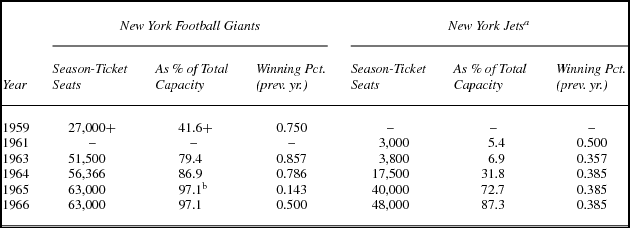
Lisle mentions the season-ticket phenomenon mostly in passing; but data on season-ticket sales culled from newspaper coverage of individual teams since the 1950s reveal that, far more than luxury boxes or additional box seats, growth in season-ticket sales constituted the primary mechanism through which franchises heightened barriers to entry for working-class fans. The NFL's New York Football Giants offer a clear case in point. In 1947, the local sports pages noted that the team's season-ticket sales had jumped by a third, though it omitted specific figures (Daley Reference Daley1947). Twelve years later the New York Times pegged the number of season tickets sold by the Giants for their home games at Yankee Stadium at more than 27,000, or more than 41 percent of total capacity (Effrat Reference Effrat1959; New York Times 1965). By 1965, as shown in table 3, the figure had more than doubled, and the Giants announced that “all of the seats at the stadium would be allocated to season ticket holders and that there would be no individual game sale” (New York Times 1965: 26).
Season-ticket sales for New York Football Giants and New York Jets, 1959–66

Source: New York Times (various years). Contact author regarding sources pertaining to specific years. Seating capacity data, which accounts for year-to-year variations in capacity and transitions to new facilities, from New York Times 1965 and Lowry Reference Lowry2006. Winning percentage data from Pro-Football-Reference.com 2014.
Notes: No data available for years not listed. Missing data in table means data was not available. Winning percentage corresponding to the listed year is for the previous year to account for the lag in any effect on ticket sales. A “+” after a figure indicates that the relevant source listed sales as “more than” the listed number.
a The Jets franchise began in 1960 and assumed its current name beginning in the 1963 season. Prior to that the team name was the Titans. The franchise played at the Polo Grounds through 1963, after which it relocated to Shea Stadium.
b Popular press reports equated 63,000 season tickets with the entire seating capacity of Yankee Stadium, the home field of the Giants during this period, at the same time that they pegged the venue's total capacity for football games at 64,892. The percentages in this table are based on the 64,892 figure.
While it is true that the relatively small number of home games played by professional American football teams translated into lower prices for individual season tickets—the football Giants charged $35 for reserve seats and $42 for box seats in 1965—this did not necessarily translate into increased accessibility for the working class (Wallace Reference Wallace1965). In fact, by the mid-1960s a very small cadre of fans had come to monopolize seats at Giants games. In 1967, the New York Times reported that only 15,000 purchasers owned all 60,000-plus season tickets for the Giants (Wallace Reference Wallace1967)! This meant that, on average, each Giants season-ticket holder purchased four seats, which would have cost (in the case of the cheaper reserve sections) more than $140—an expenditure that, as pointed out previously, few working-class consumers could support. Thus, the team not only eliminated the most realistic opportunity for access for the less-than-affluent by ceasing to sell individual-game tickets, but it also facilitated the hoarding of tickets by wealthy fans.
These phenomena were not unique to New York, nor to relatively successful franchises like the football Giants. By 1963, season-ticket sales for the NFL's Baltimore Colts and Philadelphia Eagles had reached 50,000, and the numbers for teams like the Detroit Lions appeared on course to reach similar heights (Wallace Reference Wallace1963). A decade later, the Los Angeles Times reported that 50,000 season tickets to L.A. Rams games were concentrated in the hands of only 10,000 buyers (Oates Reference Oates1972). As the data in table 3 confirms, even perennially underperforming teams like the New York Jets (originally part of the American Football League) successfully engineered dramatic growth in season-ticket sales during the 1960s. That all of this was reducing—if not eliminating outright—live spectatorship opportunities for ordinary fans was not lost on contemporary observers. In December 1967 a New York sportswriter summed up the situation with an obvious dose of cynicism when he suggested that fans of the lackluster Jets might “prefer” to “go to Yankee Stadium to watch the [football] Giants play the Detroit Lions, even though nonholders of season tickets won't be able to get in there either” (Daley Reference Daley1967: 102).
These data offer more than a simple illustration of the fact that some teams relied increasingly on season-ticket sales as a revenue source during these decades. That mediocre or subpar franchises like the Jets also dramatically increased the supply of season-ticket packages in this period suggests that the displacement of more affordable seating options—single-game tickets, for example—by more expensive ones characterized the sports business in general, at least in large markets like New York and Los Angeles.
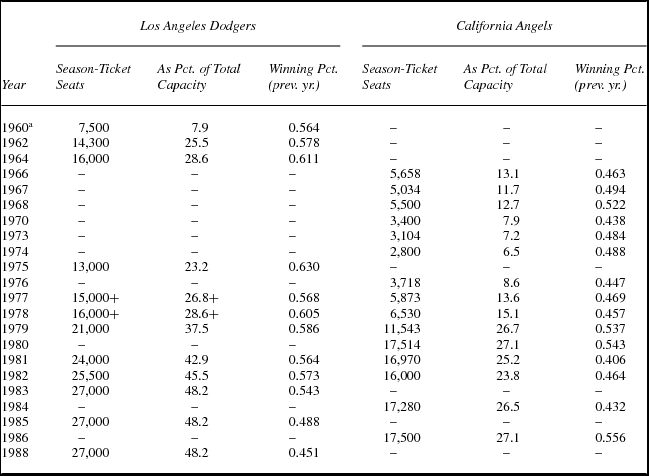
Indeed, MLB franchises also grew their season-ticket sales significantly during the 1960s, 1970s, and 1980s. This expansion happened more slowly—and at times, more inconsistently—than in professional American football, but the long-term trend proved comparable. Table 4 lists data culled from the Los Angeles Times on the number of seats sold as season tickets for the Los Angeles Dodgers and California Angels MLB clubs from 1960 to 1988. For each franchise, both the absolute number of season-ticket seats and the proportion of total capacity devoted to season tickets in the second half of the 1980s dwarfed the numbers from 20 years before. The case of the Dodgers is particularly striking, as the number of seats sold as season tickets at Dodger Stadium rose from a quarter of total capacity to nearly half between 1962 and 1983.
Season-ticket sales for Los Angeles Dodgers and California Angels, 1960–88

Source: Los Angeles Times (various years). Contact author regarding sources pertaining to specific years. Seating capacity data, which accounts for year-to-year variations in capacity and transitions to new facilities, from Lowry Reference Lowry2006. Winning percentage data from Baseball-Reference.com 2014.
Notes: No data available for years not listed. Missing data in table means data was not available. Winning percentage corresponding to the listed year is for the previous year to account for the lag in any effect on ticket sales. A “+” after a figure indicates that the relevant source listed sales as “more than” the listed number. The Dodgers capped season-ticket sales at 27,000 in 1983.
a The Dodgers played in Los Angeles Memorial Coliseum before moving to Dodger Stadium (Chavez Ravine) in 1962.
Similar to the football Giants and Jets, the very different histories of on-the-field success for the Dodgers and Angels during the period covered in table 4 make the teams telling case studies of how the season-ticket phenomenon did not necessarily depend on a team's performance. In the case of the Dodgers, the team posted consistently good winning percentages and strong finishes in the National League West between 1960 and 1983 (including World Series wins in 1963, 1965, and 1981). While the team's winning percentages proved fairly consistent throughout this stretch, season-ticket sales jumped dramatically in the early 1960s and at the end of the 1970s. That the team sold more and more seats as season tickets does not appear to have owed to improved performance. The Dodgers played well in the 1970s and early 1980s, but they had played equally well during the 1960s. Even in the absence of significant variation in on-field performance, sales of season-ticket packages that were prohibitively expensive for most Los Angelenos expanded significantly over the long term. Sales remained consistent even when the team's performance declined considerably for a stretch in the mid-1980s.
The Angels enjoyed much less on-field success than their cross-town counterparts, and it appears that their poor showings during the early 1970s had a negative effect on season-ticket sales once the novelty of the expansion team wore off. However, by the mid- and late 1970s, even in the immediate wake of thoroughly disappointing seasons, season-ticket sales at Anaheim Stadium jumped considerably and remained robust for the rest of the 1980s. In baseball as well as football, the displacement of working-class fans through the expansion of season-ticket sales characterized the growth of franchises in major metropolitan markets.
To be sure, some smaller-market ball clubs, such as the Oakland Athletics, were still struggling in the early 1980s to create the robust season-ticket markets cultivated by their big-market counterparts. Nevertheless, the football and baseball franchises tracked in tables 3 and 4 encapsulate the overall upsurge in season tickets within major league sports in the second half of the twentieth century (Newhan Reference Newhan1981). Clear evidence of this broader tendency emerged in May 1982, when the NFL projected that its franchises would sell 1,401,589 (or 77 percent) of their total seats as season tickets (Cherwa Reference Cherwa1982). No wonder that, by the 1970s, journalists sympathetic to regular fans had started to lament the fact that “season tickets are for the privileged few thousand” and point out that “pro sports have mass appeal, but the masses can't afford to see games in person on a regular basis” (Maher Reference Maher1972a, Reference Maher1972b: B1).
By the 1980s it was clear that corporations, law firms, and other institutional purchasers had emerged as the primary motors behind this trend. The “corporate community” not only leased almost all major league luxury boxes, but also dominated season-ticket purchases. In 1985 the New York Yankees reported that corporations purchased 80 to 90 percent of the team's season tickets. The same year, the Detroit Tigers claimed that 85 to 90 percent of their season tickets went to corporate buyers. These were not aberrations. By the mid-1980s corporate spending accounted for 46 percent of total gate revenues for the MLB and 51 percent for the NBA (Dunham Reference Dunham1985).
This brief history of the expansion of season-ticket sales clarifies that major league stadiums were no exception to the increasing exclusivity of US consumer markets in the postwar period. As historian Lizabeth Cohen (Reference Cohen2003) details in her study of the rise of suburban shopping centers in the decades following World War II, commercial real estate developers became increasingly enamored of growth through “market segmentation.” This depended in large part on keeping out “unwanted urban elements, such as vagrants, prostitutes, disruptive rebels, racial minorities, and poor people” in order to define communities of preferred patrons in “exclusionary socioeconomic and racial terms” (ibid.: 265). If anything, sports teams’ growing reliance on season tickets went even further, cordoning off significant portions of their facilities from consumers and families from the middle of the income distribution.
Of course, postwar gentrification of the population inside stadiums owed to much more than increased costs. As Cohen (Reference Cohen2003) shows in the context of suburban shopping centers and Lisle (Reference Lisle2010) discusses in reference to major league ballparks, the spatial arrangement of stadiums accomplished the same end. In some instances, this took the form of locating new sports facilities in relatively wealthy areas (e.g., the Angels—Anaheim stadium). In others, it consisted of using urban renewal dollars to clear out low-income residents from downtowns and replace them with stadiums easily accessible to both central city professionals and suburbanites with cars (e.g., Busch Memorial Stadium in St. Louis). Indeed, whether located downtown or on the metropolitan periphery, these facilities’ connections (or lack thereof) to transportation networks functioned as key mechanisms of exclusion. Seamless access to and from highways, combined with intentionally poor integration into public transportation networks, made many postwar stadiums effectively off-limits for sizeable segments of the working population.
A New Era of Exclusion: Premium Seating Goes Universal
Premium seating in the form of luxury boxes appeared at least as early as the 1960s, but at that time it was far from a universal presence at pro sports facilities, and it rarely constituted a primary revenue stream for stadium owners. By the 1980s, however, teams bent on translating the ongoing appetite for attending pro sporting events among moneyed Americans into expanded profits began to reshape this formula in fundamental ways. In particular, team owners made premium seating options like skyboxes and club seats the centerpiece of stadium-related franchise growth.
Most journalistic accounts of this process point to the 1987 opening of Joe Robbie Stadium, home of the NFL's Miami Dolphins, as the triggering event. According to these accounts, Dolphins owner Joe Robbie pioneered the use of expanded premium seating capacities in response to the growing reluctance on the part of voters in cities like Miami to approve public stadium financing. In order to guarantee the revenue flows needed to lock in favorable private financing terms for a new facility, Robbie “preleased” 216 skyboxes and 10,211 club seats at prices ranging from $29,000 to $65,000 a year and $600 to $1,400 a year, respectively (Pierson Reference Pierson1987; Scott et al. Reference Scott, Templeman and Lischer1988). In one fell swoop, the Dolphins went from having no premium seats at their previous home, the Miami Orange Bowl, to having upward of 13,000 at Joe Robbie (Association of Luxury Suite Directors 2013; Mitchell Reference Mitchell1998).
In fact, Robbie's use of guaranteed lease revenue was less than original. More than a decade earlier, Dallas Cowboys owner Clint Murchison had preleased new luxury suites and seats in club sections to make Texas Stadium into a state-of-the-art revenue generator (Cohn Reference Cohn1991). Moreover, Murchison did so despite significant public financing; taxpayers funded more than 85 percent of the original capital costs for the new facility, which opened in 1971 (Long Reference Long2013). Thus, a more accurate account is that Robbie “rediscovered the cash flow of luxury seat revenue” a decade later (Vrooman Reference Vrooman2006: unpaginated). While resistance from local taxpayers and the absence of generous public subsidies may have pushed Robbie toward this “rediscovery,” what ultimately linked the efforts of the Cowboys and Dolphins owners was their recognition that skyboxes and club seats were good for growth.
Historically, Joe Robbie Stadium stands out not because it pioneered a luxury-centric model of stadium building, but rather because it marked the front end of a frenzy of stadium construction during which major league franchises made the addition of skyboxes and club seats a top priority. Between 1987 and 2013, more than 90 new or significantly renovated MLB, NBA, or NFL venues opened, whereas only 61 opened between 1950 and 1986 (Long Reference Long2013). Invariably the new venues featured sizeable increases in premium seating capacity relative to their predecessors. This addressed several concerns among team owners regarding their stadium-related growth strategies. In the first place, it provided new outlets for spending by existing corporate patrons. It also helped teams subvert the advent of league revenue-sharing agreements, which excluded revenue generated by suite leases from pools of shared funds (at least initially) (Gorman and Calhoun Reference Gorman and Calhoun1994). Perhaps most importantly, premium seating became a predictable way to grow revenues and profits as the increasing militancy of players’ unions during the 1970s and 1980s reduced teams’ control over labor costs.
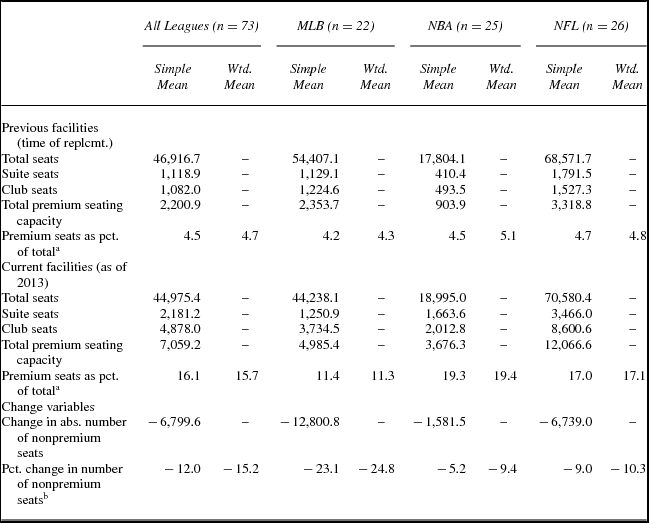
Data on premium seating capacity for both current and predecessor facilities are not available for all major league franchises. However, research for this article entailed the construction of an original data set that catalogs the number of premium seats (i.e., luxury suite seats plus club seats) at current facilities (as of 2013) and estimates for the number at previous facilities for 73 of 91 active MLB, NBA, and NFL teams whose current facilities opened in 1987 or later.Footnote 7 The vast majority of data pertaining to current venues comes from a 2013 reference manual compiled by the Association of Luxury Suite Directors (2013), while estimates for the venues they replaced were derived from archival material, newspapers, and secondary academic literature. The aforementioned reference manual contains exact numbers for the total number of seats housed within a given stadium's luxury suites. By contrast, most of the sources dealing with the older generation of stadiums contain information on the total number of suites, but not the total number of seats inside each one. However, personal correspondence with trade experts, as well as data on seats per suite found in newspapers for a smaller sample of the older generation of facilities, suggest that it is safe to assume that they featured, on average, 20 seats per skybox.Footnote 8
As of 2013 the typical (mean) franchise in this sample played in a venue that contained 7,059 total premium seats (table 5). By contrast, the typical franchise's previous facility housed an estimated 2,201 premium seats in its final year of operation.Footnote 9 Disaggregated by league, the story is the same. For the 22 MLB franchises in the sample, total premium seating capacity went from a mean of 2,354 seats to 4,985; it jumped from 904 seats to 3,676 among the 25 NBA teams sampled; and for the 26 NFL clubs, it climbed from 3,319 to 12,067.
Premium and nonpremium seating data

Sources: Association of Luxury Suite Directions 2013, Lowry Reference Lowry2006, Noll and Zimbalist Reference Noll, Zimbalist, Noll and Zimbalist1997, and other miscellaneous archival, print, and web sources.
Note: Omitted cases include those for which complete data was not available, expansion franchises who have only played in one facility, and franchises whose current facility opened before 1987. For previous facilities, “suite seats” figures assume 20-seat/suite capacity. See notes 7 and 8 for more on methodology. Median values are not reported but are available from author upon request.
a Weighted by total number of seats (i.e., total seating capacity).
b Weighted by total number of nonpremium seats at previous facility.
These figures encapsulate a relatively short period of historical transition because they are based on premium seating capacities at previous facilities as they existed at the end of their life span, after many teams had added club sections or luxury boxes to venues that originally had none. It measures the difference between the facilities teams occupied as of 2013 and the facilities that they left, not between what they had as of 2013 and predecessor facilities as they existed when they originally opened. This means that the data measures the expansion of premium seating only in the last 25 to 30 years. In a relatively short window of time, then, the percentage of total seating capacity taken up by premium seats in the aforementioned leagues has leapt from an estimated 4.7 percent at predecessor facilities to 15.7 percent at current facilities (table 5). Moreover, these represent conservative estimates. If anything, the numbers for premium seating capacity at previous venues are biased upward, given the use of cautious assumptions about the number of seats per suite at those facilities (see note 8).
While the motors behind the growth in luxury seating are well documented, nobody has offered a systematic analysis of the impact that this growth has had on the accessibility of stadiums and arenas for the working-class majority. Some journalists have equated more luxury suites and club seats with fewer opportunities to buy tickets for those of more modest means. In a 1988 story on the plethora of new luxury seating at the Detroit Pistons’ new arena, the aptly named Palace, one NBA beat writer asserted, “The result. . . has been to exclude many longtime fans. . .. They can no longer afford to go to the games and have been replaced with wealthier, less vocal suburban types” (Smith Reference Smith1988: C5).
Clearly, wage-earning fans have not been in line for skybox leases, club-seat plans, or full-season-ticket packages. By 2000, even the cheapest annual major league suite leases reached well into five figures, and many reached well into six. That year, individual club-seat packages sold for as much as $7,500 in the MLB, $15,000 in the NBA, and $2,975 in the NFL (Team Marketing Report 2000). Team and league officials, however, have rebutted accusations that they have pushed out working-class fans by arguing that the increased revenues from luxury suites and club seats actually subsidize more affordable seats elsewhere. This is not a new idea. As early as 1985, league officials were justifying the dedication of more and more seats to corporate season-ticket sales by arguing that “if teams lose revenue from the corporate ticket sales, they will be forced to compensate by dramatically increasing ticket prices for the general public” (Dunham Reference Dunham1985). A few years later, teams were applying the same logic to explain the expansion of premium seating. For example, in 1990, one team executive told the Chicago Tribune, “Skybox rentals allow team officials to keep ticket costs from soaring. . . for patrons in less privileged seats” (Buursma Reference Buursma1990: C1C).
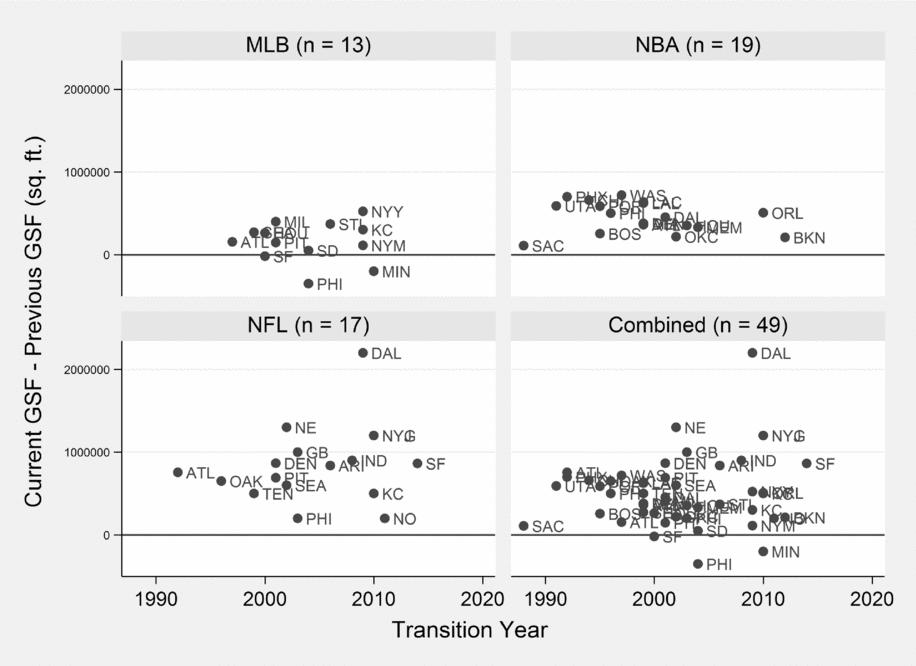
At first, this logic seems plausible enough. Most of the new facilities built since the mid-1980s dwarf the venues they replaced in terms of gross square footage (GSF), which seems consistent with the notion that many teams opted to add new luxury suites and club seats while maintaining or expanding seating capacity geared toward the average spectator. Research for this project uncovered enough information in archival records, newspapers, and personal correspondence with architects to estimate the difference in GSF between current and previous facilities for 49 franchises (13 in the MLB, 19 in the NBA, and 17 in the NFL).Footnote 10 Aggregating data from all leagues, the average (mean) franchise in this sample currently occupies a facility 511,638 square feet larger than the facility that it replaced (figure 2). In the NBA and NFL, the mean increase in GSF for sampled franchises that inaugurated new facilities since 1987 stands at 451,398 square feet and 850,843 square feet, respectively. Even in the MLB, where many teams have opted for “retro” ballparks with a more intimate feel, the actual floor area contained within stadium walls has tended to increase (by 156,106 square feet on average).
Difference between GSF of current facilities and predecessor facilities, by transition year.

In theory, by developing bigger facilities, teams could make room for everyone: the corporate set, professionals, and the working class. As journalists began to examine new stadium developments, however, serious flaws in this logic began to emerge. A 1990 GQ article on the construction of Camden Yards in Baltimore (where the MLB's Orioles moved in 1992) noted that rather than conceiving of expanded premium seating sections as an addition, the Orioles intended them as a replacement for general seating sections. According to the piece, “A good number of the sacrificed [regular] seats were moved to a special ‘club section’ on the same level as the skyboxes” (Cohen Reference Cohen1990: 126–28). Similar stories came out of other cities. In one dealing with the Texas Rangers (MLB), a reporter put the phenomenon in no uncertain terms: “By moving into a new. . . stadium that maximizes expensive seats and minimizes cheaper bleachers, the Rangers expect to surpass even the New York Yankees in gate receipts this year” (McCartney Reference McCartney1994: B1).
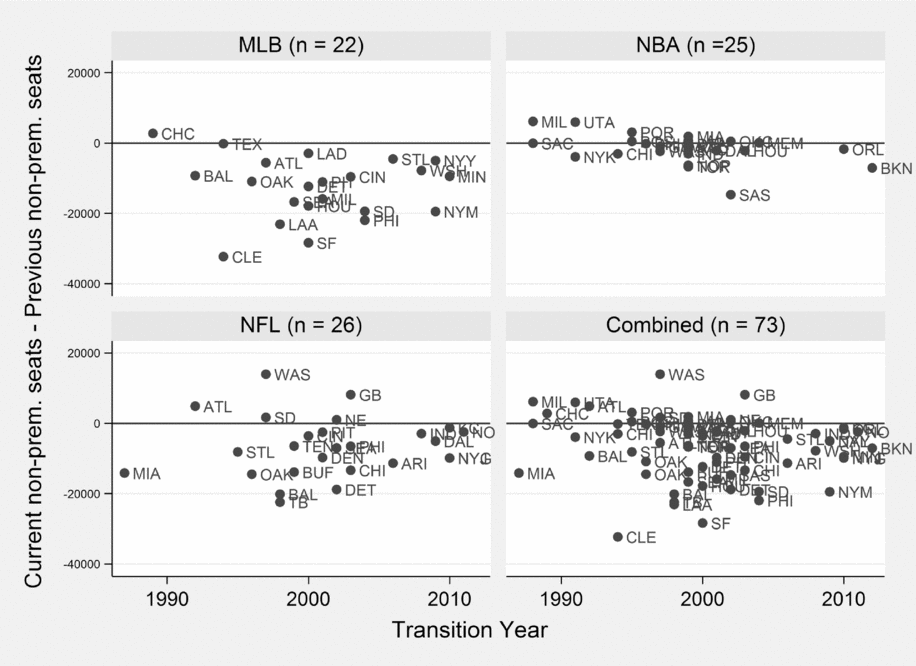
Particularly in the case of MLB teams, this story repeated itself in cities throughout the United States. Ballparks got bigger in terms of square footage, but overall seating capacities shrank while premium seating capacities rose. As documented in table 5, among the sample of 22 active baseball franchises for which data were available, the average (mean) number of total seats at MLB ballparks fell from more than 54,000 at previous venues to less than 45,000 at current venues, while average premium seating capacity rose by more than 110 percent. The meaning of this data is unambiguous: seats in luxury boxes and club sections have effectively crowded out cheaper seats in bleacher sections and upper decks. Indeed, in moving to their new venues, the typical (mean) MLB team from the sample eliminated an estimated 12,800 nonpremium seats (table 5). At least within baseball, the displacement of nonpremium seating was a systematic outcome of stadium construction over the last quarter century.
That the mean overall seating capacities at current NBA and NFL facilities exceeds that of predecessor venues should not be taken as evidence that teams in these leagues were innocent of engineering seating arrangements that pushed out working-class fans. As of 2013, premium seating offerings by the 25 NBA franchises in the larger sample accounted for 19.3 percent of total seating capacity, while at their previous venues they accounted for about 4.5 percent. At the same time, the mean nonpremium seating capacity offered by these NBA franchises declined by of 1,582 seats (table 5) with the transition to their current arenas. The same trend emerged in the case of moves to new stadiums in the NFL. Among the 26 NFL franchises sampled, the mean decline in nonpremium seats was 6,739.
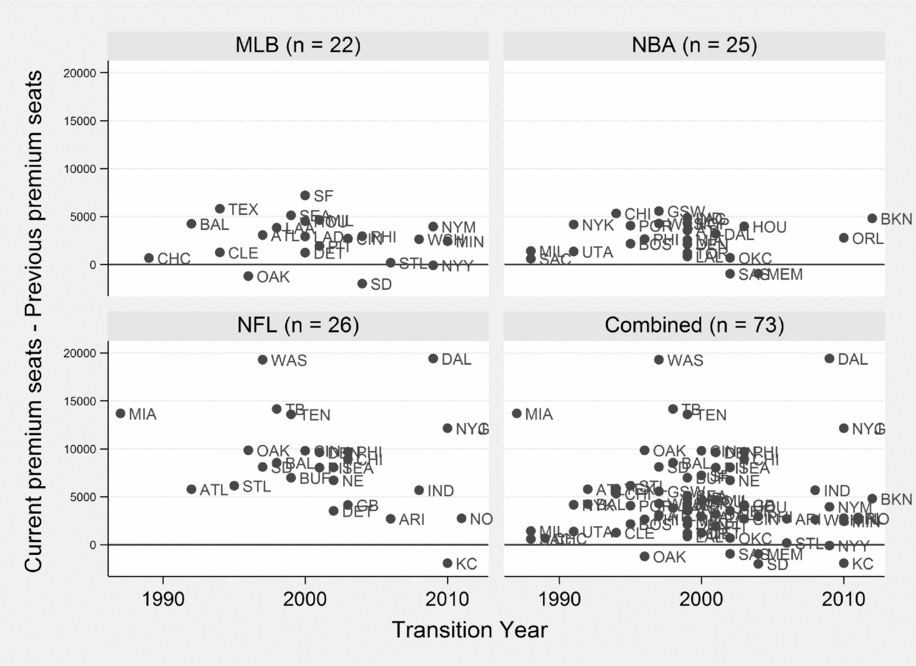
Figures 3 and 4 plot changes in absolute premium and nonpremium seating capacity, respectively, as a function of the year in which a franchise moved to its current facility. At least three trends deserve mention. First, there is no obvious correlation between the transition year and the amount of premium seats added (figure 3). This suggests that the addition of large numbers of premium seats was systematized early on in the stadium construction boom launched with Joe Robbie Stadium and consistently replicated in subsequent years. Second, figure 4 suggests a slight, negative correlation between the transition year and the net change in the number of nonpremium seats. It would appear that the crowding out of nonpremium seats has intensified over time (though this dynamic is more in evidence for the MLB and the NBA than for the NFL). Third, according to the data, only a handful of outlier franchises (6 out of the total sample of 73) experienced a decline in premium seating capacity, and only 14 saw their nonpremium seating capacities increase (though in the case of seven of the nine NBA franchises for which this was the case the estimated increase appears negligible).
Difference between total premium seating capacity (luxury suites plus club seats) at current and predecessor facilities, by transition year.

Difference between total nonpremium seating capacity at current facilities and predecessor facilities, by transition year.

On the whole, this data offers systematic evidence in support of the argument that luxury boxes and club seats have proliferated in recent decades at the expense of more modest seating options. Whereas stadiums that debuted in the three to four decades after World War II devoted much of their expanded square footage to seats not enclosed in suites or cordoned off in exclusive club sections, the current generation of even larger venues has allocated the new square footage—and then some—to amenities and infrastructure that support conspicuous consumption. The elaborate climate-control systems for luxury boxes, more and bigger upscale restaurants and cocktail lounges, and chic retail outlets all require a great deal of floor area, and teams have usually opted for a growth strategy that embraces these amenities to the exclusion of fans without the resources to pay for them (Meyers Reference Meyers1994).
As the previous sections show, stadium gentrification is a story that reaches back much further than the last 25 years. Nevertheless, the transformation of stadium and arena seating in the last quarter century marks a new phase in this ongoing history—specifically, an intensified shrinkage of opportunities for live spectatorship for most major league fans. The rapid growth of skybox and club seats has led to a situation in which an unprecedented percentage of stadium space is off limits to fans of more modest means. At the same time, teams have continued to expand season-ticket sales in recent decades through aggressive marketing campaigns (Lombardo Reference Lombardo2012; Waddell Reference Waddell1991). To make matters worse for the working class, the ongoing reduction in supply of nonpremium seats has fed an upward price spiral that has placed most of them beyond regular reach (Helyar Reference Helyar1991). For example, in 2012 the mean NBA ticket price (weighted by number of seats at each price level) for a nonpremium seat stood at $50.99 (Fort Reference Fort2013). This means that purchasing average-priced tickets for a family of four—for one game—would have amounted to more than 740 percent of the average annual expenditures on “admission to sporting events” ($27.40) for US households in the third (i.e., middle) quintile of household income (US Bureau of Labor Statistics 2014)!
This recent history of gentrification within stadiums deepens our historical understanding of gentrification more broadly. It reveals that the professional sports business's role as a motor behind central city gentrification has not been limited to displacing low-income residents who live in the path of new stadium developments. Pro sports teams have also emerged as central actors in what urbanist Mike Davis (Reference Davis1990: 226) describes as a larger, systematic effort to “secure the city” for use by leisure-seeking elites through the “destruction of accessible public space.” Of course, major league venues have never been entirely “public,” but they have become decidedly less so in recent decades.
Conclusion
In an age when smartphones and high-definition televisions deliver major league games on demand and with much better views than those available from the stands, there is a strong temptation to dismiss the preceding findings as irrelevant to the everyday fan. Admittedly, the vast majority, rich and poor alike, watch their teams from the comfort of their own living rooms, at a local bar, or at any number of other “connected,” nonstadium venues. Should the gentrification inside stadiums even matter to regular fans who may well prefer watching on a screen?
Even after putting aside evidence suggesting that class has helped shape differential access to televised sport, there is still good reason to answer in the affirmative (Dinces and Lamberti, Reference Dinces, Lamberti, Bennett, Garner and Hagueforthcoming). Particularly troubling is the fact that the value of public stadium subsidies has continued to skyrocket in recent decades alongside the construction of increasingly exclusive facilities. As Judith Grant Long (Reference Long2013) documents, while public funding as a proportion of total financing for major league facilities has actually leveled off or even declined in recent years, the fact that state-of-the-art facilities cost so much more to build than their predecessors has meant that taxpayers are, in absolute terms, paying more than ever to shield private franchise owners from the risk of investing in new facilities. Long (ibid.) estimates that the average “public costs,” which include capital costs and estimated operating costs for the life span of the of the facility, have gone from an average of $301 million for baseball stadiums built between 1991 and 2000 to $423 million for those built between 2001 and 2010 (constant 2010 dollars). For football stadiums, the figure went from $355 million for the last decade of the twentieth century to $448 for the first decade of the twenty-first century. For basketball and hockey arenas, it jumped from $143 million to $345 million. All of the extra square footage has translated into increased construction and maintenance expenditures, and with each passing decade the American public has contributed more and more tax money to stadium development projects catering to a narrower and narrower sliver of the population.
Appreciated in the context of how franchises have adjusted their stated justification for public financing of sports facilities, this state of affairs is deeply ironic. Sociologists Kevin Delaney and Rick Eckstein (2003) note that during the 1980s and 1990s, as economists convincingly refuted claims by teams that new stadiums spurred economic growth and neighborhood revitalization, league and team executives realized they needed to put a new spin on their demands for taxpayer money. As a result, franchises have increasingly taken recourse to rhetoric emphasizing the alleged role of teams in engendering civic pride and cohesion. That is, they have fallen back on claims that cannot be quantified, and that defy easy refutation as a result. Teams have thus cynically played up the notion of stadiums and arenas as public goods as they have continued to pursue a growth model that guarantees the exclusion of unprecedented proportions of the public from their facilities.
Packaged strategically, the data discussed above might be of use to opponents of public stadium financing for facilities catering primarily to corporate elites and professionals. The numbers give the lie to teams’ claims that premium seating revenues allow for price controls on nonpremium seats, and shine a light on the hollowness of the assertion that new stadiums constitute civic assets constructed with working-class residents in mind. To be sure, well-informed public relations counteroffensives on the part of the public will not, in and of themselves, solve the problem. Teams will continue to leverage the possibility of relocation in order to induce panic among citizens and local officials. Moreover, franchises and their allies in municipal government have increasingly devised public financing schemes implemented entirely outside the mechanisms of democratic governance (e.g., popular referenda).
Nevertheless, effective resistance requires strategies for reshaping public consciousness with respect to the realities of the urban sports business. Changing the terms of the debate is essential, and histories like this one offer a point from which to begin that process.