Introduction
Helianthus annuus L. and H. petiolaris Nutt. (Asteraceae) are annual diploid species native to North America where the former has a wide distribution and the latter is restricted to the central region (Heiser et al., Reference Heiser, Smith, Clevenger and Martin1969; Rogers et al., Reference Rogers, Thompson and Seiler1982). Wild or common H. annuus tends to be weedy, always located in habitats that have been disturbed. The prairie sunflower, H. petiolaris, usually grows in sandy soils, but it is also found as an adventive weed elsewhere (Seiler and Rieseberg, Reference Seiler, Rieseberg and Schneiter1997). Both species have several botanical forms and are systematically complex (Heiser, Reference Heiser1954, Reference Heiser1961; Seiler and Rieseberg, Reference Seiler, Rieseberg and Schneiter1997; Jan and Seiler, Reference Jan, Seiler and Singh2007). H. annuus is the ancestral species of cultivated sunflower (Heiser, Reference Heiser and Carter1978; Burke et al., Reference Burke, Tang, Knapp and Rieseberg2002).
Both species are valuable germplasm resources with traits that have been transferred into cultivated sunflower, i.e. cytoplasmic male sterility (CMS) from H. petiolaris (Leclercq, Reference Leclercq1969), but Rieseberg and Seiler (Reference Rieseberg and Seiler1990) provided evidence that CMS may have been derived from H. annuus, disease and pest resistance, oil quality and other traits for crop breeding (Seiler, Reference Seiler1992). These species are also crop weeds in North America (Geier et al., Reference Geier, Maddux, Moshier and Stahlman1996; Rosales Robles et al., Reference Rosales Robles, Salinas Garcia, Sánchez de la Cruz and Esqueda Esquivel2002; Deines et al., Reference Deines, Dille, Blinka, Regehr and Staggenborg2004) and are beginning to invade summer crops in Argentina.
Sixty years after the first introduction of H. annuus and H. petiolaris, they have become naturalized in the central area of Argentina (Covas, Reference Covas1966; Bauer, Reference Bauer1991; Poverene et al., Reference Poverene, Cantamutto and Carrera2002). At present, their distribution significantly overlaps that of the sunflower crop. As in the Northern Hemisphere, flowering time of both wild species and the cultivated sunflower coincide and they share pollinators, mainly honeybees, bumblebees and other wild bees, favouring gene flow (Burke et al., Reference Burke, Tang, Knapp and Rieseberg2002; Poverene et al., Reference Poverene, Carrera, Ureta and Cantamutto2004) and natural hybridization processes (Rieseberg et al., Reference Rieseberg, Baird and Desrochers1998, Reference Rieseberg, Whitton and Gardner1999b).
Wild H. annuus has been recognized as an invader species in several countries (Berville et al., Reference Berville, Müller, Poinso, Serieys and Gressel2005), but at present, H. petiolaris has been naturalized only in Argentina. The study of the invasive process of these annual species could help to understand and prevent analogous processes in other regions of the world. Cantamutto et al. (Reference Cantamutto, Poverene and Peinemann2008) studied the environmental conditions of these invader species distributions, but there is no available information about the ecology of these wild sunflower species. The objective of this research was to describe the eco-geographic distribution of H. annuus and H. petiolaris in Argentina and to characterize the populations in their natural habitats.
Materials and methods
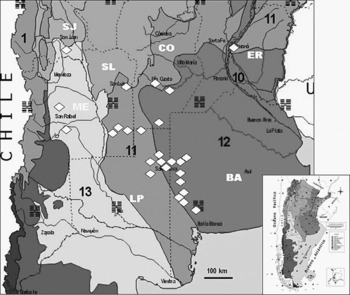
Agro-ecological descriptions of populations were made during a collection trip across seven central provinces of Argentina, during February 2007 (Fig. 1). Thirty previous explorations carried out between 2000 and 2006 provided data on population locations, habitat and soil type. Collected information included botanical name, collection site (province, district, location, latitude, longitude and altitude), environmental conditions (habitat) and community (dominance of co-occurring plant species), estimated population size, plant density, plant size and morphological variation. Also, the occurrence of prevalent sunflower diseases was recorded: downy mildew (Plasmopara halstedii), rust (Puccinia helianthi), white rust (Albugo tragopogonis), Alternaria helianthi, Verticillium dahliae, Phoma macdonaldii and Sclerotinia sclerotiorum wilt.
Wild Helianthus populations (white diamonds) sampled in three ecological regions of central Argentina (black numbers): of central Argentina: 11, Espinal; 12, Pampa; 13, Shrubs of Plateau and Plains. Soils in the Pampa region are manly Mollisols, whereas Entisols predominate in the other two regions. Provinces are Buenos Aires (BA), Cordoba (CO), Entre Rios (ER), La Pampa (LP), Mendoza (ME), San Juan (SJ) and San Luis (SL) (map from Burkart et al., Reference Burkart, Bárbaro, Sánchez and Gómez1999; scale 1:15,000,000).

The geographic coordinates were used to determine the agro-ecological regions (Burkart et al., Reference Burkart, Bárbaro, Sánchez and Gómez1999) and soil taxa (INTA, 1990) corresponding to each population. The order, great group, suborder, area and predominant texture of each soil type were used to describe the habitat environment of both species (Bouma, Reference Bouma, Eswaran, Rice, Ahrens and Stewart2003).
Data recorded for each population included occupied area, density and total number of individuals. The total area was the sum of one to five quadrants measured at each site that contained all the individuals. The density was estimated by ten samples within the quadrants, taken at regular intervals along the main transect across each population, with a 0.25 m2 circle. The total number of plants was then calculated as a product of area × mean density. In the case of populations growing in continuous patches, the limit was established as the point where the distance between two patches was greater than the longest side of the quadrant.
Plant community density was recorded for each quadrant following a semi-quantitative method (Clay and Johnson, Reference Clay and Johnson2002). At each collection site, data were collected from ten points on a uniformly spaced grid coordinate system. At each grid point (a 2 m2 circle), abundance was qualified as following: 0, absent; 1, less than 5 plants/m2; 2, 6–10 plants/m2 and 3, more than 10 plants/m2. The 20 most frequent species were characterized by life cycle, origin and status.
To estimate the number of plants potentially exposed to gene flow, a mean was obtained for population size based on the ranges observed in more than 50% of the populations. Cultivated plant number was computed taking into account the minimum acreage per cultivated field (30–60 ha) and the minimum number of plants per hectare (40,000) usually sown. Frequencies of gene flow between the three taxa were obtained from our previous research (Poverene et al., Reference Poverene, Carrera, Ureta and Cantamutto2004; Cantamutto et al., Reference Cantamutto, Ureta, Gutiérrez, Presotto and Poverene2007; Ureta et al., Reference Ureta, Carrera, Cantamutto and Poverene2008).
Results
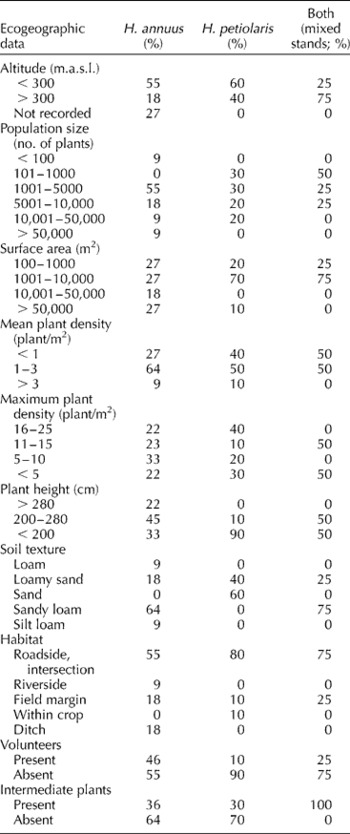
H. annuus populations were widespread ranging from 31°58′ to 37°31′S, and 60°33′ and 68°14′W, at an altitude of 128–600 m.a.s.l. (Table 1). Plants grew in patches in disturbed habitats such as roadsides, ditches, fence rows and field margins in the sunflower production areas (Buenos Aires, La Pampa and Cordoba provinces). They were also patchily distributed along irrigation channels in the western provinces (Mendoza and San Juan) and growing along crags for several kilometres of the coastal rivers in eastern Entre Rios province. Population size varied from a few dozen individuals to more than 100,000 plants, with mean densities varying between 0.25 and 6 plants/m2. However, some populations reached 72 and 80 plants/m2 in Mendoza and Cordoba provinces, respectively. Most plants were very robust with heights over 2.80 m.
Frequency of selected populations and habitat characteristics of wild Helianthus annuus and Helianthus petiolaris collected in Argentina

H. petiolaris ranged from 35°08′ to 38°08′S, and 62°16′ and 65°56′W, and up to 455 m in altitude (Table 1). Populations were very numerous in the eastern La Pampa and western Buenos Aires provinces, reaching 18,000 plants with a mean density of 0.25–6 plants/m2, and up to 40 plants/m2 in the former. Sparser populations were found in southern San Luis. In Cordoba, this species seemed to be confined to the southern extreme of the province.
Two perennial Helianthus populations were found in Mendoza, probably Helianthus tuberosus or Helianthus × laetiflorus, but were difficult to identify because they were just beginning to flower.
Volunteer plants from the cultivated sunflower crop were found among wild ones and many plants showed intermediate morphological traits. Variation was observed for leaf size, the presence of anthocyanin in stems and petioles, ray colour and white pubescent disc flowers in the centre of the head.
Three hybrid swarms were found, one in Buenos Aires and two in La Pampa. These swarms included wild-type plants of both species, intermediate plants and a number of volunteers from crop plants. In the largest swarm from La Pampa, the northern half comprised 2600 plants with about 15% being annuus-like and a plant density of 1.34 plants/m2. The southern part comprised about 8000 plants, with 50% being annuus-like and the rest petiolaris-like. Many intermediate plants were observed in the central zone.
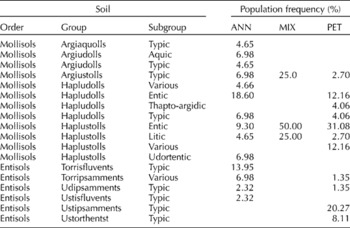
Wild species populations were found in three ecological regions: Pampa, Espinal and Shrubs of Plateau and Plains (Fig. 1). H. petiolaris and H. annuus populations were found on five Mollisol and seven Entisol groups (Table 2). Species distributions were significantly associated with soil subgroups according to Pearson's chi-squared test (Pearson's χ2 < 0.001, highly significant).
Frequency of stable wild Helianthus petiolaris (PET), Helianthus annuus (ANN) populations and mixed stands (MIX) associated with 16 of the 65 soil taxa defined by INTA 1990 for the colonized provincial counties

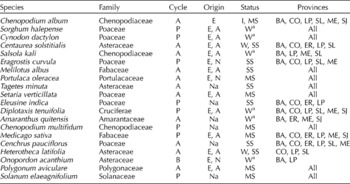
The plant communities associated with the wild Helianthus species comprised 60 species belonging to 16 families. Of these, 32 were found associated with both wild species. Most frequent species were Sorghum halepensis, Cynodon dactylon, Eragrostis curvula (Poaceae), Chenopodium album, Salsola kali (Chenopodiaceae) and Centaurea solstitialis (Asteraceae). Nineteen other species were found only in H. annuus communities, with Melilotus albus (Fabaceae) being the most common. Nine other species were only found in H. petiolaris communities, where Cenchrus pauciflorus (Poaceae) was the most frequent. Differences for the latter two species' association with wild sunflowers were significant (P < 0.05). Table 3 presents life cycle, origin and status of the 20 species most frequently found associated with wild sunflowers in the explored provinces, considered as the dominant community species.
The 20 dominant community species most frequently associated with wild sunflower populations in central Argentina

Life cycle: A, annual; P, perennial; B, biannual. Origin: Na, native; E, exotic; A, adventive; N, naturalized. Status: W, weed; I, invasive; MS, modified soils; SS, sandy soils. Provinces: BA, Buenos Aires; LP, La Pampa; SL, San Luis; CO, Cordoba; ME, Mendoza; SJ, San Juan; ER, Entre Rios; all, all the seven explored provinces.
a Agricultural epidemic.
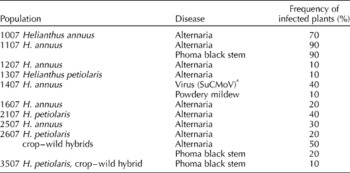
Disease symptoms were observed only in 25% of the wild populations. Alternaria lesions on leaves were the most frequent, with A. helianthi being the most likely pathogen. Puccinia helianthi was often found on volunteer plants, but never on wild plants. Table 4 presents the observed diseases and the frequency of affected plants.
Observed diseases on wild Helianthus populations from central Argentina

a Field identification by leaf lesions.
Discussion
Collection site data characterization
Regarding the number of plants, wild H. annuus populations in the centre of the country were only one magnitude of order lower than crop populations that are usually between 1 and 2.5 million plants (Ureta et al., Reference Ureta, Carrera, Cantamutto and Poverene2008). H. petiolaris was the most frequent species, but was geographically more restricted. This species often grows in field margins and seldom invades sunflower, corn or pasture crops. Most populations were found in roadsides and road intersections on disturbed sandy soils. Compared with previous collection trips, both species seemed to be more widespread, although population size and density are strongly dependent on climatic conditions, particularly moisture. Wild Helianthus populations were found in the agricultural regions where soybean, maize, sunflower and wheat are the predominate crops. Perennial Helianthus were only found in Mendoza; this kind of feral populations also occur in the Buenos Aires province, where they are usually established by rhizomes discarded from gardens (Sala et al., Reference Sala, Echarte and Rodriguez1990).
Gene flow
Morphologically intermediate plants found among volunteers indicate a frequent crop–wild gene exchange in Buenos Aires and La Pampa provinces, where there is a large sunflower crop acreage, and Mendoza where there are areas devoted to sunflower seed production. Volunteers can considerably enhance sunflower crop–wild hybridization acting as a bridge for genetic transfer of crop traits into wild populations (Reagon and Snow, Reference Reagon and Snow2006). Persistent cultivar gene flow determines high levels of introgression and the replacement of wild populations by advanced generation hybrids (Linder et al., Reference Linder, Taha, Seiler, Snow and Rieseberg1998). Crop–H. petiolaris hybridization also occurs when they come into contact.
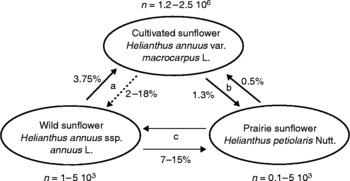
The magnitude of crop–wild gene flow in Argentina has been estimated through field observations and previous experiments (Poverene et al., Reference Poverene, Carrera, Ureta and Cantamutto2004; Ureta et al., Reference Ureta, Carrera, Cantamutto and Poverene2008 and unpublished data). Although the hybridization frequency was similar to that observed in North America (Arias and Rieseberg, Reference Arias and Rieseberg1994; Rieseberg et al., Reference Rieseberg, Kim and Seiler1999a), plants are so numerous that even at a low frequency of interspecific crosses, thousands of F1 hybrids are likely produced every year (Fig. 2).
Gene flow frequencies among cultivated and wild sunflowers in Argentina and number (n) of plants estimated as a range from data in Table 1.a: from Ureta et al. (Reference Ureta, Carrera, Cantamutto and Poverene2008); b: from Poverene et al. (Reference Poverene, Carrera, Ureta and Cantamutto2004); c: from Cantamutto et al. (Reference Cantamutto, Ureta, Gutiérrez, Presotto and Poverene2007). Gene flow values were estimated in natural conditions, except one which came from a planned field experiment (dotted arrow).

Sunflower crop genes persist for several generations in wild populations (Whitton et al., Reference Whitton, Wolf, Arias, Snow and Rieseberg1997; Linder et al., Reference Linder, Taha, Seiler, Snow and Rieseberg1998) and can modify wild populations depending on their fitness (Alexander et al., Reference Alexander, Cummings, Kahn and Snow2001; Cummings et al., Reference Cummings, Alexander, Snow, Rieseberg, Kim and Culley2002) and on the environments where they grow (Mercer et al., Reference Mercer, Andow, Wyse and Shaw2007). The high number of morphologically intermediate crop–wild plants observed in two-thirds of the populations in central Argentina could be assessed to gene flow. The consequences of the frequent hybridization process have yet to be fully evaluated.
When both wild species come into contact in North America, they can often form hybrid zones that have given rise to three other species via homoploid speciation (Rieseberg et al., Reference Rieseberg, Carter and Zona1990, Reference Rieseberg, Beckstrom-Sternberg, Liston and Arias1991; Rieseberg, Reference Rieseberg1991). Although both species have become established in Argentina rather recently, hybridization and introgression processes are taking place in this new environment.
Ecology
Wild species populations were found in three of the 18 ecological regions described in Argentina by Burkart et al. (Reference Burkart, Bárbaro, Sánchez and Gómez1999). From the east, Pampa is a grass steppe without woody species, followed by Espinal, an intermediate savannah, with grasses and scarce xeric trees. The western Shrubs of Plateau and Plains is an arid steppe with the predominance of shrubs and tough grasses. Both wild sunflower species extend along a SE–NW boundary that coincides with the limit between Pampa and Espinal regions. The subhumid region called Pampa is a cultivated area that corresponds to grasslands ploughed within last 140 years, while in the semi-arid region called Espinal agriculture is much more recent.
Soil taxonomy as an indicator of ecosystem processes can predict potential plant species suitable habitats (Mann et al., Reference Mann, King and Dale1999). Mollisols, Alfisols and Entisols orders cover only 18% of the world's temperate areas, but predominate in the centre of origin of the genus Helianthus, where together they cover 48% of the US surface. The soils of the Central Great Plains of North America, the common distribution area for the two annual species H. annuus and H. petiolaris (Rogers et al., Reference Rogers, Thompson and Seiler1982) belong to these orders (USDA, 1999). In Argentina, both species are also associated with Mollisols and Entisols. The 14 soil subgroups where the H. annuus populations were found cover 9.9 million hectares, while the 11 subgroups associated with H. petiolaris cover 13.1 million hectares (INTA, 1990). In the central area, where the sunflower crop has moved to in the last 10 years, there is a high probability of observing new wild sunflower populations because of the favourable macro-habitat conditions.
Except for Eragrostis curvula, the most frequent plant community species associated with wild Helianthus are weeds and related to disturbed soils (Marzocca, Reference Marzocca1994). E. curvula, ‘weeping lovegrass’, has become established in sandy soils subjected to wind erosion. Melilotus albus associated with wild H. annuus is a salt tolerant forage species and has become established in humid soils with medium to high salt levels; Cenchrus pauciflorus associated with H. petiolaris is a noxious weed, very common in sandy soils of the western central region (Marzocca, Reference Marzocca1994). Among species in Table 3, six are considered noxious weeds of agriculture in Argentina. All the cited species are frequent components of the flora in central Argentina and none of them was indicative of a specific ecosystem. This reinforces the hypothesis that abiotic factors, particularly disturbance determine the wild Helianthus colonization (Cantamutto et al., Reference Cantamutto, Ureta, Gutiérrez, Presotto and Poverene2007) and that the two wild sunflowers will expand their distribution when the habitat and opportunity arise. Most populations were free from diseases and confirmed that wild sunflower species are potential gene reservoirs for fungus and virus resistance.
Wild H. annuus and H. petiolaris form large populations distributed over an area of about 5 million hectares in central Argentina. Since their establishment 60 years ago they have continuously increased their area, behaving as an invasive species providing evidence that they will continue spreading. These species offer opportunities for research covering various scopes. First, both wild Helianthus constitute germplasm reservoirs of biotic and abiotic gene resistance for crop improvement. Second, wild populations subjected to gene flow may acquire crop traits (i.e. herbicide tolerance) that modify their fitness enhancing invasiveness or weediness, changing ecological relationships in their environment. Finally, hybrid zones allow comparative studies with the centre of origin regarding processes of parallel adaptation and speciation.
Acknowledgements
This research was supported by grant UNS-PGI 24A106 and special funds from Postgraduate Studies Department of the Universidad Nacional del Sur for the visit of Dr Gerald J. Seiler.