Some social scientists argue that democratic societies provide institutions that ensure economic and political freedom and protect property rights, which were necessary for economic growth and development.Footnote 1 Others, however, argue that democracy gives the poor the ability to redistribute income to themselves, increase the provision of public goods, and increase taxes on the rich. Capital owners then withdraw or reduce their investments and industrial growth and economic development slows.Footnote 2 We approach the issue of the economic effects of democracy by examining how investors reacted to changes in electoral rules in the Kingdom of SaxonyFootnote 3 between 1896 and 1909.
We do this by linking their investment behavior on the Berlin Stock Exchange to the advent of new electoral laws and elections in the Kingdom of Saxony. We focus on the Kingdom becausethe law was changed twice within a very short period; in 1896 the right to vote was restricted to a small share of the population, while the law of 1909 extended it. These events allow us to study both the effect of reduced and increased political participation of the middle and working classesin the same economic and social environment. Furthermore, the political culture of the Kingdom was polarized between Social Democrats and a conservative-liberal cartel. The Social Democrats dominated the Saxony delegation to the general parliament of the Reich, whereas inthe elected parliament of the Kingdom, they were most of the time not represented at all (Ritter 1990). Thus, in Saxony everyone understood that an extension of the suffrage would increase the influence of the Social Democrats, the party of the—overwhelmingly poor—workers, which demanded more redistribution, higher taxes on the rich, and the extension of public goods. The Kingdom of Saxony was the third largest and most industrialized state of the German Empire, but most importantly, it had a very high ratio of stock market capitalization to net national product: Joint stock companies with their headquarters in Saxony that were listed in Berlin and/or on regional stock markets had an overall market value of nearly 50 percent of the gross domestic product (GDP) in 1909.Footnote 4 As a reduced demand for stocks would have made it more difficult for firms to attract capital to overcome liquidity constraints, it would have a strong effect on short-term industrial growth and possibly long run development of the entire region.Footnote 5
Our study has two salient findings. First, the Berlin Stock Exchange reacted to political changes in Saxony. This finding is surprising considering historical research has claimed that increased suffrage in the German Empire was not accompanied by a larger political influence of the parliaments (Schönberger Reference Schönberger2001). If elections and therefore an extension of the suffrage had no or very limited political impact, stock prices would hardly be influenced by them.Footnote 6 The second finding is that a widened suffrage had a rather negative effect on stock returns of Saxony-based firms. Although capital owners seemed to fear a revolution and therefore supported a certain degree of franchise extension, they obviously opposed it when they felt that the influence became too large. This article is the first to provide quantitative evidence for such antidemocratic sentiments; itthus contributes to the literature on why Germany remained autocratic for such a long time and the debate about the ability of the Germany Empire to modernize and change at all (see for instance Wehler 1994). Although Saxony's constitutional changes were rather special (see Retallack 1990, p. 276), at the timeobservers from all political camps stated that the development in Saxony in 1909 might have implications for the entire Empire.(Lässig 1996, p. 24).
THE CONSTITUTION, ELECTORAL LAWS AND THE RISE OF THE SOCIAL DEMOCRATS
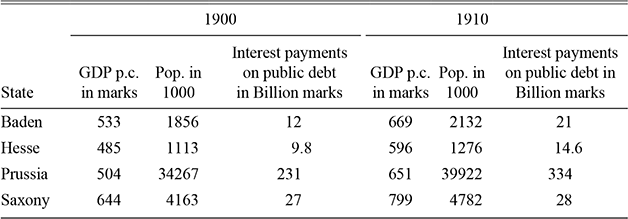
In the late nineteenth and early twentieth centuries, Saxony was one of the most industrialized regions in Germany. In 1882, about 56 percent of the working population of the Kingdom was employed in the industrial sector. This was the largest share in the whole Reich and far above the national average of 35 percent. By 1907, the agricultural sector accounted for only about 11 percent of the working population, which is comparable to England at the time (Ritter 1990, pp. 50). The most important sectors were textiles, machines, and metal working. In all of the 23 Saxon constituencies of the Imperial election (Reichstagswahlen), the majority of the electorate was working in the industrial sector. In the whole Reich we count 195 out of 397 constituencies where this was the case (Ritter 1990, p. 51). Furthermore, Saxony was quite wealthy. Its GDP per capita even exceeded that of Prussia (Table 1).
One might wonder whether it makes sense to study reactions to changes in suffrage in a single German state. Before 1914 the German Empire was a federal system where the most important decisions were taken within the member states. The Reich was responsible for military and foreign policy, the states for taxation, education, culture, and justice (Berghahn 2003, p.360). Saxony had its own fiscal system and forwarded a certain amount of its tax revenues to Berlin (Ullmann Reference Ullmann2005, p. 60). Thus, state elections may well have been more important than the Imperial elections.
Economic Indicators for Different States

Source:
Hoffman (Reference Hoffmann and Müller1959, p. 86).
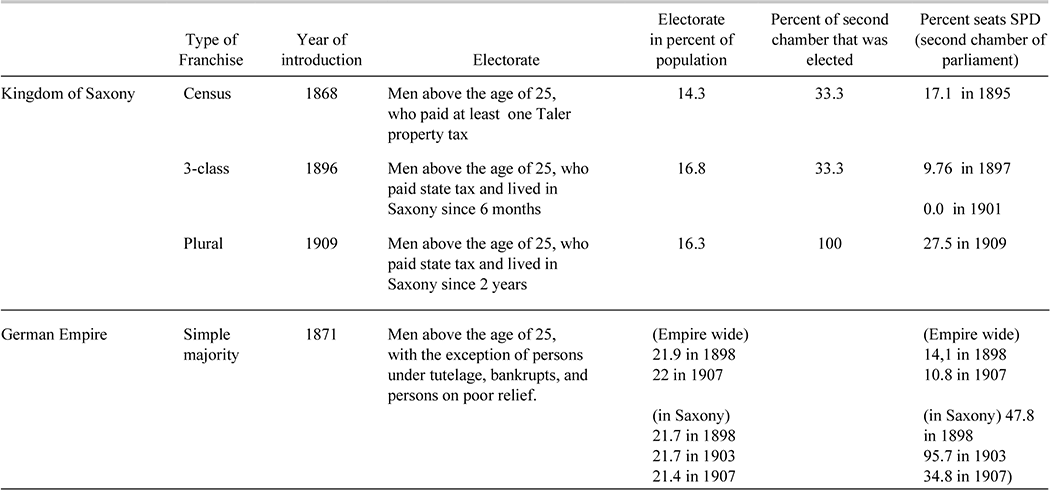
Like most other German states, Saxony was a parliamentary monarchy. The legislative power was bicameral and both chambers had equal rights.Footnote 7 The first chamber was composed of members of the nobility and other notables (such as for instance the president of the University of Leipzig). The second chamber was elected by the enfranchised part of the population (Blaschke Reference Blaschke1997, p. 18). The executive branch was appointed by the King. He could also dissolve the second chamber at any time without particular reason and chose the members of the first chamber. Although legislation could be initiated by the King's government or either chambers, passage required that all approveeach chamber with absolute majority (§§85/86 and §128 of the Saxon Constitution). Thus, although the influence of the elected politicians was limited compared to conditions in modern democracies, laws could not be passed without their agreement. Furthermore, neither the Kingnor his wife chose actively to participate in the political process. Instead policy was left to the ministry and the two chambers of the parliament (Blaschke Reference Blaschke1997, p. 16). At the Imperial level, every male above the age of 25 with the exception of incompetents, bankrupts, and persons on poor relief was allowed to vote (Ritter and Niehuss Reference Ritter and Niehuss1980, p. 28). The electoral laws of the member states of the Reich, however, were much less democratic (Ritter and Niehuss Reference Ritter and Niehuss1980, p. 28). In Saxony, 1867 to 1896, elections took place every two years and only one-third of the seats of the second chamber were contested in each round (Opitz Reference Opitz1887, p. 51). Furthermore, the right to vote was restricted: Every male above the age of 25 who paid at least one Taler (after 1873, 3 Marks) property tax had the right to cast one vote.Footnote 8 In consequence only about 14 percent of adult males could vote before 1896 (Ritter and Niehuss Reference Ritter and Niehuss1980, p. 164). Nevertheless, over time, the Social Democrats gained quite a large share of the seats (see Table 2).
As a reaction, a new electoral law similar to the very restrictive Prussian three-class system was introduced in 1896. It aimed at preventing the Social Democratsfrom making further electoral gains(Lässig Reference Simone1996, p. 251). The new law slightly extended the suffrage to a larger base of voters (16 percent), because now anyone who paid direct taxes was allowed to vote. Furthermore, the residency requirement was lowered to six months. However, voterswere now divided into three groups. The first class comprised voters in the top one-third of direct tax payments; the second class comprised those in the second one-third of taxes. All other voters belonged to the third class. Between 1897 and 1909, the first class never came to more than 4 percent of all voters, the second class to between 15 and 18 percent leaving between 78 and 81 percent of all voters in the third class. In every electoral district, every class elected one-third of the electors, who then voted for the members of parliament by an absolute majority vote.Footnote 9 The vote of a voter from the first class therefore counted about 20 to 25 times as much as a vote of a third class voter. The only substantial difference to the infamous three-class-voting system of Prussia was that in Saxony the ballot was secret. This feature was retained because the National Liberals feared that Social Democrats would try to manipulate workers in small firms in order to influence the outcome of the election (Ritter Reference Ritter1997, p. 65). This seems ironic considering how landlords, priests, and others pressured workers in Prussia, where the vote was public (Anderson Reference Anderson1993; Ziblatt Reference Ziblatt2009). The effect of the new law was dramatic: In the first election after its introduction in 1897, the Social Democrats lost about 40 percent of their seats (see Table 2), although they gained almost all electors from the third class (Ritter Reference Ritter1990, p. 74).Footnote 10
Results State Elections 1893–1909 (Seats)
Source:
Ritter and Niehuss (Reference Ritter and Niehuss1980, p. 172).
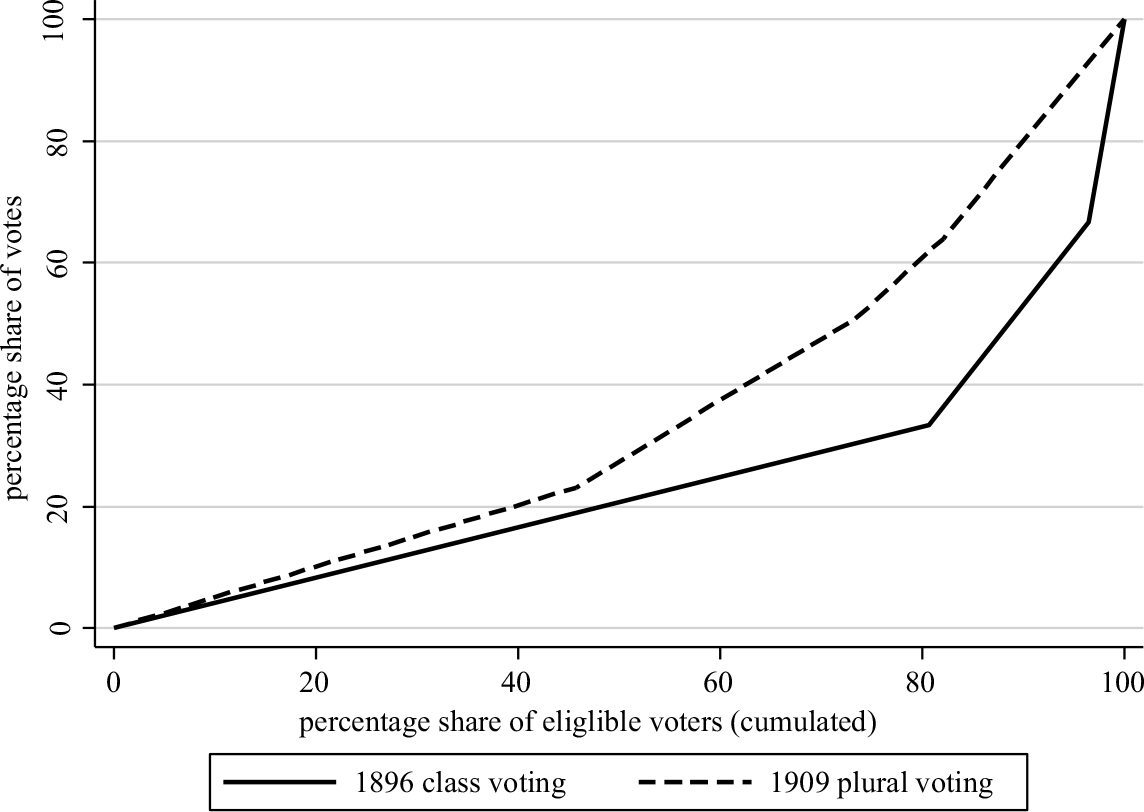
The next large change in the suffrage took place in 1909. The new law reduced the electorate from 16.8 to 16.3 percent of the population because it restricted increased residency requirements to two years instead of six months and disenfranchised men who were a year or more behind in their tax payments. However, the law did extend the impact of the votes of the middle and working class through two channels: First, the general importance of each election grew, since instead of only one-third of the MPs the whole second chamber was newly elected. Second, in the new plural voting system every voter had one vote but could receive up to threeadditional votes because of income, property, education, or age. Earning more than 1,600 Marks or owning more than 2 hectares (ha) land brought one additional vote, the maximum of four votes required 2,800 Marks income or 8 ha land ownership, respectively.Footnote 11 Based on education (at least six years of schooling in middle or high school) one could get one additional vote if one had no additional vote for any other reason. Lastly, all citizens above the age of 50 received one additional vote as long as it was not their fifth (Ritter and Niehuss Reference Ritter and Niehuss1980, p.167).Footnote 12 These additional votes were justified with the claim that the group of “high-quality” voters, which was regarded as small in size but important for the state, would need support through additional votes. Otherwise their impact would be outweighed by the “masses” (Oppe Reference Oppe1910, p. 398). The criteria to identify the “quality” of voters were then fixed as wealth, signaled by income and property, the level of education and age. The most widely discussed criterion was whether older voters really deserved an additional vote. Not all members of parliament (MPs) involved in the design of the new electoral law believed that voters became politically wiser or more patriotic as they aged (for details on the discussion see Oppe Reference Oppe1910, p.398). The most notable change in the law was the fact that although votes were still weighted differentially, the weight did not exclusively depend on income. Figure 1 illustrates how the new franchise increased the impact of the votes of the middle and working class. The figure reads like a Lorenz curve. In 1896, for example, votes of 80 percent of the voters accounted for about one-third of all votes, whereas in 1909, 80 percent of the voters cast about 60 percent of all votes. Furthermore, in every electoral district voting was now direct and an absolute majority was required to win the seat. If none of the politicians managed to win a constituency in the first ballot, a second one was held between the two candidates with the most votes (Ritter Reference Ritter and Niehuss1980, p. 167–68). Saxony's three different electoral laws in contrast to the electoral law in the Empire are summarized in Table 3.
The Bias of the Weighted Votes

Overview Franchise and Impact of the Social Democrats

Notes:
Ritter (Reference Ritter and Niehuss1980, pp.38, p.125; Reference Ritter1990, p.63), Opitz (Reference Opitz1887, pp. 51), Wahlgesetz (Electoral law) 1896/1909.
As noted at the beginning of this article the political system was polarized betweenthe Social Democrats who dominated Imperial elections and a conservative-liberal cartel that was equally dominant in Saxony (Lässig Reference Campbell, Lo and CraigMacKinlay1997, p. 204). Moreover the Social Democrats’ power at the Reich level was, if anything, growing. In 1903, they won 22 out of 23 constituencies in the Imperial elections (Ritter Reference Ritter1990, p. 63). This success of the Social Democrats exceeded all their hopes and all the fears of their opponents (Lässig Reference Simone1996, p. 101), and everyone expected an extension of the suffrage in Saxony to produce a similar increase in power of the Social Democrats.
THEORETICAL BACKGROUND, RELATED LITERATURE, AND HYPOTHESIS
Recent research on politics and financial markets show that investors take expectations about future political outcomes into account when they make financial decisions. Stock prices represent marginal expectations of market participants about the future performance of firms. Most studies however focus on the period after World War II and thus on elections or political decisions rather than changes in suffrage, since this was a phenomenon of the pre- and interwar period (see for instance Bechtel Reference Michael2009; Bernhard and Leblang Reference Bernhard2006, Chapters 3 and 4; Herron Reference Herron2000; Leblang and Mukherjee Reference Leblang2004, Reference Leblang2005; Snowberg, Wolfers, and Zitzewitz Reference Snowberg, Wolfers and EricZitzewitz2007). The exception is John Turner and Wenwen Zhan (Reference Turner and WenwenZhan2012), who show that investors on the London Stock Exchange reacted negatively to the British 1867 reform act, aimed at extending the franchise, as they saw this as undermining their property rights and freedom of contract. Like Turner and Zhan (Reference Turner and WenwenZhan2012) we apply standard event study methodology, comparing firms headquartered outside Saxony (and thus unaffected by these laws), and firms in Saxony, all of which were listed on the Berlin Stock Exchange. As discussed at the beginning of this article, there is a broad literature on the degree of democracy in the German Empire and its impact on German History and in particular on the failure of the Weimar Republic.Footnote 13 If Saxony-based firms had significantly different returns it would raise serious questions about the historiography that argues that German parliaments had little ability to affect politics.
The political economy literature suggests that left-wing governments pursue policies harmful to capital owners (Hibbs Reference Hibbs1977). Research for more recent periods shows that stock prices drop after a left electoral victory and increase after a right victory (see for instance Bechtel Reference Michael2009; Herron Reference Herron2000; Leblang and Mukherjee Reference Leblang2004, Reference Leblang2005; Snowberg, Wolfers, and Zitzewitz Reference Snowberg, Wolfers and EricZitzewitz2007). Moreover scholars have argued that extending the franchise to social groups with less property and income leads to greater income redistribution from the rich to the poor (Husted and Kenny Reference Husted and LawrenceKenny1997; Justman and Gradstein Reference Justman and MarkGradstein1999; Acemoglu and Robinson Reference Acemoglu and Robinson2000). Alessandro Lizzeri and Nicola Persico (Reference Lizzeri2004) suggest that an extension of the franchise leads to an extension in the provision of public goods, which also causes a growth of government expenditure (Husted and Kenny Reference Husted and LawrenceKenny1997; Lott Reference Lott1999). Toke Aidt and Peter Jensen (Reference Aidt and PeterJensen2009, p. 379) observe that in Western European countries from 1860 to 1938, a widening of the electorate generally increased government spending and direct taxes, given that the population exhibited a certain minimum level of literacy.Footnote 14 The Social Democrats’ party manifesto of 1891 promised general and equal suffrage including the right to vote for women, free schooling and educational materials, free legal advice for the poor, and free medical health care (see Kautsky Reference Kautsky1892). The Social Democrats proposed increasing income and property taxes to meet the expenses on their program.Footnote 15 This would directly affect the income and property of investors and shareholders based in the Kingdom. Furthermore increasing taxes on property and income were likely to correlate with a higher taxation of firms though this was not explicitly stated. The other parties—Conservatives, National Liberals, and Progressives—promised to focus especially on the protection of property rights (Ritter Reference Ritter1997, p. 67).
Thus we seek to test the following hypothesis: Prices of Saxony-based firms on the Berlin Stock Exchange react to political changes and elections in the Kingdom (positively in 1896 and negatively in 1909).
METHOD
We study the effect on changes or possible changes in the political rights of Saxon firms on the Berlin Stock Exchange with standard event study methodology (see Binder Reference Binder1998, p. 124).Footnote 16 Figure 2 illustrates the approach. In an estimation period [T–1, T1], which is unaffected by the event—the estimation window—we estimate the parameters later used to calculate expected (normal) returns. The event under consideration occurs at T0 and can affect the stock market during the event window [T1, T2], which lies on either side of T0. The estimation window for the normal returns are set to 120 trading days before the event window.Footnote 17 Five different event windows, measured in days, are selected: three are symmetric around the event ([–14; +14], [–7; +7], [–3; +3], and two are asymmetric ([–14; 0] and [0; 14]).
Estimation and Event Window
We estimatedexpected returns both with a market model anda constant mean return model. The marketmodel relates the return of any given security to the return of the market portfolio.Footnote 18 For any security i the expected returns are estimated according to the following equation:

where Rit and Rmt are the period-t returns on stock i and the market portfolio, respectively. ε it is the error term, whose variance is assumed to be constant over time. Rmt is the market portfolio. We started with the 27 firms continually listed on the Berlin Stock Exchange used by Sergy Gelman and Carsten Burhop (Reference Gelman2008) to construct a stock market index. We removed three firms based in Saxony to avoid bias. Thus the benchmark portfolio that we use contains 24 firms that account for about 22 percent of the total value of Berlin listed equities in 1909.Footnote 19
The market model is able to distinguish effects that may influence the entire market in Berlin and effects that only influence firms based in the Kingdom of Saxony. This is particularly important since a new stock exchange law (Börsengesetz) was promulgated 1 January1897 and that would have affected all firms. The law regulated the organization of all German stock exchanges, price fixing, listing of new shares; and it restricted trading of forwards, futures, and options (Gelman and Burhop Reference Gelman2008, p. 43). Since the abnormal returns calculated with the market model only show the difference between the firms based in Saxony and the portfolio of other firms listed in Berlin, we will not produce abnormal returns from the law.
The second way to calculate the normal returns is the constant mean return model. For any security i, the constant mean return model is:

We then calculate abnormal returns in the event window. Specifically, abnormal returns of the shares of firm i at time t are calculated as: ARit = Rit − E(Rit ), where Rit is a stock's realized return for time t and where E(Rit ) is its expected return in the absence of the event, as calculated in Equation 2. We then calculate the average cumulated abnormal return (ACAR) from t = T 1 to t = T 2

where N is the number of stocks in our sample during each event. To test the significance of the ACARs, the variance of the ACARs is estimated by using cross-sectional variance across the cumulative abnormal returns of the various companies. This cross-sectional approach takes account of increase in event period variance (Campbell et al. Reference Campbell, Lo and CraigMacKinlay1997, p. 168; Turner and Zhan Reference Turner and WenwenZhan2012, p. 620). Using the cross-sectional approach to form an estimator of the variance gives

The test statistic is then calculated as, 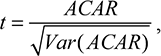 which is asymptotically standard normal.
EVENTS
An important issue is whether the events were really unexpected. If stock market participants anticipate changes before they actually take place, pre-event prices already reflect this information and stock prices respond less to the actual change (Binder Reference Binder1998, p. 123). In general, elections are less of a problem in this context, given the fact that they are rarely perfectly predictable. Before an election takes place investors cannot have a perfect forecast of its outcome and the post-election composition of the parliament (Sattler Reference Sattler2013, p. 345). In the context of Saxony, however, the direction of the outcome was unambiguous. Social Democrats were expected to lose seats after the election in 1896 and to gain power after the election in 1909. Thus investors could form expectations about the degree of power the Social Democrats might gain. The ACARs after the election therefore reflect the difference between the expected changes in power of the left wing and the realized change. If ACARs are negative, investors judged the actual change as less desirable than their expectations and vice versa.
We study the effects of seven events that occurred in the period from 1896 to 1909. Our main source to detect event dates was the Frankfurter Zeitung, one of the most important national newspapers and financial dailies in Imperial Germany. We further inspected other national newspapers (Berliner Börsenzeitung, Berliner Börsenkurier, and Vossische Zeitung) as well as regional newspapers from Saxony (Leipziger Volkszeitung, Magdeburgische Zeitung). Except for mass demonstrations and the day when the law was published in 1909, which were only mentioned in regional newspapers, we take the first day when the event appeared in any of the considered newspapers. Our first three events occurred in 1896. The first one is 7 March 1896, the day the second chamber of the Saxon parliament approved the new law that restricted the suffrage. The second event is 28 March 1896 when the law was officially published (Gold Reference Gold1995, p. 42), but this was only mentioned in the newspaper on 29 March—a Sunday. Since stock markets were closed on Sundays, we test 30 March as the first day after the notification when the stock market was open. We expect a significant positive impact after the event. The third event is the election of 28 September 1897 when after the change in suffrage the Social Democrats lost almost one-half of their seats (Lässig Reference Simone1996, pp. 87). The large loss was already apparent in the first publication of electoral results. Already on the day of the election, the Frankfurter Zeitung judged the result to be “a truly splendid victory for the supporters of the three-class franchise.” Thus we assume that investors expected the Social Democrats to lose less than they actually did, which would be reflected in positive ACARs, especially since there were no demonstrations or riots as a reaction to the electoral results.
The next event took place in November 1905 when the Social Democrats organized mass demonstrations in cities all over the Kingdom, demanding a revision of the electoral law. The Social Democratshad organized street protests to demand revisionsto the electoral law before, but this time they organized this event not only as a reaction to changes or possible changes but also to show with a large number of participants that they extended their power. The demonstrations of 1905 were the first Kingdom-wide effort since 1896 and they were very well-organized, disciplined, calm, and peaceful (Lässig Reference Simone1996, pp. 144). However, before the demonstrations it was widely feared that they would end in violent riots, and the army was put on alert on 18 November 1905.Footnote 20 Thus we expect a negative effectbefore the event, but a positive one afterwards.
The last three events took place in 1909. We examine 23 January, the day when the second chamber of the Saxon parliament passed the law that extended the suffrage. The next event is 5 May when the law was officially published, since this event was not reported in the newspaper we do not expect it to have an effect on share prices. Finally we consider 22 October, the first election under the new law, in which the Social Democrats gained so many seats. Before the vote everyone was uncertain about the actual effects of the electoral law on the election results. In the face of this uncertainty parties tried to mobilize their voters by painting a somber picture of the potential outcome of the election. The Conservatives warned that the new elections would bring about a “government of the masses,”which would result in income redistribution and higher taxation of the rich, whereas the Social Democrats claimed that the effects of the law would probably be very limited (Lässig Reference Simone1996, p. 233). Altogether uncertainty about the effects of the new law and the elections must have been very high. As a result investors might have reduced demand for firms based in Saxony to the benefit of unaffected firms located outside the Kingdom, which would be reflected in negative ACARsbefore the first results were published. The first result that was published was quite far from the final one. In only 33 of the 91 constituencies, an absolute majority of the votes was reached on 22 October, out of which the Social Democrats won 15. Thus in the following two weeks, 58 second ballots were to run, in which the Social Democrats still had a chance to win another 54 (Lässig Reference Simone1996, p. 236). These first results were extensively debated, for instance, the Frankfurter Zeitung reported a “defeat of the Saxon Conservatives” and great successes of the Social Democrats.Footnote 21 Similarly, the Berliner Börsenzeitung noted a “remarkable swing to the left.”Footnote 22 Thus we assume the first success of the Social Democrats to be by far larger than investors expected, which would be reflected in significant negative ACARs.
DATA
Information about which firms were listed on the stock exchange and the share capital was taken from Saling's Börsenpapiere 1896, 1897, 1905, and 1909. Daily prices, “Stückzinsen”Footnote 23 and dividends were taken from Berliner Börsenzeitung. Our analysis is based on all industrial firms listed at the Berlin Stock Exchange in the particular years. Typical sectors were textiles, machines, and mining.Footnote 24 Practically this means we exclude insurance companies and banks. Insurance companies were excluded becausethey only issued “vinkulierte Namensaktien,” i.e., registered shares with restricted transferability (Gelman and Burhop Reference Gelman2008, p. 49). Banks were excluded since we cannot draw clear hypotheses about what reaction we expect for their share prices. Indeed following the extension of the electoral suffrage, investors may have tried to find alternative forms of investment, which might benefit banks in Saxony. The prices of four banks headquartered in Saxony (Dresdner Bank, Leipziger Creditanstalt, Sächsische Bank zu Dresden, Sächsische Bodenkreditanstalt), however, reacted negatively to the extension of the suffrage and positively to its restriction, although in most cases not significantly.
Thus we have two samples of industrial firms whose composition mostly overlaps (1895–1896 and 1909). Furthermore, we added a third sample to study the effects of the mass demonstrations in 1905, which contains all industrial firms headquartered in Saxony that were listed on the Berlin Stock Exchange in that year. This sample is almost that for 1909, except fortwo firms that onlywent public in 1906. In 1896 the sample contains 24 industrial firms. Figure 3 shows the market capitalization of the sample for the period from November 1895 to November 1897 on a daily basis. One can already see the short-run impact of the events. After the new law passed, the market experienced a period of relatively stable positive market returns up to the election. Shortly before the election the prices fell, which can be interpreted as a sign of general insecurity of the electoral outcome. Afterwards the prices quickly recovered.
Market Capitalisation of Saxon Industrial Firm on the Berlin Stock Exchange 1895–1897

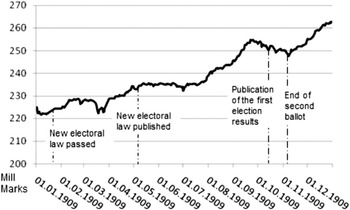
In 1909 the sample contained 35 industrial firms. Figure 4 shows the market capitalization of the firms and the events in 1909. The capitalization of the sample is about 10 percent of the GDP of the Kingdom.Footnote 25 The capitalization of the portfolio reaches its peak on 22 September with a value of about 254 million Marks. It then falls until 8 November to a level of about 248.5 million Marks and then steadily rises thereafter. At first sight, the election indeed seems to have had a negative effect in the short run, starting shortly before it took place. The stock market, however, recovered quickly. The day the law passes seems not to influence the stock market, possibly because in contrast to the election, the change in law was not discussed in the Frankfurter Zeitung.
RESULTS EVENT STUDY
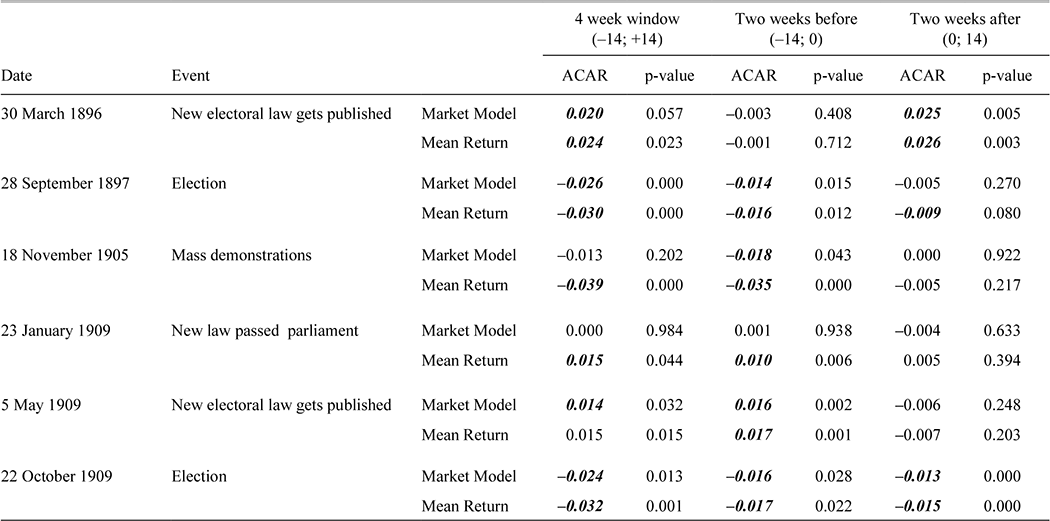
Table 4 provides the results for the seven events. The six day and two week windows produce similar but weaker effects than the four-week window so we do not report them. The first remarkable result is that most political changes lead to significantly different ACARs. Elections and political changes obviously mattered for the investment decisions of shareholders, and the claim that parliaments and elections were irrelevant cannot be supported.
Market Capitalisation of Saxon Industrial Firm on the Berlin Stock Exchange 1909

Investors did not react significantly to the passage of the law in March 1896 under any event window and with either statistical model, for brevity we do not report these results. The next event, the official publication of the law, shows clearer results. Both models show significant positive returns and these are confined to the two weeks after the law was promulgated. It seems that investors were pleasantly surprised that the executive branch went along with the suffrage restriction voted by the chambers. The fact that the stock market did not react to the vote in the parliament but to its official publication can be interpreted in two ways: First, there was no insecurity about whether the parliament would pass the law, but rather about whether the executive would sign it, suggesting the ministers’ and the King's decisions did not always conform to that made by the parliament. This seemed unlikely at least for the King, since he never intervened in politics (Blaschke Reference Blaschke1997, p. 16). Second, it is possible that investors did not take notice of the parliamentary vote and only anticipated the change in the franchise after the law was officially published.
For 28 September 1897, the first election under the new law, we find significant negative returns in the four-week window. This is mainly driven by the two weeks before the elections. In the forefront of the election, investors seem to have become worried about Saxony and reduced the demand for Saxon based firms by diversifying their portfolio. This is reflected in falling prices and negative ACARs. The returns in the two weeks after the event are negative, but applying the market model the returns arenot significantly negative. Because ACARs after the election are driven by the difference between expectations and actual outcome, it seems that investors got slightly more worried after the large loss of the Social Democrats became public. This might indicate the fear that Social Democrats and possibly other radical groups would organize protests and riots to claim their rights as a response. The fourth event was the day of the mass demonstration in Leipzig in 1905. Here the market reacted negatively, although only significantly in the four-week window and in the two weeks before the demonstrations. As discussed previously, Conservatives expected revolutionary and destructive protests and not the calm and well organized demonstrations that actually took place (Lässig Reference Simone1996, pp.144). Obviously investors were relieved that the demonstrations did not end in riots or a revolution.
Results Event Study

Note:
Bolded number indicate significance at the 10% level.
Source:
Authors' calculations, data see text.
So far, the results clearly show that political events in Saxony mattered for the returns on the Berlin stock market of firms based in Saxony. The restriction of the suffrage, however, reduced expected returns. The conservative turn thus did not produce price increase as we expected. In fact, it seems investors did not appreciate political change—either because it increased the risk of revolution or because the restriction of the suffrage would favor thepart of the conservative elite least favorable to business.
When the law that extended the suffrage was passed on 23 January 1909, in general ACARs are positive. However, in the two weeks after the law passed, the positive trend is not significant anymore. It seems that the law fitted investors’ expectations, since it did produce normal returns after it got published. Investors might have thought the law was a cheap way to reduce conflict and not sufficient to increase the power of the Social Democrats to an extent where it might negatively affect their incomes.
On 5 May, the new law was officially publishedand ACARs in the event window are positive, which is again driven by the two weeks before the event. In the two weeks following publication there are no abnormal returns. This could be interpreted similar to the previous event. Another possibility is that the news has leaked out in advance. The last event considered was the publication of the first results of the election in October 1909. Here we observe negative abnormal returns before and even more negative ones after the elections. As discussed previously, the Social Democrats won 15 out of 33 seats in the first ballot, which was a remarkable and certainly unexpected success. The interpretation that capital owner sperceived this as a great threat is clearly supported by the significantly negative ACARs after the first publication. In the following two weeks, the second ballots took place on different days and only some of them were reported. Thus in the following two weeks, investors became slowly aware that the victory of the Social Democrats was hollow.
In order to understand how investors reacted to the changes in the political system, we break our sample into two. The first subsample contains the largest firms. In 1896 we consider five firms, which held together 46 percent of the total market capitalization in terms of capital stocks. In 1905 and 1909 we consider seven firms, which held 50 and 51 percent of the total capitalization, respectively. The reasons to split the sample is that although all firms considered here were listed at the Berlin Stock Exchange, one might worry that our results may are driven by the home bias of Saxon investors in favor of Saxony's smaller firms. The marginal investor in large firms likely lived outside Saxony, so these large firms’ prices are expected to react far less to regional events such as the mass demonstrations. This could be the result of the fact that the marginal investor would not bear any changes to personal income taxation in Saxony and only a possible rise in taxation for the Saxon firms, in which they invested. Indeed, in estimations not reported, large firms’ prices only reacted significantly to the two elections (in both cases ACAR are negative). The prices of small firms reacted less to these events—ACARs are about one-half of those of large firms, but they also reacted to all the other events (promulgation of the laws and mass demonstrations in 1905).
ROBUSTNESS
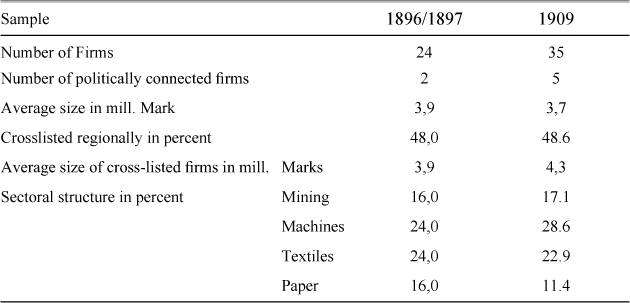
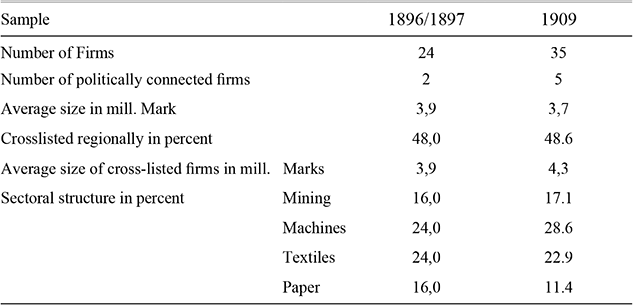
The above results might be driven by certain firm-specific characteristics. In particular, political connections of firms may have had an impact on share prices. The restriction of the electoral suffrage may have corresponded with a rise in power of conservative politicians (and the extension to a loss in power). If right wing politicians were members of the supervisory boards of firms, the restriction of the suffrage to the benefit of the richer population may have meant a rise of political support and political protection for these companies and vice versa. This would have been reflected in a rise of their share prices in 1896 and a fall in 1909 (for the impact of political connections see Faccio Reference Faccio2006; Ferguson and Voth, Reference Ferguson and Voth2008; Braggion and Moore, Reference Braggion and Moore2013). However, most firms headquartered in the Kingdom of Saxony and listed at the Berlin Stock Exchange in 1896 and 1909 had no obvious political connection: In only two of the 24 firms in 1896, we find a member of the Saxon parliament in the supervisory board and in 1909 also only five out of the 35 firms were politically connected (Matzerath Reference Matzerath2001, pp. 89; Handbuch der deutschen Aktiengesellschaften 1896, 1909). All of the politicians, who were members of supervisory boards, were indeed rather right wing—either a member of the conservative party or of the National Liberals (Repertorium 1909, pp. 40–115). In order to control for firm specific variables and political connections, we run the following simple ordinary least squares regression (OLS) with robust standard errors:
Overview Firm Samples

Sources:
Repertorium zu den Landtags-Acten und Mittheilungen über die Verhandlungen des 26. Ordentlichen Landtags 1895/96, pp. 15–43; Repertorium zu den Landtags-Acten und Mittheilungen über die Verhandlungen des 32. ordentlichen Landtags 1907/1909, pp. 40–115; Matzerath, J. (2001, pp.89–136); Handbuch der Deutschen Aktiengesellschaften (1898, 1911).

Results Robustness Tests

Notes:
Robust standard errors in parentheses.
*** p<0.01, ** p<0.05, * p<0.1
Source:
Authors' calculations, data see text.
where CAR are the abnormal returns per firm cumulated over the event window, size is the share capital of firm i, crosslistedi is a dummy variable that is equal to 1 if the firm was listed in Berlin, but also either in Leipzig or Dresden, the regional stock exchanges. Politicallyconnectedi is a dummy variable that is equal to 1 if a firm had a politician of the Saxony parliament in the supervisory board. Mining, machines, textiles, and paper are dummy variables that are equal to 1 if the firm was active in the particular sector and zero otherwise. For an overview of the control variables see Table 5. Table 6 presents the results for four events and two windows (two weeks before the event/ two weeks after the event). The F-statistics for all regressions are low and none of variables had a robust significant impact. Thus the results of the event study are not driven by firm specific characteristics or political connections.
CONCLUSION
The Kingdom of Saxony was one of the most industrialized regions of Germany and also one of the strongholds of the Social Democrats. It was furthermore the only state of the Empire where the electoral law was changed twice: first in 1896 to maintain the power of the incumbent cartel of the National Liberals and the Conservatives. Second in 1909, when the suffrage was extended to the benefit of the middle and working class due to the pressure of the Social Democrats and mass protests on the streets (Lässig Reference Campbell, Lo and CraigMacKinlay1997).
In this paper we studied the short run expectations of investors and the effect of these changes linking prices of Saxon firms listed on the Berlin Stock Exchange to political events in the Kingdom of Saxony. We found that prices of firms that were headquartered in the Kingdom of Saxony reacted sensitively.
Furthermore, we tested whether events associated with an extension of the suffrage lead to negative returns on the stock market and vice versa, indicating that capital owners and investors believed that the negative effects of democratization would outweigh its positive effects. And indeed, we do find support for this hypothesis, especially after the election in 1909. However, we also find evidence that investors feared a revolution and riots as a response to the new law and the losses of the Social Democrats in 1897. In general, it seems that investors supported more participation of the middle and working class, possibly for reasons of political stability, but opposed it if they felt this influence became too large. Moreover we learn more generally something about the Berlin stock market in the nineteenth and early twentieth centuries: first, it was relatively efficient since it reacted strongly, although not as quickly as a modern market would do, i.e., we hardly observe effects in a one week event window. Second, we gain some information about who actually invested on the stock market, which is still unknown and has not been studied so far. While large firms based in Saxony attracted investors from all over the country, i.e., persons who received regional information only to a limited extent, smaller firms possibly attracted predominantly regional investors. Prices of smaller regional firms reacted much more strongly, indicating that their investors were more afraid of an extension of the power to the working class in the Kingdom than investors of larger firms. The explanation might be that they could be affected twice: Once by higher taxation of the firms and by higher taxation of their income.