Implications
Sirtuin expression can be controlled by the diet, and genes involved in glucose, lipid and amino acid metabolism can, in turn, be regulated by sirtuins. Therefore, sirtuins represent a potential target for dietary manipulations to improve livestock production. However, sirtuins are not yet being widely studied in livestock species, opening a new field of research. This review is intended to introduce sirtuins to animal scientists interested in enhancing animal production to achieve the food supply needed for the growing population.
Introduction
Livestock provide humans with numerous products and services, of which food is the most important as a third of all protein we consume derives from livestock. In addition, there is a growing demand for food products of animal origin in developing countries because of population and economic growth (Food and Agriculture Organization of the United Nations (FAO), 2009). Population growth is a problem affecting food security. According to the United Nations’ 2010 Revision of World Population Prospects, world population will increase from 7 to 9.3 billion by the middle of the century; in less than 40 years there will be 2.3 billion more mouths to feed and this, together with increasing affluence, means that food production will have to increase by 70% (United Nations Organization Population Division, 2011). On the basis of the magnitude of the challenge, technological development is the best strategy to improve the efficiency in animal productivity, quality of the derived products and animal health. Some applications, such as those enhancing reproduction (artificial insemination, embryo transfer and embryo cryopreservation), have been in use for many decades (FAO, 1998). However, new DNA techniques, molecular biology and technological reproductive applications are now being tested (FAO, 2000). Among these new techniques, dietary manipulation is becoming a common practice as it is an easy way to enhance expression of specific genes affecting metabolism and growth. Sirtuins represent a gene family potentially controlled in this way.
Sirtuins (Sir two-like proteins) are mammalian homologs of the silent information regulator 2 (Sir2) gene of Saccharomyces cerevisiae, and they belong to the family of class III NAD+-dependent histone deacetylases (HDAC III). In yeast, five sirtuins have been identified (Sir2p and Hst1p to Hst4p), whereas in humans and other mammals there are seven sirtuins (Sirt1 to Sirt7; Frye, Reference Frye2000; North and Verdin, Reference North and Verdin2004).
Research on Sir proteins initially focused on their gene-silencing activity at the HM mating-type loci, telomeres and the ribosomal DNA repeats (Smith et al., Reference Smith, Caputo and Boeke1999; Cuperus et al., Reference Cuperus, Shafaatian and Shore2000; Garcia and Pillus, Reference Garcia and Pillus2002) as it was found that they deacetylate nucleosomes to form heterochromatin (Braunstein et al., Reference Braunstein, Rose, Holmes, Allis and Broach1993). However, it was later found that these enzymes act as sensors of the cellular energy status, establishing a link between gene silencing and metabolism in vivo (Denu, Reference Denu2003). Therefore, in the past decade, research was aimed at elucidating their structure (Sanders et al., Reference Sanders, Jackson and Marmorstein2010), enzymatic activity (Taylor et al., Reference Taylor, Maxwell, Luthi-Carter and Kazantsev2008), biology and function in the cell (Shoba et al., Reference Shoba, Lwin, Ling, Bay, Yip and Kumar2009), target proteins that include – besides histones – transcription factors that regulate stress, metabolism and survival pathways (Shoba et al., Reference Shoba, Lwin, Ling, Bay, Yip and Kumar2009), as well as natural and synthetic compounds that activate (Howitz et al., Reference Howitz, Bitterman, Cohen, Lamming, Lavu, Wood, Zipkin, Chung, Kisielewski, Zhang, Scherer and Sinclair2003; Camins et al., Reference Camins, Sureda, Junyent, Verdaguer, Folch, Pelegri, Vilaplana, Beas-Zarate and Pallàs2010) and inhibit (Cen, Reference Cen2010; Lawson et al., Reference Lawson, Uciechowska, Schemies, Rumpf, Jung and Sippl2010) them. Further general information on sirtuins is available in the reviews by Dali-Youcef et al. (Reference Dali-Youcef, Lagouge, Froelich, Koehl, Schoonjans and Auwerx2007), Shoba et al. (Reference Shoba, Lwin, Ling, Bay, Yip and Kumar2009), Imai and Guarente (Reference Imai and Guarente2010), Rajendran et al. (Reference Rajendran, Garva, Krstic-Demonacos and Demonacos2011) and Cantó and Auwerx (Reference Cantó and Auwerx2012); information on the controversy arising about the role of sirtuins in lifespan regulation can be found in the work by Burnett et al. (Reference Burnett, Valentini, Cabreiro, Goss, Somogyvári, Piper, Hoddinott, Sutphin, Leko, McElwee, Vazquez-Manrique, Orfila, Ackerman, Au, Vinti, Riesen, Howard, Neri, Bedalov, Kaeberlein, Soti, Partridge and Gems2011); information on resveratrol, the principal sirtuin activator being studied and its role in mammalian biology can be found in the review by Pervaiz (Reference Pervaiz2003).
Enzymatic activity
Sirtuins possess a robust NAD+-dependent deacetylase activity, which couples the cleavage of NAD+ to the deacetylation of a substrate. The reaction products are nicotinamide, a deacetylated product and the novel metabolite o-acetyl-ADP-ribose (oAADPr), which is unique for this reaction. The stoichiometric analysis of the reaction shows a 1-to-1 conversion from NAD+/acetylated substrate to nicotinamide/deacetylated product/oAADPr (Tanny and Moazed, Reference Tanny and Moazed2001; Borra and Denu, Reference Borra and Denu2006).
The enzyme first binds the acetylated substrate, followed by NAD+, forming a ternary complex (Supplementary Figure S1a). The nicotinamide-ribosyl bond is broken, and the acetyl group of the substrate is transferred to the ADP-ribose moiety of NAD+ (Supplementary Figure S1b). After this, nicotinamide is released and an oxocarbenium ion-like intermediate is formed. Next, the carbonyl oxygen of the acetyl-lysine performs a nucleophilic attack on the nicotinamide ribose, forming an iminium ion intermediate, which is then deprotonated, promoting the formation of a cyclic intermediate. Finally, a nucleophilic attack on this intermediate by a water molecule liberates oAADPr and the deacetylated product (Supplementary Figure S1c; Tanner et al., Reference Tanner, Landry, Sternglanz and Denu2000; Tanny and Moazed, Reference Tanny and Moazed2001; Marmorstein, Reference Marmorstein2004; Borra and Denu, Reference Borra and Denu2006).
Biology
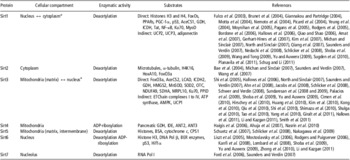
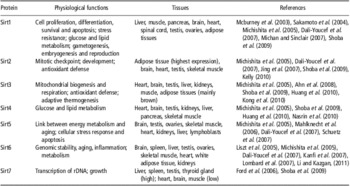
Sirtuins regulate mainly four biological processes: transcription, cell cycle and apoptosis and energy homeostasis (Sauve et al., Reference Sauve, Wolberger, Schramm and Boeke2006; Michan and Sinclair, Reference Michan and Sinclair2007; Kong et al., Reference Kong, Wang, Liu, Zhu, Shao, Chang and Fang2009). Transcription is generally negatively regulated by sirtuins because of their deacetylation of histones; however, when the sirtuin substrate is a transcription factor related to the control of either growth, cell cycle or apoptosis, sirtuin regulation may be positive and associated with extension of lifespan (Sauve et al., Reference Sauve, Wolberger, Schramm and Boeke2006). The most recently discovered sirtuin substrates comprise enzymes that regulate carbohydrate and lipid metabolism, and in this particular case, regulation of the enzymatic activity of the target protein can be either positive or negative (Sauve et al., Reference Sauve, Wolberger, Schramm and Boeke2006; Michan and Sinclair, Reference Michan and Sinclair2007). Sirtuins have been found in different subcellular locations, and they modify diverse target substrates (Table 1). In addition, each sirtuin has a specific physiological role within the different tissues where they are expressed (Table 2).
Cellular location and identified substrates for the seven mammalian sirtuins

ETChain = electron transport chain; BER = base excision repair.
a↔ means translocation.
Physiological roles and tissues where sirtuins are present

Sirtuins in livestock
Sirtuins have been extensively studied in yeast, lower organisms like fruit flies and worms, and mammals, mainly rodents and humans, with special focus on their ability to regulate lifespan and energy homeostasis; therefore, they represent potential nutraceutical targets in metabolic syndrome and age-associated diseases like cancer and Alzheimer's disease. However, little benefit has been gained from their ability to regulate glucose and lipid metabolism in livestock production. When talking about livestock production, it is understood that the main goal is to obtain more animal (food) products in a more efficient way and in a shorter period of time. Thus, sirtuins and the compounds that regulate them should be studied, given their potential to contribute to this objective.
Structure
Livestock species present all seven sirtuins (Supplementary Figure S2) and, as all members of the Sir2 protein family, they contain a core domain of around 260 amino acids, which is highly conserved in prokaryotes and eukaryotes (Brachmann et al., Reference Brachmann, Sherman, Devine, Cameron, Pillus and Boeke1995). This core domain is formed by a Rossmann-fold structure characteristic of NAD(P)+/NAD(P)H-binding proteins (Finnin et al., Reference Finnin, Donigian and Pavletich2001; Min et al., Reference Min, Landry, Sternglanz and Xu2001), a zinc-binding module containing a structural zinc atom coordinated by four conserved cysteines and a flexible loop forming a hydrophobic pocket, which may represent a class-specific protein–protein interaction domain that gives a distinct substrate specificity to each sirtuin (Finnin et al., Reference Finnin, Donigian and Pavletich2001; Min et al., Reference Min, Landry, Sternglanz and Xu2001). In addition, differences at the N- and C-termini, which can be identified from the Conserved Domain Database (Marchler-Bauer et al., Reference Marchler-Bauer, Lu, Anderson, Chitsaz, Derbyshire, DeWeese-Scott, Fong, Geer, Geer, Gonzales, Gwadz, Hurwitz, Jackson, Ke, Lanczycki, Lu, Marchler, Mullokandov, Omelchenko, Robertson, Song, Thanki, Yamashita, Zhang, Zhang, Zheng and Bryant2011), account for the variation in binding partners and substrates, subcellular localization and expression pattern, as well as different enzymatic activities (Sherman et al., Reference Sherman, Stone, Freeman-Cook, Brachmann, Boeke and Pillus1999; Borra et al., Reference Borra, Langer, Slama and Denu2004; Haigis and Sinclair, Reference Haigis and Sinclair2010).
Sirtuins and calorie restriction (CR)
Dietary manipulations, such as CR or intermittent fasting, are known to affect gene expression in many tissues (Han and Hickey, Reference Han and Hickey2005). CR consists of a 20% to 50% reduction in energy intake relative to ad libitum levels but without nutrient deficits or malnutrition (Weindruch et al., Reference Weindruch, Walford, Fligiel and Guthrie1986; Walford et al., Reference Walford, Harris and Weindruch1987). Environmental and genetic signaling pathways can be turned on by nutrient availability and utilization, thereby extending lifespan and retarding age-related diseases in many organisms ranging from yeast to mammals (Walford et al., Reference Walford, Harris and Weindruch1987; Bordone and Guarente, Reference Bordone and Guarente2005).
Under normal metabolic conditions, glucose is metabolized to pyruvate, stimulating either respiration or fermentation, depending on the oxygen availability. When glucose is limited, carbon skeletons are directed to the mitochondrial tricarboxylic acid cycle, promoting the electron transport and respiration processes (Lin et al., Reference Lin, Kaeberlein, Andalis, Sturtz, Defossez, Culotta, Fink and Guarente2002). As a result, ATP is produced in higher amounts, slowing down the rate of glycolysis, and NADH is re-oxidized to NAD+, increasing the NAD+/NADH ratio in the cell (Lin et al., Reference Lin, Kaeberlein, Andalis, Sturtz, Defossez, Culotta, Fink and Guarente2002; Wolf, Reference Wolf2006).
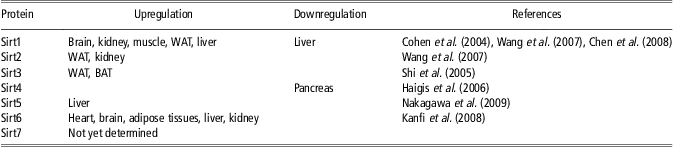
Members of the sirtuin family establish a tight linkage between nutritional status and longevity by regulating stress management and energy homeostasis in response to the cellular energy status, as measured by the NAD+/NADH ratio (Lin et al., Reference Lin, Kaeberlein, Andalis, Sturtz, Defossez, Culotta, Fink and Guarente2002; Schug and Li, Reference Schug and Li2011). Under CR conditions, sirtuin activities overlap and combine to mediate metabolism, cell growth, oxidative stress responses and apoptosis (Shi et al., Reference Shi, Wang, Stieren and Tong2005). For a long time, Sirt1 was the only member of this family implicated in the CR response; however, expression and enzymatic activity of the seven mammalian sirtuins are now known to be differently regulated by CR (Table 3). Therefore, sirtuins emerge as crucial sensors of changes in NAD+ concentrations as a result of fasting, dietary restriction or oxidative stress (Rodgers and Puigserver, Reference Rodgers and Puigserver2007), regulating the cellular response to these stimuli.
Effects of calorie restriction on sirtuin expression in different tissues
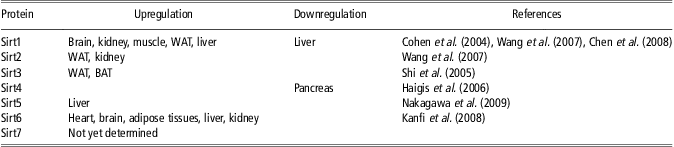
WAT = white adipose tissue; BAT = brown adipose tissue.
Experiments measuring sirtuin expression after dietary restriction in livestock have not yet been carried out. However, there are numerous reports dealing with the effects of dietary restriction on production and reproduction in livestock. For instance, in 2010, Reference Villeneuve, Cinq-Mars and LacasseVilleneuveet al. tested the effects of dietary restriction on reproduction and lactation in prepubertal ewe lambs and on growth performance of their offspring over two breeding seasons. Three diets with a concentrate-to-forage ratio of 93 : 7 (ad libitum), 69 : 31 (restricted) and 40 : 60 (high quality forage), respectively, were offered randomly for 75 days. The results were that, at the end of the experiments, ewes fed with the restricted diet produced a higher volume of high quality milk, as measured by the milk protein and milk fat yield, in addition to better growth performance in their offspring. Therefore, we deduce that the results obtained by these groups can be due, in part, to the action of sirtuins, although they were not mentioned.
Potential role in livestock production
There are few studies making reference to sirtuins in livestock species. A summary of the information available in poultry, swine and bovine is presented below.
In poultry, the first report about a chicken sirtuin was in 2003 by Reference Senawong, Peterson, Avram, Shepherd, Frye, Minucci and LeidSenawonget al., who investigated the chicken ovalbumin upstream promoter transcription factor (COUP-TF) interacting proteins (CTIP) 1 and 2. These proteins have been related to hematopoietic cell development and immune system malignancies. Originally characterized as CTIPs, they are now known to act as transcriptional repressors, but the mechanism by which they do so is still not clear. The initial observation that repression was not inhibited by trichostatin A, a known class I and II HDAC inhibitor, raised the possibility of an interaction with a class III HDAC. After co-transfection and chromatin immunoprecipitation assays, the authors found that CTIP2 interacts physically with Sirt1, which enhances CTIP2-mediated transcriptional repression. These results are relevant as previous reports on the repressive activities of CTIPs show that proliferative diseases in mammals are closely related to dysregulated expression of CTIPs (Avram et al., Reference Avram, Fields, Senawong, Topark-Ngarm and Leid2002).
In bovines, the first work on sirtuins was reported by our group (Ghinis-Hozumi et al., Reference Ghinis-Hozumi, González-Gallardo, González-Dávalos, Antaramian, Villarroya, Shimada, Varela-Echavarría and Mora2011). We used bovines as a model of ruminant animals, and our interest in sirtuins is because of their regulatory role in gluconeogenesis and lipid metabolism. We obtained the Sir2 family hallmark sequence motifs for Sirt1 to Sirt5 and the expression profiles for Sirt1 and Sirt3 in liver, muscle and subcutaneous adipose tissue of bulls and 3-day-old calves. Under normal conditions, sirtuin expression in bovines is similar to what has been reported for other species when undergoing energy deprivation.
In swine, sirtuins have been more widely studied. For instance, in 2008, Reference Bai, Pang, Yang and YangBai et al. analyzed the effects of resveratrol and nicotinamide on Sirt1 regulation of preadipocyte differentiation; they found that Sirt1 was actively expressed throughout differentiation, and by adding resveratrol or nicotinamide, Sirt1 expression was regulated in a positive or negative manner, respectively. Jin et al. (Reference Jin, Tan, Lei, Gan, Chen, Long, Feng and Yang2009) fully characterized the seven swine sirtuins, including their chromosomal mapping, phylogenetic analysis, nucleotide and amino acid sequences and tissue expression profiles, which showed that all sirtuins were most highly expressed in brain and testis. Also in 2009, Reference Shan, Wang, Wu, Liu, Guo, Zhang, Liu and XuShan et al. characterized porcine Sirt1 by sequence and phylogenetical analysis and determined the expression profiles in different adipose tissues of young and adult animals in order to compare age-related differences as well as the effect of resveratrol on Sirt1 expression. Later, Shan et al. (Reference Shan, Ren, Liu, Zhu and Wang2010) measured the expression of Sirt1, together with two adipose lipases (adipose triglyceride lipase and hormone-sensitive lipase) in two different pig breeds, a lean one and a fat one, and analyzed the effect of insulin treatment on them. This group found that Sirt1 expression is higher in lean animals, which is consistent with reports on humans, and that insulin is a negative regulator of the three enzymes examined. Finally, an applied study was made available by Weber et al. (Reference Weber, Trabue, Ziemer and Kerr2010), who evaluated the effect of a high fiber diet on the intestinal tract of growing, female pigs and observed a decrease in liver mass and energy stores and an increase in plasma triglycerides, in addition to higher Sirt1, PGC-1α (peroxisome proliferator-activated receptor-γ coactivator) and CoxII (cyclooxygenase-II) expression, suggesting a more efficient energy utilization in this tissue. In summary, Bai et al. (Reference Bai, Pang, Yang and Yang2008) and Jin et al. (Reference Jin, Tan, Lei, Gan, Chen, Long, Feng and Yang2009) studied porcine sirtuins, focusing on their role as models of human physiology for the discovery of therapeutic treatments; Shan et al. (Reference Shan, Wang, Wu, Liu, Guo, Zhang, Liu and Xu2009 and Reference Shan, Ren, Liu, Zhu and Wang2010) focused on the potential use of Sirt1 regulation to control fat deposition in pigs, which is higher in adult pigs and lean breeds, and Weber et al. (Reference Weber, Trabue, Ziemer and Kerr2010) performed the first application, regulating sirtuin expression by dietary manipulations.
Conclusions and future perspectives
Sirtuins are, with no doubt, a family of proteins arising interest in many research areas and, from the information presented above, it is clear that they play an important role in the regulation of energy homeostasis in livestock species, as they do in rodents and humans. However, further research on sirtuin expression and regulation in these species is required to determine if and how they promote growth performance and production. In this context, it is necessary to establish the best method to improve these productive parameters, taking advantage of the information about sirtuins available from other species and extrapolating it to livestock species. We are confident that research in this field will yield valuable information on sirtuin function as well as on ways to improve production systems.
Acknowledgments
Yumi Ghinis-Hozumi thanks CONACYT for a scholarship at the Facultad de Estudios Superiores-Cuautitlán, UNAM, and grant 55429 from SEP-CONACYT (SEP (Ministry of Public Education); Consejo Nacional de Ciencia y Tecnología, México City, México). The authors also thank Dorothy Pless (INB (Neurobiology Institute)-UNAM, Querétaro, Qro., México) for revising the English manuscript.
Supplementary materials
For supplementary material referred to in this article, please visit http://dx.doi.org/doi:10.1017/S1751731112001115