Introduction
Normal human balance is classically described as relying on three sensory inputs: vision, proprioception and the peripheral vestibular system. This sensory information is relayed centrally, where it is integrated and interpreted. The latter requires a comparison to be made between the new information and previously generated templates, with a mismatch between the two resulting in perceived symptoms of dizziness, unsteadiness or vertigo.
The principal functions of the vestibular system are postural control and gaze stabilisation. Postural control is achieved by means of the vestibulospinal reflex, which allows rapid correction of posture in response to head acceleration, and the righting reflex, which maintains head position in a horizontal plane irrespective of trunk position.Reference Telian and Shepard1 The vestibulo-ocular reflex, in contrast, provides image stabilisation during head movement.
An increase in postural sway is a recognised consequence of eye closure, and has also been demonstrated in individuals with visual acuity and visual field impairments.Reference Uchiyama and Demura2–Reference Dault, de Haart, Geurts, Arts and Nienhuis4 Similarly, immediately after sustaining an acute peripheral vestibular deficit, subjects demonstrate marked unsteadiness and gaze abnormalities, including skew deviations and nystagmus. Static and dynamic postural control is also markedly affected by bilateral vestibular hypofunction and peripheral neuropathy.Reference Horstmann and Dietz5
Although there have been few formal studies indicating that hearing contributes to normal balance function, anecdotal accounts suggest that hearing loss may contribute to unsteadiness.Reference Dozza, Horak and Chiari6 We therefore undertook the current study to assess postural control in human subjects in normal and sound-limited environments.
Materials and methods
Subjects
Twenty-one normal-hearing volunteers aged between 23 and 44 years were recruited to this pilot study. All subjects were regarded as independent in their activities of daily living.
Individuals with a history of hearing loss, balance disorder or visual abnormality were excluded from the study. Those with proprioceptive loss or peripheral neuropathy were also excluded.
Informed consent was obtained from all subjects.
Instrumentation
Postural control was assessed using the Physio Fun software program (Nintendo, Kyoto, Japan), a Nintendo Wii™ gaming console and a balance board. The balance board contained multiple pressure sensors which measured the subject's centre of balance, and was calibrated using the subject's height (in cm) and weight (in kg). Sway measurements were recorded as an area of ellipse (measured in cm2) depicting the centre of gravity (Figure 1a).
(a) Graphical representation of the Wii output data for centre of gravity area. (b) Diagram of subject standing in the Romberg position on the balance platform.

Design
Each subject was randomly assigned to one of two environments – a normal clinic room or a standard soundproof audiology booth (both of similar dimensions) – and then retested in the second environment.
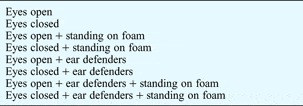
Each subject was tested for 30 seconds, standing upright on the Wii balance board (Figure 1b), in one of the eight standing test scenarios (Table I). Serial measurements were taken, firstly with the subject standing barefoot on the Wii balance board with their eyes open and then closed, then repeated with the subject wearing industrial ear defenders and standing on foam, and then again with the subject standing on foam and the Wii board with ear defenders. Normal room and soundproof room sway measurements were recorded for each test scenario. The area of ellipse (indicating the centre of gravity) was recorded.
Standing test scenarios

Data were statistically compared using the Friedman one analysis of variance test. A p value of less than 0.05 was taken to indicate statistical significance.
Results
Normal room
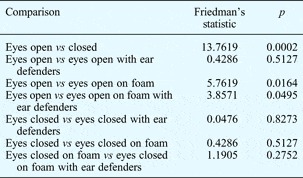
During testing in the normal clinic room, a significant increase in postural sway measurements was found for the following subjects: those standing with their eyes closed, compared with those with their eyes open (p = 0.0002); those standing on versus off foam (p = 0.0164); and those standing on foam with eyes open whilst wearing ear defenders versus standing on foam with eyes open and without ear defenders (p = 0.0495) (Table II).
Postural sway in normal room: statistical comparison

Soundproof room
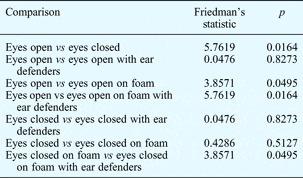
Table III shows the results for comparison of postural sway in the soundproof room. A significant increase in postural sway was found for the following subjects: those with their eyes open versus closed (p = 0.0164); those with eyes open standing on versus off foam (p = 0.0495); and those with eyes closed with versus without ear defenders, both on and off foam (p = 0.0495).
Postural sway in soundproof room: statistical comparison

Comparison of both rooms
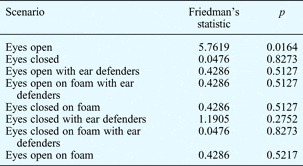
Table IV compares postural sway results from both rooms. There was a general trend towards increased sway for all standing test scenarios conducted in the soundproof room, compared with the normal room; however, a statistically significant difference was observed only between subjects standing with their eyes open (p = 0.0164).
Postural sway in normal vs soundproof room: statistical comparison

Discussion
It is currently believed that integration and interpretation of three primary sensory modalities are required to maintain balance, namely vision, proprioception and peripheral vestibular sensation. Our current model suggests that the new sensory information is compared with previously generated templates. An absence of a suitable template, or the inability to compare relayed information with those templates, results in perceived symptoms of dizziness, unsteadiness or vertigo.
Some studies have attempted to demonstrate the existence of additional sensory contributions to balance, including tactile sensations, as well as the effect of simultaneous performance of concentrative tasks.Reference Tremblay, Mireault, Dessureault, Manning and Sveistrup7, Reference Prado, Stoffregen and Duarte8 Anecdotal accounts suggest that hearing loss may contribute to unsteadiness (e.g. ‘clumsiness’ in children with bilateral middle-ear effusions, and loss of balance in patients with unilateral or bilateral hypofunction when in the shower); however, no formal studies have demonstrated a clear relationship between auditory information and static postural control.Reference Dozza, Horak and Chiari6
Our study findings support the importance of visual and proprioceptive input with regards to normal balance. However, our results also suggest that auditory cues are important in maintaining postural control, as standing test scenarios with reduced auditory input (i.e. wearing ear defenders) or reduced ambient environmental sound (i.e. the soundproof room) resulted in increased postural sway. Whilst the audiology booth used in our study provided a sound-limited environment (i.e. a semi-anechoic chamber), some low-level ambient sound was produced by the hardware used during the study. However, the ear defenders worn by our subjects further limited hearing, and resulted in significantly greater sway in some scenarios.
As the basis of normal postural control relies on cross-referencing new sensory information against pre-existing central templates, we would suggest that normal balance templates include auditory information and that a reduction in ambient environmental sound, or hearing loss, significantly affects postural control. As our cohort was unlikely to routinely use ear defenders, nor to spend significant periods of time in a soundproof environment, these situations did not conform to any previously generated templates, and hence resulted in increased postural sway.
Interestingly, many patients undergoing audiological testing describe the environment as ‘strange’ or ‘weird’. None of our subjects were audiology staff, who may have pre-generated templates for such an environment, and it would be interesting to assess this specific group in the future. It may be the case that the relative weighting of the different sensory inputs for balance varies depending on one's environment, and that this weighting is determined by experience. Era and Heikkinen, for example, found poor postural control in subjects exposed to noise at work, and questioned the contribution of hearing to normal balance.Reference Era and Heikkinen9 Moving auditory stimuli have also been shown to affect postural control.Reference Soames and Raper10
Auditory biofeedback has been suggested to have an effect on reducing body sway in individuals with bilateral vestibular loss. Tanaka et al. suggested that an auditory feedback system can be helpful for individuals with poor balance secondary to hearing impairment.Reference Tanaka, Takeda, Izumi, Ino and Ifukube11 Patients with profound, bilateral loss of vestibular function have been shown to rely upon other sensory information to compensate.Reference Telian and Shepard1 However, Palm et al. found that exposure to non-specific auditory stimuli did not significantly affect postural stability.Reference Palm, Strobel, Achatz, von Luebken and Friemert3 These authors used auditory stimulation in the form of music played through headphones. They concluded that auditory stimuli may play a substantial role when one of the three main sensory modalities is impaired. The results of our study may support their suggestion.
The higher risk of falls in elderly individuals is attributed in large degree to the reduced visual acuity that occurs with ageing.Reference Tanaka, Takeda, Izumi, Ino and Ifukube11 It has been suggested that elderly patients rely more on tactile input to maintain posture.Reference Tanaka, Kojima, Takeda, Ino and Ifukube12 Tanaka et al. have suggested that reliable sensory information, especially during times of otherwise conflicting sensory input within changing environments, is crucial if falls are to be avoided.Reference Tanaka, Kojima, Takeda, Ino and Ifukube12 Prado et al. found that 24 subjects performing dual tasks on a force plate had a reduced centre of balance, compared with subjects performing no tasks at all.Reference Prado, Stoffregen and Duarte8 The results of the present study suggest that hearing should be optimised to promote balance; furthermore, our findings suggest that further study comparing postural sway in those with unilateral versus bilateral hearing aids would be useful.
• Balance is proven to rely upon vision, proprioception and peripheral vestibular input
• Sensory inputs are processed centrally, and determine gaze stability and postural control
• Anecdotal accounts suggest hearing loss contributes to unsteadiness
• This study used a Nintendo Wii gaming console to assess postural control
• Balance was influenced by ambient noise levels
Many methods have been used to measure postural sway, with varying success. The sensorimotor control of balance is a complex phenomenon, and each modality is not easily quantifiable by a single test. Kelso and Hellebrandt devised a footplate measuring the centre of foot pressure.Reference Kelso and Hellebrandt13 This method has been further developed with the use of an accelerometer mounted on a belt attached at the waist.Reference Stevens and Tomlinson14 The Wii balance board utilises similar principles, and has recently been validated as an instrument to precisely quantify the centre of balance pressure. Its validity has been tested against the ‘gold standard’ force platform, with reliable results, making it a useful tool in the clinical setting.Reference Clark, Bryant, Pua, McCrory, Bennell and Hunt15 Posturography was not feasible in the current study, due to logistical and measurement problems associated with its use in both a normal room and a soundproof room. Our results suggest that using the Wii gaming console provides a simple and inexpensive tool for assessing static postural control.
Conclusion
The results of this pilot study suggest that auditory cues influence postural sway, and support anecdotal evidence of an association between hearing and balance. Clinical implications may include optimising patients' hearing in order to improve their global balance function.
Further study will be required to evaluate the reliability of this hypothesis. Additional research is required to assess postural sway in those with hearing loss (acute and chronic) and those with vestibular pathology.