Introduction
The use of modern single-crystal X-ray diffractometers with area detectors enables detailed and extensive studies of minerals affected by polytypism. Several articles dealing with the layered silicate, cronstedtite, from Pohled (Czech Republic), Nižná Slaná (Slovakia), and Chyňava (Czech Republic) (Hybler et al. Reference Hybler, Sejkora and Venclík2016, Reference Hybler, Števko and Sejkora2017; Hybler and Sejkora Reference Hybler and Sejkora2017) have been published recently. Furthermore, electron diffraction tomography (EDT) and/or 3D electron diffraction are appropriate options for polytype identification of submicroscopic crystals, e.g. in synthetic run products (Pignatelli et al. Reference Pignatelli, Mugnaioli, Hybler, Mosser-Ruck, Cathelineau and Michau2013; Hybler et al. Reference Hybler, Klementová, Jarošová, Pignatelli, Mosser-Ruck and Ďurovič2018), or separated from meteorites (Pignatelli et al. Reference Pignatelli, Marrochi, Vacher, Delon and Gounelle2016, Reference Pignatelli, Marrocchi, Mugnaioli, Bourdelle and Gounelle2017, Reference Pignatelli, Mugnaioli and Marrocchi2018).
Cronstedtite was described first from the Vojtěch Mine in Příbram (now Czech Republic) by Steinmann (Reference Steinmann1820, Reference Steinmann1821), and was named in honor of the Swedish chemist and mineralogist Axel Fredrik Cronstedt (23 December 1722–19 August 1765). Pioneering studies classified cronstedtite as a T–O or 1:1 trioctahedral phyllosilicate of the serpentine-kaolinite group, with a general formula (Fe2+3–x Fe3+ x )(Si2–x Fe3+ x )O5(OH)4, where 0 < x < 0.85 (Steadman and Nuttall Reference Steadman and Nuttall1963, Reference Steadman and Nuttall1964; Steadman Reference Steadman1964; Bailey Reference Bailey1969, Reference Bailey and Bailey1988). Its octahedral sheet is formed by edge-sharing MA 6 octahedra. Ideally, M = Fe, A = O in corners shared with the tetrahedral sheet, while in corners not shared with the tetrahedral sheet A = OH, or rarely F, Cl, S. The tetrahedral sheet is formed by TO4 tetrahedra grouped in sextuple rings by sharing basal oxygen atoms at the corners. Both sheets form the 1:1 layer (in fact the structure building layer) by sharing apical O atoms of tetrahedra and corners of octahedra. The neighboring layers are connected via hydrogen bonds, where the OH groups of the octahedral sheet serve as donors and the basal oxygen atoms of the adjacent tetrahedral sheets are acceptors. The stacking of consecutive layers is guided by stacking rules of some of four OD (Order-Disorder) subfamilies – Bailey’s groups A, B, C, D (Bailey Reference Bailey1969, Reference Bailey and Bailey1988).
In cronstedtite, Fe enters not only into the octahedral, but also into tetrahedral positions, where Si4+ is partially replaced by Fe3+. Presumably an equivalent amount of Fe3+ replaces Fe2+ in octahedral positions in order to achieve charge balance. Some other divalent cations such as Mg2+ and/or Mn2+ can substitute for Fe2+ in various amounts in octahedral positions (e.g. Steinmann Reference Steinmann1821; Geiger et al. Reference Geiger, Henry, Bailey and Maj1983; Hybler and Sejkora Reference Hybler and Sejkora2017). The Mn-rich analogue of cronstedtite was found in South Africa and approved as a new distinct mineral species, guidottiite (Wahle et al. Reference Wahle, Bujnowski, Guggenheim and Kogure2010).
Crystal-structure refinements of the following polytypes have been published to date: 1T (Hybler et al. Reference Hybler, Petříček, Ďurovič and Smrčok2000), 2H 2 (Geiger et al. Reference Geiger, Henry, Bailey and Maj1983; Hybler et al. Reference Hybler, Petříčcek, Fábry and Ďurovič2002), 3T (Smrčok et al. Reference Smrčok, Ďurovič, Petříček and Weiss1994), 1M (Hybler Reference Hybler2014), and 6T 2 (Hybler Reference Hybler2016). High-resolution transmission electron microscopy (HRTEM) studies of cronstedtite were published by Kogure et al. (Reference Kogure, Hybler and Ďurovič2001, Reference Kogure, Hybler and Yoshida2002).
The aim of the current study was to carry out a thorough examination of polytypism and chemical variation of cronstedtite from Nagybörzsöny, Hungary, with the aid of single-crystal X-ray diffraction (XRD) and electron probe microanalysis (EPMA).
OCCURRENCE
The famous Nagybörzsöny ore deposit (known formerly also as Deutsch Pilsen) is situated in northern Hungary (Fig. 1), near the Slovakian border, in the Börzsöny Mountains, ~5 km ENE of the village of Nagybörzsöny, and ~50 km NNW of Budapest. The GPS coordinates of the entrance of the main adit (known as Alsó-Rózsa-Taró) are: 47.9408644°N, 18.8943714°E.
Outline map of Hungary showing the location of the Nagybörzsöny deposit

The Börzsöny Mountains are part of the Neogene Intra-Carpathian Volcanic Arc. Two periods of volcanic activity occurred during the Middle Badenian (Korpás and Lang Reference Korpás and Lang1993): an early extrusive phase (Lower Unit) was followed by a second phase, characterized by a large stratovolcanic structure (Upper Unit). Only the Lower Unit is affected by hydrothermal processes in its central area. The alteration is represented near the surface by an argillite zone with local Au-bearing polymetallic sulfide mineralization (Cu, Pb, Zn ± Ag) in veins and stockworks. This zone grades laterally and vertically into a propylite zone with massive and disseminated copper mineralization. K/Ar ages of both fresh and hydrothermally altered rocks show a Gaussian distribution, with a maximum between 15 and 14 My and an average age of 15.2±0.8 My. The average age of the Upper Volcanic Unit is 14.2±0.9 My. Paleomagnetic data indicate that the total period of volcanic activity was <0.7 My. The estimated duration of the early phase, including the hydrothermal event, is between 0.2 and 0.4 My.
The ore mineralization in the Nagybörzsöny area is hosted in Miocene calc-alkaline volcanic rocks and it forms veins and stockwork in a dacite breccia pipe affected by strong propylitic alteration (Pantó and Mikó Reference Pantó and Mikó1964; Dobosi and Nagy Reference Dobosi and Nagy1989; Korpás and Lang Reference Korpás and Lang1993; Nagy Reference Nagy2002). This deposit has been exploited mainly for gold and silver since the Middle Ages, especially in the 14th and 15th Centuries. The area of the Rózsa hill was explored in detail by drilling in 1989 (Nagy Reference Nagy2002). The mineralization at the Nagybörzsöny deposit is multistage (mesothermal to epithermal) with Cu-Fe-(Au-Mo), Zn-Pb-Cu, Bi-Pb-As-W-(Au-Ag-Te), Zn-Pb-Ag-(Cu-Sb), and Au-Ag assemblages (Szakáll et al. Reference Szakáll, Zajzon and Kristály2012). More than 120 minerals have been described from this locality (Szakáll et al. Reference Szakáll, Fehér and Tóth2016). Two principal stages of the mineralization were distinguished by Koch and Graselly (Reference Koch and Grasselly1953) and Pantó and Mikó (Reference Pantó and Mikó1964). Pyrrhotite, chalcopyrite, and sphalerite are the main minerals of the first stage. The typical minerals of the second stage are arsenopyrite, pyrite, galena, native bismuth, and bismutinite. They are accompanied by other rare sulfosalts and tellurides such as joséite-A, ikunolite, emplectite, canizzarrite, cosalite, pavonite, gustavite, and lillianite (Szakáll et al. Reference Szakáll, Zajzon and Kristály2012; Zajzon et al. Reference Zajzon, Szakáll, Kristály, Hartai and Fehér2014). The Nagybörzsöny deposit is the type locality of pilsenite (Kenngott Reference Kenngott1853), jonassonite (Paar et al. Reference Paar, Putz, Topa, Roberts, Stanley and Culetto2006), and jaszczakite (Bindi and Paar Reference Bindi and Paar2017).
According to Koch and Graselly (Reference Koch and Grasselly1953), small (~1 mm) aggregates of cronstedtite were first found by J. Erdélyi (without reference, not dated) in a piece of ore material collected from the dump of the Alsó-Rózsa-Táró. This sample is no longer available. Another sample found by mineral collector Gábor Koller in the same dump in 2000 was used in the present study, therefore.
EXPERIMENTAL
A small piece of the porous, mostly pyrite and siderite ore material (~18 mm×14 mm×8 mm) contained scarce, isolated, lath-shaped or pyramidal black cronstedtite crystals, typically up to 1.5 mm long, in cavities. Some of them were partially covered by a brown crust or small crystals of siderite. Unlike other occurrences, no veins, druses, or aggregates were observed. The crystals were removed by a needle and glued to glass fibers under the stereomicroscope. Some were cleaved into smaller pieces. Polytypes were identified by single-crystal XRD. Some crystals identified previously were used later for determination of the chemical composition using EPMA. All of the crystals selected from the ore material were consumed by the study.
Single-crystal X-ray Diffraction
The fragments of cronstedtite crystals (34 altogether) were tested using the four-circle (double-wavelength) X-ray diffractometer Gemini A Ultra (Rigaku Oxford Diffraction, Kazimierza Witalisa Szarskiego 3, 54-609 Wrocław, Poland) equipped with an Atlas CCD area detector (Agilent Technologies, Santa Clara, California) at the Institute of Physics, Academy of Sciences, Prague. The MoKα radiation, with graphite monochromator, λ = 0.71070 Å, and a Mo-enhanced fiber-optic collimator were used throughout all experiments.
A pre-experiment was performed first, in order to set parameters for the full experiment. Then a quick full experiment with some parameters reduced (mainly exposure time) was started. Typically, ~450–500 frames were recorded. The total experiment time varied from 10 to 100 min. The CrysAlisPro, version 171.40.35a (Rigaku Oxford Diffraction 2018), package was used for the data collection, lattice-parameter calculations, and data processing. The ‘unwarp’ procedure created user-defined images of reciprocal space sections (henceforth referred to as RS sections) – the equivalents of precession photographs. In some cases the full experiment was repeated with modified parameters, mainly longer exposures, in order to obtain more precise data as well as smoother and less noisy RS sections appropriate for publication.
The RS sections corresponding to six important reciprocal lattice planes were generated: (
 l hex)*, (hhl hex)*, (
 2hl hex)*, (h0l hex)*, (0kl hex)*, and (
 hl hex)*. In the orthohexagonal setting, valid also for monoclinic polytypes, these planes are denoted as follows: (h
 l ort, mon)*, (h0l ort, mon)*, (h3hl ort, mon)*, and (h
 l ort, mon)*, (hhl ort, mon)*, (0kl ort, mon)*. Distributions of subfamily reflections along the reciprocal lattice rows [2
 l]* / [11l]* / [
 2l]* in (
 l hex)* / (hhl hex)* / (
 2hl hex)* RS sections (i.e. [1
 l]* / [10l]* / [13l]* in (h
 l mon)*/ (h0l mon)*/ (h3hl mon,)* RS sections in the monoclinic setting), were used to determine OD subfamilies (Bailey’s groups) A, B, C, D (Dornberger-Schiff and Ďurovič Reference Dornberger-Schiff and Ďurovič1975a, Reference Dornberger-Schiff and Ďurovičb; Bailey Reference Bailey1969, Reference Bailey and Bailey1988). Similarly, distributions of characteristic reflections along [10l]* / [01l]* / [
 1l]* rows in (h0l hex)* / (0kl hex)* / (
 hl hex) RS sections (i.e. [
 l]* / [11l]* / [02l]* in (h
 l mon)*/ (hhl mon)*/ (0kl mon,)* in the monoclinic setting) allowed determination of particular polytypes. For this purpose, graphical identification diagrams simulating distribution of reflections along named rows were used (Hybler et al. Reference Hybler, Klementová, Jarošová, Pignatelli, Mosser-Ruck and Ďurovič2018). The lattice parameters of polytypes were calculated using the CrysAlisPro software.
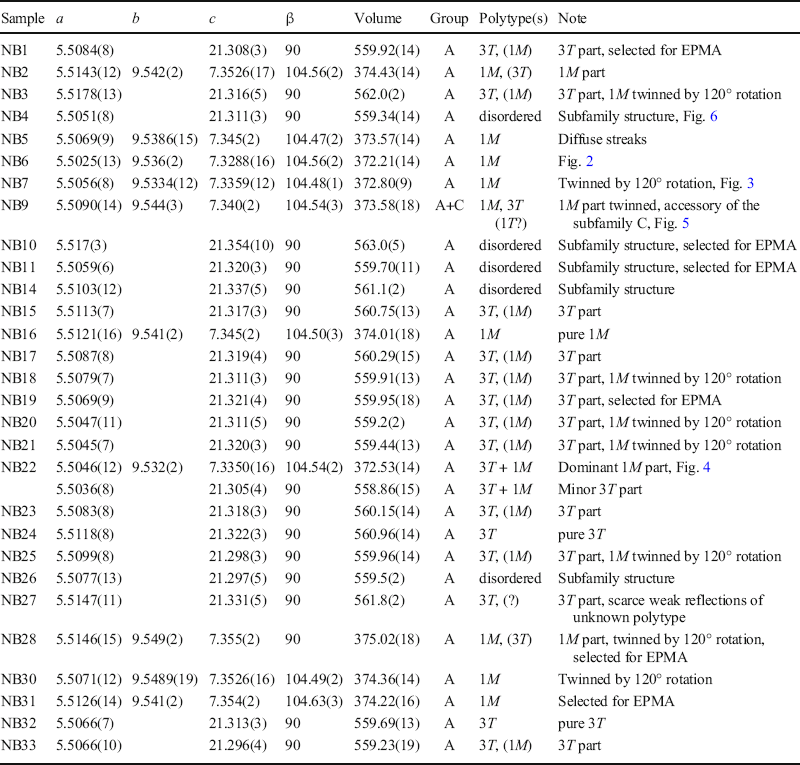
A more detailed description of the interpretation of RS sections can be found in recent studies by Hybler et al. (Reference Hybler, Sejkora and Venclík2016, Reference Hybler, Klementová, Jarošová, Pignatelli, Mosser-Ruck and Ďurovič2018). The lattice parameters of the crystals studied are presented in Table 1.
Lattice parameters (in Å, degrees, with standard uncertainties in parentheses), subfamilies (Bailey’s groups), and polytypes of cronstedtite from Nagybörzsöny, Hungary. Minor polytypes in given samples are shown in parentheses. For most mixed crystals, the lattice parameters of dominant polytypes are given. Disordered crystals are indexed with respect of the unit cell of the subfamily structure of the subfamily A identical to that of the 3T polytype. In most mixed crystals, lattice parameters of the dominant polytypes are given

Space groups of polytypes: 3T: P31, 1M: Cm
Electron Probe Microanalysis
The selected fragments of cronstedtite crystals (14 altogether), in which polytypes were determined, were mounted on epoxy discs, polished by diamond suspensions, and coated with a carbon layer ~30 nm thick. The polished grains were analyzed at the National Museum in Prague using a CAMECA SX-100 electron probe micro analyzer (CAMECA, Gennevilliers Cedex, France) operating in wave-dispersive (WDS) mode with acceleration voltage of 15 kV, beam current of 10 nA, and beam diameter of 5 μm. The following standards and analytical lines were used: albite (NaKα), fluorapatite (PKα), celestite (SKα), diopside (MgKα), halite (ClKα), chalcopyrite (CuKα), LiF (FKα), rhodonite (MnKα), sanidine (KKα, SiKα, AlKα), wollastonite (CaKα), and ZnO (ZnKα). The peak counting times were between 10 and 20 s and a half of the peak time was used for both background positions. The raw counts were converted to wt.% using the standard PAP procedure (Pouchou and Pichoir Reference Pouchou, Pichoir and Armstrong1985). Oxygen was calculated from the stoichiometry. Elements from the list above which do not appear in the tables, in all cases, occurred at levels which were below the limits of detection. The amounts of H2O, Fe2+, and Fe3+ as well as x-values were calculated on the basis of the general formula of cronstedtite (Fe2+3–x Fe3+ x )(Si2–x Fe3+ x )O5(OH)4.
RESULTS AND DISCUSSION
With one exception, discussed below, all polytypes identified in the crystals studied belong entirely to subfamily A (Bailey’s group). The stacking rule of this group is represented by the ensemble of ±ai/3 shifts of consecutive 1:1 layers (without any rotation).
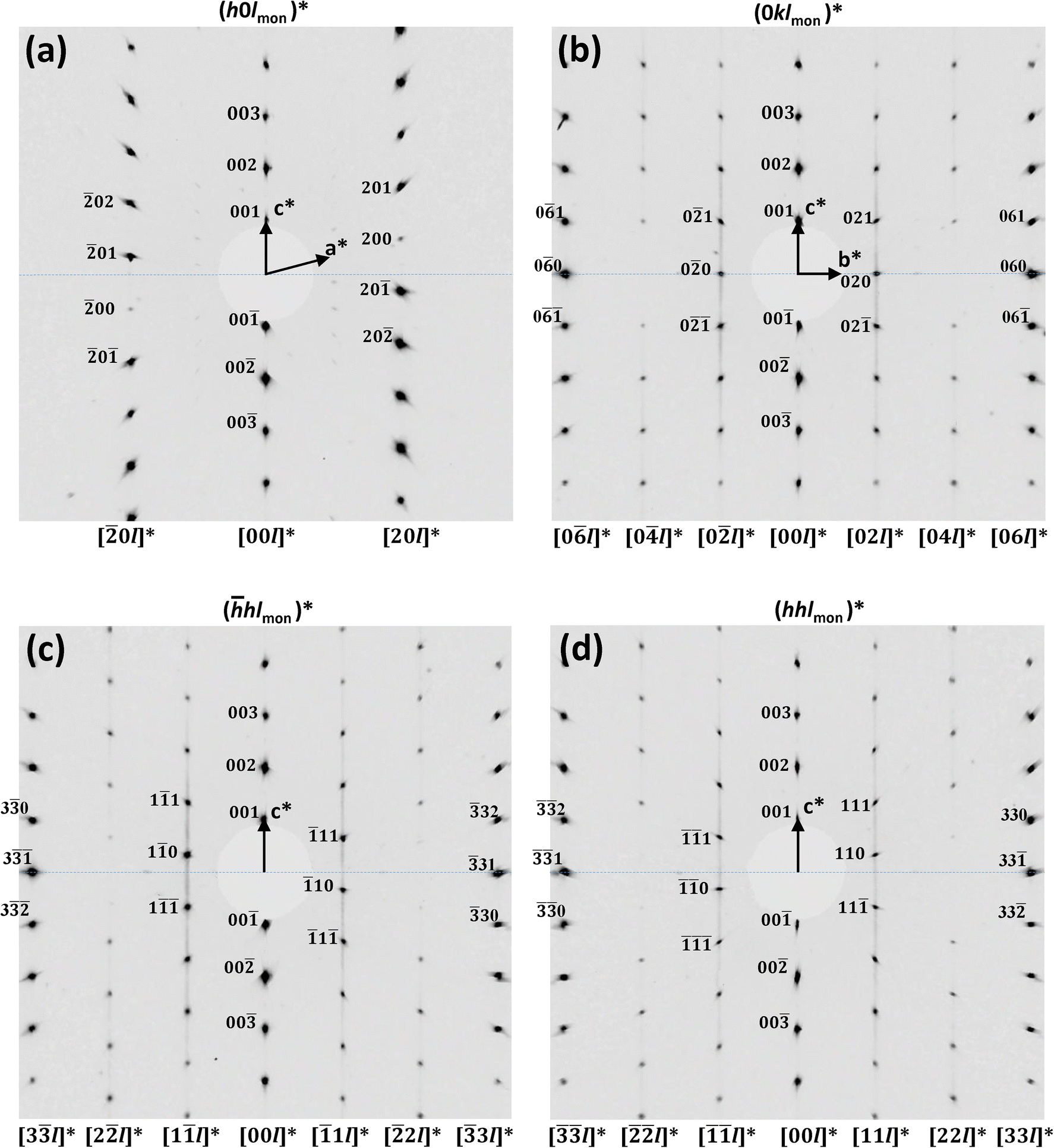
The most remarkable finding in the present study was the relative abundance of the otherwise rare 1M polytype, lattice parameters a = 5.51, b = 9.54, c = 7.33 Å, β = 104.5°, space group Cm. This polytype is quite common in the occurrence and provides well developed crystals. The RS sections of one of the crystals studied are presented in Fig. 2. The (h0l mon)* RS section corresponds to one of three (identical) (
 l hex)* / (hhl hex)* / (
 2hl hex)* (i.e. (
 3hl mon)* / (h0l mon)* / (h3hl mon)*) planes containing the subfamily reflections in the arrangement characteristic of the A subfamily (Fig. 2a). Reflections in [20l]* and [
 0l]* rows were shifted vertically by –1/3 and 1/3, respectively, of the periodicity of the [00l]* row, in accordance with the graphical identification diagram by Hybler et al. (Reference Hybler, Klementová, Jarošová, Pignatelli, Mosser-Ruck and Ďurovič2018), for example. Reciprocal lattice rows and selected reflections were indexed according to the polytype and reciprocal lattice vectors are indicated. This section corresponds to the m plane of the polytype in direct space.
RS sections of the 1M polytype of cronstedtite from Nagybörzsöny. Indices of reciprocal lattice rows and of selected reflections, as well as reciprocal lattice vectors, are indicated. Auxiliary dotted horizontal lines passing through origins of sections are added to aid the eye. a The (h0l mon)* RS section contains the subfamily reflections characteristic of the A group indexed with respect to the monoclinic cell of the polytype. b The (0kl mon)* section perpendicular to the m plane of the monoclinic unit cell. Note the single periodicity of rows of characteristic reflections at the same levels as reflections of the [00l]* row. c, d The (
 hl mon) (mirror image of (h
 l mon)), and (hhl mon)* sections, diagonal to the m plane. The rows of characteristic reflections [1
 l]*, [
 1l]*, [
 l]*, and [11l]* are also single periodic, but shifted by 1/3 c* or –1/3 c* with respect to [00l]* reflections

The following (h0l hex)* / (0kl hex)* / (
 hl hex)* RS sections ((h
 l mon)* / (hhl mon)* / (0kl mon)* in monoclinic indexing) were unequal due to the monoclinic character of the polytype. The (0kl mon)* section (Fig. 2b) was perpendicular to the m plane. The characteristic reflections in rows [02l]* and [0
 l]* reflected the single periodicity. Two remaining sections (
 l mon)* and (hhl mon)* were diagonal to the m plane. The rows of characteristic reflections [1
 l]*, [
 1l]*, [
 l]*, and [11l]* were also single periodic, but shifted by 1/3 c* or –1/3 c* with respect to [00l]* reflections (Fig. 2c,d).
The ‘pure’ 1M polytype is rare in terrestrial samples. A unique crystal from Lutherstadt Eisleben, Germany, was studied by Hybler (Reference Hybler2014), who performed a structure refinement and presented RS sections. On the other hand, the pure 1M polytype was found to be relatively abundant in the synthetic run product quoted by Pignatelli et al. (Reference Pignatelli, Mugnaioli, Hybler, Mosser-Ruck, Cathelineau and Michau2013, Reference Pignatelli, Mosser-Ruck, Mugnaioli, Sterpenich and Gemmi2020) and Hybler et al. (Reference Hybler, Klementová, Jarošová, Pignatelli, Mosser-Ruck and Ďurovič2018).
The 1M polytype is often affected by twinning by order 3 reticular merohedry, with +120° or –120° rotation along chex as the twinning operation. Several twinned crystals were found in the Nagybörzsöny samples, and RS sections of one of them are presented in Fig. 3. Two sections represent superposition of one perpendicular and one diagonal section of two individuals (Fig. 3b,d), while the third section represents superposition of two diagonal sections arranged as mutual mirror images (Fig. 3c). The amounts of particular twin individuals in the crystal are unequal, so that the respective subsets of reflections are unequally intense. The (h0l mon)* RS section containing entirely so-called subfamily reflections common for all polytypes of the A subfamily is not affected by this kind of twinning. However, two alternative indices are possible, either (h0l mon)* or (
 )*, according to the first and second twin individual, respectively (Fig. 3a).
RS sections of the crystal of the 1M polytype of cronstedtite twinned by reticular merohedry, with +120° along chex rotation as a twin operation. Indices of rows and reflections of the first (stronger) and second (weaker) twin individuals are shown in black and blue, respectively. a The (h0l mon)* RS plane corresponding to the (h3hl mon)* of the second twin individual. b The (0kl mon)* section perpendicular to the m plane of the first twin individual superimposed on the (
 hl mon)* diagonal section of the second twin individual. c Superimposed diagonal (
 hl mon)* and (hhl mon)* sections of the first and second twin individuals, respectively. d The diagonal (hhl mon)* section of the first twin individual superimposed on the perpendicular (0kl mon)* section of the second twin individual

Another A group polytype present in the Nagybörzsöny occurrence is 3T, lattice parameters a = 5.51, c = 21.32 Å, space group P31 or P32. This polytype is quite common (the most frequent of all A group polytypes), and it has been referred from many localities recently e.g. from Příbram, Chvaletice, Pohled, and Nižná Slaná (Smrčok et al. Reference Smrčok, Ďurovič, Petříček and Weiss1994; Hybler Reference Hybler1998; Hybler et al. Reference Hybler, Sejkora and Venclík2016, Reference Hybler, Števko and Sejkora2017). The 3T polytype occurs either isolated, or in mixed crystals with the 1M polytype. The diffraction pattern is a superposition of a triply periodic pattern of 3T and of monoclinic 1M described above (Fig. 4). As a result, every third diffraction spot in [10l]* / [01l]* / [
 1l]* rows (hexagonal indexing) is stronger than its neighbors. In the section perpendicular to the mirror plane of 1M, the l = 3n reflections of 3T are stronger (Fig. 4c). In the other two sections the l = 3n + 1 or l = 3n + 2 reflections are stronger (Fig. 4b,d). The (h0l mon)* RS section corresponds to (2h
 l hex)* plane of 3T (Fig. 4a).
RS sections of the mixed crystal of 1M and 3T polytypes. Reciprocal lattice vectors, indices of rows and selected reflections of 1M and 3T polytypes are shown in black and red, respectively. a The (h0l mon)* RS section of 1M corresponds to the (
 l hex)* section of the 3T polytype. The indexing of the 3T polytype (hexagonal indices) is optional, six possible unit cell choices exist. b The diagonal (hhl mon)* RS section of 1M and (h0l hex)* section of 3T polytypes superimposed. c The perpendicular (0kl mon)* section of 1M and (0kl hex)* section of 3T polytypes superimposed. d The second diagonal (
 hl mon)* section of 1M and (
 hl hex)* section of 3T polytypes superimposed

Such mixed crystals are known from other localities (e. g. Pohled). This phenomenon was studied and modeled by Ďurovič (Reference Ďurovič1997) for the various proportions of both polytypes. The 3T+1M mixed crystals were observed in reality by Steadman and Nuttall (Reference Steadman and Nuttall1964), and also mentioned by Bailey (Reference Bailey and Bailey1988). However, in most such mixed crystals, the 3T polytype is usually dominant and differences in intensities are not significant. In the Nagybörzsöny cronstedtite, dominant 1M crystals were found, with superimposed 3T+1M reflections noticeably stronger than mere 3T reflections (Fig. 4).
Among the crystals studied, one rare complex crystal containing 1M+3T polytypes with the 1M part twinned by 120° rotation (Fig. 5) was found. The 1M part consisted of ‘stronger’ and ‘weaker’ twin individuals (cf. Figs 3 and 5). Their diffraction patterns were superimposed on those of the 3T polytype. Moreover, the (
 l hex)*/ (hhl hex)*/ (
 2hl hex)* RS sections contained weak extra reflections in the arrangement corresponding to the subfamily C, placed at the same level as the [00l]* reflections. It is thus a complex mixed crystal of A+C subfamilies, the only one in the occurrence. The presence of the most common polytype 1T of the C subfamily remains uncertain, because its characteristic reflections are arranged identically with characteristic reflections of the perpendicular sections of the 1M polytype. They are thus overlapped by l = 3n reflections of the 3T polytype, and, of course, of 1M reflections in perpendicular sections. Note also that the recorded subfamily C reflections are weaker and smaller than the subfamily A ones (see Fig. 5a). They were probably produced by a limited area within the crystal composed mainly of subfamily A polytypes.
RS sections of the 1M+3T mixed crystal, with the 1M part twinned by 120° rotation along chex. In addition, weak, extra reflections belonging to subfamily C are present. Indices of rows and reflections of the first (stronger) and second (weaker) individuals are shown in black and blue, respectively, and those of the 3T polytype are in red. The reciprocal unit-cell vectors in respective colors are indicated when possible. The c*m vectors of both twin individuals are identical. a Superimposed (h0l mon)* and (hhl hex)* RS sections, with some of the subfamily C reflections (not indexed) indicated by arrows. These reflections are at the same levels as the [00l]* ones. For the sake of clarity, the indices of the weaker individual of the 1M polytype were omitted. This RS section is presented at a scale which is different (‘zoomed out’) from other sections in order to present a larger proportion of the reciprocal space. b The perpendicular (0kl mon)* section of the stronger + diagonal (
 hl mon)* section of the weaker individuals of the 1M + (
 hl hex)* section of the 3T superimposed. c Superposition of the diagonal (hhl mon)* section of the stronger individual + perpendicular (0kl mon)* section of the weaker individual of the 1M + (0kl hex)* section of the 3T polytypes. d Superposition of two diagonal sections of (
 hl mon)* and (hhl mon)* of the strong and weak individuals of the 1M, respectively, + (h0l hex)* section of the 3T polytype

Mixed crystals of subfamilies A+C are rare. The C subfamily reflections were recognized in RS sections recorded by EDT of several crystals of the 1M polytype from the synthetic run product (Hybler et al. Reference Hybler, Klementová, Jarošová, Pignatelli, Mosser-Ruck and Ďurovič2018). In most cases no ordered C subfamily polytype was found, however, with the exception of one mixed 1M+1T crystal. Here, because of absence of the 3T polytype, the 1T polytype was easily distinguished. The electron diffraction pattern of 1M+1T (A+C) mixed crystal of meteoritic cronstedtite from the Cochabamba carbonaceous chondrite was published by Müller et al. (Reference Müller, Kurat and Kracher1979).
Several crystals in the occurrence are completely or almost completely disordered. In the diffraction pattern, the so-called subfamily reflections – common for all polytypes of the A subfamily (Bailey’s group) – remain sharp, while the rows of characteristic reflections are replaced by diffuse streaks. A good example of RS sections of such a crystal is presented in Fig. 6. The indices of reflections and rows are related to the unit cell of the so-called subfamily structure, a fictitious structure resulting from superposition of all possible shifts of the OD packet (i.e. structure building 1:1 layer) allowed by the stacking rule of the subfamily A; the unit cell corresponds formally to that of the 3T polytype.
RS section of the disordered crystal of the subfamily A. Reciprocal lattice rows and reflections are indexed with respect to the 3T polytype. a The subfamily reflections in the (hhl hex)* RS section are not affected by the stacking disorder. b In the (0kl hex)* RS section the rows of characteristic reflections ([01l]*, [02l]*, [0
 l]* and [0
 l]*) are replaced by diffuse streaks. An unequal density along streaks indicates a certain low degree of ordering, however. The [03l]* and [0
 l]* rows contain sharp subfamily reflections

Note that diffraction patterns of other crystals also contain diffusion strips along the rows of characteristic reflections (Figs 2–5). The reflections themselves remain sharp, however.
CHEMICAL COMPOSITION
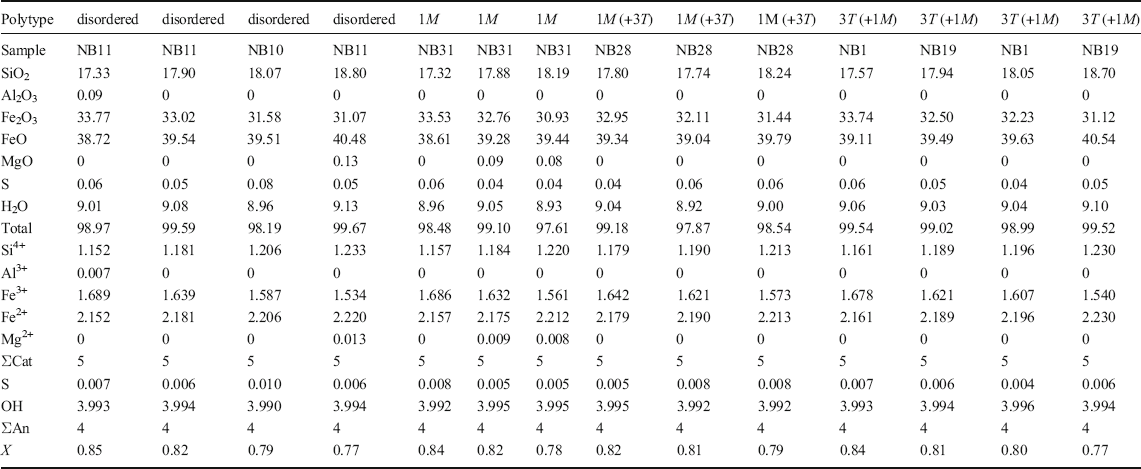
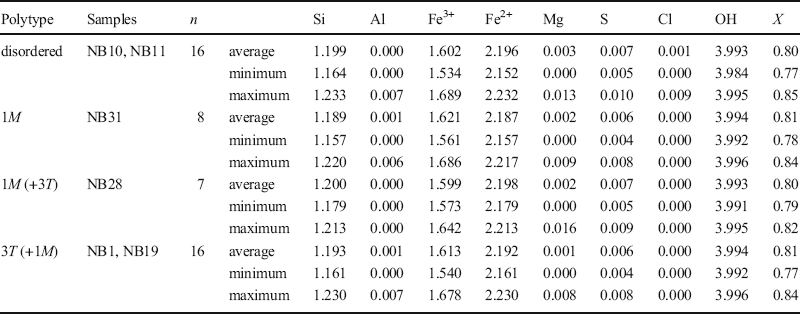
The chemical composition (Table 2) revealed no systematic differences between individual polytypes. The BSE imaging suggested that all the fragments of cronstedtite crystals were compositionally homogeneous. In order to examine compositional variability, 47 spot analyses were collected from six selected samples (Table 3). The data revealed a simple composition of all the cronstedtite samples studied, with negligible minor elements contents. The Si contents ranged between 1.157 and 1.233 a.p.f.u., Fe3+ between 1.534 and 1.689 a.p.f.u., and Fe2+ between 2.152 and 2.232 a.p.f.u.. The x-values in the general formula ranged between 0.77 and 0.85. The ranges of calculated x value for individual polytypes were comparable (Fig. 7). All compositions showed low levels of S (0.004–0.010 a.p.f.u. of S substituting for OH); these amounts did not correlate with the polytype determined or the x value calculated (Fig. 8). Detectable levels of other elements were recorded only exceptionally (Al ≤ 0.007 a.p.f.u., Mg ≤ 0.016 a.p.f.u., Cl ≤ 0.009 a.p.f.u.). No traces of Mn were detected.
Chemical compositions (wt.%) of the cronstedtite crystals from Nagybörzsöny and calculated a.p.f.u. values

The H2O content (4 OH+S p.f.u.), Fe3+/Fe2+ ratio, and x value were calculated based on the stoichiometry of general formula (Fe2+3–x Fe3+ x )(Si2–x Fe3+ x )O5(OH)4
Variations in chemical composition of the studied polytypes of cronstedtites from Nagybörzsöny. Contents of ions per formula unit are given

n – number of spot analyses
Range of calculated x for individual cronstedtite polytypes

Graph of calculated x vs S contents (a.p.f.u.) for individual cronstedtite polytypes

ACCOMPANYING PHASES
One black fragment selected from the ore material originally considered to be cronstedtite provided different hexagonal lattice parameters a = 3.8306(5), c = 9.3844(14) Å. These parameters matched those of alleged 3R polytype of ZnS structure, known as ‘matraite,’ described from Gyöngyösoroszi, Mátra mountains, Hungary (Koch Reference Koch1958; Sasvári Reference Sasvári1958). This mineral was later discredited (Niita et al. Reference Niita, Kimata, Hoshino, Echigo, Hamasaki, Nishida, Shimizu and Akasaka2008), however, and found to be identical to (111) multiply twinned sphalerite. The indexation of diffraction data using a twin option in CrysAlis clearly confirmed a cubic cell with a = 5.4171(4) Å, in a good agreement with sphalerite (e.g. Becker and Lutz Reference Becker and Lutz1978). The (
 hl hex)* RS section (Fig. 9) revealed twinning which was identical to the scheme in Fig. 2 of Niita et al. (Reference Niita, Kimata, Hoshino, Echigo, Hamasaki, Nishida, Shimizu and Akasaka2008). Because the F-centered cubic cell of sphalerite can be regarded as a special case of the rhombohedral cell, this twinning can be interpreted as a special case of the so-called ‘obverse-reverse’ twinning. A quick analysis by EPMA in energy-dispersive (EDS) mode revealed the presence of Zn, S, a small amount of Fe, and traces of Cu. The black crystals of sphalerite might sometimes be mistaken for cronstedtite, especially if they are developed in columnar or acicular form due to multiple twinning. Their mechanical properties are different, however; sphalerite is harder and cannot be cleaved easily into thin plates.
RS section (
 hl hex)* of the multiple twin of sphalerite. Hexagonal indices of selected reflections related to the “mátraite” pseudocell are in black; cubic indices related to the first and second twin individuals are in blue and red, respectively. Reflections belonging to respective twin individuals are connected by blue and red auxiliary lines. In the [3
 l]*, [00l]*, and [
 3l]* rows the reflections of both twin individuals are overlapped; in the remaining ones, they are separated

Several honey-brown crystals grown on the cronstedtite substrate or thin crusts of siderite partially covering cronstedtite crystals were observed. Some cronstedtite crystals were partially replaced by siderite pseudomorphs close to one end. Two fragments of siderite were separated and tested using single-crystal diffractometry. The lattice parameters were a = 4.6910(15), c = 15.371(6) Å, in good agreement with those for siderite (Effenberger et al. Reference Effenberger, Mereiter and Zemann1981). The EPMA in EDS mode revealed Fe, C, O, and traces of Mg, Al, Ca, and S. Siderite together with pyrite constitute the majority of the ore material.
Conclusions
Cronstedtite from the Nagybörzsöny occurrence has interesting properties: (1) well developed crystals of the rare polytype 1M; (2) twinning by reticular merohedry by 120° rotation along chex of the 1M polytype; (3) mixed crystals of 1M+3T polytypes with the 1M polytype significantly dominant; (4) the 1M and 3T polytypes identified in the sample belong to standard polytypes – they are also known as MDO (Maximum Degree of Order) polytypes, in which all layer triples, quadruples, etc. are equivalent; (5) copybook examples of disordered crystals of the A group were found; (6) cronstedtite crystals in the sample studied occurred isolated, not in aggregates – veins or druses; a possible sample with aggregates was mentioned by Koch and Graselly (Reference Koch and Grasselly1953) but none of the material from their study was available for study; (7) all EPMA analyses reveal pure cronstedtite with very minor substitutions for Fe; as in the previous studies, no significant differences in composition of particular polytypes or disordered crystals were observed.
ACKNOWLEDGMENTS
The authors thank collector Gábor Koller for providing the sample. M. Jarošová checked the compositions of accompanying phases. L. Jilemnická read the manuscript critically. Valuable comments by two anonymous referees are appreciated. The study was supported by project No. LO1603 under the Ministry of Education, Youth and Sports National sustainability programme 1 of Czech Republic to JH, and by institutional funding of the National Museum as a research organization 00023272 under project DKRVO 2019-2023/1.II.b to ZD and JS.
Funding
Funding sources are as stated in the Acknowledgments.
Compliance with Ethical Statements
Conflict of Interest
The authors declare that they have no conflict of interest.