Your representative owes you, not his industry only, but his judgment; and he betrays instead of serving you if he sacrifices it to your opinion.
— Edmund Burke
Speech to the Electors of Bristol, 3 November 1774
A representative government must not merely be in control, not merely to promote the public interest, but must also be responsive to the people…. For in a representative government the governed must be capable of action and judgment, capable of initiating government activity, so that government may be conceived as responding to them.
— Hannah F. Pitkin (Reference Pitkin1967, 232)
The Concept of Representation
Should elected officials be responsive to the policy wishes of citizens? Or should elected officials choose to go against the grain of popular will? This basic tension is central to competing normative visions of representative democracy espoused by political philosophers such as Edmund Burke and Hannah Pitkin. At its core, representative democracy is about the relationship between voters (principals) and politicians (agents). Robert Dahl notes, “At the heart of the practice of every democracy, is the need to delegate authority from citizens to the elected officials” (Dahl Reference Dahl1982, 48). Dahl's statement is acutely germane to understanding administrative policy-making in representative democracies. Although a rich body of scholarship has yielded fundamental insights regarding the relationship between politicians and bureaucrats regarding policy-making (e.g. Bawn Reference Bawn1995; Epstein and O'Halloran Reference Epstein and O'Halloran1999; Huber and Shipan Reference Huber and Shipan2002; Bendor and Meirowitz Reference Bendor and Meirowitz2004), these insights are divorced from the broader polity. This dilemma is also manifested in empirical studies that conclude democratic responsiveness on the basis of evidence of political control (or influence) over the bureaucracy (e.g. Moe 1985; Wood and Waterman Reference Wood and Waterman1994; Shipan Reference Shipan2004). Instead, the democratic will that is implied from such theoretical and empirical studies is premised on the extent to which politicians are able to implement policy as close to their ideal point as possible. This particular body of research implies that democratic responsiveness can be equated with political control insofar that it is presumed politicians make policy choices, which accurately represent the wishes of the broader polity. However, both considerable slippage and bias exist in policy representation between constituents and their elected officials (e.g. Achen Reference Achen1978; Lax and Phillips Reference Lax and Phillips2012). Politicians may be motivated by partisan, ideological, or policy goals that may not coincide with those of their constituents (e.g. Fenno Reference Fenno1978; Levitt Reference Levitt1995). Therefore, a politician's policy choices may not reflect the will of their constituents, and thus one cannot ascribe democratic responsiveness when politicians exert strong influence over the bureaucracy.
Further, bureaucratic agencies do not merely serve the interests of political principals, but also those of citizens. This broader conceptualisation of democratic responsiveness is rooted in the constitutional underpinnings of the administrative state. In the United States, for example, the Madisonian “precept of managerial responsibility” makes it reasonable to presume that public agencies may often do a better job of representing the interests of citizens than their elected representatives (Bertelli and Lynn Reference Bertelli and Lynn2006). Two reasons why agencies may represent the interests of citizens better than politicians is that government agencies are able to exercise “situational variance” when making policy, while not being subject to the indeterminacy of “majority cycling” among competing alternatives that arise in representative bodies (Mashaw Reference Mashaw1998, 155–156). To be more specific, public administrators often engender greater trust from the polity as they exercise socially just and legitimate actions viewed within the prism of constitutionalism. This is because public administrators must routinely strike the right balance among various governmental and non-governmental factions (Balogh Reference Balogh2009, Chapter 3). This is reflected through various mechanisms ranging from sunshine laws to public notice and comment provisions in rulemaking procedures, whereby citizens can have their voice heard directly by public agencies without the need of politicians serving as policy intermediaries. In turn, an emerging research agenda during the last few decades has focused on the importance of citizen participation in administrative governance (e.g. Rosener Reference Rosener1982; Gormley Reference Gormley1986; Kathlene and Martin Reference Kathlene and Martin1991), a focus on clientele service in administrative policy-making (e.g. Kettl and Milward Reference Kettl and Milward1986; Peters Reference Peters1996), and even the benefits of policy-making handled by “specialist” elected administrators as opposed to appointed administrators, who are subject to the direct supervisory control of “generalists” such as legislators or chief executives (Besley and Coate Reference Besley and Coate2003; Reference MillerMiller ND).
Unfortunately, existing scholarship on the positive theory of the administrative state often, but clearly not always, has overlooked this important facet of Madisonian Liberalism embedded in representative democracies – the relationship between polity and politicians, and its subsequent implications for administrative policy-making. Addressing this puzzle can determine whether or not elected officials are responsive to the will of voters in the realm of administrative policy-making. Because voters can sanction politicians through the mechanism of elections but not administrative agencies, voters are posited as possessing a direct relationship with politicians, while possessing an indirect relationship with administrative agencies (Spence Reference Spence2003). Only a handful of studies explicitly consider the theoretical relationship among the polity, elected officials, and administrative agencies in policy-making. In a particularly illuminating study, Gerber et al. (2004) demonstrate the irony of the citizen initiative policy-making process that renders policy change (i.e. compliance) less likely, especially when confronted with opposition from elected and unelected government agents charged with the responsibility for policy implementation. Another study that presumes that a policy-making chasm may exist between constituents and their elected representatives is advanced by David Spence (Reference Spence2003). Spence (Reference Spence2003) develops a simple complete information model that highlights the conditions in which voters will prefer bureaucratic autonomy to political control. Spence's main conclusion is that the benefits associated with agency policy-making are severely understated in positive theories of administrative policy-making that omit the polity from consideration. Yet, the comparative static implications from the Spence model are not analysed. This is a critical lacuna, given that without assessing the extent that the politician's preferred choice is representative with the choice preferred by their constituents, one cannot infer anything about the nature of the popular will being reflected through the politician's delegation choices. Put simply, Spence's model focuses exclusively on the voter's decision calculus, and hence is incapable of arriving at theoretical predictions regarding the inherent principal–agent problem between voters and politicians regarding their choice of preferred policy-making venue.
The aim of this study is to focus on a core aspect of representative democracy that is often overlooked: the politician's preferred choice of policy-making venue to handle policy – Politician or Agency. Moreover, to what extent this choice of policy-making venue coincides with the representative voter's preferred venue choice of policy-making venue. The choice of policy-making venue is a critical aspect of policy delegation studies, as whichever institution makes policy has tangible consequences for policy representation of the broader polity. For instance, Volden (Reference Volden2002) elegantly demonstrates the analytical conditions that result in policy delegation to an executive agency versus an independent commission. However, this current study limits its focus to the ex ante selection of policy-making venue, and thus leaves the analysis of ex post consequences policy-making venue choice (i.e. implementation processes and outcomes) for future scholarly inquiry. This is a reasonable approach, given that little theoretical and empirical attention has been given to the principal–agent relationship between the voter and politician, and that selection of policy-making venue is less informationally demanding of voters compared with policy implementation processes, which they know precious little, if anything, about.Footnote 1 As a result, the theoretical analysis advanced in this study is admittedly agnostic about the amount of discretion granted when policy is delegated from politicians to an agency, and its resulting policy consequences.
The present study uses Spence's (Reference Spence2003) theoretical framework as a starting point, and then extends it in two fundamental ways. Firstly, uncertainty (i.e. incomplete information) regarding other actors’ policy values and the level of accurate information is incorporated into the modelling enterprise. By treating both the representative voter and politician's preferences regarding policy-making venue as probabilistic (as opposed to deterministic), their ensuing choices are affected not only by the relative gap in policy values and information levels between the decision maker and another actor as in the study by Spence (Reference Spence2003), but it is also weighted by the relative degree of uncertainty for each component. The incorporation of incomplete information is a critical extension to understanding democratic representation in the administrative state. Although the policy value gap between a voter and a politician may be smaller than that between a voter and agency, greater uncertainty regarding a politician's policy values vis-à-vis an agency will reduce the likelihood of a voter preferring to vest policy-making authority with a politician, ceteris paribus. Conversely, agency discretion is not necessarily desirable from the voter's perspective if their policy values are more closely aligned with an agency as maintained by Spence (Reference Spence2003). This is because a voter's greater uncertainty regarding agency policy values may lead it to prefer vesting policy-making authority with a politician, ceteris paribus.
The second extension of Spence's (Reference Spence2003) model is of even more critical importance for understanding the principal–agent relationship between voters and politicians in the realm of policy-making. This particular extension involves characterising the nature of democratic responsiveness (or lack thereof) by directly comparing the extent to which politicians’ policy-making venue choices represent their constituent's own preferences. The major conclusion drawn from this study is a simple one. Although Spence (Reference Spence2003) correctly notes that many positive theories of policy-making that ignore the role of the broader polity can overstate the extent to which politicians reflect popular will, failure to account for incomplete information may overstate the benefits of agency policy-making in certain instances.
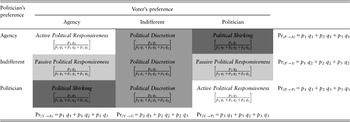
This study's theoretical analysis is premised on the formulation of expected decision rules under incomplete information (uncertainty) for both the representative voter and politician's preferred choice as to whether the politician or the bureaucracy administers policy-making. The representative voter's (politician's) choice is determined by the relative balance between weighted expected policy values and information asymmetry between the politician (voter) and agency in relation to the voter's own policy values and information. The extent to which political institutions serve as an effective mechanism for transmission of popular preferences into administrative policy-making is analysed by deriving the conditional expectation of the politician's preferred choice of policy-making venue, given the voter's preference for vesting policy-making authority with elected vis-à-vis unelected government officials. In turn, theoretical predictions range from Active Political Responsiveness (i.e. voter and politician's unambiguous preferred policy-making venue choice coincides) to Political Shirking (i.e. politician's choice as to who should make policy is unambiguously different from what the voter prefers). The “intermediate” democratic responsiveness predictions entail situations where either the voter (Political Discretion) or politician (Passive Political Responsiveness) is indifferent, regarding whether their preferred policy-making venue is an electoral institution or agency, whereas the other policy actor is not. Each of these comparative static outcomes involving the principal–agent relationship between voters and politicians reflect the degree of policy representation reflected in politician's choices when determining whether to handle policy or delegate it to an agency.Footnote 2
The next section explains why understanding the extent to which the voter's preferred policy-making venue coincides with that of the politician's is critical for students of public administration and representative democracy. The subsequent section develops the micro-foundations of the voter and politician's decision rules under conditions of incomplete information (i.e. uncertainty). The fourth section derives the nature of the principal–agent relationship between voters and politicians by analysing the extent to which a politician's choice of either making policy on its own or delegate such authority to an agency, conditional on the voter's preference as to which institution policy-making authority resides. This study concludes by discussing the implications of the theoretical analysis within the context of the role of the administrative state in representative democracies.
Policy-making and plebiscitary politics in the administrative state
Although existing studies of policy-making involving politician–agency relationships has generated critical insights into both policy-making and administration, they are limited in directly speaking to broader concerns centred on representative democracy. This is because the vast majority of these studies omit the broader polity from having an actual voice, independent of their elected representatives. Politicians are assumed to have the best interests of the polity at heart, if for no other reason but to be re-elected, and the bureaucracy is thought to be out of touch with citizens (e.g. see Mueller Reference Mueller1996, 254–260). This particular perspective is valid only if administrative agencies’ policy preferences are thought to be intrinsically at odds with those of citizens. This, however, is an unlikely supposition, given the variance of opinion that naturally occurs in pluralist democracies. The highly fragmented and unresponsive nature of electoral politics has given rise to citizens having direct influence over administrative processes for the past 40 years. For example, the “Representation Revolution” in public administration that began in the American states during the 1970s focused on various mechanisms, such as public hearings, ombudsmen, citizen groups and proxy advocates to convey citizen preferences into policy decisions made by government agencies (e.g. Rosener Reference Rosener1982; Gormley Reference Gormley1986; Vigoda Reference Vigoda2002). This trend in the use of “collaborative governance” structures as a means to bypass electoral institutions in the policy-making process has spread even deeper and further over the last two decades, with the rapid and widespread diffusion of Reinventing Government/New Public Management (Osborne and Gaebler Reference Osborne and Gaebler1992) reforms around the world as a means to tighten the accountability linkage directly between citizen clients and their administrator service providers (Peters Reference Peters1996). The necessity of bridging citizens to public administrators has become even more critical during the last few decades in the United States, where partisan polarisation (McCarty et al. Reference McCarty, Poole and Rosenthal2006), among other factors, has reduced political institutions’ capacity to be responsive to popular will.
Moreover, citizens’ attitudes towards a bureaucratic agency are often contingent on the solutions that are offered in tackling public policy problems. This, in turn, will fluctuate through time as new problems arise, old problems are redefined, political change occurs, and turnover of agency personnel takes place (e.g. see Downs Reference Downs1972). The omission of the broader polity from administrative policy-making only makes sense if they passively sit on the sidelines and allow politicians to hash out such details. Citizens do have direct contact with public agencies through the day-to-day provision of public services (e.g. Lipsky Reference Lipsky1980; Brehm and Gates Reference Brehm and Gates1997, Reference Brehm and Gates2011; Goodsell Reference Goodsell2004). In the US federal case, participatory rulemaking in the form of sunshine laws and other openness requirements, plus the establishment of the Freedom of Information Act in 1966, has also been utilised to enfranchise private citizens into the administrative policy-making process (Gormley Reference Gormley1989, Chapter 3).
The administrative state is part and parcel of constitutional democracies. Some public administration theorists, for instance, assert that the role of bureaucracy is on equal footing with electoral institutions and the judiciary (e.g. Diamond Reference Diamond1981, 69; Rohr Reference Rohr1986; Walmsley et al. Reference Walmsley, Goodsell, Rohr, Stivers, White and Wolf1987). This perspective is shared by both the Hamiltonian and Madisonian visions of the administrative state. From a Hamiltonian perspective, both elected and appointed government officials are viewed as “officers”, as Federalists interpreted the concept of representation as simply involving the flow of authority form citizens to their government (Wood Reference Wood1969; Rohr Reference Rohr1986, footnote 12). From a Madisonian perspective that espouses diffusing power among various policy actors, public administrators accurately reflect the diverse array of pluralistic interests that reflect the broader polity through the mechanisms of selective recruitment and varying management of agency personnel (Bertelli and Lynn Reference Bertelli and Lynn2006). The extent to which public administration meets this normative goal is crucial for ensuring a stable, well-functioning public bureaucracy that is effective at serving the needs of the polity (White Reference White1948; Bertelli and Lynn Reference Bertelli and Lynn2006). Therefore, the support and legitimacy of public policies in representative democracies requires that it be consistent with the wishes of the polity, even when elected officials are ineffective at controlling the behaviour and performance of public agencies (Spence Reference Spence2003). What matters is whether public agencies are making policies that reflect the will of the polity, not whether electoral institutions are inducing agency compliance. If, for example, politicians can obtain agency compliance, but it is incompatible with the electorate's preferences, then democratic responsiveness is merely an illusion.
Because these competing constitutional perspectives view both elected and unelected government as “representatives of the people”, one cannot assume that interests of citizens and government agencies are incapable of being aligned. It is true that voters cannot directly sanction agencies owing to the nature of representative democracy, yet this does not translate into the former abdicating any revealed preferences of their own regarding policy-making. Nor will voters necessarily prefer politicians to choose policy on their behalf instead of an agency just because they have a direct relationship with the former agent. Instead, rational voters within a representative democracy will prefer a policy-making venue on the basis of weighing the relative net benefits associated with delegating policy choice to elected officials vis-à-vis government agencies. Put simply, voters will possess preferences whether they wish to have their elected representatives or public administrators make public policy on their behalf. If one presumes that voters possess preferences regarding whether an electoral institution or government agency handles policy-making, then it naturally follows that voters can serve as principals by utilising information so as to make explicit decisions regarding as to who they wish to delegate policy-making authority – an elected official or an unelected official (Lupia and McCubbins Reference Lupia and McCubbins1994, Reference Lupia and McCubbins1998; Mashaw Reference Mashaw1998; Spence Reference Spence2003). In a representative democracy, the functioning of the administrative state is not solely about how successful a political principal is able to direct and monitor the behaviour of a bureaucratic agent, but also the extent to which voters’ policy interests are reflected in policy actions made by either elected or unelected government officials.
The theoretical analysis is motivated by the view that both elected officials and bureaucrats are the agents of voters. This analysis focuses on voter's preferred choice of agent for delegating policy-making authority. Does this delegation choice subsequently coincide with a politician's choice to make policy or delegate it to an agency? The resulting answers to these questions reveal the extent to which electoral institutions accurately reflect citizen preferences in policy-making. As a result, the nature of democratic responsiveness in the administrative state can be deduced within this principal–agent context.
Voters, politicians and choice of policy-making venue: formulating decision rules
If voters are capable of determining whether they prefer electoral institutions or government agencies to handle policy-making, which one would they choose to delegate such authority? This question lies at the heart of evaluating democratic responsiveness as voters want government to do what they would do, if they only had the time and wherewithal to address the problem (Lupia and McCubbins Reference Lupia and McCubbins1994; Spence Reference Spence2003). Understanding policy responsiveness in representative democracies is essentially about the linkage between voters (principal) and their elected (politicians) and unelected (bureaucracy) agents. Democratic responsiveness is defined for the purposes of this study, simply as the extent to which voters’ and politicians’ preferred policy choices to delegate to an agency coincide with one another. The focus of this study is on the selection of policy-making venue – that is, which government actor makes policy? As noted earlier, this question has tangible distributional consequences for policy representation.
Voters face a pair of formidable obstacles when deciding which government agent they wish to vest with policy-making authority. Firstly, they do not know with complete certainty the policy values held by elected officials and government agencies. Because voters are uncertain regarding the information advantage held by unelected agents vis-à-vis elected agents, they will be uncertain regarding their preferred choice of policy-making venue. The representative voter's decision rule will be governed by four factors: (1) the relative degree of uncertainty surrounding each agent's policy values in relation to one another; (2) the expected relative distance that each agent's policy values lie from the median voter; (3) the relative degree of uncertainty faced by the typical voter when considering the information advantage that the agency enjoys because of its superior expertise and functional specialisation; and (4) the expected relative information advantage each agent possesses with respect to the median voter. Next, the basic notation and assumptions of the spatial decision theoretic analysis are presented.
Basic notation and assumptions
Using the study by Spence (Reference Spence2003) as a starting point, the ith actor's ideal point/policy opinion (Oi) is simply a function of the level of accurate information that they possess (Ii), as well as their vector of policy values (Vi) – that is,  $$)(-->$<>{{O}_i}\, = \,f\left( {{{I}_i},\,{{V}_i}} \right)<$>
<!--$$
. Differences in opinion (preferences) over policy choices among the representative voter (OV), politician (OP), and agency (OA) in a unicameral legislature are simply a function of each information actor's respective level of accurate information (IV, IP, IA) and policy values (VV, VP, VA).Footnote 3 Policy values reflect how an actor will qualitatively translate information into an opinion/preference over policy choices. In addition, voters are assumed to be rationally ignorant in the Downsian sense, as opportunity and search costs are sufficiently high enough to discourage them from making a fully informed choice. Further, politicians are policy generalists who work in a variety of policy areas through legislative committees and assorted policy tasks, and hence are more informed than voters. Politicians, however, are less informed than government agencies whose purpose is to bring specialised knowledge and expertise to bear on public policy problems within a narrowly confined set of issues reflected by its administrative jurisdiction. Therefore, following Spence (Reference Spence2003), one can assume a hierarchy of rational ignorance that exists, whereby IV < IP < IA.
For the sake of simplicity and without loss of generality, let us also assume that the representative voter's utility function (UV) takes the form:  $$)(-->$<>{{U}_V}\, = \,{\rm{ - }}{{\left( {{{O}_x}{\rm{ - }}{{O}_V}} \right)}^{\rm{2}}} <$>
<!--$$
, where voter preferences lie along a single policy dimension, are single-peaked (symmetric), and deviations in the actual policy chosen (Ox) from the voter's ideal point (OV) exerts successively greater utility loss. Because agencies enjoy information advantages over politicians by the amount of IA – IP, and in the limiting case when agency policy values equate with those of the politician's (VA = VP), a rational voter will always prefer to delegate policy-making authority to an agency as opposed to an electoral institution.Footnote 4 In reality, however, this particular special case is more nuanced because VA and VP are not known with certainty by voters, and neither do they know the values of IA and IP. In other words, the penultimate decision rule for the representative voter is ambiguous because they must make their decision on the basis of uncertainty regarding each agent's policy values, as well as the degree of information advantage held by the agency vis-à-vis politicians. Derivation of expected decision rules for a rational voter can enable one to assess whether their preferred policy-making venue is an electoral institution or an administrative agency.
The micro-foundations of the voter's decision rule
Because voters possess uncertainty regarding the policy choices of politicians and agencies entrusted with delegated policy-making authority, they will form expectations of both actors. This necessitates deriving an expected decision rule for the representative voter, given that she is uncertain about both the actors’ policy values and levels of accurate information (expertise). This decision rule is centred on the representative voter selecting a policy-making venue that will minimise its utility loss. In its most basic formulation, the representative voter's expected decision rule will be:
 $$\!\!\!\!\!E\left[ {{{{\left( {{{O}_V}{\rm{ - }}{{O}_A}} \right)}}^{\rm{2}}} } \right]\,\, \gt \,\,E\left[ {{{{\left( {{{O}_V}{\rm{ - }}{{O}_P}} \right)}}^{\rm{2}}} } \right]{\rm{:}}\,\,V \ {\rm{prefers}} \ {\rm{to}} \ {\rm{delegate}} \ {\rm{to}} \ P$$
 $$\!\!\!\!\!E\left[ {{{{\left( {{{O}_V}{\rm{ - }}{{O}_A}} \right)}}^{\rm{2}}} } \right]\, \lt \,E\left[ {{{{\left( {{{O}_V}{\rm{ - }}{{O}_P}} \right)}}^{\rm{2}}} } \right]{\rm{:}}\,\,V \ {\rm{prefers}} \ {\rm{to}} \ {\rm{delegate}} \ {\rm{to}} \ A$$
 $$\quad{ E\left[ {{{{\left( {{{O}_V}{\rm{ - }}{{O}_A}} \right)}}^{\rm{2}}} } \right]\, = \,E\left[ {{{{\left( {{{O}_V}{\rm{ - }}{{O}_P}} \right)}}^{\rm{2}}} } \right]{\rm{:}}\,\,V\,{\rm{is}} \ {\rm{indifferent}} \ {\rm{between}}\,P\,{\rm{\& }}\,A$$
The resulting theoretical analysis assumes a simplified binary choice between whether P (Politician) or A (Agency) is the venue that is assigned policy-making responsibility. In practice, however, policy-making is essentially shared and can be thought of as a weighted combination of both policy actors. Therefore, the model presupposes that politicians wish to either abdicate policy-making responsibility or receive the credit (or blame) that goes along with taking ownership of policy-making. In this sense, the model set-up is consistent with theories of corporate governance where one agent is granted a “controlling interest” for a given policy. This “controlling interest” (e.g. majority stakeholder), for example, may pertain to the amount of authority P delegates to A, or instead which institution possesses decisive authority over policy-making (via statutes, rules, or policy-making tools). Yet, this “controlling interest” does not preclude constraints on this agent's autonomy, as in reality some degree of power is shared between politicians and bureaucrats (e.g. Bawn Reference Bawn1995; Volden Reference Volden2002; Gailmard and Patty Reference Gailmard and Patty2012). That is, in some instances, an agent's “controlling interest” may not enable it to fully implement its preferred course of action because of constraints imposed by other agents. Admittedly, this particular aspect is not adequately handled under a binary decision rule assumption.
The binary choice decision rule for assigning policy-making venues also has implications for the voter's decision rule. As a poorly informed principal, the voter's choice is simplified by offering them with a cleaner assessment of policy accountability. Thus, the binary decision rule assumption contains the attractive feature of not making heroic information assumptions regarding voters’ capacity for allocating policy-making authority in a more complex manner (see footnote 1). This simplified assumption presumes that voters are much more poorly informed about policy relative to politicians’ principals (IV << IP) on all policies. Yet, the binary decision rule assumption comes at the expense of theoretical richness insofar that voter information may be higher in some policy domains. Hence, voters may have sufficient capacity in such high-salience policy areas to effectively allocate shared policy-making authority between both political and bureaucratic agents. Future theoretical extensions of this model should relax this binary decision rule to fully explore the rich implications associated with explicit power sharing between political and bureaucratic agents from both the principal and agent perspectives. Even with its limitations, the binary decision rule assumption can still allow one to shed important novel insights into democratic responsiveness in the administrative state.
Given that the voter's expected decision rule defined as a binary decision rule in (1a)–(1c), the aim here is to understand the underlying causal mechanism that results in such rational choices made by voters as to whether they prefer to have politicians (P) or agency (A) assigned policy-making responsibility. Addressing this issue requires assessing the components of policy opinion/preferences by formulating expected decision rules for policy values and information, respectively, that is, E[(IV−IA)2], E[(IV−IP)2], E[(VV−VA)2] and E[(VV−VP)2]. Recasting these four components as random variables yields:
 $${{I}_A}\, = \,{{\bar{I}}_A}\, + \,{{\eta }_A},\,\,{\rm{where}}\,\,{{\eta }_A}\,\sim \,\left( {0,\,\sigma _{{{{\eta }_A}}}^{2} } \right)$$
 $${{I}_P}\, = \,{{\bar{I}}_P}\, + \,{{\eta }_P},\,\,{\rm{where}}\,\,{{\eta }_P}\,\sim \,\left( {0,\,\sigma _{{{{\eta }_P}}}^{{\rm{2}}} } \right)$$
 $${{V}_A}\, = \,{{\bar{V}}_A}\, + \,{{{\epsilon}}_A}\,,\,{\rm{where}}\,\,{{{\epsilon}}_A}\,\sim \,\left( {0,\,\sigma _{{{{{\epsilon}}_A}}}^{{\rm{2}}} } \right)$$
 $${{V}_P}\, = \,{{\bar{V}}_P}\, + \,{{{\epsilon}}_P}\,,\,{\rm{where}}\,\,{{{\epsilon}}_P}\,\sim \,\left( {0,\,\sigma _{{{{{\epsilon}}_P}}}^{{\rm{2}}} } \right)$$
where each variable is symmetrically distributed across their means  $$)(-->$<>({{\bar{I}}_A},\,{{\bar{I}}_P},\,{{\bar{V}}_A},\,{{\bar{V}}_P})<$>
<!--$$
, and contain mean-zero stochastic disturbance terms
 $$)(-->$<>(E\left[ {{{\eta }_A}} \right]\, = \,E\left[ {{{\eta }_P}} \right]\, = \,E\left[ {{{{\epsilon}}_A}} \right]\, = \,E\left[ {{{{\epsilon}}_P}} \right]\, = \,{\rm{0}})<$>
<!--$$
with known variances
 $$)(-->$<>(\sigma _{{{{\eta }_A}}}^{{\rm{2}}}, \,\sigma _{{{{\eta }_P}}}^{{\rm{2}}}, \sigma _{{{{{\epsilon}}_A}}}^{{\rm{2}}}, \,\sigma _{{{{{\epsilon}}_P}}}^{{\rm{2}}} )<$>
<!--$$
. Substituting (2a)–(2d) into the expected decision rules directly preceding them, and carrying out some standard algebraic manipulation produces the expected decision rules treated as random variables:
 $$E\left[ {{{{\left( {{{I}_V}{\rm{ - }}\left( {{{{\bar{I}}}_A}\, + \,{{\eta }_A}} \right)} \right)}}^{\rm{2}}} } \right]\, = \,{{\left( {{{I}_V}{\rm{ - }}{{{\bar{I}}}_A}} \right)}^{\rm{2}}} \, + \,E\left( {\eta _{A}^{{\rm{2}}} } \right)$$
 $$E\left[ {{{{\left( {{{I}_V}{\rm{ - }}\left( {{{{\bar{I}}}_P}\, + \,{{\eta }_P}} \right)} \right)}}^{\rm{2}}} } \right]\, = \,{{\left( {{{I}_V}{\rm{ - }}{{{\bar{I}}}_P}} \right)}^{\rm{2}}} \, + \,E\left( {\eta _{P}^{{\rm{2}}} } \right)$$
 $$E\left[ {{{{\left( {{{V}_V}{\rm{ - }}\left( {{{{\bar{V}}}_A}\, + \,{{{\epsilon}}_A}} \right)} \right)}}^{\rm{2}}} } \right]\, = \,{{\left( {{{V}_V}{\rm{ - }}{{{\bar{V}}}_A}} \right)}^{\rm{2}}} \, + \,E\left( {{\epsilon}_{A}^{{\rm{2}}} } \right)$$
 $$E\left[ {{{{\left( {{{V}_V}{\rm{ - }}\left( {{{{\bar{V}}}_P}\, + \,{{{\epsilon}}_P}} \right)} \right)}}^{\rm{2}}} } \right]\, = \,{{\left( {{{V}_V}{\rm{ - }}{{{\bar{V}}}_P}} \right)}^{\rm{2}}} \, + \,E\left( {{\epsilon}_{P}^{{\rm{2}}} } \right),$$
where  $$)(-->$<>E\left[ {\eta _{A}^{{\rm{2}}} } \right]\, = \,\sigma _{{{{\eta }_A}}}^{{\rm{2}}}, \,\,E\left[ {\eta _{P}^{{\rm{2}}} } \right]\, = \,\sigma _{{{{\eta }_P}}}^{{\rm{2}}}, \,\,E\left[ {{\epsilon}_{A}^{{\rm{2}}} } \right]\, = \,\sigma _{{{{{\epsilon}}_A}}}^{{\rm{2}}}, \,\,E\left[ {{\epsilon}_{P}^{{\rm{2}}} } \right]\, = \,\sigma _{{{{{\epsilon}}_P}}}^{{\rm{2}}} <$>
<!--$$
. Equations (3a)–(3d) represent the expected squared difference between the representative voter's policy values and information levels relative to those held by the politician and agency, plus the variance corresponding to random shocks emanating from each component. The volatility associated with this random shock captures the degree of uncertainty that the representative voter possesses regarding elected (politician) and unelected (agency) agents’ policy values and capacity. Recall that the voter is uncertain about the policy values and expertise of both the politician and agency. Therefore, greater uncertainty concerning an agent's level of information (expertise) reveals either a higher level of rational obfuscation regarding their capacity to handle a policy, the voter's difficulty in processing information pertaining to an agent's capacity, or perhaps both. In practical terms, voters ascribe significance to how informed each agent is, how close their policy values are to their own, and the extent to which they are uncertain about each agent's policy values and information. The resulting expected decision rule for voter from (1a)–(1c) can be restated asFootnote 5
 $$\frac{{E\left( {{\epsilon}_{A}^{{\rm{2}}} } \right)}}{{E\left( {{\epsilon}_{P}^{{\rm{2}}} } \right)}}\,\times \,\frac{{{{{\left( {{{V}_V}{\rm{ - }}{{{\bar{V}}}_A}} \right)}}^{\rm{2}}} }}{{{{{\left( {{{V}_V}{\rm{ - }}{{{\bar{V}}}_P}} \right)}}^{\rm{2}}} }}\,\,\,\,\, \gt \,\,\,\,\frac{{E\left( {\eta _{P}^{{\rm{2}}} } \right)}}{{E\left( {\eta _{A}^{{\rm{2}}} } \right)}}\,\times \,\frac{{{{{\left( {{{I}_V}{\rm{ - }}{{{\bar{I}}}_A}} \right)}}^{\rm{2}}} }}{{{{{\left( {{{I}_V}{\rm{ - }}{{{\bar{I}}}_P}} \right)}}^{\rm{2}}} }} \ {\rm{:}}\,\,\,V\,\,{\rm{prefers}} \ {\rm{to}} \ {\rm{delegate}} \ {\rm{to}}\,P$$
 $$\frac{{E\left( {{\epsilon}_{A}^{{\rm{2}}} } \right)}}{{E\left( {{\epsilon}_{P}^{{\rm{2}}} } \right)}}\,\times \,\frac{{{{{\left( {{{V}_V}{\rm{ - }}{{{\bar{V}}}_A}} \right)}}^{\rm{2}}} }}{{{{{\left( {{{V}_V}{\rm{ - }}{{{\bar{V}}}_P}} \right)}}^{\rm{2}}} }}\,\, \lt \,\frac{{E\left( {\eta _{P}^{{\rm{2}}} } \right)}}{{E\left( {\eta _{A}^{{\rm{2}}} } \right)}}\,\times \,\frac{{{{{\left( {{{I}_V}{\rm{ - }}{{{\bar{I}}}_A}} \right)}}^{\rm{2}}} }}{{{{{\left( {{{I}_V}{\rm{ - }}{{{\bar{I}}}_P}} \right)}}^{\rm{2}}} }}{\rm{:}}\,\,\,V\,{\rm{prefers}} \ {\rm{to}} \ {\rm{delegate}} \ {\rm{to}}\,A$$
 $$\frac{{E\left( {{\epsilon}_{A}^{{\rm{2}}} } \right)}}{{E\left( {{\epsilon}_{P}^{{\rm{2}}} } \right)}}\,\times \,\frac{{{{{\left( {{{V}_V}{\rm{ - }}{{{\bar{V}}}_A}} \right)}}^{\rm{2}}} }}{{{{{\left( {{{V}_V}{\rm{ - }}{{{\bar{V}}}_P}} \right)}}^{\rm{2}}} }}\,\,\,\,\, = \,\,\,\,\frac{{E\left( {\eta _{P}^{{\rm{2}}} } \right)}}{{E\left( {\eta _{A}^{{\rm{2}}} } \right)}}\,\times \,\frac{{{{{\left( {{{I}_V}{\rm{ - }}{{{\bar{I}}}_A}} \right)}}^{\rm{2}}} }}{{{{{\left( {{{I}_V}{\rm{ - }}{{{\bar{I}}}_P}} \right)}}^{\rm{2}}} }}{\rm{:}}\,\,\,V\,\,{\rm{is}} \ {\rm{indifferent}} \ {\rm{between}}\,P\,{\rm{\& }}\,A$$
The expected relative policy value gap and information asymmetry are weighted by the relative uncertainty that the representative voter possesses regarding each of these random variables. The relative uncertainty that the representative voter has regarding the agency's policy values and accurate information vis-à-vis those held by the politician are denoted by  $$)(-->$<>\frac{{E\left( {{\epsilon}_{A}^{{\rm{2}}} } \right)}}{{E\left( {{\epsilon}_{P}^{{\rm{2}}} } \right)}}<$>
<!--$$
and
 $$)(-->$<>\frac{{E\left( {\eta _{P}^{{\rm{2}}} } \right)}}{{E\left( {\eta _{A}^{{\rm{2}}} } \right)}}<$>
<!--$$
, respectively. As
 $$)(-->$<>\frac{{E\left( {{\epsilon}_{A}^{{\rm{2}}} } \right)}}{{E\left( {{\epsilon}_{P}^{{\rm{2}}} } \right)}}<$>
<!--$$
increases (decreases), it magnifies the relative policy value gap in favour of the politician (agency), ceteris paribus. Increases (decreases) in
 $$)(-->$<>\frac{{E\left( {\eta _{P}^{{\rm{2}}} } \right)}}{{E\left( {\eta _{A}^{{\rm{2}}} } \right)}}<$>
<!--$$
enhance (erode) the relative information advantage that an agency enjoys vis-à-vis a politician, and thus reduces (increases) the likelihood that the voter will prefer to delegate policy authority to an electoral institution instead of an agency. The
 $$)(-->$<>\frac{{{{{\left( {{{V}_V}{\rm{ - }}{{{\bar{V}}}_A}} \right)}}^{\rm{2}}} }}{{{{{\left( {{{V}_V}{\rm{ - }}{{{\bar{V}}}_P}} \right)}}^{\rm{2}}} }}<$>
<!--$$
term representing the policy value gap between the politician and agency reveals that higher (lower) values infer that the agency is a less (more)-attractive policy-making venue according to the voter. The
 $$)(-->$<>\frac{{{{{\left( {{{I}_V}{\rm{ - }}{{{\bar{I}}}_A}} \right)}}^{\rm{2}}} }}{{{{{\left( {{{I}_V}{\rm{ - }}{{{\bar{I}}}_P}} \right)}}^{\rm{2}}} }}<$>
<!--$$
term captures the relative information advantage enjoyed by the agency vis-à-vis the politician. Higher (Lower) values of this ratio term will make an agency a more (less) preferred policy-making venue to the voter. In essence, the expected relative policy value gap and expected relative information asymmetry terms are separately weighted by the relative uncertainty that the representative voter has regarding each of these variables.Footnote 6 Balancing this type of uncertainty weighed against these policy values and information differentials is essential, as a voter may prefer a less informed politician when their relative uncertainty regarding an agency's policy values and expertise is sufficiently high.
In essence, the rational voter seeks to determine as to who they wish to delegate policy-making authority on the basis of the weighted information asymmetry that the agency enjoys over the politician, in relation to the comparatively closer distance that the politician is to the voter reflected in the weighted policy value gap. Because IP < IA, if the weighted information symmetry expression is of smaller magnitude than the policy value gap in (4a), then the voter views the agency's information advantage as contributing less to their own utility compared with the relative gap between the agency and politician's policy values. Conversely, if the weighted information asymmetry expression is of a larger magnitude than the weighted expected policy value gap denoted by (4b), then a rational voter will prefer to delegate policy-making authority to an agency. When the weighted information asymmetry favouring the agency is equivalent to its weighted distance in policy values denoted in (4c), then she will be indifferent between delegating policy-making authority to an electoral institution or a bureaucratic agency.
The micro-foundations of the politician's decision rule
Unlike voters, electoral institutions possess the formal authority to choose a policy-making venue. Because politicians, like voters, incur uncertainty over both policy values and the level of accurate information held by other actors, their expected decision rule is derived in a manner analogous to the representative voter. The politician is an agent of voters in a representative democracy, and hence bears the responsibility for faithfully representing the policy interests of voters. Yet, voter's policy preferences will not be identical to those of their elected representative, and hence the decision rules of the representative voter's and politician's decision rule must be developed separately. As a policy generalist, the politician's problem is to balance the interests of their constituents (voters) with the comparative advantage in expertise and policy specialisation offered by bureaucratic agencies. The politician finds the bureaucracy a favourable policy-making venue for purposes of functional specialisation, as well as blame avoidance if negative consequences arise from policy choices. Put simply, the politician faces tension between effective representation of their constituents’ policy interests and exploiting information (expertise) advantages when selecting a preferred policy-making venue. The tension between service as a ‘delegate’ and a ‘trustee’ reflects the politician's problem of democratic representation. As a result, electoral institutions can be thought of as “policy intermediaries”.
The behavioural assumptions regarding the politician's choice of preferred policy-making venue are identical to those of the representative voter developed in the preceding sub-section (see (1a)–(1c)). More formally, it can be stated as
 $$\!\!E\left[ {{{{\left( {{{O}_P}{\rm{ - }}{{O}_V}} \right)}}^{\rm{2}}} } \right]\,\, \lt \,E\left[ {{{{\left( {{{O}_P}{\rm{ - }}{{O}_A}} \right)}}^{\rm{2}}} } \right]\,\,{\rm{:}}\,\,\,P\,{\rm{prefers}} \ {\rm{to}} \ {\rm{make}} \ {\rm{policy}}$$
 $$\ E\left[ {{{{\left( {{{O}_P}{\rm{ - }}{{O}_V}} \right)}}^{\rm{2}}} } \right]\,\,\, \gt \,\,E\left[ {{{{\left( {{{O}_P}{\rm{ - }}{{O}_A}} \right)}}^{\rm{2}}} } \right]\,\,{\rm{:}}\,\,\,P\,{\rm{prefers}} \ {\rm{to}} \ {\rm{delegate}} \ {\rm{to}}\,A$$
 $$\quad\ \ \ { E\left[ {{{{\left( {{{O}_P}{\rm{ - }}{{O}_V}} \right)}}^{\rm{2}}} } \right]\, = \,E\left[ {{{{\left( {{{O}_P}{\rm{ - }}{{O}_A}} \right)}}^{\rm{2}}} } \right]\,\,{\rm{:}}\,\, & P\,{\rm{is}} \ {\rm{indifferent}} \ {\rm{between}} \cr & \,{\rm{making}} \ {\rm{policy}} \ {\rm{and}} \ {\rm{delegating}} \ {\rm{to}}\,A \cr}$$
In (5a), the politician prefers to make policy as the bureaucratic agency is relatively more out of touch with the politician's policy sentiments compared with that of the voter. In (5b), the politician is mindful of the fact that their ideal point is more distant from the voter relative to the agency. Under this scenario, the politician exploits the bureaucracy's information advantages. The final case (5c) is the instance where the politician's ideal point is equidistant from the voter and agency, and hence selecting between the alternatives of delegating to the bureaucracy or making policy itself will not have a differential impact on the politician's utility.
Breaking down these actors’ ideal points into their individual components as random variables for the politician's decision problem yields the following:
 $${{I^{\prime}}\!\!_A}\, = \,{{\bar{I}^{\prime}\!\!_A}}\, + \,{{\phi }_A},\,\;\,{\rm{where}}\,\;\,{{\phi }_A}\,\sim \,\left( {0,\,\sigma _{{{{\phi }_A}}}^{2} } \right)$$
 $$\ \,{{I^{\prime}}\!\!_V}\, = \,{{\bar{I}^{\prime}}\!\!_V}\, + \,{{\phi }_{\,V}}\,,\;\,{\rm{where}}\,\;\,{{\phi }_{\,V}}\,\sim \,\left( {0,\,\sigma _{{{{\phi }_{\,V}}}}^{2} } \right)$$
 $$\!\!\!{{V^{\prime}}\!\!_A}\, = \,{{\bar{V^{\prime}}}\!\!_A}\, + \,{{\gamma }_A}\,,\;\,{\rm{where}}\,\;\,{{\gamma }_A}\,\sim \,\left( {0,\,\sigma _{{{{\gamma }_A}}}^{{\rm{2}}} } \right)$$
 $${{V^{\prime}}\!\!_V}\, = \,{{\bar{V^{\prime}}}\!\!_V}\, + \,{{\phi }_{\,V}}\,,\;\,{\rm{where}}\,\;\,{{\gamma }_V}\,\sim \,\left( {0,\,\sigma _{{{{\gamma }_{\,V}}}}^{{\rm{2}}} } \right)$$
where each random variable is symmetrically distributed across their means  $$)(-->$<>({{\bar{I^{\prime}}}\!\!_A}\,,\,\,{{\bar{I^{\prime}}}\!_V},\,\,{{\bar{V^{\prime}}}\!\!_A}\,,\,\,{{\bar{V^{\prime}}}\!\!_V})<$>
<!--$$
, and contains a mean-zero stochastic disturbance term (i.e. E[φV] = E[φA] = E[γV] = E[γA] = 0) with known variances (
 $$)(-->$<>(\sigma _{{{{\phi }_{{A}}}}}^{{\rm{2}}}, \,\sigma _{{{{\phi }_{{V}}}}}^{{\rm{2}}}, \sigma _{{{{\gamma }_{{A}}}}}^{{\rm{2}}}, \,\sigma _{{{{\gamma }_{{V}}}}}^{{\rm{2}}} )<$>
<!--$$
). The politician's expected decision rule is based on the weighted expected relative policy value gap and information asymmetry that it experiences with respect to the representative voter and agency.Footnote 7
 $$\frac{{E\left( {\gamma _{{{A}}}^{{\rm{2}}} } \right)}}{{E\left( {\gamma _{{{V}}}^{{\rm{2}}} } \right)}}\,\times \,\frac{{{{{\left( {{{V}_{{P}}}{{ - }}{{{\bar{V^{\prime}}}}\!\!_{{A}}}} \right)}}^{\rm{2}}} }}{{{{{\left( {{{V}_{{P}}}{\rm{ - }}{{{\bar{V^{\prime}}}}\!\!_{{V}}}} \right)}}^{\rm{2}}} }}\,\,\,\,\, \gt \,\,\,\,\frac{{E\left( {\phi _{{\,{{V}}}}^{{\rm{2}}} } \right)}}{{E\left( {\phi _{{\,{{A}}}}^{{\rm{2}}} } \right)}}\,\times \,\frac{{{{{\left( {{{I}_{{P}}}{\rm{ - }}{{{\bar{I^{\prime}}}}\!\!_{{A}}}} \right)}}^{\rm{2}}} }}{{{{{\left( {{{I}_{{P}}}{{ - }}{{{\bar{I^{\prime}}}}_{\!\!{V}}}} \right)}}^{\rm{2}}} }}{\rm{:}}\,\,\,P\,\,{\rm{prefers}} \ {\rm{to}} \ {\rm{make}} \ {\rm{policy}}$$
 $$\frac{{E\left( {\gamma _{{{A}}}^{{\rm{2}}} } \right)}}{{E\left( {\gamma _{{{V}}}^{{\rm{2}}} } \right)}}\,\times \,\frac{{{{{\left( {{{V}_{{P}}}{\rm{ - }}{{{\bar{V^{\prime}}}}\!\!_{{A}}}} \right)}}^{\rm{2}}} }}{{{{{\left( {{{V}_{{P}}}{\rm{ - }}{{{\bar{V^{\prime}}}}\!\!_{{V}}}} \right)}}^{\rm{2}}} }}\,\, \lt \,\frac{{E\left( {\phi _{{\,{{V}}}}^{{\rm{2}}} } \right)}}{{E\left( {\phi _{{\,{{A}}}}^{{\rm{2}}} } \right)}}\,\times \,\frac{{{{{\left( {{{I}_{{P}}}{\rm{ - }}{{{\bar{I^{\prime}}}}\!\!_{{A}}}} \right)}}^{\rm{2}}} }}{{{{{\left( {{{I}_P}{\rm{ - }}{{{\bar{I^{\prime}}}}\!\!_{{V}}}} \right)}}^{\rm{2}}} }}{\rm{:}}\,\,P\,{\rm{prefers}} \ {\rm{to}} \ {\rm{delegate}} \ {\rm{to}}\,A$$
 $$no{ \frac{{E\left( {\gamma _{A}^{{\rm{2}}} } \right)}}{{E\left( {\gamma _{V}^{{\rm{2}}} } \right)}}\,\times \,\frac{{{{{\left( {{{V}_P}{\rm{ - }}{{{\bar{V^{\prime}}}}\!\!_A}} \right)}}^{\rm{2}}} }}{{{{{\left( {{{V}_P}{\rm{ - }}{{{\bar{V^{\prime}}}}\!\!_V}} \right)}}^{\rm{2}}} }}\,\,\,\,\, = \,\,\,\,\frac{{E\left( {\phi _{{\,V}}^{{\rm{2}}} } \right)}}{{E\left( {\phi _{{\,A}}^{{\rm{2}}} } \right)}}\,\times \,\frac{{{{{\left( {{{I}_{{P}}}{\rm{ - }}{{{\bar{I^{\prime}}}\!\!}_A}} \right)}}^{\rm{2}}} }}{{{{{\left( {{{I}_P}{\rm{ - }}{{{\bar{I^{\prime}}}}\!\!_V}} \right)}}^{\rm{2}}} }}{\rm{:}}\,\,\, P\,\,{\rm{is}} \ {\rm{indifferent}} \ {\rm{between}} \cr \qquad \ {\rm{making}} \ {\rm{policy}} \ {\rm{and}} \ {\rm{delegating}} \ {\rm{to}}\,A $$
In (7a), the politician chooses to handle policy-making on their own. The logic underlying this decision is straightforward. Because IA > IP > IV by definition, the politician's weighted policy values are relatively more distant from the agency in relation to the weighted relative information disadvantage that it incurs. In (7b), the politician prefers to have an agency make policy as their weighted relative policy value gap in relation to the agency is comparatively smaller to their corresponding weighted information asymmetry gap. Finally, in (7c) the politician is indifferent between making policy and delegating it to the bureaucracy. This is because the weighted relative disparity in policy values is proportional to the information advantage enjoyed by the agency at the expense of the politician.
The consequences of policy-making venue choices for democratic responsiveness
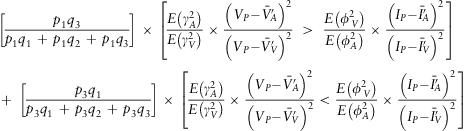
Now that the decision rules for both the representative voter and politician have been derived, attention can be given to determining whether their preferred choice of policy-making venue coincides. To reiterate, the three potential outcomes for each actor are as follows: (1) politician prefers to delegate to an agency, (2) politician prefers to make policy “in-house” or (3) their indifference between each option. This requires assessing the politician's preferred policy-making venue – electoral institution or agency – conditional on the representative voter's preferred choice. Addressing this decision in a joint manner provides direct insight into the nature of the principal–agent relationship between the polity and their elected representatives in the administrative state. The probability of the voter's choice of policy-making venue is denoted as pi, where p 1 = Pr(Agency), p 2 = Pr(Indifferent), p 3 = Pr(Politician), whereas the corresponding probability of the politician's choice is given by qi, where q 1 = Pr(Agency), q 2 = Pr(Indifferent), q 3 = Pr(Politician). The resulting conditional probabilities provide information on the joint likelihood of the voter and politician's preferences for a particular policy-making venue, given the voter's own preference.
These comparative static outcomes are summarised by a 3 × 3 conditional probability matrix in Table 1. Lighter-shaded cells represent greater preference concordance between the voter and politician. Active Political Responsiveness refers to when both the voter and politician unequivocally agree which institution should be responsible for policy-making. Under these circumstances, political responsiveness is defined as being active, as the politician's preferred choice exactly matches that of the representative voter. Passive Political Responsiveness occurs when the voter has a clear preference for policy-making venue, whereas the politician is indifferent between making policy and delegating it to an agency. In such instances, the politician will have an incentive to comply with the voter's preferred policy-making venue, and hence make their choice accordingly. Conversely, when the representative voter is indifferent between policy-making venue options, whereas the politician clearly prefers one venue over another, the politician will exercise her discretion as to whether they make policy or delegate it to an agency (Political Discretion). Because the voter is indifferent between an electoral institution and an agency handling policy, the politician is free to choose either venue option without fear of electoral sanction. Political Shirking takes place when the politician's preferred policy-making venue is directly at odds with those of the voter.
Conditional probability matrix involving the voter's and politician's preferences regarding choice of policymaking venue

These outcomes are analytically obtained by multiplying a particular conditional probability of a given outcome corresponding to the expected decision rule adopted by the politician. That is, the conditional expectation of observing each of these four principal–agent outcomes between the voter and politician are as follows:
 $$no{{\rm{E}} \ {\rm{(}}Active\,Political\,Responsiveness{\rm{)}} \ {\rm{ = }}\,E\left( {P\, = \,A\,\,\left| {\,V\, = \,A} \right.} \right)\,\cr + \,\,E\left( {P\, = \,P\,\left| {\,V\, = \,P} \right.} \right)$$
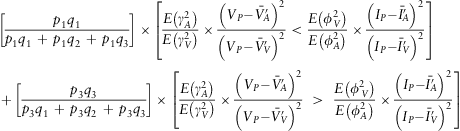 $$\openup 3pt{ & \left[ {\frac{{{{p}_{\rm{1}}}{{q}_{\rm{1}}}}}{{{{p}_{\rm{1}}}{{q}_{\rm{1}}}\, + \,{{p}_{\rm{1}}}{{q}_{\rm{2}}}\, + \,{{p}_{\rm{1}}}{{q}_{\rm{3}}}}}} \right]\times \left[ {\frac{{E\left( {\gamma _{A}^{{\rm{2}}} } \right)}}{{E\left( {\gamma _{V}^{{\rm{2}}} } \right)}}\,\times \frac{{{{{\left( {{{V}_P}{\rm{ - }}{{{\bar{V^{\prime}}}}\!\!_A}} \right)}}^{\rm{2}}} }}{{{{{\left( {{{V}_P}{\rm{ - }}{{{\bar{V^{\prime}}}}\!\!_V}} \right)}}^{\rm{2}}} }}\, \lt \,\frac{{E\left( {\phi _{V}^{{\rm{2}}} } \right)}}{{E\left( {\phi _{A}^{{\rm{2}}} } \right)}}\,\times \frac{{{{{\left( {{{I}_P}{\rm{ - }}{{{\bar{I^{\prime}}}}\!\!_A}} \right)}}^{\rm{2}}} }}{{{{{\left( {{{I}_P}{\rm{ - }}{{{\bar{I^{\prime}}}}\!\!_V}} \right)}}^{\rm{2}}} }}\,} \right] \cr & + \left[ {\frac{{{{p}_{\rm{3}}}{{q}_{\rm{3}}}}}{{{{p}_{\rm{3}}}{{q}_{\rm{1}}}\, + \,{{p}_{\rm{3}}}{{q}_{\rm{2}}}\, + \,{{p}_{\rm{3}}}{{q}_{\rm{3}}}}}} \right]\times \left[ {\frac{{E\left( {\gamma _{A}^{{\rm{2}}} } \right)}}{{E\left( {\gamma _{V}^{{\rm{2}}} } \right)}}\,\times \frac{{{{{\left( {{{V}_P}{\rm{ - }}{{{\bar{V^{\prime}}}}\!\!_A}} \right)}}^{\rm{2}}} }}{{{{{\left( {{{V}_P}{\rm{ - }}{{{\bar{V^{\prime}}}}\!\!_V}} \right)}}^{\rm{2}}} }}\,\,\, \gt \,\,\,\frac{{E\left( {\phi _{{\,V}}^{{\rm{2}}} } \right)}}{{E\left( {\phi _{A}^{{\rm{2}}} } \right)}}\,\times \frac{{{{{\left( {{{I}_P}{\rm{ - }}{{{\bar{I^{\prime}}}}\!\!_A}} \right)}}^{\rm{2}}} }}{{{{{\left( {{{I}_P}{\rm{ - }}{{{\bar{I^{\prime}}}}\!\!_V}} \right)}}^{\rm{2}}} }}\,} \right] \cr}$$
 $${\rm{E(}}Passive\,Political\,Responsiveness{\rm{)}} \ {\rm{ = }}\,E\left( {P\, = \,I\,\,\left| {\,V\, = \,A} \right.} \right)\,\, + \,\,E\left( {P\, = \,I\,\,\left| {\,V\, = \,P} \right.} \right)$$
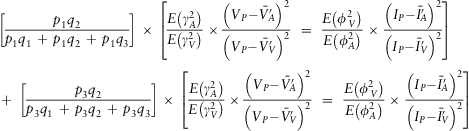 $$\openup 3pt{ & \left[ {\frac{{{{p}_{\rm{1}}}{{q}_{\rm{2}}}}}{{{{p}_{\rm{1}}}{{q}_{\rm{1}}}\, + \,{{p}_{\rm{1}}}{{q}_{\rm{2}}}\, + \,{{p}_{\rm{1}}}{{q}_{\rm{3}}}}}} \right]\,\times \,\left[ {\frac{{E\left( {\gamma _{A}^{{\rm{2}}} } \right)}}{{E\left( {\gamma _{V}^{{\rm{2}}} } \right)}}\,\times \frac{{{{{\left( {{{V}_P}{\rm{ - }}{{{\bar{V^{\prime}}}}\!\!_A}} \right)}}^{\rm{2}}} }}{{{{{\left( {{{V}_P}{\rm{ - }}{{{\bar{V^{\prime}}}}\!\!_V}} \right)}}^{\rm{2}}} }}\,\,\, = \,\,\,\frac{{E\left( {\phi _{{\,V}}^{{\rm{2}}} } \right)}}{{E\left( {\phi _{A}^{{\rm{2}}} } \right)}}\,\times \,\frac{{{{{\left( {{{I}_P}{\rm{ - }}{{{\bar{I^{\prime}}}}\!\!_A}} \right)}}^{\rm{2}}} }}{{{{{\left( {{{I}_P}{\rm{ - }}{{{\bar{I^{\prime}}}}\!\!_V}} \right)}}^{\rm{2}}} }}} \right] \cr & + \,\,\left[ {\frac{{{{p}_{\rm{3}}}{{q}_{\rm{2}}}}}{{{{p}_{\rm{3}}}{{q}_{\rm{1}}}\, + \,{{p}_{\rm{3}}}{{q}_{\rm{2}}}\, + \,{{p}_{\rm{3}}}{{q}_{\rm{3}}}}}} \right]\,\times \,\left[ {\frac{{E\left( {\gamma _{A}^{{\rm{2}}} } \right)}}{{E\left( {\gamma _{V}^{{\rm{2}}} } \right)}}\,\times \frac{{{{{\left( {{{V}_P}{\rm{ - }}{{{\bar{V^{\prime}}}}\!\!_A}} \right)}}^{\rm{2}}} }}{{{{{\left( {{{V}_P}{\rm{ - }}{{{\bar{V^{\prime}}}}\!\!_V}} \right)}}^{\rm{2}}} }}\,\,\, = \,\,\,\frac{{E\left( {\phi _{{\,V}}^{{\rm{2}}} } \right)}}{{E\left( {\phi _{A}^{{\rm{2}}} } \right)}}\,\times \,\frac{{{{{\left( {{{I}_P}{\rm{ - }}{{{\bar{I^{\prime}}}}\!\!_A}} \right)}}^{\rm{2}}} }}{{{{{\left( {{{I}_P}{\rm{ - }}{{{\bar{I^{\prime}}}}\!\!_V}} \right)}}^{\rm{2}}} }}} \right] \cr}$$
 $${ {\rm{E(}}Political\,Discretion{\rm{)}} \ {\rm{ = }}\,E\left( {P\, = \,A\,\,\left| {\,V\, = \,I} \right.} \right)\,\, + \,\,E\left( {P\, = \,I\,\,\left| {\,V\, = \,I} \right.} \right)\cr \quad+ \,E\left( {P\, = \,P\,\,\left| {\,V\, = \,I} \right.} \right) $$
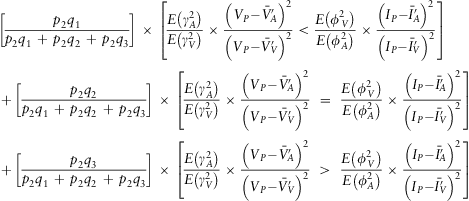 $$\openup 3pt{ & \left[ {\frac{{{{p}_{\rm{2}}}{{q}_{\rm{1}}}}}{{{{p}_{\rm{2}}}{{q}_{\rm{1}}}\, + \,{{p}_{\rm{2}}}{{q}_{\rm{2}}}\, + \,{{p}_{\rm{2}}}{{q}_{\rm{3}}}}}} \right]\,\times \,\left[ {\frac{{E\left( {\gamma _{A}^{{\rm{2}}} } \right)}}{{E\left( {\gamma _{V}^{{\rm{2}}} } \right)}}\,\times \,\frac{{{{{\left( {{{V}_P}{\rm{ - }}{{{\bar{V^{\prime}}}}\!\!_A}} \right)}}^{\rm{2}}} }}{{{{{\left( {{{V}_P}{\rm{ - }}{{{\bar{V^{\prime}}}}\!\!_V}} \right)}}^{\rm{2}}} }}\, \lt \,\frac{{E\left( {\phi _{{\,V}}^{{\rm{2}}} } \right)}}{{E\left( {\phi _{A}^{{\rm{2}}} } \right)}}\,\times \,\frac{{{{{\left( {{{I}_P}{\rm{ - }}{{{\bar{I^{\prime}}}}\!\!_A}} \right)}}^{\rm{2}}} }}{{{{{\left( {{{I}_P}{\rm{ - }}{{{\bar{I^{\prime}}}}\!\!_V}} \right)}}^{\rm{2}}} }}\,} \right] \cr & + \left[ {\frac{{{{p}_{\rm{2}}}{{q}_{\rm{2}}}}}{{{{p}_{\rm{2}}}{{q}_{\rm{1}}}\, + \,{{p}_{\rm{2}}}{{q}_{\rm{2}}}\, + \,{{p}_{\rm{2}}}{{q}_{\rm{3}}}}}} \right]\,\times \,\left[ {\frac{{E\left( {\gamma _{A}^{{\rm{2}}} } \right)}}{{E\left( {\gamma _{V}^{{\rm{2}}} } \right)}}\,\times \,\frac{{{{{\left( {{{V}_P}{\rm{ - }}{{{\bar{V^{\prime}}}}\!\!_A}} \right)}}^{\rm{2}}} }}{{{{{\left( {{{V}_P}{\rm{ - }}{{{\bar{V^{\prime}}}}\!\!_V}} \right)}}^{\rm{2}}} }}\,\,\, = \,\,\,\frac{{E\left( {\phi _{{\,V}}^{{\rm{2}}} } \right)}}{{E\left( {\phi _{A}^{{\rm{2}}} } \right)}}\,\times \,\frac{{{{{\left( {{{I}_P}{\rm{ - }}{{{\bar{I^{\prime}}}}\!\!_A}} \right)}}^{\rm{2}}} }}{{{{{\left( {{{I}_P}{\rm{ - }}{{{\bar{I^{\prime}}}}\!\!_V}} \right)}}^{\rm{2}}} }}\,} \right] \cr & + \left[ {\frac{{{{p}_{\rm{2}}}{{q}_{\rm{3}}}}}{{{{p}_{\rm{2}}}{{q}_{\rm{1}}}\, + \,{{p}_{\rm{2}}}{{q}_{\rm{2}}}\, + \,{{p}_{\rm{2}}}{{q}_{\rm{3}}}}}} \right]\,\times \,\left[ {\frac{{E\left( {\gamma _{A}^{{\rm{2}}} } \right)}}{{E\left( {\gamma _{V}^{{\rm{2}}} } \right)}}\,\times \,\frac{{{{{\left( {{{V}_P}{\rm{ - }}{{{\bar{V^{\prime}}}}\!\!_A}} \right)}}^{\rm{2}}} }}{{{{{\left( {{{V}_P}{\rm{ - }}{{{\bar{V^{\prime}}}}\!\!_V}} \right)}}^{\rm{2}}} }}\,\,\, \gt \,\,\,\frac{{E\left( {\phi _{{\,V}}^{{\rm{2}}} } \right)}}{{E\left( {\phi _{A}^{{\rm{2}}} } \right)}}\,\times \,\frac{{{{{\left( {{{I}_P}{\rm{ - }}{{{\bar{I^{\prime}}}}\!\!_A}} \right)}}^{\rm{2}}} }}{{{{{\left( {{{I}_P}{\rm{ - }}{{{\bar{I^{\prime}}}}\!\!_V}} \right)}}^{\rm{2}}} }}\,} \right] \cr}$$
 $${\rm{E(}}Political \ \ Shirking{\rm{)}} \ {\rm{ = }}\,E\left( {P\, = \,P\,\,\left| {\,V\, = \,A} \right.} \right)\,\, + \,\,E\left( {P\, = \,A\,\,\left| {\,V\, = \,P} \right.} \right)$$
 $$\openup 3pt{ & \left[ {\frac{{{{p}_{\rm{1}}}{{q}_{\rm{3}}}}}{{{{p}_{\rm{1}}}{{q}_{\rm{1}}}\, + \,{{p}_{\rm{1}}}{{q}_{\rm{2}}}\, + \,{{p}_{\rm{1}}}{{q}_{\rm{3}}}}}} \right]\,\times \,\left[ {\frac{{E\left( {\gamma _{A}^{{\rm{2}}} } \right)}}{{E\left( {\gamma _{V}^{{\rm{2}}} } \right)}}\,\times \,\frac{{{{{\left( {{{V}_P}{\rm{ - }}{{{\bar{V^{\prime}}}}\!\!_A}} \right)}}^{\rm{2}}} }}{{{{{\left( {{{V}_P}{\rm{ - }}{{{\bar{V^{\prime}}}}\!\!_V}} \right)}}^{\rm{2}}} }}\,\,\, \gt \,\,\,\frac{{E\left( {\phi _{{\,V}}^{{\rm{2}}} } \right)}}{{E\left( {\phi _{A}^{{\rm{2}}} } \right)}}\,\times \,\frac{{{{{\left( {{{I}_P}{\rm{ - }}{{{\bar{I^{\prime}}}}\!\!_A}} \right)}}^{\rm{2}}} }}{{{{{\left( {{{I}_P}{\rm{ - }}{{{\bar{I^{\prime}}}}\!\!_V}} \right)}}^{\rm{2}}} }}\,} \right] \cr & + \,\,\left[ {\frac{{{{p}_{\rm{3}}}{{q}_{\rm{1}}}}}{{{{p}_{\rm{3}}}{{q}_{\rm{1}}}\, + \,{{p}_{\rm{3}}}{{q}_{\rm{2}}}\, + \,{{p}_{\rm{3}}}{{q}_{\rm{3}}}}}} \right]\,\times \,\left[ {\frac{{E\left( {\gamma _{A}^{{\rm{2}}} } \right)}}{{E\left( {\gamma _{V}^{{\rm{2}}} } \right)}}\,\times \,\frac{{{{{\left( {{{V}_P}{\rm{ - }}{{{\bar{V^{\prime}}}}\!\!_A}} \right)}}^{\rm{2}}} }}{{{{{\left( {{{V}_P}{\rm{ - }}{{{\bar{V^{\prime}}}}\!\!_V}} \right)}}^{\rm{2}}} }}\, \lt \,\frac{{E\left( {\phi _{{\,V}}^{{\rm{2}}} } \right)}}{{E\left( {\phi _{A}^{{\rm{2}}} } \right)}}\,\times \,\frac{{{{{\left( {{{I}_P}{\rm{ - }}{{{\bar{I^{\prime}}}}\!\!_A}} \right)}}^{\rm{2}}} }}{{{{{\left( {{{I}_P}{\rm{ - }}{{{\bar{I^{\prime}}}}\!\!_V}} \right)}}^{\rm{2}}} }}\,} \right] \cr}$$
These four cases delineate the degree of policy responsiveness present in a representative democracy when one considers the relationship between the broader polity, elected representatives, and the administrative state. In a Burkean (trustee) conceptualisation of representative democracy, Political Shirking can yield superior policy outcomes as politicians are considerably more knowledgeable about policy than the typical constituent. In the opposite extreme, both Active and Passive Political Responsiveness are consistent with the broader polity's wishes being served by elected representatives, as they are both consistent with choices made by constituents if they were self-governing. Political Discretion is consistent with the view that the broader polity is indifferent about policy, and thus their elected representatives are entrusted with making a choice on their behalf. In all but the Political Shirking scenario, the comparative static outcomes are implicitly treated as being observationally equivalent to one another in standard models focusing only on politician–agency relations. That is, existing studies restricting their focus to the politician-agency presume that electoral institutions faithfully represent the broader polity's interests since it is presumed that both the voter's and politician's preferences coincide with one another. Nonetheless, the present theoretical analysis reveals that these three seemingly observationally equivalent cases provide distinct types of democratic responsiveness involving citizens and their elected representatives.
Implications for understanding policy-making in the administrative state
Whether politicians should be responsive to their constituents, or instead exercise their best independent judgement, is largely a matter of normative debate. Assessing the extent to which politicians do respond to popular will is something that lends itself to positive analyses. For students interested in the intersection between democratic responsiveness and public policy, this often means evaluating the extent to which government officials carry out popular will. Yet, policy representation between citizens/voters and politicians contains considerable slippage and bias (e.g. Achen Reference Achen1978; Lax and Phillips Reference Lax and Phillips2012). This is also true in the realm of policy administration of citizen-based initiatives (Gerber et al. Reference Gerber, Lupia and McCubbins2004). Therefore, one must consider the dual nature of principal–agent relationships between the voter and politician, as well as between the politician and bureaucrat, when gauging the comprehensive nature of democratic responsiveness in the administrative state.
This study has sought to analyze such a dual principal-agent problem by extending the results of Spence's (2003) study to allow for incomplete information (uncertainty) in each actor's decision rule, plus derive the full range of comparative static outcomes regarding the (mis)match between voter's and politician's preferred choice of policy-making venue – an electoral institution or an agency. The resulting comparative static outcomes provide insight into the nature of administrative policy-making in representative democracies. Specifically, these outcomes reveal the conditions in which the representative voter's and politician's choice of policy-making venue are synchronous with one another (Active Political Responsiveness), when one actor's preference is stronger than the other (Passive Political Responsiveness or Political Discretion), and when they are directly at odds with one another (Political Shirking). These comparative static outcomes offer theoretical insights into representative democracy in an administrative state by analysing the extent to which politician's policy-making venue choices accurately represent the wishes of their constituents in a principal–agent context.
In closing, the theoretical results from this study lead one to draw more temperate conclusions regarding the benefits of agency policy-making than posited by Spence (Reference Spence2003). On one hand, much of the positive theory of public bureaucracy literature subsumes that political control over government agencies is normatively desirable in representative democratic systems. This bias stems from presuming that elected officials faithfully and accurately represent to the will of their constituents, as they, unlike government agencies, can be held directly accountable via elections. Moreover, this “democratic control” perspective often views agency autonomy as a pathology associated with representative democracy when government agencies are seen as “runaway bureaucracies” not responding to their political principals (e.g., Moe Reference Moe1985a; McNollGast Reference McCubbins, Noll and Weingast1987, Reference McCubbins, Noll and Weingast1989). This perspective discounts the legitimacy of the administrative state by inferring that democratic responsiveness cannot be obtained in a direct relationship between citizens and government agencies (Spence Reference Spence2003). On the other hand, neither one can infer that the benefits of agency policy-making necessarily exceed those from electoral institutions solely on the basis of information advantages. Under certain conditions, having politicians make the policy will best serve the interests of voters. On a normative level, the current study demonstrates that whether agency discretion or political control is desirable essentially depends on which policy-making venue maximises the polity's utility, subject to uncertainty surrounding each government actors’ policy values and expertise for handling policy issues. Although this study adopts a rather simplified analytical framework that is void of additional institutional features,Footnote 8 it nonetheless provides a useful starting point for establishing a rich set of theoretical conditions for understanding democratic responsiveness in the administrative state.
Acknowledgement
A much earlier (and different) version of this paper was presented at the 2001 Scientific Study of Bureaucracy (S2OB) conference, 2–3 February 2001, Texas A&M University, College Station, Texas. The author thanks both the JPP reviewers and Editor for their excellent set of comments that greatly improved this manuscript.