


En cas de dissolution, le Cabinet, à l’exception du président du Conseil et du
ministre de l’intérieur, reste en fonction pour expédier les affaires courantes.
—Article 52, Constitution de 1946, IVe République Footnote 1
1. Introduction
Following the snap election in July 2024, an unusual constitutional question arose in France: what should an outgoing incumbent government do when the formation of a new government cannot be achieved in a timely manner? The election resulted in a landslide defeat for President Emmanuel Macron’s liberal alliance, Ensemble, which lost 86 seats. Unable to form a majority coalition in parliament quickly, Prime Minister (PM) Gabriel Attal’s resignation was accepted by Macron on July 16, and the government entered the caretaking phase. Article 52 of the 1946 French Constitution constrains caretaker governments to managing only current affairs (les affaires courantes). Despite the pressing need for a functioning government, Macron refused to appoint a PM from the largest coalition in the parliament, hoping instead to form a centrist coalition. On September 5, Michel Barnier was appointed as the new PM, ending a 52-day caretaking period with no major legislation introduced.Footnote 2
As the French case shows, the necessity of forming a coalition government with majority support in parliamentary systems inevitably creates a time gap for government transition. During this period, the outgoing government acts as the caretaker until the new one is established, which creates an institutional dilemma. On the one hand, the caretaking period indicates a standstill in government policy when caretakers are bound by constitutional or unwritten conventions to maintain the policy status quo. On the other hand, this period is a potential loophole for parties in the outgoing government losing their political legitimacy to pursue partisan policy changes. Such legislative moves often do not incur any legal consequences, as adherence to the policy status quo is mostly a convention and because the vague terms like “current” or “necessary” affairs are subject to interpretation.
The coalition literature does not provide a concrete empirical analysis of how this dilemma gets resolved. In an influential contribution, Laver and Shepsle (Reference Laver and Shepsle1994) suggest that the resigned or defeated caretaker maintains the policy status quo, since the outgoing government has lost parliamentary support. In fact, a caretaker government does not fully represent the policy position of the outgoing government, because it lacks the authority to respond to spontaneous situations as it did during its regular governing period (p. 292). Thus, the literature has assumed that caretaker status endows no privilege to the incumbent (Martin and Stevenson, Reference Martin and Stevenson2010), and the policy status quo prevails during the government formation period (Laver and Shepsle, Reference Laver and Shepsle1996; De Marchi and Laver, Reference De Marchi and Laver2023). However, these assumptions remain unexamined empirically—recent attention focused primarily on the duration of caretaker governments (Bromo and Cheibub, Reference Bromo and Cheibub2025) and their relationship to government survival (Conrad and Golder, Reference Conrad and Golder2010; Shomer et al., Reference Shomer, Erik Rasch and Akirav2022).
Given this gap in the literature and the growing duration of government formation periods in Western Europe (Bergman et al., Reference Bergman, Bäck and Hellström2021), along with anecdotal evidence of policymaking during the caretaking period—including proposing budgets, adjusting tax policies, and in rare cases, even amending the constitutionFootnote 3—this article focuses on government bills during the caretaking period to challenge the prevailing policy status quo assumption.
I begin by defining the caretaking period in the coalition lifecycle. Using an original dataset on caretaker cabinets, I demonstrate that the duration of the caretaking period in Western Europe has been increasing since 1945. I then discuss the normative concerns associated with caretaker governments, especially prolonged ones, to necessitate the need to validate the status quo assumption. Afterward, I use government bills to show that, despite a general decline in policymaking during the caretaking phase, outgoing, non-returning incumbent caretaker governments remain active in both proposing and adopting novel policies. I conclude by discussing the implications.
2. Caretaker government in the coalition lifecycle
As the essence of parliamentary democracy, the making and breaking of governments is a continuous process (Laver and Shepsle Reference Laver and Shepsle1996, p. 278). From the moment it takes office, the incumbent government is constantly reappraised by the legislature, remaining in power only in the absence of a credible alternative from the opposition. Nevertheless, these seemingly seamless transitions in the government lifecycle warrant a more nuanced examination.
The key elements in the governing process are election, government formation, coalition governance, and government termination (Strøm et al., Reference Strøm, Müller and Bergman2010). The coalition lifecycle begins with an election, after which parties negotiate to form a government with majority support, unless a single party wins an outright majority. Governance then commences and continues until the government is terminated for any number of reasons, or when no alternative majority government can be formed (e.g., through a constructive vote of no confidence). Government termination is followed by either a regular or early election, or by a direct replacement. In either case, political parties need to secure new governing allies.
Termination also marks the point at which a government effectively ceases to exist, with the outgoing incumbent continuing as the caretaker, either in its original form or a reduced one.Footnote 4 A caretaker government thus bridges the gap between government termination and formation while operating alongside the electoral and bargaining processes leading to a new government.
Building on existing definitions (Warwick Reference Warwick1995; Schleiter and Belu Reference Schleiter and Belu2015; Dandoy and Terrière Reference Dandoy, Terrière, Caluwaerts and Reuchamps2021), Figure 1 depicts a new timeframe-based definition of caretaker government applicable to parliamentary democracies in general. The caretaking period begins on the earliest occurrence of one of the following events: 1) the cabinet loses a confidence motion or the parliament passes a vote of no confidence; 2) the PM resigns for any reason; 3) the PM or the head of state announces an early election; or 4) an officially designated caretaker is appointed, if, for instance, no government can be formed after an election or the PM is incapable of resigning. If none of these conditions apply, the caretaking period begins on whichever occurs first: the dissolution of parliament or the election. The caretaking period ends when 1) a new government is sworn in, either through appointment by the head of state or an investiture vote (in practice, this could also be the date the new PM publicly announces the cabinet composition under negative parliamentarism), or 2) parliament is installedFootnote 5—whichever occurs last.
Lifespan of caretaker government.

1 Long description
The flowchart illustrates the process of a caretaker government from termination to formation. It begins with ′Caretaking Start (Government Termination)′ leading to several events: ′Loss of Confidence Vote′, ′PM Resignation′ and ′Early Election Announcement′. ′PM Resignation′ connects to ′Resignation Acceptance′, which then leads to ′Appointment of Designated Caretaker′. ′Early Election Announcement′ branches into ′Parliament Dissolution′, followed by ′Election/Polling Day′ and finally ′Parliament Installment′. The process concludes with ′Caretaking End (Government Formation)′ leading to ′New Government Formed/Appointed′. Arrows indicate the flow and connections between these events.
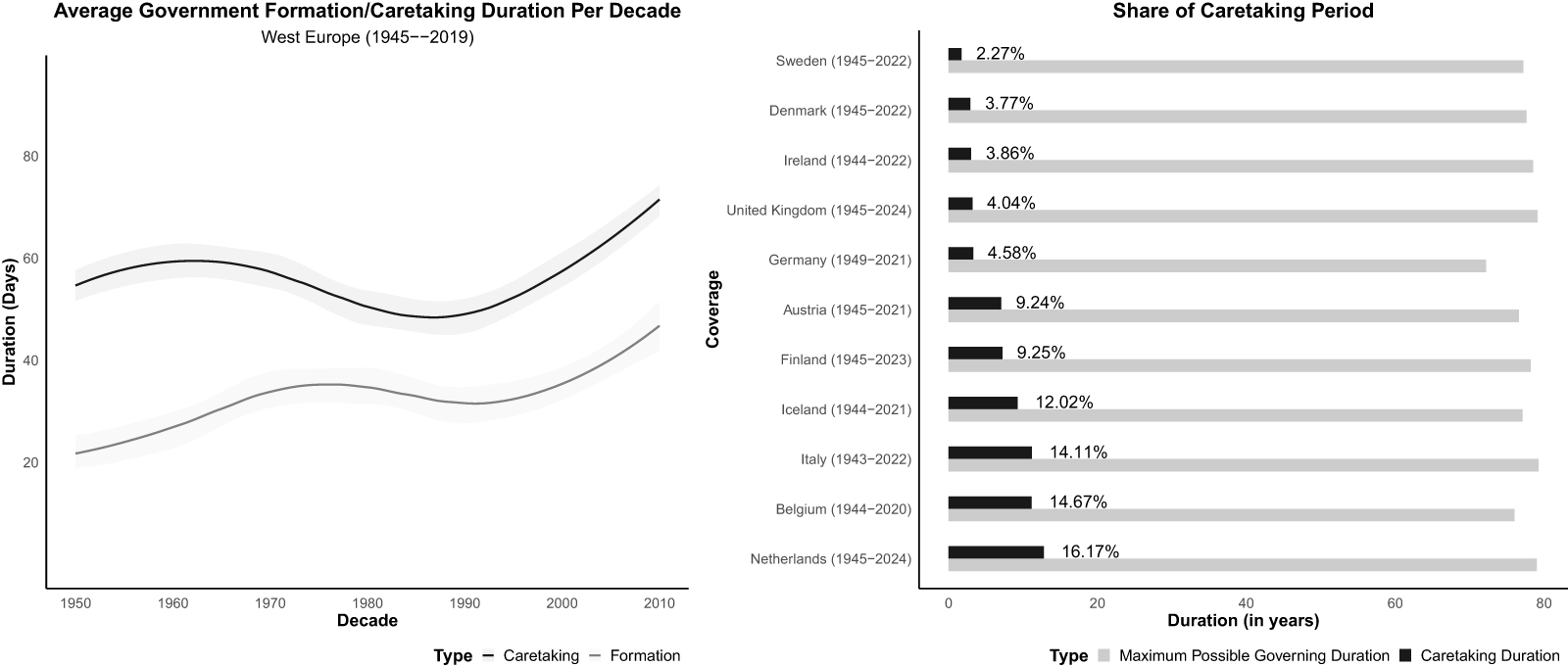
Using the definition above, Figure 2 (left panel) shows that the average caretaking period in Western Europe has increased from approximately 55 days in the 1950s to around 80 days today. Comparing across countries, unsurprisingly, the Netherlands and Belgium have the highest share of caretaking periods relative to total governing time, i.e., 16.17% (12.77 years) and 14.67% (11.15 years), respectively. Nevertheless, 11.18 years (14.11% of the governing time) in Italy since 1943 have also been under caretaker governments due to frequent breakdowns and designated caretaker governments. For the other countries, the share of caretaking time ranges from 2% to 12% of their total available governing time—a significant amount of time with low government policy output, if the policy status quo assumption generally holds.
Caretaker governments and duration.

Figure 2 Long description
Average Government Formation slash Caretaking Duration Per Decade West Europe left parenthesis 1945 dash 2019 right parenthesis The horizontal axis label is Decade. The horizontal axis range is 1950 to 2010 with tick labels 1950, 1960, 1970, 1980, 1990, 2000, 2010. The vertical axis label is Duration left parenthesis Days right parenthesis. The vertical axis shows tick labels 20, 40, 60, 80. Two lines are shown with the legend text: Type dash Caretaking dash Formation. The upper line starts near 55 at 1950, rises to near 60 around 1960, then declines to near 50 around 1990, then rises to near 70 by 2010. The lower line starts near 22 at 1950, rises to near 35 around 1970 to 1980, stays near the mid 30s around 1990 to 2000, then rises to near 45 by 2010. Share of Caretaking Period The horizontal axis label is Duration left parenthesis in years right parenthesis. The horizontal axis range is 0 to 80 with tick labels 0, 20, 40, 60, 80. The vertical axis label is Coverage. A list of countries with date ranges is shown at left, each with a percentage label: Sweden left parenthesis 1945 dash 2022 right parenthesis 2.27 percent. Denmark left parenthesis 1945 dash 2022 right parenthesis 3.77 percent. Ireland left parenthesis 1944 dash 2022 right parenthesis 3.86 percent. United Kingdom left parenthesis 1945 dash 2024 right parenthesis 4.04 percent. Germany left parenthesis 1949 dash 2021 right parenthesis 4.58 percent. Austria left parenthesis 1945 dash 2021 right parenthesis 9.24 percent. Finland left parenthesis 1945 dash 2023 right parenthesis 9.25 percent. Iceland left parenthesis 1944 dash 2021 right parenthesis 12.02 percent. Italy left parenthesis 1943 dash 2022 right parenthesis 14.11 percent. Belgium left parenthesis 1944 dash 2020 right parenthesis 14.67 percent. Netherlands left parenthesis 1945 dash 2024 right parenthesis 16.17 percent. Legend text at the bottom reads: Type Maximum Possible Governing Duration Caretaking Duration.
3. Caretaker government, accountability, and representation
The presence of a caretaker government in the coalition lifecycle implies that there is always a government in parliamentary democracies (Laver and Shepsle, Reference Laver and Shepsle1996; Golder et al., Reference Golder, Golder and Siegel2012). However, a caretaker government differs from a regular government by nature. The unique characteristics of the caretaker government challenge the accountability principle of parliamentary democracies and limit its legal and political capacity to make policies—the central task of a government.
Caretaker governments are less accountable to the legislature, as the power of the legislature to hold them accountable for controversial policy initiatives is diminished. Since the caretaker government is already outgoing—or, in some cases, as the Attal government, has resigned—parliament cannot use the vote of no confidence, the most effective tool in the legislature to constrain the government’s behavior, to remove the government without a cause.Footnote 6 In such a scenario, the regime effectively shifts from a parliamentary system to a gouvernement d’Assemblée, where the no-confidence motion is no longer applicable to the government (Klein, Reference Klein1977). Consequently, the presence of a caretaking phase inherently weakens the responsibility relationship between the legislative and the executive branches, rendering parliamentary democracy less parliamentary.
Caretaker governments lack a legitimate electoral mandate compared to full-fledged governments, particularly when government termination results from resignation or the loss of confidence. Resignation voluntarily severs the confidence relationship between the government and the legislature, while a defeat signals the legislature’s withdrawal of delegation to the government. In either case, the indirectly elected government, serving as the caretaker, no longer possesses the same degree of legal mandate from the electorate to implement its policy agendas as the official government.
Caretaker governments sometimes also lack a popular mandate from the electorate, especially when a regular or early election terminates the government. With coalition governments, the shifts in vote and seat shares of caretaker parties can leave the caretaker government significantly short of a majority mandate. For instance, the Attal minority government held only 43% of the seats in the parliament while maintaining the tacit confidence of the opposition parties. After the July election, the caretaker government’s command of a popular mandate was reduced to less than 25% of the popular vote. Had it initiated policy changes, it would have been difficult to justify that the caretaker government acted in the interests of a majority of the population. Like the lame-duck presidents in the United States, caretaker governments without an electoral majority face a degree of democratic deficit in governing (Weill, Reference Weill2011).
Thus, the caretaking phase represents a distinct form of democracy, during which the parliament’s formal control of the executive is significantly weakened. Policy changes by caretaker governments also undermine the procedural fairness in terms of who has the right to govern, especially when an ousted or unpopular government advances its policy agenda. Nonetheless, coalition-building makes caretaker governments a necessity for parliamentary transitions. Such normative challenges become more visible as coalition formation protracts. Do caretaker governments indeed exploit their extended governing time to make policy?
4. Policymaking during caretaking period
While all caretaker governments raise democratic concerns, those without a proper electoral or popular mandate are normatively more problematic. As reflected in Laver and Shepsle (Reference Laver and Shepsle1994),
we can take the status quo … to be the policy position of the incumbent government, if this has not been defeated, and to remain the position of the outgoing government, even if this has been defeated and a caretaker has taken over, until a new full-fledged cabinet has been installed. (p. 292)
Nonetheless, a coalition government’s loss of its current mandate does not necessarily indicate its lack of capacity to secure a future mandate, particularly under two circumstances: 1) a government deliberately loses a confidence vote or resigns to trigger an early election and returns with strengthened bargaining power in the legislature (e.g., Kohl Cabinet, 1982); 2) a resigned government (e.g., Rutte III Cabinet, 2017) or one that has lost confidence (Löfven Cabinet I, 2019) returns because an alternative is hardly achievable. Conversely, an undefeated government may lose a popular vote or fail to form the same coalition.
To test the status quo assumption, I thus focus on the cabinet’s returning status, i.e., whether the caretaker government returns to power in the subsequent administration. I argue that reasons for termination do not inherently dictate a caretaker government’s potential to regain office—a factor critical to long-term policy continuity. I assume that politicians are primarily forward-looking (cf. Fortunato and Loftis, Reference Fortunato and Loftis2018; De Marchi et al., Reference De Marchi, Laver, Vanberg, Bräuninger and Debus2025); thus, their future political capital, rather than their outgoing status, dictates their adherence to the status quo.Footnote 7
Ideally—consistent with the assumption by Laver and Shepsle (Reference Laver and Shepsle1994)—non-returning caretaker governments should strictly retain the policy positions held at the moment of termination, regardless of whether they resigned, were defeated, became unpopular, or were simply unlucky. Conversely, returning caretaker governments’ policymaking activity levels could theoretically be as high as during their regular governing period. However, since incumbents cannot perfectly predict their prospects of returning to office, this uncertainty necessitates that they avoid making major policy decisions. Thus, I expect an overall decline in policymaking during caretaking periods and a complete cessation of such activities by non-returning caretakers—the latter reflecting a posture of high-level caution and responsible governance.
I use government bill initiation to examine caretaker governments’ policymaking potential and bill adoption to assess actual status quo shifts. To distinguish substantive impact from the sheer volume of caretaker bills, I also emphasize bills targeting important policy domains. The transparent legislative process rigorously tests caretaker discipline—substantive changes via this costly route signal likely active engagement in less visible domains, including ministerial decrees or appointments. The data cover bills introduced in the lower house (or unicameral legislature) during both regular governing and caretaking periods (for coverage, see Figure 4).Footnote 8 Each bill is coded according to the party of the primary ministry that initiated it.
Following König et al. (Reference König, Lin, Xiao, Silva, Yordanova and Zudenkova2021) and Lu (Reference Lu2025), Figure 3 shows the density of government bills introduced plotted against relative time within the cabinet’s full term. While most governments tend to introduce more bills towards the end of their term, the attempts to make policy changes indeed decline as governments enter the typical caretaking period (the gray zone). Thus, the general expectation of a restrained policymaking nature for caretaker governments holds.
Relative timing of government bills introduction.

Figure 3 Long description
Timing of Bill Initiation: Relative Position Within Cabinet Duration. The graphs compare bill density across cabinet durations for pooled data and 10 countries: Austria, Belgium, Denmark, Finland, Germany, Iceland, Ireland, Italy, Netherlands, Sweden and the United Kingdom. The horizontal axis represents Relative Position from 0 percent (Cabinet Start) to 100 percent (Caretaking End). The vertical axis shows Kernel Density from 0.0 to 1.5. Each graph features a single line labeled Bill Density. A vertical dashed line marks the Caretaking Start, with a shaded band to its right. Pooled data shows a relatively stable density with a slight decline near the caretaking period. Austria and Belgium exhibit peaks mid-term, followed by declines. Denmark shows a consistent density with a drop near the caretaking period. Finland and Germany have multiple peaks, with density decreasing towards the caretaking period. Iceland and Ireland show steady density with slight declines at the end. Italy has a peak early in the term, followed by a gradual decline. The Netherlands shows a peak mid-term, then a drop. Sweden has a peak early, followed by a decline. The United Kingdom shows fluctuations with a decline near the caretaking period. Overall, most countries exhibit higher bill density mid-term, with declines as they approach the caretaking period. The graphs highlight variations in bill initiation timing across different countries, emphasizing the general trend of reduced policymaking activity during the caretaking phase.
The volume of policymaking attempts, however, varies by country and by caretaker governments’ returning status. The left panel of Figure 4 shows that the Netherlands has the highest proportion of bills introduced during caretaker periods relative to all government bills. While other countries have a considerably lower share of caretaker bills, these governments do initiate bills in general, though not strictly in proportion to the stringency of formal caretaker rules (Appendix B). For instance, although Austria, Germany, and Ireland all recognize caretaker government as having the status of a regular government, their level of activity remains low, with caretaking periods constituting 3.8–9.2% of total governing time. With a few country exceptions, a majority of caretaker bills were initiated by non-returning cabinets—the dominant government type in general (see Table C2 and Figure C5, Online Appendix). Such bills also originate mainly from important ministries, including Interior, Finance, and Justice (right panel). On the whole, the number of caretaker bills and their jurisdictions imply that non-returning cabinets, with clear cross-country variation, have taken the initiative to make important policy changes.
Share of caretaker bills.

Figure 4 Long description
Caretaker Bill Share by Country. Horizontal stacked bar chart titled Caretaker Bill Share by Country. X axis label Share left parenthesis percent right parenthesis with tick labels 0 percent, 5 percent, 10 percent, 15 percent. Y axis label Country. Countries listed: Finland left parenthesis 1989 dash 2011 right parenthesis, Germany left parenthesis 1949 dash 2021 right parenthesis, Ireland left parenthesis 1944 dash 2022 right parenthesis, Denmark left parenthesis 1953 dash 2022 right parenthesis, Sweden left parenthesis 2001 dash 2022 right parenthesis, Iceland left parenthesis 1945 dash 2021 right parenthesis, United Kingdom left parenthesis 2006 dash 2024 right parenthesis, Austria left parenthesis 1996 dash 2021 right parenthesis, Belgium left parenthesis 1988 dash 2019 right parenthesis, Italy left parenthesis 1948 dash 2021 right parenthesis, Netherlands left parenthesis 1995 dash 2024 right parenthesis. Legend label Cabinet Type with two entries: Non dash Returner and Returner. Each country has one stacked bar split into Non dash Returner and Returner. Bars for Finland, Germany, Ireland, Denmark, Sweden and Iceland are close to 0 percent and remain below the 5 percent tick. United Kingdom is below 5 percent. Austria is below 5 percent. Belgium is between 5 percent and 10 percent. Italy is between 5 percent and 10 percent. Netherlands extends beyond the 15 percent tick and ends before 20 percent. Share of Caretaker Bills by Ministerial Portfolio. Horizontal stacked bar chart titled Share of Caretaker Bills by Ministerial Portfolio. X axis label Share left parenthesis percent right parenthesis with tick labels 0 percent, 5 percent, 10 percent, 15 percent, 20 percent. Y axis label Ministry. Ministries listed: Environment, Labour, Industry, Other, Defence, Agriculture, Education, Health, Foreign Affairs, Economy, PM, Social Affairs, Justice, Finance, Interior. Legend label Cabinet Type with two entries: Non dash Returner and Returner. Each ministry has one stacked bar split into Non dash Returner and Returner. Environment and Labour are close to 0 percent and remain below 5 percent. Industry and Other remain below 5 percent. Defence and Agriculture are below 5 percent. Education is below 5 percent. Health is between 5 percent and 10 percent. Foreign Affairs is between 5 percent and 10 percent. Economy is between 5 percent and 10 percent. PM is between 5 percent and 10 percent. Social Affairs is between 5 percent and 10 percent. Justice is between 10 percent and 15 percent. Finance is between 15 percent and 20 percent. Interior extends close to 20 percent. In both charts, the Non dash Returner segment is longer than the Returner segment for each stacked bar.
Policy change materializes when the legislature approves a bill, and caretaker bills often get passed during caretaking periods (Figure 5). While the passage rate is relatively lower for non-returning cabinets (38.27%) compared to those proposed by returning cabinets (56.47%), the overall passage rate for caretaker bills is similar between the non-returning (88.81%) and returning (87.93%) caretaker cabinets (Appendix C, Figure C4)—changes made by non-returning caretakers, while sometimes delayed, still enjoy the passage rate as high as that of regular government bills.
Caretaker bills adopted during caretaking period.

Figure 5 Long description
Adopted Caretaker Bills Vertical axis label: Count. Range: 0 to 1000. Tick labels: 0, 500, 1000. Horizontal axis label: Returning Cabinet. Categories: No, Yes. Bars for No: Adopted Bills 390; All Caretaker Bills 1019. Bars for Yes: Adopted Bills 262; All Caretaker Bills 464. Legend label: Type. Entries: Adopted Bills; All Caretaker Bills. Adopted Caretaker Bills by Returner Text under title: (Budget, Fiscal and Social Policies) Vertical axis label: Country. Entries: Sweden (2001 minus 2022); Austria (1996 to 2021); Belgium (1988 minus 2019); Netherlands (2008 minus 2024). Horizontal axis label: Number of Bills. Tick labels: 0, 25, 50. Sweden (2001 minus 2022): 2. Austria (1996 minus 2021): 1 and 2. Belgium (1988 minus 2019): 6. Netherlands (2008 minus 2024): 20, 11 and 1. Legend label: Policy Category. Entries: Budget; Fiscal; Social. Adopted Caretaker Bills by Non minus Returner Text under title: (Budget, Fiscal and Social Policies) Vertical axis label: Country. Entries: Austria (1996 minus 2021); Ireland (1944 minus 2022); Iceland (1945 minus 2021); Denmark (1953 minus 2022); Belgium (1988 minus 2019); Netherlands (2008 minus 2024). Horizontal axis label: Number of Bills. Tick labels: 0, 25, 50. Austria (1996 minus 2021): 1. Ireland (1944 minus 2022): 4. Iceland (1945 minus 2021): 2 and 2. Denmark (1953 minus 2022): 3 and 1. Belgium (1988 minus 2019): 2, 9 and 3. Netherlands (2008 minus 2024): 33, 19 and 8. Legend label: Policy Category. Entries: Budget; Fiscal; Social.
As some of the caretaker bills can be seen as inherently administrative, technical, or minor in scope—though policy changes can be embedded into such bills, I further emphasize bills addressing politically important issues, including national budget, taxation, and social spending, as shown in Figure 5 (right panel). Non-returning cabinets are more than just active; they passed more major bills than returning ones, with the exceptions of Germany, Sweden, and the United Kingdom.Footnote 9 While one can argue that the budget is an urgent matter that caretaker governments must manage given a fixed deadline, the necessity of making policy changes in the other areas remains a matter of political discretion (cf. Beyens and Brummel, Reference Beyens and Brummel2024).Footnote 10
Overall, the patterns of bill initiation and adoption reflect lame-duck behavior in the parliamentary democracies studied here: non-returning caretaker cabinets have been active in changing policies (predominantly after 1990). Despite the thoughtful discussion in Laver and Shepsle (Reference Laver and Shepsle1994) on the merits of deriving generalized wisdom about institutional features across countries, variations in caretaker governments’ policymaking behavior—whether viewed in aggregate or through the lens of important policies—indicate that the “policy status quo discipline,” an expert opinion-based consensus reached in the 1990s, is not an easily generalizable feature across parliamentary democracies over time.Footnote 11
5. Conclusion
The descriptive patterns highlight a simple yet intuitive contradiction to the long-standing policy status quo assumption: caretaker governments, even the defeated ones, are not always passive housekeepers. While the assumption has merit for returning caretaker cabinets, non-returning cabinets do not pass a clean test. The vulnerability of this assumption – especially when government formation is protracted and incumbents become less likely to return amid economic, military, or international crises – underscores the institutional dilemma of the caretaking period and highlights the need for further research.
While breaching the policy status quo convention seems normatively undesirable, inaction is not necessarily better. Golder (Reference Golder2010) proposes that caretaker governments undermine “perceived government legitimacy” either by implementing policy without proper mandates or by neglecting the public interest due to inaction (p. 5). This tension underscores a trade-off between efficiency and legitimacy during government transitions. To navigate this trade-off, caretaking rules should be tailored to different types (returning vs. non-returning cabinets) and phases of the caretaking period (election vs. replacement).
Furthermore, the descriptive evidence demonstrates that caretaker governments, regardless of their returning status, initiate and pass legislation, which is an avenue often overlooked in the literature. Future research should investigate the strategic purposes of such behavior and examine how, for instance, parliamentary policing strength, continuation rules, and investiture requirements affect the timing, lifespan, volume, and success of caretaker bills and other policy initiatives.
Moreover, caretaker parties in non-returning government can join in coalition negotiation. Can policy initiatives by the caretaker parties influence future government formation? A dynamic coalition formation model, as has been long called for (Austen-Smith and Banks, Reference Austen-Smith and Banks1988; Laver, Reference Laver2003), incorporating the caretaking rationale will offer more nuanced insights (e.g., Bassi, Reference Bassi2013; Battaglini, Reference Battaglini2021).
Supplementary material
The supplementary material for this article can be found at https://doi.org/10.1017/psrm.2026.10118. To obtain replication material for this article, https://url.uk.m.mimecastprotect.com/s/AUycCKZXXuqxWlnwfMfwf5VRAR?domain=doi.org.
Data availability statement
Replication data are available on the PSRM Dataverse.
Acknowledgements
I thank editor Nathalie Giger and three anonymous reviewers for their constructive comments. I am grateful for the comments and dedicated support of Daniele Caramani, Jonathan Slapin, Indridi Indridason, Radoslaw Zubek, and André Kaiser. I further thank Enrico Borghetto, Lisa van Dijk, Arnór Steinn Ívarsson, Yannick Léonard, Conor Little, Jonathan Klüser, Gunnar Helgi Kristinsson, Peter Nielsen, Francesco Visconti, Stefaan Walgrave, and the anonymous staff at the parliamentary services of the 11 countries for providing relevant data or information. Lastly, I appreciate the early suggestions from Michael Laver and from the participants of the 2022 Summer School of the Standing Group on Parliaments. Cursor (AI Code Editor) was used to facilitate coding with R. All remaining errors are my own.
Funding statement
The author’s current research is funded by the Postdoc.Mobility Grant from the Swiss National Science Foundation (Project Number: 235119). She is grateful for the Doc.Mobility Grant from the University of Zurich in support of her research stay at the University of Oxford during the academic year 2023/2024.
Competing interests
N.A.



 Open access

