Introduction
Archaeologists studying cultures with textual traditions are fortunate in that the datasets they use for understanding the past include primary source written materials. With this evidence, it becomes possible to investigate distinctive questions related to experience, voice and local history (among other topics). At the same time, we encounter challenges of fragmentary data sets, interpretive lacunae and issues of textual bias. Archaeologists working with texts endeavour to address these issues in a variety of ways, in order to use textual evidence productively to understand the past. Given renewed interests in indigenous ontologies and awareness of multiple worldviews (e.g. Alberti & Bray Reference Alberti and Bray2009; Astor-Aguilera Reference Astor-Aguilera2010; Colwell-Chanthaphonh & Ferguson Reference Colwell-Chanthaphonh and Ferguson2006; Descola Reference Descola2013; Hamann Reference Hamann2002; Harrison-Buck Reference Harrison-Buck2012; Holbraad & Pedersen Reference Holbraad and Pedersen2017; Kohn Reference Kohn2013; Viveiros de Castro Reference Viveiros de Castro1998), textual evidence and the often unexamined acts of reading and writing require careful looking in order to understand them in locally meaningful ways. To understand texts more fully as evidence, we must contextualize them according to the ways they were perceived and experienced, and understood as capable, in the ancient cultures that created them. As a result, we enrich our understanding of textual sources by illuminating how these texts were regarded in a culturally situated sense. This is also important because of the methodological impacts for modern interpretations: we may shift how we understand texts as an evidentiary source as a result of linking them with how written records might have been conceptualized in the past. Such an approach builds upon, but does not supplant, long and valuable histories of decipherment and layered interpretations. There are limitations to what I present in the following pages: in this initial attempt at such an approach, I rely on qualitative observation of examples rather than a quantitative, large-scale analysis. Additionally, care must be taken (e.g. through awareness of internal patterns, cultural referents, or visual precedents, for instance) in interpreting visual or iconographic phenomena to avoid unsupported observations. The contribution of this manuscript is to suggest a further direction for archaeological thinking about ancient written sources, complementary to other interpretive approaches to texts. This direction explores the productive possibilities that emerge when we contextualize textual evidence in ways that take ancient experiential perspectives into account.
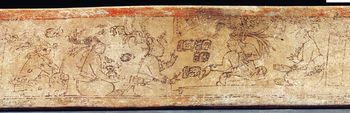
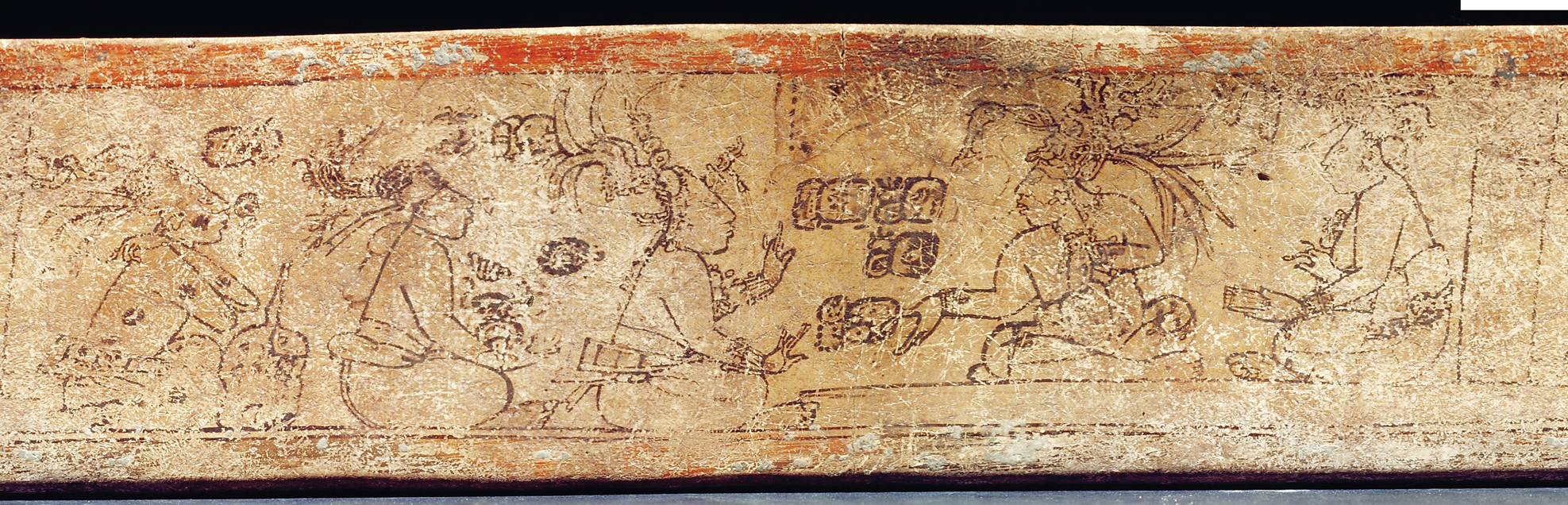
I examine these topics through the case study of the Classic Maya, who lived c. 250–900 ad in Mexico and Central America. After over a century of epigraphic investigations, our ways of reading and interpreting this script have grown more nuanced. In what follows, I take a next step in a contextualized interpretation of Maya hieroglyphic texts by looking at how the Classic Maya understood text and writing. I ask: how were texts perceived? How did people relate to them? What capabilities were texts understood to have? While we may not be able to answer these questions definitively, they provide productive entry points for engaging with textual evidence in different ways. The evidentiary sources I look at—depictions on painted ceramic vessels—are elite in their production and in the scenes they portray. In this study, these depictions serve as a starting point for a topic that will need to be plumbed more deeply and investigated more broadly. See Figure 1 for one such example, which shows a hieroglyph that is a part of the scene itself, and not bounded within a structured textual grid—the glyph that appears between the outstretched hands of the two individuals gesturing. Based on observations gleaned from the ways in which hieroglyphs themselves are shown, the ways people are shown interacting with them and the work that glyphs apparently accomplish, I argue that the Classic Maya understood texts to be real, relational and persistent. To be clear: these are not intended to be pragmatic assertions (that a book was real, or that an object adorned with a text was gifted to cement a relationship, for instance); rather, these are iconographically supported observations that suggest something about Classic Maya textual ideologies—how they conceptualized the meanings and capabilities of text.
Opportunities for understanding Maya textual ontologies through iconographic depictions: note the glyph that appears between the hands of the two central, gesturing individuals, separated from other textual elements shown. (Photograph: Justin Kerr, Justin Kerr Maya vase archive K512, Dumbarton Oaks, Trustees for Harvard University, Washington DC.)
Approaching texts
Maya hieroglyphic writing
Maya hieroglyphic writing is a logosyllabic script (that is, composed of a combination of phonetic syllables and word signs) that was used across the Maya lowlands during the Classic period and developed even earlier (Coe & Van Stone Reference Coe and Van Stone2005; Houston & Martin Reference Houston and Martin2016). It is found on a variety of media, ranging from large-scale carved stone monuments to painted murals to portable personal objects, as well as perishable objects such as bark-paper books that typically do not survive to the present day. Literacy—both textual production and consumption—was limited in extent (Houston Reference Houston, Boone and Mignolo1994; Houston & Stuart Reference Houston and Stuart1992). Texts have been interpreted as belonging primarily to the social and physical domains of royalty and their elite associates, who would have been the primary literate audience. Trained scribes recorded passages related to regal personal histories, important political events and religious observances; texts also frequently acted as labels, naming people and objects.
Maya hieroglyphic script is now considered well understood (Bassie-Sweet & Hopkins Reference Bassie-Sweet and Hopkins2019, 5–10), with recent studies engaging with discussion of nuanced textual topics like linguistic analysis (e.g. Law & Stuart Reference Law, Stuart, Aissen, England and Zavala Maldonado2017; Wichmann Reference Wichmann2006), studies of style and hand (e.g. Herring Reference Herring2005; Houston et al. Reference Houston, Fash and Stuart2015), genre (e.g. Lacadena García Gallo Reference Lacadena García Gallo, Gunsenheimer, Harada and Chuchiak2009; Wichmann & Nielsen Reference Wichmann, Nielsen, Magnussen and Christiansen2000) and textual agency (e.g. Englehardt Reference Englehardt and Englehardt2013), among others. Related to the queries driving this paper about how writing is understood and experienced in specific contexts, research on Maya writing has engaged with topics such as non-textual communicative qualities of glyphs (e.g. Stone & Zender Reference Stone and Zender2011), the role of monuments as active and vulnerable beings (e.g. Looper Reference Looper2003; O'Neil Reference O'Neil2012) and Maya understandings of various substances (including some glyphs) as manifesting in lively ways (e.g. Houston Reference Houston2014).
Refocusing: different ways of seeing texts
I start by acknowledging different ways of seeing and approaching texts (ancient or modern), thereby positioning my work within these multiple ways of seeing. A foundational approach to the study of written materials is textual or epigraphic: looking at the content of written materials in order to read words put down in the past and decipher what they say. This type of textual engagement is important for engaging with voices, narratives, discourses and perspectives; epigraphic approaches may also encompass decipherment, translation and linguistic usage.
Approaches to the written content of texts may be specifically contextual (Basso Reference Basso, Bauman and Sherzer1974), adopting a pragmatic or sociohistorical approach that takes into account the settings in which texts were created. Using this lens, textual studies can examine the cultural forces impacting the production and reception of texts, including authorship, bias, genre, etc. In Maya studies, earlier conversations highlighted concerns about hieroglyphic texts as ‘propaganda’ (created by Maya ruling elites, addressing a limited set of topics and used to advance specific agendas) (Fash Reference Fash1994; Marcus Reference Marcus1992). Underlying these concerns is a preoccupation with flaws in written evidence for which we cannot compensate: an impossibility of placing texts or reading against the grain. The field is now more optimistic about our ability to read texts meaningfully as products of particular times, people and places. A move towards more explicit contextualization has led to interest in Classic Maya scribes (e.g. Coe & Kerr Reference Coe and Kerr1998; Johnston Reference Johnston2001; Stuart Reference Stuart and Kerr1989a) and Classic-era literacy (e.g. Houston Reference Houston2000). More recently, new finds related to ancient Maya pedagogical spaces have added nuance to our understanding of Maya processes of textual learning and the production of specialized knowledge practices (e.g. Rossi Reference Rossi2017; Rossi et al. Reference Rossi, Saturno and Hurst2015). These inquiries represent a move to see texts as socially embedded, to examine positionality in terms of textual evidence and to view texts not only as inscribed, but as consumed in specific ways.
Other productive engagements with texts have focused on materialist readings of books, and texts more broadly, as objects (e.g. Stoler Reference Stoler2002; Van Mierlo Reference Van Mierlo2007; Walker Reference Walker2013), as part of the material turn in multiple disciplines. Investigations of the physical forms and material meanings of texts have been productively pursued in Maya contexts through increased attention to non-textual qualities such as size, material, location. Such studies indicate awareness of the experiential aspect of textual engagement and suggest a potential dynamism to texts. That is, their material manifestations can change over time, and they can be engaged with differentially, depending on the viewer or audience (e.g. Harrison-Buck Reference Harrison-Buck2012; O'Neil Reference O'Neil2010; Reference O'Neil, Boldrick, Brubaker and Clay2013).
Elements of all of these approaches are important: understanding the genre in which particular texts are created, considering the people who created and interacted with texts and positioning texts within specific, lived environments. This last work points towards an important next step: situating Maya texts within their specific ideological contexts (in Street's Reference Street1984 sense), in order to understand beliefs about what texts are and what they do.
The research I present here is not an epigraphic investigation. Nor is my focus on directly experienced physical forms of texts, though I do engage with texts as real and in-the-world. I intentionally refocus on texts in a way that does not singularly emphasize either content or material form (see Bender Reference Bender2010 and Houston Reference Houston2014, 102–23, for related inquiries). I take from epigraphic studies an interest in what the Maya represented as their perspective. From socio-historical approaches, I investigate how texts are meaningful as products of a specific time and place; and, from materialist engagements, I look at texts as entities in and of themselves, not just as vehicles for content. The point of focus that emerges amongst these topics is one that focuses on how people in a particular time and place perceived and experienced texts and how people understood texts as active and capable entities.
Examining representations of Maya text
To investigate the questions articulated above, I draw upon images from Classic period painted ceramic vessels that may facilitate examination of hieroglyphs as culturally situated representations. In order to find out more about how the Classic Maya understood text and writing, my investigations do not focus on reading or interpreting textual passages, in part because Maya texts do not directly address questions of beliefs about texts. Instead, I focus on glyphs that appear within scenes (outside the space of textual passages or captions), occupying a visual space that suggests the possibility of engagement with both textual content and iconographic conventions. My interest in engaging with texts as historical artifacts suggests that thinking carefully about how texts are represented could provide useful insight into how they were understood. In looking at a distinctive context of visual representation (glyphs that appear in scenes), this study fits amongst other work that looks at specific, differentiated types of Maya textual expressions (e.g. Berlo Reference Berlo and Berlo1983; Bíró Reference Bíró2011; Burdick Reference Burdick2016; Law et al. Reference Law, Houston, Carter, Zender and Stuart2013; Stuart Reference Stuart1989b, among many others), which has aimed in various ways to understand the functioning of Maya hieroglyphic texts in particular uses and contexts, though the present study posits broader questions about textual ontologies. This article does not involve a comparative, autoethnographic investigation into modern, Western understandings of scholarly texts; however, because my aim is not simply to illuminate difference, but also to think about methodological ramifications, there are implicit juxtapositions between how readers of the present article might typically understand texts and elements of how the Classic Maya might have done so.
I chose to begin this longer-term study with a focus on ceramic vessels, because my preliminary investigations on this topic suggested that Maya depictions of glyphs within scenes, the specific phenomenon I consider in this article, occur more frequently within the genre of painted ceramic vessels; future investigations should also include imagery on stone monuments, with attention to possible differences in how text is represented through these different media. My observations are qualitative and iconographically based, and are supported by references to internally consistent patterns, linkages to known cultural referents and contextual visual precedents; iconographic approaches must be grounded in these ways in order to be supportable. I suggest that it is critical that we recognize the valuable information that can structure visual representations; otherwise, we risk dismissing ancient expert depictions as meaningless or as not encoding nuance. The close intersection between text and iconography in ancient Maya contexts is useful here: as I will discuss below, we can look productively at both depiction and content (together, but also separately)—both registers are important.
For this study, I drew upon published images of painted ceramic vessels. Many of them come from a collection of images by Justin Kerr that is available online as part of the Maya Vase Database (Maya Vase Database n.d.); Kerr's rollout photographs represent a large number of pots from multiple parts of the Maya world, providing a selection of images from multiple artists and communities. Many of the vessels do not have clear proveniences or acquisition histories (these issues also introduce the possibility of later changes like repainting over time). While not ideal, these issues are not critical flaws for the queries investigated here, since the emphasis is on shared Maya understandings of writing, a prelude to more fine-grained investigations. A note about rollout photos: the photographic rendering of a three-dimensional pot into a rectangular image eases our ability to examine images in detail, but obscures the material nature of the ceramic vessel itself, departing from how the image was intended to be perceived (see Jackson Reference Jackson2009, 79–80) (see Figure 8, below, which allows us to remain engaged with the form of the pot).
The images I examine suggest some possible Classic Maya understandings of, and expectations about, writing. Before considering the specifics of Maya texts, I discuss some ideas about texts in a variety of settings that set the scene for moving towards new understandings of ancient texts. Specifically: we know that texts can be analytically invisible or hard to see. Texts are locally contextualized and understood, and are accompanied by beliefs and practices; and texts have capabilities—they are active, and can do things. (If we look back to Figure 1, there may be opportunities to investigate the textual understandings recorded in this image in a distinctive way when we adopt these frameworks.) These frames help us to refocus and shift our gaze, approaching texts differently, revisiting the questions we ask of them and reflecting on methodological consequences.
Textual frames
Texts can be invisible or hard to see
Above, I mentioned refocusing on texts. Continuing with this metaphor of sight, texts can be invisible or hard to see. This may seem counterintuitive, given current attention to materializations of texts; and yet there are many materials, including texts, that we look past or through every day. Brown (Reference Brown2001) has talked about the ways in which we routinely look past things, rendering objects transparent and at least temporarily erasing their physicality. He notes that moments of interruption allow us to ‘catch a glimpse’ of otherwise invisible objects; the example of dirty windows contrasts the moments of looking through versus looking at things around us (Brown Reference Brown2001, 4). Texts can operate analogously: read effortlessly, with realness evaporating in front of content; moments of disruption or stoppage (a torn page, a smudged and illegible line, a word we have to look up) change our rhythm and shift our awareness.
Research on bureaucratic processes and seemingly dull paperwork (e.g. Harper Reference Harper2009; Hull Reference Hull2012b; Riles Reference Riles2006) provide ethnographic examples of this invisibility of text, illustrating how we may become inattentive to things that fade into the background. Vismann (Reference Vismann2008, 11) frames invisibility of certain types of texts as a ‘blind spot,’ in which some texts—in her study, legal files—’remain below the perception threshold’. Notably, research on texts indicates that practices associated with texts can also be rendered invisible. Brenneis (Reference Brenneis and Riles2006, 43) discusses this with regard to National Science Foundation grant reviewing (and associated forms), which he characterizes as analytically invisible.
What are some of the reasons for this invisibility? Certain characteristics may facilitate us looking past or through texts. These include the sheer volume of certain bodies of texts, as in the case of reams of paperwork. Ubiquity may signal to viewers not to linger on specific documents. Function may render documents invisible: that which we perceive as prosaic or repetitive, whether in content, meaning, or origin, may disinvite deeper engagement (Bowker & Star Reference Bowker and Star1999). A lack of aesthetic differentiation may also be important, along with repetitious format or associated disengagement (e.g. forms or standardized narratives/documentation). These might thus be textual qualities to which we can be better attuned, in terms of correcting for our analytical blind spots. Brown (Reference Brown2001, 4) suggests that relationality is key to understanding this visibility/invisibility: ‘[t]he story of objects asserting themselves as things, then, is the story of a changed relation to the human subject’. ‘Invisible’ texts might be framed as arelational, existing in instances in which they are not elevated to the position of potential subjects.
The result of examining situations of textual invisibility, or under-visibility, is an increased awareness of what we do not typically see, and thus query. This can potentially yield a heightened sensitivity to the qualities that might mask texts and their work.
Writing is locally contextualized and understood
Refocusing on texts also involves a recognition that the impact or experience of writing is not the same in every place. Research on texts and literacy previously focused on shared, even universal, transformations associated with the use of writing (e.g. Olson Reference Olson1996; Ong Reference Ong2013). These discussions recognized the power of text as a tool or technology and noted many differing contexts in which such impacts could be seen. However, critiques of these ‘autonomous’ models emerged, based on their focus on the universally transformative impacts of literacy and their framing of these impacts as neutral. Instead, Street (Reference Street1984) argued for a locally defined ‘ideological model,’ which emphasized the culturally and socially specific ways that literacy was experienced. Proponents of this ‘New Literacy Studies’ (NLS) stressed the cultural embeddedness of texts (Street Reference Street1993): texts are experienced through associated practices and beliefs. Since then, these ideas have been further developed (e.g. Barton & Papen Reference Barton and Papen2010; Barton et al. Reference Barton, Hamilton and Ivanič2000; Baynham Reference Baynham1995; Boyarin Reference Boyarin1993), including in complementary archaeological discussions (e.g. Baines Reference Baines2007; Moreland Reference Moreland2001; Piquette & Whitehouse Reference Piquette and Whitehouse2013). The positioned nature of texts may be most immediately apparent in spaces of contested or conflictual narratives (e.g. see Wickwire Reference Wickwire1994, 18, for discussion of the impacts of differing ‘preoccupations and interests’ in the context of European versus native points of view in the Americas), but such positionality is about more than differing perspectives. In a larger sense, we might ask, as Barber (Reference Barber2007) articulates in introducing her study of African written culture, ‘What, then, does it mean to understand a text?’; Barber's response is to investigate texts vis à vis the ‘social relations, ideas and values in the cultures that produce them’ (Reference Barber2007, 2).
This local embeddedness of texts brings with it particular practices related to texts. These include: literacy (and its limitations to certain settings or identities); the production of writing; the teaching of reading/writing; and the ownership, gifting and exchange of texts. We also observe norms related to appropriate manners of reading or writing, and expectations related to the creation and consumption of writing. This idea of ‘expectations’ points towards beliefs about texts (see related discussions of language ideologies, e.g. Schieffelin et al. Reference Schieffelin, Woolard and Kroskrity1998; Silverstein Reference Silverstein, Mertz and Parmentier1985), equally important for local contextualization. I refer here to what we think happens when we read or write, and our understandings of processes of interaction with texts. These are hard topics to train our eyes on, and they raise the possibility of anachronism in our interpretation of reading and writing (Clanchy Reference Clanchy2012, 234). If I asked what you think happens when you get sucked into a good book, you might not have a ready answer. Where are you located when you read (are you entering the text? Is the text entering you?)? How is your relationship with a text negotiated? What happens to a text when you are not reading or writing it? These questions point towards the necessity of querying local understandings of how we perceive and experience ourselves as involved in relationships with texts. These understandings are ideologies, in the sense that they represent deeply held beliefs, and also represent practices, in that they dictate what we do in relation to texts.
For example, Bender's discussion of the Cherokee syllabary identifies local practices and ideologies associated with the syllabary, what it is doing, and how it impacts people (Bender Reference Bender2002, 11–16). These include the understandings that: literacy is not a steady state, but can appear and disappear (Bender Reference Bender2002, 91); handwriting has significance with regard to content (Reference Astor-Aguilera2002, 93); and the process of becoming literate in the Cherokee syllabary has a moral dimension, preferably involving a personal calling (Reference Astor-Aguilera2002, 96, 100). In discussing modern, Western legal files, Vismann (Reference Vismann2008, 10) talks about textual beliefs in terms of legal files taking on ontological properties, part of a set of beliefs about their characteristics and abilities. Wogan's (Reference Wogan2018) discussion of magical writing in Ecuador focuses on local beliefs about the process and influence of writing. There is great variety in what texts are like, in what they do, and in what it means to interact with them. In recognizing texts as locally understood, we bring to the fore the practices and ideologies within which they operate, and that make them intelligible to those who produce and consume them. This indicates a clear need for archaeologists to approach ancient textual sources with these questions in mind.
Texts have capabilities—they are active and do things
An important outgrowth of considering textual engagements is making interpretive space for texts to be active. This approach acknowledges that texts are not simply their content, or containers for content, but rather can accomplish work in their own right, an idea that has been long-acknowledged in different ways (e.g. Derrida Reference Derrida1983; Lévi-Strauss Reference Lévi-Strauss1992).
One broad set of textual capabilities might be framed as constitutive or constructive. This acknowledges texts as loci of ‘rules, ideologies, knowledge, practices, subjectivities, objects, outcomes, and even the organizations themselves’ (Hull Reference Hull2012a, 253), which make the imagining and functioning of particular contexts effectual. Hull (Reference Hull2012a) and others (e.g. Harper Reference Harper2009; Riles Reference Riles2006; Vismann Reference Vismann2008) make this argument for bureaucracies, but this is a broadly applicable type of textual work. This is seen, for instance, through emotionally charged letter-writing practices in Polynesia (Besnier Reference Besnier1995), or ‘tin trunk’ practices of preserving valued documents in Africa (Barber Reference Barber2007, 176). These are instances of texts acting as mediators (Irvine-Smith Reference Irvine-Smith2015) that make real particular social or structural contexts.
In other instances, texts may take action more directly by speaking out. The Greek concept of ekphrasis, in which words on the page become vivid and alive to the reader, provides one version of texts speaking, expressing energies that reside within the written word (Webb Reference Webb2016, 5); ancient Greek contexts also include examples of speaking objects that use direct address (e.g. the cup of Nestor, which states its identity as such, using the first person: Thomas Reference Thomas1992, 63). In modern-day Guatemala, Knowlton (Reference Knowlton2015) examines inscribed votive plaques that speak to supernaturals as part of ritual communications. Kilby (Reference Kilby2019, 266, 270, 272) argues that Tibetan epistolary styles and practices involve Buddhist conceptions of texts as bodies, which graphically bow in devotion; bodily elements like voice, gesture and physical presence are encoded in the written texts. The import of all of these instances lies both in the ability of texts to reach beyond their margins and instigate outcomes in the world and in the relational basis of these engagements.
An emphasis on the material form of texts allows us to see them more directly as tool-like, suggesting a stronger version of textual action. Recent explorations of texts as objects point to their presence in the world (e.g. Scollon & Scollon Reference Scollon and Scollon2003) and the importance of their forms. These may take the form of large and public texts (e.g. monuments as orientational technology in Mesoamerica and Mongolia: Jackson & Wright Reference Jackson and Wright2014), or of smaller and private ones (e.g. manuscript recipe books in early modern Ireland: Shanahan Reference Shanahan2014). These examples foreground the material form of texts in terms of the work they carry out. They also point towards a variety of types of meaningful engagement with texts and the ways in which the category of ‘text’ may at times de-emphasize written content.
In order to frame textual capabilities locally, we must recognize that textual action is context dependent and often contingent. This requires awareness of possible constraints on the capabilities of texts. We can interpret text acts (per Fraenkel's Reference Fraenkel, Barton and Papen2010 framing of writing-as-doing) as parallel to Austin's speech acts (Reference Austin1975). These concepts explicitly engage with the active nature of words or texts, while also focusing on the importance of local contexts for meaning making. Austin pays attention to placement in multiple senses (appropriate person, place, content), reminding us that positionality is important, and that the effectiveness or capability of text is not a steady state and is associated with particular requirements or triggers (see Barber's discussion of texts as attached to material things, such as locations in the landscape: Reference Barber2007, 212).
From the examples mentioned above, we see that textual outcomes may relate to the content, the material form, or both. The range of textual capabilities is most effectively seen when texts are considered holistically, as integrated entities.
Each of these frames makes explicit something that we know about texts that may help us in re-seeing archaeological texts and querying the characteristics that are important for understanding them. I turn next to how we can understand Classic Maya conceptions of texts.
Classic Maya understandings of texts
Texts are real
From an archaeological point of view, we know that in the ancient Maya world elite individuals interacted with texts in multiple forms and on multiple media. For instance, we can think of texts that were carved onto benches or painted onto ceramics, as well as textually labelled personal objects. In this sense, texts were real and had materialized forms, and were not hard to see (for modern investigators, or for ancient elites who had access to them). Invisibility or undervisibility plays a part here through the modern interpretation of texts that may render them only partially visible until they are more fully contextualized according to local understandings.
In the examples on painted ceramic vessels that I examine, we see text appearing as real in an additional way. Text that is depicted within scenes (and outside the structured grid of formal hieroglyphic passages) can be shown appearing apart from objects—that is, not adhering to the surface of a depicted object. These examples indicate that texts, the hieroglyphs themselves, appear to be real things. More specifically, we see that text seems to have presence and solidity. Images show us that glyphs seem to be concrete, they have weight and they take up space. In the experience of ancient Maya individuals, text, independent of objects or other material substrates, appear to have existed in the world, suggestions that indicate the importance of local contextualization of texts.
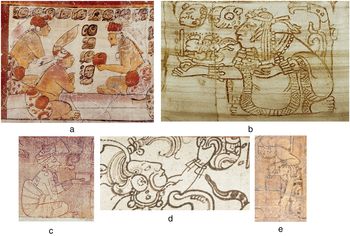
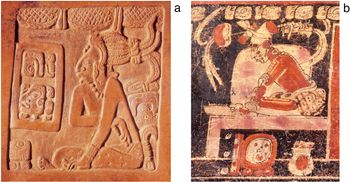
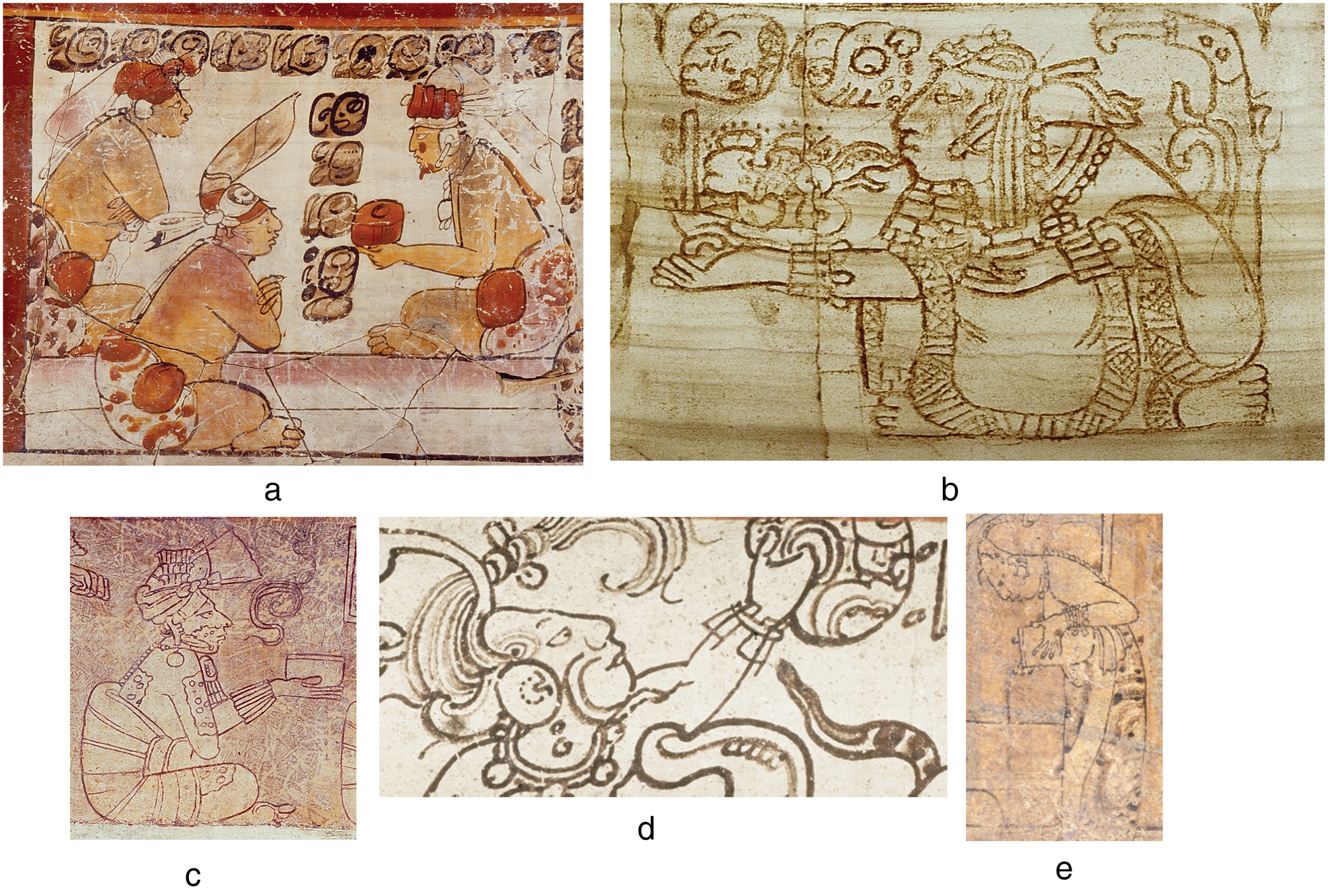
Visually, we see this realness of text manifested in examples in which glyphs can be picked up, held and moved (see related discussion of touch and experience in Maya art in O'Neil Reference O'Neil2019). Glyphs are shown as solid, with apparent similarities to material objects. If we look at K5450 (Fig. 2), for instance, a person is holding a reddish glyph with both hands at chest level, showing or offering it to two compatriots; note that this glyph is visually differentiated from the background text through colour and line weight. This glyph is small and apparently relatively light-weight, given the bodily engagement represented, but still takes up physical space and exhibits mass and realness. K4340 shows similar postures of holding glyphs, though without the social context and visual background seen in the other examples; these glyphs are lighter still—held with a single hand—suggesting that there might be meaningful differences in the heaviness of different textual elements. We can visually contextualize such representations through analogous postures in which people interact with solid objects (Fig. 2). This juxtaposition places the examples of glyphs being held within a set of materials that can be grasped with the hands and that have material shape and heft: they are shown as inviting physical engagement and exhibiting characteristics of physical realness in the world.
Glyphs are solid: (a) K5450 is lifted with two hands; (b) K4340 is lighter. Other examples (c) K732, (d) K521, (e) K511 show analogous interactions with solid objects such as ceramic vessels (c & e) and a defensive chert hand stone, here shown with an animated face (d). (Photographs: Justin Kerr, Justin Kerr Maya vase archive K5450, K4340, K732, K521, K511, Dumbarton Oaks, Trustees for Harvard University, Washington DC.)
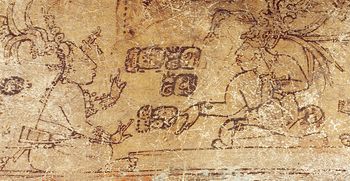
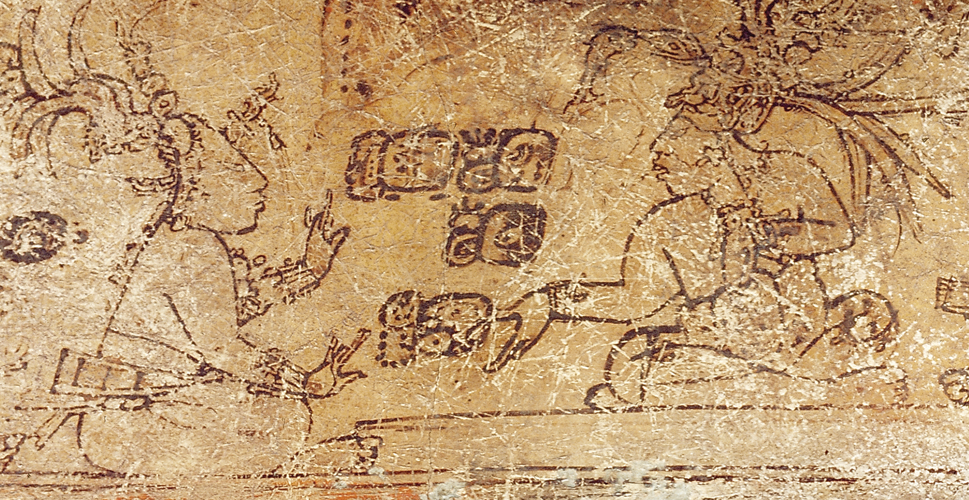
This suggestion of difference in relative weight is further underlined by examples in which texts float, apparently characterized by lightness. For instance, K512 shows an example of a glyph—reading ‘holiness’—that is being passed between the hands of two gesturing individuals (Fig. 3). The person on the raised dais is shown as nudging the glyph forward with an open hand. In contrast to the examples mentioned above, this glyph hovers between the two hands, untethered. However, the visual and haptic orientation towards it nonetheless suggests its realness in an embodied world. Differences in the relative weight of glyphs may relate to the specific meanings of the glyphs involved, contrasting the weighted reality of dates, for example (e.g. see visual examples from Stela D at Copán of glyphs for temporal periods being carried with effort using tumplines: Aveni Reference Aveni1989, 206; see also Stuart's discussion of the material linkage between units of time and physical stones: Reference Stuart1996, 149–51), with a less graspable concept of holiness. Juxtaposition of iconographic depictions of materials such as clouds versus poured liquids versus stones suggests that such qualities are routinely depicted and differentiated, whether among material objects or texts.
A lightweight glyph (K512), signifying holiness, passing between hands. (Photograph: Justin Kerr, Justin Kerr Maya vase archive K512, Dumbarton Oaks, Trustees for Harvard University, Washington DC.)
Examples of differential weight of glyphs indicate that there were characteristics—including physical ones—of texts apart from their content that would likely have been meaningful to ancient viewers, including to individuals who might not have been able to read content. Such an observation leads to a different type of visibility of texts to modern scholars—the potential to see a different set of characteristics. This concept of texts having observable or experiential qualities outside read content is also seen through recent work on Classic Maya glyphic ‘property qualifiers’, which convey information, for instance, on material categories to which glyphs and the materials they describe belong (Houston et al. Reference Houston, Brittenham, Mesick, Tokovinine and Warinner2009; Jackson Reference Jackson2017; Stone & Zender Reference Stone and Zender2011).
These examples suggest that the glyphs shown in such scenes had an existence and reality, one that offered the possibility of direct interaction between individuals and text. In understanding text as real and in-the-world, we see that it seems to have been concrete and visible, and not necessarily contained by written passages or textual objects. Text could take up space within lived contexts and may have been accessible to some individuals and groups in ways that might shift how we think about literacy, textual interaction and the impact of texts.
Texts are relational
The existence of glyphs in social spaces and the possibility of direct interaction point towards the need for contextualizing these glyphs socially; this relates to the premise raised earlier of querying textual capabilities. Here, I look at specific and embodied ways in which we see evidence of human–text interactions in these examples of texts-in-scenes. The idea that glyphs are not only real but also invite close interaction is immediately apparent in some full-figure glyph examples (Houston Reference Houston2014, 105–23), in which glyphs are draw in an expanded format that includes bodies and can hold textual elements within the formal grid of a hieroglyphic text. The scenes on painted ceramic vessels further flesh out some of the manners and meanings of people interacting closely with glyphs.
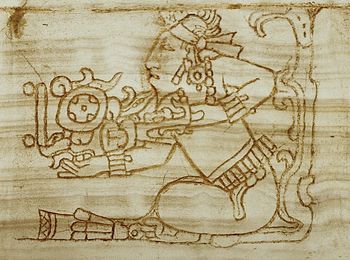
As evidenced in the previous section, we see examples of direct touch between people and glyphs. As a bodily sense, we know less about touch in Classic Maya terms in contrast with, for instance, their conceptions of sight (Houston et al. Reference Houston, Stuart and Taube2006, 134–79). Classic Maya descriptions of the material world suggest that touch or haptic sensing was often coupled with sight and sound to describe the world (see discussion in Jackson Reference Jackson2017 of emic material descriptors such as bright/shiny/wet, or windy/airy/breathy). This indicates that touch was recognized as one of several primary senses used in knowing and classifying the perceptual world. Additionally, we know that there was a correlation of tactility with relationality, in which touch indicated connectivity, with both positive and negative valences. Caressing or embracing, as we see in K4340 (Fig. 4), shows a distinctive two-hand/forearm-involved cradling gesture, used in Mesoamerican contexts for entities, akin to infants, that are ‘small, powerless, and in need of care’ (Hughes Reference Hughes2016, 55). This gesture has been argued to be a marker of the required caretaking that characterizes interaction with ‘beings’, whether human or non-human (Hughes Reference Hughes2016, 56–7). In contrast, touch with negative or even violent connotations (e.g. with the feet, or involving vertical hierarchical differentiation: Houston Reference Houston and Houston1998, 343–4) is part of marking oppositional relationships. People touching glyphs would have confirmed their realness, while also characterizing them as relational entities (see also Houston Reference Houston2014, 114).
A glyph held in a cradling gesture (K4340). (Photograph: Justin Kerr, Justin Kerr Maya vase archive K4340, Dumbarton Oaks, Trustees for Harvard University, Washington DC.)

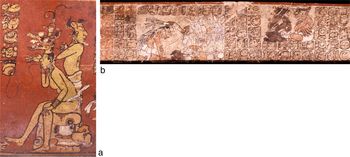
The relational role of glyphs is further suggested through patterned ways in which they are positioned within scenes: they often co-occupy benches and dedicated seating areas. This may seem prosaic, but it is important. Benches are commonly seen as central elements in scenes painted on ceramic vessels. Benches and seats are important both in Maya iconography and in architectural realities as a place of social intercourse, and of affirmation of identity (e.g. Gillespie Reference Gillespie, Joyce and Gillespie2000; Hendon Reference Hendon1991; Noble Reference Noble and Mock1998; Reference Noble1999). These all-purpose pieces of furniture provided gathering places for group interactions, while also including other social participants—in particular, the ancestors who were frequently buried within benches. Identity is also represented in organizational terms through benches via the official act of ‘seating’ that marked entry into political offices (Houston & Inomata Reference Houston and Inomata2009, 142). Thus, bench spaces were meaningful for the people who were arrayed on them, and it seems significant that we sometimes see glyphs ‘seated’ in this way, too. We see this, for instance, on K8270, which depicts an intimate architectural space, with a curtain framing an interaction between a human, gesturing formally, and a glyph (Fig. 5). Additional elements of glyphs’ participation in seating arrangements may be represented through their positioning in front of benches (e.g. K717), where they join other objects of tribute. Such an arrangement echoes the lines of ranked courtiers who may similarly be arranged at the foot of a bench, indicating formal and relative relationships to the seated authority figure. Through these spatial arrays, glyphs are potentially positioned as relational members of a social community.
(a) A private audience between a person and glyph (K8270); (b) a glyph positioned in front of a bench as a seated community member (K717). (Photographs: Justin Kerr, Justin Kerr Maya vase archive K8270, K717, Dumbarton Oaks, Trustees for Harvard University, Washington DC.)
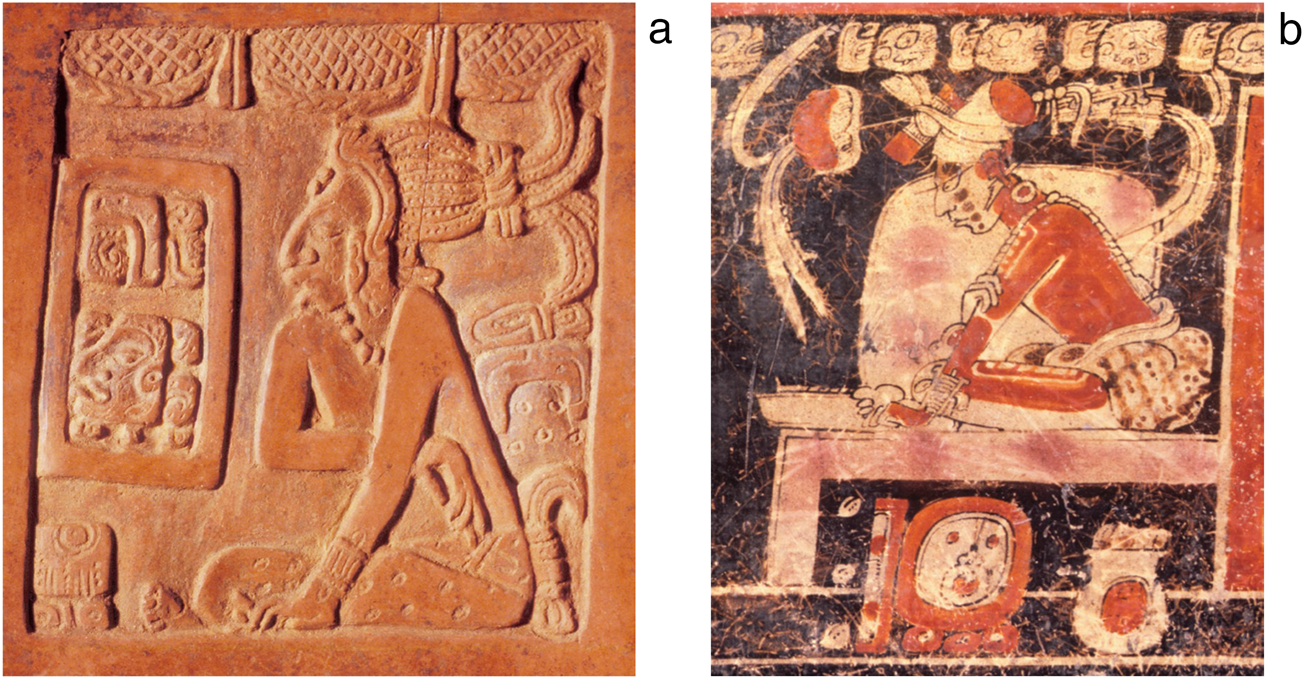
There is one other, somewhat different, way in which glyphs participate in social settings, showing themselves as integral (literally) to the definition and experience of relational interactions: these are instances in which depicted glyphs, whether singly or in groups, operate as elements of the built environment, acting as walls or sitting surfaces. For instance, people are shown sitting on single glyphs, such as we see on 7727, which indicates that the seats are made of stone (Fig. 6). In other instances (e.g. K1440), individuals sit on two rows of text in postures typical of individuals sitting on a bench. We see people's backs leaning against glyphs, in the same mode as if they were cushions at the back of a bench. This intersects intriguingly with archaeologically recognized instances, such as at Copán (e.g. Webster et al. Reference Webster, Fash, Baudez, Riese and Sanders1989), in which we see elaborate stone benches with texts carved onto them, but—in the iconographic depictions—without a visual record of the stone matrix of the seat. In imagery, glyphs and text can also act as elements of the built environment that serve to define space—for instance, columns of glyphs separate segments of an image as though they were walls and frame them as though ceilings. With these architectural glyphic examples, we see a substitution of text for elements of the built environment. By visually framing inhabited environments and supporting humans in social spaces, these texts provide the setting for community gatherings. This is significant because the relational elements of text are not only about acting person-ish and are not fully encompassed by simply extending the fold of personhood to contain writing as a social entity. Rather, text is also seen at times as creating senses of place that facilitate and undergird human (inter-)action in the world. In this way, clues related to textual capabilities according to a local framework can perhaps be identified.
Glyphs can be seats: (a) K7727; or (b) benches and ceilings (K1440) (located at the Museum of Fine Arts, Boston). (Photographs: Justin Kerr, Justin Kerr Maya vase archive K7727, K1440, Dumbarton Oaks, Trustees for Harvard University Washington, DC.)

Texts are persistent
The preceding two points—texts as real and as relational—underline their presence and abilities according to local conceptions. One final element—that texts are persistent—reflects an important additional quality of texts. In characterizing texts as persistent, I emphasize that they seem to take on a life of their own, both by being dynamic and through their tenaciousness. Again, in examining evidence that suggests this interpretation, I attempt to make visible qualities and capabilities that may have been part of ancient Maya understandings of text.
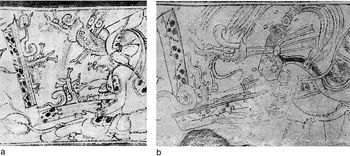
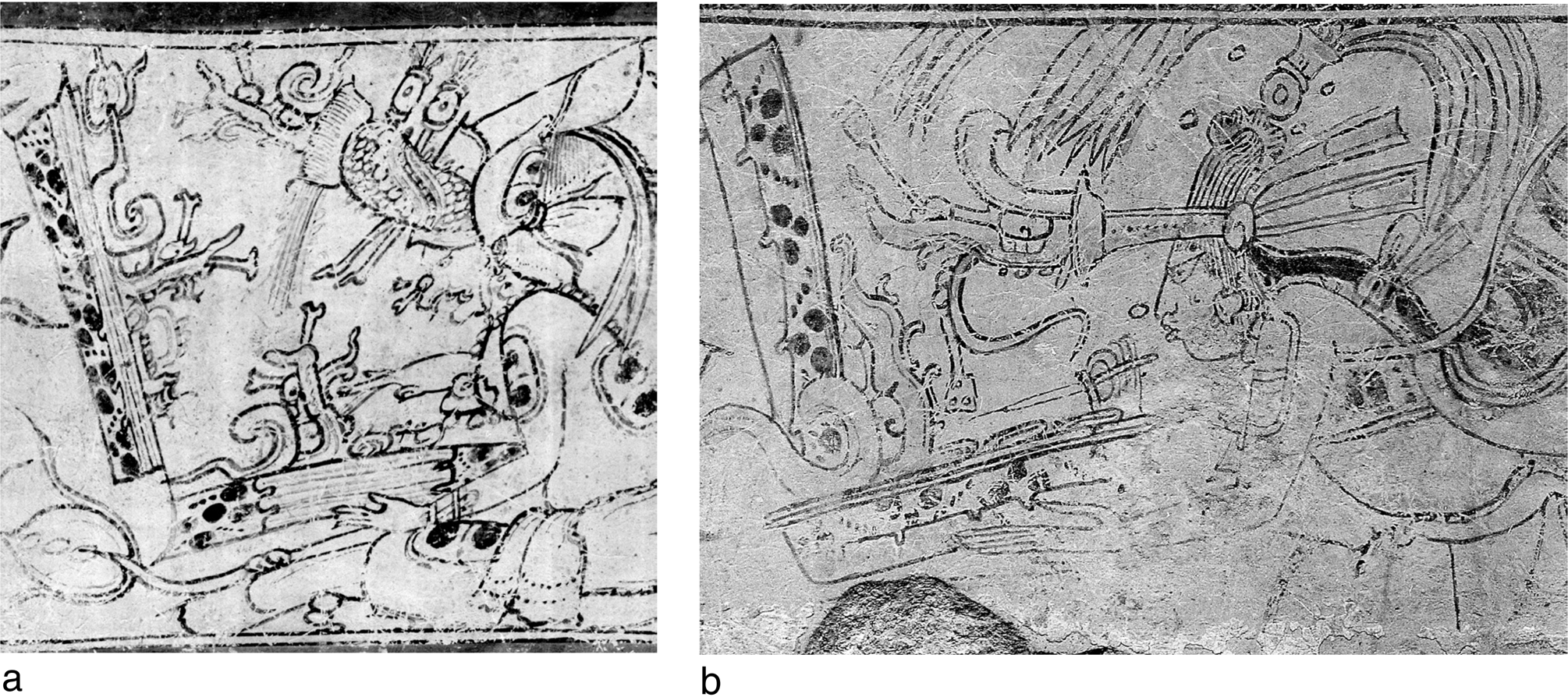
Glyphs’ roles as social actors and their participation in interactive activities point toward a certain dynamism. This suggests that texts, even if solid, might have been understood as potentially labile. Notably, in addition to evidence of engagement via tactile engagement, we also see examples of glyphs acting as interlocutors. These are instances in which hieroglyphs are shown as being engaged in conversation or interaction with individuals. Examples like K760 (Fig. 7) depict the emanation of text and image off the surface of a page. While we may not be surprised that text or writing is shown as ‘speaking’ to a reader, these depictions suggest a possible Maya understanding of such interactions: text is not static on the page. Taking this a step further, K1565, which shows individuals with stylus in hand involved in such an interaction (Fig. 7), suggests that text might have actively participated in its own creation. If these conversations were conceptualized as ongoing or iterative during subsequent readings of texts, perhaps content and meaning were understood as changeable over time, with the effect that texts might not have been framed as stable or tractable in the ways that we are accustomed to thinking.
Text emanates off the page: (a) K760; the spotted jaguar skin book is open, like the shape of a laptop, with animated faces marked by snouts, eyes and fanged mouths appearing on the surface of the pages to the reader. (b) Note individual with stylus in hand, suggesting co-creation of text (K1565). (Photographs: Justin Kerr, Justin Kerr Maya vase archive K760, K1565, Dumbarton Oaks, Trustees for Harvard University, Washington, DC.)
But it appears that the activeness of texts and writing was not a steady state—another element of textual persistence. Instances of apparent latency, in which there is no direct human interaction with text, are illustrated by the example noted above (K717) (see Fig. 5b), in which a glyph sits amongst objects, analogous to a valued tribute item. This is writing that is in a state of passive potentiality (see parallel discussions of potentiality as a state for non-human persons in other contexts: e.g. Harris & Robb Reference Harris and Robb2012, 670). Texts thus seem to have been capable of inhabiting different states, and could still exist as a materialized glyph, independent of direct interaction. The realness of text does not appear to require an activating engagement, unlike the argued contingency of ancient Maya ideas of personhood, which appears to rely heavily on relational engagements (Jackson Reference Jackson2019). This points towards the persistent nature of text, as conceptualized as a semi-independent entity in the world.
Persistence also manifests in terms of the tenaciousness of texts in accomplishing textual work even in contexts in which typical textual requirements might not be met. These include situations in which glyphs depart from typical grammatical/visual expectations, or contexts and situations in which texts operate apart from content.
In the preceding sections, I have focused on depictions in which glyphs appear directly in scenes. In those cases, glyphs depart from expectations about the expected formal or visual structure of a text by appearing within the scenes themselves. Other types of deviations show textual tenaciousness through defiance of grammatical expectations in terms of how glyphs ‘should’ combine together to make a text. These include instances in which glyphs appear as decontextualized, as seen in examples in which we see a date appearing alone (Fig. 5b). Other instances show deviation from grammatical rules through repetition of a particular glyph. Such examples have been discussed in the instance of the BATBATBAT pot (Tedlock Reference Tedlock, Hull and Carrasco2012), for instance, in terms of the graphic use of text (see related discussion in Carrasco Reference Carrasco and Englehardt2013). These instances show textual efficacy, in terms of communicative meaning, occurring even in non-standard situations in which glyphs lack expected structural or grammatical context.
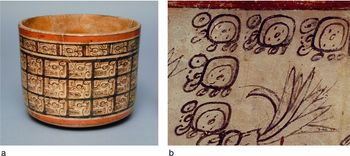
A particularly intriguing instance of textual tenaciousness relates to so-called pseudoglyphs, glyph-like written/artistic gestures that are not readable in terms of phonetic or logographic content (e.g. Calvin Reference Calvin2006; Houston Reference Houston2004; Reference Houston2018), representing another instance of glyphs departing from standard expectations and yet still appearing to be efficacious. Some examples of pseudoglyphs attempt to look like ‘real’ (that is, content-bearing) hieroglyphs, while others do not, either in their level of abstraction or through the repetition of a single glyph-like form (Fig. 8)—the latter operating in a parallel manner to the BAT text mentioned above.
Glyphs departing from standard expectations: (a) a ‘text’ that consists of a repeated glyph (bat) (located at the Los Angeles County Museum of Art) (Photograph: courtesy of www.lacma.org); (b) pseudoglyphs (K761). (Photograph: Justin Kerr, Justin Kerr Maya vase archive K761, Dumbarton Oaks, Trustees for Harvard University, Washington, DC.)

Whether realistically depicted or not, pseudoglyphs often appear as rim texts on ceramic vessels, a place where content-filled hieroglyphs are expected (Fig. 9): on many vessels, this is where we see a Primary Standard Sequence (PSS), a formulaic text that labels a vessel and its contents (Calvin Reference Calvin2006; Carrasco Reference Carrasco and Englehardt2013; Coe Reference Coe1973; Houston et al. Reference Houston, Stuart and Taube1989; Stuart Reference Stuart and Kerr1989a). Carrasco (Reference Carrasco and Englehardt2013, 148) suggests that the presence of pseudoglyphic PSS texts makes a vessel ‘formally correct’: that is, the ‘textual’ presence allows for correct belonging to a certain category, and the pseudoglyphs would have ‘added value’ (Reference Carrasco and Englehardt2013, 147) through their presence. Gestures of writing successfully take over the work of quite specific labelling—that which would normally occur with a PSS—even without the content. The value that Carrasco cites is further supported with contextual evidence: Calvin's research indicate that ceramic vessels painted with pseudoglyphs were not infrequently found in elite contexts (Calvin Reference Calvin2006, 223–4). This indicates that pseudoglyphs were meaningful and tenacious in efficacy, despite their lack of readable content (or, at times, formal correctness).
(a) A typical primary standard sequence (K4991) versus (b) a pseudoglyphic PSS (K3231). (Photographs: Justin Kerr, Justin Kerr Maya vase archive K4991, K3231, Dumbarton Oaks, Trustees for Harvard University, Washington, DC.)

We may stumble upon some of our own textual assumptions here: pseudoglyphic expressions have been variously framed implicitly or explicitly as devoid of meaning, illegible, created by individuals lacking formal knowledge, and even as evidence of decay; these characterizations suggest an emptiness to them, a fundamental lack. However, as has been previously argued, the examples above indicate that pseudoglyphs have value and are effective, appearing in contexts that matter (spatially—as gifts in burials—and textually, in place of standardized, content-filled text). There was value in the textual gesture, the ‘doing’ of texts. The idea of a Maya interest in writing-as-act is supported by examples in which text is hidden, obscured, or covered, and/or not intended to be read (e.g. buried or cached monuments, locationally inaccessible texts, dressed or wrapped seats and monuments, palimpsests). We can see pseudoglyphs as representing one part of textual practice, a recognized and worthwhile activity. This matters in a larger sense because it suggests that value and meaning resided in the engagement with textual acts (whether production or consumption), in addition to, but also apart from, content.
In this section, I use the characterization of texts as persistent in order to acknowledge their adaptability and dynamism, as well as their apparent strength and power. Peeling away some of our own assumptions about their nature (must they have content?) and capabilities (how contextually adaptable and changeable are they?) shifts the interpretive landscape in which we engage with texts and writing.
Methodological ramifications and impacts
There is inherent value in decentring some of our most central scholarly acts of reading and writing: I argue throughout this article that it is important t explore the ways that production and consumption of texts are locally understood, and are contextualized by specific ideologies that make meaning of human–text interactions. This shifts our perspective, and may make more visible elements of text on which we have not previously focused. Beyond this, reexamining texts through the framework of local understandings has methodological impacts, affecting how we understand texts as resources for understanding the past. This article offers a preliminary foray into how engagement with ancient textual evidence could be made more multi-vocal, thereby further strengthening existing approaches and adding additional interpretive complexity. Based on the ideas that have emerged in the discussion above, I suggest a few areas that we should think more about, in terms of our modern interaction with Maya texts as sources of evidence. These also represent starting places for scholars working in other textually influenced archaeologies, in terms of areas for deeper inquiry or directions of expansion in methodological thinking. These are topics that are often considered essential for engaging with textual evidence, and that may require us to adjust how we frame and address questions related to textual evidence.
Authorship and stability of text
Recall that we examined above the relational status of texts—that they are shown interacting with humans, but also that they appear not to be entirely dependent on, or entirely controlled by, humans. In thinking about authorship, this points towards a concept of co-construction of texts: the making of text occurring in a space between humans and writing itself. We might consider the possibilities of the interactions between person and text as not unidirectional.
Additionally, the apparent involvement of glyphs in broader social settings and their movement in and out of active engagement suggest that they might have been understood as authored or re-authored by multiple humans as part of ongoing engagement and relationships. Texts, and human relationships to text, would thus have been relationally made through recursive interaction. When we think of authorship, it might be inaccurate to think of it as a singular event, or as one involving a clearly defined author or authors, or even as resulting in a diachronically stable text in terms of perceived content or authorship. Text making may have occurred in different episodes, potentially separated by time, space and situation.
Might this mean, in practical terms, that subsequent readers were understood to take part in textual construction or revision? Did readings/relationships accumulate, or change, over time? While interpretive revision of text is an expected element of engagement in historical societies, here it may have been conceived as a more active, dynamic and co-participative process. As documentary sources, we may need to view hieroglyphic texts as co-created, as malleable over time, and representing multiple readings. In considering readings of, for instance, public monuments, this opens the possibility of a dynamic spatial-textual landscape, changing over time even without radical renovation of architectural spaces.
Literacy and accessibility
The topic of literacy is key for contextualizing Maya texts—who could read? Was the restricted skill of decipherment of complex hieroglyph texts an important limiting factor for how we (modern scholars) read texts? How should the rich textual evidence to which we have access be interpreted if it was the domain of only a limited elite? Past discussions of literacy have reminded us that this issue can be reframed from a simple binary to include interpretive engagement that takes advantage of the overlap between visual/iconographic representations and formal text in Maya contexts (Houston Reference Houston, Boone and Mignolo1994). The discussion of access to texts and the possession of literacy is impacted by the modes of textual interaction imagined here. Depictions of engagement with texts that hinge on touch, speech, or proximity all enlarge what meaningful textual interaction might have looked like.
Admittedly, the scenes I examined in which such interactions took place remain constrained by elite architecture and largely attended by elite populations. However, it is useful to return to the discussion of pseudoglyphs and other ‘non-standard’ textual expressions: recall that these examples pointed towards the efficaciousness of text without content. This idea further extends the types of meaningful connection possible with text and the ways in which these interactions might have taken place. That is to say, reading the content from glyphic texts would not have been the only way one meaningfully engaged with such texts. This suggests a widening of the segments of the population to whom textual resources would have been relevant. Physical access to texts remains key, but many texts were, in fact, publicly located and available for visual and tactile interaction.
At the heart of this is assumptions about what literacy means, whether one wants to define it narrowly or broadly, and a perceptiveness about other types of consequential engagement with texts beyond a specific definition of ‘reading’. If we shift some of these concepts, we also reframe (though do not erase) concerns about how text was used in the past, and differential relevance of texts for different segments of the population.
Ownership and control of texts
As mentioned, these discussions point towards a reexamination of modes of relating to texts beyond formal reading—interactions such as the touching of texts, or visually perceiving texts, for instance. If we consider the importance of textual interactions in experiential terms, there were likely notable meanings attached to the ability to own or possess textual objects. Given the suggested importance of relationality between humans and texts, possession of texts may have been seen as contingent, and possibly custodial. Textual interaction and ownership might have been a weighty responsibility.
We also then wonder, in a lived sense—how tractable were texts? We know that they could be transferred between people, and depictions suggest that they could potentially sustain themselves outside human interaction. This may shift how we interpret the presence of textual objects in archaeological contexts and widens the meanings associated with the presence of ‘elite markers’ such as texts in structures or at sites. That is, the presence of text would not merely have been a signal of high status or access to a limited resource. Rather, coexisting with texts (whether monumental or personal) might have implied enmeshment in relationships and perhaps responsibilities; whether at the level of the individual or the community, those who were equipped to host texts demonstrated their participation in networks of activity and meaning.
Texts that moved or changed—gifted, reset, destroyed (e.g. Harrison-Buck Reference Harrison-Buck, Iannone, Houk and Schwake2017; Houston et al. Reference Houston, Stuart and Taube2006; O'Neil Reference O'Neil, Boldrick, Brubaker and Clay2013)—further shed light on the social elements of texts and underscore their ability to operate amidst multiple temporal, spatial and human contexts. The presence of texts thus remains an important marker for understanding ancient social positioning, but perhaps in more complex and expansive ways than we may previously have articulated.
Concluding thoughts
This paper has aimed to suggest some possible shifts in our reading and interpretive use of archaeological texts through a contextualization that pays attention not only to placement and practice, but also to belief. As part of an invitation to refocus on the familiar idea of the written record, I suggest that making it newly visible allows us to interpret texts (understood as involving both content and form) in ways that recognize them as specifically contextualized. This has larger impacts in terms of potentially shifting how we read these texts as evidentiary sources, with locally meaningful ideas about capabilities, stability, accessibility and meaning in mind.
My case study of Classic Maya texts endeavours to shed light on questions about perceptions of texts as a conceptual category, human–text relationships and textual capabilities. This article represents an exploration of a new direction, one that—with further development—might prove fruitful as a complement to other approaches to textual evidence. The preliminary observations offered here, while no doubt a partial reality in terms of representing Classic period textual meaning making, point towards possible next chapters in hieroglyphic interpretation, in which deciphered texts might be framed in terms of the relational and constructive work they are doing with regard to content and also their material forms and placement—the latter being particularly important for meaningful synthesis of archaeological and textual data.
In a larger sense, this discussion points the way for future archaeological studies of ancient texts to develop understandings of textual ideologies, recognizing (or re-examining) the impact of texts through local framings. At the outset of the article, I suggested some things that we know about texts, from many different settings: that they can be surprisingly hard to see, even invisible at times; that they should be locally contextualized and understood; and that they have capabilities—they are active and do things. These assertions provided a starting point for this study, pointing towards why it might be useful to attempt to look in a new way at Maya hieroglyphic writing, using evidence related to local textual ontologies. These assertions might also provide directions for archaeologists working on other textual traditions, suggesting rationales for integrating long-standing epigraphic approaches with new modes of interpretation and for examining texts with locally relevant queries that may bring to light previously unseen details of textual meaning, value, or impact. Texts are constituted through processes and practices—’texting’ as an active process of making and engaging with the written, for both ancient and modern readers. Notably, relationality arises repeatedly in the discussions of this paper, pointing towards next steps of examining text-related beliefs and activities as part of larger current discussions of personhood. Ongoing investigations at a more fine-grained level will also need to investigate different experiences of texts, as informed by different identities, as well as beliefs about different genres of texts, coupled with more explicit attention to our own, modern beliefs about textual practices and experiences.
Acknowledgements
I have been thinking about the ideas in this article for a long time, which means I have been fortunate to benefit from many illuminating conversations along the way. Particularly helpful exchanges that advanced my thinking included: the University of Wisconsin-Madison's Borghesi Mellon Workshop on Reading and Writing Space: New Approaches to the Study of Epigraphic Landscapes (with sincere thanks to Alice Mandell for the invitation); a 2015 SAA session on infrastructure (with appreciation to Darryl Wilkinson for the invitation to be part of that group); and a stimulating 2019 SAA session co-organized with Uzma Rizvi on crafting and subjectivity. Additional thoughts and feedback that clarified my thinking came from valued friends, kind colleagues and generous fellow scholars, including Ilana Gershon, Kathryn Gutzwiller, Christie Kilby, Stacy Pigg and members of the Center for Textile and Conflict Studies, Stephanie Sadre-Orafai and Joshua Wright. Christina Hahn and Colleen O'Brien helped track down sources as indefatigable research assistants. Two anonymous reviewers and CAJ editor John Robb provided constructive critiques and perceptive guidance on strengthening this article, which I greatly appreciate. Thanks go to Dumbarton Oaks and LACMA for sharing images for the figures in this article. As ever, heartfelt thanks go to Justin Kerr for making his images so freely available.