Introduction
Echinostoma caproni (Trematoda: Echinostomatidae) is an intestinal trematode that does not undergo tissue migration in its definitive host. Following infection of the definitive host with E. caproni, the metacercariae excyst in the duodenum and the juvenile parasites migrate to the ileum where they attach to the mucosa by their ventral sucker (Fried & Huffman, Reference Fried and Huffman1996; Toledo et al., Reference Toledo, Esteban and Fried2009). Echinostoma caproni has been used as an experimental model to study the factors determining the rejection of intestinal helminths (Toledo and Fried, Reference Toledo and Fried2005). This parasite has a broad spectrum of definitive laboratory hosts, although its compatibility may vary depending on the host species (Toledo et al., Reference Toledo, Esteban and Fried2009). In highly compatible hosts, such as mice, the infection is characterized by the development of T-helper 1 (Th1)-type local immune responses with elevated levels of local interferon-gamma (IFN-γ). In contrast, in rats, which are hosts with low compatibility, the early rejection of the worms is mediated by the expansion of the local Th2 lineage, concomitantly with Th17 lineage, at the expense of the Th1 response (Sotillo et al., Reference Sotillo, Trelis, Cortes, Fried, Marcilla, Esteban and Toledo2011; Trelis et al., Reference Trelis, Sotillo, Monteagudo, Fried, Marcilla, Esteban and Toledo2011). Due to these characteristics, the E. caproni–rodent model provides suitable systems to study the factors determining the early rejection of the intestinal helminths or, in contrast, the establishment of chronic infections.
An interesting aspect of infections in hosts of high compatibility is that, despite the generation of intense immune responses to the primary infections, they become chronic and the adult worms are able to evade these immune mechanisms. Although the primary response to E. caproni infections is well documented, little is known about the responses in homologous secondary infections and about its effects on trickle infections. Recent studies have shown that the effect of primary and secondary responses to intestinal helminths may be different, since the target of each response is different. Host protective mechanisms during primary infections operate against adult worms, whereas in secondary infections larval stages are the targets of the responses (Harris, Reference Harris2011). In this context, studies on the host–parasite interactions in secondary infections are of interest for the development of control tools against intestinal helminths (Harris, Reference Harris2011). In the present work, we analyse the effect of primary infections with E. caproni on the development of resistance against homologous challenge infections in ICR mice, to show that the E. caproni/ICR mouse system can be used as an experimental model for studying acquired resistance against helminths.
Materials and methods
Experimental design
The strain of E. caproni used here has been described previously by Fujino & Fried (Reference Fujino and Fried1993). Encysted metacercariae of E. caproni were removed from the kidney and pericardial cavity of experimentally infected Biomphalaria glabrata snails and used to infect male ICR mice. A total of 60 ICR mice, weighing 30–35 g, were haphazardly allocated to two groups (A and B) of 30 mice each.
Group A mice were used to evaluate the resistance to homologous challenge infections after termination of primary infections. To this purpose, group A mice were each infected with 50 metacercariae of E. caproni as described previously (Muñoz-Antoli et al., Reference Muñoz-Antoli, Sotillo, Monteagudo, Fried, Marcilla and Toledo2007). Positivity of the infection was determined by detection of eggs in stools, as described previously (Toledo et al., Reference Toledo, Espert, Carpena, Muñoz-Antoli, Fried and Esteban2004). At 2 weeks post-primary infection (wppi), group A mice were treated with 100 mg/kg of praziquantel, as described by Keiser et al. (Reference Keiser, Brun, Fried and Utzinger2006). All mice responded to the treatment and reverted to negative, as determined by coprological examination. Two weeks after treatment, group A mice were challenged with 50 metacercariae each, following the same procedure as used in primary infections.
Group B mice were used as praziquantel-treated controls. At 2 wppi of the group A mice, group B mice were treated with praziquantel as described above. At 2 weeks after treatment, group B mice were each infected with 50 metacercariae, following the same procedure as described above. Experimental animals were managed and housed in the Animal House of SCSIE-University of Valencia.
Rates of infection and worm recovery
To compare the rate of infection and worm recovery in primary and challenge infections with E. caproni, at 2 and 4 weeks post-challenge infection (wpci) 15 mice of the group A were necropsied and the worms recovered per host were recorded. In the same manner, at 2 and 4 weeks post-infection, 15 mice of the group B were necropsied and the worm recovery was recorded.
Morphological analysis
To evaluate the effect of a primary infection on the morphology of adult worms from a secondary infection with E. caproni, several morphometric features were compared between worms collected in challenged (group A) and primary infected mice (group B). Twenty of the adults collected each week from mice of the groups A and B were fixed in Bouin's fluid under coverslip pressure, stained with Grenacher's borax carmine and mounted in Canada balsam. The following metric features were subjected to analysis: body area (BA), ventral sucker area (VSA), ovarian area (OVA), anterior testis area (ATA) and posterior testis area (PTA). These metric values were selected since previous studies have shown that they are the most sensitive to the host environment in E. caproni infections (Toledo et al., Reference Toledo, Espert, Carpena, Muñoz-Antoli, Fried and Esteban2004; Muñoz-Antoli et al., Reference Muñoz-Antoli, Sotillo, Monteagudo, Fried, Marcilla and Toledo2007).
Data analysis
The χ2 test was used to compare the rates of infection between both groups of mice at each week post infection. To compare the worm recovery and the morphology of worms between primary and challenge infections, a Student's t-test was used at each week post infection. P < 0.05 was considered as significant. Prior to analysis, data were log transformed to achieve normality.
Results and discussion
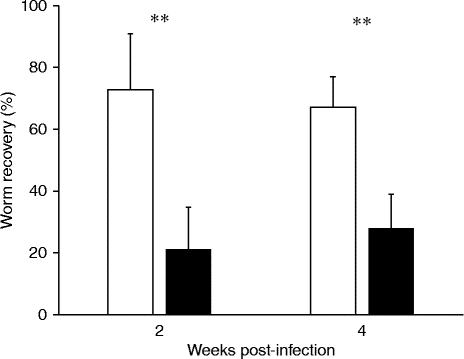
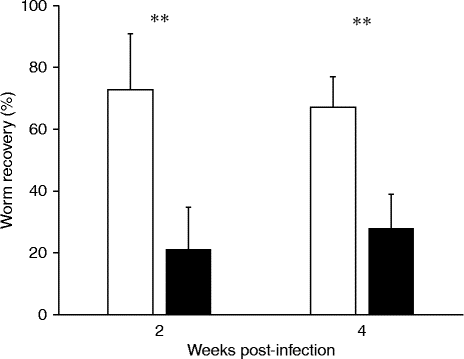
The results obtained in the present study show that ICR mice develop a partial resistance against homologous challenge infection with E. caproni. This resistance is expressed in rate of infection, worm recovery and the growth of adult worms. All the control mice experimentally exposed to 50 metacercariae of E. caproni became infected and were positive at both 2 and 4 wppi. In contrast, we found that only 60 and 67% of the challenged animals were positive to infection at 2 and 4 wpci, respectively. Application of the χ2 test showed that the rates of infection were significantly higher in control mice at each week post infection (P < 0.001). Moreover, worm recovery was significantly higher in control animals than that in challenged mice (fig. 1). Worm recovery in control animals at 2 and 4 wppi is reflected in fig. 1 (expressed as a percentage). At 2 wppi, the number of worms collected per mouse ranged from 23 to 48 (36.3 ± 12.1) (73% of worm recovery), whereas at 4 wppi it ranged from 22 to 50 (33.0 ± 10.1) (67% of worm recovery). These values of worm recovery are similar to those described previously for primary E. caproni infections in non-treated animals (Muñoz-Antoli et al., Reference Muñoz-Antoli, Sotillo, Monteagudo, Fried, Marcilla and Toledo2007). Although all the challenged animals became infected, the number of worms collected in this group was markedly lower. At 2 wpci, the number of worms collected per mouse ranged from 0 to 40 (10.5 ± 8.9) (21% of worm recovery), which represents a reduction of 72% with respect to 2 wppi. At 4 wpci, the number of worms collected ranged from 0 to 31 (12.1 ± 7.8) (28% of worm recovery), with a reduction of 73% in relation to the worm recovery at 4 wppi. Application of the Student's t-test to the worm recovery at each time post infection showed that the values of worm recovery were significantly lower in the challenged animals than in praziquantel-treated control animals at both 2 and 4 weeks after infection (P < 0.001).
Adult worm recovery (%) of Echinostoma caproni in primary infections (white bars) and challenge infections (black bars) in ICR mice up to 4 weeks post infection (pi); vertical bars represent standard deviation; ** level of significance with P< 0.001.
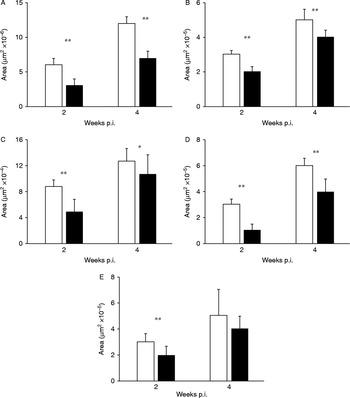
Apart from worm recovery, the overall appearance and the growth of adult worms were also different in control and challenged mice. The adult worms collected in control mice were white-yellowish and similar to those described previously in ICR mice (Muñoz-Antoli et al., Reference Muñoz-Antoli, Sotillo, Monteagudo, Fried, Marcilla and Toledo2007). In contrast, the worms collected from challenged animals were whitish and almost transparent both at 2 and 4 wpci and they were markedly smaller than in control animals. To compare the morphology of the worms from primary and secondary infections, we analysed a total of five parameters that were considered as the most affected by the host environment in E. caproni infections (Toledo et al., Reference Toledo, Espert, Carpena, Muñoz-Antoli, Fried and Esteban2004). The results show a greater growth in the adults from primary infections than those from challenge infections. Means and their standard deviations for each metric variable of E. caproni adult worms collected in primary and secondary infections are shown in fig. 2. Values of four of the metric variables analysed (BA, VSA, OVA and ATA) were significantly higher in the adult worms collected from control animals than those collected from challenged animals for both 2 and 4 weeks post infection. In the remaining variable (PTA), values observed at 2 weeks post infection were also significantly higher in primary infections than in secondary infections. At 4 weeks post infection, values were higher in primary infections but without statistical significance (P= 0.056)
Morphological analysis of adult worms of Echinostoma caproni to show differences in the mean values of the areas of/around the (A) body (BA); (B) ventral sucker (VSA); (C) ovary (OVA); (D) anterior testis (ATA); and (E) posterior testis (PTA) in primary and control treated (white bars) and challenge infections (black bars) in ICR mice up to 4 weeks post infection (pi); vertical bars represent standard deviation; level of significance with *, P < 0.05; and **, P < 0.001.

In the present study, we have demonstrated that E. caproni primary infection induces partial resistance against subsequent homologous infections in ICR mice. Resistance was expressed by reduced rate of infection, worm recovery and worm size, suggesting that primary infection induces changes in the host, making a hostile environment for the development of the parasite. Both at 2 and 4 wpci, the rate of infection and worm recovery in challenged mice were significantly lower than those values observed in control animals (40 and 33% reduction in the rate of infection and 72 and 73% reduction in worm recovery for 2 and 4 wpci, respectively). Regarding the morphometrical analysis, almost all the parameters studied were significantly lower than in control animals at each wpci. Furthermore, the appearance of worms collected from challenged mice was different than those from control mice. In challenge infections the worms were whitish and almost transparent, whereas those from control animals were white-yellowish. This protection is not likely to arise from residual praziquantel since all the parameters analysed were comparable to those previously described in primary E. caproni infections in ICR mice, indicating that the drug had been eliminated.
Previous studies on this topic of echinostome infections showed that primary infections with E. caproni were able to generate resistance against challenge infections in mice, although the degree of resistance seems to be dependent on the strain of mice (Christensen et al., Reference Christensen, Odaibo and Simonsen1988). In NMRI and SVS mice, complete or almost complete resistance (85–100%) to homologous challenge infections with E. caproni is generated and persists for up to at least 12–14 weeks after the expulsion of the primary infection (Sirag et al., Reference Sirag, Christensen, Frandsen, Monrad and Nansen1980; Christensen et al., Reference Christensen, Knudsen and Andreassen1986; Odaibo et al., Reference Odaibo, Christensen and Ukoli1989). In contrast, ICR mice only developed a limited resistance to reinfection with E. caproni (named as E. liei by the authors) (Hosier et al., Reference Hosier, Fried and Szewczak1988). In our study, we have shown that primary infection in ICR mice induces a partial resistance against challenge E. caproni infections expressed as a significant reduction of worm recovery, but also affecting the development of adult worms.
Little is known about the mechanisms involved in the resistance to homologous challenge E. caproni infections. Christensen et al. (Reference Christensen, Knudsen and Andreassen1986) showed that congenitally thymus-deficient nude mice did not develop resistance, suggesting that specific T-cell-dependent mechanisms were responsible. Inflammatory response was not considered to be implicated in the resistance (Christensen et al., Reference Christensen, Knudsen and Andreassen1986). Studies on heterologous resistance to E. caproni infections induced by primary infections with nematodes have shed some light on this issue. Fujino et al. (Reference Fujino, Yamada, Ichikawa, Fried, Arizono and Tada1996) demonstrated that primary infection with Nippostrongylus braziliensis in C3H/HeN mice induced a rapid expulsion of either E. trivolvis or E. caproni. Increased secretion of mucus by hyperplasic goblet cells associated with N. braziliensis primary infection was suggested to be responsible for earlier expulsion. Recently, Trelis et al. (Reference Trelis, Cortes, Fried, Marcilla, Esteban and Toledo2013) showed that infection with Syphacia muris in rats induced resistance against a subsequent infection with E. caproni, although each parasite occupies different niches in the host. Primary infection with S. muris induced the development of a biased Th17/Th2 phenotype in the ileum of rats, which is associated with the expulsion of E. caproni primary infections (Sotillo et al., Reference Sotillo, Trelis, Cortes, Fried, Marcilla, Esteban and Toledo2011; Trelis et al., Reference Trelis, Sotillo, Monteagudo, Fried, Marcilla, Esteban and Toledo2011). In the experiments we report here, E. caproni primary infection was allowed to persist for 4 weeks before clearance prior to reinfection. This period is sufficient for the worms to mature sexually and for the host to develop the immune responses to E. caproni (Muñoz-Antoli et al., Reference Muñoz-Antoli, Sotillo, Monteagudo, Fried, Marcilla and Toledo2007; Sotillo et al., Reference Sotillo, Muñoz-Antoli, Marcilla, Fried, Esteban and Toledo2007; Trelis et al., Reference Trelis, Sotillo, Monteagudo, Fried, Marcilla, Esteban and Toledo2011). Furthermore, reinfection was performed at 6 weeks from the primary infection when the immune mechanisms initiated by the primary infection persist. It is well documented that primary infection with E. caproni in ICR mice induces local Th1 responses with elevated levels of IFN-γ, which are detectable from 2 wppi and persist for up to at least 8 wppi (Trelis et al., Reference Trelis, Sotillo, Monteagudo, Fried, Marcilla, Esteban and Toledo2011). Moreover, increased levels of mucosal IgA, IgM and IgG can be detected as early as 2 wppi for IgA and 6–8 wppi for IgG and IgM. The antibody levels remain high until at least 12 wppi (Sotillo et al., 2007).
In spite of these strong responses, ICR mice are not able to expel E. caproni primary infection and the infection may last for up to 23 wppi (Fried & Peoples, Reference Fried and Peoples2007). This raises the question whether the effective mechanisms to eliminate primary infections are the same as those responsible for the resistance to secondary infections. In this sense it should be considered that host protective mechanisms during primary infection operate against adult worms, whereas in helminth reinfections the responses are targeted against tissue-invasive stages, in our case metacercariae or juvenile worms. For example, a central role for antibodies in providing protective immunity has been identified recently in secondary infections with Heligmosomoides polygyrus (McCoy et al., Reference McCoy, Stoel, Stettler, Merky, Fink, Senn, Schaer, Massacand, Odermatt, Oettgen, Zinkernagel, Bos, Hengartner, Macpherson and Harris2008; Wojciechowski et al., Reference Wojciechowski, Harris, Sprague, Mousseau, Makris, Kusser, Honjo, Mohrs, Mohrs, Randall and Lund2009; Liu et al., Reference Liu, Kreider, Bowdridge, Liu, Song, Gaydo, Urban and Gause2010). Response to primary infection is essential for the generation of specific antibody responses that do not eliminate this infection. In subsequent infections, the development of sexually mature worms was prevented and the parasites were quickly rejected (Morimoto et al., Reference Morimoto, Morimoto, Whitmire, Xiao, Anthony, Mirakami, Star, Urban and Gause2004). The protective immunity was entirely dependent on the antibodies, mainly IgA and IgG1, which arose from the primary H. polygyrus infections. Antibodies affected early larval worm migration and development during the tissue-dwelling phase (McCoy et al., Reference McCoy, Stoel, Stettler, Merky, Fink, Senn, Schaer, Massacand, Odermatt, Oettgen, Zinkernagel, Bos, Hengartner, Macpherson and Harris2008; Liu et al., Reference Liu, Kreider, Bowdridge, Liu, Song, Gaydo, Urban and Gause2010). In the present study we cannot evaluate the role of the immune mechanisms activated by the primary infection in the partial resistance to secondary E. caproni, although the results do indicate that primary infections alter the ileum microenvironment and convert it to an aggressive milieu for the development of E. caproni. Further studies, currently in progress, may serve to elucidate the alterations induced by the primary infection and provide a better understanding of the mechanisms of resistance acting in secondary helminth infections.
In conclusion, the present work has shown that ICR mice develop homologous partial immunity following experimental infection with E. caproni. This immunity significantly affects the subsequent rate of infection and worm recovery, and the development of the adult worms is markedly affected in challenged mice. The results presented herein indicate that the system E. caproni/ICR mice may be an excellent model for the study of mechanisms generating resistance against intestinal helminths.
Financial support
This work was supported by the projects: PROMETEO2014-083 Fase II from Conselleria d'Educació, Generalitat Valenciana (Valencia, Spain); BFU2013-41 040-P from the Ministerio de Economía y Competitividad (Madrid, Spain); and RD12/0018/0013, Red de Investigación Cooperativa en Enfermedades Tropicales-RICET, IV National Program of I+D+I 2008-2011, ISCIII-Subdirección General de Redes y Centros de Investigación Cooperativa and FEDER, Ministerio de Salud y Consumo (Madrid, Spain).
Conflict of interest
None.
Ethical standards
This research has been reviewed by an appropriate ethics committee and complies with the current laws for animal health research in Spain.