





Introduction
Infants with single-ventricle physiology represent a medically fragile population requiring staged surgical palliation early in life. This palliation typically consists of three operations: the Norwood procedure in the neonatal period, followed by the bidirectional Glenn procedure in early infancy, and ultimately the Fontan procedure in early childhood. Reference Ohye, Schranz and D’Udekem1–Reference Baker-Smith, Goldberg and Rosenthal3 Advances in surgical procedures have significantly improved survival rates, with many patients now living into adulthood; however, children with single-ventricle physiology often present with impaired neurodevelopment. Reference Ohye, Schranz and D’Udekem1,Reference Ravishankar, Zak and Williams4,Reference Sood, Newburger and Anixt5
Beyond internal factors, these neurodevelopmental delays may be influenced by the surgical procedures themselves. Access for the staged procedures is typically performed through a median sternotomy, and paediatric sternal precautions are often implemented to reduce complications such as infection, dehiscence, and poor sternal healing. Reference Ohye, Schranz and D’Udekem1–Reference Baker-Smith, Goldberg and Rosenthal3,Reference Yin, Yan, Li, Li, Wang and Wang6–Reference Gal, Cleveland and Kipps9 In addition to surgery recovery time, prolonged hospitalisation and medical instability may reduce the number of opportunities for routine infant positioning during a critical period of development, potentially contributing to delayed motor skill acquisition. Reference Ravishankar, Zak and Williams4–Reference Yin, Yan, Li, Li, Wang and Wang6,Reference Uzark, Smith, Donohue, Yu and Romano10
Prone positioning, often referred to as “tummy time,” has cardiopulmonary benefits and is an important part of early motor development. Reference Clifton, Cruz, Patel, Cahalin and Moore8,Reference Hewitt, Kerr, Stanley and Okely11–Reference Huang, Su, Du, Liu, Su and Lin13 Prior research has shown that infants younger than 6 months old who had routine prone positioning demonstrated higher locomotion scores than those who were rarely placed in prone. Reference Hewitt, Kerr, Stanley and Okely11 Additional studies have similarly reported that infants with more frequent prone positioning achieved developmental milestones such as rolling, creeping, sitting, and standing earlier than infants with less exposure to prone play. Reference Hewitt, Kerr, Stanley and Okely11,Reference Uzark, Smith and Yu12 Conversely, infrequent prone positioning has been associated with reduced trunk extension, limited active trunk rotation, asymmetries in motor development, and flexor/extensor motor control imbalance. Reference Hewitt, Kerr, Stanley and Okely11,Reference Uzark, Smith and Yu12 Physical therapists play an important role in promoting prone positioning and neurodevelopment post-cardiac repair. Reference Haseba, Sakakima and Nakao14
Despite the recognised developmental benefits of prone positioning, current clinical practice regarding paediatric sternal precautions and prone positioning restrictions remains highly variable and is frequently guided by institutional preference rather than evidence or clinical decision-making. Reference Uher, Nguyen and Monge7,Reference Clifton, Cruz, Patel, Cahalin and Moore8 Prior survey-based research has demonstrated significant inconsistency in both the duration and implementation of prone positioning restrictions following infant cardiac surgery, highlighting the lack of standardised, evidence-based guidelines. Reference Clifton, Cruz, Patel, Cahalin and Moore8
Given the importance of prone positioning for developmental outcomes and the absence of clear clinical guidance, there is a need to better understand real-world practice patterns and associated outcomes. Therefore, the purpose of this retrospective study was to examine the timing, clinical determinants, and safety of prone positioning in infants following cardiac surgery via median sternotomy using an algorithm-based approach.
Materials and methods
Study design
A retrospective cohort study was conducted at a single paediatric cardiac centre accessing records between 2022 and 2025 to examine the timing, clinical considerations, and safety of prone positioning in infants with single-ventricle physiology following cardiac surgery via median sternotomy.
Participants
Infants (birth to 12 months) were eligible for inclusion if they underwent cardiac surgery requiring median sternotomy and received a post-operative physical therapy evaluation during hospitalisation. To improve cohort homogeneity and minimise variability in post-operative physiology and recovery trajectories, only infants undergoing Norwood and Glenn procedures for single-ventricle physiology were included. Patients were excluded if they were not placed in prone positioning prior to discharge. Given the staged nature of surgical palliation in this population, multiple surgical encounters for a single patient were included and analysed as independent events when separate post-operative rehabilitation courses were documented.
Data collection
Data were extracted from electronic medical records and physical therapy documentation. Collected variables included demographic information (age at surgery and sex) and clinical characteristics (cardiac diagnosis and surgical procedures). Rehabilitation-related variables included time from surgery to initial physical therapy evaluation and time to initiation of prone positioning. Clinical factors influencing the timing of prone positioning were also recorded, including the presence of invasive lines and devices, medical instability, and surgical factors such as delayed sternal closure or need for re-exploration. A summary of factors contributing to delayed or modified prone positioning is provided in Supplemental Table S1. Outcome variables included sternal healing status at discharge follow-up and any adverse events associated with prone positioning.
Data definition
Prone positioning initiation was defined as the first documented instance of therapeutic or developmental prone positioning following surgery. Delayed prone positioning was defined as postponement due to clinical factors, including instability, surgical considerations, or the presence of invasive devices.
Sternal healing was categorised based on discharge documentation as normal (e.g., “well healing,” “clean, dry, intact”) or complicated (e.g., infection, dehiscence). Clinical instability was defined as conditions limiting safe participation in therapy, including mechanical ventilation, extramembrane corporeal support, haemodynamic instability, or ongoing invasive monitoring.
Prone decision-making
In this institution, there are no set time restrictions to prone positioning. Instead, clinical decision-making for progression to prone positioning is guided by a structured, algorithm-based approach incorporating patient-specific factors, including sternal risk factors, haemodynamic stability, sternal healing, and the presence of invasive lines and devices. This framework was adapted from prior work and applied consistently in clinical practice to support individualised positioning decisions (Figure 1). Reference Clifton, Cruz, Patel, Cahalin and Moore8
Clinical decision-making algorithm for prone positioning following median sternotomy in infants with congenital heart disease.

Figure 1. Long description
This flowchart presents a clinical decision-making algorithm for progression to prone positioning after median sternotomy in infants with congenital heart disease. The process begins with caregiver education and assessment of patient-specific sternal risk factors, including age younger than 90 days, previous cardiac surgery, delayed sternal closure, prolonged ventilator support, infection risk, and sternal closure technique. Clinicians then assess hemodynamic stability. If the infant is unstable, prone positioning is deferred and reassessed later. If stable, the sternotomy incision is evaluated for appropriate healing. If healing is incomplete, prone positioning is delayed until the incision and postoperative devices permit safe positioning. The algorithm next evaluates whether invasive lines or devices, including umbilical lines, pacing wires, chest tubes, tracheostomy, or gastrostomy, limit safe positioning. When these are present, positioning is modified or postponed. If no limitations exist, clinicians determine whether modified or inclined prone positioning is appropriate because of hypotonia, decreased cervical strength, or elevated sternal risk. Modified prone positioning may occur on a caregiver’s or therapist’s chest or another inclined surface while heart rate, oxygen saturation, behavioral tolerance, and incision integrity are continuously monitored. As tolerance improves, infants progress to full prone positioning. Caregivers receive education throughout regarding safe positioning, signs of intolerance, incision monitoring, and return to supine sleep after discharge. The algorithm emphasizes individualized clinical assessment rather than fixed postoperative timelines.
The use of this algorithm began with an assessment of sternal risk factors and haemodynamic stability. Readiness for prone positioning was determined through multidisciplinary clinical assessment and included haemodynamic stability during handling, absence of clinically significant tachycardia or oxygen desaturation, adequate tolerance of positional changes, progression toward reduced respiratory support requirements, acceptable sternal healing status, and safe management of invasive lines and devices. Patients requiring ongoing mechanical circulatory support, demonstrating haemodynamic instability, or exhibiting poor tolerance to handling generally remained in modified positioning strategies until clinical status improved. Subsequent decision-making incorporated the presence of invasive lines and devices, including umbilical lines, pacing wires, and chest tubes, which could limit safe positioning. When present, prone positioning was either deferred or modified to reduce risk. In appropriate cases, modified or inclined prone positioning was utilised as an intermediate step prior to progression to full prone. Modified prone positioning referred to individualised adaptations of prone positioning used when full prone positioning was not yet clinically appropriate because of invasive devices, physiologic status, or positioning restrictions. Examples included prone positioning on a caregiver’s chest, supported prone over positioning aids, or inclined prone positioning. Specific implementation was determined by clinical judgement and institutional practice. For patients without limiting factors, prone positioning was initiated and advanced from modified to flat in the crib based on physiologic tolerance and clinical response, including heart rate, oxygen saturation, respiratory pattern, and behavioural cues. Positioning was progressed incrementally, with continuous monitoring for signs of intolerance or clinical instability (Figure 1). Reference Clifton, Cruz, Patel, Cahalin and Moore8
This approach emphasised dynamic reassessment across therapy sessions, rather than a single clearance decision, allowing progression to be guided by evolving clinical status. This framework provides a clinically applicable model to standardise decision-making while preserving flexibility for patient-specific risk profiles which will be represented in the discussion.
Statistical analysis
Descriptive statistics were used to summarise patient characteristics and outcomes. Continuous variables are reported as medians with interquartile ranges and ranges, and categorical variables as frequencies and percentages. Analysis was performed using Microsoft Excel (Microsoft Corp., Redmond, WA).
Results
Participant characteristics
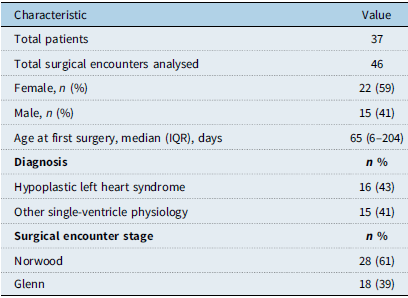
A total of 37 patients were included, representing 46 surgical encounters. Participant and surgical characteristics are summarised in Table 1. The median age at first surgery was 65 days (interquartile range: 6–204), with a majority of female patients (59%). The cohort primarily consisted of infants with hypoplastic left heart syndrome.
Participant and surgical characteristics

Table 1. Long description
The table summarizes 37 infants representing 46 surgical encounters. Most patients were female (59%), the median age at first surgery was 65 days, hypoplastic left heart syndrome was the most common diagnosis, and Norwood procedures accounted for most surgical encounters. The table characterizes the study cohort.
IQR = interquartile range.
Timing of rehabilitation and prone positioning
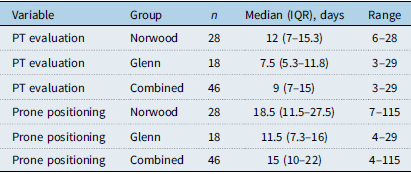
The timing of physical therapy evaluation and initiation of prone positioning following surgery is summarised in Table 2. Across the combined cohort, initial physical therapy evaluation occurred at a median of 9 days post-operatively (interquartile range: 7–15; range: 3–29 days). Prone positioning was initiated at a median of 15 days post-operatively (interquartile range: 10–22; range: 4–115 days).
Timing of rehabilitation and prone positioning by surgical stage

Table 2. Long description
The table compares timing of physical therapy evaluation and prone positioning after surgery. Across all encounters, physical therapy evaluation occurred before prone positioning. Norwood procedures had later evaluation and later prone positioning than Glenn procedures, demonstrating that progression was individualized according to postoperative recovery and clinical status.
IQR = interquartile range; PT = physical therapy.
When stratified by surgical stage, physical therapy evaluation occurred later following Norwood procedures compared to Glenn procedures. Infants undergoing Norwood procedures received physical therapy evaluation at a median of 12 days post-operatively (interquartile range: 7–15.3; range: 6–28 days), whereas infants following Glenn procedures were evaluated at a median of 7.5 days (interquartile range: 5.3–11.8; range: 3–29 days).
Similarly, prone positioning was initiated later following Norwood procedures than Glenn procedures. Following Norwood procedures, prone positioning was initiated at a median of 18.5 days post-operatively (interquartile range: 11.5–27.5; range: 7–115 days), while infants following Glenn procedures initiated prone positioning at a median of 11.5 days (interquartile range: 7.3–16; range: 4–29 days).
Factors influencing rehabilitation and prone positioning
Delays in prone positioning were consistently associated with identifiable clinical factors related to physiologic stability, surgical complexity, invasive support requirements, and tolerance to handling. Factors were analysed by surgical encounter, and multiple contributing factors could be present within a single encounter.
Surgical complexity was among the most common contributing factors, with delayed sternal closure or re-exploration occurring in 21.7% of surgical encounters. These patients frequently required postponement of prone positioning until adequate sternal healing and clinical stabilisation were achieved. The presence of invasive lines and devices contributed to delayed or modified positioning in 15.2% of encounters. Common limitations included umbilical lines, pacing wires, chest tubes, and other devices that restricted safe positioning or increased concern for line displacement during handling. In several cases, positioning was modified or deferred until these devices were removed. Medical instability also influenced rehabilitation progression. Mechanical ventilation and haemodynamic intolerance to handling were identified in 8.7% of encounters and frequently limited early positioning activities. Extracorporeal membrane oxygenation support was present in one encounter (2.2%), representing the highest level of post-operative complexity within the cohort.
Behavioural and physiologic tolerance factors additionally contributed to variability in progression. Irritability, agitation, desaturation during handling, and reduced tolerance to positional changes were identified in 15.2% of encounters and often resulted in gradual or modified advancement of prone activities. Procedural constraints, including bedside imaging or ongoing medical procedures, temporarily delayed rehabilitation progression in one encounter (2.2%).
Importantly, multiple contributing factors were frequently present within the same surgical encounter, reinforcing the need for individualised clinical decision-making rather than standardised post-operative timelines. These factors were incorporated into the structured algorithm-based framework to guide progression of prone positioning based on evolving clinical status and tolerance. Representative cases illustrating both delayed and early progression using this framework are presented in the Discussion.
Sternal healing outcomes
No cases of sternal dehiscence, infection, or adverse healing outcomes were identified at follow-up across the cohort, regardless of the timing of prone positioning.
Discussion
Variability in timing of prone positioning
This study demonstrates that prone positioning following infant cardiac surgery via median sternotomy is characterised by variability in timing but can be safely implemented when guided by patient-specific clinical factors. Across a medically complex cohort of infants with single-ventricle physiology, prone positioning was initiated over a broad post-operative range without any observed adverse sternal healing outcomes, supporting the safety of an individualised, criteria-based approach.
The variability observed in time to prone positioning, particularly the broader range following Norwood procedures (range: 7–115 days), likely reflects differences in post-operative course and physiologic stability rather than inconsistency in clinical practice. Reference Clifton, Schwartz and Cahalin15,Reference Rohit and Rajan16 Infants undergoing Norwood palliation frequently experience greater haemodynamic instability, prolonged respiratory support requirements, and increased post-operative complexity compared to those undergoing Glenn procedures. Reference Rohit and Rajan16–Reference Andronache, Di Cosola and Evangelista18 These differences were reflected in the current cohort, where prone positioning occurred later following Norwood procedures compared to Glenn procedures (18.5 days versus 11.5 days, respectively). Importantly, delays in prone positioning were consistently associated with identifiable clinical factors, including mechanical ventilation, delayed sternal closure, and the presence of invasive lines and devices, rather than arbitrary post-operative restrictions.
In the current cohort, prone positioning was initiated as early as post-operative day 4 in a patient without adverse outcomes, suggesting that early progression may be feasible when guided by patient-specific clinical status. Although infants with biventricular physiology may tolerate earlier progression more consistently, additional research is needed within that population. Despite variability in timing, no sternal complications were identified across the cohort, supporting the safety of prone positioning within a structured and monitored framework.
Clinical decision-making and criteria-based progression
These findings support a paradigm shift similar to that proposed by Cahalin et al. in the adult sternotomy literature, in which traditional sternal precautions were reconsidered in favour of patient-specific movement limitations rather than universally applied restrictions. Reference Cahalin, Lapier and Shaw19 Since that time, adult sternotomy rehabilitation practices have evolved substantially, with increasing emphasis on evidence-based progression of upper extremity strengthening, functional mobility, and patient quality of life. Reference El-Ansary, LaPier and Adams20,Reference Blakoe, Gottlieb, Højskov, Olsen, Damgaard and Christensen21
In the present study, clinicians did not rely on predetermined post-operative timelines to guide prone positioning progression. Instead, positioning decisions were based on ongoing assessment of haemodynamic stability, sternal integrity, respiratory status, invasive support requirements, and overall tolerance to handling. This approach aligns with prior literature demonstrating significant variability in paediatric sternal precautions and prone positioning practices, which are often influenced more by institutional preference than evidence. Reference Clifton, Cruz, Patel, Cahalin and Moore8 The current study extends this body of literature by providing clinical data regarding factors influencing progression to prone positioning and supporting individualised, criteria-driven rehabilitation following infant cardiac surgery.
Application of the algorithm in clinical practice
To further illustrate clinical application of the algorithm-based framework, two representative cases are presented.
Case 1: delayed progression in a medically complex post-operative course
One representative case involved a 3-day-old female with transposition of the great arteries, ventricular septal defect, and aortic arch narrowing who underwent a Norwood-type repair. Her post-operative course was highly complex, requiring prolonged open chest management, inotropic support, mechanical ventilation, and placement of a peritoneal dialysis catheter. On post-operative day 1, the patient developed a left occipital haemorrhage followed by seizures and additional multifocal intracranial microhaemorrhages involving the right frontal region, bilateral centrum semiovale, and left brainstem. Corneal cloudiness was also noted during hospitalisation.
The patient was referred to physical therapy on post-operative day 27 while still intubated and medically unstable. Given the presence of prolonged open chest management, invasive support, ongoing respiratory dependence, and haemodynamic instability, progression to prone positioning was deferred in accordance with the clinical algorithm. Her chest remained open for a total of 30 days, and she continued to require significant cardiopulmonary support for 3 months post-operatively.
As physiologic stability gradually improved and invasive support requirements decreased, modified prone positioning was initiated on post-operative day 115 following successful extubation. Positioning was progressed cautiously with close monitoring of tolerance and haemodynamic response. The patient remained hospitalised until subsequent Glenn palliation. Following this procedure, physical therapy resumed on post-operative day 16, and the patient demonstrated improved physiologic tolerance and stability, allowing initiation of prone positioning during the same therapy session without adverse response.
Case 2: early progression following clinical stabilisation
In contrast, another patient demonstrated a comparatively stable post-operative course allowing for earlier progression to prone positioning. This case involved a 4-day-old male with hypoplastic left heart syndrome who underwent Norwood palliation. His post-operative course was notable for delayed chest closure of one day; however, he otherwise demonstrated progressive clinical stabilisation with minimal ongoing invasive support requirements.
Physical therapy evaluation was completed on post-operative day 7. At the time of evaluation, prone positioning was deferred due to the presence of an umbilical line, consistent with the algorithm’s emphasis on positioning safety and line management. Following removal of the line on post-operative day 10, prone positioning was initiated with maternal involvement and was well tolerated without evidence of physiologic instability or sternal concerns. The patient was subsequently discharged home and later returned for Glenn palliation at approximately 4 months of age. Although the post-operative course following the Glenn procedure was complicated by mediastinal bleeding, chest closure was completed on the same day without prolonged instability. Physical therapy consultation was placed on post-operative day 4, and based on reassessment using the same clinical framework, the patient demonstrated sufficient haemodynamic stability, intact sternal healing, and tolerance to handling to safely initiate prone positioning during the initial therapy session.
Together, these cases illustrate that variability in timing of prone positioning reflects individualised clinical decision-making rather than inconsistency in practice. The algorithm provided a structured framework allowing clinicians to safely advance positioning while accounting for each patient’s unique physiologic and surgical considerations.
Developmental and clinical implications
Despite concerns that early prone positioning may increase risk to sternal healing, no complications were observed in this cohort, including among patients who initiated prone positioning relatively early in their post-operative course. These findings are consistent with emerging literature suggesting that carefully monitored positioning interventions can be safely implemented in medically complex paediatric populations. Reference Clifton, Cruz, Patel, Cahalin and Moore8,Reference Huang, Su, Du, Liu, Su and Lin13,Reference Haseba, Sakakima and Nakao14
Prone positioning plays a critical role in infant motor development, contributing to trunk strength, postural control, weight shifting, and progression of developmental milestones. Delays in prone exposure during critical developmental periods may contribute to long-term motor impairments, particularly among infants with CHD who are already at elevated neurodevelopmental risk. Reference Sood, Newburger and Anixt5,Reference Song, Kim, Ko and Sung22 Minimising unnecessary restrictions while maintaining patient safety is therefore essential.
Collectively, these findings support a transition away from rigid, time-based restrictions toward individualised rehabilitation strategies that balance surgical healing with developmental opportunity. By incorporating key clinical factors into a structured decision-making process, clinicians may safely advance positioning while reducing unnecessary delays in developmental intervention.
Limitations and future directions
This study has several limitations. As a retrospective, single-centre analysis, findings may reflect institutional practice patterns and documentation of variability. Although prone positioning decisions were guided by a standardised clinical framework and multidisciplinary collaboration, variability in clinician comfort or individual recommendations may represent a source of selection bias. Furthermore, physician provider preferences were not captured and may have influenced rehabilitation progression. Additionally, detailed data regarding vasoactive medication burden, sedation requirements, feeding tolerance, and standardised readiness metrics were not consistently available through retrospective chart review and therefore could not be incorporated into the analysis.
While the current findings are limited to infants with single-ventricle physiology, the clinical principles underlying the algorithm may have broader applicability to other CHD populations. Future studies should evaluate the framework in infants undergoing repair of other lesions as well as investigate long-term developmental outcomes. Prospective studies are needed to evaluate the impact of earlier prone positioning initiation on functional and neurodevelopmental outcomes and to further refine evidence-based clinical guidelines for post-operative rehabilitation following infant cardiac surgery. Overall, the findings of this study support the use of a structured, algorithm-based approach to guide clinical decisions and progression to prone positioning following infant cardiac surgery. By incorporating key clinical factors such as haemodynamic stability, sternal healing, and the presence of invasive devices, this approach allows for individualised decision-making while maintaining patient safety. Such frameworks may help bridge the gap between variable clinical practice and the need for standardised, evidence-informed guidance.
Supplementary material
The supplementary material for this article can be found at https://doi.org/10.1017/S1047951126124068.
Acknowledgements
The authors would like to acknowledge the cardiac intensive care teams and rehabilitation staff at Nicklaus Children’s Hospital for their commitment to early mobility, developmental care, and rehabilitation following paediatric cardiac surgery. The authors would especially like to recognise Cristi Tyler, Chantelle Mouttet, Natalie Llama, and Jessica Miller for their ongoing collaboration. The authors also acknowledge the patients and families whose clinical experiences contributed to this work.
Financial support
This research received no specific grant from any funding agency, commercial, or not-for-profit sectors.
Competing interests
None.
Ethical standard
The authors assert that all procedures contributing to this work comply with the ethical standards of the relevant national guidelines on human experimentation and with the Helsinki Declaration of 1975, as revised in 2008. This study was reviewed and deemed exempt by the Nicklaus Children’s Hospital Institutional Review Board. The requirement for informed consent was waived due to the retrospective nature of the study.



 Open access

