Introduction
The narrow-barred Spanish mackerel (Scomberomorus commerson) is the most commercially important pelagic species in the northern Persian Gulf, where it typically is targeted using trolled and longlines by artisanal fishers from various regional countries (Eighani et al., Reference Eighani, Paighambari and Bayse2019), and mostly surface-set gillnets off Iran (Niamaimandi et al., Reference Niamaimandi, Kaymaram, Hoolihan, Mohammadi and Fatemi2015; Eighani et al., Reference Eighani, Paighambari, Herrmann and Feekings2018). Iranian gillnet catches of S. commerson substantially increased from 3.9 mt in 1997 to 8.1 mt in 2003 and have since reached ~15 mt – levels that have contributed towards overexploitation of the regional population (Motlagh & Shojaei, Reference Motlagh and Shojaei2009; Kaymaram et al., Reference Kaymaram, Ghasemi, Vahabneshad and Darvishi2013). More broadly, S. commerson is considered a threatened species (Svedang & Hornborg, Reference Svedang and Hornborg2014; IUCN, 2016).
For nearly two decades, Iranian gillnets (typically 30 m deep × 180 m long) were made from continuous multifilament polyamide (PA; between 1.5- and 2-mm twine diameter; Ø). More recently, in response to lower costs, and improved abrasion resistance and longevity, some gillnet fishers have changed to thinner, monofilament PA. There are concerns about possible increases in catching efficiency, considering several studies on other species have demonstrated relatively greater (up to ~1.5–2.7×) catch-per-unit-of-effort (CPUE) among gillnets made from monofilament (e.g. Washington, Reference Washington1973; Balik & Çubuk, Reference Balik and Çubuk2000, Reference Balik and Çubuk2004; Thomas et al., Reference Thomas, Edwin and George2003; Simasiku et al., Reference Simasiku, Mafwila and Sitengu2017; Richard Winston et al., Reference Richard Winston, Phiri and Singini2019). Such concerns are not only directed towards S. commerson but also several other retained (e.g. mackerel tuna, Euthynus affinis) and discarded species (e.g. giant catfish, Netuma thalassina).
Improved CPUE by monofilament often is attributed to its greater elasticity and lower visibility, which typically are maximized by a smaller twine diameter that can be fished (Hamley, Reference Hamley1975). Catch impacts can also extend to variations among size selectivity, although these often are species- and/or gear-specific. For example, previous studies have shown that compared with multifilament gillnets, those made from monofilament (different twine diameters) did not affect the size selectivity of lake whitefish (Coregonus clupeaformis; Collins, Reference Collins1979), white bass (Morone chrysops), white perch (M. americana; Henderson & Nepszy, Reference Henderson and Nepszy1992), cod (Gadus morhua; Faife, Reference Faife2003) or marbled sole (Pleuronectes yokohamae; Kim et al., Reference Kim, Park, Cho, Kim and Cha2011). Conversely, for walleyes (Sander vitreus; Vandergoot et al., Reference Vandergoot, Kocovsky, Brenden and Liu2011), monofilament had greater selectivity for small and large individuals and multifilament had greater selectivity for mid-sized individuals.
While several local studies have compared catches of S. commerson from different mesh sizes within multifilament gillnets (Grandcourt et al., Reference Grandcourt, Al-Abdessalaam, Francis and Al-Shamsi2005; Darvishi et al., Reference Darvishi, Kaymaram, Salarpouri, Behzadi and Daghooghi2011; Hosseini et al., Reference Hosseini, Kaymarm, Behzady, Kamaly and Darvishi2017), no comparative assessments have been made between multi- and monofilament. The possibility of an overall increase in CPUE or size-specific effects among S. commerson (and other species) raises concerns given the current status of the stocks. Considering the above, our aims here were to assess the relative catching efficiencies and size-selectivities of conventional multifilament surface-set gillnets against those made from thinner monofilament, and with the same nominal mesh size.
Methods
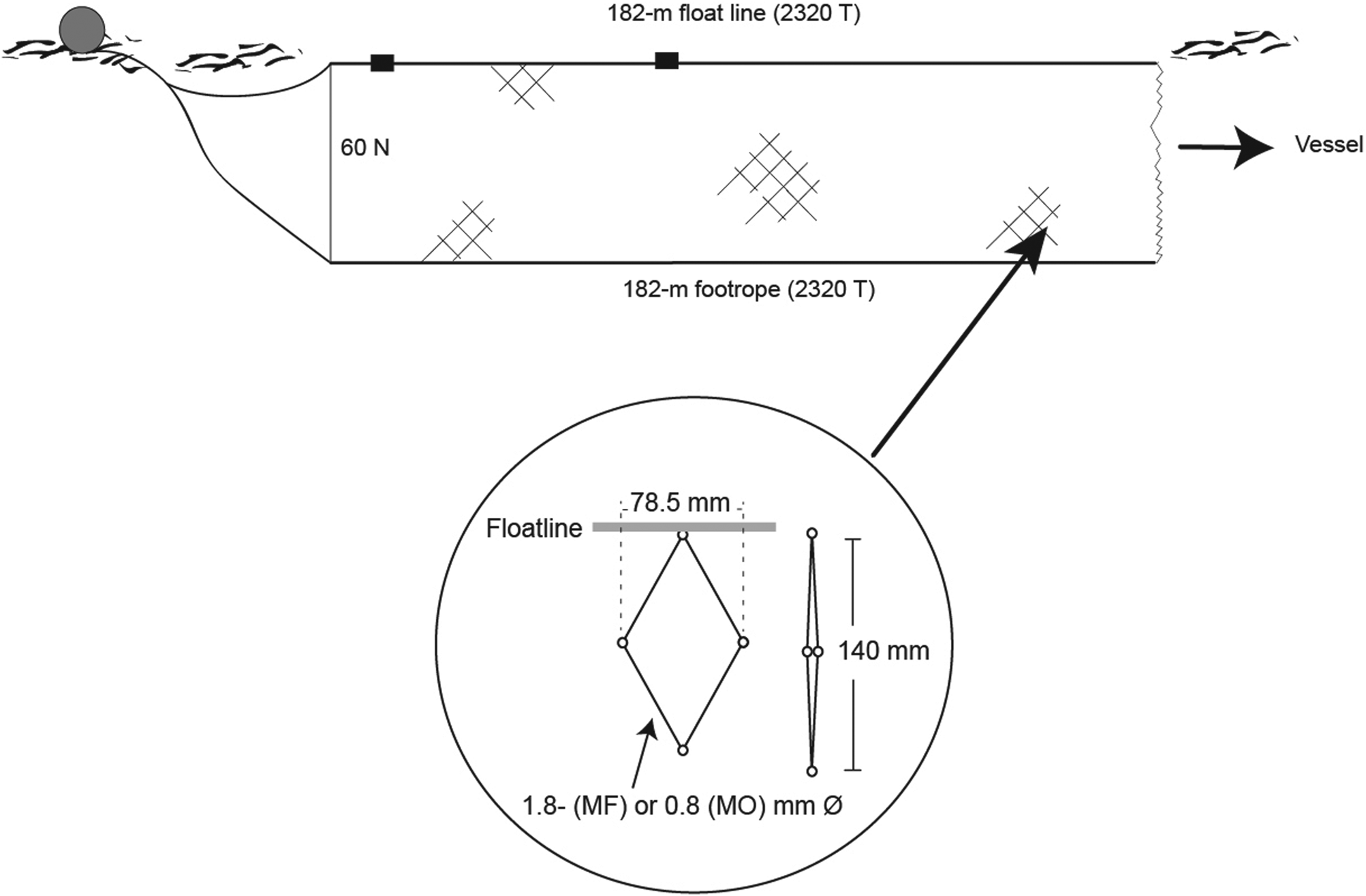
The experiment was completed during 20 days, between 5–20 October and 1–6 November 2017 using two artisanal vessels (7 m) fishing in the Persian Gulf (at 27°40′N 51°36′E) across depths of 25 m and within 10 km of the coast. Each vessel deployed a single, surface-set gillnet (that fished the entire water column) with the same nominal mesh size (140 mm stretched mesh opening; SMO) attached to 182-m polyamide (PA) float lines (10 mm Ø and 90 buoys) and foot ropes at a hanging ratio of 0.56, and had panel depths of 8.5 m (60 meshes in the normal direction; N) (Figure 1). The only difference between gillnets was their twine material, with one made entirely from conventional multifilament (manufacturer's specifications of 210 denier and 30 ply and a nominal twine Ø of 1.8 mm), and the other comprising monofilament twine with a nominal twine Ø of 0.8 mm.
Schematic representation of the surface-set gillnets used in the study. MO, monofilament twine; MF, multifilament twine. N, normal direction; T, transverse direction.

Prior to fishing, 10 replicate meshes in each gillnet were measured for SMO (to the nearest 1 mm) using a ruler against the bar length (×2). On each day of fishing, the two vessels concurrently deployed their gillnets (within 2.5 km of each other) at sunrise (06:00) with one end fastened to a marker buoy and the other to the vessel (Figure 1). Both gillnets were allowed to drift for between 5 and 6 h before being concurrently hauled at the same time on each vessel. Catches were immediately removed, and separated by species. All S. commerson were counted, weighed (nearest 10 g), and measured for total length (TL) to the nearest 1 mm. All other species were counted and weighed as above. The gillnets were qualitatively assessed for any major damage.
A linear model (LM) and linear mixed model (LMM) were first used to test for no differences in mesh sizes and soak time, respectively between gillnets. For catches, first a SIMPER analysis (cut-off 90%) was used to identify those important taxa that contributed to overall dissimilarity between gears (Clarke, Reference Clarke1993). Generalized linear mixed models (GLMM) were then used to test the hypothesis of no differences between gillnets for the numbers of total, retained and discarded catches, S. commerson and other species identified in SIMPER analysis with sufficient data. Linear mixed models were applied to the weights and mean sizes of S. commerson between gillnets. In all mixed models, random effects included ‘months fished’ and the interaction with ‘days’, while fixed effects were ‘gillnet material’. Models were fitted in the ASreml package of the R statistical language and the significance of gillnet material was determined using a Wald F-test (Butler et al., Reference Butler, Cullis, Gilmour and Gogel2009).
Catch-at-length data for S. commerson were analysed by comparing the proportion of the catch between mono- and multifilament gillnets. This analysis used polynomial GLMMs to fit curves of the expected proportions (logit; monofilament/(monofilament + multifilament)) of catch length with a binomial error. The models were fitted by maximum likelihood using the glmer function of the lme4 package (Bates et al., Reference Bates, Mächler, Bolker and Walker2015). The method involved low-order polynomial approximations (cubic, quadratic, linear or constant) to fit proportions at length retained by each gillnet. The dependent variable was the proportion per length class, the independent variable was ‘length’, and the random effect was ‘set pair’ on the intercept. The best model was selected based on the minimum AICc value, a version of the Akaike information criterion with a correction for small sample sizes using the function AICctab from the bblme package (Bolker, Reference Bolker2017). The results are interpreted whereby a proportion of 0.5 indicates no gear-specific difference in catch for a length, while 0.75 indicates 75% of fish at a specific length were caught by the monofilament and 25% by the multifilament gillnet. Confidence intervals were generated via bootstrapping from the bootMer function in the lme4 package with 1000 simulations deriving 95% confidence intervals.
Results
There was no significant difference in nominal mesh size between the monofilament and multifilament gillnets, with a pooled mean (± SE) SMO of 140.3 ± 0.18 mm (LMM, P > 0.05). Each gillnet was simultaneously deployed and retrieved over the 20 days, and with no significant difference in soak time (LMM, P > 0.05; for a combined mean of 5.6 ± 0.11 h). There were no obvious differences in net damage (i.e. broken meshes) between gillnets, which remained minimal at ~5–7 broken bars for each deployment.
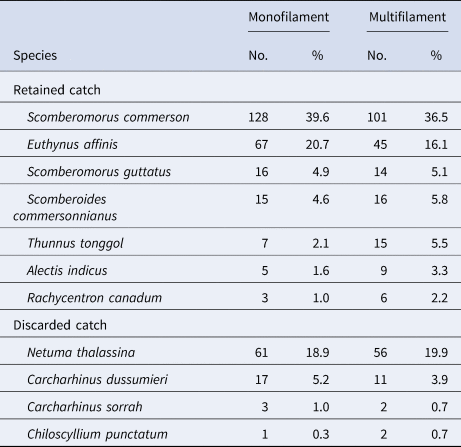
In total, 11 species from seven families were caught with total numbers and weights of 600 and 2220 kg, respectively (Table 1). In both gears, S. commerson, E. affinis and N. thalassina were the most abundant species (total accounting for ~75% by number), and were often entangled in multiple meshes. The SIMPER analyses revealed a significant difference in assemblages between the two gillnets with a dissimilarity average of 10.16% (P < 0.05). Those species (pairwise comparisons) responsible for catch-composition dissimilarity by number were S. commerson, Indian threadfish (Alectis indicus), E. affinis and longtail tuna (Thunnus tonggol) (although the latter were caught at too few numbers to permit further analyses; Table 1).
Species and the numbers (No.) and percentage (%) of catches of retained and discarded species during 20 replicate deployments of monofilament and multifilament gillnets in the Persian Gulf, Iran

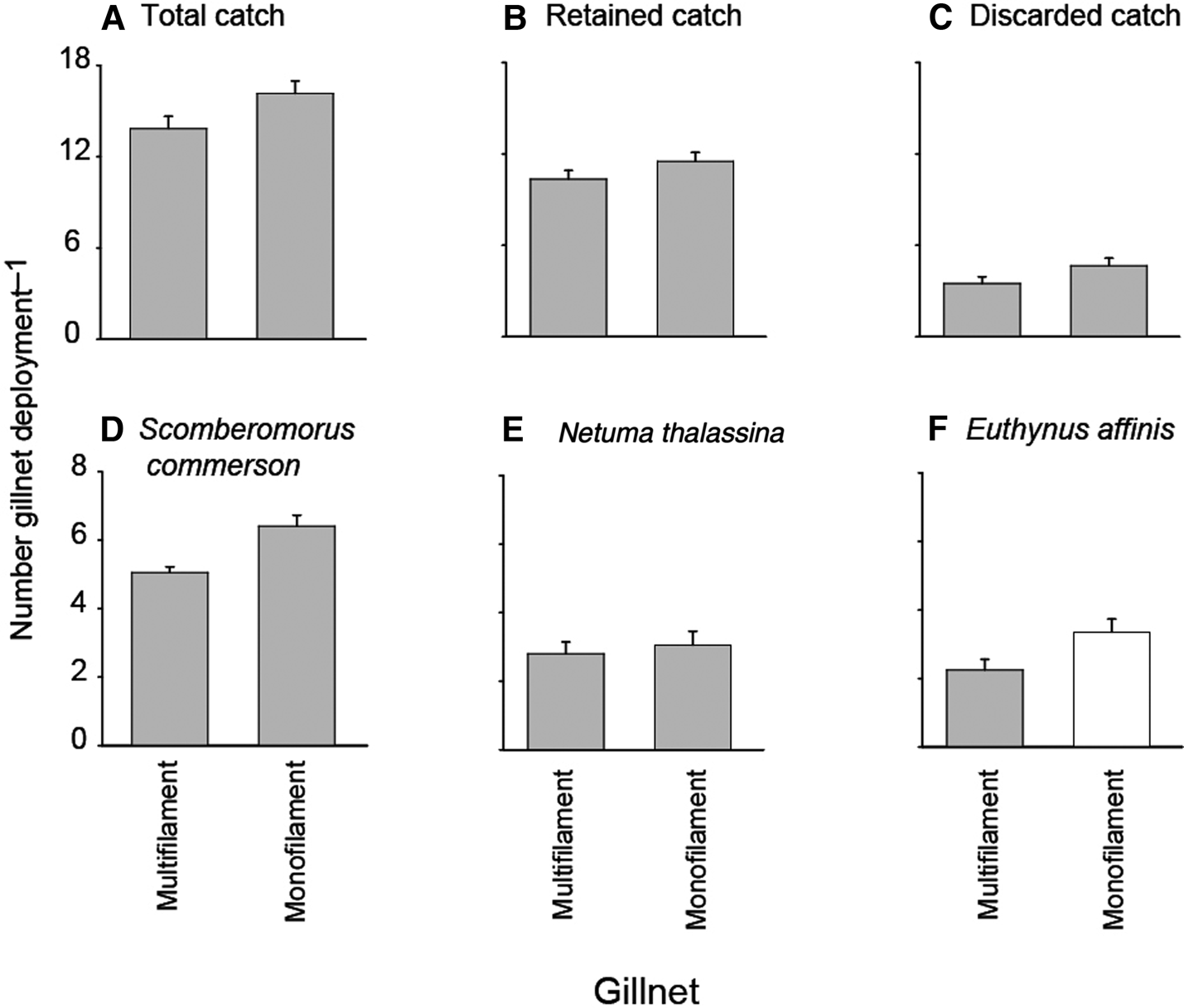
The mixed models failed to detect significant differences between gillnets for the numbers of total (Wald F = 3.52), retained (Wald F = 1.21) and discarded (Wald F = 3.22) catches, weight (Wald F = 0.19) and number (Wald F = 3.17) of S. commerson, and the number of discarded N. thalassina (Wald F = 0.21), although mean catches were all slightly greater (1.2–1.3×) in the monofilament gillnet (P > 0.05, Figures 2A–E). The monofilament gillnet did retain significantly more E. affinis (1.5×) than the multifilament gillnet, with most fish severely entangled (GLMM, P < 0.05, Figure 2F).
Differences in mean (±SE) numbers of (A) total, (B) retained and (C) discarded catches and (D) narrow-barred Spanish mackerel (Scomberomorus commerson), (E) giant catfish (Netuma thalassina) and (F) mackerel tuna (Euthynus affinis) between multifilament and monofilament surface-set gillnets. The white histogram represents the only significant difference detected in the generalized linear mixed model (P < 0.05).

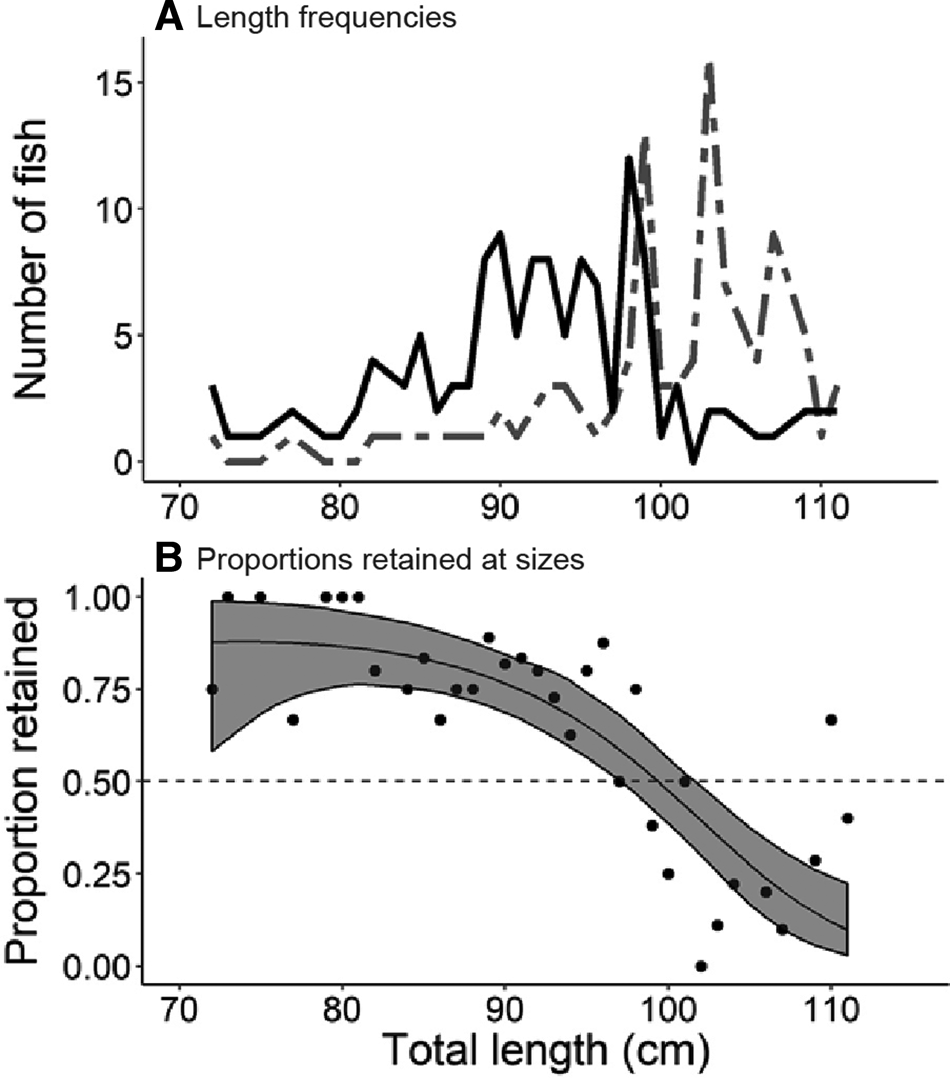
There were clear differences in the sizes of S. commerson retained between gillnets, with a significantly smaller mean size in the monofilament (92.7 ± 1.4 cm TL) than the multifilament (100.6 ± 1.4 cm TL) (LMM, P > 0.001; Table 2). Of note, larger fish were frequently entangled around their jaws as well as along the body in the multifilament. The latter size differences were reiterated in the catch-at-length analysis, which identified the best fitting model as the quadratic polynomial, whereby the monofilament caught significantly more small fish (i.e. <97 cm TL) while the multifilament caught more large fish (>101 cm TL) determined by a proportion of 0.5 being within the confidence intervals (Figure 3). The size-selection translated to 18 and 5% of the catches, respectively, being below the length at maturity for S. commerson (85 cm TL; Froese & Pauly, Reference Froese and Pauly2019).
(A) Length frequencies of narrow-barred Spanish mackerel (Scomberomorus commerson) from monofilament (black line) and multifilament (grey dashed line) gillnets and (B) proportions retained at each cm (black, solid circles; monofilament/(monofilament + multifilament)) whereby a value of 0.5 indicates an even split between gillnets for the specific length. The bold line represents the mean curve and the grey shaded areas are the 95% confidence regions determined by bootstrap simulation. For example, a value of 0.75 indicates that 75% of fish caught at this length were captured by monofilament and 25% by multifilament gear.

Generalized linear mixed model parameters for narrow-barred Spanish mackerel (Scomberomorus commerson), where model and parameter is the chosen model (either constant (β0), linear (β1) or quadratic (β2)), estimate is the value of the slope or intercept, and SE is the standard error of the estimate

Discussion
The results from this study contribute towards the broad literature assessing the importance of material in gillnets for affecting size and species selectivity and represent the first formal assessment for the Persian Gulf (Hansen, Reference Hansen1974; Hamley, Reference Hamley1975; Jensen, Reference Jensen1995; Turunen et al., Reference Turunen, Kukilahti and Suuronen1998; Holst et al., Reference Holst, Wileman and Madsen2002; Grati et al., Reference Grati, Bolognini, Domenichetti, Fabi, Polidori, Santelli, Scarcella and Spagnolo2015). As in many previous studies, we detected species-specific effects of gillnet material, with one pelagic species (E. affinis) caught at significantly greater numbers by the monofilament gillnet, and a trend of greater catches for N. thalassina and S. commerson, but at smaller sizes for the latter. Such differences can be discussed by considering possible gear- and species-specific catching mechanisms, but first the confounding effect of twine diameter between materials needs to be considered.
Several previous studies have shown that when tested within materials (for either multi- or monofilaments), usually the twine diameter of entangling nets is negatively associated with their catches (Hovgård, Reference Hovgård1996; Turunen, Reference Turunen1996; Grati et al., 2015; Kim et al., Reference Kim, Lim, Lee and Park2016). Owing to this effect, fishers will often seek to minimize twine diameter within different material types to maximize catches, but maintain other desired technical properties such as low visibility, with sufficient elongation and strength (Hamley, Reference Hamley1975). Here, through trial and error, Iranian fishers have chosen a monofilament twine at diameter ~50% of their existing multifilament, and probably because even slightly larger diameters of monofilament (approaching that of the multifilament) would be too stiff and unlikely to catch many fish. Ultimately, this characteristic means that the observed catch differences reflect not only the different materials, but also their very different twine diameters.
The relative twine thicknesses and their known associated strengths provide some insight into the possibly divergent catching mechanisms of the two gillnets, including that evoking the significantly different size selectivity for S. commerson. Specifically, the monofilament should have a wet line breaking strength of ~15 kgf, and almost five times weaker than the multifilament at ~73 kgf (FAO, 1990). However, the monofilament nets did not incur greater (qualitative) damage, and so either the existing multifilament twine is too thick, or the catching mechanisms of the thinner monofilament were sufficient to compensate for its lower strength. Broadhurst & Millar (Reference Broadhurst and Millar2019) observed similar results when comparing monofilament against multifilament in baited entangling nets and attributed this apparent intuitive anomaly to the way in which catches were entangled and the superior abrasive resistance of monofilament over multifilament—irrespective of twine diameter.
In the present study, all three of the most abundant species were large and fusiform, but E. affinis has the greatest depth (to length) and S. commerson has the least. The latter species also has large teeth. Most individuals of each species were always severely and tightly entangled in multiple meshes, but especially E. affinis in the monofilament. Individuals of this fast-swimming pelagic species probably contacted the gillnets quite forcefully, but owing to the thinner, less visible monofilament, they were more quickly entangled, especially considering their deeper bodies which would mean the head was secured, but leaving two-thirds of their posterior body free to struggle and become entangled. Despite being thinner, the monofilament did not abrade, and fish were tightly entangled.
While S. commerson is also a fast swimmer (similar to E. affinis), the species is more fusiform. Most S. commerson appeared to penetrate meshes more deeply, but were then often entangled by their large teeth, and especially in between the twisted twines of the thicker multifilament. Although speculative, this capture mechanism might explain the observed difference in size-selectivity between gillnets, whereby relatively larger S. commerson were retained in the multifilament simply because these fish had bigger teeth and were more securely held by their jaws. By comparison, N. thalassina is normally a benthic species, and likely a much slower swimmer (with no large teeth). Their catches were similar between gillnets, and so presumably the mechanisms by which they encountered and were entangled by each gear were not that different.
Conclusions
It is important to note that the data here are few. Over larger data sets, there might be more differences in catches among other species. Nevertheless, monofilament at the chosen diameter will significantly increase catches of E. affinis in Iranian gillnets and there are implications for harvesting larger proportions of S. commerson smaller than size at maturity. One solution to preclude such effects is to simply prohibit monofilament, although this has an economic cost to fishers, considering the material is inexpensive and readily obtained. Alternatively, because of the often negative relationship between twine diameter and catches, it might be possible to allow fishers to use monofilament and return some of the associated benefits of cost and better abrasion resistance and elongation, but at slightly thicker diameters to offset some of the potential increases in catches; assuming previously observed negative relationships between catches and twine diameter remain consistent (Hovgård, Reference Hovgård1996; Turunen, Reference Turunen1996; Grati et al., Reference Grati, Bolognini, Domenichetti, Fabi, Polidori, Santelli, Scarcella and Spagnolo2015; Kim et al., Reference Kim, Lim, Lee and Park2016).
One simple operational modification for improving regional gillnet selectivity might be to vary the vertical fishing height. Certainly, deploying the gillnets even slightly off the seabed should reduce unwanted catches of N. thalassina. Other worthwhile modifications might involve different hanging ratios, or a larger mesh size in monofilament to increase size selection of S. commerson. Future research would warrant assessing the relative catches of monofilament (and multifilament) at different twine diameters and also differences in other key technical parameters (Hamley, Reference Hamley1975). Comprehensive understanding of the factors affecting the selectivity of fishing gears is a prerequisite towards controlling the exploitation rate, and should be a priority for threatened species, such as S. commerson.
Financial support
This research received no specific grant from any funding agency, commercial or not-for-profit sectors.