The universe seems drenched in time. Through time, trees inch upwards, galaxies coalesce, empires rise and decay. But what is time? Everything changes over time, and that includes our idea of time itself. Philosophers have fused time with the stars, with God, with space. Our tale of time in Western philosophy starts over 2,300 years ago – in the back garden of a house in Athens.
Starry Time
Plato's Timaeus describes friends celebrating a festival, probably Athena's summer feast. I picture them breathing in the fragrance of olive trees, Socrates’ beard lit by moonlight, faint music drifting over the wall. An astronomer called Timaeus dominates the conversation, telling a creation story. (We learn the universe is like a living creature, formed from fire, earth, air, and water.) Along the way, he talks about time.
Timaeus picks out some heavenly bodies: the sun, the moon, and five stars. He tells us these ‘wanderers’ came to be in order to ‘stand guard’ over time (Plato, trans. Reference Plato and Cooper1997, Tim. 38c). What does that mean?
Many of the ways we think about time involve the heavens. A day stretches from sunrise to sunset. Every hour the sun curves a little further through the sky, shifting shadows measurable on a sundial. A year is one full revolution of the earth around the sun, stars slipping in and out of view.
The movements of the sun and stars are intertwined with measuring time. By claiming that these bodies ‘guard’ time, Timaeus could simply be saying we use them to tell time. But many scholars read Timaeus as saying something more than that; see Whitrow (Reference Whitrow1988: 41) and Hussey (Reference Hussey1983: 141). Timaeus is telling us what time is. Time is the motions of the heavenly bodies. If the heavens stopped moving, time itself would stop.
Today, we know the earth does not sit at the centre of the universe, and we know the earth moves around the sun. Yet people believed otherwise for centuries – and with good reason. The earth does not move beneath our feet, and so seems to be unmoving. From the perspective of a stargazer, it is the heavens that revolve around the earth: the sun once a day, and the stars once a year. How do these celestial bodies move? Aristotle, one-time pupil of Plato, hypothesized that they are carried on celestial spheres.
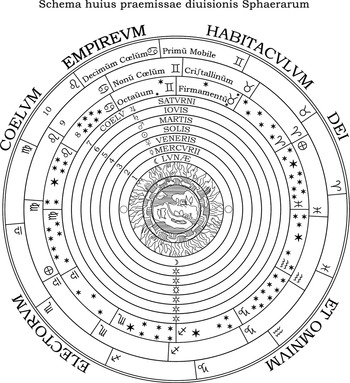
In Aristotle's universe, the earth sits at the centre of fifty-six moving spheres. Heavenly bodies are attached to the spheres, and the revolutions of the spheres explain the revolutions of the sun, moon, planets, and stars. Figure 1 shows how spheres cocoon the earth.
The Ptolemaic system.
Credit: Wikipedia Commons, <https://commons.wikimedia.org/wiki/File:Ptolemaicsystem-small.png>.

The system explains all kinds of phenomena, including unchanging star constellations. Why do the five stars of Cassiopeia stubbornly remain in the same ‘W’ shape? Because they are pinned in place on their sphere. This led philosophers to identify time with the motion of the spheres – even Aristotle sometimes hints at this view. For example, Aristotle (trans. Reference Aristotle and Barnes1984, Phys 223, b18–24) associates time with the measure of the outermost ‘celestial sphere’.
The basic idea, that time is the motion of celestial stars or spheres, stuck for centuries. It was arguably held by Averroës, Aquinas, Copernicus, and Thomas White; see Ariotti (Reference Ariotti1973) and Thomas (Reference Thomas2018: 18–22). Later thinkers branded it ‘celestial reductionism’ – the literal reduction of time to celestial motions. If the stars sped up, time would quicken. And, if the heavens ceased moving, time would halt.Footnote 1
Absolute Time
Very slowly, from the sixteenth century onwards, a new theory of time began to emerge. Many of the arguments for it involve thought experiments: experiments we can work through in our minds. Philosophers asked, ‘What would happen to time if the stars stopped moving?’. Many had the intuition that if the stars stilled, time would still continue to pass. They also asked, ‘Can we imagine a universe without time?’. Many couldn't. You can delete everything that exists in the universe – people, planets, stars – but it seems impossible to delete time.
Sixteenth-century scientists Bernadino Telesio and Jan Baptist van Helmont pointed towards the new view, by separating time from motion. The first fully-fledged ‘absolute’ account of time emerged a bit later, in the 1640s work of Pierre Gassendi (trans. Reference Gassendi1972: 384–8). He argued that time would continue to flow at the same rate, whether the stars stuttered or sped up. This means that time must be a necessary, real being, independent of other things in the universe.
Gassendi seems to picture time as a kind of immaterial dimension, a ghostly medium through which bodies move. It is ‘absolute’ in the sense it doesn't depend on the stars or celestial spheres, or indeed on anything else in the world. For more on this part of the history of absolutism, see Hutton (Reference Hutton1977) and Thomas (Reference Thomas2018: 58–63).
In the 1650s, Cambridge philosopher Henry More independently developed another absolutism about time. More (repr. Reference More, Nicolson and Hutton1992: 487) also used thought experiments, arguing that if God annihilated the world, and then remade it, time would still pass. However, he puts a new twist on the nature of time.
More argues that there was time before God created the material world, and there will still be time after it ends. This means time is eternal, unchanging – ‘never-fading’. This hints at the true nature of time: it is an ‘obscure sub-indication’ of God. More (Reference More1662: 164; VII: 2) claims that time is God's eternal existence, his attribute of eternity.
By naming time an attribute of God, I've argued that More has avoided a potential objection to absolutism. Imagine claiming that a thing exists, and it has various divine qualities, but it's not the Christian God. In the seventeenth century, that would be blasphemy. If time is a real being, and it's uncreated, eternal and unchanging, it could rival God. It would be a second God. George Berkeley blasted such a notion as ‘pernicious and absurd’. By identifying time with God, More has ensured there is only one divine being, escaping heresy; see Thomas (Reference Thomas2018: 55).
This kind of absolutism caught on, attracting philosophical giants such as Isaac Barrow, John Locke, and Samuel Clarke. Most importantly, it attracted Isaac Newton. His Principia (trans. Reference Newton, Cohen, Whitman and Budenz1999: 408–9) stated that absolute time, ‘of its own nature . . . flows uniformly and by another name is called duration’. Later, Newton (trans. Reference Newton, Cohen, Whitman and Budenz1999: 941) added that God ‘endures always’, and ‘constitutes’ duration and eternity.
In Newton's hands, absolutism became all the rage. Debate exploded, with time discussed far from the university madding crowd, by the likes of farmers and stocking makers; see Thomas (Reference Thomas2018: 204–6). It even became the subject of poetry. Edward Young's poem ‘The Consolation’ waxes lyrical about boundless time.
Time and the Mind
A few decades later, absolute time came under attack again – from Immanuel Kant. He turned back to the thought experiments used by absolutists. They had argued that the fact that we cannot dis-imagine time tells us something about the universe. However, Kant argues that it tells us about something else altogether: our minds.
Kant's 1781 Critique of Pure Reason argues that humans cannot help but imagine a single, unified time. However, Kant (trans. Reference Kant, Guyer and Wood1998: B45–50) argues that this is not because time is a real, necessary being. Rather, time comes from us: it is a form of thought, a precondition whereby we can experience anything. Human minds are wired in such a way that our experiences are always temporal. This is why we cannot imagine deleting time from the universe: our minds are not rigged to imagine a non-temporal world. Nonetheless, the world outside our heads might be non-temporal. Because we must perceive things in time, we do not know what things-in-themselves are like.
We can only speak of time from a human standpoint. Yet Kant leaves open the possibility that other, non-human minds are wired differently. As he puts it, ‘we cannot judge at all whether the intuitions of other thinking beings are bound to the same conditions that limit our intuition and that are universally valid for us’. Science fiction writers have explored the notion that alien races could perceive time differently: see Kurt Vonnegut's 1969 novel Slaughterhouse-Five, or the 2016 movie Arrival.
For Kant, human minds play an active role in constructing our perceptions. The world-in-itself may not be temporal, but the world humans perceive is. This is a form of ‘idealism’, a family of views stressing the activity of mind.
The nineteenth century saw waves of idealism sweep Western thought. Kant offers a form of ‘epistemic’ (knowledge-based) idealism: although things exist outside our minds, our mental activity permeates everything we can know about reality. Later philosophers offered ‘ontological’ (reality-based) idealism: reality is founded on minds. German idealists include Johann Gottlieb Fichte, Friedrich Wilhelm Joseph Schelling, and Georg Wilhelm Friedrich Hegel. British-American idealists included T. H. Green, F. H. Bradley, and Josiah Royce. Each of their idealisms are unique yet they agree that, deep down, time is unreal. We might perceive the world to be in time but ultimate reality is timeless.
Time the Twin of Space
Despite the popularity of idealism in the nineteenth century, other ideas began brewing. For a while now, philosophers had been treating time and space the same way. Gassendi's time and space are both immaterial dimensions. More and Newton agreed that God is the source of time and space. Kant held that time and space are human forms of thought. Philosopher Walter Charleton (Reference Charleton1654: 73) nicknamed time the ‘twin-brother’ of space.
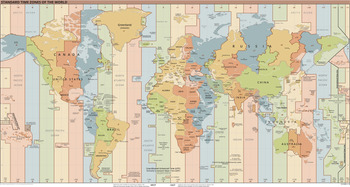
Outside philosophy, it was becoming more common to represent time using space. In 1765, Joseph Priestley created the world's first timeline. His Reference Priestley1765 Chart of Biography depicted peoples’ lives using lines, across uniform time. Timelines quickly became common, portraying empires, evolutionary processes, art history. People were also creating time zones and, by 1900, time zones had been mapped onto the whole world. Figure 2 shows an early map of time zones.
World time zones.
Credit: Wikipedia Commons, <https://commons.wikimedia.org/wiki/File:World_Time_Zones_Map.png>.

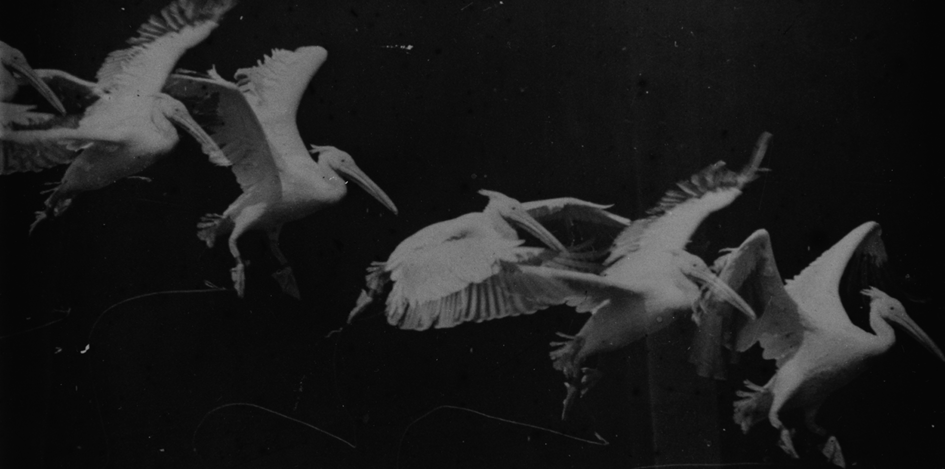
The 1860s saw the invention of chronophotography – literally, ‘time photography’. It captured motion through successive images, as shown in Étienne-Jules Marey's photograph of pelicans (Figure 3). His book Movement provides many more haunting examples.
Pelicans from Marey's Movement.
Credit: Wikipedia Commons, <https://commons.wikimedia.org/wiki/File:Marey_-_birds.jpg>.

In this environment, some Anglo-American philosophers began arguing against idealism that time is a real feature of the world. However, time really resembles space. For example, in the early twentieth century, Victoria Welby (Reference Welby1907: 384–91) argued that our idea of time derives from space. She points out that we usually refer to time using spatial ideas, especially line metaphors. We speak of ‘vast’ or ‘small’ spaces of time, of short or long ‘lengths’ of time, of the ‘distant’ past and the ‘near’ future. She argues time has ‘no vocabulary of its own’, borrowing its terminology from space. This has a ‘hitherto unsuspected’ significance: space is the primary, original idea, and time is secondary to it.
On Bertrand Russell's view, time also resembles space. Russell (Reference Russell1915: 212) argued for ‘eternalism’: past, present, and future times are all real. All parts of space exist: Japan, Australia, and England are all equally real. Similarly, he thought all parts of time exist: 2181 bce, 1066 ce, and 2025 ce are all equally real. To get at this idea, look at Figure 4, a map representing space.
Map of space.
Credit: Wikipedia Commons, <https://commons.wikimedia.org/wiki/File:BlankMap-Europe-v4.png>.

All the parts of space are as real as each other. In the same way, on this simple timeline:

The parts of time – t1, t2, and t3 – are all as real as each other.
For Russell, there is nothing special about any one part of space. You might be in London, but that doesn't make London any more special than Edinburgh or Paris. Nor is there is anything special about any part of time. The present may seem special: the moment right now, while you are reading these words, seems more vivid than earlier moments. The present seems to divide the past from the future. Yet Russell argues that our belief in a present moment is just that – a belief, the product of human psychology. Russell (Reference Russell1915: 212) claims that if there were no humans, an event occurring at t1 would still happen before an event occurring at t2. But in that world ‘there would be no past, present, or future’.
I suspect the intertwining of time and space fuelled the rise of Victorian time travel stories. There are no directions in space: you can move up, down, north, south, left, right. If all the parts of time exist, there may be no direction in time either. We often think that time has a one-way direction, into the future. Space-time symmetry raises the possibility of travelling in another direction: into the past. We can hop on a train leaving London for Cairo, and hop into a time machine leaving Covid London for Shakespearian London.
H. G. Wells's 1895 novel The Time Machine led the time travel charge. It features a time traveller who may have been ‘swept back into the past’, doomed to wander ‘some plesiosaurus-haunted Oolitic coral reef’, or ‘the lonely saline lakes of the Triassic Age’. Time travel stories mushroomed, including Mark Twain's 1889 A Connecticut Yankee in King Arthur's Court and Edith Nesbit's 1906 The Story of the Amulet. Surprisingly, it took philosophy decades to take time travel seriously: J. J. C. Smart published the first substantial discussion in Reference Smart1963.
Pure Time: Durée
French philosopher Henri Bergson also rejected the view that time is unreal. But he watched the ongoing ‘spatialization’ of time with dismay. From the 1880s to 1930s, he argued against ‘mathematical time’, which involves space. Timelines illustrate mathematical time – have another look at the one above. It represents time spatially, stringing countable moments out along a line. Time becomes static, motionless. Bergson argues that this misses the true, pure nature of time.
Pure time is durée. It is ‘free from all alloy’, as it does not involve space. Unlike mathematical time, pure time is not divisible into countable units. Bergson implies that pure duration can only be experienced by conscious beings. When we listen to music, a C note can melt into a D note in such a way that we cannot mark one note off from one another. The past and present notes form an organic whole that cannot be divided into units, and this is how we experience durée. Pure time is melting, changing, motion.
As time is really unlike space, Bergson argues we can only travel through it one way:
If I glance over a road marked on the map and follow it up to a certain point, there is nothing to prevent my turning back and trying to find out whether it branches off anywhere. But time is not a line along which one can pass again. (Bergson, trans. Reference Bergson and Pogson1910: 181)
Although we cannot travel backwards in time, Bergson accepts the reality of the past. His view is partly based in psychology.
In that period, philosopher-psychologists Shadworth Hodgson and William James were pondering time perception.Footnote 2 How much time humans do perceive at any one moment? Do we perceive the tiniest possible slice of time – an infinitesimally small present? This tiny slice might be some fraction of a microsecond. Or, do we perceive a larger slice, known as the ‘specious’ or roomy present? This might last as long as a second.
Hodgson and James argued that we perceive a specious present, using human perceptions of change. Imagine watching traffic lights changing from red to green. We seem to literally perceive the change: we see the lights turn from red to green. This implies we perceive a specious present, perhaps lasting as long as a second. As Bergson puts it, our lived presents have duration.
Bergson (trans. 1910: 176–94) builds on this view to advance an ontology of time. He argues that as we perceive a span of time, we must perceive the infinitesimally small moment that is present and the past moments preceding it. If we perceive the past, it must exist. Bergson concludes, ‘the survival of the past . . . forces itself upon philosophers’.
Although the past exists, the future doesn't. Bergson argues that the future is still unfolding, and we can still affect it. This view, on which the past and present are real yet the future is unreal, is the ‘growing block’ view of time. The ‘block’ of reality, the past and present, are ever growing into the future. As time moves forward, it literally brings new things into existence. Time is a creative force.
Although Bergson is no longer well known within the Anglophone world, his views were powerful. He publicly debated the nature of time with Albert Einstein, and went on to win a Nobel prize for his bestselling books.
Unreal Time Strikes Again
Many thinkers railed against idealism, including Welby, Russell, and Bergson. But idealism had not quite perished. In Britain, a second wave of idealism took hold in the early twentieth century. In 1908, it yielded what would become an infamous piece of philosophy: J. M. E. McTaggart's article ‘The Unreality of Time’. Akin to Kant and Hegel, McTaggart aimed to show that reality is ultimately timeless. To reach this old conclusion, he offered a new argument.
Imagine three events: a girl builds a sandcastle, the tide comes up, ocean-waves dissolve the sandcastle. How do we order them? Like series of numbers, McTaggart put events into two series. Both the ‘A-series’ and the ‘B-series’ order events according to whether they are earlier or later. The tide rises after the sandcastle is built, and before the waves hit the beach.
Additionally, the A-series takes some event to be special – present. It brands earlier events past, and later ones are future. If the tide rising is the present moment, then the sandcastle was built in the past, and the waves will sweep away the sandcastle in the future.
McTaggart's argument against time has two steps. First, he argues that the A-series is essential to time. On the B-series, nothing changes, for every event will always occupy the same position in time: the waves will always hit the sandcastle after the tide rises. In contrast, on the A-series, things really change as the present moves on: the tide rising was once present, and is now past. The castle-destroying waves are future but will be present. McTaggart claims this kind of change, from future to present to past, is essential to time.
Second, McTaggart argues that the A-series cannot exist. Being future, present, and past are incompatible, contradictory properties. An event can be future or past – not both. Yet, McTaggart argues, every event has all these properties: the rising tide was once future, then present, then past. As these properties are contradictory, he concludes they are unreal. If the A-series is essential to time, and the A-series does not exist, then time does not exist. Time is unreal.
This deceptively simple argument has proved knotty to unravel. McTaggart's article was just seventeen pages long. Philosophers have since written tens of thousands of pages about it. Many have tried to show where it goes wrong, from McTaggart's peers C. D. Broad and Hilda Oakeley, to contemporary philosophers Robin Le Poidevin and Hugh Mellor. Occasionally, philosophers like Michael Dummett defend it. However, McTaggart's argument is not just important because of its conclusion.
A-theory vs B-theory
The argument also matters because it spawned two views with fiercely humdrum labels: A-theory and B-theory. These stem from McTaggart's A- and B-series, which provided a new framework to discuss time. All realists about time agree that events occur before or after one another. But is there really a moving present?
‘B-theory’ says no. Russell was an early B-theorist, and B-theory usually comes packaged with his view that all parts of time exist. In contrast, ‘A-theory’ says yes – there really is a moving present. Bergson was an early A-theorist, and his growing block view inspired other A-theories, such as C. D. Broad's.
As the twentieth century moved on, the A versus B debate thrived. Richard Gale offered an impassioned defence of A-theory. Donald Williams argued for B-theory, decrying a ‘repulsive’ moving present. Memorably, Williams (Reference Williams1951: 471–2) describes A-theories as a ‘primitive magma of confusion’. And the A versus B debate shows no sign of abating – recent guides to the philosophy of time are still riddled with it.
Questions about Time: Pansies or Tulips?
Time has been sourced in crystalline spheres, in God, in a moving present. Can this evolution in philosophy tell us anything else? I believe so. We often think philosophical questions are ‘perennial’, recurring throughout history like metaphysical tulips. Yet in the case of time, many of the questions do not recur. Would time stop if the stars stopped? Is time God's eternity? These questions are deeply rooted in particular eras – like the ephemeral lives of pansies or petunias.
I think the questions we ask now will also turn out to be pansies, rather than tulips. Is the special present? Does the future exist? These may seem like perennial questions but they have only bedevilled philosophers for the last hundred years or so. Philosophy might return to the same topics time after time (pun intended). But its questions, like everything else in the world, change.