Coexistence of closely related species is a central issue in community ecology, and those species are expected to present niche differentiation, particularly when resources become scarce (García & Arroyo Reference GARCÍA and ARROYO2005). Hence, resource abundance and diet differences might be playing a key role in determining species coexistence (Chapman & Rosenberg Reference CHAPMAN and ROSENBERG1991, Stevenson et al. Reference STEVENSON, QUIÑONES and AHUMADA2000). Trophic niche differentiation in frugivorous birds could be driven by fruit selection, morphology, behaviour (Moermond & Denslow Reference MOERMOND and DENSLOW1983, Reference MOERMOND and DENSLOW1985) and the spatiotemporal resource dynamics (Blake & Loiselle Reference BLAKE and LOISELLE1991, Saracco et al. Reference SARACCO, COLLAZO, GROOM and CARLO2005, Solórzano et al. Reference SOLÓRZANO, CASTILLO, VALVERDE and ÁVILA2000).
Manakins (Pipridae) are Neotropical birds typically considered as generalist and opportunistic frugivore species (Moermond & Denslow Reference MOERMOND and DENSLOW1985) that feed mainly on berries but also on arthropods (Snow Reference SNOW, Hoyo and Christie2004). Previous studies have described manakin diet and its relationship with plant phenology (Loiselle & Blake Reference LOISELLE and BLAKE1990, Marini Reference MARINI1992, Stiles & Rosselli Reference STILES and ROSSELLI1983), but quantitative analyses of trophic niches are virtually non-existent. We evaluated the fruit-based diet of two manakin species: the white-bearded manakin (Manacus manacus L.) and the golden-headed manakin (Pipra erythrocephala L.) aiming to test the following hypotheses: (1) if fruit abundance is a limiting factor at least during one season, we should find diet differences among manakin species during periods of fruit scarcity; and (2) if manakins are opportunistic, the resource abundance of a given plant species should be associated with its consumption by M. manacus and P. erythrocephala.
This research was conducted in a 43-ha protected forest plantation, located at the western Colombian Central Andes (05°03′32′′N, 75°44′07′′W; 825–1025 m asl), adjacent to a second-growth remnant and embedded in a matrix of cattle pastures, citrus and tomato crops. The mean annual temperature is 22.5 °C, and the annual cumulative rainfall reaches 2245 mm (Meteorological Station La Esmeralda). For analytical purposes, we defined the dry season as those months with less than 200 mm of rainfall (June–September and December–March). Two distinct rainy seasons corresponded to April–May and October–November.
This plantation is dominated by four native tree species: Cupania americana L. (Sapindaceae), Cedrela odorata L. (Meliaceae), Aegiphila grandis Moldenke (Lamiaceae) and Cordia alliodora (Ruiz & Pav.) Oken (Boraginaceae), as well as many understorey shrubs and herbs. Four manakin species inhabit the area: Manacus manacus, Pipra erythrocephala, Machaeropterus regulus Hahn and Corapipo leucorrhoa Sclater. We excluded the latter two species due to their low capture rate.
We set mist nets during the dry season (4 mo) and the rainy season (4 mo) between August 2005 and November 2006. Mist nets (12 × 2.5 m) were systematically placed at 40 different points (one net per point) within the plantation, separated by at least 32 m one from each other, and located >100 m from adjacent habitats. Each point was monitored for 12 mist net h mo−1, between 06h30 and 17h00, with a monthly sampling effort of 480 mist-net h mo−1 and 3840 mist-net h of total sampling effort.
To determine fruit consumption, captured manakins were placed in plastic containers lined with filter paper in order to obtain faecal or regurgitated material, for a maximum of 30 min (Blake & Loiselle Reference BLAKE and LOISELLE1992). No emetic protocols were in order to guarantee animal well-being. Samples were air-dried, preserved in individually labelled bags, and examined using a 16× stereoscopic microscope. Seeds were identified by comparison with a seed reference collection (Universidad de Caldas). We recorded the number of plant species found at each sample (recording counts and presence/absence data).
To determine resource abundance we established two 12.5 × 2-m plots 1 m from each mist net (Blake & Loiselle Reference BLAKE and LOISELLE1991), and monitored all fruiting plants encountered therein. Plots were monitored on a monthly basis, counting all fruiting plants and all ripe fruits located at a height of ≤ 10 m (Blake & Loiselle Reference BLAKE and LOISELLE1991) to ensure an accurate count. Every fruit was counted directly using 10 × 50 binoculars.
Differences in the number of plants and fruits per plant between dry and rainy seasons were assessed through a Wilcoxon signed rank test performed using R 2.12. Aiming to describe the spatial association of fruiting plants, ripe fruits and manakin captures among plots as well as the spatial association between seasons, we used the SADIE technique (Perry et al. Reference PERRY, WINDER, HOLLAND and ALSTON1999). Plot clustering was assessed using an aggregation index (I a), and spatial association between seasons was assessed using a chi-squared association index (X p), both calculated using SADIEShell 1.22. For each season, we performed Spearman rank correlations between manakin captures and the number of fruiting plants and the number of ripe fruits.
Aiming to compare the seasonal diet composition of M. manacus and P. erythrocephala, we performed a one-way analysis of similarities (ANOSIM) for each captured manakin. Pairwise P values were corrected using a step-down sequential Bonferroni correction (Clarke Reference CLARKE1993). We also performed a similarity percentage analysis (SIMPER) for assessing the contribution of a given plant species on diet dissimilarity (Clarke Reference CLARKE1993). ANOSIM and SIMPER were conducted using PAST 2.15.
To assess the association between the resource consumption vs. its abundance, we calculated the Jacobs index (D) (Jacobs Reference JACOBS1974):

where p = the number of fruiting plants of a given species, r = number of times that a given species was found in the faecal samples. D values > 0 indicate that the item is consumed in a greater proportion than expected by its abundance, D values < 0 indicate the contrary. D values significance was tested through bootstrapping (Crawley Reference CRAWLEY2005).
We captured a total of 198 individuals. Manacus manacus was captured the most (N = 154; 78% of the total captures), followed by P. erythrocephala (N = 44; 22%). From those individuals we collected 102 samples, 76% from M. manacus and 24% from P. erythrocephala. Manakin captures were not clustered during dry (I a = 1258, P = 0.27) or rainy (I a = 0.90, P = 0.79) seasons, and they were spatially independent (X p = −0.11, P = 0.73) between seasons.
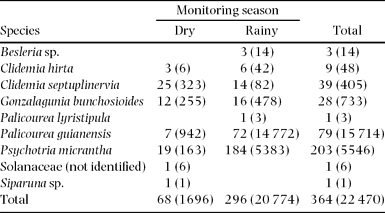
We monitored 364 individuals of nine plant species, from which we counted 22 470 fruits (Table 1). The most abundant fruiting plants were Palicourea guianensis Aubl. (Rubiaceae) and Psychotria micrantha Kunth (Rubiaceae). Only P. micrantha and Clidemia septuplinervia Cogn. (Melastomataceae) presented fruits throughout the year. The number of sampled fruiting plants did not differ significantly between seasons (Wilcoxon test, V = 11, P = 0.92), and the median number of ripe fruits per plant was significantly higher during the rainy season (Wilcoxon test, V = 28, P = 0.02).
Number of monitored plants (2005–2006) with ripe fruits per sampling season. The number of fruits counted is shown in parentheses.

Fruiting plants at the study plots were clustered in both dry (I a = 1.99, P < 0.01) and rainy (I a = 1.90, P = 0.03) seasons, as well as the number of ripe fruits at dry (I a = 1.89, P < 0.01) and rainy (I a = 1.78, P = 0.03) seasons. Fruiting plants (X p = 0.87, P < 0.01) and ripe fruits (X p = 0.81, P < 0.01) were found to be spatially associated between seasons. During the dry season, manakin captures at each plot were significantly correlated with the number of fruiting plants (rs = 0.40, N = 40, P < 0.01) and the number of ripe fruits (rs = 0.32, N = 40, P = 0.04), but not for the rainy season (fruiting plants: rs = 0.08, N = 40, P = 0.63; number of ripe fruits: rs = 0.04, N = 40, P = 0.81).
Both manakins were mainly frugivorous. About 90% of the samples contained fruit pulp or seeds. We found seeds of 36 species in the faecal samples (31 in M. manacus and 11 in P. erythrocephala), predominately from C. septuplinervia, Miconia longifolia (Aubl.) DC. (Melastomataceae) and P. micrantha. Tree fruits were also consumed: Tetrorchidium rubrivenium Poepp. (Euphorbiaceae; consumed by both manakins), and Aegiphila grandis Moldenke (Lamiaceae; consumed only by M. manacus). The herb Carludovica palmata Ruiz & Pav. (Cyclanthaceae) was consumed by M. manacus. A complete list of plant species consumed is available upon request.
We detected a significant difference in diet composition between M. manacus and P. erythrocephala during the rainy season (ANOSIM test, R = 0.05, P = 0.02), and in the diet of M. manacus between seasons (R = 0.08, P < 0.01). Miconia longifolia, P. micrantha and C. septuplinervia accounted for 44% of the diet dissimilarity between M. manacus and P. erythrocephala. For M. manacus, 36% of diet dissimilarity between seasons was due to the consumption of P. micrantha, C. septuplinervia and M. longifolia. Whereas for P. erythrocephala, 51% of diet dissimilarity between seasons was due to the consumption of M. longifolia and P. micrantha. Four species were consumed in greater proportion than expected by their abundance. Manacus manacus consumed: C. septuplinervia (Jacobs's index, D = 0.60, P < 0.01) and P. guianensis (D = 0.46, P = < 0.01) during the dry season, and C. septuplinervia (D = 0.82, P < 0.01) and P. lyristipula (D = 0.90, P < 0.01) during the rainy season. Pipra erythrocephala consumed mostly P. micrantha during dry (D = 0.59, P < 0.01) and rainy seasons (D = 1.00, P < 0.01).
At our study site resource abundance varied significantly between seasons, hence food resource abundance might be a limiting factor during the dry season. Contrary to our first hypothesis, the diets of M. manacus and P. erythrocephala differed to a greater degree during the rainy season, when fruits were abundant, suggesting a diet differentiation. Conversely, when fruit resources were scarce, manakins tend to consume the same subset of fruiting plant species but in different proportions. Therefore, diet differences might be playing a central role reducing overlapping and allowing coexistence, as has been observed for other frugivorous birds (Rodrigues Reference RODRIGUES1995). Probably, the difference in diet breadth between the manakins is associated with the diverse M. manacus foraging tactics (perching, in flight, and jumping), whereas P. erythrocephala has only a perching tactic (Marini Reference MARINI1992), limiting the variety of resources that are accessible to it. Foraging behaviour could be a more likely explanation for the patterns observed, since the sizes of the consumed fruits (5.5–10 mm) were less than the beak width (M. manacus: 10.2 ± 1.26 mm, N = 11; mean ± SD; P. erythrocephala: 10.0 ± 1.02 mm, N = 15; t24 = −0.66, P = 0.51), imposing no morphological restriction for its consumption (Levey Reference LEVEY1987).
Regarding our second hypothesis, manakins were considered as opportunistic species (Moermond & Denslow Reference MOERMOND and DENSLOW1985). However, our results showed that contrary to this idea, both M. manacus and P. erythrocephala consumed some species in high proportion despite their low abundance and give less attention to other species with large crop sizes. Despite manakin captures being spatially correlated with the resource abundance (fruiting plants and number of fruits) during the dry season, they still consume available fruits differentially. However, other studies have observed that visitation rate and crop size were positively correlated (Blendinger et al. Reference BLENDINGER, LOISELLE and BLAKE2008, Saracco et al. Reference SARACCO, COLLAZO, GROOM and CARLO2005) and are highly variable over space and time (Levey Reference LEVEY1988, Ortiz-Pulido & Rico-Gray Reference ORTIZ-PULIDO and RICO-GRAY2000, Sallabanks & Courtney Reference SALLABANKS and COURTNEY1993). This could be reflecting a non-random fleshy fruit selection pattern, where consumption is not dependent on the resource abundance. Such non-random consumption pattern could be allowing species coexistence by reducing interspecific competition.
ACKNOWLEDGEMENTS
This work was funded by Central Hidroeléctrica de Caldas, The E. Alexander Bergstrom Memorial Research Award, and Universidad de Caldas. J. Guevara, S. Ramos, M. Bedoya and N. López assisted in the field. C. Franco arranged field logistics. J. Estevez and P. Jordano helped with data analyses. R. Durães, R. Ortiz-Pulido, J. Blake, T.H. White, R. Medel and two anonymous reviewers provided valuable suggestions. M. Posada, D. Sanin, C. Taylor and H. Mendoza contributed to plant identification. GJC and FEF were supported by CONICYT doctoral fellowships.