Introduction
Everyone has experienced listening to a second/foreign language (L2) and not being able to “hear” words. The speech signal is a continuous flow of sounds in which word boundaries are not reliably marked. In order to process this flow of sounds, non-native listeners must map the information they extract from the speech signal onto acoustic-phonetic, phonological, syntactic and lexical representations (among others). Whereas the speech signal can be defined objectively, its perception and subsequent processing depend on the representations that non-native listeners have developed in the target language, which may or may not be target-like and which compete with existing representations from the native language (e.g., Carroll, Reference Carroll2001; Cutler, Reference Cutler2000/2001). Specifying how non-native listeners are eventually able to “hear” words in the target language thus entails determining what L2 acoustic-phonetic, phonological, syntactic and lexical representations they have developed and how they use them in real time.
The present research investigates how this process unfolds with increasing proficiency in the target language. It focuses specifically on the development and use of phonological and lexical representations by examining the recognition of French words in liaison contexts. Liaison is a process by which word-final latent consonants are realized at the onset of the following vowel- or glide-initial word (e.g., gros ours [gʁozuχs] ‘big-sg bear’; gros oiseau [gʁozwazo] ‘big-sg bird’; cf. gros chat [gʁoʃa] ‘big-sg cat’).Footnote 1 Because liaison consonants are typically resyllabified, they create a misalignment of the syllable and word boundaries (e.g., gros ours [gʁo.z#uχs], where the period (.) represents a syllable boundary and the pound sign (#) a word boundary), which can make it difficult for non-native listeners whose native language lacks a similar process (e.g., English) to recognize vowel- or glide-initial words preceded by a liaison consonant (henceforth, liaison-initial words) in continuous speech.
This study investigates how native English speakers at different proficiencies in French (experimental group) and native French speakers from France (control group) parse vowel-initial words preceded by liaison /z/ in spite of this misalignment, and whether the procedure they adopt for segmenting real words also generalizes to nonce words. It does so using eye-tracking in an adaptation of the visual-world paradigm, a methodology that makes it possible to examine the precise time course of lexical activation in the presence of temporary phonemic ambiguity in the speech signal.
Factors determining the realization and occurrence of liaison
Liaison in French is a complex linguistic phenomenon at the interface of several components of the grammar and the lexicon. It has received much attention from theoretical linguists over the last thirty years. Since a discussion of all the factors that influence its realization and occurrence would lie beyond the scope of this article, the following summary presents only the factors that are most relevant for the present study.
Liaison consonants include /z, t, n, ʁ, p, g/, the first three of which represent over 99% of all liaisons attested in the spontaneous speech of 195 French speakers in the Phonologie du Français Contemporain (PFC) corpus (Durand & Lyche, Reference Durand and Lyche2008; see also Boë & Tubach, Reference Boë and Tubach1992). These word-final latent consonants occur more frequently after monosyllabic words than after polysyllabic ones (e.g., Booij & De Jong, Reference Booij and De Jong1987; De Jong, Reference De Jong and Lyche1994; Encrevé, Reference Encrevé1988), and they are realized as syllable onsets in spontaneous speech (Durand & Lyche, Reference Durand and Lyche2008; for discussions of non-resyllabified liaison in rehearsed speech and in read speech, see Encrevé, Reference Encrevé1988; Laks, Reference Laks2005). This process, referred to in the French literature as enchaînement, becomes evident in right-dislocated phrases, where the liaison consonant is resyllabified across a prosodic boundary (J'en ai un, ami [ʒɑ̃.ne.œ̃.n#a.mi] ‘I have one-masc, friend’; Morin & Kaye, Reference Morin and Kaye1982; Tranel, Reference Tranel1987).
Despite their similar syllabification, liaison- and consonant-initial words differ acoustically and sometimes phonetically. For example, based on production data from ten native French speakers, Spinelli, McQueen and Cutler (2003) report that liaison consonants /t, n, ʁ, p, g/ elicited between an adjective and a noun (e.g., brilliant acte ‘brilliant act’; p. 252) and between an adverb and a past participle (e.g., trop unis ‘too united’; p. 251) are on average 12 milliseconds shorter than the corresponding word-onset consonants (e.g., brilliant tact ‘brilliant tact’; trop punis ‘too punished’; pp. 251–252). Which acoustic-phonetic cues distinguish liaison-initial words from consonant-initial ones depends on the particular pivotal consonant. The duration of the pivotal consonant appears to be a reliable cue for /ʁ/, which represents over half of the liaisons in Spinelli et al.'s (2003) stimuli. For /p/ and /t/, the duration of the closure and of the burst and voice onset time are shorter for liaison-initial words than for consonant-initial ones (e.g., Dejean de la Bâtie, Reference Dejean de la Bâtie1993; Wauquier-Gravelines, Reference Wauquier-Gravelines1996). For /n/, when it follows a prenominal adjective, the adjective can lose its word-final nasalization in liaison contexts (e.g., certain air [sɛʁ.tɛ.n#ɛʁ] ‘certain air’), but not in word-onset contexts (e.g., certain nerf [sɛʁ.tɛ̃.#nɛʁ] ‘certain nerve’) (e.g., Féry, Reference Féry2003).
Liaison consonants can be lexical (e.g., gros ours ‘big-sg bear’, where /z/ is part of the lexical representation of the first word) or morphological (e.g., petits ours ‘small-pl bears’, where /z/ is epenthesized) (e.g., Morin & Kaye, Reference Morin and Kaye1982; Tranel, Reference Tranel1987). Their occurrence has traditionally been categorized as obligatory, optional or illicit depending on the syntactic context in which the latent consonant is found (e.g., Ågren, Reference Ågren1973; Morin & Kaye, Reference Morin and Kaye1982; Tranel, Reference Tranel1987). Liaison has been said to be obligatory between a determiner and a noun or adjective (e.g., les ours ‘the-pl bears’; les autres chats ‘the-pl other cats’), between an adjective and a noun (e.g., gros ours ‘big-sg bear’), between a monosyllabic adverb and an adjective or adverb (e.g., très avide(ment) ‘very eager(ly)’), after a non-inverted subject or object clitic (e.g., vous avez ‘you-pl/formal have’; il les a ‘he has them’) and between a preposition and a noun or verb (e.g., sans ours ‘without bears’; sans avoir ‘without having’). On the other hand, liaison has been considered illicit between a singular noun and an adjective (e.g., chat// affamé ‘the starving cat’, where the double slash bar represents a syntactic boundary where liaison is not licensed), between a subject noun phrase and a verb (e.g., les gens// arrivent ‘people are arriving’), after an inverted subject clitic (e.g., avez-vous// eu ‘did you-pl/formal have’), between a verb and an object noun phrase (e.g., remplis// un verre ‘fill-sg a glass’), after a discourse marker (e.g., ben// on s'en va ‘well we are leaving’), before a preposition (e.g., tu vas// au parc ‘you are going to the park’) and after et ‘and’ (e.g., argent et// or ‘silver and gold’). Liaison has been considered optional elsewhere (for a similar categorization, see Delattre, Reference Delattre1966).
Recent corpus research has shown, however, that this description may not accurately represent the actual syntactic contexts in which liaison is categorical, variable or absent, to borrow Durand and Lyche's (2008) terminology. In their survey of 100 French speakers from France, Durand and Lyche report that liaison is not always found between an adjective and a noun (e.g., gros immeuble ‘big building’; p. 45), between a monosyllabic degree adverb and an adjective or adverb (e.g., très âgée ‘very old’; p. 59) or after a preposition (e.g., chez un copain ‘at a friend's’; p. 44). They conclude that liaison is categorical only between a determiner and a noun, after a subject or object clitic, and with enclitics (e.g., parle-t-on ‘do we speak’; p. 53). Their data are otherwise in line with the above classification.
The occurrence of liaison also varies as a function of lexical factors (e.g., Reference ÅgrenÅgren, 1973; De Jong, Reference De Jong and Lyche1994; Durand & Lyche, Reference Durand and Lyche2008; Malécot, Reference Malécot1975). For example, liaison is categorical in fixed expressions (e.g., fait accompli ‘accomplished fact’; Nations Unies ‘United Nations’), even if the syntactic context would otherwise not license liaison (e.g., tout à coup ‘all of a sudden’; de temps en temps ‘from time to time’). Liaison also tends to be produced after the copula and auxiliary être ‘to be’, with liaison being more likely to follow lexically frequent forms of the verb (e.g., est ‘is’, sont ‘are’) than lexically infrequent ones (e.g., êtes ‘are-2ndpers.pl’) (e.g., Reference ÅgrenÅgren, 1973; De Jong, Reference De Jong and Lyche1994).
Although the above summary does not do justice to the complexity of liaison as a linguistic phenomenon, it presents the main factors determining its realization and occurrence. Of particular importance for the present study are the usual realization of liaison consonants as syllable onsets, the acoustic-phonetic differences between liaison- and consonant-initial words, and the frequent occurrence of liaison between adjectives and nouns. Let us now turn to the processing difficulties that liaison may (or may not) pose for native and non-native French listeners.
Recognizing liaison-initial words in continuous speech
Psycholinguistic research has shown that words are more readily recognized when their onsets align with syllable onsets (e.g., Content, Kearns & Frauenfelder, 2001; Cutler & Norris, Reference Cutler and Norris1988; Dumay, Frauenfelder & Content, 2002; McQueen, Reference McQueen1998; Norris, McQueen, Cutler & Butterfield, 1997). On the basis these findings, Norris et al. (Reference Norris, McQueen, Cutler and Butterfield1997) and Dumay et al. (Reference Dumay, Frauenfelder and Content2002) have proposed, respectively, the Possible-Word Constraint and the Syllable Onset Segmentation Heuristic, according to which listeners use syllable onsets as reliable points for aligning word-initial boundaries in speech processing (see Cutler & Norris, Reference Cutler and Norris1988, for a similar account that also takes into account the role of prosodic cues in word recognition). Given the misalignment of the syllable and word boundaries that liaison creates, we might thus expect adult French listeners to have difficulty recognizing liaison-initial words. On the other hand, if the acoustic-phonetic differences attested between liaison- and consonant-initial words are reliable (e.g., Dejean de la Bâtie, Reference Dejean de la Bâtie1993; Féry, Reference Féry2003; Spinelli et al., Reference Spinelli, McQueen and Cutler2003; Wauquier-Gravelines, Reference Wauquier-Gravelines1996), and if the processing mechanism uses such fine-grained information to recognize words, liaison-initial words should not be more difficult to recognize than consonant-initial ones.
Gaskell, Spinelli and Meunier (2002) investigated the role of lexical and acoustic-phonetic information in the recognition of liaison-initial words by native French listeners. In cross-modal priming and word-monitoring experiments, the participants heard naturally recorded phrases in which a vowel-initial word was preceded by a liaison consonant (e.g., généreux Italien ‘generous Italian’; p. 801) or a non-latent word-final consonant (e.g., virtuose italien ‘virtuoso Italian’; p. 801) (syllable-misaligned targets), or by another vowel (e.g., chapeau italien ‘Italian hat’; p. 801) (syllable-aligned target). Acoustic analyses of the pivotal consonants in the first two conditions (/z, t, ʁ, g/) revealed no duration difference between liaison and non-latent word-final consonants. The participants made a lexical decision on the vowel-initial target (e.g., “italien”) they saw during or at the offset of the auditory stimulus (cross-modal priming), or they saw the vowel-initial target (e.g., “italien”) and pressed a button as soon as they heard it in the subsequent auditory stimulus (word monitoring). In the cross-modal priming experiment, the results showed no significant difference between resyllabified and non-resyllabified targets, whereas in the word monitoring experiment, they showed faster reaction times for resyllabified targets than for non-resyllabified ones. To reduce possible lexical and syntactic effects, the researchers conducted a follow-up fragment-monitoring task using a similar design, but with truncated stimuli (e.g., -reux Ita-, -tuose ita-, -po ita-). The participants were instructed to monitor a sequence corresponding to the first two phonemes of the vowel-initial word (e.g., “it-”). The results showed faster recognition of the phonemes when preceded by a liaison consonant than when preceded by a non-latent word-final consonant or no consonant, and no significant difference between the last two conditions.
Based on these findings, Gaskell et al. (Reference Gaskell, Spinelli and Meunier2002) concluded that the listeners’ equally fast or faster reaction times for resyllabified targets was due to their use of lexical information in the first word to predict the occurrence of a resyllabified consonant at the onset of the second word. In the absence of such information in the third experiment, the advantage decreased but persisted for words following a liaison consonant (e.g., -reux ita-) and disappeared for words following a non-latent word-final consonant (e.g., -tuose ita-). The authors indicate that acoustic-phonetic information may have also helped the listeners recognize liaison-initial words, but it is not clear how it did so in the third experiment, given that their non-latent word-final consonants were not different from liaison consonants with respect to duration (although their surrounding vowels might have been). While their results overall suggest that the recognition of resyllabified words does not incur a processing cost for native French listeners, an alternative interpretation of their data also exists: the use of two consecutive vowels in the syllable-aligned condition may have posed segmentation difficulties for the listeners, because the transition between two vowels is gradient and more difficult to detect than the transition between a consonant and a vowel (the syllable-aligned stimuli did not appear to contain glottal stops). This might have resulted in no advantage for the syllable-aligned condition. Using phonemically identical word sequences might provide a better comparison for the purpose of investigating speech segmentation.
Spinelli et al. (Reference Spinelli, McQueen and Cutler2003) examined the role lexical and acoustic-phonetic information in native French speakers’ recognition of liaison- and consonant-initial words. In cross-modal priming experiments, the participants heard naturally recorded sentences in which the last word was lexically ambiguous between a vowel- (i.e., liaison-) and consonant-initial word (e.g., grand ami [gʁɑ̃.t#a.mi] ‘good friend’ vs. grand tamis [gʁɑ̃.#ta.mi] ‘large sifter’; p. 252) or where it was unambiguous (e.g., vrai ami ‘real friend’ vs. vrai tamis ‘real sifter’; p. 252). They then saw the corresponding vowel- or consonant-initial word (e.g., “ami” or “tamis”) and decided whether it was a real French word. Acoustic analyses of the pivotal consonants (/t, n, ʁ, p, g/) indicated that liaison consonants were significantly shorter than word-onset ones. The results showed that the activation of the vowel- and consonant-initial words was facilitated when the participants had heard, respectively, the vowel- and consonant-initial words in the stimuli. Yet, it did not completely block the activation of the corresponding consonant- and vowel-initial near-homophone in the lexically ambiguous conditions. These findings suggest that the acoustic-phonetic differences between liaison and word-onset consonants are sufficiently strong to facilitate native French listeners’ recognition of liaison- and consonant-initial words, but not strong enough to prevent lexical competition from corresponding near-homophones.
Phoneme-monitoring tasks have also been used to examine the processing of liaison consonants in native French (e.g., Nguyen, Wauquier-Gravelines, Lancia, & Tuller, 2007; Wauquier-Gravelines, Reference Wauquier-Gravelines1996). Studies using such tasks report that liaison consonants are more difficult to detect than word-onset consonants. This finding, however, does not necessarily implicate that liaison-initial words are more difficult to recognize than consonant-initial ones. Since liaison consonants (at least stops and fricatives) are generally shorter than word-onset consonants, they may be more difficult to perceive in phoneme-monitoring tasks. Orthography can also present a confounding variable: liaison phonemes sometimes differ from their graphemes (e.g., liaison /z/ is spelled “s” or “x”), unlike the corresponding word-onset phonemes (e.g., word onset /z/ is spelled “z”). This can make them more difficult to detect for naïve French listeners. Finally, the phonologically latent status of these consonants may influence their perceptual saliency for French listeners (for discussion, see Nguyen et al., Reference Nguyen, Wauquier-Gravelines, Lancia, Tuller, Prieto, Mascaró and Solé2007).
In summary, the misalignment of the syllable and word boundaries that liaison creates does not appear to incur a processing cost for native French listeners, as the processing system exploits lexical and acoustic-phonetic information to facilitate the recognition of liaison-initial words. This suggests that the processing mechanism also uses fine-grained information to make lexical access a highly efficient process, at least in the native language. This fine-grained information could be encoded as abstract representations that intervene prior to lexical access (e.g., McQueen, Cutler & Norris, 2006) or as part of the lexical representations themselves (e.g., Goldinger, Reference Goldinger1998; Johnson, Reference Johnson, Johnson and Mullennix1997); the findings of the previous studies on the recognition of liaison-initial words are compatible with both possibilities.
The recognition of liaison-initial words by non-native French listeners has been the object of little research. Dejean de la Bâtie and Bradley (Reference Dejean de la Bâtie and Bradley1995) investigated the non-native and native processing of liaison consonants using a phoneme detection task. Second-year English-speaking L2 learners of French and native French speakers heard naturally recorded adjective–noun sequences in which a vowel- or /t/-initial noun was preceded by an adjective that contained or did not contain the latent consonant /t/ (e.g., grand éléphant [gʁɑ̃.t#e.le.fɑ̃] ‘large elephant’ and grand théâtre [gʁɑ̃.#te.ɑ.tʁ] ‘large theater’, vs. vrai éléphant ‘real elephant’ and vrai théâtre ‘real theater’; p. 62). The participants pressed a button only if they heard a word beginning with the consonant /t/ (e.g., théâtre). In one version of the task, the sequences were embedded in short neutral sentences; in the other version, they were embedded in sentences that provided a biasing context for the noun. The results of the first experiment showed that, unlike native speakers, the L2 learners made considerably more errors when the adjective contained a latent consonant (e.g., grand) than when it did not (e.g., vrai). The presence of contextual information in the second experiment only slightly decreased their error rates. These results suggest that potential liaison contexts may create persistent segmentation difficulties for L2 learners.
Stridfeldt (Reference Stridfeldt2003) examined whether Swedish-speaking L2 learners of French can use acoustic-phonetic information to segment nonce words in potential liaison contexts from speech. The participants heard determiner- noun and adjective -noun sequences in which the noun was a vowel- (i.e., liaison-) or consonant-initial nonce word (e.g., un avas vs. un navas ‘a (n)avas’; petit uveur vs. petit tuveur ‘small (t)uveur’; p. 170). The pivotal consonants in her stimuli were /z, n, t, ʁ/. The L2 learners were asked to write down the nonce word they heard. With the exception of /t/-initial nonce words, for which the number of vowel- and consonant-initial responses hovered around chance level, she found that the L2 learners tended to perceive the nonce words as vowel-initial, whether or not the word actually began with a vowel. These results suggest that the L2 learners were well aware that liaison is a common process in French, but did not use the acoustic-phonetic differences between liaison- and consonant-initial words to recognize these words. Note, however, that Stridfeldt (Reference Stridfeldt2003) does not report acoustic analyses of her stimuli, nor did she elicit parallel data from native speakers.
Similarly, Shoemaker and Birdsong (Reference Shoemaker and Birdsong2008) investigated whether non-native and native French listeners can perceive the acoustic-phonetic differences between liaison- and consonant-initial words. Native English speakers at various proficiencies in French and native French speakers listened to some of the lexically ambiguous stimuli used in Spinelli et al. (Reference Spinelli, McQueen and Cutler2003) and chose the written form to which they corresponded (e.g., after listening to grand ami ‘good friend’, they chose either “grand ami” or “grand tamis” ‘large sifter’; 2008, p. 61). The results revealed accuracy rates that hovered around chance level for both groups. A breakdown of the participants’ responses indicates that the native speakers were more accurate in recognizing consonant-initial words than in recognizing liaison-initial ones (e.g., 57% vs. 48%), whereas the L2 learners showed the opposite pattern (e.g., 48% vs. 54%). The authors do not report statistical analyses on this breakdown, however. Correlations were performed to determine whether the differences in duration between liaison and word-onset consonants could explain the accuracy rates in the task, but the analyses were not significant. Similarly, correlations were performed between the lexical (token) frequency of the second word in the sequences (e.g., ami, tamis) and the participants’ accuracy rates, and between the plausibility of the sequences (as rated by native French speakers who did not complete the perception experiment) and the participants’ accuracy rates, but none were significant.
While Stridfeldt's (2003) and Shoemaker and Birdsong's (2008) results suggest that the acoustic-phonetic differences between liaison- and consonant-initial words are too subtle to be perceived (even by native French speakers, but for different results, see Dejean de la Bâtie, Reference Dejean de la Bâtie1993), it is likely that the processes underlying the above task differ from those underlying the word recognition tasks used in Spinelli et al. (Reference Spinelli, McQueen and Cutler2003), with Stridfeldt's (2003) and Shoemaker and Birdsong's (2008) studies requiring the participants to make explicit metalinguistic judgments about the words that they heard. Such a paradigm may not capture the role of acoustic-phonetic information as one contributing piece of information among other types of information. Spinelli et al.'s (2003) finding that acoustic-phonetic cues do not block the activation of lexically near-homophones, together with Stridfeldt's (2003) and Shoemaker and Birdsong's (2008) findings that these cues do not fully disambiguate between liaison- and consonant-initial near-homophones, suggest that acoustic-phonetic information may play only a secondary role in the recognition of these words in clear-speech contexts, a point to which I will return in the ‘Discussion’ section of this article.Footnote 2
Given the scarcity of research on the recognition of liaison-initial words by non-native French listeners, beyond liaison posing segmentation difficulties for English speakers and acoustic-phonetic information not allowing them to disambiguate between liaison- and consonant-initial near-homophones, little is currently known about these non-native listeners’ development of a parsing procedure for segmenting liaison-initial words. Let us now consider the factors that might influence their ability to parse such words, and formulate specific predictions on the basis of L2 speech-processing theories.
Learning to parse liaison-initial words
Orthography, native phonological representations and potentially universal parsing heuristics all conspire to make the recognition of liaison-initial words difficult for native speakers of English. Adult L2 learners of French in post-secondary institutions are literate and tend to learn new French words first in their written form, at least in a foreign language setting, where the target language is not spoken much (if at all) outside the classroom. Given that liaison consonants are attached to the first word in the orthography, these L2 learners are likely to assume that liaison consonants are realized as phonologically non-resyllabified word-final consonants, at least in early stages of development, which may then lead them to mis-segment liaison consonants as word onsets in the speech signal. The fact that English has phonetic (rather than phonological) resyllabification and that this resyllabification is often signaled by strong phonetic (rather than subtle acoustic-phonetic) cues (lack of aspiration in resyllabified word-final voiceless stops, flap rather than stop in resyllabified word-final alveolar stops, etc.) may further reinforce this behavior, at least for L2 learners at low proficiency levels. If universal, parsing heuristics such as the Possible-Word Constraint and the Syllable Onset Segmentation Heuristic may also contribute to making the segmentation of vowel-initial words at the offset of liaison consonants difficult (for discussion, see Dumay et al., Reference Dumay, Frauenfelder and Content2002; Norris et al., Reference Norris, McQueen, Cutler and Butterfield1997). Thus, for English-speaking L2 learners of French, the misalignment of the syllable and word boundaries that liaison creates may initially result at best in processing inefficiency, and at worst in failure to recognize liaison-initial words in continuous speech.
Studies on L2 speech segmentation have shown that non-native listeners do not use native-like parsing procedures for segmenting the target language. Instead, they tend to apply parsing procedures that promote listening efficiency in the native language. To illustrate, for rhythmic cues, Golato (Reference Golato2002) found that English-speaking L2 learners of French can use both stress- and syllable-based segmentation strategies (e.g., segmenting balance as bal.ance in English but as ba.lance in French), whereas French-speaking L2 learners of English use a syllable-based segmentation strategy to recognize both French and English words (e.g., segmenting balance as ba.lance in both languages). These results may be due to the fact that stress placement interacts with syllable boundaries in English, attracting medial liquid consonants to the initial syllable when stress is word-initial (e.g., bal.ance) but not when stress is word-final (e.g., ba.lloon). English listeners may thus rely on stress placement to locate syllable boundaries and segment English and French words accordingly. On the other hand, since stress usually falls on the last syllable of French words, it does not affect the location of syllable boundaries (e.g., ba.lance, ba.llon). Hence, French listeners may ignore stress placement as a cue to syllable boundaries and segment both French and English words using a syllable-based strategy, even when stress is not word-final.Footnote 3 Cutler, Mehler, Norris and Segui (1992) have proposed that even French–English simultaneous bilinguals may remain functionally monolingual, using only the rhythmic segmentation strategy that is the most efficient for parsing their dominant language, but being able to suppress it when parsing their non-dominant language.
Likewise, for allophonic cues, Altenberg (Reference Altenberg2005) reports that Spanish-speaking L2 learners of English have difficulty using aspiration to identify word-initial boundaries in English. Unlike in Spanish, voiceless stops (/p, t, k/) in English are aspirated in word-initial syllables but not after the consonant /s/ (e.g., loose tops vs. Lou stops; p. 340). Spanish listeners performed only slightly above chance in their use of the presence or absence of aspiration as a cue to word-initial boundaries. The fact that Spanish does not have words that begin with /s/-initial consonant clusters may also have contributed to their low accuracy rates on the task. By contrast, their performance was much more accurate when word-initial boundaries were signaled by the presence or absence of a glottal stop (e.g., seen either vs. see neither), a segmentation cue that also exists Spanish. The L2 learners in that study varied in their English proficiency, but correlational analyses did not reveal significant relationships between either their age of first exposure to English, their number of years studying English, their age of arrival in the United States, or their length of residence in the United States and their overall accuracy on the task. These results further question the ability of non-native listeners to develop native-like parsing procedures for segmenting the target language.
Yet, since liaison is a very frequent phonological process in French (one in sixteen words occurs in a liaison context; Boë & Tubach, Reference Boë and Tubach1992), failure to develop a parsing procedure for segmenting vowel-initial words at the offset of these consonants would result in the mis-segmentation and/or failure to process many words in French.Footnote 4 L2 speech-processing theories that assume parsing failure to drive much of the learning (e.g., Carroll, Reference Carroll2001; VanPatten, Reference VanPatten1996) would predict that English-speaking L2 learners of French would rapidly become able to represent liaison consonants as syllable onsets and segment vowel-initial words at the offset of these consonants, despite the interference of orthography, native phonological representations and potentially universal parsing heuristics. In other words, these L2 learners should learn to activate vowel-initial lexical candidates that partially overlap with consonant-initial lexical candidates (at the phonemic level), even if their initial boundary is not aligned with a syllable boundary. Such a development would not be surprising in the sense that L2 learners’ ability to recognize French words would otherwise be seriously limited. Such findings would suggest that it is not impossible for non-native listeners to develop parsing procedures that can efficiently segment the target language.
More difficult to predict is whether these learners would be able to use acoustic-phonetic information to detect the presence of a liaison and segment vowel-initial words accordingly, or whether they would instead rely on other (e.g., phonemic, lexical, syntactic) information to do so. Although acoustic-phonetic cues are not sufficient to disambiguate between liaison- and consonant-initial words (e.g., Shoemaker & Birdsong, Reference Shoemaker and Birdsong2008; Stridfeldt, Reference Stridfeldt2003), they contribute relevant information for lexical access (e.g., Spinelli et al., Reference Spinelli, McQueen and Cutler2003). Studies have shown that non-native listeners are sensitive to acoustic-phonetic information in L2 lexical processing (e.g., Altenberg, Reference Altenberg2005; Bradlow & Pisoni, Reference Bradlow and Pisoni1999; Shoemaker, Reference Shoemaker2009; Trofimovich, Reference Trofimovich2005). Since the left edge of vowel-initial words is often signaled by strong phonetic cues in English, native English listeners might be looking for similar cues to segment liaison-initial words in French, even though the cues to liaison are more subtle. It is therefore conceivable that acoustic-phonetic information would help them recognize liaison- and consonant-initial words and eliminate the cost that resyllabification would otherwise pose for the recognition of liaison-initial words. Such findings would suggest that non-native speakers process liaison-initial words in a similar way to native speakers.
An additional question that poses itself is whether the segmentation procedures that L2 learners would develop (and, in fact, that native speakers use) are abstract and mediate lexical access (e.g., McQueen et al., Reference McQueen, Cutler and Norris2006) or whether they are strictly lexical (e.g., Goldinger, Reference Goldinger1998; Johnson, Reference Johnson, Johnson and Mullennix1997). Both accounts entail that L2 learners would initially encode the acoustic-phonetic properties of liaison- and consonant-initial words as part of their lexical representations, but only the first account predicts that L2 learners would at least generalize from these representations by identifying the relevant acoustic-phonetic properties of liaison- and consonant-initial words as a function of the particular pivotal consonant (duration of the pivotal consonant, voice onset time, nasalization of the preceding vowel, etc.) and use this information to recognize resyllabified words. At the phonemic level, a pre-lexical segmentation procedure would also track the probability of occurrence of particular phonemes in liaison and word-onset contexts and, based on this information, predict whether a given word is likely to be liaison- or consonant-initial, independently of the word itself.
The present study sheds light on these issues by examining whether L2 learners show any asymmetry in their recognition of liaison- and consonant-initial words. Moreover, it investigates whether the parsing procedure that L2 learners adopt for segmenting liaison-initial words generalizes from real words to nonce words, and whether their recognition of these words changes with increasing proficiency in French. Non-native listeners’ development of a parsing procedure for segmenting vowel-initial words at the offset of liaison consonants is contingent on their representing liaison consonants as syllable onsets (otherwise, they would parse the liaison consonant as a word onset). Similarly, their use of this parsing procedure as a function of acoustic-phonetic information is dependent on their having encoded the acoustic-phonetic differences between liaison- and consonant-initial words. Although non-target-like processing may be attested even in the presence of target-like representations (e.g., due to various performance limitations), finding evidence that L2 learners successfully segment vowel-initial words at the offset of liaison consonants and use acoustic-phonetic information to do so would suggest that they represent liaison consonants as syllable onsets and have encoded the acoustic-phonetic differences between liaison- and consonant-initial words. Furthermore, finding evidence that L2 learners’ successful segmentation of liaison-initial words generalizes to nonce words would suggest that their parsing procedure is phonologically abstract (e.g., McQueen et al., Reference McQueen, Cutler and Norris2006) rather than strictly lexical (e.g., Goldinger, Reference Goldinger1998; Johnson, Reference Johnson, Johnson and Mullennix1997).
To investigate these questions, the present study uses a cross-modal word-monitoring task with eye-tracking in an adaptation of the visual-world paradigm with only linguistic stimuli (for discussion of this variant of the paradigm, see Huettig & McQueen, Reference Huettig and McQueen2007, and McQueen & Viebahn, Reference McQueen and Viebahn2007). The visual-world paradigm was used as methodology, because it makes it possible to examine the precise time course of lexical activation that takes place when the participants hear stimuli that are temporarily ambiguous at the phonemic level between a liaison- and consonant-initial word. By manipulating the words presented on the visual display, one can examine the extent to which consonant- and vowel-initial lexical competitors interfere with the recognition of, respectively, vowel- (i.e., liaison-) and consonant-initial targets.
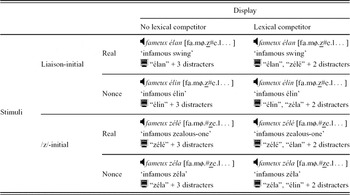
More specifically, the participants were asked to monitor nouns in temporarily, phonemically ambiguous adjective-noun sequences, where the adjective contained the latent consonant /z/ and the noun was either vowel- (i.e., liaison) or consonant- (i.e., /z/-) initial (e.g., fameux élan [fa.mø.z#e.lɑ̃] ‘infamous swing’ vs. fameux zélé [fa.mø.#ze.le] ‘infamous zealous-one’). The temporary ambiguity in the stimuli allowed for a cohort effect in the conditions where both the target (e.g., “élan”) and its lexical competitor (e.g., “zélé”) were present on the display, thus providing a precise examination of the lexical activation and selection process for liaison- and consonant-initial words. The stimuli were limited to the pivotal consonant /z/, because it made it possible to tease apart orthography, native language and parsing heuristic effects from language learning effects while ensuring that L2 learners would have received sufficient exposure to liaison: /z/ is the most frequent liaison consonant (e.g., Durand & Lyche, Reference Durand and Lyche2008), but it is a very infrequent word onset in French (e.g., New, Pallier, Ferrand & Matos, 2001). If L2 learners are sensitive to this predictive dependency in the input, as their proficiency increases in French, they should recognize vowel-initial words preceded by liaison /z/ more easily than /z/-initial words, at least for a period of time, because such a parsing procedure would be very efficient given the high frequency of liaison /z/ and the low frequency of word-onset /z/. Importantly, if their parsing procedure is phonologically abstract, this successful segmentation of liaison-initial words should apply to both real and nonce words.
Method
Participants
Thirty-three adult native speakers of English who had learned French as a second or foreign language (experimental group; age 18–31, 26 females, 7 males) and ten adult native speakers of French from France (control group; age 19–40, 5 females, 5 males) participated in this study. The native speakers of English and the native speakers of French did not speak languages other than, respectively, English and French before puberty. They had normal or corrected-to-normal vision and did not have hearing problems. Most of them were undergraduate and graduate students at a Midwestern university in the United States.
The L2 learners had completed at least four semesters of French at the time of the study, and most of them had little exposure to French before the onset of puberty. Their proficiency in French was identified with the help of a cloze (i.e., fill-in-the-blank) test, which was administered after the main experiment. Such tests are commonly used as proficiency measures in L2 research, because they correlate highly with standardized proficiency tests (e.g., Bachman, Reference Bachman1985; Fotos, Reference Fotos1991). The validity, reliability and discriminability of the particular cloze test used in this study had been established independently (Tremblay, to appear; Tremblay & Garrison, Reference Tremblay, Garrison, Prior, Watanabe and Lee2010). The L2 learners were evenly divided into three proficiency groups (conveniently labeled as low, mid, high) on the basis of their cloze test scores.
The participants completed a language background questionnaire in which they specified relevant biographical information. For the L2 learners, this information included their age of first exposure to French, their number of years of instruction in/on French, the number of months they had spent in a French-speaking environment, their percent weekly use of French, and their self-rated proficiency in French. The L2 learners’ cloze test scores and biographical information are provided for each proficiency group in Table 1.
L2 learners’ biographical information.

note: Mean (standard deviation)
aAge of first exposure to French
bNumber of years of instruction in/on French
cMonths of residence in a French-speaking environment
dPercent weekly use of French
eSelf-rated proficiency in French (1 = beginner; 2 = intermediate; 3 = advanced; 4 = near-native)
To validate the cloze test scores, a factor analysis was conducted on the language background variables, and the resulting components entered into a linear regression analysis as predictors of the cloze test scores. The factor analysis revealed two underlying components. For the first component, years of instruction in/on French and percent weekly use of French yielded the strongest loading (respectively, .89 and .81), followed by self-rated proficiency (.68), age of first exposure to French (−.45), and months of immersion in a French-speaking environment (.29). This first underlying component, which seems to approximate the L2 learners’ knowledge and use of French, accounts for 44.3% of all the variance in the language background variables. For the second component, age of first exposure to French and months of immersion in a French-speaking environment yielded the strongest loading (respectively, .79 and .77), followed by self-rated proficiency in French (.48), percent weekly use of French (−.17) and years of instruction in/on French (−.06). This second underlying component, which appears to approximate the span of time that the L2 learners have been exposed to French, accounts for 29.4% of all the variance. Together, the two underlying components account for 73.7% of all the variance in the language background variables. Using regression equations, z-scores were derived from each component and entered into a linear regression analysis as predictors of the cloze test scores. The model that included the two components was found to be a reliable predictor of the cloze test scores, accounting for 45% of all the variance in the cloze test scores (df = 2,30; constant: B = 21.394, SE = .780; knowledge and use of French: B = 3.450, SE = .792, β = .592, p < .001; span of time that the L2 learners have been exposed to French: B = 1.792, SE = .792, β = .308, p < .031). These results validate the cloze test scores and proficiency groups that were formed accordingly. The two underlying components identified in this factor analysis will be considered in the analysis and interpretation of the results.
Materials
The experimental stimuli were neutral sentences containing a singular adjective and a noun (i.e., the target) in direct object position (e.g., Kim regarde le [adjective + noun] . . . ‘Kim is looking at the [adjective + noun] . . .’). Three factors were manipulated: the onset of the target in the stimuli, which was vowel- (i.e., liaison-) initial or /z/-initial (e.g., fameux élan [fa.mø.z#e.lɑ̃] ‘infamous swing’ vs. fameux zélé [fa.mø.#ze.le] ‘infamous zealous-one’), the nature of the word (real vs. nonce), and the presence or absence of a lexical competitor in the display (respectively, “zélé” and “élan”). The conditions with a competitor were used to determine how the participants resolve the temporary ambiguity between liaison- and /z/-initial words, and those without a competitor served as baselines. The eight conditions that resulted from crossing these three variables are summarized in Table 2.
Experimental conditions.

The liaison consonant was lexical (i.e., it belonged to the adjective) rather than morphological (e.g., plural /z/), because agreement morphology is known to pose independent difficulties for non-native speakers (e.g., Lardiere, Reference Lardiere2006). The adjectives curieux ‘strange’, coûteux ‘costly’, douteux ‘doubtful’, fâcheux ‘upsetting’, fameux ‘infamous’ and précieux ‘precious’ were used before the target nouns, because they were frequent prenominal disyllabic adjectives that could trigger a lexical liaison with /z/. It was not possible to use adjectives that end in “s” in the orthography, as gros ‘big’ and mauvais ‘bad’ are the only ones that can be used in prenominal position and would have had to be repeated too many times during the experiment. The real words were controlled for lemma frequency between liaison- and /z/-initial conditions using the Lexique database (www.lexique.org; New et al., Reference New, Pallier, Ferrand and Mattos2001). The nonce words approximated the real words in the phonemic content of their first syllable and its following onset (e.g., élin for élan, zéla for zélé). As much as possible, all the words were controlled for graphemic length within display and between liaison- and /z/-initial conditions. Twenty-four experimental word pairs (12 with real nouns, 12 with nonce nouns) were selected/created for the experiment (for a complete list, see the Appendix).Footnote 5
The nonce words and the critical sentences were evaluated by a native French speaker other than the author. The nonce words were rated as to whether they sounded like possible masculine words in French, and those that were judged as sounding feminine were revised by altering the ending of the word. The critical sentences with real words were rated for plausibility bias toward the target or competitor, those that were judged as being biased toward one or the other (prior to the target word) were revised by altering the preamble and/or using a different adjective. Finally, the critical sentences were evaluated for naturalness, and those that did not sound natural were revised until they did.
The 48 critical targets were heard twice in the experiment (once in the condition without lexical competitor, once in the condition with the lexical competitor), but a different preamble preceded them each time. They appeared on the display with distracter words that began with a consonant other than /z/ or /s/. In each trial, the words appearing together on the display were either real words or nonce words (not both). The 96 experimental trials were interspersed with 144 filler trials (72 with real words, 72 with nonce words). The filler trials included words that were heard twice and seen three times during the experiment so that the critical trials would not stand out. To further distract the participants from the exact purpose of the experiment, some of these words were semantically related (real words) or had their syllables inverted (nonce words). They also varied in length (1–4 syllables) and were heard in different positions in the sentence (subject, direct object, indirect object, etc.).
One consequence of limiting the critical items to the pivotal consonant /z/ is that the experiment contained more /z/-initial words than one would typically hear in French. The /z/-initial words might thus stand out to the native speakers, who would not be used to their unusual distribution in the experiment, but perhaps not to the L2 learners, who frequently hear /z/-initial words in English. This limitation of the design will be considered in the interpretation of the results.
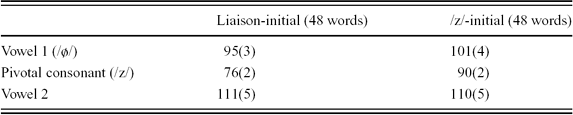
The auditory stimuli were recorded by a female native speaker of French from Paris using a Marantz PMD 750 solid-state recorder and head-mounted condenser microphone. The sentences were recorded as neutrally as possible, with no pause in the sentence and no contrastive accent on any of the words. They were then normalized for amplitude, and acoustic analyses of the adjective-noun sequence in the critical stimuli were performed in PRAAT (Boersma & Weenink, Reference Boersma and Weenink2007). The pivotal consonant and its surrounding vowels were segmented using formant transitions (e.g., Turk, Nakai & Sugahara, Reference Turk, Nakai, Sugahara, Sudhoff, Lenertóva, Meyer, Pappert, Augurzky, Mleinek, Richter and Schließer2006). The duration of these three segments were then extracted. Table 3 presents the results of the acoustic analyses.
Duration of the pivotal consonant and its surrounding vowels (milliseconds).

note. Mean (standard error)
As can be seen in Table 3, /z/ and the vowel preceding it are shorter in liaison contexts than in word-onset contexts. Repeated-measures ANOVAs with onset as within-item factor confirmed that this difference was significant, but only for the pivotal consonant (F[1,47] = 26.788, p < .001; vowel 1: F[1,47] = 1.847, p < .181; vowel 2: F < 1). These results indicate that at least the duration of the pivotal consonant in the stimuli can potentially help the participants distinguish liaison- from /z/-initial words prior to disambiguation in the stimuli. It should be noted, however, that not all the stimuli are good exemplars of the acoustic-phonetic differences between liaison- and /z/-initial words, with some of them even showing the reverse pattern of what is found in the overall means.
Since different recordings of the same words were heard in the conditions with and without a lexical competitor, to ensure the stimuli in these two conditions were equivalent, a second repeated-measure ANOVA was conducted on the duration of /z/, with onset as within-item factor and lexical competitor as between-item factor. This analysis did not reveal a significant effect of lexical competitor (F[1,46] = 1.941, p < .170) or a significant lexical competitor × onset interaction (F < 1), thus confirming that the stimuli were equivalent in the conditions with and without a lexical competitor.
Procedures
The participants completed the experiment inside a booth in a quiet room. The experiment was designed and compiled with Experiment Builder software (SR Research), and the participants’ eye movements were recorded with a desktop-mounted EyeLink 1000 eye-tracker (SR Research). The signal from the eye-tracker was sampled every millisecond. A chin rest was used to minimize the participants’ head movements. An ASIO-compatible sound card was used on the display computer to ensure that the audio timing would be accurate.
The experiment began with a calibration of the eye-tracker using the participants’ right eye. This initial calibration was followed by a practice session of ten trials and by the main experiment. In each trial, the participants saw four orthographic words in a (non-displayed) 2 × 2 grid for 4,000 milliseconds. This long reading time ensured that the L2 learners would be able to read each word before the onset of the auditory stimulus. The words then disappeared and a fixation cross appeared in the middle of the screen for 500 milliseconds. As the fixation cross disappeared, the four words reappeared on the screen and the auditory stimulus was heard (synchronously) under JVC HA-G101 headphones. The participants were instructed to click on the target with the mouse as soon as they heard the target word in the stimulus. The participants’ accuracy rates, their reaction times and their eye movements were recorded, with the latter two being measured from the onset of /z/ in the critical trials. Given the duration of /z/ and of the following vowel in the acoustic analyses, the target words disambiguated at approximately 187 milliseconds in the liaison-initial conditions and at 200 milliseconds in the /z/-initial conditions. Since it takes approximately 200 milliseconds for the eye movements to reflect auditory processing, target fixations should begin to diverge from distracter fixations at 387 milliseconds and 400 milliseconds for the two onset conditions (this 13-millisecond difference will be considered in the interpretation of the results). The trial ended with the participants’ response, with an inter-trial interval of 1,000 milliseconds.
The experimental and filler trials were presented in four blocks, with each block containing three items from each condition, and with no more than one word from each experimental word pair being heard in each block. The order of presentation of the forty-eight adjective–noun sequences was balanced such that half of them were heard for the first time in the condition without a lexical competitor and half of them were heard for the first time in the condition with a lexical competitor. This neutralizes the potential effect that order of presentation may have had on the results. Both the order of the critical and filler items within block and the order of blocks were randomized across participants. The participants took a break after completing the second block, and the eye-tracker was recalibrated at the beginning of the third block and whenever the eye-tracker lost the participant's pupil. Since the regions of interest corresponding to each word in the display were sufficiently large, more frequent calibrations of the eye-tracker were not deemed necessary. The experiment took between 40 and 50 minutes to complete.
One potential concern with the word pairs selected for the experiment is that the low frequency of some of the real words might make the task difficult for the L2 learners, even if they were given some time to read all the words on the display before they heard the stimulus in each trial. To determine whether the L2 learners’ prior knowledge of these words could explain their performance on the experiment, at the end of the experimental session, the participants were asked to rate their knowledge of the real words on a scale from 0 to 3 (0 = “I have never seen/heard this word”; 1 = “I have seen/heard this word, but I don't know what it means”; 2 = “I have seen/heard this word and I know what it means in context, but I could not provide a definition for it”; 3 = “I have seen/heard this word, I know what it means, and I can provide a definition for it”). Similarly, to establish whether the L2 learners’ knowledge of the phonemic form of the real and nonce words (the latter based on their spelling) played a role in their recognition of these words, the participants were also asked to rate their ability to pronounce these words on a scale from 0 to 2 (0 = “I do not know how to pronounce this word”; 1 = “Given its spelling, I think I might know how to pronounce this word”; 2 = “I definitely know how to pronounce this word”). These ratings will be considered in the analysis and interpretation of the results.
Data analysis and predictions
Trials that received distracter responses (rather than target or competitor responses) and/or that did not have any fixations in the region of interest of the target word were excluded from the analyses. This resulted in the exclusion of 4.8% of the data.
For the remaining test items, statistical analyses were conducted on the subject (1) and item (2) means (accuracy rates, reaction times and eye fixations). Eye movements were analyzed as the proportion of fixation in one of the four regions of interest for each 100-millisecond time window, from 0 to 1,000 milliseconds. Since L2 learners’ proportions of target and distracter fixations typically began to diverge at 400 milliseconds, only the last six 100-millisecond windows entered the statistical analyses. For the accuracy rates and reaction times, the within-subject variables were onset (liaison-initial, /z/-initial), word type (real, nonce) and competitor (yes, no). For the eye movements, the within-subject variables were time window (six levels, one for each window), onset and word type, and the analyses were conducted separately for the conditions without and with a lexical competitor to reduce the number of factors in the analysis and facilitate the interpretation of the results. In itself, the effect of time window is uninteresting, but the interaction between time window and other variables is relevant, as it can indicate that a particular variable has an effect on the speed with which given targets are recognized. For the time-window variable, whenever Mauchly's test indicated that the assumption of sphericity was violated, the Greenhouse Geisser correction was applied to correct the degrees of freedom; in such cases, for simplicity, the epsilon (ɛ) value is reported together with the unadjusted degrees of freedom. Given the unequal number of native and non-native speakers, the statistical analyses were conducted separately for each group. For the latter group, proficiency (low, mid, high) also entered the statistical analysis as a between-subject variable. Effects are considered significant at an alpha level of .05. To streamline the presentation of the results, p values will be considered significant if they are smaller than the alpha level in both subject and item analyses, and they will be considered marginally significant if they are smaller than the alpha level in either the subject or the item analysis and the other p value is reasonably close to alpha.
If the participants have more difficulty recognizing liaison-initial words than /z/-initial ones, whether this difficulty is due to a potentially universal parsing heuristic (e.g., Dumay et al., Reference Dumay, Frauenfelder and Content2002; Norris et al., Reference Norris, McQueen, Cutler and Butterfield1997) or, for L2 learners, to the influence of orthography and the native language, slower reaction times, lower accuracy rates and smaller proportions of fixations should be found for liaison-initial targets than for /z/-initial ones in corresponding trials, at least in the conditions with a lexical competitor and possibly also in the conditions without one. In other words, the difficulty in recognizing liaison-initial words would be reflected in a delay in fixating targets in liaison-initial trials relative to /z/-initial trials. Importantly, when a /z/-initial lexical competitor is present in the display, the participants would initially fixate the /z/-initial competitors before realizing that their hypothesis is incorrect, resulting in an even greater delay in recognizing liaison-initial targets (as compared to trials without a /z/-initial lexical competitor).
If, on the other hand, predictive dependencies in the input instead drive the segmentation of liaison-initial words, given the high frequency of liaison /z/ but the low frequency of word-onset /z/ (e.g., New et al., 2001), the participants should show faster reaction times, higher accuracy rates and greater proportions of fixations to liaison-initial targets than to /z/-initial ones in corresponding trials, especially in the presence of a lexical competitor. That is, the difficulty in recognizing /z/-initial words would be reflected in a delay in fixating targets in /z/-initial trials relative to liaison-initial trials, and when a liaison-initial lexical competitor is present in the display, the participants would initially fixate the liaison-initial competitors before realizing that their hypothesis is incorrect, resulting in an even greater delay in recognizing /z/-initial targets (as compared to trials without a liaison-initial lexical competitor). Alternatively, native speakers, but not L2 learners, might recognize /z/-initial words more rapidly than liaison-initial ones due to the unusual distribution of /z/-initial words in the experiment.
Finally, if acoustic-phonetic information facilitates the recognition of liaison-initial words, we might expect no asymmetry between the two word types, at least in the conditions without a lexical competitor, and possibly also in the conditions with one.
Results
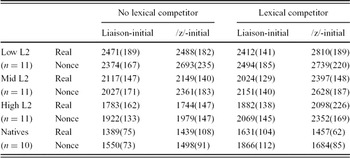
The participants’ reaction times for identifying the target words are provided for each condition in Table 4. For real words, L2 learners recognized liaison-initial targets more rapidly than /z/-initial targets in the presence of a lexical competitor, and for nonce words, they recognized liaison-initial targets more rapidly than /z/-initial targets whether or not a lexical competitor was present on the display. By contrast, for real words, native speakers recognized liaison-initial targets more slowly than /z/-initial targets in the presence of a lexical competitor, and for nonce words, they recognized liaison-initial targets more slowly than /z/-initial targets, especially if a lexical competitor was present in the display.
Participants’ reaction times.

note: Mean (standard error)
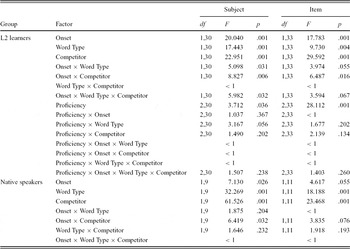
Mixed 2 × 2 × 2 × 3 ANOVAs were performed on L2 learners’ reaction times, with onset (liaison-initial, /z/-initial), word type (real, nonce) and competitor (yes, no) as within-subject variables, and with proficiency (low, mid, high) as between-subject variable. Similar 2 × 2 × 2 repeated-measures ANOVAs were conducted on native speakers’ reaction times, but without proficiency as between-subject variable. These statistical analyses are reported in Table 5.
Statistical analyses on the participants’ reaction times.

The statistical analyses conducted on L2 learners’ reaction times revealed main effects of onset, word type and competitor, as well as a marginally significant interaction between onset and word type, a significant interaction between onset and competitor, and a marginally significant three-way interaction between onset, word type and competitor. No other significant interaction between the within-subject variables was found. The statistical analyses also yielded a main effect of proficiency, but no interaction between proficiency and any of the within-subject variables. Given the significant two-way and three-way interactions, additional paired-samples t-tests with onset as within-subject variable were conducted separately on real and nonce words in the conditions without and with a lexical competitor. The post-hoc analyses revealed a significant effect of onset for real words with a lexical competitor (t 1[32] = −4.565, p < .001; t 2[35] = −3.800, p < .001), nonce words without a lexical competitor (t 1[32] = −2.797, p < .002; t 2[35] = −3.329, p < .002) and nonce words with a lexical competitor (t 1[32] = −4.871, p < .001; t 2[35] = −3.754, p < .001), but not for real words without a lexical competitor (−1 < ts < 1).
For native speakers, the statistical analyses revealed a marginally significant main effect of onset, a main effect of word type and a main effect of competitor, as well as a marginally significant interaction between onset and competitor. No other significant interaction between the within-subject variables was found. Subsequent repeated-measures ANOVAs conducted separately on the conditions without and with a lexical competitor yielded a main effect of onset only in the conditions with a lexical competitor (F 1[1,9] = 9.895, p < .012; F 2[1,11] = 5.338, p < .041; conditions without a lexical competitor: Fs < 1).
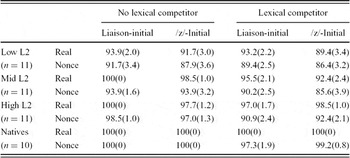
The participants’ accuracy rates for identifying the targets are presented in Table 6. The asymmetry between liaison- and /z/-initial targets that the participants showed in the reaction times decreased for L2 learners and disappeared for native speakers in the accuracy rates.
Participants’ percent accuracy rates.

note: Mean (standard error)
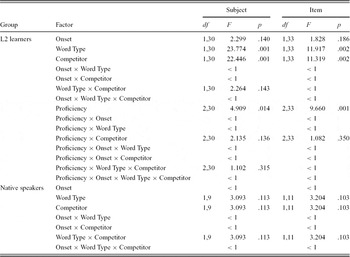
Mixed 2 × 2 × 2 × 3 ANOVAs were performed on the L2 learners’ percent accuracy rates, with the same within- and between-subject variables as the analyses conducted for the reaction times. Similar 2 × 2 × 2 repeated-measures ANOVAs were conducted on native speakers’ percent accuracy rates, but without proficiency as between-subject variable. These statistical analyses are reported in Table 7.
Statistical analyses on the participants’ accuracy rates.

The statistical analyses performed on L2 learners’ accuracy rates revealed only main effects of word type and competitor; unlike the reaction times, they did not reveal a main effect of onset or significant interactions between any of the within-subject variables. The statistical analyses also yielded a significant effect of proficiency, but no interaction between proficiency and any of the within-subject variables. For native speakers, whose results were at ceiling, the statistical analyses did not reveal main effects or significant interactions between any of the within-subject variables.
To summarize, in line with the predictive dependencies of the input, when L2 learners showed an asymmetry in their recognition of liaison- and /z/-initial targets, they recognized the former more rapidly than the latter. This pattern of results was more prominent with nonce words than with real words, because with the former, it manifested itself whether or not a lexical competitor was present in the display. The fact that the target words were disambiguated on average 13 milliseconds earlier for liaison-initial targets than for /z/-initial ones cannot explain the much larger asymmetries that L2 learners showed in their reaction times. Their preference for liaison-initial words did not lead them to make significantly more errors on liaison-initial targets than on /z/-initial ones, but recall that the words were only temporarily ambiguous. L2 learners recognized the targets more rapidly and accurately as their proficiency in French increased, but otherwise their results patterned similarly across proficiency levels. The absence of a significant interaction between proficiency and either word type or competitor may have been due to a lack of power, but the main variable of interest here is onset and the interaction between it and proficiency did not approach significance.
Conversely, as predicted from the distribution of /z/-initial words in the experiment, when native speakers showed an effect of onset, it was in favor of /z/-initial targets for both real and nonce words, but this arose only when a lexical competitor was present in the display. Their accuracy rates did not parallel these results, perhaps because the words were only temporarily ambiguous and their results were already at ceiling.
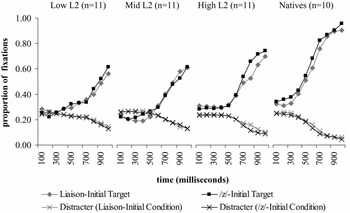
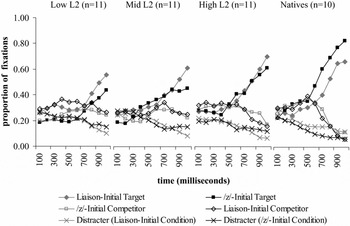
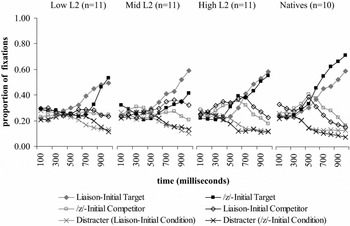
Figures 1 and 2 illustrate the participants’ proportions of target and distracter fixations for, respectively, the real and nonce words in the conditions without a lexical competitor. The x-axis represents time in milliseconds (from the onset of /z/), and the y-axis represents the proportions of target and distracter fixations. Note that for each group, the liaison- and /z/-initial conditions (seen in different trials and represented with different patterns) are plotted in the same area for the sake of comparison, and the proportion of distracter fixations plotted in the graphs represent the average proportion of fixation for the three distracter words that were seen on the screen. Recall liaison- and /z/-initial words disambiguated at, respectively, 187 and 200 milliseconds, and evidence for divergence between the proportions of target and distracter fixations should begin at approximately 387 and 400 milliseconds.
Proportions of target and distracter fixations for real words, no lexical competitor.

Proportions of target and distracter fixations for nonce words, no lexical competitor.

As can be seen in Figures 1 and 2, for real words, low- and mid-level L2 learners showed similar proportions of fixations to liaison- and/z/-initial targets, whereas high-level L2 learners appeared to fixate /z/-initial targets more than liaison-initial targets; on the other hand, for nonce words, all three proficiency groups showed earlier and greater proportions of fixations to liaison-initial targets than to /z/-initial ones, and the mid-level L2 learners more so than the low- and high-level L2 learners. By contrast, for both real and nonce words, native speakers fixated liaison-initial targets later and less than /z/-initial ones.
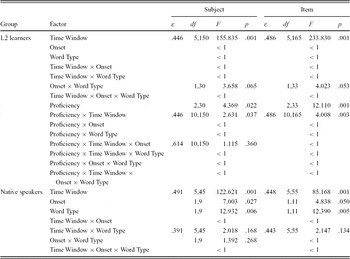
Mixed 6 × 2 × 2 × 3 ANOVAs were conducted on L2 learners’ proportion of target fixations in the conditions without a lexical competitor, with time window (six 100-millisecond windows), onset (liaison-initial, /z/-initial) and word type (real, nonce) as within-subject variables, and with proficiency (low, mid, high) as between-subject variable. Similar 6 × 2 × 2 repeated-measures ANOVAs were performed on native speakers’ proportion of target fixations in the conditions without a lexical competitor, but without proficiency as between-subject variable. These statistical analyses are provided in Table 8.
Statistical analyses on the participants’ eye fixations in the absence of a competitor.

The statistical analyses conducted on L2 learners’ proportion of target fixations revealed a main effect of time window and a marginally significant interaction between onset and word type. No other main effects or significant interactions were found for the within-subject variables. The same analyses also yielded a main effect of proficiency and a significant interaction between proficiency and time window, but not between proficiency and any of the other within-subject variables. Given the significant two-way interaction between onset and word type, subsequent repeated-measures ANOVAs were conducted separately on real and nonce words. These analyses indicated that the effect of onset was not significant for real words (Fs < 1), and it did not quite reach significance for the nonce words (F 1[1,30] = 1.870, p < .181; F 2[1,33] = 2.934, p < .096). For native speakers, the statistical analyses revealed main effects of time window, onset and word type. No interaction was found between the within-subject variables.
In brief, these results indicate that in the absence of a lexical competitor, L2 learners’ proportion of fixations to liaison- and /z/-initial targets differed as a function of whether they heard a real or nonce words, with only the latter showing a numerical tendency for liaison-initial targets to be fixated earlier and more than /z/-initial targets. The higher-level L2 learners recognized the target words more rapidly, but the proficiency groups did not show a different pattern of results, with the interaction between proficiency and the other within-subject variables not even approaching significance (unlike what Figure 1 suggests for the high-level L2 learners). These results contrast with those of the native speakers, who fixated liaison-initial targets later and less than /z/-initial ones whether or not the target words were real.
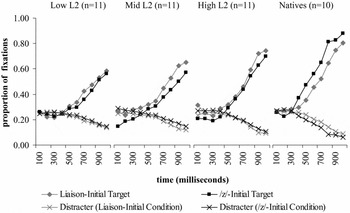
Figures 3 and 4 illustrate the participants’ proportions of target, competitor and distracter fixations for, respectively, the real and nonce words in the conditions with a lexical competitor. Again, for each group, the liaison- and /z/-initial conditions are plotted in the same area for the sake of comparison, and the proportion of distracter fixations plotted in the graphs represent the average proportion of fixation for the two distracter words that were seen. Divergence between the proportions of target and distracter fixations should begin at approximately 387 and 400 milliseconds, but a cohort effect should also be observed for the proportions of target and competitor fixations.
Proportions of target, competitor and distracter fixations for real words, lexical competitor.

Proportions of target, competitor and distracter fixations for nonce words, lexical competitor.

As shown in Figures 3 and 4, for real words, low-level L2 learners showed earlier and greater proportions of fixations to liaison-initial targets than to /z/-initial ones, with this effect decreasing and disappearing for the mid- and high-level L2 learners; on the other hand, for nonce words, the three proficiency groups fixated liaison-initial targets earlier and more than /z/-initial ones (especially the low- and mid-level L2 learners), and their proportions of target and competitor fixations began to diverge earlier when the target word was liaison-initial than when it was /z/-initial. Conversely, for both real and nonce words, native speakers fixated liaison-initial targets later and less than /z/-initial ones, and their proportions of target and competitor fixations began to diverge later for liaison-initial targets than for /z/-initial ones.
Mixed 6 × 2 × 2 × 3 ANOVAs were conducted on L2 learners’ proportion of target fixations in the conditions with a lexical competitor, with the same within- and between-subject variables as the analyses conducted for the proportion of target fixations in the conditions without a lexical competitor. Similar 6 × 2 × 2 repeated-measures ANOVAs were performed on native speakers’ proportion of target fixations in the conditions with a lexical competitor, but without proficiency as between-subject variable. These statistical analyses are presented in Table 9.
Statistical analyses on the participants’ eye fixations in the presence of a competitor.

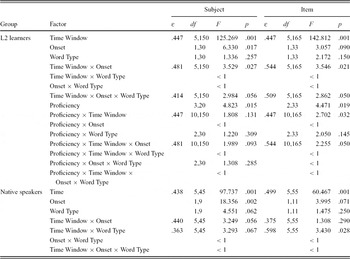
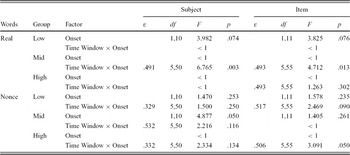
The statistical analyses performed on L2 learners’ proportion of target fixations revealed a main effect of time window and a marginally significant effect of onset, as well as a significant two-way interaction between time window and onset and a marginally significant three-way interaction between time window, onset and word type. For the within-subject variables, no other main effect or significant interaction was found. The analyses also yielded a main effect of proficiency, a marginally significant two-way interaction between proficiency and time window, and a marginally significant three-way interaction between proficiency, time window and onset. No other interaction between proficiency and the within-subject variables reached significance. Given the marginally significant three-way interactions between time window, onset and word type, and between proficiency, time window and onset, subsequent repeated-measures ANOVAs with time window and onset as within-subject variables were conducted separately on real and nonce words for each proficiency group. These analyses are reported in Table 10.
Statistical analyses on each L2 group's eye fixations in the presence of a competitor.

For real words, the effect of onset almost reached significance only for the low-level L2 learners, and it interacted with time window only for the mid-level L2 learners. For nonce words, the effect of onset was marginally significant only for the mid-level L2 learners, and it interacted marginally with time window only for the high-level L2 learners.
For native speakers, the main statistical analyses (in Table 9) revealed a main effect of time window, a marginally significant effect of onset and a marginally significant interaction between time window and word type. No other main effect or interaction reached significance.
In short, these results indicate that in the presence of a lexical competitor, L2 learners showed earlier and greater proportions of fixations to liaison-initial targets than to /z/-initial ones, but importantly, the asymmetry attested between the two onset types decreased as L2 learners’ proficiency in French increased. For real words, only the low- and mid-level L2 learners tended to be affected by the onset of the target; for nonce words, only the mid- and high-level L2 learners were similarly affected, but the clear numerical tendencies observed for the low-level L2 learners suggest that the statistical analyses may not have reached significance for this group due to a lack of power. These findings, together with those presented for the conditions without a lexical competitor, suggest that lexical knowledge (to which I turn next) may have helped eliminate L2 learners’ preference for segmenting words preceded by the pivotal consonant /z/ as liaison-initial. The numerical asymmetries between the points in time at which the proportions of target and competitor fixations begin to diverge for liaison- and /z/-initial nonce words suggest, again, that the 13-millisecond difference between the disambiguation of the two onset types cannot be responsible for these results. Native speakers, unlike L2 learners, fixated liaison-initial targets later and less than /z/-initial targets, and they showed earlier fixations to real words than to nonce ones.
For L2 learners, the interaction between onset, word type and proficiency perhaps suggests that the more proficient L2 learners are, and thus the more familiar they are with real words, the less likely they are to show an effect of onset, here a cost for the processing of /z/-initial words. The numerically (but not statistically) higher familiarity ratings that the high-level L2 learners provided for the real words used in the experiment (low-level L2 learners: 0.99/3; mid-level L2 learners: 1.08/3; high-level L2 learners: 1.48/3; effect of proficiency: F 2(2,33) = 1.942, p < .159) are consistent with this hypothesis. It is unlikely, however, that L2 learners’ faster recognition of liaison-initial targets in the presence of a competitor is due to their better lexical knowledge of these words, as low- and mid-level L2 learners provided numerically (but not statistically) lower familiarity ratings for vowel-initial words than for /z/-initial ones (respectively: 0.81/3 vs. 1.17/3 for the low-level learners; 0.98/3 vs. 1.19/3 for the mid-level learners; 1.47/3 vs. 1.49/3 for the high-level learners; effect of onset and onset × proficiency interaction: F 2s < 1). Linear regression analyses were conducted on the reaction times and the proportions of target fixations averaged for the last six 100-milliseconds time windows, with the difference between L2 learners’ familiarity ratings for vowel- and /z/-initial words as predictor of the difference between L2 learners’ performance in the liaison- and /z/-initial conditions (real words). None of the analyses reached significance. These results indicate that while lexical knowledge may help reduce and eliminate the processing cost that L2 learners exhibit for /z/-initial targets, it is not responsible for it. The fact that this processing cost was even more present in the nonce word conditions further strengthens this interpretation of the results.
One might also wonder whether L2 learners’ knowledge of the phonemic form of the target real and nonce words (the latter based on the spelling of the words) is responsible for their faster recognition of liaison-initial targets relative to /z/-initial ones. The ratings that L2 learners provided for their ability to pronounce the vowel- and /z/-initial words used in the experiment are very similar, however, and they are higher for vowel-initial words only for the high-level L2 learners, who show the least asymmetry between liaison- and /z/-initial targets in the experiment (respectively: 1.44/2 vs. 1.44/2 for the low-level L2 learners; 1.56/2 vs. 1.66/2 for the mid-level L2 learners; 1.95/2 vs. 1.84/2 for the high-level L2 learners; effect of onset: F 2 < 1; onset × proficiency interaction: F 2(2,33) = 3.045, p < .061). As with the word familiarity ratings, linear regression analyses were performed on the reaction times and the proportion of target fixations averaged for the last six 100-milliseconds time windows, with the difference between L2 learners’ pronunciation ratings for vowel- and /z/-initial words as predictor of the difference between L2 learners’ performance in the liaison- and /z/-initial conditions (separately for real and nonce words). The only analysis that reached significance did so for the averaged proportions of eye fixations in the real word condition without a lexical competitor (constant: B = −3.388, SE = 3.055; difference between L2 learners’ pronunciation ratings for real vowel- vs. /z/-initial words: B = −26.601, SE = 12.599, β = −.340, p < .042), and it was in the opposite direction of what we would have predicted (the results showed that the better the ability to pronounce vowel-initial words, the lower the averaged proportions of fixations to liaison-initial targets), raising the possibility that the linear regression yielded a Type I error but also questioning the validity of the pronunciation ratings. These results strongly suggest that L2 learners’ knowledge of the phonemic form of the target real and nonce words, at least as assessed by their pronunciation ratings, is not responsible for their faster recognition of liaison-initial targets in the experiment.
Finally, to investigate the relationship between L2 learners’ language learning experience and the asymmetry they evidenced in their recognition of liaison- versus /z/-initial targets, step-wise linear regression analyses were performed on the reaction times and the proportion of target fixations averaged for the last six 100-milliseconds time windows, with the two underlying components identified in the analysis of the language background information (knowledge and use of French, and the span of time that the L2 learners have been exposed to French; for details, see the Participants section) as predictors of the difference between L2 learners’ performance in the liaison- and /z/-initial conditions. These analyses reached significance for the first factor in L2 learners’ reaction times on nonce words without a lexical competitor (constant: B = –236.485, SE = 78.660; knowledge and use of French: B = 195.276, SE = 79.880, β = .402, p < .020) and on real words with a lexical competitor (constant: B = −328.788, SE = 64.363; knowledge and use of French: B = 196.886, SE = 65.361, β = .476, p < .005), both indicating that the effect of onset decreases as L2 learners’ knowledge and use of French increases.Footnote 6 These findings indicate that L2 learners’ preference for liaison-initial words weakens as they learn more of the language and eventually realize that /z/-initial words can also be encountered in French.
Let us now turn to a discussion of the present findings and their implications for understanding non-native listeners’ development of a parsing procedure for segmenting liaison-initial words in continuous speech.
Discussion
At the onset of this study, it was predicted that English L2 learners of French might have more difficulty recognizing liaison-initial targets than /z/-initial ones due to the misalignment of the syllable and word boundaries that liaison creates. This misalignment was hypothesized to cause word segmentation difficulties due to the orthography (with liaison consonants being attached to the first word), to the native language (which does not have a phonological resyllabification process like liaison) and to potentially universal parsing heuristics (e.g., Dumay et al., Reference Dumay, Frauenfelder and Content2002; Norris et al., Reference Norris, McQueen, Cutler and Butterfield1997). It was also predicted that if acoustic-phonetic information instead facilitates the recognition of liaison-initial words, no asymmetry might be found between the two word types. Finally, it was hypothesized that if L2 learners are sensitive to predictive dependencies in the input, they might in fact segment liaison-initial words more easily than /z/-initial ones due to the high frequency of liaison /z/ and the low frequency of word-onset /z/ in French (unlike in English).
In line with this third prediction, the results showed that without sufficient lexical knowledge of the target words, and especially in the presence of a lexical competitor, L2 learners recognized liaison-initial targets earlier and more rapidly than their /z/-initial counterparts. This asymmetry was found for the lower-level L2 learners’ recognition of real words in the presence of a lexical competitor and for L2 learners’ recognition of nonce words, and it was not linked to L2 learners’ greater familiarity with (for real words) or better phonemic knowledge of (for real and nonce words) vowel-initial targets. This means that from very early on, L2 learners become able to represent liaison consonants as syllable onsets and segment vowel-initial words at the offset of these consonants, with this parsing procedure being overapplied to contexts where /z/ is not resyllabified. These findings suggest that the knowledge of liaison that L2 learners have developed is not strictly lexical: Although it is derived in part from existing words, it is consistently applied to nonce words, with L2 learners computing the probability of occurrence of /z/ in liaison and word-onset contexts and segmenting words accordingly, regardless of the word itself. This suggests that some generalization has taken place. Since English does not have a phonological resyllabification process like liaison, it seems reasonable to conclude that, prior to this study, L2 learners passed through a stage during which they learned to represent liaison /z/ as a syllable onset and segment vowel-initial words following that consonant accordingly. The decrease in the overapplication of this parsing procedure as L2 learners’ knowledge and use of French increases suggests that these L2 learners underwent what appears to be a U-shaped development.
These findings make sense in the light of the liaison consonant examined: /z/ is the most frequent liaison consonant (e.g., Durand & Lyche, Reference Durand and Lyche2008), but also one of the least frequent word onsets in French (e.g., New et al., Reference New, Pallier, Ferrand and Mattos2001). In the absence of lexical knowledge, using a parsing procedure that predictably segments French words at the offset of /z/ in the early stages of development will result in much more efficient parsing, given the high frequency of vowel-initial words and the likelihood that they will be preceded by liaison /z/. Such findings are consistent with L2 processing theories that assume parsing failure to drive much of the learning (e.g., Carroll, Reference Carroll2001; VanPatten, Reference VanPatten1996), and they suggest that non-native listeners can develop new parsing procedures for efficiently segmenting the target language, unlike what has been proposed for the use of rhythmic cues in L2 speech segmentation (e.g., Cutler et al., Reference Cutler, Mehler, Norris and Segui1992). What is unclear from the present study is whether similar findings would be found for other liaison consonants (e.g., /n/ and /t/). A parsing-failure-driven theory of L2 processing would predict that non-native listeners’ preference for liaison-initial words would disappear with other liaison consonants, because the same consonants occur much more frequently as word onsets, and so parsing them as liaison consonants would not necessarily be efficient.
The results also showed that when L2 learners have sufficient lexical knowledge of the target words, and in the absence of a lexical competitor, they do not display an asymmetry between liaison- and /z/-initial targets, recognizing both word types equally rapidly. It was predicted that such results might be found if the participants used acoustic-phonetic information for segmenting these words from the input. L2 learners’ similar recognition of real liaison- and /z/-initial targets in the absence of a lexical competitor, albeit null evidence, is consistent with this hypothesis. On the one hand, the fact that these results were found only for real words suggests that this acoustic-phonetic information, if it is indeed used, may be encoded at the lexical level rather than at a pre-lexical level, as otherwise it would also be used in the recognition of nonce words. On the other hand, it is possible that acoustic-phonetic cues, even if processed pre-lexically, play a less important role than other cues to word recognition, such as the relative likelihood of the occurrence of consonants in liaison and word-onset contexts. Mattys, White and Melhorn (Reference Mattys, White and Melhorn2005) proposed a hierarchy of cues to word recognition, with lexical cues dominating allophonic cues. The relative likelihood of occurrence of consonants in liaison and word-onset contexts is a distributional cue, one that is derived not only from the lexicon and from the co- occurrence of words in speech, but also from the underlying and surface positions of consonants in the syllable structure (e.g., with liaison consonants being in the lexical representation of the first word but being realized as the onset of the second word). If, in cases of uncertainty (e.g., with insufficient lexical knowledge, or when lexical competition arises), this distributional cue dominates acoustic-phonetic cues to liaison (which approximate allophonic cues), then we would expect listeners to rely on this distributional cue more than on acoustic-phonetic ones when parsing liaison-initial targets. The L2 learners’ results are compatible with this hypothesis, but research that specifically investigates the role of acoustic-phonetic cues in relation to distributional ones is needed to clarify this issue.
Unlike L2 learners, the native French speakers who completed the present eye-tracking experiment recognized /z/-initial targets more rapidly than liaison-initial ones. Although these findings are in line with research on the role of syllable onsets as segmentation points in word recognition (e.g., Content et al., Reference Content, Kearns and Frauenfelder2001; Dumay et al., Reference Dumay, Frauenfelder and Content2002), they are inconsistent with previous studies on the processing of resyllabified words in French (e.g., Gaskell et al., Reference Gaskell, Spinelli and Meunier2002; Spinelli et al., Reference Spinelli, McQueen and Cutler2003), which show that acoustic-phonetic information helps French listeners segment liaison-initial words from the speech signal. Yet, given the unusual distribution of /z/-initial words in the experiment (as compared to in French), it was hypothesized that these words might stand out for native speakers and, as a result, they might recognize them more rapidly than liaison-initial words. The present results are compatible with this possibility. Although some questions remain as to whether the native speakers’ results can indeed be attributed to the test items in the task, it is clear that the native and non-native listeners in the present study did not rely on the same segmentation strategies for recognizing liaison- and /z/-initial targets.
The results of this study may not be conclusive for the processing of liaison-initial words in native French, but they are quite revealing for the development of L2 word recognition: they indicate that some parsing procedures develop very early if they are essential for non-native listeners to be able to recognize words in the target language and if they are efficient for the purpose of word segmentation, to the extent that L2 learners may show evidence of a U-shaped development rather than slowly restructuring their existing representations. Furthermore, these parsing procedures appear to be phonologically abstract rather than strictly lexical, with L2 learners computing the probability of occurrence of phonemes in liaison and word-onset contexts and segmenting words accordingly, regardless of the word itself. These findings highlight the (often underestimated) learning capacity that L2 learners have, even if they began learning the target language shortly before the onset of puberty.
Conclusion
Using eye-tracking, the present study investigated the recognition of liaison-initial words by English-speaking L2 learners of French and native speakers of French. The results showed that L2 learners had little difficulty segmenting liaison-initial targets from the speech signal, and without sufficient lexical knowledge or in the presence of a lexical competitor, they overapplied this parsing procedure to contexts where the pivotal consonant was in fact not resyllabified. In contrast, native speakers recognized /z/-initial targets faster than liaison-initial ones, which may be due to the task itself, specifically the pivotal consonant examined and its unusual frequency in the experiment. Although several questions have yet to be answered, the results of this study helped to reach a better understanding of the factors that influence L2 learners’ development of parsing procedures for segmenting words in the target language.
Appendix: experimental noun pairs