Introduction
State and local public health workers play a critical role as first responders. They are often responsible for providing immediate community services and direct care as disaster events unfold, as observed during recent hurricanes, including Harvey, Irma, and Maria in 2017, Florence in 2018, and Dorian in 2019. Public health workers living in disaster-affected communities often experience significant personal challenges related to the disaster’s impact while concurrently providing care to others. Although studies have examined the psychological consequences of disasters in large samples of public health workers, Reference Akbayrak, Oflaz, Aslan, Ozcan, Tastan and Ciçek1-Reference Kerasiotis and Motta5 fewer have focused on behavioral factors related to hurricane exposure, such as hurricane preparedness. Furthermore, the role of protective characteristics such as collective efficacy, defined as social cohesion among neighbors along with their willingness to intervene for the common good, Reference Sampson, Raudenbush and Earls6 and its influence on behavioral preparedness for future disasters has not been often addressed.
Collective efficacy can be both an individual-level perception and a community-level capacity. Reference Fullerton, Ursano, Liu, McKibben, Wang and Reissman7,Reference Ursano, McKibben and Reissman8 Individual-level collective efficacy identifies each person’s perception of his/her neighborhood, and can vary across different individuals in the same neighborhood, whereas community collective efficacy is assessed at the group level, identifying the general perception of collective efficacy of residents in a particular zip code, community, or neighborhood. The majority of disaster mental health studies, which address neighborhood and social processes, measure and analyze them as individual-level variables, which identifies each person’s perception of the level of collective efficacy. Reference Benight9,Reference Norris, Stevens, Pfefferbaum, Wyche and Pfefferbaum10 In previous studies, collective efficacy has often been assessed as an outcome following disaster exposure. Individual-level perceptions of collective efficacy were examined 1 year after the small community of Buffalo Creek, Colorado was destroyed by a forest fire and then a flood within a 2-month period in 1996. Reference Benight9 In this study, fewer lost resources and higher perceived social support soon after the disaster was associated with higher collective efficacy 1 year later, which is suggested to influence a community’s beliefs in their ability to respond to future events. Reference Hobfoll11-Reference Kaniasty, Norris, Ursano, Norwood and Fullerton13 Common experiences during a disaster, such as the 2010 Chilean earthquake, often foster a shared social identity and perceived within group similarity, which result in efforts to act together towards the common good, Reference Drury, Jetten, Haslam and Haslam14,Reference Drury, Brown and Gonzalez15 such as instrumental and emotional social support actions of collective sharing of supplies and providing aid, and promotes community resilience to disaster. Alternatively, perceived collective efficacy was found to decrease in individuals who were exposed to the 2011 Queensland, Australia flood and cyclone events. Reference Fay-Ramirez, Antrobus and Piquero16 Reduction in collective efficacy post-disaster was most pronounced in those who were already socially and economically vulnerable, and perhaps lacking the social network and resources that would aid recovery. Reference Fay-Ramirez, Antrobus and Piquero16
In addition to investigating community characteristics, such as collective efficacy, as outcomes following disaster exposure, the level of collective efficacy prior to a disaster may also have a role in influencing behavioral outcomes following a disaster. At the community level, the willingness of community members to intervene for the common good depends on mutual trust and solidarity among neighbors. Reference Sampson, Raudenbush and Earls6,Reference Sampson, Jeffrey and Gannon-Rowley17 Collective efficacy involves both informal social control (i.e., willingness to intervene in neighborhood problems to enforce social norms and maintain social order) and social cohesion (i.e., attachment between individuals and their communities based on shared values, belongingness, and cooperation). Reference Sampson, Raudenbush and Earls6,18 Collective efficacy has been found to be protective, with higher levels of collective efficacy associated with a lower prevalence of intimate partner violence, antisocial behavior in adolescence, and neighborhood crime. Reference Sampson, Raudenbush and Earls6,Reference Browning19-Reference Sapouna22 Furthermore, community interventions that have incorporated efforts to increase collective efficacy have found improvements in behavioral health outcomes, Reference Butel and Braun23 including reductions in child injury suggesting maltreatment, Reference McDonell, Ben-Arieh and Melton24 and decreased youth alcohol and marijuana use and number of sexual partners. Reference Berg, Coman and Schensul25
Previous disaster exposure has been found to be related to increases in preparedness behaviors, Reference Malmin26 and engaging in disaster preparedness behaviors can reduce vulnerability to potential threats and promote resilience following disaster exposure. Reference Prior and Eriksen27 However, few studies examine the relationship of collective efficacy characteristics (e.g., social cohesion) to disaster preparedness behaviors. Reference Bihari and Ryan28,Reference Wei, Sim and Han29 Further, much of the research examining disaster preparedness focuses on perceived preparedness Reference Cagney, Sterrett, Benz and Tompson30-Reference Priyanti, Hidayah and Rosmaharani32 versus behaviors, which can be discrepant. Reference Bronfman, Cisternas, Repetto and Castañeda33 In a study of perceived preparedness and emergency preparedness behaviors, Reference Ferguson, Kiernan, Spannhake and Schwartz34 feeling completely prepared for a disaster was found to be associated with preparedness-related behaviors, including having an emergency plan and 3 days of food; however, approximately half of these respondents did not consistently report practicing certain preparedness behaviors, such as practicing emergency plans or having a designated meeting place, suggesting areas of possible risk. Welton-Mitchell and her colleagues found that almost 3 months after an earthquake in Nepal in 2015, Reference Welton-Mitchell, James and Khanal35 individuals with lower social cohesion, a feature of collective efficacy, reported fewer disaster preparedness behaviors. However, because this study was cross-sectional, it was not possible to examine the predictive influence of social cohesion on long-term preparedness behaviors.
The 2004 Florida hurricane season was unprecedented: 4 hurricanes (Charley, Frances, Ivan, and Jeanne) and 1 tropical storm (Bonnie) made landfall within a period of 7 weeks. Reference Acierno, Ruggiero and Galea36,37 The $4.85 billion in costs incurred for hurricane relief accounted for nearly 88% of the total disaster aid in 2004. 38 In 2005, there were 27 named storms, 14 of them hurricanes, resulting in the most hurricanes identified in a single season. 39 Hurricanes Dennis, Katrina, Rita, and Wilma were among the strongest that made landfall in Florida, with Katrina, Rita, and Wilma identified as Category 5 strength during their most severe periods over several southeastern US states. They together incurred over $124 billion in losses. 39 Hurricane Katrina itself resulted in a total of more than 1300 deaths and incurred over $100 billion in losses, making it one of the most destructive and costly hurricanes in U.S. history. In Florida, Hurricane Katrina was a Category 1 storm, incurring approximately $630 million in damages, primarily centered in southern Florida.
The 2004 and 2005 hurricane seasons provided a unique opportunity to examine public health workers of the Florida Department of Health (FDOH) who experienced both personal hurricane-related injuries and high levels of community storm damage. FDOH workers are responsible for coordination of community emergency and disaster preparation, response, and recovery, which distinguishes them from other categories of first responders, such as medical first responders and law enforcement. Their role in disaster planning and response highlights the importance of preparedness in this particular group of first responders. This study examined the association of individual-level, representing perceived, collective efficacy 1 month prior to the 2005 hurricane season with preparedness behaviors 9 months following the hurricanes in this population of FDOH public health workers. Severity of hurricane exposure, as assessed by individual and community storm/injury indicators, was taken into account, given the dose-response effects on psychological response found in previous research. Reference Galea, Nandi and Vlahov40 To our knowledge, this is the only longitudinal disaster mental health study to use perceived collective efficacy to predict subsequent hurricane preparedness behaviors. Understanding the factors that may influence preparedness could benefit public health workers who may be exposed to future disasters, as well as promote community planning, readiness, and response.
Methods
Participants and Procedures
The current study examines FDOH personnel who worked during both the 2004 and 2005 hurricane seasons, with assessment occurring 1 month prior to the 2005 hurricane season, in June 2005 (Time 1 (T1)) and 9 months after the 2005 hurricane season, in June 2006 (T2). Participants were 631 public health workers whose ages ranged from 21 to 72 years (M(SD) = 48.5 (10.15) years). The majority of the participants were female (78%, n = 491), White (82%, n = 516), and currently married (69%, n = 437), and 57% (n = 360) had a BA/BS degree or higher.
Study participation was voluntary. Questionnaires and a project description were distributed to all FDOH employees at each time point using the personnel e-mail distribution lists. The response rate for participants at T1 was 38.7% (recruitment details in McKibben et al., 2010 Reference McKibben, Fullerton and Ursano41 ), with an attrition rate of 26% at T2. All participants indicated agreement to participate by completing and returning a questionnaire that was transmitted electronically and de-identified. Participants were informed that the questionnaires included items regarding their work and personal experiences before and since the 2005 hurricane season. The study was approved by the Institutional Review Board of the Uniformed Services University of the Health Sciences in Bethesda, Maryland.
Measures
Collective efficacy
Collective efficacy was assessed at T1 (i.e., 1 month prior to the 2005 hurricane season) with a single item from the 10-item scale (range 10-50) employed by Sampson and colleagues. Reference Sampson, Raudenbush and Earls6 The original scale has 5 items in each of 2 domains: informal social control and social cohesion/trust. Each individual’s response to both 5-item, 5-point Likert scales (ranging from very likely to very unlikely and strongly disagree to strongly agree) were summed to a total score for individual-level collective efficacy. Informal social control includes 5 items that ask how likely it would be that their neighbors could be counted on to intervene if: a) children were skipping school and hanging out on a street corner; b) children were spray painting graffiti on a local building; c) children were showing disrespect to an adult; d) a fire broke out in front of their house; and e) if a fire station closest to their home was threatened with budget cuts. The social cohesion/trust scale includes 5 items that assess the extent to which participants agreed that in their home neighborhood: a) people are willing to help their neighbors; b) it is a close-knit neighborhood; c) people can be trusted; d) people generally get along with each other; and e) people share the same values. Higher scores indicate greater collective efficacy. Sampson and colleagues Reference Sampson, Raudenbush and Earls6 demonstrated high between-neighborhood reliability (ranging from 0.80 to 0.91) across 343 neighborhoods in Chicago, IL. There was a strong association between social cohesion and informal social control across neighborhoods (r = 0.80, P < 0.001), suggesting that these scales were measuring aspects of the same latent construct.
In this study, we examined a shorter version of the collective efficacy scale that consisted of a single item from the social cohesion/trust subscale that assessed how strongly participants agreed that people in their neighborhood were willing to help their neighbors. This item correlated strongly with the full collective efficacy (r = 0.76, P < 0.001) in a previous study examining this sample, Reference Fullerton, Mash, Wang, Morganstein and Ursano4 suggesting good concurrent and predictive validity.
Disaster preparedness behaviors
Hurricane preparedness was measured at T1 and 9 months after the 2005 hurricanes (T2) using these 7 items: (1) “Do you have a home emergency preparedness plan that all members of your household know about?”; (2) “Do you have at least 2 days of food and water?”; (3) “Do you have a flashlight?”; (4) “Do you have a portable radio?”; (5) “Do you have spare batteries?”; (6) “Do you have emergency phone numbers?”; and (7) “Do you have a plan to communicate with family and friends?” with response options of “yes” or “no.” These preparedness behavior items are disaster-specific and were derived from interviews with key informants at the FDOH. Expert consensus determined that that these items conceptually captured individuals’ disaster preparedness behaviors. Cronbach’s alpha for items at T1 = 0.67 and T2 α = 0.66. A mean total score of the 7 items was computed, and mean scores were categorized into 3 levels (low = 0-0.71 (20%); medium = 0.75-0.86 (20%); and high = 1.00 (60%)). Group categorization was established by evenly dividing participants who did not report all 7 preparedness behaviors into the low and medium preparedness groups. These groups indicate different levels of risk for subsequent disasters, with low preparedness signifying more risk.
Individual hurricane injury/damage
Injury/damage at the time of the 2005 hurricanes was assessed at T2 with the following question: “What kinds of problems or damage did you experience during the hurricane season?” The individual-level hurricane injury/damage variable was calculated based on whether participants had experienced any of the following 6 events during each of the 4 hurricanes: loss of electrical power; damage to vehicle; injury or harm to self; injury or harm to spouse/significant other; and injury/harm to children or injury/harm to pets. The possible range of individual injury/damage scores for the 4 hurricanes was 0-24, and a median split was used to identify low and high levels of injury/damage. Those reporting 2 or more of the events during the 4 hurricanes were considered to have high hurricane-related injury/damage (2005 hurricanes: n = 151, 24%). Dichotomizing this variable with 0 or 1 hurricane event signifying low injury/damage allows for the severity and degree of the personal hurricane impact to be assessed.
Community hurricane damage
In order to control for level of community damage, we used FEMA county data for the storms in 2005, 38 and identified the zip code level of FEMA public and individual assistance received. Each zip code was scored based on its highest community storm damage across the 4 storms to index the level of individual and public assistance received. We combined levels to create 5 levels of public assistance and, therefore, community storm damage. The level of community storm damage ranged from none (0) to individual assistance only (1) to increasing levels of public assistance with FEMA categories A to G (scored 2, 3, and 4). This level-2 variable was then centered.
Statistical Analysis
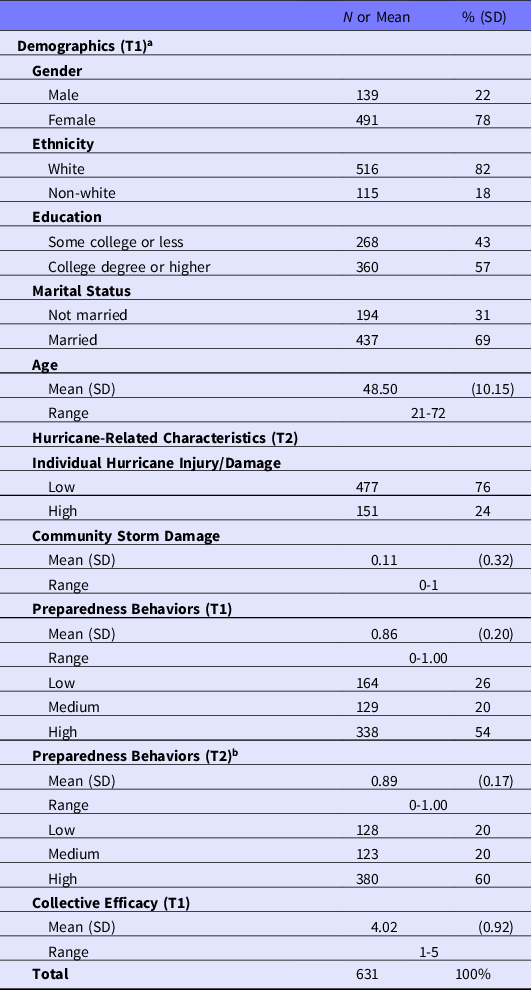
Potential individual- and community-level risk factors for hurricane preparedness during the 2005 season in FDOH employees were analyzed using linear regression analyses. Mean levels of collective efficacy and mean total scores of hurricane preparedness were computed using descriptive statistics, and are presented in Table 1. Preliminary univariate linear regression analyses examined socio-demographics (age, gender, education, race/ethnicity, and marital status at T1), hurricane-related characteristics (individual injury/damage and community storm damage effects related to the 2005 hurricanes at T2) and individual collective efficacy (T1) as predictors of hurricane preparedness 9 months following the multiple hurricanes in 2005 (T2). A separate multivariate model investigated the relationship of baseline collective efficacy and preparedness behaviors to hurricane preparedness following the 2005 hurricanes, adjusting for demographic and hurricane-related characteristics. An additional multivariate model that included the interaction of preparedness and collective efficacy at T1 was conducted. Statistical analyses were conducted using SPSS software Version 25 (IBM Corp, Armonk, NY). 42
Demographics, hurricane-related characteristics, preparedness behaviors, and collective efficacy

a T1 (Time 1) = Assessment 1 month prior to the 2005 hurricane season (June 2005).
b T2 (Time 2) = Assessment 9 months following the 2005 hurricane season (June 2006).
Results
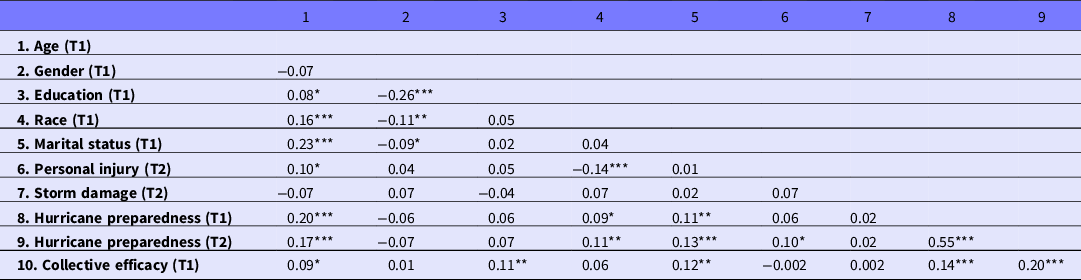
A month prior to the 2005 hurricanes (i.e., at T1), the average score for individual-level collective efficacy was 4.02 (SD = 0.92) (Table 1). At 9 months after the 2005 hurricanes (T2), 60% of participants (n = 380) reported a high level of hurricane preparedness, defined by having all 7 of the identified preparedness items (i.e., home emergency plan, 2+ days of food and water, flashlight, portable radio, spare batteries, emergency phone numbers, communication plan with friends and family). The mean hurricane preparedness score at T1 was 0.86 (SD = 0.20; range 0 - 1.00) and at T2 was 0.89 (SD = 0.17), indicating that the sample was highly prepared in general. Bivariate correlations among the variables are presented in Table 2.
Bivariate correlations of demographic and hurricane-related characteristics, hurricane preparedness, and collective efficacy

Note. *P < 0.05; **P <0 .01; ***P < 0.001.
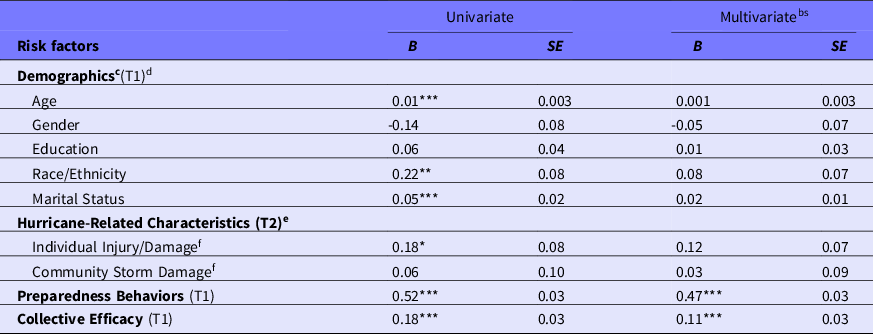
In a univariate model, being older (B = 0.1, SE = 0.003, R 2 = 0.03, P ≤ 0.001), White (B = 0.22, SE = 0.08, R 2 = 0.01, P ≤ 0.01), and married (B = 0.05, SE = 0.02, R 2 = 0.02, p ≤ 0.001) was associated with more preparedness following the 2005 hurricanes (Table 3). Further, FDOH workers who reported higher collective efficacy at T1 were more prepared following the 2005 hurricanes (B = 0.18, SE = 0.03, P ≤ 0.001), with collective efficacy accounting for 4% of the variance in hurricane preparedness. Hurricane preparedness at T1 was also related to preparedness following the 2005 hurricanes (B = 0.52, SE = 0.03, R 2 = 0.30, p < 0.001), as were personal injury and damage effects of the last hurricanes in 2005 (B = 0.18, SE = 0.08, R 2 = 0.01, P < 0.05).
Relationship of prior collective efficacy to hurricane preparedness behaviors following the 2005 hurricanes

Note: n = 599.
aPreparedness behaviors = mean total of seven preparedness items (no = 0; yes = 1); Low = 0-0.71; Medium = 0.75-0.86; High = 1.00.
b The multivariate model includes: demographics (age, gender, education, race, and marital status), hurricane-related characteristics (individual hurricane injury/damage, and community storm damage), preparedness behaviors (T1), and collective efficacy (T1), and accounts for 30.4% of the variance in preparedness behaviors at T2.
c Gender: Male = 0, Female = 1; Education: Some college or less = 0, College degree or higher = 1; Race: Non-white = 0, White = 1; Marital status: Unmarried = 0, Married = 1.
d T1 (Time 1) = Assessment 1 month prior to the 2005 hurricane season (June 2005).
e T2 (Time 2) = Assessment 9 months following the 2005 hurricane season (June 2006).
f Individual and/or family hurricane injury/damage from the 2005 hurricanes: Low (0-1) = 0, High (≥ 2) = 1.
*p ≤ 0.05, **p ≤ 0.01, ***p ≤ 0.001.
In a multivariate model predicting preparedness at T2, adjusting for socio-demographics and other hurricane-related characteristics, results for collective efficacy and preparedness for the 2004 hurricanes were similar. FDOH employees who reported higher levels of collective efficacy (B = 0.11, SE = 0.03, P < 0.01) and more preparedness behaviors (B = 0.47, SE = 0.04, P < 0.001) at T1 exhibited more preparedness behaviors following the 2005 hurricanes. The variables in the model together accounted for 30.4% of the variance in preparedness after the 2005 hurricanes. Inclusion of the interaction of preparedness with collective efficacy at T1 in a separate model did not indicate a significant association with preparedness following the 2005 hurricanes.
Discussion
First responders, including public health workers, have a critical role in the community during and following a disaster. Community responses to hurricanes involve extensive immediate and long-term support from local and national first responders, who are typically exposed to multiple disasters. The impact of hurricane exposure, and the responsibility of responding to a disaster while simultaneously experiencing personal injury and property damage, can have significant behavioral effects, including efforts to prepare for future disasters.
For workers who live in a disaster-affected community, as those in the current study, neighborhood factors, such as collective efficacy, can serve as resources, Reference Benight9 promoting resilience and influencing preparedness behaviors. The longitudinal design of this study extends previous research by highlighting the important contribution that perceived collective efficacy has on long-term behavioral response in public health workers exposed to multiple hurricanes. Among public health workers who responded to the 2004 and 2005 hurricane seasons, we found that higher levels of collective efficacy and preparedness prior to the 2005 hurricane season were associated with more disaster preparedness after the hurricanes.
In this sample of relatively well-educated public health workers, level of education did not predict degree of hurricane preparedness, as it is expected that their training emphasizes preparedness. However, participants who were married and older reported more hurricane preparedness after experiencing this series of hurricanes. These findings are comparable to results found in a study of behavioral preparedness for earthquakes and floods, Reference Bronfman, Cisternas, Repetto and Castañeda33 which indicated that respondents who were married and between the ages of 30-59 years reported the highest level of disaster preparedness (although those who were aged 60 years or older were the least prepared). This affiliation and responsibility for others may motivate married individuals to prepare for the safety of themselves and their family members. Reference Hoffmann and Muttarak43,Reference Sun and Sun44 In contrast, living alone has been associated with less disaster preparedness. Reference Sun and Sun44 Although age has been found to be positively associated with preparedness in previous studies, which may be due to disaster experience, Reference Hong, Kim and Xiong45 a particular vulnerability has been identified for older individuals, generally defined as age 65 or older, who may be relatively more socially isolated and limited in their daily activities and physical abilities to prepare for and respond to disasters. Reference Sun and Sun44,Reference Al-Rousan, Rubenstein and Wallace46,47 To address the possible effects of age/developmental stage in the current study, which may also be associated with previous disaster exposure and life events, we controlled for age and other demographics in our final analysis. Further, although the individual effects of the most recent hurricanes (i.e., the extent of injury and/or damage to oneself, one’s family, and one’s home) were related to level of hurricane preparedness, the level of storm damage experienced by the community was not associated with personal hurricane preparedness.
Collective efficacy prior to the hurricanes remained associated with hurricane preparedness, even after adjusting for the effects of socio-demographic characteristics and the level of individual and community hurricane-related injury and/or storm damage. This finding suggests that one’s perception of their community as cohesive, with neighbors willing to intervene during adverse circumstances for the common good of the community, is an important characteristic that may foster recovery both within the community and for individuals, which includes preparing for future disasters. This has particular significance for public health workers, who may be involved in disaster response and for whom operational readiness and being professionally and personally prepared is essential, in order to effectively support the community. The mutual trust and solidarity found in communities with higher collective efficacy promote experiences of safety, calming, optimism, and social support. Reference Hobfoll, Watson and Bell48 This is particularly important following a disaster, when residents in communities with higher collective efficacy are more likely to work together to make resources available for rebuilding, as well as provide mutual support and assistance. In addition, collective efficacy offers opportunities for communication and modeling of safety and planning behaviors, which benefit communities prior to and during disasters. To enhance a community’s resilience and security following a disaster, it is critical that not only do community members work together to develop their collective response, but that individuals take responsibility for their own and their family’s preparedness, both of which benefit the community. 49 Engaged community social networks, including faith-based organizations, schools, and workplaces, can collaborate in influencing preparedness education by providing opportunities to discuss preparedness and organize opportunities for disaster planning and training. 50 In this way, individuals who take care of each other by sharing information and materials, will also take care of themselves. Further, communities that are disaster-resilient are those that are able to function well and solve problems effectively under normal conditions. 49 Efforts to increase collective efficacy may have an impact on the mental health and economic recovery of the community post-disaster, Reference Brisson, Lopez and Yoder51-Reference Sherrieb, Norris and Galea53 and merits future study. Attention to other important neighborhood characteristics that have been related to disaster outcomes may also provide insight into the ways in which neighborhood characteristics may influence preparedness behaviors following a disaster, and should be examined in future research. These may include proximity to the disaster epicenter, extent of community loss or collective destruction, as well as preexisting community characteristics, including socioeconomic status and education. Reference Norris, Friedman, Watson, Byrne, Diaz and Kaniasty54
As collective efficacy and preparedness have received limited attention as factors influencing hurricane response in particular, efforts to identify common risk and protective factors across different types of natural disasters have important implications for our understanding of hurricane response and future preparedness. Previous research examining collective efficacy following exposure to forest fires and flooding indicated that resource loss and social support within one’s community are important factors in understanding disaster response. Reference Benight9 Understanding of the role of factors such as resource loss and social support, and their relationship to collective efficacy and preparedness, can have potential relevance and inform future study of hurricane response as well.
The present findings must be interpreted in terms of methodological considerations. This study focuses on an important population of public health workers, and will directly inform research on first responders; however, its generalization to other populations is limited and requires further study. Although previous studies have examined the effects of both individual and community-level collective efficacy following hurricane exposure using zip code-level data, Reference Fullerton, Ursano, Liu, McKibben, Wang and Reissman7,Reference Ursano, McKibben and Reissman8 the size of the current sample did not allow for assessment of community collective efficacy at the zip code level. Further examination of preparedness that extends beyond the behaviors identified in this study will promote additional understanding of this important construct. The behavioral preparedness items included in the current study were disaster-specific, and although they were applicable to hurricane preparedness, appropriate and effective behaviors may vary for different types of disasters. The individual injury/damage item categorization indicated that 2 or more hurricane-related events were considered a high level of injury/damage. Although there may be variation in the severity of the events (e.g., loss of electrical power versus injury to self), this dichotomization was determined to broadly identify levels of severity. Further examination of the features that would define event severity in future studies is needed. Despite the inclusion of a single item as a brief measure of collective efficacy in this study, additional research with a more robust assessment of this construct is recommended. The higher proportion of females in the study sample may reflect response bias versus the actual gender composition of the FDOH, and demographic characteristics have been controlled for in the study analyses. Importantly, although the data of the present study were collected in 2005 and 2006, given the increased prevalence of hurricane and tropical storm activity in the region related to progressive climate-related changes, understanding the behavioral responses of first responders to serial hurricanes, and the factors that may influence these responses, remains significant and timely. However, this examination may be necessarily limited by changes that may have occurred over time and within communities. The T2 survey administration was administered 9 months following the 2005 hurricane season, which may have affected participant recall. As the current study sample was comprised of FDOH workers, who are both responsible for responding to state disasters and typically live in Florida communities, the factors examined in this study can help inform readiness plans for these first responders. Although the initial response rate of 38.7% is relatively low, it is not uncommon for computer-based surveys. Reference Deutskens, Ruyter and Wetzels55-Reference Nulty57 The attrition rate found (26%) may be due to changes in employment and residence, among other life-related factors, which may reduce the number of FDOH workers who continued their participation at Time 2.
Our results suggest that efforts to strengthen collective efficacy in communities and public health workplaces during a period of stability will also prepare neighborhoods to effectively respond in the event of a subsequent disaster. This study demonstrates the significant relationship of perceived collective efficacy to hurricane preparedness following disaster response specifically in Florida DOH workers. Efforts to generalize these findings to other community populations, such as populations that may have less preparedness training than community health workers, are important and merit further examination. Awareness of the importance of collective efficacy in the community highlights the needs to incorporate methods that increase neighborhood cohesion and promote resilience. In particular, use of screening tools that assess collective efficacy may help in identifying populations that need additional support in preparing for future disasters, and can be an important addition to disaster planning efforts. Further, bolstering collective efficacy in public health workers through preventive interventions may also serve a protective role in preparing community residents for future disasters. Community-level intervention is often cost effective and practical, and may reach individuals who may not seek or have available individual interventions post-disaster. This access may be particularly important for public health workers who are dedicated to supporting the community, but may not request assistance and support themselves.