INTRODUCTION
Due to its large coastal area, Brazil is undoubtedly one of the biggest recipients and donors of tropical and subtropical organisms (Ferreira et al., Reference Ferreira, Junqueira, Villac, Lopes, Rilov and Crooks2009). However, research on marine bioinvasions is still a new topic in Brazil (Souza et al., Reference Souza, Calazans and Silva2009b). Bioinvasions in marine ecosystems are increasingly reported in the literature. However, it is unclear whether this is due to a growing interest in this topic, or whether the reported bioinvasions simply constitute new records in great distances from the type locality that may not represent the species' area of origin.
Nowadays, most of the new records on the Brazilian coast include species that were introduced by ballast water or biofouling (Ferreira et al., Reference Ferreira, Junqueira, Villac, Lopes, Rilov and Crooks2009) related to increased efforts in offshore oil exploration and to increased commercial vessel traffic in Brazil in the past 20 years (Silva & Souza, Reference Silva and Souza2004). The biggest problem has been to identify the pathways of bioinvasion.
This also seems to be the case for the species of this study, Mytilopsis leucophaeata (Conrad, 1831) (Venerida: Dreissenoidea: Dreissenidae), popularly known as the dark falsemussel, Conrad's false mussel, or, in north-eastern Brazil, as white ‘sururu’ (Souza et al., Reference Souza, Rocha and Lima2005). This bivalve is the type species of the Mytilopsis genus, which comprises seven other species (Bouchet, Reference Bouchet2014). However, the taxonomy is confusing, because of extensive synonymy for some species (Marelli & Gray, Reference Marelli and Gray1983; Kennedy, Reference Kennedy2011). This genus occurs mainly in tropical and subtropical fresh and brackish waters with the exception of M. leucophaeata which is also found in temperate latitudes (Marelli & Gray, Reference Marelli and Gray1983; Kennedy, Reference Kennedy2011).
The native range of M. leucophaeata covers oligo- to mesohaline estuaries on the Atlantic coast of North America, from the estuary of the River Hudson (New York, USA) to Tampico (Mexico) (Marelli & Gray, Reference Marelli and Gray1983; Kennedy, Reference Kennedy2011). Mytilopsis leucophaeata was recorded in France almost two centuries ago by Nyst (Reference Nyst1835). His assumption that this species was introduced into European waters (Kennedy, Reference Kennedy2011) seems correct although the means of introduction are unknown. It is speculated that the introduced bivalves were attached to rocks used as ship ballast (Marelli & Gray, Reference Marelli and Gray1983). Subsequently, the species was also reported in other European locations, and in South America, particularly Brazil (Oliver et al., Reference Oliver, Holmes and Mettam1998; Therriault et al., Reference Therriault, Docker, Orlova, Heath and MacIsaac2004; Souza et al., Reference Souza, Rocha and Lima2005; MMA, Reference Lopes2009; Kennedy, Reference Kennedy2011; Leão et al., Reference Leão, Almeida, Dechoum and Ziller2011). In its native range, M. leucophaeata's population density is usually low whereas its reproduction rates in newly colonized areas are explosive (Kennedy, Reference Kennedy2011). Thus, in areas of introduction the species may become a plague (Rajagopal et al., Reference Rajagopal, van der Velde and Jenner1997; Souza et al., Reference Souza, Rocha and Lima2005), similar to its better known relative Dreissena polymorpha (Pallas, 1771), the zebra mussel.
The first occurrence of M. leucophaeata in Brazil was recorded by Souza et al. (Reference Souza, Rocha and Lima2005) who first found this species in estuaries around Recife harbour (Pernambuco State, north-eastern Brazil) in 2004, but reported that local fishermen noticed its presence since 1998. Rios (Reference Rios1999) did not mention the presence of Mytilopsis in Brazil. The only other record of this genus in Brazil is of the freshwater species, Mytilopsis lopesi Alvarenga & Ricci, Reference Alvarenga and Ricci1989.
Mytilopsis leucophaeata was probably introduced accidentally, attached to vessel hulls, or as larvae in ballast water (Farrapeira et al., Reference Farrapeira, Melo, Barbosa and Silva2007; Teixeira et al., Reference Teixeira, Barbosa, López, Silva, Coutinho and Villaça2010; Leão et al., Reference Leão, Almeida, Dechoum and Ziller2011), but in Brazil almost nothing is known about its biology. Like most marine bivalves it has a veliger larva, and is suspensivorous (Siddall, Reference Siddall1980; Pathy & Mackie, Reference Pathy and Mackie1993).
Souza et al. (Reference Souza, Vieira and Teixeira2009a) demonstrated the negative effect of the M. leucophaeata invasion on mollusc harvesting activities in communities around Recife harbour, where shell fishermen spend twice as much time to separate clams of commercial interest from the invader. Maciel & Souza (Reference Maciel and Souza2010) presented preliminary data on the reproductive biology of this bivalve in the Capibaribe River (Recife, Pernambuco State) indicating that the proportion of females was higher than males and reproduction was continuous and asynchronous during the study period.
Here, we present the second record of M. leucophaeata in Brazil, and the first for the south-eastern region and in Rio de Janeiro State.
MATERIALS AND METHODS
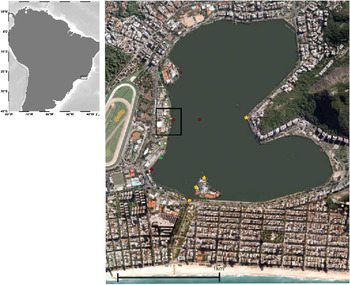
Rodrigo de Freitas lagoon (22°57′02″S 22°58′09″W–43°11′09″S 43°13′03″W) is located within a major urbanized area, and is highly affected by coastal development in the surroundings of Rio de Janeiro City (FEEMA, 2003). The lagoon is a eutrophic estuarine system, with a tidal range from 0.1 to 0.8 m, and a salinity range between 15 and 16 (Lima, Reference Lima2010), except at the freshwater river tributaries and at the artificial channel (Jardim de Alah) that connects the lagoon to the sea. Specimens of Mytilopsis leucophaeata were collected in March and May 2014 (summer–autumn) near the Clube Naval Piraquê and Fishermen base (Figure 1). In May 2014, the lagoon was sampled along transect to evaluate the status of infestation in other places.
Position of studied area in South America and at Rio de Janeiro State. In detail, areas surveyed at Rodrigo de Freitas lagoon: green dots, area without Mytilopsis leucophaeata; yellow dots, areas with small size M. leucophaeata; red dots, areas dominated by M. leucophaeata. The black square indicates the area where we collected the specimens for analysis. Sources: Shilitzer, R. 2011, Ocean Data View, http://odv.awi.de—for South America and south coast of Rio de Janeiro maps; and orthophotos http:portalgeo.rio.rj.gov.br—for digital map of Rio de Janeiro City.

Organisms were collected and fixed directly in 70% alcohol. Basic morphometrics measurements were made on a subsample of the total sample collected, (maximum length and height), using a caliper with 0.05 mm precision. The biological material is deposited in the mollusc collection at UERJ (Rio de Janeiro State University).
RESULTS
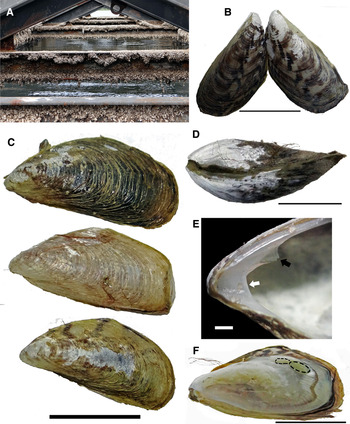
Agglomerations of Mytilopsis leucophaeata were observed throughout almost the entire lagoon (Figures 1 & 2A), with the exception of the channel near the Clube Naval Piraquê (mouth of the River Macacos) and the Jardim de Alah Channel. Salinities at those two locations were near zero and 18, respectively. In other parts of the lagoon, salinity ranged between 16 and 18 (rising tide) which appeared to limit the occurrence of M. leucophaeata. Specimens were found forming large clusters attached to wood pilasters, styrofoam, plastic packaging, rocks, concrete walls, tires and buoys (Figure 2A). The bivalve beds located closer to the Jardim de Alah Channel contained smaller specimens than those located in the innermost part of the lagoon, probably related to salt water inflow from the sea during high tide. The bivalves were also not found on mangrove roots surrounding the lagoon.
Mytilopsis leucophaeata at Rodrigo de Freitas lagoon, Rio de Janeiro, Brazil: (A) dead shells attached to an iron structure; (B) single specimen with valves opened. It is possible to see the zigzag pattern and different sizes of the valves; (C) different colour and ornamentation patterns; (D) ventral view, the left smaller valve is up; (E) detail of the hinge plate, white arrow points to the septum and the black arrow to apophysis; (F) overview of soft parts. The two dashed lines enclosed the bigger posterior adductor muscle and the smaller posterior retractor muscle. Scale bar = 1 cm, except in E = 1 mm.

Specimens were identified by shell and muscle scar morphology (Keen, Reference Keen and Moore1969; Marelli & Gray, Reference Marelli and Gray1983). The shell is fragile, mytiliform, narrower at the anterior region, rounded and expanded at the posterior region; dorsal margin convex, ventral margin straight or slightly concave (Figure 2B, C). The shell is inequivalve, with the right valve slightly larger than the left (Figure 2B, D). The periostracum is well-developed, with laminar appearance, usually eroded on the umbo; it is whitish with greyish or almost black zigzag stripes. In some specimens, especially in larger shells, the stripes can be absent or barely evident (Figure 2C). Internally, the hinge is edentulous; at the beak end, a narrow septum is present with the anterior adductor muscle scar; posteriorly to the septum at the dorsal margin there is an apophysis (where the anterior retractor muscle attaches) (Figure 2E). The posterior adductor muscle scar is elliptical, or rounded, and bigger than the elongated-elliptical posterior retractor muscle (Figure 2F). This muscle runs almost parallel to the shell margin extending forward. The pallial line is without sinus. There is a byssus and two short siphons; siphons, when extended, can be long in relation to shell size.
Specimens ranged from 6.85 to 22.15 mm, with an average length of 18.59 mm and an average height of 9.47 mm. The length:height ratio was 1.96, indicating specimens with an elongated aspect.
DISCUSSION
Although Mytilopsis leucophaeata superficially resembles a young true mussel, i.e. a member of the Mytilidae, such as Perna perna L. (brown mussel), another invasive species as well, a closer look reveals the differences in relation to M. leucophaeata, highlighting the inequivalve shells, the presence of a septum and an apophysis (Figure 2E), the position of the muscles, and the resulting scars in the shells. Mytilopsis leucophaeata is smaller, not exceeding 30 mm in length (Figure 2C), whereas P. perna reaches lengths up to 170 mm (Rios, Reference Rios1999).
Shell shape, colour and ornamentation of the periostracum often causes the confusion of M. leucophaeata with the ‘zebra mussel’, Dreissena polymorpha (Pallas, 1771), especially of young specimens. The easiest way to differentiate the two species is that only M. leucophaeata has an apophysis (Figure 2E). Mytilopsis leucophaeata and Mytilopsis sallei (Récluz, 1849) are very similar parapatric species, and easily confused with each other. The latter has been recorded for South America (Caracas, Venezuela). Marelli & Gray (Reference Marelli and Gray1983) re-described these two species and provide means to separate them based on shell characters, basically the width:height ratio of the shell, being less than 1.25:1 in M. leucophaeata and 1.3:1 in M. sallei. In addition, M. sallei is concave ventrally with the umbo slightly curved. Other differences can be found on the inside of the valves.
Several introductions of benthic species recorded on the Brazilian coast have been considered isolated occurrences (Ferreira et al., Reference Ferreira, Junqueira, Villac, Lopes, Rilov and Crooks2009). Most of them do not cause damage or loss, or such effects have not yet been detected. Currently, the range expansion of five species with obvious impacts on ecosystems and other species have been reported: Isognomon bicolor (Adams, 1845) (Mollusca: Bivalvia); Tubastraea coccinea Lesson, 1829; Tubastraea tagusensis Wells, 1982 (Cnidaria: Anthozoa); Chromonephthea braziliensis (Ofwegen, 2005) (Cnidaria: Anthozoa); and Charybdis helleri (Milne-Edwards, 1867) (Crustacea: Decapoda) (Ferreira et al., Reference Ferreira, Junqueira, Villac, Lopes, Rilov and Crooks2009).
Mytilopsis leucophaeata seems well adapted to its introduction locality, considering that the agglomerations are large and young individuals are abundant, possibly indicating that the population is reproducing massively in this area. There are no detailed previous reports on the effects of M. leucophaeata in estuarine environments from Brazil, since this is only the second record in Brazilian waters. In a study conducted on oyster reefs in an estuary of Virginia (USA), the seasonal abundance of M. leucophaeata peaked in summer and decreased substantially afterwards, remaining at low densities during the rest of the year (Larsen, Reference Larsen1985). This may indicate that this species is an r-strategist, i.e. a species that reproduces early in life with large numbers of usually small and short-lived offspring produced within a short period.
Water clarification occurs due to the removal of particulate matter and nutrients from the water. An individual of M. leucophaeata with a length of 20 mm has the ability to filter 55 ml of water per hour, while smaller individuals have a correspondingly lower filtration capacity (Rajagopal et al., Reference Rajagopal, van der Gaag, van der Velde and Jenner2005). Considering the ability of this species to form large clusters (Figure 2A), this can significantly increase the volume of filtered water. Although a clear correlation to the dark falsemussel invasion cannot be made, the local fishermen claim that the water in the lagoon is much clearer than in previous years. However, these agglomerations may also cause economic losses because they can clog pipes, cause changes of physicochemical factors in the water column and change species composition (Rajagopal et al., Reference Rajagopal, van der Velde and Jenner1997; Higgins & Zanden, Reference Higgins and Zanden2010; Verween et al., Reference Verween, Vincx, Degraer, Velde, Rajagopal and Vaate2010).
Mytilopsis leucophaeata has been considered as the brackish equivalent of D. polymorpha, which typically occurs in freshwater (Verween et al., Reference Verween, Vincx, Degraer, Velde, Rajagopal and Vaate2010). This latter species was also recognized for its ability to aggressively colonize new habitats, as well as for having severe economic impacts. Negative economic and ecological impacts of introduced bivalves on the native fauna were widely reported for Limnoperna fortunei and Dreissena polymorpha (e.g. Burlakova et al., Reference Burlakova, Karatayev and Padilla2000; Mansur et al., Reference Mansur, Santos, Darrigran, Heydrich, Callil and Cardoso2003; Verween et al., Reference Verween, Vincx, Degraer, Velde, Rajagopal and Vaate2010).
Studies in North America, Europe and Australia have recommended the use of chlorine to control Mytilopsis species (Willan et al., Reference Willan, Russell, Murfet, Moore, McEnnuity, Horner, Hewitt, Dally, Campbell and Bourke2000; Kennedy, Reference Kennedy2011). However, further studies are necessary to clarify the effects of this practice on other organisms. For example, in the case of M. sallei in Australia, the surrounding community was destroyed together with the exotic species (Willan et al., Reference Willan, Russell, Murfet, Moore, McEnnuity, Horner, Hewitt, Dally, Campbell and Bourke2000).
The 2016 Olympic Games that will take place in Rio de Janeiro bring new challenges to the city with periodic inputs of large amounts of organic matter. In the Rodrigo de Freitas lagoon, much mortality of fish due to a lack of oxygenation of the water can be caused by one of three environmental conditions. The first is connected with a sharp decrease in air temperature that cools the water surface and/or with strong winds that generate waves (Oliveira et al., Reference Oliveira, Nascimento, Krau and Miranda1957). Both associated events lead to a significant water column circulation that promotes re-suspension of bottom sediments and later the oxidation of organic matter. The second environmental condition is related to a lack of lagoon–seawater exchange, which accelerates the accumulation of organic matter and the consumption of dissolved oxygen at high water temperatures as well as the activity of sulphate-reducing bacteria and the production of hydrogen sulphide gas (H2S) (Souza et al., Reference Souza, Branco, Domingos and Bonecker2011). The third condition associated with fish mortality in the lagoon is related to phytoplankton blooms with two distinct patterns: one related to rainfall and replacement of the cyanobacteria Pseudoanabaena limnetica by Prorocentrum cordatum and one with no rainfall and dominance of Synechocystis aquatilis (Domingos et al., Reference Domingos, Gômara, Sampaio, Soares and Soares2012). The introduction of M. leucophaeata is a new challenge because we do not know how this invasive species will interact with the other factors. Moreover, the lagoon will be used as a competition venue of the 2016 Rio de Janeiro Olympic Games. As a legacy of the Olympic Games, an improvement of conditions for swimming and other nautical sports was promised to be made for the lagoon. However, an increased amount of vessels in the lagoon has the potential to promote a range expansion of M. leucophaeata.
In Rio de Janeiro State, other estuarine environments may become immediately affected, such as the complex of coastal lagoons of Jacarepaguá and lagoons in the north of the state. Therefore, continuous monitoring of the lagoon to study and improve our knowledge about this exotic bivalve must urgently be implemented. Although some authors state that once an exotic species is established, its eradication is very difficult (Myers et al., Reference Myers, Simberloff, Kuris and Carey2000) and sometimes impossible for both technical and political reasons (Oliveira & Pereira, Reference Oliveira and Pereira2010), we recommend to attempt the control of M. leucophaeata by mechanical removal. We also note that it is important to inform the local community about the differences between native and exotic bivalves in order to preserve the native fauna. However, these are only initial suggestions based on the available knowledge about the species in order to avoid a range expansion of M. leucophaeata.
ACKNOWLEDGEMENTS
We are grateful to Carlo M. Cunha who helped us in the early identification of species and references; Alexandre de Oliveira, Comandante Viveiros and Clube Naval Piraquê who gave us support for navigating across the Rodrigo de Freitas lagoon; and Dagmar Frisch for English improvement. We thank Dr Luiz Ricardo L. de Simone and one anonymous referee for improving this manuscript.