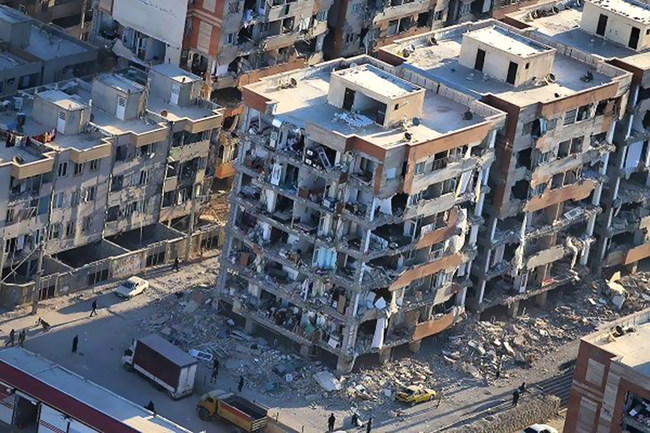
An earthquake with a magnitude of 7.3 Richter occurred in some parts of Western Iran on Sunday, November 13, 2017, causing a devastating loss of property and fatality in Sarpol-e Zahab, Kermanshah Province. More than 483 people were killed and nearly 10 000 were injured. Some villages were completely destroyed, and about 70 000 people were homeless. About 37 800 residential units were destroyed by the earthquake, and about 52 000 units required repair. In this regard, US $80 trillion credits were estimated for reconstructing and modernizing these units.1
Destruction of Affordable Housing
After the earthquake, the collapse of the new affordable housing (Mehr housing) was one of the first incidents that attracted our attention. A 500-unit Mehr housing project (built by the government and based on a plan to house low-income families where the government attempted to encourage housing by assigning free lands) existed in Sarpol-e Zahab and, because these buildings were built on the fault, most of them were destroyed.2 Imam Hospital of Islamabad was another building made by the government, with 72 active beds. More than 100 beds were added to this treatment complex with the opening of its second phase in 6 floors in April 2017. At least 40% of the newly established hospital units were destroyed by the Kermanshah earthquake, whereas the first phase of the hospital, which lasted about 30 years, was not destroyed. This hospital was one of the first places destroyed in this earthquake.3 The destruction of 78 schools, including 415 classrooms, due to the recent earthquake of Western Iran was another devastating loss of this earthquake. The public schools destroyed were over 25 years old, and none of the newly developed and upgraded schools were destroyed.1 The same thing happened in the Bam earthquake in 2003Reference Matsuoka and Yamazaki4 and in the Ahar-Varzaghan earthquake in 2012Reference Ommi and Zafarani5 (Figure 1).
Affordable Housing in Western Iran Earthquake.
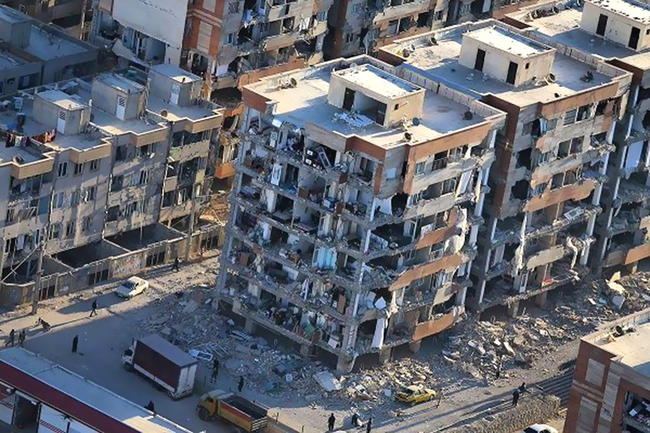
Based on the released statistics, many people living in these affordable buildings were killed (about 2500 people have lived in these affordable housing),6 leading to the strong criticism of the experts. According to officials, such buildings were not built according to earthquake-resistant housing standards. According to the experts, some of the technical causes of the damages in the buildings included inappropriate location (construction on the fault), poor quality of the used concrete, inappropriate connection of the facade to the structure, use of undesirable construction materials, and low quality of non-structural components.7
DISCUSSION
Housing is considered one of the main dimensions of social welfare, as well as one of the primary needs for every individual and family for living with human dignity. This right is based on different principles of the constitution in Iran, upon which the government is obliged to provide adequate housing for all categories of society, especially the low income and rural groups.Reference Vargas-Hernandez, Noruzi and Ali8
In terms of earthquake resistance, buildings are designed differently. In other words, the resistance and response of different buildings against earthquake vibrations are designed based on their use. The building of a hospital should withstand many years of use, and the design should be in such a way that no structural or non-structural destruction can occur as a result of an earthquake. The hospitals in construction regulation 2800 were classified as “very important,” which must remain stable after the earthquake. Furthermore, the schools in this regulation were in the category of “highly important” buildings.9
Hospitals are one of the most important buildings that must continue to provide services during and after disasters. In spite of their importance, health facilities themselves are vulnerable to emergencies and can become damaged or completely collapse, risking the lives of patients and health professionals.10
Several studies in Iran surveyed the level of hospital preparedness against disasters, especially during an earthquake. According to these researches, the hospitals acquired medium and high levels of preparedness but, in times of disasters, were deemed unsafe.Reference Daneshmandi, Amiri and Vahedi11, Reference Shokouh, Anjomshoa and Mousavi12 This is a result of incorrect reports being sent by the hospitals to the Ministry of Health.
Residential buildings and offices are categorized as “moderately important” based on the design regulations and standards. Such buildings should not encounter any structural and non-structural damage, and their mortality must be at the least degree. Therefore, the apartments of Mehr housing in Sarpol-e Zahab are categorized as “moderately important,” based on regulations, and must have been resistant to the earthquake in such a way that the majority of residents would escape and mortality would be minimized.13 It is noteworthy to mention, in Iran, the fourth edition of construction regulation 2800 is used to seismic retrofitting against earthquakes. All builders and investors of construction in all urban and rural areas are required to comply with the regulations 2800 regarding the design of buildings and economics against earthquakes. The Ministry of Road and Urban Development Planning is obligated to supervise the various stages of design and construction of buildings.14
In general, based on the results of the studies, the following factors should be considered to prevent such destructions caused by an earthquake in the future:
Conducting some comprehensive and multidisciplinary studies in the area in which the disaster occurred before presenting the reconstruction program of the affected areas
Consulting with the people of the region and their involvement in reconciliation decisions, especially with respect to the displacement or aggregation of settlements
Avoiding the full cost of reconstruction projects by the government and assigning reconstruction costs to the people, although with government-controlled assistance and avoiding any expected mistakes among the people in the affected area
Managing reconstruction programs and transferring responsibility for reconstruction to a specific organization with adequate staffing and an executive authority
Determining the main reasons for the damage caused by the disaster and making decisions based on the displacement of settlements in the event of a hazardous place of residence and the choice of a new location for the cities affected based on precise geological studies
Constructing resilient housing after the disaster, according to the people’s expectations of the affected area, and their consultation with regard to the space they need and their training in relation to new and resistant structures
Training the people of the affected area with respect to the risk reduction perspectives and the related methods for earthquake retrofitting
Training the executives of reconstruction projects regarding the reconstruction program and the risk reduction perspectives and new structures designed for the affected area
Synchronizing new construction systems and disaster risk reduction plans with the placement in which the plan will be implementedReference Fallahi and Khajehei15-Reference Mehrabian and Haldar17
Also, in these cases, it is possible to use the experiences of earthquake-stricken countries such as Japan, which have used modern technologies to increase building resistance. Japanese researchers have reported the effectiveness of visco-elastic dampers like high-hardness rubber dampers in the reduction of responses of super high-rise buildings subjected to such long-period ground motions. The response reduction rate is investigated in detail in addition to the maximum response reduction.Reference Takewaki, Murakami and Fujita18
CONCLUSION
Iran, as one of the earthquake-prone countries of the world, has been exposed to devastating earthquakes over the past years. Due to the potential for destructive earthquakes, Iran’s natural geographical conditions require that the safety of the community in every respect be taken seriously, especially architecture and engineering principles and safety structures in earthquake-prone areas against the effects of the earthquake. Inappropriate design, inadequate attention to the principles and rules of repair and maintenance, and non-use of standard materials can increase the vulnerability of buildings, and accordingly decrease the useful life among the members of the community.
The level of accountability of building managers must be clarified so that everyone knows and responds to their duties and responsibilities. Thus, the committed consulting engineers and conscientious constructors should design buildings using high quality materials in order to reduce the damage created by the earthquake. When one of the sides of this triangle fails to fulfill its task correctly, the quality of construction will decrease. Urban development and management in developing countries are under governmental policies. In addition, governments have an important role in sustainable urban development. Therefore, the governments are required to manage this important matter as far as possible and implement its policies to enhance the structural and non-structural safety of buildings against disasters.
Conflict of Interest Statement
The authors have no conflicts of interest to declare.