

Introduction
Scholars have long been interested in the factors that influence taxing decisions in the American states. These studies typically offer explanations that draw heavily on Tiebout’s (Reference Tiebout1956) assertion that taxes represent revenue that politicians need to survive, but that the wrong mix of taxes and services can lead to political blowback (voice) or loss of the tax base (exit). One portion of the literature has focused more heavily on the intrastate characteristics associated with the risk of taxing choices, such as partisanship and fiscal health. Another body of work has focused primarily on strategic interactions between jurisdictions in tax-setting decisions. This work finds fairly consistently that localities, states and nations adjust tax rates in response to changes by their neighbours, particularly when the likelihood of “cross-border shopping” is higher.
One thing these disparate studies have in common is that they tend to treat political and competition factors as independent influences on taxing decisions. More specifically, these studies model the impact of tax choices in neighbouring states as if that impact is equivalent across different intrastate characteristics, such as partisanship. This is particularly true of the more recent studies focused on strategic competition only because they have tended to include a more complete set of variables capturing political and competitive pressures. We argue here that treating political and competitive factors as independent is a mistake, and that models based on that assumption are likely misestimating the impact of the latter.
We build a simple theoretical argument that the costs of cross-border shopping should depend in part on the political party of elected officials because of the different constituencies on which the parties depend for support. From that argument, we derive the expectation that competitive pressures will matter for right-leaning governments, but not for those on the political left. We test that expectation in an analysis of cigarette tax rate adjustments in the United States (US) between 1980 and 2011. The results indicate that the threat of cross-border shopping has a substantially larger negative impact on cigarette taxes under Republican governors than under Democrats. Several robustness checks demonstrate that the results hold despite different operationalisations of both the independent and dependent variables. We also present two falsification tests in order to confirm that it is the political costs of cross-border shopping that drive greater tax competition among Republicans. From these results, we conclude that the importance of competition on tax setting is moderated in important ways by political party.
Taxing choices in the literature
Because of the obvious economic impact, as well as the inherent political risk involved in these decisions, scholars have long been interested in the determinants of taxing choices. Politicians require revenue to deliver promised goods and services to constituents, but perceive significant electoral consequences if tax increases designed to garner that revenue are too large or mistimed (Berry and Berry Reference Berry and Berry1992). If resources are mobile, tax-setting errors may also drive the sources of revenue into other jurisdictions where they do not contribute to the electoral success of the politician making taxing choices. These two elements – political backlash and competition – have largely defined the literature on tax setting.
Not surprisingly, political scientists have paid the most attention to the political costs and determinants of taxation. Numerous studies have investigated the role of partisanship in these decisions, often using it as a proxy for citizen demand of government services. Although some older studies have found little connection between party and taxes (see Poterba Reference Poterba1994; Besley and Case Reference Besley and Case1995), the majority of literature suggests that the control of institutions by Democratic or left-leaning parties correlates with higher levels of taxation (see e.g. Berch Reference Berch1995; Alt and Lowry Reference Alt and Lowry2000; Caplan Reference Caplan2001; Reed Reference Reed2006). Scholars have also noted that different types of taxes carry different political risks and that politicians are drawn to lower risk alternatives. More specifically, they have found that increases in excise taxes are easier to implement than changes to income, property or sales taxes (see e.g. Mikesell Reference Mikesell1978), and that adjustments to existing taxes carry less risk than the creation of a new tax (Davies Reference Davies1986; Kone and Winters Reference Kone and Winters1993). Finally, studies have found that government characteristics such as unified control; institutional constraints such as tax and expenditure limits; and economic conditions all influence the political feasibility of tax increases (Hansen Reference Hansen1983; Berry and Berry Reference Berry and Berry1992; Poterba Reference Poterba1996; Winters Reference Winters1996; Stults and Winters Reference Stults and Winters2000).
Another category of studies tests whether politicians strategically adjust tax levels in order to compete with neighbouring jurisdictions.Footnote 1 These studies approach the question of strategic interaction from a number of theoretical perspectives, although they demonstrate relatively consistently that tax choices in one jurisdiction are correlated with those in neighbouring jurisdictions (see e.g. Ladd Reference Ladd1992; Case Reference Case1993; Besley and Case Reference Besley and Case1995; Revelli Reference Revelli2002; Aiura and Ogawa Reference Aiura and Ogawa2013). The idea of tax competition is premised on the assumption of fiscal mobility, and a rather large literature on cross-border shopping has demonstrated that consumers are, indeed, quite likely to travel to other jurisdictions for goods when price savings outweigh transportation costs (see Leal et al. Reference Leal, Lopez-Laborda and Rodrigo2010 for an extensive review). Intuitively, the aggregate variation in transportation costs means that cross-border shopping is a greater concern for small jurisdictions and those where a larger share of the population is located near a border. Recent empirical work has combined this insight with the consistent finding of tax competition among jurisdictions, and has demonstrated that countries and states are more responsive to tax changes by their neighbours when population density along the border is greater (Nelson Reference Nelson2002; Rork Reference Rork2003; Devereux et al. Reference Devereux, Lockwood and Redoano2006).Footnote 2
One final piece to the tax competition and cross-border shopping puzzle is the opportunities that consumers have to shop if they venture to a neighbouring jurisdiction. Research suggests that consumers gravitate towards “retail agglomerations”, or clusters of similar retail outlets, because of perceived improvements in selection, quality and/or price (see Oppewal and Holyoake Reference Oppewal and Holyoake2004 for a review). Indeed, studies find that shoppers will travel to more distant shopping centres of sufficient size instead of choosing closer groupings of retailers (Fotheringham 1985; Abdel-Rahman Reference Abdel-Rahman1990). Most importantly, for the purposes of this article, work on tax competition finds that the revenue consequences of differential tax rates are, in part, a function of the size and diversity of shopping opportunities on the other side of the border (Burge and Rogers Reference Burge and Rogers2011). This work also suggests that consideration of those opportunities influences the interdependence of taxing choices among jurisdictions (Burge and Piper Reference Burge and Piper2012).
Partisanship and the need to compete
In all the studies discussed above that include both intrastate characteristics and competitive pressures in the same model, these variables are treated as independent of one another. This treatment betrays an assumption that the impact of behaviour in other jurisdictions does not vary depending on the characteristics of policymakers considering a tax adjustment. To put this in context, we can hypothetically examine the impact of two of the most commonly included measures in these models – gubernatorial partisanship and population density. Current models of tax adjustment would predict that taxes would be lower under Republicans and include a measure of gubernatorial partisanship to capture that effect. They would also assume that taxes would be lower in jurisdictions where it is easy for consumers to travel to another jurisdiction to shop for goods. They would include a measure of border population density or cross-border retail agglomeration in order to account for the impact of the costs of cross-border shopping on politicians’ willingness to raise taxes. These models would not, however, predict that the costs of cross-border shopping are different for Republican and Democratic governors, or that those differences would help explain tax-setting decisions.
In this section, we offer the very simple, but we believe very intuitive, argument that the costs of cross-border shopping, and thus the impact of competitive pressures on tax adjustment, should be moderated by the partisanship of elected officials within a jurisdiction. We begin with the assumption that the utility of a tax adjustment to an elected official is a function of the revenue raised by increasing the tax with no cross-border shopping minus the revenue lost due to cross-border shopping, discounted by the political cost of raising taxes. This suggests that the net revenue from a tax increase, which politicians can use to deliver on campaign promises and provide goods desired by the median voter, among other purposes, must be higher when political costs are higher if an elected official is going to see positive utility in raising taxes.
This presentation indicates that three variables will determine the utility of a tax increase, including the size of the increase, the likelihood of cross-border shopping and the political costs of the increase. Thinking now about politicians of different parties in a specific state considering a tax adjustment, the gross revenue, as a function of the rate increase, will be the same for each. Similarly, the density of the population along the border, and thus the potential cost of cross-border shopping, is the same whether the governor is a Democrat or a Republican.
However, the political cost of raising taxes is not likely to be the same across the parties. Research suggests that Republican governors are punished electorally for increasing revenue while Democrats are not (Lowry et al. Reference Lowry, Alt and Ferree1998). Moreover, Republican candidates are far more likely to rely on rhetoric regarding smaller government and lower taxes during campaigns, which increase the reputation costs for them of raising taxes after an election (see e.g. Burden and Sanberg Reference Burden and Sanberg2003). These differences are, of course, part of the reason why scholars expect Republicans to prefer lower taxes and include indicators of party to capture that effect.
What is not captured by the main effect of partisanship, and is central to our argument, is that the political costs of cross-border shopping are also likely to differ across the parties. A tax increase will likely raise the overall costs of a product for consumers, because they have to incur some transportation costs in order to shop in a jurisdiction with a lower tax rate. However, the cost of a tax increase for firms in the presence of cross-border shopping are significantly higher, because they have to internalise part of the increase in the form of lower prices in order to remain competitive with firms in the lower tax jurisdiction (Christansen Reference Christansen1994; Leal et al. Reference Leal, Lopez-Laborda and Rodrigo2010). This is the rather obvious reason why groups like the Petroleum Retailers Association are often the loudest opponents of increases to cigarette, alcohol and fuel taxes (Aston Reference Aston1989; Trask Reference Trask2012; Long Reference Long2013).
The monetary costs of tax-induced cross-border shopping for these firms should translate into a greater political cost for Republican politicians relative to their Democratic counterparts, because the former depend far more heavily on industry groups for their political survival (Center for Responsive Politics 2013). Through September, Republicans received 62% of the contributions given by industry donors to state-level candidates in 2014.Footnote 3 That figure is based on contributions from all federally identified sectors.Footnote 4 In some sectors such as Energy and Natural Resources, the percentage received by Republicans was much greater (>75%). Another way to think about the relative dependence upon an industry is to look at the percentage of total contributions that come from that group. Here again, the evidence suggests that state-level Republicans are more beholden. They received over 38% of direct contributions from industry groups, whereas their Democratic counterparts depended on the same groups for only 26% of total direct contributions.Footnote 5 Given their reliance on these interests, particularly for campaign contributions, ignoring opposition to a tax increase from associated industry groups should hurt Republicans more than Democrats who, on average, depend less heavily on those groups for their electoral success.
We can now return to our original assertion that the value of a tax adjustment for a politician is a function of net revenue (total minus losses to cross-border shopping), discounted by political costs. Given the arguments presented above, we can develop the more specific proposition that (1) Republican control of major policy-making institutions and (2) a densely populated border will both correlate with lower taxes. As the political costs of cross-border shopping are higher for Republicans, however, we expect that border density will exert greater downward pressure on taxes when a member of that party controls policy-making institutions.
Although the argument presented above is a very parsimonious and inductive approach to policy decisionmaking, it accords relatively well with the expectations and findings generated by other models and analyses. For example, the assertion that policy preference and political cost interact in the production of policy decisions fits well with political agency models and the empirical tests derived from them (see e.g. Besley and Case Reference Besley and Case1995).
An empirical test: cigarette taxes in the American states
We test our assertion regarding the moderating effect of political costs on competitive pressures in tax setting in an analysis of cigarette taxes in the US. More specifically, we examine changes in the cigarette tax rate in all 48 states that share a border with another state between 1980 and 2011.
We chose taxes on cigarettes for several reasons. Primary among these is that it is the area where scholars have most frequently looked for evidence of tax competition (see e.g. Nelson Reference Nelson2002; Rork Reference Rork2003; Devereux et al. Reference Devereux, Lockwood and Redoano2006; Leal et al. Reference Leal, Lopez-Laborda and Rodrigo2009). The second reason, which is obviously not independent of the first, is that cigarettes are a commodity likely to motivate cross-border shopping among consumers because they are both expensive and easy to transport. In other words, the market for these goods is marked by high fiscal mobility. Third, state-level revenue from cigarette taxes totalled more than $17 billion in 2012, making them a far from trivial source of revenue for many state policymakers. Obviously, this varies by state; however, in 28 states, tobacco taxes made up more than 1.5% of total tax revenue. In New Hampshire, it constituted 4.4%.
Finally, there is ample evidence that Republicans are more beholden to cigarette retailers for campaign contributions than are Democrats. Research has found Republicans are the leading recipients of tobacco industry campaign contributions (Luke and Krauss Reference Luke and Krauss2004), and the data suggest that they are also the primary beneficiaries of contributions from cigarette retailers. Between 1990 and 2011, Republicans received an average of 67% of the contributions made to state-level candidates by petroleum retailer/convenience stores,Footnote 6 which are the largest retailers of cigarettes in the American states.
Dependent variables
We use the change in the state cigarette tax rate as our dependent variable. The differenced variable is the most appropriate theoretically and is also necessary because the tax rate series is integrated. State-level cigarette tax rate data are collected from the 2011 edition of The Tax Burden on Tobacco (Federation of Tax Administrators 2011), a report on tobacco revenue and industry statistics.
Independent variables
In order to test our key hypothesis, we first used a spatial lag approach to create two variables capturing the difference in the tax rate between a state and its neighbours. The choice of these differential variables, rather than ones that simply measured the tax rate change in metro and non-metro border states, was driven by the logic of competition. There is little reason for a state to respond to tax changes in another jurisdiction if, despite that adjustment, its rate is still lower. Alternatively, if a neighbouring state’s adjustment gives that state a lower rate, then a state may be motivated to make its own adjustment, especially if revenue is likely to be lost due to cross-border shopping.
In order to capture this logic, we needed variables that measure the relative tax rates in state i and its neighbouring states. In order to create these variables, we first created a measure of the difference in the lagged tax rate between each state and those neighbours with whom it shares a metropolitan border (IV 1). In order to code the presence of a “metropolitan” border, we used US Census Bureau data to identify those instances where a Metropolitan Statistical Area was located in at least two states. We believe that this was the best and most parsimonious way to account for the probability of cross-border shopping, because it simultaneously captured relative population density along the border and retail agglomeration, which previous work suggests are key predictors of that phenomenon.
The second spatial lag variable that we created captured the difference in the lagged tax rates between state i and all neighbours with whom it did not share a metro border. Both of these variables were coded so that positive values mean that a state has higher taxes than its neighbours. Based on existing literature, we expect that having a higher rate than neighbours with whom you share a metro border will have a larger negative impact on the change in cigarette tax rate than having a higher rate than neighbours with whom you do not share such a border.
For our primary models, we also included an interaction between the spatial lag measuring tax differential with metro border states and a measure of gubernatorial partisanship (1=Republican) in order to test our key hypothesis. We suggest that, when there is the likelihood of cross-border shopping, Republicans will be more responsive than Democrats to tax differentials with neighbouring states. As such, we expect the interaction between tax differences with metro border states (IV 1) and gubernatorial partisanship to be negative.
We focused on governors in this analysis for two reasons. First, in almost all cases, the governor is a key veto player without whose support tax increases cannot occur. Second, many key studies of tax competition have focused on governors’ roles in this process (see Besley and Case Reference Besley and Case1995), because the correlation between taxes and re-election (Beyle Reference Beyle1983) gives those actors a significant incentive to care about tax policy. In addition, as unitary actors, governors are more likely to be the targets of anger over tax increases than are members of a legislature, where power and, theoretically, control over policy outputs are more diffuse.
For these same reasons, however, it may be that governors provide an “easy” test of our hypothesis and that partisanship only changes the risks of cross-border shopping under a limited set of conditions. In order to ensure that this was not the case, and to provide a more rigorous test of our hypothesis, we also estimated a model that includes interactions between our spatial lag variables and an indicator of Republican control of both houses of the state legislature. If the logic of our argument holds, regardless of the policy-making institution that Republicans control, then, all else being equal, the interactions should again be negative and significant.
Interestingly, the interaction between tax rate differences with non-metro border states (IV 2) and Republican control of policy-making institutions provide a good falsification test of our theoretical story. We discuss the logic of this test further and present a model to implement it in a subsequent section of this article.
Control variables
The first control variable captured gubernatorial partisanship. In most cases, in order to be properly estimated and interpreted, interactive models need to include the main effect for the moderator. The party of the governor should, therefore, have been included, regardless of its theoretical significance. In this case, however, it was also important to control for the fact that Republican governors may tax cigarettes at lower levels than their Democratic counterparts, regardless of what neighbouring states are doing. Of course, governors do not make taxing choices on their own; therefore, we also controlled for legislative partisanship. Specifically, we included an indicator of whether both houses of the state legislature were controlled by Republican majorities. Of course, in the model that features interactions between legislative partisanship and tax rate differentials with neighbouring states, this variable served as the main effect and the indicator of gubernatorial partisanship took on the role of control variable.
We also recognise that a Republican in Vermont is not the same as a Republican in Georgia, as well as the fact that a Republican in Georgia in 2010 may have been a Democrat in 1980. All the models discussed below include state and year fixed effects, which help to account for differences in party positions across state and time. We also included a measure of the per cent vote for the Republican candidate in the previous presidential election as another control for the specific “type” of Republican that occupied the governor’s mansion in any given state.
We included the change in the state’s population (logged), which is a standard control in taxing models and was assumed to provide another proxy for cross-border shopping. Based on the assumption that tobacco-producing states are less likely to tax their cash crop, we also coded an indicator of the top five tobacco-producing states in the US (North Carolina, Kentucky, Tennessee, Virginia and South Carolina). As additional measures of a state’s economic incentive to alter tax rates, we included the change in annual unemployment rate and per capita income.
We also included three measures designed to capture a state’s ability to raise taxes. The first of these was a measure of state tax effort (Mikesell Reference Mikesell2007) based on the assumption that the political costs of an increase in cigarette taxes may be higher if the citizenry is already carrying a heavy tax burden.Footnote 7 Second, the literature suggests that it is more difficult for a state to sell a tax increase to citizens if rates have recently been raised; therefore, we included a measure of the number of years since the last adjustment in cigarette taxes. Finally, we included a measure of the percentage of governors in neighbouring states that are Republicans. Our assumption here is that it may be easier for a Republican governor to sell a tax increase to constituents if they are acting in a manner similar to regional co-partisans.
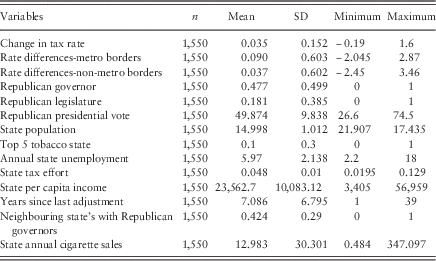
Some additional variables and operationalisations of key variables will be introduced in an effort to check the robustness of the results. These will be discussed after the main findings section when we turn to our ancillary models. Descriptive statistics for the variables used in this analysis are presented in Table 1.
Descriptive statistics

Estimation
The primary models discussed below are estimated as cross-sectional time series regressions. As noted above, these include both state and year fixed effects and report robust standard errors.
Findings and discussion
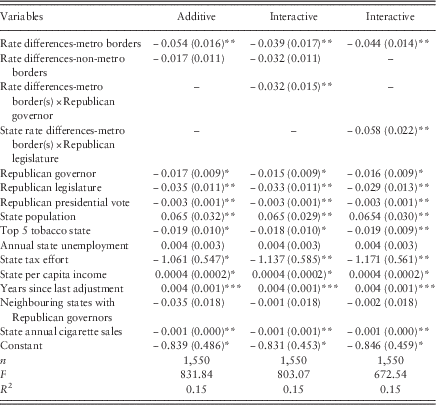
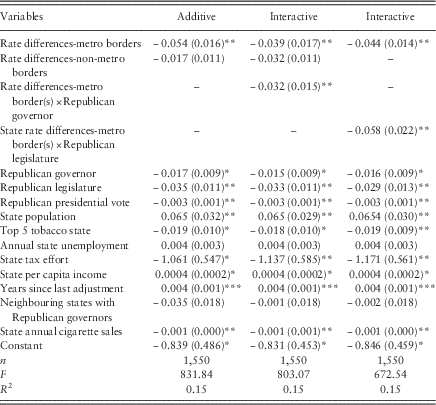
The findings from our primary models of interest are presented in Table 2. The first column contains an additive model that includes only the lagged tax differential variables described above. The coefficient on the lagged metro border tax differential is negative and significant. Thus, higher cigarette taxes in year t−1 – relative to those neighbours with whom a state shared a metropolitan border – correlate with a reduction in tax rate in year t. Specifically, it shows that, all else equal, states with taxes that were 1SD higher than their metro border neighbours reduced their taxes by 0.22SD. This is equivalent to about a $0.03 decrease per pack. This suggests that having higher taxes when the possibility of cross-border shopping is high is associated with a substantively important reduction in those taxes in the following year.
The interaction of party and the threat of cross-border shopping in cigarette tax setting in the American states
*p<.10 , **p<.05, ***p<.01.
The same cannot be said when cross-border shopping is not a meaningful threat to state revenue. The measure of lagged tax differential with non-metro border states is not statistically significant. It is also substantively quite close to 0. This null result accords well with the larger literature on tax competition, which suggests that jurisdictions have a limited incentive to respond to taxing choices in other jurisdictions if there is no threat of lost revenue due to fiscal mobility. Before moving on, we can note that the controls performed largely as expected. The model suggests that higher existing tax efforts correlate with lower rate adjustments. Having a Republican governor and a Republican-controlled legislature were also negatively correlated with a change in tax rate, as was the vote for the Republican in the last presidential election. Intuitively, being the top tobacco-producing state and having a higher proportion of smokers in the population are also negatively associated with the dependent variable. Alternatively, higher per capita income, a larger population and the number of years since the last tax adjustment all correlate with a positive change in the cigarette tax rate. Finally, it is important to note that the state fixed effects are jointly significant, although the year fixed effects are not.
The real model of interest, which includes the interaction between tax differential with metro border states and gubernatorial partisanship, is presented in the second column of Table 2. As the moderator is dichotomous, the sign, significance and impact of the interaction term and main effects can be interpreted relatively easily. In the presence of the interaction, the coefficient on the lagged tax differential represents the response of Democratic governors. It is negative and significant, suggesting that having a higher tax rate than neighbours when cross-border shopping is possible correlates with a reduction in cigarette taxes in the next year when a Democrat occupies the governor’s mansion. The size of the impact, however, is relatively small. Specifically, the coefficient suggests that having a tax rate that is 1SD higher in year t−1 is associated with a 0.15SD reduction in cigarette taxes in year t.
As expected, tax competition is significantly moderated by the party of the governor. The interaction term is negative and significant, meaning that the difference with neighbouring metro border states correlates with a significantly larger reduction in cigarette taxes under Republican governors. The coefficient on that term plus the coefficient on the main effect for tax differential with metro border states represent the impact for Republicans. Taken together, they suggest that a 1SD higher tax rate when cross-border shopping is possible correlates with a 0.46SD reduction in cigarette taxes in the next year under Republican governors. That impact translates to approximately a $0.06 decrease in cigarette taxes.
A model that allows legislative partisanship to moderate the impact of cross-border shopping is presented in the third column of Table 2. As the coefficients suggest, the substantive results are unchanged if Republicans control this portion of the policy-making process. In fact, the impact of our theoretically interesting relationship is slightly larger. The findings suggest that a 1SD higher tax rate under the threat of cross-shopping correlates with approximately a $0.08 decrease in cigarette taxes when the legislature is controlled by Republicans.
The remainder of this article offers a variety of tests that further explore causal mechanisms and test the robustness of our primary results. For these tests, we return our focus to the interaction between gubernatorial party and interstate tax differentials. We do so because of the degree to which the legislative results discussed above confirm the findings from our gubernatorial model and out of a desire to streamline the presentation. We also do so because we believe the theoretical model we describe is most applicable to these policymakers.
Confirming the industry-Republican connection
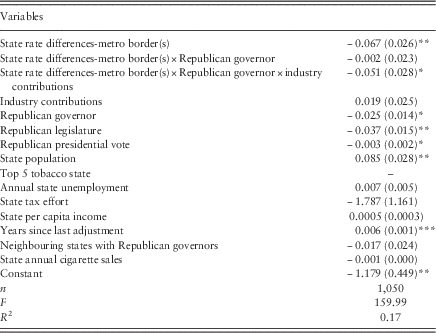
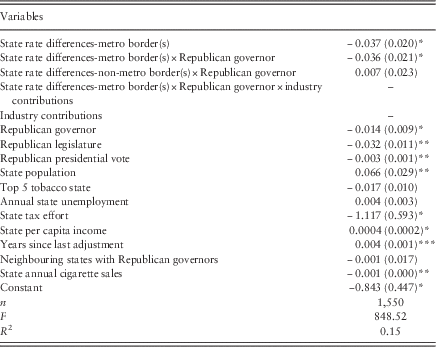
A key piece of our theoretical explanation for the finding discussed above is that Republicans are more beholden than Democrats to industries hurt by cross-border shopping. We provided some anecdotal evidence of this earlier in the article, but we offer a more rigorous test of that assumption here. If the assumption is true, Republican responsiveness to tax rates in metro border states should increase as the electoral importance of affected industries increases. Table 3 offers this test by introducing the campaign contributions from petroleum retailers/convenience stores to state-level candidates into the equation.
Testing the political costs assumption

*p<.10 , **p<.05, ***p<.01.
Unfortunately, these data are only available after 1990, and then only for election years. Furthermore, in many states, data are not available for every two-year cycle. The upshot is that there is a great deal of error in the measure of contributions, and therefore results should be interpreted with caution. This is the primary reason why we utilise these data for falsification purposes rather than in our primary analyses. In this analysis, we use linear interpolation in order to create a measure that captures the percentage of tobacco retailer contributions that went to Republicans in each state and year between 1990 and 2011. In order to avoid false precision and the complexity of a three-way interaction between continuous variables, we then dichotomise the variable, coding states and years where Republicans received more than 50% of contributions as 1.
Table 3 presents a model that includes a three-way interaction between the lagged tax differential with metro border states, gubernatorial party and the indicator of whether Republicans in the state receive the majority of contributions from cigarette retailers. If the political cost of alienating those donors is not a contributor to tax competition by Republican governors in the presence of cross-border shopping, then the interaction term should be statistically indistinguishable from 0. As the results suggest, however, that is not the case. The interaction term is negative and significant, suggesting that having higher taxes than neighbours with whom you share a metro border causes a larger reduction in taxes under Republican governors when they receive a larger share of donations from industry groups hurt by cross-border shopping. In fact, the constituent terms of the interaction actually suggest that Republicans only respond to the threat of fiscal mobility when they receive a majority of the donations from cigarette retailers.
As noted above, the data on contributions are not reliable enough to support conclusions about the precise level of contributions at which Republican governors may alter tax competition behaviour. Nonetheless, findings of a relationship between party, high taxes relative to metro border states and contributions from cigarette retailers lend credence to our theoretical assertion that Republicans are more responsive to the threat of cross-border shopping because they are more fearful of alienating the industries hurt by it.
Robustness checks
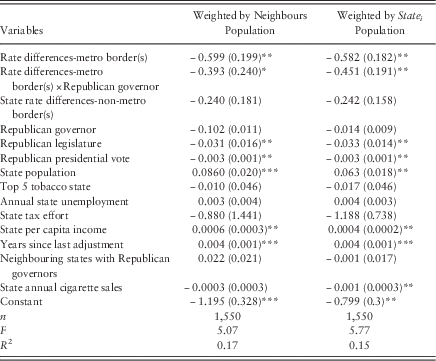
Table 4 presents two robustness checks to determine whether the findings from our primary models hold if we make different operational choices regarding the key independent and dependent variables. These are estimated in the full sample of states and years.
Robustness checks

*p<.10 , **p<.05, ***p<.01.
Many studies utilise a spatial lag weighted by population of neighbouring states, based on the assumption that the behaviour of bigger states is more likely to invoke competition. We believe that our measures of tax differences among states that share a metropolitan border, and those that do not, inherently capture the power of a state to induce competition. Nonetheless, it is important to confirm that this is the case. Thus, the first column of Table 4 presents a model where our measures of lagged tax difference are weighted by the neighbour’s population. As the model shows, the results are unchanged. States whose tax rates are higher than the neighbours with whom they share a metro border in the previous year reduce their cigarette tax rate, regardless of which party controls the governor’s mansion, but the reduction is significantly and substantively larger under Republican governors.
The literature on tax competition suggests that cross-border shopping may represent a larger threat for small states. In order to test for this possibility, column 2 presents a model where the lagged tax differential variables are weighted by the population in state i (rather than neighbouring states). Again, the findings are unchanged, with both the measure of tax differential with metro border states and the interaction between that variable and gubernatorial party being negative and significant.
Falsification test
In Table 5, we offer a falsification test of our primary theoretical assertion. We have suggested that Republicans are more likely to respond to tax decreases in neighbouring jurisdictions when cross-border shopping is possible due to political costs. A plausible alternative story, however, is that Republicans are simply more responsive to taxing choices by neighbours because of their ideological opposition to taxes or because they fear that governing over a state with relatively high tax rates will jeopardise their reputation. If these alternative stories are the causal mechanisms driving increased tax competition among Republicans, then we should see those effects even when cross-border shopping is not a threat. In other words, the interaction between gubernatorial partisanship and the lagged tax differential with non-metro border states should also be negative and significant.
Falsification test

*p<.10 , **p<.05, ***p<.01.
As the model in Table 5 shows, however, this is not the case. The main effect of the non-metro border differential and the interaction term are statistically indistinguishable from 0. It is important to note that both coefficients are also substantively very close to 0, and that the interaction term actually has the wrong sign, suggesting that it is not simply collinearity from the inclusion of multiple interactions driving the result. This null finding allows us to conclude with greater confidence that it is not general ideological leanings or partisan platforms that induce Republicans to be more responsive to taxing choices in other jurisdictions, but is instead something unique to the threat they perceive from lost revenue due to cross-border shopping.
Conclusion
Although previous research treats political and competitive factors as independent influences on tax setting, we contend that these two factors interact in decisions regarding state tax policy. We suggest that this is the case because the costs of cross-border shopping, one of the key mechanisms assumed to underlie tax competition, are higher for firms and, therefore, higher for the Republican politicians who depend heavily on business interests for their electoral success. In an analysis of cigarette taxation in the American states between 1980 and 2011, we found evidence to support this assertion. Specifically, the results indicate that a higher threat of cross-border shopping reduces cigarette taxes to a greater degree under Republicans relative to Democrats. This result persists whether we focus on Republican control of the governor’s mansion – which is our primary focus – or of the legislature.
Several robustness checks confirm that this primary result holds regardless of changes to the operationalisation of both independent and dependent variables. Two falsification tests help confirm political costs as an underlying causal mechanism for the observed relationship between cross-border shopping, partisanship and tax rate adjustments.
Thus, we conclude that partisanship significantly moderates the impact of competitive pressures on taxing decisions in the American states. As the effect of these pressures has been assumed to be uncorrelated with internal state characteristics such as partisanship, it raises the possibility that the effect of tax competition has been misestimated in previous work.
We believe that the results and their implications would likely hold for not only “sin” taxes but also for many sales taxes where differential rates, along with other conditions like retail agglomerations, create a likelihood of fiscal mobility. Whether it is taxes on gasoline or food, it is reasonable to expect that politicians who are more electorally dependent on retailers of those items would be more responsive to the threat of cross-border shopping in the same way they appear to be in the case of cigarettes.
As an important caveat to that expectation, the findings might not apply to those cases in which one party is not more beholden than the other to contributions from the industry likely to be hurt by cross-border shopping. In addition, the theoretical mechanisms offered herein may not apply to goods like insurance or automobiles, which states regulate the purchase of or for which they have mechanisms in place for capturing lost tax revenue.
Obviously, more research is necessary to confirm that this is the case and that the findings reported herein hold up in other research contexts. At the very least, however, the results suggest that future work on tax competition should model the possibility that the degree to which jurisdictions look outside their borders when making taxing decisions is, in part, a function of conditions within their borders.