Introduction
Excessive alcohol use is associated with structural brain changes (Harper, Reference Harper2009), and may contribute to the structural brain changes found in schizophrenia and bipolar disorder (Schiffer et al. Reference Schiffer, Muller, Scherbaum, Forsting, Wiltfang, Leygraf and Gizewski2010; Nery et al. Reference Nery, Matsuo, Nicoletti, Monkul, Zunta-Soares, Hatch, Lafer and Soares2011). There are indications of increased vulnerability to alcohol-related brain injury in schizophrenia (Sullivan et al. Reference Sullivan, Deshmukh, Desmond, Mathalon, Rosenbloom, Lim and Pfefferbaum2000b ; Mathalon et al. Reference Mathalon, Pfefferbaum, Lim, Rosenbloom and Sullivan2003), although results are conflicting (Nesvag et al. Reference Nesvåg, Frigessi, Jonsson and Agartz2007). Investigating the effects of alcohol use at different consumption levels on brain structure in severe mental illness might yield new insights.
Patients suffering from severe mental illnesses (schizophrenia or bipolar disorder) are at increased risk for misuse of alcohol and other substances (Regier et al. Reference Regier, Farmer, Rae, Locke, Keith, Judd and Goodwin1990). Prevalence of alcohol use disorders (AUDs; i.e. alcohol abuse or dependence) is higher in bipolar disorder than in schizophrenia (Nesvag et al. Reference Nesvåg, Knudsen, Bakken, Hoye, Ystrom, Suren, Reneflot, Stoltenberg and Reichborn-Kjennerud2015), with lifetime prevalence estimates of 35% and 20%, respectively (Koskinen et al. Reference Koskinen, Lohonen, Koponen, Isohanni and Miettunen2009; Di Florio et al. Reference Di Florio, Craddock and van den Bree2014). Co-morbid AUD, or even levels of alcohol use below threshold for AUD, negatively impact course and outcome of schizophrenia (Mueser et al. Reference Mueser, Drake and Wallach1998; Large et al. Reference Large, Mullin, Gupta, Harris and Nielssen2014) and bipolar disorder (Levin & Hennessy, Reference Levin and Hennessy2004; Goldstein et al. Reference Goldstein, Velyvis and Parikh2006).
Widespread gray- and white-matter deficits in both cortical and subcortical structures are found in alcohol-dependent patients (Sullivan & Pfefferbaum, Reference Sullivan and Pfefferbaum2005; Buhler & Mann, Reference Buhler and Mann2011; Monnig et al. Reference Monnig, Tonigan, Yeo, Thoma and McCrady2013). Gray-matter reductions were shown in adolescents and young adults with AUD (Welch et al. Reference Welch, Carson and Lawrie2013) and in heavy drinkers (Kubota et al. Reference Kubota, Nakazaki, Hirai, Saeki, Yamaura and Kusaka2001; Cardenas et al. Reference Cardenas, Studholme, Meyerhoff, Song and Weiner2005; Thayer et al. Reference Thayer, Hagerty, Sabbineni, Claus, Hutchison and Weiland2016). Regarding moderate alcohol consumption, there is some evidence of a negative relationship with brain structural measures (Mukamal et al. Reference Mukamal, Longstreth, Mittleman, Crum and Siscovick2001; Ding et al. Reference Ding, Eigenbrodt, Mosley, Hutchinson, Folsom, Harris and Nieto2004; Taki et al. Reference Taki, Goto, Evans, Zijdenbos, Neelin, Lerch, Sato, Ono, Kinomura, Nakagawa, Sugiura, Watanabe, Kawashima and Fukuda2004; Paul et al. Reference Paul, Au, Fredman, Massaro, Seshadri, Decarli and Wolf2008; Kapogiannis et al. Reference Kapogiannis, Kisser, Davatzikos, Ferrucci, Metter and Resnick2012), whereas others have found no association (Sasaki et al. Reference Sasaki, Abe, Yamasue, Fukuda, Yamada, Takei, Suga, Takao, Kasai, Aoki and Ohtomo2009; Davis et al. Reference Davis, Vidal, Garcia, Aspelund, van Buchem, Jonsdottir, Sigurdsson, Harris, Gudnason and Launer2014; Preti et al. Reference Preti, Muscio, Boccardi, Lorenzi, de Girolamo and Frisoni2014) or positive associations (den Heijer et al. Reference den Heijer, Vermeer, van Dijk, Prins, Koudstaal, van Duijn, Hofman and Breteler2004; Sachdev et al. Reference Sachdev, Chen, Wen and Anstey2008; Gu et al. Reference Gu, Scarmeas, Short, Luchsinger, DeCarli, Stern, Manly, Schupf, Mayeux and Brickman2014; Downer et al. Reference Downer, Jiang, Zanjani and Fardo2015). Longitudinal studies have demonstrated that both gray-matter (Pfefferbaum et al. Reference Pfefferbaum, Sullivan, Mathalon, Shear, Rosenbloom and Lim1995; Gazdzinski et al. Reference Gazdzinski, Durazzo and Meyerhoff2005; Cardenas et al. Reference Cardenas, Studholme, Gazdzinski, Durazzo and Meyerhoff2007) and white-matter (Agartz et al. Reference Agartz, Brag, Franck, Hammarberg, Okugawa, Svinhufvud and Bergman2003; Cardenas et al. Reference Cardenas, Studholme, Gazdzinski, Durazzo and Meyerhoff2007) volume loss, ventricular enlargement (Wobrock et al. Reference Wobrock, Falkai, Schneider-Axmann, Frommann, Wolwer and Gaebel2009) and reduced white-matter integrity (Pfefferbaum et al. Reference Pfefferbaum, Rosenbloom, Chu, Sassoon, Rohlfing, Pohl, Zahr and Sullivan2014) can show partial reversibility with abstinence in alcohol-dependent patients.
Studies of alcohol-related brain damage in patients with severe mental illness have yielded mixed results. Schizophrenia and bipolar disorder both demonstrate cortical (Bora et al. Reference Bora, Fornito, Yucel and Pantelis2010; Haijma et al. Reference Haijma, Van Haren, Cahn, Koolschijn, Hulshoff Pol and Kahn2013) and subcortical (van Erp et al. Reference van Erp, Hibar, Rasmussen, Glahn, Pearlson, Andreassen, Agartz, Westlye, Haukvik, Dale, Melle, Hartberg, Gruber, Kraemer, Zilles, Donohoe, Kelly, McDonald, Morris, Cannon, Corvin, Machielsen, Koenders, de Haan, Veltman, Satterthwaite, Wolf, Gur, Gur, Potkin, Mathalon, Mueller, Preda, Macciardi, Ehrlich, Walton, Hass, Calhoun, Bockholt, Sponheim, Shoemaker, van Haren, Pol, Ophoff, Kahn, Roiz-Santianez, Crespo-Facorro, Wang, Alpert, Jonsson, Dimitrova, Bois, Whalley, McIntosh, Lawrie, Hashimoto, Thompson and Turner2015; Hibar et al. Reference Hibar, Westlye, van Erp, Rasmussen, Leonardo, Faskowitz, Haukvik, Hartberg, Doan, Agartz, Dale, Gruber, Kramer, Trost, Liberg, Abe, Ekman, Ingvar, Landen, Fears, Freimer, Bearden, Sprooten, Glahn, Pearlson, Emsell, Kenney, Scanlon, McDonald, Cannon, Almeida, Versace, Caseras, Lawrence, Phillips, Dima, Delvecchio, Frangou, Satterthwaite, Wolf, Houenou, Henry, Malt, Boen, Elvsashagen, Young, Lloyd, Goodwin, Mackay, Bourne, Bilderbeck, Abramovic, Boks, van Haren, Ophoff, Kahn, Bauer, Pfennig, Alda, Hajek, Mwangi, Soares, Nickson, Dimitrova, Sussmann, Hagenaars, Whalley, McIntosh, Thompson and Andreassen2016) changes with greater subcortical alterations and more widespread cortical deficits in schizophrenia (Arnone et al. Reference Arnone, Cavanagh, Gerber, Lawrie, Ebmeier and McIntosh2009; Ellison-Wright & Bullmore, Reference Ellison-Wright and Bullmore2010). Scientific evidence indicates more pronounced findings in schizophrenia (Sullivan et al. Reference Sullivan, Deshmukh, Desmond, Mathalon, Rosenbloom, Lim and Pfefferbaum2000b ; Mathalon et al. Reference Mathalon, Pfefferbaum, Lim, Rosenbloom and Sullivan2003; Schiffer et al. Reference Schiffer, Muller, Scherbaum, Forsting, Wiltfang, Leygraf and Gizewski2010; Smith et al. Reference Smith, Wang, Cronenwett, Goldman, Mamah, Barch and Csernansky2011) and bipolar disorder (Nery et al. Reference Nery, Matsuo, Nicoletti, Monkul, Zunta-Soares, Hatch, Lafer and Soares2011) patients with co-morbid AUD than without AUD. Nery et al. (Reference Nery, Matsuo, Nicoletti, Monkul, Zunta-Soares, Hatch, Lafer and Soares2011) reported structural brain changes only in bipolar disorder patients with AUD, while patients without AUD did not differ from healthy controls (Nery et al. Reference Nery, Matsuo, Nicoletti, Monkul, Zunta-Soares, Hatch, Lafer and Soares2011). Mathalon et al. (Reference Mathalon, Pfefferbaum, Lim, Rosenbloom and Sullivan2003) found reduced prefrontal cortex volumes in patients with schizophrenia and alcohol dependence compared to patients with schizophrenia or alcohol dependence alone with lower lifetime alcohol consumption in the co-morbid group than in the alcohol-dependent group, suggesting an increased vulnerability for alcohol-related brain damage in schizophrenia (Mathalon et al. Reference Mathalon, Pfefferbaum, Lim, Rosenbloom and Sullivan2003). In contrast, Nesvåg et al. (2007) reported heavy alcohol use to be related to equally reduced frontal white-matter volumes in both schizophrenia patients and healthy controls (Nesvåg et al. Reference Nesvåg, Frigessi, Jonsson and Agartz2007).
Three previous cortical thickness studies reported widespread thinner cortices in alcohol-dependent patients compared to healthy controls (Durazzo et al. Reference Durazzo, Tosun, Buckley, Gazdzinski, Mon, Fryer and Meyerhoff2011; Fortier et al. Reference Fortier, Leritz, Salat, Venne, Maksimovskiy, Williams, Milberg and McGlinchey2011; Momenan et al. Reference Momenan, Steckler, Saad, van Rafelghem, Kerich and Hommer2012). Durazzo et al. (Reference Durazzo, Tosun, Buckley, Gazdzinski, Mon, Fryer and Meyerhoff2011) found regional area reductions in abstinent alcohol-dependent patients that later relapsed (Durazzo et al. Reference Durazzo, Tosun, Buckley, Gazdzinski, Mon, Fryer and Meyerhoff2011). To our knowledge, there are no previous studies on how different levels of alcohol consumption are related to measures of cortical thickness, surface area or subcortical volumes in severe mental illness.
In the present study, we investigated associations between quantitative estimates of alcohol consumption and measured cortical thickness, surface area, total brain, white-matter and subcortical volumes in a cross-sectional sample (n = 609) of patients with severe mental illness and healthy controls. We used the Alcohol Use Disorders Identification Test, Consumption part (AUDIT-C) to obtain dimensional data on alcohol consumption. Composed of the three first items of the AUDIT that cover quantity and frequency of drinking and frequency of binge drinking, AUDIT-C is a self-report instrument validated for detecting heavy drinking and AUD (Reinert & Allen, Reference Reinert and Allen2007).
We expected alcohol use to be associated with thinner cortex, particularly in frontal regions (Durazzo et al. Reference Durazzo, Tosun, Buckley, Gazdzinski, Mon, Fryer and Meyerhoff2011; Fortier et al. Reference Fortier, Leritz, Salat, Venne, Maksimovskiy, Williams, Milberg and McGlinchey2011; Momenan et al. Reference Momenan, Steckler, Saad, van Rafelghem, Kerich and Hommer2012), ventricular expansion (Hayakawa et al. Reference Hayakawa, Kumagai, Suzuki, Furusawa, Haga, Hoshi, Fujiwara and Yamaguchi1992; Ding et al. Reference Ding, Eigenbrodt, Mosley, Hutchinson, Folsom, Harris and Nieto2004), hippocampal (Agartz et al. Reference Agartz, Momenan, Rawlings, Kerich and Hommer1999) and subcortical volume reductions (Sullivan et al. Reference Sullivan, Deshmukh, Desmond, Lim and Pfefferbaum2000a ). We hypothesized stronger associations in patients than in healthy controls (Mathalon et al. Reference Mathalon, Pfefferbaum, Lim, Rosenbloom and Sullivan2003; Nery et al. Reference Nery, Matsuo, Nicoletti, Monkul, Zunta-Soares, Hatch, Lafer and Soares2011).
Method
Subject sample
The participants were recruited from 2003 to 2011 as part of an ongoing multi-center study of psychotic disorders [Thematically Organized Psychosis (TOP) study] conducted by the Norwegian Centre for Mental Disorders Research (NORMENT). Patients with schizophrenia spectrum or bipolar spectrum disorders were recruited from major public psychiatric hospitals and outpatient clinics in the Oslo region in Norway. Healthy control subjects were randomly selected from the population register of the same catchment area as the patients, and invited to participate. Inclusion criteria for all participants were age 18–65 years, no history of head injury leading to loss of consciousness, and absence of previous or current somatic illness that might affect brain morphology. Further, controls were excluded if they or first-degree relatives had a history of severe psychiatric disorder (schizophrenia, bipolar disorder or major depression), or if they had a lifetime alcohol or other substance use disorder.
The study was approved by the Regional Committee for Medical Research Ethics and the Norwegian Data Protection Authority and performed in accordance with the Helsinki Declaration of ethics in medical research. All subjects gave written consent to participate after the study procedures had been explained to them.
Clinical assessment
All patients underwent thorough clinical investigation by trained psychologists and physicians. DSM-IV diagnoses were determined using semi-structured interviews (Structured Clinical Interview for DSM-IV, patient version, modules A–E; First et al. Reference First, Spitzer, Gibbon and Williams2002) and reviewing clinical records. All interviewers underwent structured training, supervision and reliability testing, with an overall agreement for diagnostic categories of 82%, kappa = 0.77 [95% confidence interval (CI) 0.60–0.94] (Ringen et al. Reference Ringen, Lagerberg, Birkenaes, Engn, Faerden, Jonsdottir, Nesvåg, Friis, Opjordsmoen, Larsen, Melle and Andreassen2008). Psychosocial functioning was rated using the split version of the Global Assessment of Functioning Scale (GAF; Pedersen et al. Reference Pedersen, Hagtvet and Karterud2007). Current psychotic symptoms were assessed with the Positive and Negative Syndrome Scale (PANSS; Kay et al. Reference Kay, Fiszbein and Opler1987), and affective symptoms were assessed with the Inventory of Depressive Symptoms – Clinician Rating (IDS; Rush et al. Reference Rush, Gullion, Basco, Jarrett and Trivedi1996) and the Young Mania Rating Scale (YMRS; Young et al. Reference Young, Biggs, Ziegler and Meyer1978). Information on use of psychotropic medication was obtained from interviewing the patient and reviewing medical records. Dose of antipsychotic medication at the day of magnetic resonance imaging (MRI) scan was converted into chlorpromazine equivalents (Jørgensen et al. Reference Jørgensen, Skjaervo, Morch-Johnsen, Haukvik, Lange, Melle, Andreassen and Agartz2015). The healthy controls were evaluated with the Primary Care Evaluation of Mental Disorders (Prime-MD; Spitzer et al. Reference Spitzer, Williams, Kroenke, Linzer, deGruy, Hahn, Brody and Johnson1994).
Assessment of alcohol and other substance use
Both patients and controls completed the Alcohol Use Disorders Identification Test (AUDIT; Saunders et al. Reference Saunders, Aasland, Babor, de and Grant1993), a self-report instrument reviewing amount and pattern of alcohol use during the last 12 months. The AUDIT-Consumption part (AUDIT-C) comprises the first three items of the AUDIT covering amount and frequency of alcohol consumption, and frequency of binge drinking (⩾6 alcohol units on the same occasion). Each item is scored from 0 to 4 with a maximum total score of 12. This spans a wide range of consumption levels with a score of 1 corresponding to consumption of ⩽2 units per month, while a score of 12 corresponds to a weekly consumption of ⩾40 units. In a factor analysis of multiple samples, the three items of AUDIT-C loaded on a single factor, indicating that it represents a scale which is separate from alcohol-related consequences (Doyle et al. Reference Doyle, Donovan and Kivlahan2007). AUDIT-C was validated as an independent screening tool for detecting heavy drinking and AUD in a variety of settings (Bush et al. Reference Bush, Kivlahan, McDonell, Fihn and Bradley1998; Gual et al. Reference Gual, Segura, Contel, Heather and Colom2002; Rumpf et al. Reference Rumpf, Hapke, Meyer and John2002; Bradley et al. Reference Bradley, DeBenedetti, Volk, Williams, Frank and Kivlahan2007; Kaarne et al. Reference Kaarne, Aalto, Kuokkanen and Seppa2010) (for further discussion on the use of AUDIT-C see Supplementary material). AUDIT-C score was available for 671 participants. AUDIT-C was administered on the day of MRI acquisition for all participants except 24 patients. For the 24 patients AUDIT-C score was obtained during the clinical assessment performed at a median of 37 days (range 1–480 days) before MRI. We included participants who reported alcohol use during the last year (i.e. AUDIT-C ⩾ 1), resulting in 609 participants, comprising 165 schizophrenia spectrum disorder patients (schizophrenia n = 130, schizophreniform disorder n = 15, schizoaffective disorder n = 20; hereafter referred to as schizophrenia patients), 172 bipolar spectrum disorder patients (bipolar disorder type I n = 104, bipolar disorder type II n = 60, bipolar disorder NOS n = 8; hereafter referred to as bipolar disorder patients) and 272 healthy controls. Since reasons for abstinence were unknown, and could potentially confer selection bias (de Bruin et al. Reference de Bruin, Hulshoff Pol, Schnack, Janssen, Bijl, Evans, Kenemans, Kahn and Verbaten2005b ), we excluded 62 participants (schizophrenia n = 41, bipolar disorder n = 11, healthy controls n = 10) who reported abstinence from alcohol.
All participants were administered The Drug Use Disorders Identification Test (DUDIT; Berman et al. Reference Berman, Bergman, Palmstierna and Schlyter2005), reviewing the use of illicit substances and misuse of legal prescription drugs over the last year. For the patients, information about lifetime and current substance use was recorded in addition to assessment of DSM-IV diagnoses of alcohol and other substance use disorders.
MRI acquisition
All participants underwent MRI scanning on the same 1.5 T Siemens Sonata scanner (Siemens Medical Solutions, Germany) equipped with a standard head coil. After a conventional three-plane localizer, two sagittal T1-weighted magnetization-prepared rapid-gradient echo volumes were acquired with the Siemens tfl3d1_ns pulse sequence (echo time = 3.93 ms, repetition time = 2730 ms, inversion time = 1000 ms, flip angle = 7°, field of view = 24 cm, voxel size = 1.33 × 0.94 × 1 mm, number of partitions = 160) and subsequently averaged together, after rigid-body registration, to increase the signal-to noise ratio. Patients and controls were scanned interchangeably. No major scanner upgrade was performed during the study period. All scans were evaluated by a neuroradiologist. Scans showing brain pathology were excluded.
MRI post-processing
FreeSurfer software (version 5.3.0) (http://surfer.nmr.mgh.harvard.edu/) was used to automatically compute measurements of cortical thickness and area across the cortical surface, and subcortical structure volumes. Briefly, this process consists of within-subject motion correction and averaging, intensity corrections, skull stripping and tissue classification. The pial and gray-white surfaces were then reconstructed and used to obtain measures of cortical thickness and area at approximately 1 60 000 vertices in each hemisphere across the cortical surface. The volumes of subcortical structures were estimated by counting number of voxels in the tissue classified volumes (Dale et al. Reference Dale, Fischl and Sereno1999; Fischl et al. Reference Fischl, Sereno and Dale1999, Reference Fischl, Salat, Busa, Albert, Dieterich, Haselgrove, van der, Killiany, Kennedy, Klaveness, Montillo, Makris, Rosen and Dale2002). For the present study the cortical thickness maps were smoothed with a 20 mm full-width half maximum Gaussian kernel constrained to lie on the cortical surface. To investigate the effect of kernel size, additional analyses using a smoothing kernel of 10 mm were performed (see Supplementary material).
Statistical analyses
Analyses were performed using SPSS v. 22.0 (IBM Corp., USA), and R v. 3.1.2 (R Foundation for Statistical Computing, Austria). The vertex-wise statistical maps of cortical thickness were created in FreeSurfer.
Demographic and clinical data
Group differences in demographic and symptom variables were examined with χ2 tests (categorical variables), one-way ANOVA or Student's t tests (continuous variables). Non-parametric tests (Kruskal–Wallis H test, Mann–Whitney U test) were used for non-normally distributed variables (duration of illness, YMRS, AUDIT and DUDIT total scores).
Cortical thickness and surface area analyses
For the surface based analyses, a general linear model was fit at each vertex with cortical thickness or cortical area as dependent variables and AUDIT-C score as variable of interest, covarying for age, gender and diagnostic group (schizophrenia, bipolar disorder or healthy control). To test the hypothesis of differential effect of alcohol in patients and controls, interaction terms between AUDIT-C score and diagnostic groups were tested and included if significant. Since previous studies reported gender (Hommer et al. Reference Hommer, Momenan, Kaiser and Rawlings2001; Pfefferbaum et al. Reference Pfefferbaum, Rosenbloom, Deshmukh and Sullivan2001) as well as age (Pfefferbaum et al. Reference Pfefferbaum, Lim, Zipursky, Mathalon, Rosenbloom, Lane, Ha and Sullivan1992) differences in the effect of alcohol on brain structure, we tested interaction terms between AUDIT-C score and age and gender, one at a time, and included them if they demonstrated significant effect. A 5% false discovery rate (FDR; Genovese et al. Reference Genovese, Lazar and Nichols2002) was applied to adjust for multiple comparisons.
Subcortical volume analyses
For total brain volume and subcortical volumes, linear regression models were fitted with age, gender, estimated total intracranial volume (eTIV) and diagnostic group entered as independent variables in addition to the AUDIT-C score. Interaction terms between AUDIT-C score and age, gender and diagnostic group were tested one at a time and included if significant. The Bonferroni–Holm method (Holm, Reference Holm1979) was used to correct for multiple testing (33 subcortical volumes tested resulting in a significance threshold for the lowest p value of p = 0.05/33 = 0.0015).
Post-hoc analyses
Based on significance maps from surface-based analyses of the effect of AUDIT-C score, we used FreeSurfer to create clusters of regions remaining significant after FDR correction. Mean cortical thickness or area was extracted for clusters larger than 15 cm2. These clusters were used for post-hoc analyses of the relative importance of each independent variable (AUDIT-C, age, gender, group) by linear regression models with mean cortical thickness or area for each cluster as dependent variable. The clusters were also used to test higher-order interactions between age, group and AUDIT-C score for each gender.
Potentially confounding variables were tested for subcortical volumes where AUDIT-C score had a significant effect and for the cortical clusters. First, linear regression models investigating effect of AUDIT-C score on structural brain measures (covaried for age, gender and diagnoses, and eTIV, for subcortical volumes) were rerun excluding participants with a current AUD (n = 34) or reporting intake of alcohol in the 24 h prior to MR scanning (n = 112). Next, potentially confounding effects of tobacco use (Jørgensen et al. Reference Jørgensen, Skjaervo, Morch-Johnsen, Haukvik, Lange, Melle, Andreassen and Agartz2015), illicit substance use (Berman et al. Reference Berman, O'Neill, Fears, Bartzokis and London2008; Lorenzetti et al. Reference Lorenzetti, Lubman, Whittle, Solowij and Yucel2010; Ide et al. Reference Ide, Zhang, Hu, Sinha, Mazure and Li2014), illness severity, duration of illness and antipsychotic medication (Ho et al. Reference Ho, Andreasen, Ziebell, Pierson and Magnotta2011; Andreasen et al. Reference Andreasen, Liu, Ziebell, Vora and Ho2013) and years of education were tested by entering all variables in the model, one at a time (see Supplementary material for details).
Results
Demographic and clinical data
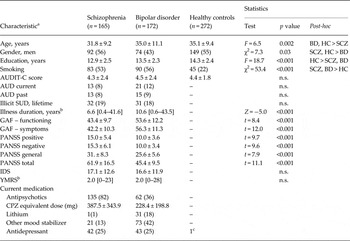
There were more women among bipolar disorder patients than among schizophrenia patients or healthy controls (Table 1). The schizophrenia patients were significantly younger, and the schizophrenia and bipolar patients had fewer years of education than the healthy controls. Mean AUDIT-C score did not differ between groups. Distribution of AUDIT-C score by group is shown in Supplementary Fig. S2. AUDIT-C score was significantly higher in men than in women in healthy controls and bipolar patients, and inversely related to age in healthy controls and schizophrenia patients (see Supplementary Table S1 and Fig. S3). The schizophrenia patients had shorter duration of illness, more severe symptoms and worse psychosocial functioning than the bipolar disorder patients (Table 1). Eight percent of the schizophrenia patients and 12% of the bipolar patients had a current AUD, mainly alcohol dependence (77% and 67%, respectively). Supplementary Table S2 presents AUDIT and DUDIT total scores and data on use of illicit drugs.
Demographic and clinical characteristics of the study sample, n = 609 [mean ± s.d. or number (%) unless otherwise specified]

AUDIT-C, Alcohol Use Disorder Identification Test – Consumption part; AUD, alcohol use disorder; SUD, substance use disorder; GAF, Global Assessment of Functioning scale; PANSS, Positive And Negative Syndrome Scale; IDS, Inventory of Depressive Symptomatology; YMRS, Young Mania Rating Scale; CPZ, chlorpromazine equivalents; BD, bipolar spectrum disorder; HC, healthy controls; SCZ, schizophrenia spectrum disorder; n.s., not significant.
a Information on smoking was missing for 88 subjects (69 controls), duration of illness was missing for three patients, PANSS was missing for five patients, IDS was missing for 78 patients, YMRS was missing for 29 patients.
b Median (range).
c One control reported using citalopram 30 mg daily but was not diagnosed with current or previous psychiatric disorder.
Association between AUDIT-C score and cortical thickness and surface area
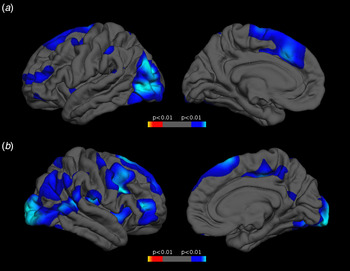
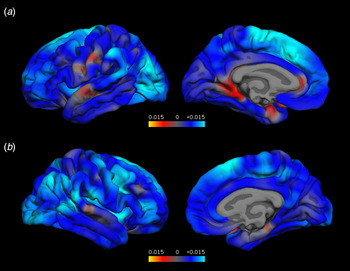
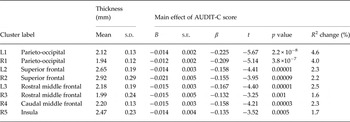
Increasing AUDIT-C score was related to thinner cortex in frontal and occipital brain regions bilaterally (Fig. 1a, b ; with corresponding effect-size maps in Fig. 2a, b ). There were no significant interaction effects between AUDIT-C score and age, gender or diagnostic group in the vertex-wise analyses. We extracted mean cortical thickness for eight cortical clusters (>15 cm2) that reached FDR-adjusted statistical significance. The eight clusters included the left superior frontal gyrus and medial parts of right superior frontal gyrus, regions of right insula, right caudal middle frontal and bilateral rostral middle frontal and parieto-occipital regions (depicted in Supplementary Fig. S4a, b, see Supplementary Table S3 for coordinates and detailed description of the clusters). Main effect of AUDIT-C for each cluster is given in Table 2.
(a, b) FDR-corrected statistical p-maps demonstrating negative association between AUDIT-C score and cortical thickness in (a) left and (b) right hemisphere, lateral and medial view, in 609 participants. FDR, False discovery rate; AUDIT-C, Alcohol Use Disorder Identification Test – Consumption part.

(a, b) Effect-size maps (in millimeters) of the association between AUDIT-C score and cortical thickness in (a) left and (b) right hemisphere, lateral and medial view, in 609 participants. AUDIT-C, Alcohol Use Disorder Identification Test – Consumption part.

Effect of AUDIT-C score on mean cortical thickness in the cortical clusters. Linear regression models covaried for age, gender and diagnostic group (n = 609)

AUDIT-C, Alcohol Use Disorder Identification Test – Consumption part.
There were no significant associations between AUDIT-C score and surface area and no significant interactions between AUDIT-C score and age, gender or diagnoses for the surface area analyses.
Association between AUDIT-C score and subcortical volumes
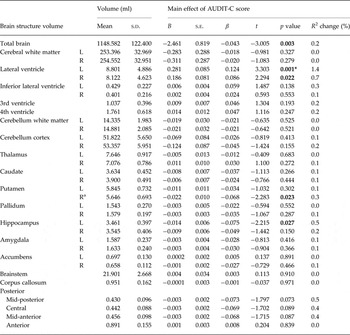
There was a statistically significant positive association between AUDIT-C score and left lateral ventricle volumes (β = 0.124, p = 0.001) (Table 3). There was a nominally significant positive association between AUDIT-C and right lateral ventricular volumes (β = 0.086, p = 0.022), and negative associations between AUDIT-C and total brain volume (β = −0.043, p = 0.003), left hippocampus (β = −0.075, p = 0.027) and right putamen (β = −0.068, p = 0.023) volumes, but these were not significant after adjusting for multiple testing.
Main effect of AUDIT-C score on subcortical volumes, n = 609. Linear regression models, covaried for age, gender, group and estimated total intracranial volume. Uncorrected p values

AUDIT-C, Alcohol Use Disorder Identification Test – Consumption part.
*Significant after correction for multiple comparisons with Bonferroni–Holm for 33 tests.
a Right putamen: there was significant interaction between AUDIT-C and age, main effect displayed is with interaction term included in the model.
Post-hoc analyses
Supplementary Fig. S4a, b depicts with bar graphs the relative contribution of all independent variables (AUDIT-C, age, gender and diagnostic group) in each cluster. As expected, age explained the most variance in all clusters, but we also noted a substantial contribution of group. In the higher-order interaction analyses, no results survived correction for multiple tests (see Supplementary material for details).
The association between AUDIT-C and mean cortical thickness in the cortical clusters and left lateral ventricular volume remained significant when the 34 patients with a current AUD were removed from the sample and after removing the 112 participants with alcohol intake in the 24 h prior to MR scanning. The main effect of AUDIT-C score remained significant when potential confounders (detailed in the Supplementary material) were added to the model.
Discussion
The main finding was the dose-dependent relationship between increasing levels of alcohol use and ventricular enlargement and thinner cortex in widespread brain regions in participants reporting past year alcohol consumption. The association between alcohol use and structural changes was not significantly different in schizophrenia or bipolar disorder patients compared to healthy controls. The effects remained significant after controlling for substance use disorders, including AUDs, illicit substance use, antipsychotic medication and disease severity.
The cortical regions associated with alcohol use (parts of superior and middle frontal gyri bilaterally, right insula and bilateral parieto-occipital regions) are in accordance with gray-matter deficits found in studies of alcohol-dependent patients in treatment (Jernigan et al. Reference Jernigan, Butters, DiTraglia, Schafer, Smith, Irwin, Grant, Schuckit and Cermak1991; Fein et al. Reference Fein, Shimotsu, Chu and Barakos2009; Durazzo et al. Reference Durazzo, Tosun, Buckley, Gazdzinski, Mon, Fryer and Meyerhoff2011; Fortier et al. Reference Fortier, Leritz, Salat, Venne, Maksimovskiy, Williams, Milberg and McGlinchey2011; Rando et al. Reference Rando, Hong, Bhagwagar, Li, Bergquist, Guarnaccia and Sinha2011; Momenan et al. Reference Momenan, Steckler, Saad, van Rafelghem, Kerich and Hommer2012), treatment-naive alcohol-dependent individuals (Fein et al. Reference Fein, Di Sclafani, Cardenas, Goldmann, Tolou-Shams and Meyerhoff2002; Cardenas et al. Reference Cardenas, Studholme, Meyerhoff, Song and Weiner2005) and in moderate alcohol consumption (Taki et al. Reference Taki, Goto, Evans, Zijdenbos, Neelin, Lerch, Sato, Ono, Kinomura, Nakagawa, Sugiura, Watanabe, Kawashima and Fukuda2004). Interestingly, the temporal gray-matter reductions often reported in alcohol dependence (Jernigan et al. Reference Jernigan, Butters, DiTraglia, Schafer, Smith, Irwin, Grant, Schuckit and Cermak1991; Pfefferbaum et al. Reference Pfefferbaum, Sullivan, Mathalon and Lim1997; Cardenas et al. Reference Cardenas, Studholme, Gazdzinski, Durazzo and Meyerhoff2007; Fortier et al. Reference Fortier, Leritz, Salat, Venne, Maksimovskiy, Williams, Milberg and McGlinchey2011), also found in studies of heavy drinkers (Cardenas et al. Reference Cardenas, Studholme, Meyerhoff, Song and Weiner2005; Thayer et al. Reference Thayer, Hagerty, Sabbineni, Claus, Hutchison and Weiland2016) were not found in our study.
We found substantial effects in the frontal cortex bilaterally, including parts of middle frontal gyri and medial aspects of superior frontal gyri, although the strongest association with alcohol use was found in the parieto-occipital clusters. Neuroimaging of alcohol-dependent individuals have found the frontal lobes to be the region most affected by alcohol (Sullivan & Pfefferbaum, Reference Sullivan and Pfefferbaum2005). Post-mortem findings of selective neuronal loss in the superior frontal association cortex in alcohol dependence (compared with lack of neuronal loss in motor cortex) (Kril et al. Reference Kril, Halliday, Svoboda and Cartwright1997) supports a particular vulnerability to alcohol toxicity in this region. Of functional relevance, the medial frontal cortex is involved in cognitive control over habitual actions (Isoda & Hikosaka, Reference Isoda and Hikosaka2007) and atrophy in these regions in alcoholics has been suggested to lead to reduced ability to override habitual responses to environmental cues, stress and other factors leading to alcohol relapse (Rando et al. Reference Rando, Hong, Bhagwagar, Li, Bergquist, Guarnaccia and Sinha2011). The dorsolateral prefrontal cortex (DLPFC), located in the middle frontal gyri, is part of the mesocorticolimbic circuit, a ‘reward network’ involved in behavioral reinforcement (Bowirrat & Oscar-Berman, Reference Bowirrat and Oscar-Berman2005) considered central to the neurobiology of alcohol dependence (Koob, Reference Koob1999). Structural alterations in the DLPFC could disrupt the network (Makris et al. Reference Makris, Oscar-Berman, Jaffin, Hodge, Kennedy, Caviness, Marinkovic, Breiter, Gasic and Harris2008b ) and increase the risk for drug-seeking behavior (Bowirrat & Oscar-Berman, Reference Bowirrat and Oscar-Berman2005).
Ventricular enlargement is an established finding in studies of alcohol dependence (Jernigan et al. Reference Jernigan, Butters, DiTraglia, Schafer, Smith, Irwin, Grant, Schuckit and Cermak1991; Hayakawa et al. Reference Hayakawa, Kumagai, Suzuki, Furusawa, Haga, Hoshi, Fujiwara and Yamaguchi1992; Wobrock et al. Reference Wobrock, Falkai, Schneider-Axmann, Frommann, Wolwer and Gaebel2009) and of moderate alcohol consumption (Mukamal et al. Reference Mukamal, Longstreth, Mittleman, Crum and Siscovick2001; Ding et al. Reference Ding, Eigenbrodt, Mosley, Hutchinson, Folsom, Harris and Nieto2004) and has been associated with cerebral atrophy (Jernigan et al. Reference Jernigan, Butters, DiTraglia, Schafer, Smith, Irwin, Grant, Schuckit and Cermak1991; Hayakawa et al. Reference Hayakawa, Kumagai, Suzuki, Furusawa, Haga, Hoshi, Fujiwara and Yamaguchi1992; Ding et al. Reference Ding, Eigenbrodt, Mosley, Hutchinson, Folsom, Harris and Nieto2004). The positive association between alcohol use and left ventricular volume found in our sample is thus in accordance with the scientific literature.
We did not observe a differential brain effect of alcohol between patients with severe mental illness and controls. Hence, our findings do not support the hypothesis that patients with severe mental illness have increased vulnerability to alcohol-induced brain damage. Previous studies showing increased vulnerability for alcohol in schizophrenia or bipolar disorder differ from ours in design as they have compared patients with and without co-morbid AUD and healthy controls (Nery et al. Reference Nery, Matsuo, Nicoletti, Monkul, Zunta-Soares, Hatch, Lafer and Soares2011; Smith et al. Reference Smith, Wang, Cronenwett, Goldman, Mamah, Barch and Csernansky2011), often with an additional group of alcohol-dependent subjects without severe mental illness (Sullivan et al. Reference Sullivan, Deshmukh, Desmond, Mathalon, Rosenbloom, Lim and Pfefferbaum2000b ; Mathalon et al. Reference Mathalon, Pfefferbaum, Lim, Rosenbloom and Sullivan2003). There were comparably few patients with co-morbid AUD in our sample. Therefore, if the increased vulnerability to alcohol-induced brain injury in severe mental illness is linked to alcohol dependence, this could help to explain the discrepant results between previous studies and ours. Further, our results are in line with an earlier study from our group on a separate sample (Nesvåg et al. Reference Nesvåg, Frigessi, Jonsson and Agartz2007). Using a similar design as the present study, schizophrenia patients and healthy controls showed similar relationship between alcohol use and smaller frontal white-matter volumes (Nesvåg et al. Reference Nesvåg, Frigessi, Jonsson and Agartz2007).
We found no significant gender differences in the effect of alcohol consumption on structural brain measures. Results of previous studies appear contradictory, with some findings indicating greater vulnerability to alcohol's effects on brain structure in women (Agartz et al. Reference Agartz, Momenan, Rawlings, Kerich and Hommer1999; Hommer et al. Reference Hommer, Momenan, Kaiser and Rawlings2001; Paul et al. Reference Paul, Au, Fredman, Massaro, Seshadri, Decarli and Wolf2008) while others have found more pronounced effects in men (Pfefferbaum et al. Reference Pfefferbaum, Rosenbloom, Deshmukh and Sullivan2001; Taki et al. Reference Taki, Goto, Evans, Zijdenbos, Neelin, Lerch, Sato, Ono, Kinomura, Nakagawa, Sugiura, Watanabe, Kawashima and Fukuda2004; de Bruin et al. Reference de Bruin, Hulshoff Pol, Bijl, Schnack, Fluitman, Böcker, Kenemans, Kahn and Verbaten2005a ; Fein et al. Reference Fein, Shimotsu, Chu and Barakos2009) or no gender differences (Cardenas et al. Reference Cardenas, Studholme, Meyerhoff, Song and Weiner2005; Momenan et al. Reference Momenan, Steckler, Saad, van Rafelghem, Kerich and Hommer2012). Variations in sampling, image analysis, and gender differences in alcohol consumption might contribute to the heterogeneity of these results; e.g. the Cardenas et al. (Reference Cardenas, Studholme, Meyerhoff, Song and Weiner2005) study included only nine alcohol-dependent women and nine healthy control women, and in the study by Taki et al. (Reference Taki, Goto, Evans, Zijdenbos, Neelin, Lerch, Sato, Ono, Kinomura, Nakagawa, Sugiura, Watanabe, Kawashima and Fukuda2004) lifetime consumption in women was 12% of that in men, whereas consumption levels were comparable across genders in the study by Hommer et al. (Reference Hommer, Momenan, Kaiser and Rawlings2001).
Cortical thickness and area are thought to represent distinct biological entities, arising independently during neurodevelopment (Rakic, Reference Rakic1988). In the present study, we found alcohol use to be associated with cortical thickness but not cortical surface area. Our finding is in agreement with a recent study by Thayer et al. (Reference Thayer, Hagerty, Sabbineni, Claus, Hutchison and Weiland2016) that found AUDIT score to be associated with cortical volume and thickness but not surface area in heavy drinkers (Thayer et al. Reference Thayer, Hagerty, Sabbineni, Claus, Hutchison and Weiland2016). It supports the understanding that cortical thickness is more sensitive to environmental influences (Goldman et al. Reference Goldman, Pezawas, Mattay, Fischl, Verchinski, Chen, Weinberger and Meyer-Lindenberg2009; Habets et al. Reference Habets, Marcelis, Gronenschild, Drukker and van Os2011), whereas surface area is thought to be more resistant to change after developmental completion (Rakic, Reference Rakic1988).
The similar levels of AUDIT-C scores between patients and healthy controls were unexpected considering that the AUD prevalence generally is higher in patients with severe mental illness than in the general population (Regier et al. Reference Regier, Farmer, Rae, Locke, Keith, Judd and Goodwin1990; Grant et al. Reference Grant, Goldstein, Saha, Chou, Jung, Zhang, Pickering, Ruan, Smith, Huang and Hasin2015). Mean AUDIT-C scores and AUDIT total scores in the healthy controls in our study corresponded well to those found in corresponding age groups in a recent population-based survey in Norway (Mathiesen et al. Reference Mathiesen, Nome, Richter and Eisemann2012). Also similar to Mathiesen et al. AUDIT-C scores were higher among men than women and inversely related to age in the healthy control group, altogether indicating that alcohol use in our control sample was representative of the Norwegian general population. Patients with problematic substance use might be underrepresented in our sample as they might be less likely to participate in research projects. Yet, the rates of 8% current AUD in schizophrenia and 12% in bipolar disorder in our sample correspond well with findings in a Norwegian registry-based population study reporting a 5-year AUD prevalence (with or without co-morbid drug use disorders) of 9.5% in schizophrenia and 12.5% in bipolar disorder (table 2 in Nesvåg et al. Reference Nesvåg, Knudsen, Bakken, Hoye, Ystrom, Suren, Reneflot, Stoltenberg and Reichborn-Kjennerud2015), indicating that our patient sample is representative of the Norwegian patient population. In analogy, a meta-analysis showed a 9.4% prevalence of current AUD in schizophrenia (Koskinen et al. Reference Koskinen, Lohonen, Koponen, Isohanni and Miettunen2009) and co-morbid current AUD was found in 12% of Swedish bipolar disorder patients (van der Werf-Eldering et al. Reference van der Werf-Eldering, Burger, Holthausen, Aleman and Nolen2010), whereas rates were higher in other Western countries (e.g. The Netherlands and the United States, table 1 in Hunt et al. Reference Hunt, Malhi, Cleary, Lai and Sitharthan2016). Per capita alcohol consumption correlated positively with co-morbidity rates in a meta-analysis of AUD in bipolar disorder (Di Florio et al. Reference Di Florio, Craddock and van den Bree2014). Per capita alcohol consumption in Norway is among the lowest in Europe (6.6 litres per year in 2010; WHO Global Information System on Alcohol and Health, 2010). Moreover, gender ratio may influence co-morbidity rates of AUD in severe mental illness studies, with generally higher rates in men than in women (Koskinen et al. Reference Koskinen, Lohonen, Koponen, Isohanni and Miettunen2009; Di Florio et al. Reference Di Florio, Craddock and van den Bree2014). The gender distribution in our study was fairly equal whereas men are overrepresented in many studies of severe mental illness. Both factors can partly explain the relatively low prevalence of AUD in our study.
The present study is naturalistic and cross-sectional and the following limitations apply: First, we could not make assumptions about causality, only investigate the statistical association between alcohol use and structural brain measures. Second, a large part of the patient group used illicit substances in addition to alcohol (Table 1 and Supplementary Table S2). Both cocaine (Makris et al. Reference Makris, Gasic, Kennedy, Hodge, Kaiser, Lee, Kim, Blood, Evins, Seidman, Iosifescu, Lee, Baxter, Perlis, Smoller, Fava and Breiter2008a ; Ide et al. Reference Ide, Zhang, Hu, Sinha, Mazure and Li2014) and amphetamine (Berman et al. Reference Berman, O'Neill, Fears, Bartzokis and London2008) dependencies have been associated with cortical gray-matter reductions (in the frontal lobe and other regions) although alcohol has been shown to be an important factor also in brain changes in amphetamine dependency (Lawyer et al. Reference Lawyer, Bjerkan, Hammarberg, Jayaram-Lindstrom, Franck and Agartz2010). This opens up for the possibility that our findings could in part be related to other substance use than alcohol, but since the alcohol effect remained significant after controlling for tobacco and other substance use, we have indications that this was not the case. Further, excluding all patients with illicit substance use would have made our sample less representative.
The strengths of the study include the large and thoroughly characterized subject sample. Moreover, all MR images were acquired on the same scanner and there were no major software or hardware upgrades during the study period.
Conclusion
The results of the present study show a dose-dependent relationship between increasing levels of alcohol use and widespread cortical thinning and ventricular expansion in drinkers across a continuum of alcohol consumption levels. This association was found in schizophrenia and bipolar disorder patients as well as in healthy control subjects, and did not support previous findings of increased vulnerability to alcohol's brain effects in patients with severe mental illness. Importantly, the statistical effect of alcohol use remained after controlling for AUDs, implicating that alcohol use has a negative effect on brain structure even in the absence of behavioral or social adverse consequences of alcohol. The results emphasize the importance of addressing alcohol use in patients with schizophrenia and bipolar disorder in the clinic as well as in non-mental illness populations. Alcohol should be taken into account as a potential confounder in neuroimaging studies.
Supplementary material
The supplementary material for this article can be found at https://doi.org/10.1017/S0033291716002920.
Acknowledgements
We thank the study participants and clinicians involved in recruitment and assessment at the Norwegian Research Centre for Mental Disorders (NORMENT). We also thank Thomas Bjella, Marin Furan and Linn Norbom for technical assistance. The study was supported by grants from the Research Council of Norway (grant nos. 190311/V50, 167153/V50, 223273), the South-Eastern Norway Regional Health Authority (grant nos. 2012100, 2011092, 2009037) and the K. G. Jebsen Foundation.
Declaration of Interests
O.A.A. has received speaker's honorarium from pharmaceutical companies Osaka, GSK and Lundbeck. The remaining authors report no conflict of interests.