Introduction/Background
In extreme disasters (eg, hurricanes, pandemics, earthquakes, and major chemical incidents), the number of potentially salvageable patients requiring ventilatory support exceeds the number of available mechanical ventilators.Reference Kaji, Koenig and Bey1–Reference Scales, Green and Chan6 Lacking this capacity, critically ill casualties are to be triaged “expectant,” – left to die.Reference Rubinson, Nuzzo and Talmor7 In resource-poor locations, the only alternative for delivering mechanical ventilatory support may be by means of an inexpensive bag-valve device (BVD; PH personal communication).
A few clinical descriptions of prolonged manual ventilation in disasters exist in the literature.Reference Klein and Nagel8 In the wake of Hurricane Katrina (2005; USA), patients were manually ventilated for many hours by nurses, respiratory therapists, and others, completely occupying one caregiver each.Reference deBoisblanc and Hawk9 However, no data were given regarding the quality of ventilation provided. Prolonged manual ventilation does not feature in most textbooks on disaster medicine. In a consensus European Guideline, it is explicitly considered not feasible:
If sufficient ventilators are not available, manual ventilation is usually not recommended because of operator fatigue, patient hypoventilation, and high risk for disease transmission.Reference Sprung, Zimmerman and Christian10
In the 1952 polio epidemic in Copenhagen (Denmark),Reference Lassen11 respiratory paralysis occurred in 345 patients, with up to 70 patient requiring ventilation at one time. Due to insufficient mechanical ventilators, medical students ventilated patients manually in four-hour shifts. Such a sudden increase in the number of critically ill patients following a disaster may result in irreversible casualty triage decisions.Reference Farmer and Carlton12 Critically, many of these patients may survive if their lung ventilation is mechanically supported during a period of reversible respiratory failure. Examples of causes of reversible respiratory failure in such circumstances include near drowning, chemical agent exposure, botulinum intoxication, postoperative ventilation, and chest trauma.Reference Scales, Green and Chan6
Studies of brief periods of manual ventilation, usually during transport of critically ill patients, have demonstrated stable oxygenation and hemodynamics, but usually some hyperventilation.Reference Gervais, Eberle and Konietzke13 Manual ventilation equipment (ie, self-inflating BVDs) are inexpensive, often single use, have long shelf lives, and are easily stored, retrieved, and transported. Using them requires only minimal training, usually 30 minutesReference Lin, Bhalla and King14 to one hour.15
A working group of the Society of Critical Care Medicine (Illinois USA)Reference Rubinson, Nuzzo and Talmor7 has considered the situation in which infrastructure is intact but overwhelming numbers of casualties occur (eg, in a bioterrorist attack). In their view, manual ventilation is restricted to very short periods, of the order of seconds to minutes, because it requires physical effort on the part of the caregivers and their full attention. It is difficult to verify in a clinical setting whether the correct volume of air is actually delivered during manual resuscitation.Reference Rubinson, Nuzzo and Talmor7 Lee, et alReference Lee, Cho and Choi16 found that the delivered volume depends on the method of squeezing the BVD: two-handed squeeze resulted in larger volumes than one. Thus, the BVD may theoretically lead to a large variation in the insufflated tidal volume (TV).Reference Lee, Cho and Choi16,Reference Seidelin, Stolarek and Littlewood17
Thus, the BVD may be the only option for ventilatory support in major disasters and also in medically under-served countries and regions.Reference Neyman and Irvin18 The authors’ previous studyReference Halpern, Dang and Epstein19 showed that six hours of manual ventilation of a lung simulator by trained medical operators is feasible. However, in the above circumstances, trained operators may not be available and may be replaced by minimally trained operators. It is not self-evident that untrained operators can indeed successfully provide adequate manual ventilation after a very brief training session. The present study investigated this issue.
Methods
The study was approved by Tel Aviv Medical Center’s (Tel Aviv, Israel) Institutional Review Board (0340-18 TLV), and preregistered in Israel’s Ministry of Health (Jerusalem, Israel) clinical research portal (MOH_2018-07-02_002488).
Study Design and Setting
This was a volunteer bench study performed in the Tel Aviv Medical Center’s Respiratory Unit simulation lab.
Selection of Participants
Twenty volunteers participated, including students (medical students were all pre-clinical), medical orderlies, or hospital volunteers previously unfamiliar with manual ventilation. The volunteers filled out a health questionnaire inquiring about limitations in performing manual effort, hypertension, or chronic lung disease which would exclude them from the study. Additionally, the study excluded volunteers below 18 years old, pregnant women, and anyone not qualified to sign a consent form.
Interventions
Participants signed an informed consent form. The PI then provided a structured, 20-minute training session explaining the technique of BVD-endotracheal tube ventilation and the rationale of the study (Appendix 1; available online only).
Volunteers wore regular clothes and were seated on a standard issue hospital chair (height 47cm), while the BVD was connected to a lung simulator (TTL 5600; Michigan Instruments; Grand Rapids, Michigan USA) positioned at a height of 90cm, similar to the height of an actual supine patient’s airway if lying on an emergency department gurney. Volunteers were instructed to provide ventilation to the lung simulator at the standard rate and depth, (12-15 breaths/min, approximately 500ml per breath). Participants used ventilation techniques of their choice: one hand, two hands, hand-on-thigh, or any other acceptable ventilatory technique based on the training they received from the investigator.
Participants were divided into two groups of 10 volunteers each, according to the two scenarios of severity of lung injury employed (as simulated by increased resistance and decreased compliance of the simulator). Both groups manually ventilated the lung simulator for six hours. Group One manually ventilated a “normal lung.” The simulator was set to a simulated lung compliance of 50cmH2O/L and a simulated airways resistance of 5cmH2O/L/minute (CL = 50; RL = 5). Group Two manually ventilated a “moderately injured lung.” The simulator was set at a simulated lung compliance of 20cm H2O/L and a simulated airway resistance of 20cmH2O/L/minute (CL = 20; RL = 20).
Measurements
Using a laptop computer, the PI recorded TV, ventilation rate (VR), and minute volume (MV) every five minutes from the output of the lung simulator. For each participant, systolic blood pressure (SBP) and diastolic blood pressure (DBP), respiratory rate (RR), heart rate (HR), and peripheral capillary oxygen saturation (SpO2) were measured and recorded every 60 minutes, as well as subjective effort score. Each subject then had seven repeated measures data values at time points: 0, 60, 120, 180, 240, 300, 360 minutes. A dynamometer (CAMRY, Model: Eh 101; South El Monte, California USA) measurement of hand grip strength was obtained every two hours, including a baseline measurement. The Borg Rating of Perceived Effort scaleReference Borg20 (Borg G: Borg’s Perceived Exertion and Pain Scales; Human Kinetics; Champaign, Illinois USA) was used to assess subjects’ perceived effort at the end of every hour.
Subjects were allowed a five-minute break every 55 minutes, representing a schedule that was considered standard in a clinical scenario. In an actual situation, there will, of course, be a substitute caregiver assigned to continue ventilating the patient without interruption during the break. The study closed at the end of six hours for each subject.
Statistical Analysis
Normality was determined by using Kolmogorov-Smirnov test. The following measures were not normally distributed: MV, VR, RR, dynamometer, and Borg scale. A rank transformation was performed in order to overcome this problem. The ranked transformed data were used in the analysis of variance (ANOVA). A two-way (group: 1 versus 2) *7 (time: 0, 60, 120, 180, 240, 300, 360) mixed-model repeated-measures ANOVA was performed to assess the time and group effect in the physiological changes. Quality of ventilation was assessed by measuring TV (mL/breath), MV (L/min), and VR (breaths/min), collected every five minutes for an overall of 330 minutes. The data were analyzed every 15 minutes for each subject, and the value in each time point was the mean of the previous three collected data values. In this way, each subject had 22 data values.
A two-way (group: 1 versus 2) *22 (time: 15, 30, … 330) mixed-model repeated-measures ANOVA was performed to assess the time and group effect in the quality of ventilation measures. Significant differences between pairs of time points were determined by Studentized Maximum Modulus multiple comparison adjustment method.Reference Hochberg21 Simple mean analysis was used to reveal significance in interaction. Statistical analysis was performed by SAS for Windows, version 9.4 (SAS Institute Inc.; Cary, North Carolina USA).
Results
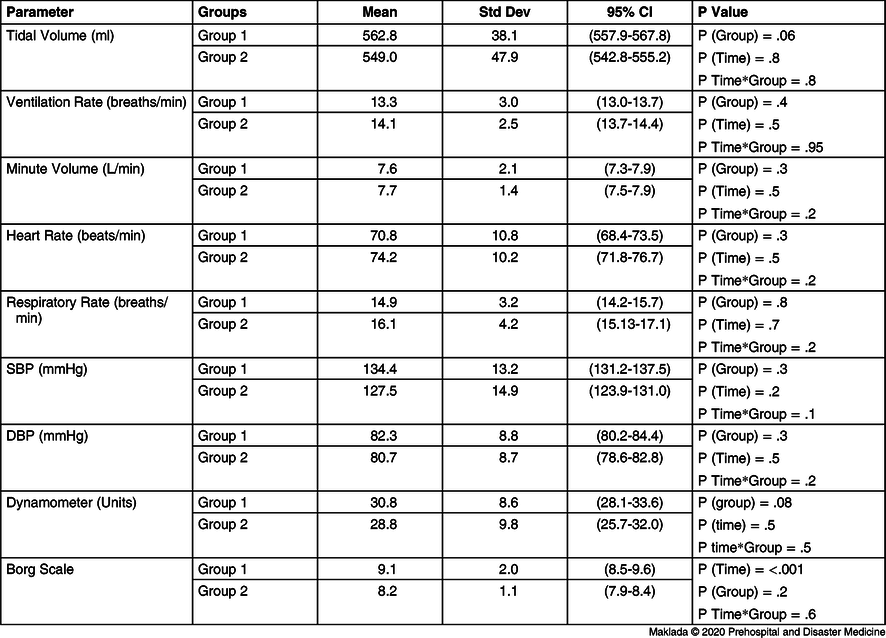
All subjects completed the required six-hour study period. Table 1 describes the results of the three parameters: quality of ventilation (TV, MV, and VR); cardiopulmonary effort (HR, RR, BP, and SpO2); and perceived effort (Borg scale) and dynamometer hand grip. Because there were breaks of five minutes for each hour, only 330 minutes of ventilation data were collected through the 360 minutes of experiment. The data are displayed in 15-minute average intervals.
Main Results

Note: Mean delivered tidal volume, respiratory rate, minute volume, and operator cardio-respiratory parameters.
Abbreviations: DBP, diastolic blood pressure; SBP, systolic blood pressure.
Main Results
Mean delivered TV, RR, and MV, as well as operator cardio-respiratory parameters, did not differ significantly between the groups (Table 1).
Quality of Ventilation (Table 1)
Mean TV was 562.8 (SD = 38.1; 95% Confidence Intervals, 557.9-567.8) in Group One and 549 (SD = 47.9; 95% CI, 542.8-555.2) in Group Two.
Mean VR was 13.3 (SD = 3.0; 95% CI, 13.0-13.7) in Group One and 14.1 (SD = 2.5; 95% CI, 13.7-14.4) in Group Two.
Mean MV was 7.6 (SD = 2.1; 95% CI, 7.3-7.9) in Group One and 7.7 (SD = 1.4; 95% CI, 7.5-7.9) in Group Two.
Cardiopulmonary Effort (Table 1)
Mean HR was 70.8 (SD = 10.8; 95% CI, 68.4-73.5) in Group One and 74.2 (SD = 10.2; 95% CI, 71.8-76.7) in Group Two.
Mean RR was 14.9 (SD = 3.2; 95% CI, 14.2-15.7) in Group One and 16.1 (SD = 4.2; 95% CI, 15.13-17.1) in Group Two.
Mean SBP was 134.4 (SD = 13.2; 95% CI, 131.2-137.5) in Group One and 127.5 (SD = 14.9; 95% CI, 123.9-131.0) in Group Two.
Mean DBP was 82.3 (SD = 8.8; 95% CI, 80.2-84.4) in Group One and 80.7 (SD = 8.7; 95% CI, 78.6-82.8) in Group Two.
The average SpO2 level remained stable 99% Room Air throughout the experiment.
Subjective and Objective Effort
The average subjective effort of the subjects on the Borg scale increased slightly, though statistically significantly for both groups, as time proceeded from one hour to six hours, ranging from 6.0 (very, very light) to 11.0 (fairly light); P <.001. Mean hand grip strength by dynamometer was 30.8 in Group One and 28.8 in Group Two, an insignificant difference.
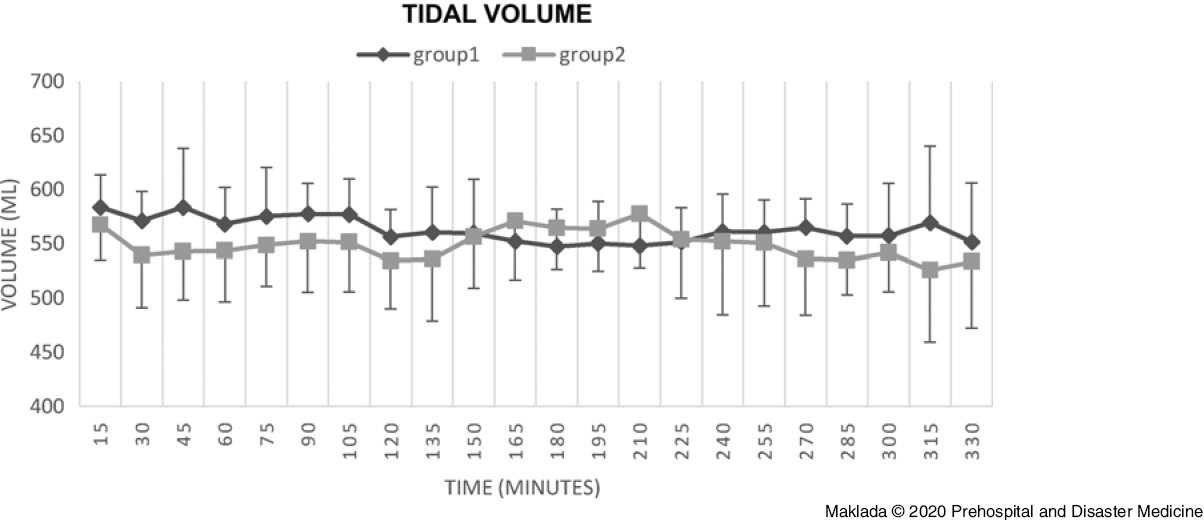
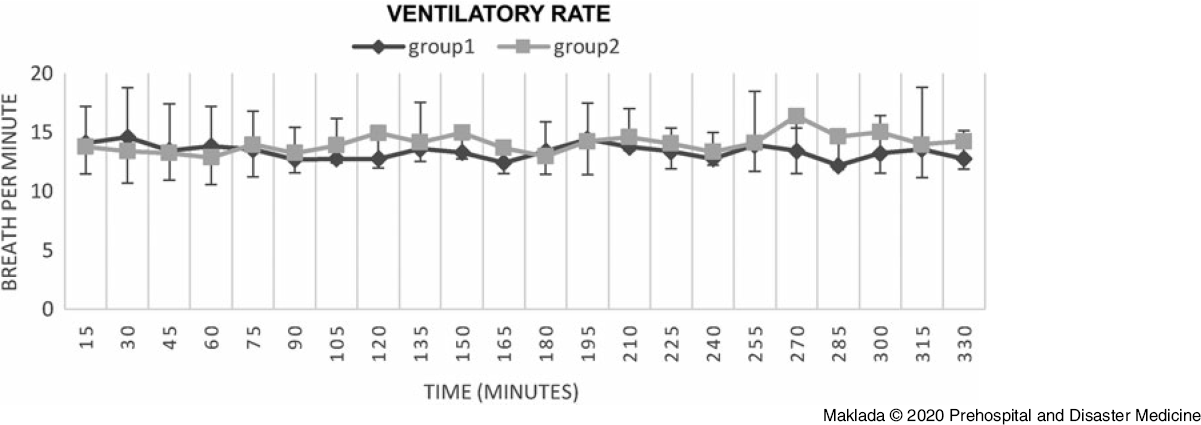
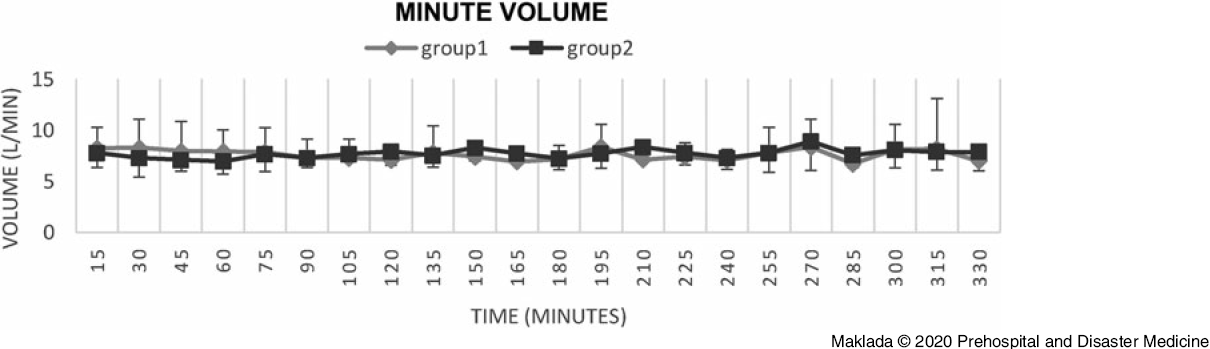
Delivered ventilatory values remained constant for both groups throughout the six hours of study (Figure 1, Figure 2, and Figure 3). The average TV remained constant throughout the study period, and on average, within the acceptable range of 500ml-600ml. There was no significant difference between the normal lung (Group One) and the “sick” lung group (Group Two). Both groups remained stable over time. There was no change over time for both groups.
Tidal Volume.

Ventilatory Rate.

Minute Volume.

Discussion
Prolonged manual mechanical ventilation is a relevant alternative in some under-served medical systems and a staple of major disaster situations. Previous studies of manual ventilation have centered on brief periods of time, usually following endotracheal intubation or cardiopulmonary resuscitation, and on the major issue of inadvertent hyperventilation.Reference Wenzel, Idris and Dörges22,Reference Bacior23 It was previously shownReference Halpern, Dang and Epstein19 that it is feasible and safe for trained nurses to manually bag-tube ventilate for six hours. The present study extended the design to a perhaps more clinically relevant situation, whereby non-medically-trained individuals may be called upon to manually ventilate for hours at a time, with minimal training. The present study assessed non-medical operators’ objective and perceived effort, as well as the quality of manual ventilation, they delivered for six hours to simulated normal and injured lungs. The results indicate that the effort was reasonable and did not pose a limitation on ability to perform the task, and the quality of ventilation was stable and clinically acceptable.
The average TV delivered by the subjects (Figure 1) was only slightly above the study-indicated 500ml level in both groups, and it remained constant throughout the study period and was, on average, within an acceptable clinical range of 500ml-600ml. There was no significant difference between the “normal” lung and the “sick” lung group. This is a remarkable finding, indicating that the TV delivered by these briefly trained subjects was accurate and relatively stable, even though they lacked a feedback mechanism to inform them about the actual delivered volume and rate, and they never had previous experience in manual ventilation.
The average TV (Figure 1), VR (Figure 2), and MV (Figure 3) were stable throughout the experiment. It seems that operators can settle down to a stable, accurate mode which can be maintained for hours on end.
The subjective effort of the volunteers increased slightly over time for both groups, but remained within the mild zone. There was no muscle fatigue, as evidenced by the hand grip dynamometer results. Volunteers remained hemodynamically stable throughout the study.
The present study extends the previous initial findingsReference Halpern, Dang and Epstein19 and strengthens the data indicating that even very brief training can produce well-performed, prolonged manual ventilation. The importance of the data is that they add credence to the recommendation that this mode be made part of the armamentarium of disaster managers, and also of health care managers in under-served locations, where life and death decisions to initiate endotracheal intubation and mechanical ventilation in potentially salvageable patients may be a daily occurrence.
Study Limitations
One limitation of this study is that participants were relatively young (18-35 years old). In a real scenario, perhaps older family members will be called upon to manually ventilate. Also, the study did not simulate the emotional distress of the situation of disaster or very austere conditions, nor the potential environmental difficulties such as a very hot/cold environment. These issues may be addressed in future studies. A further limitation of this study is that the simulators used for the study may not realistically simulate the dynamics of actual human subjects.
Conclusion
The current study extended a previous conceptReference Halpern, Dang and Epstein19 in two ways: (1) by showing that medically untrained persons, a realistic option in both disasters and austere conditions, can do the same; and (2) by showing that increased work of breathing imposed by an ill lung did not have a detrimental effect on operator performance.
The authors propose that manual ventilation may be considered for incorporation into standard operating procedures for austere medical situations and major disasters.
Acknowledgements
The authors thank Ms. Dana Hadar for conducting the statistics for the study.
Conflicts of interest/funding
This work received no specific grant from any funding agency in the public, commercial, or not-for-profit sectors. NM, MKS, EL, and PH report no conflicts of interest. This study was pre-registered in Israel’s Ministry of Health (Jerusalem, Israel) clinical research portal –https://my.health.gov.il/CliniTrials(MOH_2018-07-02_002488).
Author Contributions Statement
PH conceived the study, designed the trial, and co-wrote the manuscript with NM. NM wrote the protocol and PH and MKS helped in revision. MKS prepared the protocol for IRB, presented the study to the IRB, and assisted with protocol revisions to the IRB. NM conducted the trial and data collection, undertook recruitment of participating volunteers, management of volunteers, and management of the data. EL assisted in managing the volunteers and data collection. NM drafted the manuscript, and all authors contributed substantially to its revision. PH takes responsibility for the paper as a whole.
Supplementary Material
To view supplementary material for this article, please visit https://doi.org/10.1017/S1049023X20000679