Introduction
The southern right whale (SRW; Eubalaena australis) has a circumpolar distribution in the southern hemisphere (Ohsumi & Kasamatsu, Reference Ohsumi and Kasamatsu1986; Cooke & Zerbini, Reference Cooke and Zerbini2018). It spends the austral summers on feeding grounds concentrated at mid-latitudes (40–50°S), though some individuals forage southwards as far as Antarctica (65°S: Bannister et al., Reference Bannister, Pastene and Burnell1999). Core wintering grounds have been documented in the coastal waters of southern Australia, New Zealand (Auckland Islands and Campbell Island), South America (Brazil and Argentina) and South Africa (IWC, 2001).
SRWs were heavily exploited over several centuries of whaling, due to their accessibility in nearshore habitat, large oil yield, approachability, and tendency to float once dead. Populations were targeted by open-boat American and European whalers in the 1700s and 1800s, and were already severely depleted prior to the development of modern whaling in the 1900s. Approximately 150,000 SRWs were landed globally between the 1770s and 1970s, with only around 300 animals remaining worldwide by the 1920s (IWC, 2001). As a result, the SRW received full protection from the International Whaling Commission (IWC) in 1935. Despite that, illegal catches by the Soviet Union between 1951 and 1971 included 3368 right whales (Tormosov et al., Reference Tormosov, Mikhaliev, Best, Zemsky, Sekiguchi and Brownell1998), which likely delayed the recovery process by another 20 years (IWC, 2001).
In recent decades, evidence of increasing population size (doubling times of 10–12 years) has been provided by long-term studies at several of the core winter breeding grounds in the South-west Atlantic (Uruguay, Argentina and Brazil: Payne et al., Reference Payne, Rowntree, Perkins, Cooke and Lankester1990; Cooke et al., Reference Cooke, Rowntree and Payne2001), South-east Atlantic (South Africa and Namibia: Best et al., Reference Best, Brandão and Butterworth2001; Brandão et al., Reference Brandão, Butterworth, Ross-Gillespie and Best2013), Australia (Bannister et al., Reference Bannister, Hammond and Double2016) and the South-west Pacific (New Zealand; Carroll et al., Reference Carroll, Childerhouse, Fewster, Patenaude, Steel, Dunshea, Boren and Baker2013). While the global population in 2009 (13,600 individuals: IWC, 2013) was still significantly below the estimated pre-exploitation size of 55,000 to 75,000 animals (IWC, 2001), the steady signs of recovery documented worldwide have led to the species recently being allocated a status of Least Concern by the International Union for Conservation of Nature (Cooke & Zerbini, Reference Cooke and Zerbini2018).
Although the SRW is increasing worldwide, not all populations are recovering equally or continuously at the same rate. One example is the South-west Atlantic (SWA) region, where large catches estimated at 29,500 right whales occurred between 1772 and 1814 at Brazilian shore stations and on the offshore Brazil Banks/Falklands grounds (Richards, Reference Richards1993). SRWs have been studied at the principal SWA breeding ground at Península Valdés (PV: 42–43°S) in Argentina since the 1970s (Payne, Reference Payne1986), and were recovering well until the 1990s (Cooke et al., Reference Cooke, Rowntree and Payne2001). In recent decades, high calf mortality has affected population growth (Rowntree et al., Reference Rowntree, Uhart, Sironi, Chirife, Di Martino, La Sala, Musmeri, Mohamed, Andrejuk, McAloose, Sala, Carribero, Rally, Franco, Adler, Brownell, Seger and Rowles2013) and the overall rate of increase has slowed (Crespo et al., Reference Crespo, Pedraza, Dans, Svendsen, Degrati and Coscarella2019). Consequently, the IWC has adopted a Conservation Management Plan (CMP) for SWA right whales (Iñíguez Bessega et al., Reference Iñíguez Bessega, Boscarol, Galletti Vernazzani, Le Bas, Luna, Ponce de León and Tombesi2012), aiming to protect their habitat, minimize anthropogenic impacts and ensure that recovery of the species continues to pre-exploitation levels.
One area of the SWA where a historical and contemporary occurrence of SRWs has received relatively little recognition, is the Falkland Islands (Malvinas). The CMP and the 1998 Comprehensive Assessment of right whales (IWC, 2001) both mentioned the Falklands only briefly, and solely in the context of the ‘Brazil/False Banks/Falkland Islands’ summer feeding ground, a large offshore area that extends between latitudes 30° and 55°S (IWC, 2001). This paper describes current knowledge of SRWs in the Falkland Islands, including a literature review, whaling catch summaries, and contemporary data originating from recent systematic cetacean survey work and citizen science. This information is relevant to SRW conservation throughout the SWA region, since identifying the locations of feeding grounds and migratory routes has been stated as a priority of the CMP (Iñíguez Bessega et al., Reference Iñíguez Bessega, Boscarol, Galletti Vernazzani, Le Bas, Luna, Ponce de León and Tombesi2012).
Materials and methods
Study area
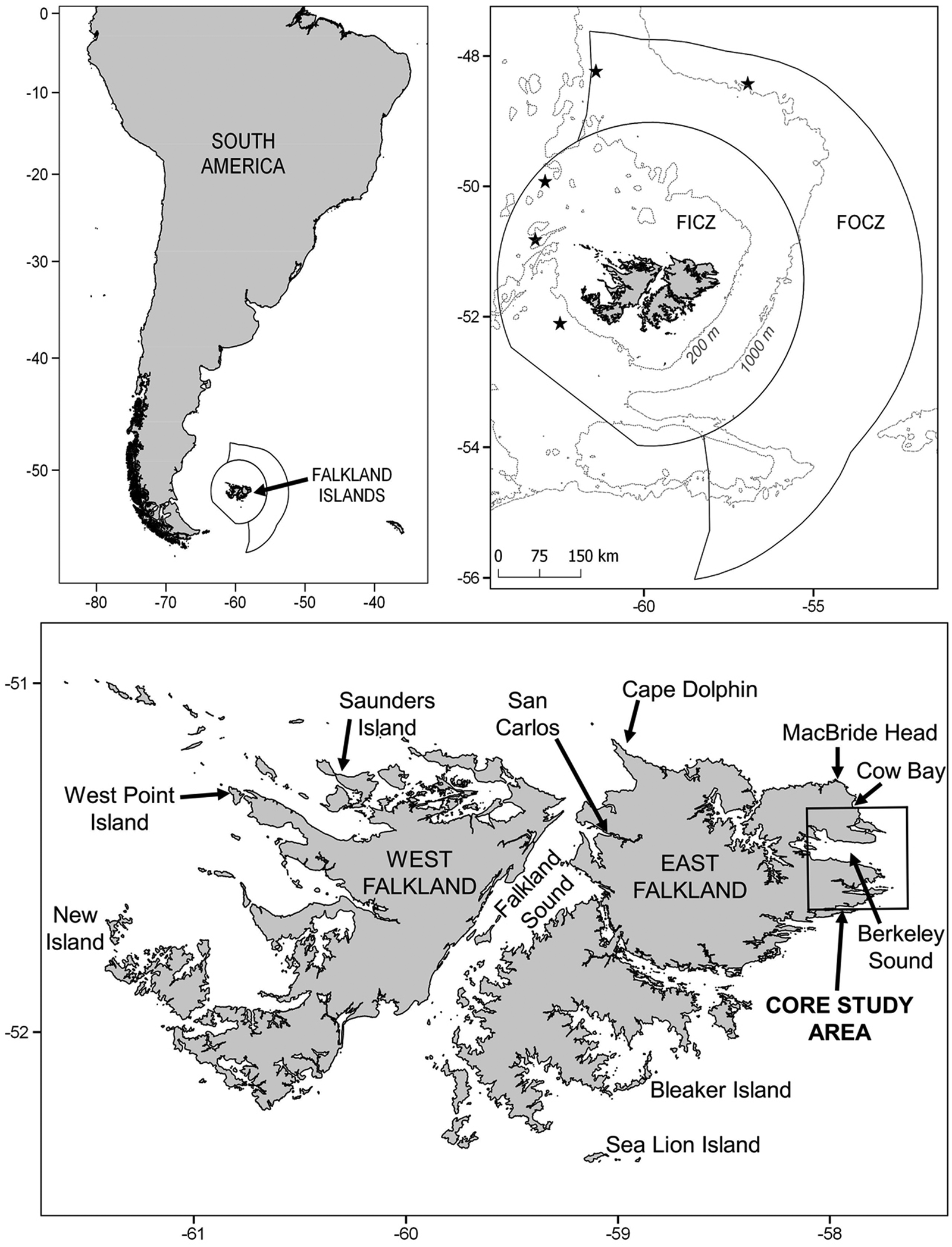
The Falkland Islands are located on a south-easterly projection of the Patagonian Shelf, ~500 km east from the southern tip of South America (Figure 1). Two marine resource management zones have been designated (hereafter referred to collectively as Falklands Conservation Zones, FCZs); (1) the Falkland Islands Interim Conservation and Management Zone (FICZ) comprising an area of 300 km radius around Falkland Sound; and (2) the Falkland Islands Outer Conservation Zone (FOCZ) extending between the FICZ and the 200 nautical mile economic zone boundary (Figure 1). At their maximum extents, the FCZs occur between latitudes of ~47.7°S to 56.2°S, and longitudes of ~52.3°W to 63.5°W. The islands are surrounded by shallow (<200 m depth) shelf waters, while deeper water associated with the shelf edge occurs off the north-east, east and south coasts (Figure 1).
Location of the Falkland Islands showing the Falkland Islands Interim Conservation and Management Zone (FICZ), the Falkland Islands Outer Conservation Zone (FOCZ), the study area, place names mentioned in the text, and the locations of southern right whale sightings (black stars) recorded by White et al. (Reference White, Gillon, Black and Reid2002).

Literature review
A literature review was carried out to locate records of SRWs in the Falklands. Additionally, right whale catch data for the SWA region were extracted from the IWC databases (version 6.1; Allison, Reference Allison2016a, Reference Allison2016b), including compiled revised catches from the Soviet Union (Zemsky et al., Reference Zemsky, Berzin, Mikhalyev and Tormosov1995; Tormosov et al., Reference Tormosov, Mikhaliev, Best, Zemsky, Sekiguchi and Brownell1998).
Systematic surveys during 2017
Cetacean surveys using shore, aerial and boat platforms were carried out in Berkeley Sound, East Falkland (Figure 1), between January and June 2017. The work was part of a dedicated project that primarily targeted sei whales (Balaenoptera borealis). The methods are summarized below, and are available in full detail in Weir (Reference Weir2017). Fieldwork was conducted under Falkland Islands Government (FIG) Research Licences R23/2016 and R11/2017. Survey effort from all platforms only commenced during favourable weather conditions. For the purposes of this paper, favourable weather conditions are defined as Beaufort sea state ≤3, combined swell/wave height of ≤1.5 m, and visibility ≥5 km. However, for shore watches from the Cape Pembroke lighthouse, combined swell/wave heights of ≤2.0 m were considered favourable due to the particularly high eye height at that platform.
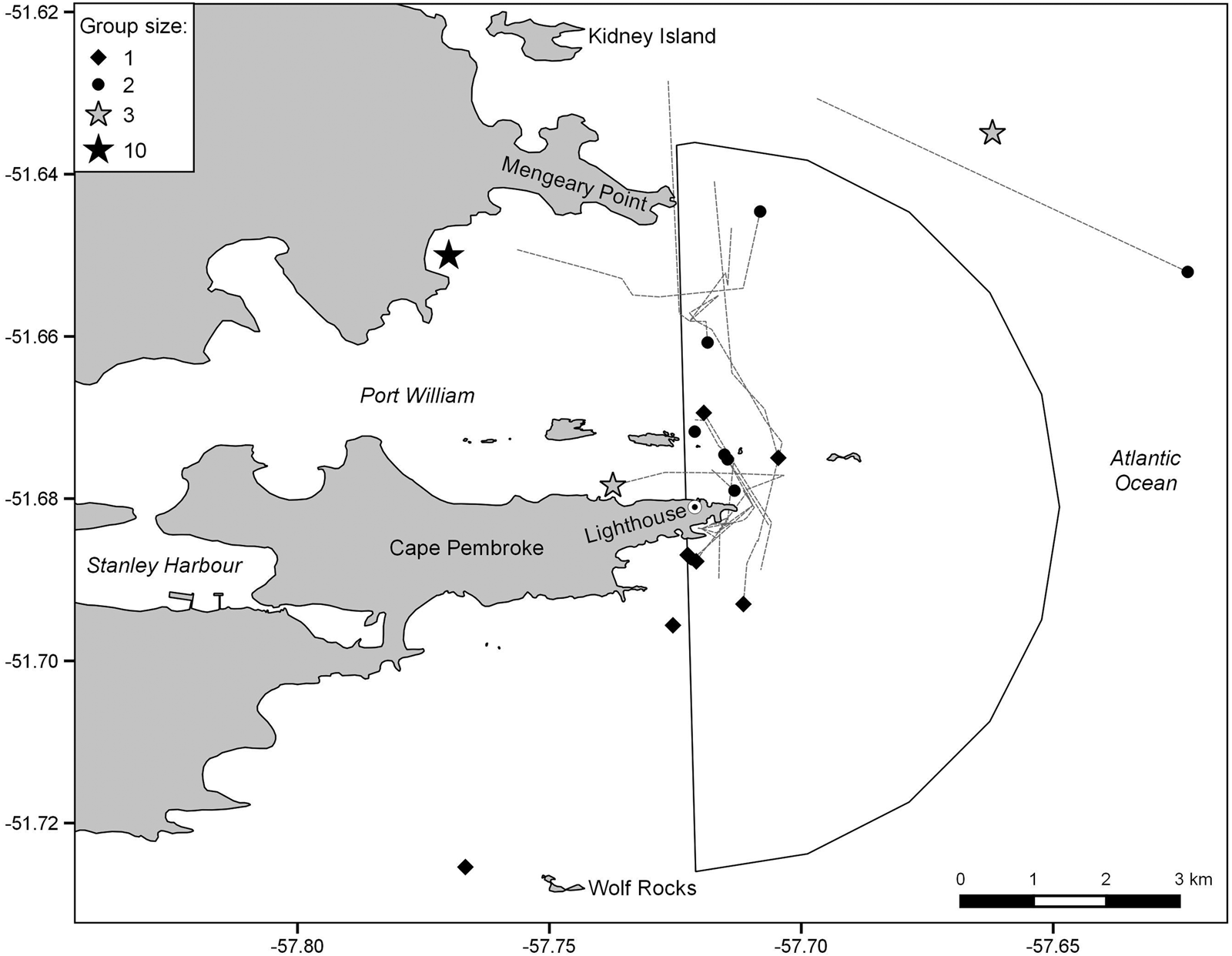
Standardized shore watches were conducted from the Cape Pembroke lighthouse (28 m eye height) between January and June 2017. The lighthouse is situated at the eastern end of the Cape Pembroke peninsula, and offered unrestricted views eastwards across the Atlantic (Figure 2). A single observer searched for cetaceans with the naked eye and Bushnell Marine 7 × 50 binoculars (model 137570, with a vertical reticle). Most watches comprised active search effort, with a single observer continuously searching a 180° arc of 5 km radius (Figure 2). Approximately once every 40–60 min, a systematic 10 min binocular scan of the 180° search arc was conducted, to produce a tally count of cetacean individuals available at the surface. Standardized effort data were logged, including the start and end times of each watch, effort status and environmental conditions. When cetaceans were observed, the time, angle and reticle reading, species, group size and behaviour were noted. Some sightings were tracked over time on an ad hoc basis to determine their route.
Location of the Cape Pembroke lighthouse and 5 km semi-circle search area, and the locations of southern right whale sightings and tracks recorded from the lighthouse during May and June 2017.

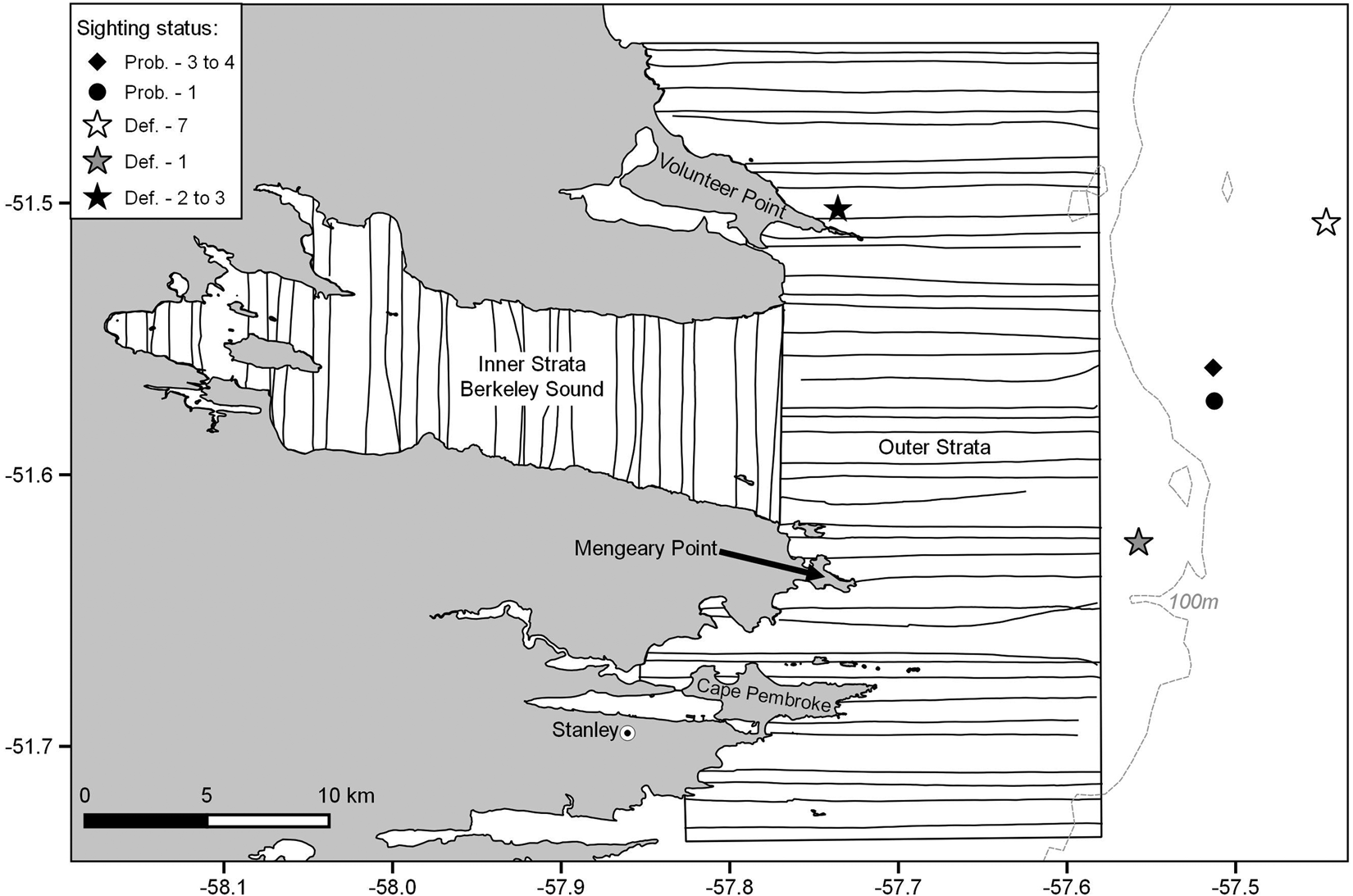
Between February and May 2017, aerial surveys were carried out in two strata: (1) Berkeley Sound; and (2) the coastal waters between Cape Pembroke and Volunteer Point to ~10 km offshore (Figure 3). Each survey comprised 12 individual transect lines designed using the software Distance 6.2 (Thomas et al., Reference Thomas, Buckland, Rexstad, Laake, Strindberg, Hedley, Bishop, Marques and Burnham2010), and producing a total trackline of 123.5–136.5 km per survey. A Britten-Norman BN-2B Islander aircraft with bubble windows was flown along the transects at a target altitude and speed of 750 feet (229 m) and 90 knots (167 km h–1) respectively. Single trained observers searched for cetaceans in a 90° quadrant from ahead to abeam on each side of the aircraft, and used an inclinometer to measure the declination angles to sightings. Standardized data were logged using digital voice recorders.
The location of aerial survey strata, realized effort and southern right whale sightings between February and May 2017. Sighting status refers to certainty of identification (definite or probable) and group sizes.

A rigid-hulled inflatable boat (6.5 m with twin 125-hp engines; mean survey speed of 11.5 knots or 21.3 km h–1) was used to survey Berkeley Sound and adjacent coastal waters between February and May 2017. The same general loop of Berkeley Sound was followed on each boat survey, but the exact route varied according to whale occurrence. At least two observers searched continuously for cetaceans by naked eye. Effort status was recorded as active search, cetacean encounter, or off effort. The time, species, group size and behaviour were recorded for all cetacean sightings. For SRW sightings, a closing mode was implemented to approach animals for photo-identification and assessment of group size/composition.
Vantage point (VP) surveys
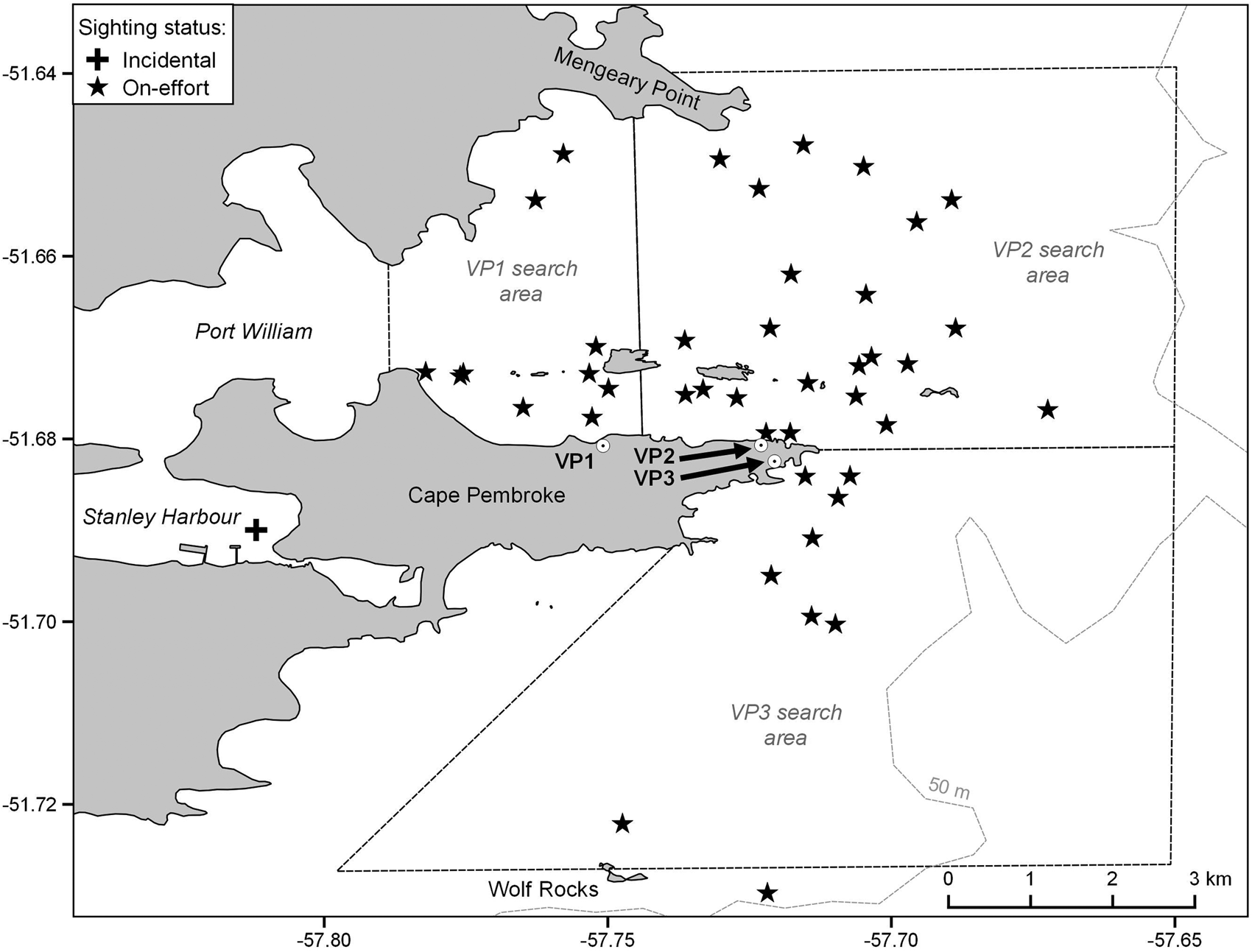
The systematic survey effort described above was completed by early June 2017. In response to the ongoing presence of SRWs at that time, a vantage point (VP) survey was initiated and continued until February 2019. Three VPs were selected on the Cape Pembroke peninsula, providing non-overlapping search areas that covered the outer area of Port William and the adjacent Atlantic coast (Figure 4). A minimum of 20 min was spent searching for SRWs by a single observer at each VP using the naked eye and binoculars. The short duration of the observation period was intended to maximize concentration and ensure a thorough search effort. The start and end times of each search, observer name, Beaufort sea state, and details of any cetacean sightings (species, time, group size and composition, and behaviour) were logged. Sighting locations were estimated by the observer in relation to coastal topographic features, and marked on an ordnance survey map in the field.
Location of the three vantage points (VPs), the VP search areas and associated southern right whale sightings from 13 June 2017 to 1 February 2019.

Citizen science
Opportunistic sightings of SRWs in the Falklands were compiled from social media and reports to Falklands Conservation. Such records lacked associated search effort. Potential duplicates (e.g. the same group size at the same location on the same date) were amalgamated in the database. Species identification was independently confirmed via supporting material (photographs or video) or from verbal or written descriptions. SRWs are the only Falklands whale species to lack a dorsal fin, and the only species to exhibit surface-active behaviour of the nature described by observers during many sightings. Only records where species identifications were considered to be reliable were included in the analysis.
Data analysis
The positions of sightings recorded from Cape Pembroke lighthouse were calculated from the reticle reading, bearing and eye height, via trigonometry. A monthly scan sampling relative abundance was then calculated, as the mean number of individuals observed per 10 min scan.
The relative abundance of SRWs was compared across months and sites for the VP dataset. The Sighting rate Per Unit Effort (SPUE) and Individuals Per Unit Effort (IPUE) were calculated as the number of sightings and individuals per 60 min search effort in favourable weather conditions. Relative abundance was not examined for other datasets due to the small sample sizes. The estimated latitudes and longitudes of the sightings recorded on ordnance survey maps during VP surveys, and those reported opportunistically as written descriptions by citizen scientists, were determined in GoogleEarth. All mapping was carried out in Quantum Geographic Information System (QGIS; http://qgis.org). Distances were calculated using a QGIS plugin. Water depths were extracted from the General Bathymetric Chart of the Oceans (GEBCO) 2014 grid. Where sightings occurred too close to shore to yield a depth value, a proxy value of 5 m was used.
Aqua Modis (https://modis.gsfc.nasa.gov) daytime monthly composites (4 km resolution) of sea surface temperature (SST) data for May to September in 2017 and 2018 were imported into QGIS. SST values were extracted for data points using a QGIS plugin.
Results
Literature review
Whaling catches
Although there are caveats to interpretation (e.g. spatio-temporal variation in whaling ‘effort’; Smith et al., Reference Smith, Reeves, Josephson and Lund2012), the logbooks of American open-boat whalers in the 18th and early 19th centuries show that SRW catches were primarily concentrated north of 40°S between June and November; the only records within the FCZs over that period comprised a few individuals caught in July (Townsend, Reference Townsend1935; Supplementary Figure S1A). In contrast, between December and May the catches were distributed widely between Brazil and Tierra del Fuego, including throughout the FCZs (Supplementary Figure S1B). Townsend's (Reference Townsend1935) charts reflect only a portion of catches by the American fleet, while other nations such as the French also whaled on the Brazil Banks (Du Pasquier, Reference Du Pasquier1986). Additionally, little whaling was carried out south of 50°S by pre-modern whalers due to poor weather (Smith et al., Reference Smith, Reeves, Josephson and Lund2012). Consequently, the Townsend data are considered to provide a minimum indication of SRW occurrence around the Falklands prior to the 20th century.
By the early 20th century, modern whaling techniques arrived in the SWA (Morais et al., Reference Morais, Danilewicz, Zerbini, Edmundson, Hart and Bortolotto2017); however, SRWs were already depleted and comprised only a small component of commercial catches in the region (IWC, 2001). At New Island (West Falkland), a floating factory vessel was moored in 1905 and 1906, and a shore station operated from 1909 to 1915. Although over 1700 whales were landed during the New Island operations, only a single SRW was caught (Allison, Reference Allison2016a). The Soviet Union pelagic fleet (illegally) caught at least 1455 SRWs in the SWA between 1961 and 1966 (Tormosov et al., Reference Tormosov, Mikhaliev, Best, Zemsky, Sekiguchi and Brownell1998; Allison, Reference Allison2016b). Interpretation of the Soviet catches is limited by the restricted summer operations of the whaling expeditions and the lack of accurate positions for some catches (see Tormosov et al., Reference Tormosov, Mikhaliev, Best, Zemsky, Sekiguchi and Brownell1998). However, the vast majority of summer SRW catches in the SWA were concentrated between latitudes 39° and 47°S, with only small numbers taken around the Falklands between December and April (Supplementary Figure S2).
Non-whaling data
Extensive sighting surveys were carried out by Japanese scouting vessels between October and April from 1965 to 1982, across mid-latitudinal waters (30–65°S) throughout the southern hemisphere (Ohsumi & Kasamatsu, Reference Ohsumi and Kasamatsu1986). In the SWA, the highest densities of SRWs were recorded between November and January in the 35–50°S latitudinal band, but primarily to the north and east of the FCZs (Ohsumi & Kasamatsu, Reference Ohsumi and Kasamatsu1986).
Little Falklands-specific information has been published on SRWs. Hamilton (Reference Hamilton1952) commented that baleen whales were frequently seen in coastal waters between January and June, but did not observe SRWs. Year-round surveys of Falklands waters between February 1998 and January 2001 (20,907 km2 of survey effort) yielded only five SRW sightings, with four occurring between November and January, and a single sighting in June (White et al., Reference White, Gillon, Black and Reid2002). The records were located at distances of 58 to 315 km to the west or north of the islands, over water depths of 157 to 1074 m (Figure 1). A year of acoustic monitoring ~220 km north of the Falkland Islands in 2012/2013, detected SRWs on 11 days, although just 5% of the dataset was assessed (Hipsey et al., Reference Hipsey, Delarue, Martin, Burns and Lumsden2013). With the exception of one detection in early June, all calls were detected between August and January.
FIG maintains a cetacean stranding database, with records dating back to 1866. Three SRW strandings are included, comprising two from West Falkland in 1990 and one from Sea Lion Island in March 2019. A compilation of opportunistic sightings and interviews with local Falklands inhabitants, anecdotally indicated that SRWs were one of the least common baleen whale species seen in coastal and offshore waters since the 1940s (Frans & Augé, Reference Frans and Augé2016).
Satellite-tagging studies of 11 animals (where tags transmitted for >3 weeks) at PV during October 2014 and September 2015, included at least three animals that subsequently entered the FCZs during November and December (Zerbini et al., Reference Zerbini, Rosenbaum, Mendez, Sucunza, Andriolo, Harris, Clapham, Sironi, Uhart and Fernandez Ajó2016). In 2016 and 2017, tags were deployed on nine animals (all tags transmitted for at least 46 days) in the northern Golfo San Matías, of which two whales also subsequently visited the FCZs (Zerbini et al., Reference Zerbini, Fernández Ajó, Andriolo, Clapham, Crespo, González, Harris, Mendez, Rosenbaum, Sironi, Sucunza and Uhart2018). One of the tagged animals moved purposefully through the FCZs and continued south-east to the South Orkney Islands. ‘Area restricted search’ behaviour within the FCZs during 2015 and 2017 was consistent with foraging (Zerbini et al., Reference Zerbini, Rosenbaum, Mendez, Sucunza, Andriolo, Harris, Clapham, Sironi, Uhart and Fernandez Ajó2016, Reference Zerbini, Fernández Ajó, Andriolo, Clapham, Crespo, González, Harris, Mendez, Rosenbaum, Sironi, Sucunza and Uhart2018).
Systematic surveys during 2017
Totals of 22.7 h of active search effort and 7.2 h of scan sample data were collected in favourable conditions from Cape Pembroke lighthouse on 14 dates between 25 January and 7 June 2017. No SRWs were observed between January and April. However, 18 unique sightings were recorded on the four survey dates between 18 May and 7 June 2017, resulting in a sharp seasonal increase in sighting rate from 0 animals/scan (Jan to Apr) to 2.25 animals/scan by June. The initial sighting locations were concentrated around the eastern Cape Pembroke peninsula and in Port William (Figure 2). The distance from shore of the initial sighting locations ranged from 0.14 to 5.09 km (N = 18, mean = 1.04, median = 0.44), and the water depths ranged from 5 to 66 m (N = 18, mean = 26.4, median = 28.5). Sightings predominantly comprised singletons and pairs, with group size comprising 1 to 10 animals (N = 18, mean = 2.2, median = 2.0). Two observations of three and 10 animals respectively, comprised surface active groups (SAGs; Best et al., Reference Best, Schaeff, Reeb and Palsbøll2003). SRWs were tracked from the lighthouse on 12 occasions, over durations ranging from 6 min to over 3 h (mean = 1.3 h, SD = 1.1). Several of the tracks extended across the Port William channel, used by vessels entering and departing Stanley Harbour (Figure 2). Little consistent directional movement was detected, with individuals and groups moving northwards, southwards and in variable routes that often paralleled the shoreline.
Six aerial surveys were flown between 16 February and 12 May 2017, comprising 758.6 km of on-effort transect trackline in favourable conditions. There were two confirmed on-effort sightings of SRWs, and three additional off-effort sightings (one confirmed as SRW, and two probable). On 12 March, two separate whale sightings (a group of 3–4 animals, and a singleton) were observed ~15 km from the coast in 117 m depth (Figure 3). The blows were bushier and denser than those produced by sei whales, but it was not possible to close on the animals and unequivocally confirm species. Later on the same survey, an aggregation of seven SRWs was recorded ~19 km offshore and in 133 m depth. The asynchronous fluke-up dives in various directions were most consistent with foraging behaviour. The blows were similar in form to those observed earlier on the same survey, supporting the likelihood of those sightings also comprising SRWs. On 22 March, a single SRW was observed 10 km from shore in a depth of 87 m (Figure 3). No SRWs were seen during the two April flights. However, a group of 2–3 SRWs was recorded on the final survey (12 May 2017), ~800 m from the coast at Volunteer Point and in a water depth of <20 m (Figure 3).
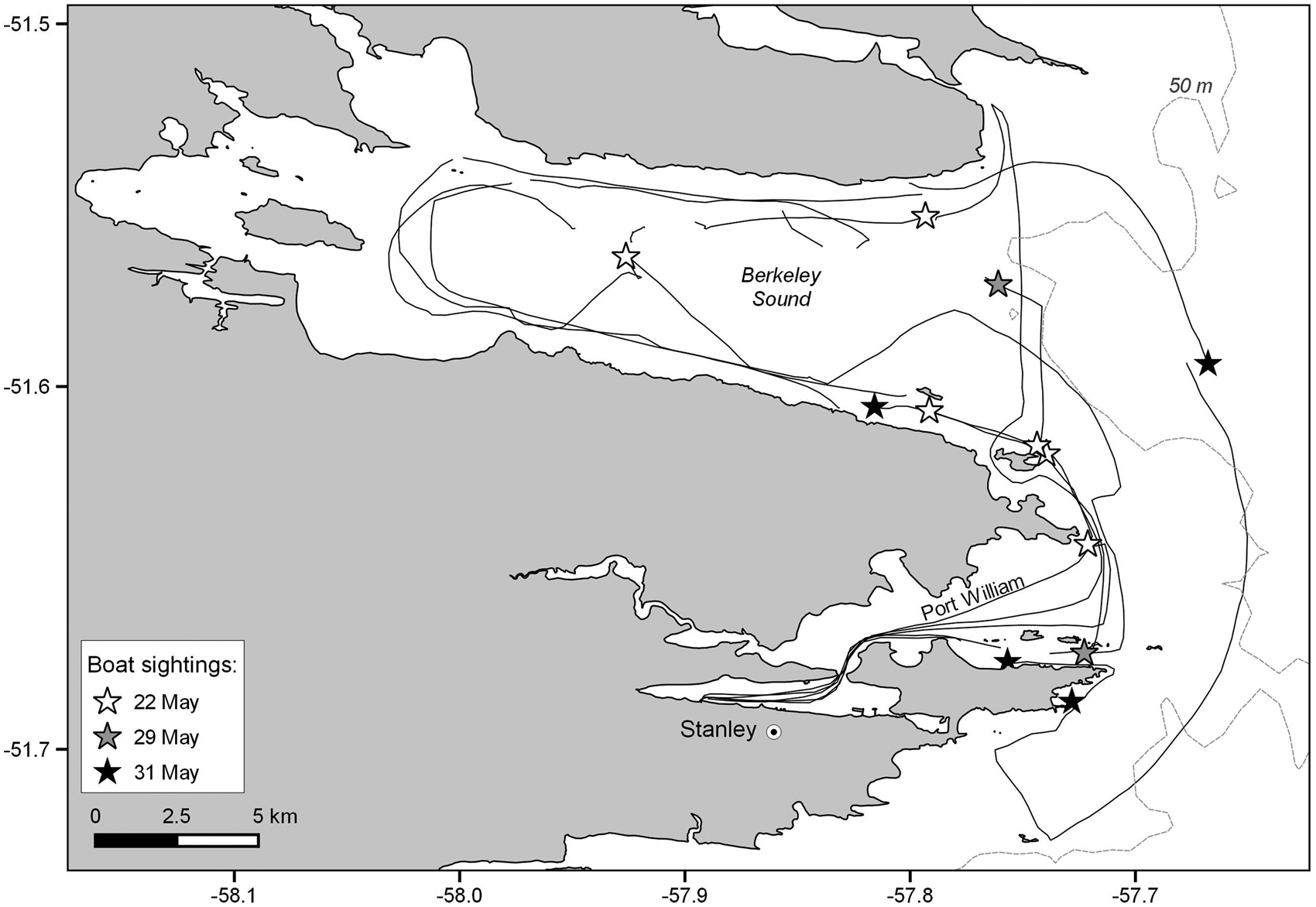
Boat surveys were completed in Berkeley Sound on 26 dates between February and May 2017, resulting in 72.4 h and 1718 km of active search effort in favourable conditions. No SRWs were recorded between February and April. During May, five surveys were carried out prior to the 16th without producing any SRWs. However, a total of 10 on-effort and two off-effort sightings were recorded during three surveys between 22 and 31 May. The sightings were distributed across most of the surveyed area (Figure 5), with mean distances from shore and water depths of 0.13 to 6.07 km (N = 12, mean = 1.40, median = 0.46) and 5 to 64 m (N = 12, mean = 22.3, median = 19.5) respectively. Solitary (N = 9) and pairs (N = 3) of animals were recorded. Social interactions (i.e. body contact) were observed in three pairs, and by two individuals that subsequently paired up.
Distribution of boat-based active search effort (black lines) and location of southern right whale sightings between 22 and 31 May 2017.

VP surveys
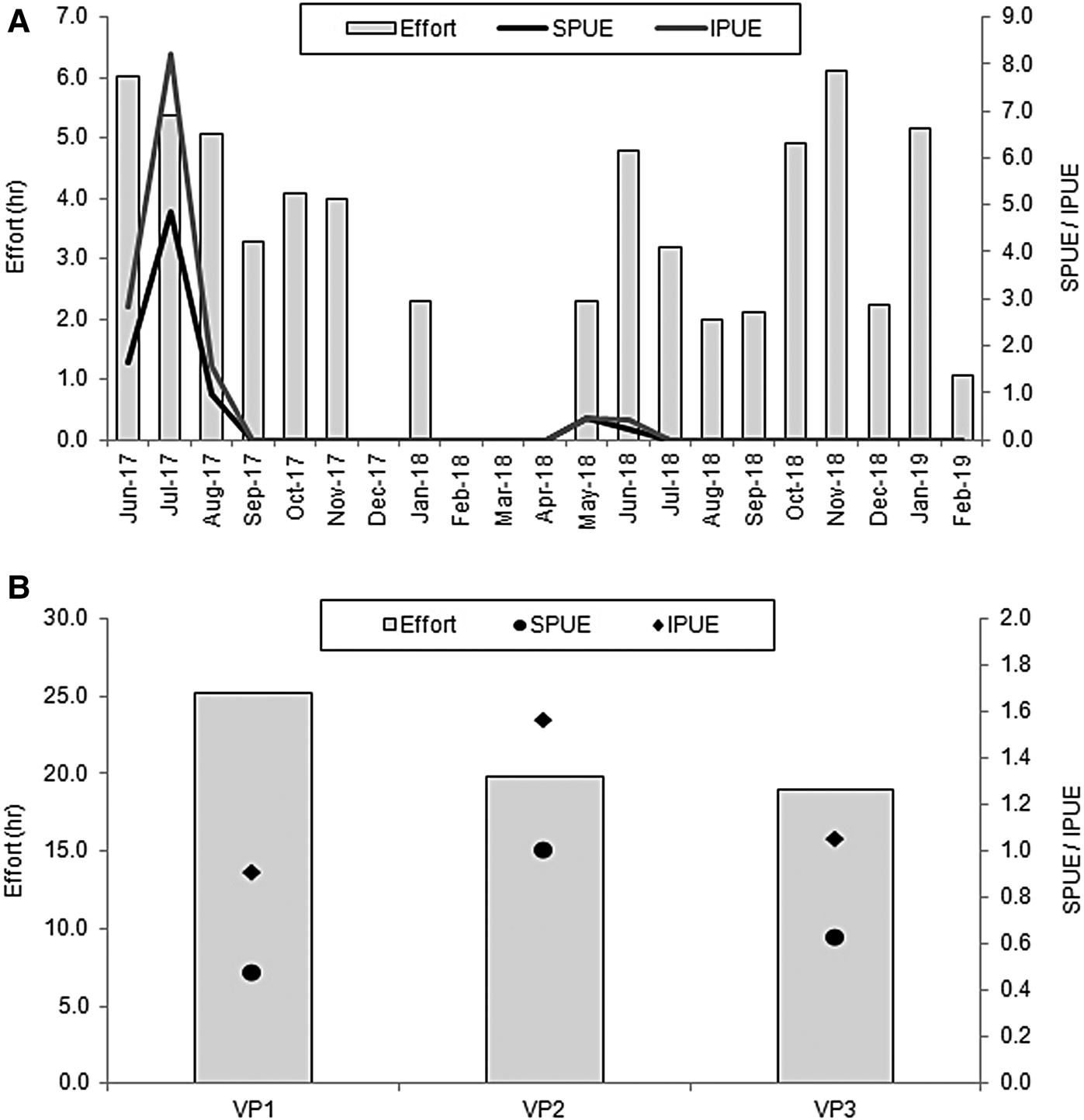
A total of 63.9 h of VP search effort in Beaufort sea states ≤3 was carried out on 60 dates between 13 June 2017 and 1 February 2019, producing 44 associated SRW sightings. Group size ranged from 1 to 3 animals (N = 44, mean = 1.7, median = 2.0). Both the SPUE and IPUE peaked between June and August 2017, with a secondary smaller peak during May and June 2018 (Figure 6A). No right whales were recorded between September and April (austral spring and summer). Most sightings were distributed along the north coast and tip of the Cape Pembroke peninsula, and in the mouth of Port William (Figure 4). The three VPs produced comparable SPUE and IPUE values, but the highest values were recorded from VP2 at the mouth of Port William (Figure 6B). VP sightings were recorded at a mean distance of 0.71 km from shore (N = 44, median = 0.51, range = 0.09–2.27) and in a mean water depth of 20.6 m (N = 44, median = 22.5, range = 5–53), reflecting the coastal nature of the survey effort.
Sighting rate Per Unit Effort (SPUE) and Individuals Per Unit Effort (IPUE) of southern right whales during vantage point (VP) surveys by: (A) month and (B) VP.

The behaviour of single animals mostly comprised travel, milling and fluking. However, active behaviour including SAGs, exposed flippers or breaching was recorded in 68.2% of sightings of ≥2 animals. Drone footage was taken during two sightings (three animals and a pair, all comprising adults) in Port William on 21 July 2017. The footage revealed social interaction and body contact between individuals, with belly-to-belly contact and the emergence of flippers and flukes as animals rolled on their sides. The pair of whales exhibited apparent courtship behaviour, with the female repeatedly rolling onto her back with the genital area raised above the water surface (Supplementary Figure S3), and a male swimming belly-up subsurface and occasionally with exposed penis.
Citizen science
The opportunistic sighting database contained 69 reports of SRWs in Falklands waters, with 68 occurring between 24 May 2017 and 3 December 2018. One older record was located of a SRW in Port William on 3 March 2016. In addition, a coastal flight between Stanley and Volunteer Point on 30 June 2017 reported 20 to 28 right whales between Berkeley Sound and MacBride Head, but those data were not included in the analyses due to the lack of specific positions and group sizes. The clear majority of records (N = 57; 82.6%) related to the 3-month period from June to August 2017. Seven records originated from 2018, six of which also occurred between June and August. Only six records occurred in other months, including March (N = 1), May (N = 3), September (N = 1) and December (N = 1). Most records were distributed along the north-east coast of the Falklands, between Cape Pembroke and Cow Bay (Supplementary Figure S4). However, there were also scattered records from Bleaker Island in south-east Falkland, San Carlos in Falkland Sound, and from West Falkland at New Island, West Point and Saunders Islands. Reported group sizes ranged from single animals to a group of ~17 animals (N = 70, mean = 2.5, median = 2.0). Seventeen of the records comprised ≥3 animals, with the largest groups consistently reported from Volunteer Point and Saunders Island.
Sea surface temperature
For 133 grid cells located nearshore off the north-east coast of the Falklands in which SRWs were recorded (combined systematic survey, VP, and opportunistic sightings) during the austral winters of 2017 and 2018, SST values were in the region of 4–5°C during the peak of the winter (Supplementary Table S1). A total of 76 SRW sightings were recorded during systematic and VP surveys in the Berkeley Sound–Cape Pembroke region during the austral winters (May to August) of 2017 and 2018, of which SST values were available for 43 sightings. The values ranged from 3.5 to 8.5°C (N = 43, mean = 5.7°C, median = 4.7°C).
Discussion
Status of southern right whales in the Falklands
The 18th century whaling catches presented by Townsend (Reference Townsend1935) support a historical presence of SRWs around the Falklands. However, very few verified records exist for Falklands waters in the period between the species receiving international protection in 1935 and the systematic survey work reported here from 2017 onwards. The 1960s Soviet whaling catches primarily occurred north of the Falklands (Tormosov et al., Reference Tormosov, Mikhaliev, Best, Zemsky, Sekiguchi and Brownell1998), and only scarce reports originated from systematic offshore surveys (White et al., Reference White, Gillon, Black and Reid2002), opportunistic sightings (Frans & Augé, Reference Frans and Augé2016), or the long-term stranding database. The two latter datasets do not conclusively support true ‘absence’ of the species, due to the lack of associated effort information. Nevertheless, in combination, the available datasets indicate that SRWs were uncommon around the Falklands during the 1900s and early 2000s.
The 2017 season was unusual relative to earlier years, with regard to both the sharp increase in number of SRWs reported and the prolonged presence of the species over several months in coastal waters. It is acknowledged that the 2017 season was the first in which systematic coastal whale surveys have been carried out off the north-east Falklands. Additionally, road access to the Cape Pembroke peninsula had been completed in late 2016, which facilitated numerous people looking for whales following the initial sightings. However, a local regular sea-watcher confirmed that, while SRWs have been occasionally seen in the past, the numbers observed in 2017 were unprecedented (A. Henry, personal communication). Furthermore, the extensive year-round work by White et al. (Reference White, Gillon, Black and Reid2002) included nearshore waters around Cape Pembroke but did not record SRWs in that area.
Although the total survey effort in the VP dataset was less in 2018 than in 2017, both the lower VP sighting rate and the lack of opportunistic reports indicated that the high SRW numbers recorded in the Port William–Cape Pembroke region during 2017 were not repeated to the same extent during 2018. It is plausible that SRWs were present in other parts of the Falklands during 2018, since coverage outside of the immediate area surrounding Stanley is lower in winter due to adverse weather conditions and a sparser human population. Ongoing monitoring will be required to determine whether 2017 marked the onset of a regular occurrence of SRWs in the Falklands or was an anomalous year.
Right whale habitats in the Falklands
Although temporal limitations or a lack of associated effort data hindered the interpretation of several of the available datasets, the combined data are broadly indicative of differences in the spatio-temporal distribution of SRWs around the Falklands. Whaling catches (Townsend, Reference Townsend1935; Tormosov et al., Reference Tormosov, Mikhaliev, Best, Zemsky, Sekiguchi and Brownell1998), acoustic data (Hipsey et al., Reference Hipsey, Delarue, Martin, Burns and Lumsden2013), tag data (Zerbini et al., Reference Zerbini, Rosenbaum, Mendez, Sucunza, Andriolo, Harris, Clapham, Sironi, Uhart and Fernandez Ajó2016, Reference Zerbini, Fernández Ajó, Andriolo, Clapham, Crespo, González, Harris, Mendez, Rosenbaum, Sironi, Sucunza and Uhart2018) and sightings (White et al., Reference White, Gillon, Black and Reid2002) together indicate a presence of SRWs year-round in more pelagic regions of the FCZs, but especially during the summer between November and April. In contrast, and despite recent high amounts of survey effort in coastal areas around the Falklands over the summer (Weir, Reference Weir2017, Reference Weir2018), most nearshore SRW observations have occurred in late autumn and winter between May and August. These datasets suggest that SRWs are using Falkland waters for different purposes according to habitat and time of year.
The IWC (2001) defined four categories of SRW habitat (not necessarily exclusive): (1) seasonal feeding areas; (2) calving grounds; (3) nursery grounds; and (4) breeding areas in which courtship and mating are predominant. The existence of major SRW feeding areas (the ‘Brazil/False Banks/Falkland Islands grounds’) along the south-east coast of South America has been known for decades (Townsend, Reference Townsend1935; Tormosov et al., Reference Tormosov, Mikhaliev, Best, Zemsky, Sekiguchi and Brownell1998; IWC, 2001; Zerbini et al., Reference Zerbini, Rosenbaum, Mendez, Sucunza, Andriolo, Harris, Clapham, Sironi, Uhart and Fernandez Ajó2016, Reference Zerbini, Fernández Ajó, Andriolo, Clapham, Crespo, González, Harris, Mendez, Rosenbaum, Sironi, Sucunza and Uhart2018). Those feeding areas extend southwards to encompass the FCZs, and the presence of foraging SRWs in pelagic waters around the Falklands during (at least) the austral late spring and summer is therefore expected, although it remains poorly documented. The scarcity of observations of feeding SRWs in nearshore Falkland waters during the austral summer is perhaps more surprising given the prevalence of known prey such as lobster krill (Munida gregaria: Matthews, Reference Matthews1932; Argüelles et al., Reference Argüelles, Fazio, Fiorito, Pérez-Martínez, Coscarella and Bertellotti2016; D'Agostino et al., Reference D'Agostino, Degrati, Santinelli, Sastre, Dans and Hoffmeyer2018). It has been suggested that SRWs and sei whales may compete for resources (IWC, 1986; Ohsumi & Kasamatsu, Reference Ohsumi and Kasamatsu1986), and the scarcity of SRWs in nearshore Falklands waters throughout the austral summer could potentially be a consequence of the abundance of feeding sei whales in coastal waters at that time (Weir, Reference Weir2017, Reference Weir2018).
The occurrence of SRWs on their SWA breeding grounds is strongly seasonal. At PV, they begin to arrive in May, reach peak numbers in August or September, and then decrease from October so that few remain by early December (Argüelles et al., Reference Argüelles, Fazio, Fiorito, Pérez-Martínez, Coscarella and Bertellotti2016; Crespo et al., Reference Crespo, Pedraza, Dans, Svendsen, Degrati and Coscarella2019). Most new calves appear in August, and the final ones as late as October (Rowntree et al., Reference Rowntree, Uhart, Sironi, Chirife, Di Martino, La Sala, Musmeri, Mohamed, Andrejuk, McAloose, Sala, Carribero, Rally, Franco, Adler, Brownell, Seger and Rowles2013). Similar seasonality occurs at the Santa Catarina (25–27°S) calving ground in Brazil, where SRWs are present from May to December and peak between August and October (Groch et al., Reference Groch, Palazzo, Flores, Adler and Fabian2005; Seyboth et al., Reference Seyboth, Groch, Secchi and Dalla Rosa2015). The seasonality observed in nearshore Falklands waters during 2017 (May to August, with highest relative abundance in July) therefore occurred earlier in the winter than the peak numbers observed on the two major SWA calving and mating grounds.
Several potential (and non-exclusive) explanations exist for the use of nearshore Falklands waters by SRWs during the May to August period. First, the Falkland Islands may be located on the northerly migration route of a component of the SWA breeding population that feeds in areas further south or east of the Falklands over the summer. The satellite tags used so far to monitor SRW movements in the SWA have been deployed on the breeding grounds during September and October and had transmission periods of less than six months (Zerbini et al., Reference Zerbini, Rosenbaum, Mendez, Sucunza, Andriolo, Harris, Clapham, Sironi, Uhart and Fernandez Ajó2016, Reference Zerbini, Fernández Ajó, Andriolo, Clapham, Crespo, González, Harris, Mendez, Rosenbaum, Sironi, Sucunza and Uhart2018). They have therefore produced information on the outward spring and summer movements of SRWs departing the breeding areas, but not the migratory routes taken by whales on their autumn and winter return journeys. Animals feeding in regions such as Antarctica, South Georgia or the South Sandwich Islands may pass close to the north-east coast of the Falklands as they migrate north-westwards towards winter breeding grounds in South America. However, the lack of clear directional movement exhibited by many animals during shore-based tracking in the Falklands, together with numerous sightings of milling or socializing groups, isn't consistent with exclusively migratory behaviour (Danilewicz et al., Reference Danilewicz, Moreno, Tavares and Sucunza2016). It is plausible that some SRWs suspend their northerly migration briefly in the Falklands, and use the region as a short-term resting and socializing area before continuing northwards to the calving grounds to mate or give birth.
One of the categories of SRW habitat recognized by the IWC (2001) is wintering areas in which courtship and mating (rather than calving) predominate. Such areas have been described in Saldanha Bay in South Africa (Barendse & Best, Reference Barendse and Best2014), and along the coast of Uruguay (Costa et al., Reference Costa, Piedra, Franco and Paez2007). Based on calving period, foetal growth, and a proposed gestation period of 12–13 months, Best et al. (Reference Best, Schaeff, Reeb and Palsbøll2003) estimated that conceptions may occur from late May (or earlier) through to early November, with a strong peak during July and August. Consequently, the whales aggregated off the north-east Falklands during 2017 may have included females that were mating prior to calving the following year. Observations of SAGs (usually associated with courting or mating: Best et al., Reference Best, Schaeff, Reeb and Palsbøll2003) and apparent mating behaviour are consistent with that theory. Only a small number of females visit the calving grounds in the year before they give birth (Payne, Reference Payne1986; Best et al., Reference Best, Schaeff, Reeb and Palsbøll2003), and mating further south could reduce the energy expenditure of continuing the northwards migration.
It was recently suggested that the sub-Antarctic waters around Campbell Island (52.5°S) in New Zealand may represent a significant wintering habitat for sub-adult and adult SRWs (Torres et al., Reference Torres, Rayment, Olavarria, Thompson, Graham, Baker, Patenaude, Bury, Boren, Parker and Carroll2017). Aggregations occurred predominantly in one area (Northwest Bay), and animals were often engaged in social behaviour within SAGs, but no mating or calving was observed. Consequently, it was hypothesized that Campbell Island may be an important winter gathering location for sub-adult SRWs, perhaps primarily for social interaction (Torres et al., Reference Torres, Rayment, Olavarria, Thompson, Graham, Baker, Patenaude, Bury, Boren, Parker and Carroll2017). Neither this study nor that of Torres et al. (Reference Torres, Rayment, Olavarria, Thompson, Graham, Baker, Patenaude, Bury, Boren, Parker and Carroll2017) was able to conclusively distinguish between sub-adult and adult whales in the field. However, the Falkland Islands are a comparable sub-Antarctic habitat and with similar observations of socializing aggregations, and could potentially support a non-breeding socializing component of the SWA population during winter.
Another possibility is that the Falkland Islands represent a historical winter calving ground, which was completely lost during the whaling era. SRWs show significant maternally directed fidelity to their calving grounds, and if local extirpation occurred then the ‘memory’ of that migratory destination may be lost (Carroll et al., Reference Carroll, Baker, Watson, Alderman, Bannister, Gaggiotti, Gröcke, Patenaude and Harcourt2015). No calves have been confirmed to date within the Falklands, and the seasonality of SRWs in nearshore waters precedes that of the peak calving period in the SWA calving grounds. Therefore it is unlikely that SRWs were giving birth or nursing in nearshore Falkland waters during 2017 or 2018. However, recolonizations of former grounds (or discovery of new ones) may begin with a predominance of solitary animals or mating groups (Carroll et al., Reference Carroll, Rayment, Alexander, Baker, Patenaude, Steel, Constantine, Cole, Boren and Childerhouse2014; Arias et al., Reference Arias, Coscarella, Romero, Sueyro, Svendsen, Crespo and González2018). Although most SRW calving areas are located north of 45°S, some do occur at higher latitudes. For example, the Auckland Islands (50.7°S) are the primary calving ground for SRWs in New Zealand waters (Rayment et al., Reference Rayment, Dawson and Webster2015). Although the Falklands and the New Zealand sub-Antarctic islands are located at comparable latitudes, the Antarctic Convergence occurs further south in the Pacific than in the Atlantic (Ohsumi & Kasamatsu, Reference Ohsumi and Kasamatsu1986; Dong et al., Reference Dong, Sprintall and Gille2006). Consequently, SSTs during the peak SRW calving period (August) are colder off the north-east Falklands (4–5°C) than in the Auckland Islands (6.1–7.7°C: Rayment et al., Reference Rayment, Dawson and Webster2015) and potentially less suitable for calving. Nevertheless, as both SRW populations and global SSTs increase, the suitability of the region as a potential calving habitat may improve.
Regardless of the underlying reasons for their occurrence in the Falklands, it is likely that habitat preferences and social cohesion play important roles in determining the finer-scale spatial and temporal occurrence of SRWs. Wintering areas share broad characteristics such as shallow depth (5–20 m), shelter from prevailing weather, and sandy bottoms (e.g. Payne, Reference Payne1986; Barendse & Best Reference Barendse and Best2014; Rayment et al., Reference Rayment, Dawson and Webster2015; Seyboth et al., Reference Seyboth, Groch, Secchi and Dalla Rosa2015). Within those habitats, SRWs appear to be most strongly attracted to other whales. For example, SRWs in Argentina cluster into loose herds that shift together back and forth along sections of coast tens of kilometres in extent (Payne, Reference Payne1986). In the Falklands, any such aggregations forming even small distances outside of the small study area described here could be easily overlooked.
Conclusions and conservation implications
The IWC has endorsed the CMP developed by Brazil, Argentina, Uruguay and Chile for the SWA population of SRWs. Although the CMP does not currently include recognition of the Falklands as a significant range state for the species, this paper demonstrates that the Falkland Islands may be growing in importance as a SRW habitat. The steady increase in SRW populations following the cessation of whaling, may lead to both recolonization of former grounds and expansion of range into previously less favoured areas adjacent to existing wintering grounds, potentially including the Falklands. For example, the high growth rates recently observed at Golfo San Matías (10% per year; Arias et al., Reference Arias, Coscarella, Romero, Sueyro, Svendsen, Crespo and González2018) north of PV, are consistent with a redistribution of whales and may be linked to PV approaching its carrying capacity as an optimal habitat (Crespo et al., Reference Crespo, Pedraza, Dans, Svendsen, Degrati and Coscarella2019). Ongoing distribution and abundance monitoring is required to clarify the status of SRWs in the Falklands, in both the offshore summer feeding areas and in nearshore waters during the late autumn and winter. Genetic work to support stable isotope and population structure analyses would contribute significantly to understanding of SRWs in the wider SWA region.
Ensuring the recovery and maintenance of SWA SRWs requires collaborative effort throughout their known range. In particular, while the coastal calving grounds in South America are relatively well-documented, the identification of contemporary feeding areas, and of the migration corridors that link feeding and breeding areas, have been highlighted as priorities in the CMP (Iñíguez Bessega et al., Reference Iñíguez Bessega, Boscarol, Galletti Vernazzani, Le Bas, Luna, Ponce de León and Tombesi2012). The Falkland Islands may potentially provide feeding habitat, wintering habitat, and migration routes for SRWs, and represent a significant geographic region with regard to addressing the current knowledge gaps identified for the SWA population.
Supplementary material
The supplementary material for this article can be found at https://doi.org/10.1017/S0025315419001024.
Acknowledgements
Nick Rendell of the Falkland Island Government's Environmental Planning Department issued the research permits for the field studies reported here. Many people in the Falklands assisted with logistical components of the fieldwork; our gratitude to all, particularly Steve Cartwright (Shallow Marine Surveys Group), the Falkland Islands Museum and National Trust, and the Falkland Islands Government Air Service. Our thanks to the many Falklands Conservation staff and volunteers who contributed sightings and carried out shore-based surveys, and to everyone who reported sightings or posted information about SRWs on Falklands' social media sites. Jen Jackson commented on a draft of this manuscript, and two reviewers also provided useful feedback which helped to improve the manuscript.
Financial support
The 2017 fieldwork was funded by the European Union BEST 2.0 Programme and The Royal Society for the Protection of Birds.