

Introduction
Tobacco smoking is the most prevalent health risk behaviour globally. Recently the trend of smoking and tobacco use has been increasing in developing countries. The World Health Organization (WHO) has emphasized the priority need for tobacco control (‘WHO: Report on the global tobacco epidemic, 2013,’ 2014). Currently, tobacco-related health problems kill 5.4 million people per year- one person every six seconds- with 70–80% of those deaths confined to developing countries (‘WHO: Tobacco Free Initiative (TFI): Tobacco Fact,’ 2014). While those developing countries are witnessing a smoking epidemic and with it rising death tolls, smoking-cessation services are not available in primary care settings (Piné-Abata et al., Reference Piné-Abata, McNeill, Murray, Bitton, Rigotti and Raw2013).
Evidence has shown that the mere existence of a smoking-cessation programme can improve long term survival, even if it leads to just a minority of the smokers to successfully stop smoking. (Anthonisen et al., Reference Anthonisen, Skeans, Wise, Manfreda, Kanner and Connett2005). However, a recent global survey reported that more than half of the countries surveyed lacked an official national treatment strategy, as well as national treatment guidelines and clearly assigned government officials for smoking-cessation therapy (Piné-Abata et al., Reference Piné-Abata, McNeill, Murray, Bitton, Rigotti and Raw2013). Therefore, smoking cessation intervention is an urgent but largely inaccessible health service.
Treatment of tobacco dependence in routine primary care requires properly strengthening of health system (‘WHO: TFI: Strengthening health systems for treating tobacco dependence in primary care,’ 2013). The challenges to successful implementation of smoking cessation interventions differ markedly between countries. Reviewing the pros and cons of smoking cessation intervention in the global literature may help to indicate the most effective way to integrate tobacco addiction treatment into routine primary care. Ultimately, this review aims to provide advice on the best strategies for launching smoking cessation services within the primary care settings of developing countries.
The literature review is based on PubMed citations and Cochrane reviews on smoking cessation intervention, as well as strategic searches using the keywords: ‘smoking cessation’. The literature search was filtered as (1) research with an outcome of smoking cessation for six months (2) articles published after 2000 indexed in the PubMed database. Risk ratios in the Cochrane review pooled analyses were appraised in terms of the efficacy of each smoking cessation methods; otherwise randomized controlled clinical trials with an outcome of smoking cessation of more than six months were also reviewed. To appraise the practicality of those methods, intervention studies, effectiveness trial and observational studies indexed in the PubMed database were likewise reviewed. (Singal, Higgins, & Waljee, Reference Singal, Higgins and Waljee2014).
Evidence of Smoking Cessation Methods
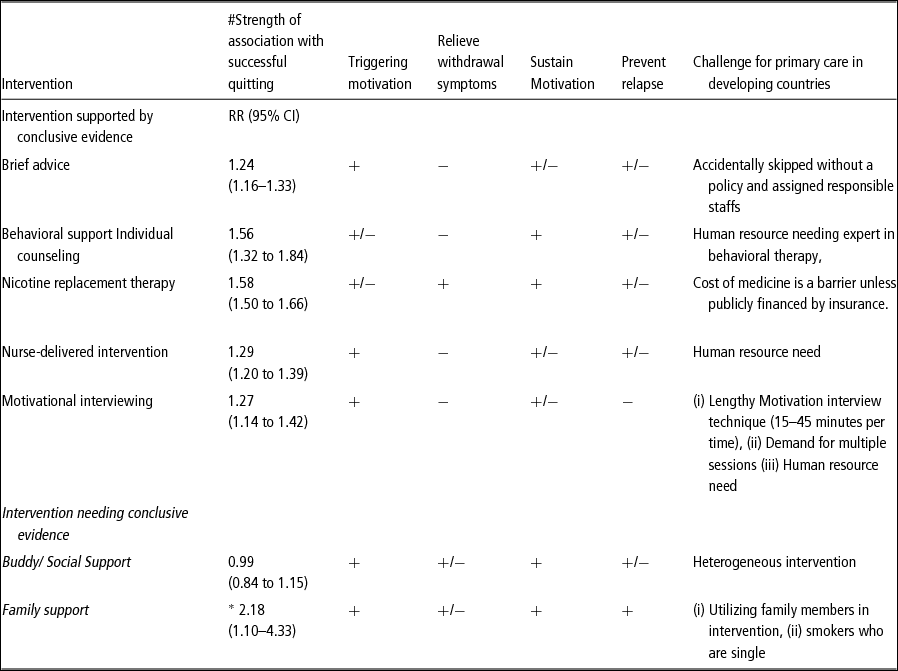
Many trials and interventions studies have reported efficacy of various smoking cessation methods. The question is how to make those smoking cessation interventions practicable within developing settings (Aveyard, Begh, Parsons, & West, Reference Aveyard, Begh, Parsons and West2012; Hong-Qiang et al., 2009; Lai, Cahill, Qin, & Tang, Reference Lai, Cahill, Qin and Tang2010; Lancaster & Stead, Reference Lancaster and Stead2005; Park, Tudiver, & Campbell, Reference Park, Tudiver and Campbell2012; Rice, Hartmann-Boyce, & Stead, Reference Rice, Hartmann-Boyce and Stead2013; Stead et al., Reference Stead, Perera, Bullen, Mant, Hartmann-Boyce and Cahill2012). The table below summarizes the efficacy of smoking cessation methods and the challenges for implementation in primary care settings.
Brief Advice
A doctor's or a nurse's advice can make a smoker give up smoking. Evidence from a recent meta-analysis confirmed that opportunistic brief medical advice increased the quitting rate of the smokers even without a follow up visit (risk ration (RR) 1.24, 95% confidence interval (CI) 1.16–1.33) (Aveyard et al., Reference Aveyard, Begh, Parsons and West2012; Stead Lindsay et al., Reference Stead, Buitrago, Preciado, Sanchez, Hartmann-Boyce and Lancaster2013). It should be noted that most of the trials included in the meta-analysis were undertaken in developed countries. An individual patient's education and heath literacy may influence how seriously advice is taken, impacting upon the success of subsequent smoking cessation (Stewart et al., Reference Stewart, Adams, Cano, Correa-Fernández, Li and Waters2013), Fundamentally, the most important need for this intervention is an opportunity of giving such an advice to the smoker patient by the health care worker.
Such an opportunity exists when a smoking cessation policy with guidelines is in place, where health care workers are assigned the responsibility of asking whether a person smokes and assessing if the smokers are willing and able to give up smoking. A recent survey of tobacco dependence treatment in 121 countries reported that national policy guidelines and human resource allocation was lacking in more than half of the countries (Piné-Abata et al., Reference Piné-Abata, McNeill, Murray, Bitton, Rigotti and Raw2013). Moreover, only 22% of the countries kept a medical record of patients’ smoking status, indicating that checking patients’ smoking status was often not part of normal hospital routine. It could lead to unintentionally omitting this intervention as part of routine clinical practice. Without asking about a patient's smoking history, the delivery of brief advice is unlikely. Moreover, brief advice intervention is made more problematic in developing countries given the prevalence of crowded hospitals and the lack of time physicians or nurses have to advise patients about giving up smoking.
Brief advice triggers smokers’ motivation to give up smoking and is an important start point in the smoking cessation process. Counselling and motivation interviews likewise serve to motivate smokers to stop smoking (6, 13), although, motivation to give up smoking is counterbalanced by the extent to which the smoker is dependent on nicotine.
Evidence has shown that additional support provided by behavioural assistance (RR 2.17, 95% CI 1.52–3.11) or the offering of NRT medication (RR 1.68, 95% CI: 1.48–1.89) helps smokers in their attempts to give up smoking, more than when they receive advice alone (RR 1.24, 95% CI 1.16–1.33) (Aveyard et al., Reference Aveyard, Begh, Parsons and West2012). Nonetheless, behavioural assistance cannot help smokers who are not motivated to give up smoking. Therefore, it is important to incorporate brief advice so as to trigger the smoking cessation process. This may be difficult in crowded hospitals, but might be possible within primary care settings. Primary care providers’ awareness of smoking cessation, technical training, equipment and instruments to measure smokers’ motivation and nicotine dependence are all basic needs (Rice et al., Reference Rice, Hartmann-Boyce and Stead2013). Surveys determining the existence of such primary health care capacities are, therefore, a necessary research within each country setting.
Behavioural Support
Behavioural interventions include individual counselling, group counselling and self-help. Individual counselling has been shown to increase the rate of smoking cessation (RR 1.56, 95% CI 1.32–1.84, 18 trials) (Lancaster & Stead, Reference Lancaster and Stead2005). Group counselling has been reported as more effective than self-help but evidence is inconclusive when compared to individual counselling (Stead & Lancaster, Reference Stead and Lancaster2005).
These interventions can be classified as those which are based on the Stages of Change theory and those which are not (Cabezas et al., Reference Cabezas, Advani, Puente, Rodriguez-Blanco and Martin2011; May, West, Hajek, McEwen, & McRobbie, Reference May, West, Hajek, McEwen and McRobbie2006; Roig et al., Reference Roig, Perez, Prieto, Martin, Advani and Armengol2010). In the Stages of Change theoretical approach, smokers are classified based on their motivation to give up smoking according to one of five stages: (1) pre-contemplation (not wishing to stop), (2) contemplation (thinking about stopping, but not in the near future), (3) preparation (planning to stop in the near future), (4) action (trying to stop) and (5) maintenance (having stopped for some time). However, the cycle of these stages can see the switching back and forth between contemplation and action stages many times before stopping permanently (West, Reference West2004).
Non-motivated person will not attempt to quit smoking. Thus, it is likely that the efficacy of behavioural support intervention is dependent on their stage of motivation to stop smoking. However, recent Cochrane review evidence reported that stage-based interventions were not better than non-stage based counter parts practically. (Cahill, Lancaster, & Green, Reference Cahill, Lancaster and Green2010). Additionally, behavioural support intervention yielded a better rate of smoking cessation when delivered in combination with pharmacological intervention (Stead & Lancaster, Reference Stead and Lancaster2012).
Effective implementation of smoking cessation interventions in primary care settings of developing countries must be based on the limited resources available. Simple evidence-based interventions are more practical than complex interventions which demand professional resources scarce in developing countries. It is necessary, therefore, to choose interventions which can be implemented according to locally available resources.
The key resource for behavioural support intervention is the availability of an expert in behavioural therapy. This represents a human resource challenge in developing settings, however, it could be solved by the training of primary health care staff. (Olano-Espinosa et al., Reference Olano-Espinosa, Matilla-Pardo, Minué, Antón, Gómez-Gascón and Ayesta2013). The efficacy of such behavioural counselling by trained primary care staff was proven to be effective in several trials (RR 2.41, 95% CI 1.91–3.02, 8 trials) (Stead & Lancaster, Reference Stead and Lancaster2012). Furthermore, alternatives to such human resource-consuming behaviour counselling exist, for example in terms of pharmacological intervention applying nicotine replacement medication, and social support intervention applying buddy support, family support, group support or self-help.
Pharmacological Intervention: Nicotine Replacement Therapy (NRT)
Several pharmacological interventions, such as the use of NRT, bupropion and varenicline, have undergone trials. (Rigotti, Reference Rigotti2013) NRT, the long-established intervention, and recommended by WHO, is the most suitable intervention for developing country settings (Gilbert et al., Reference Gilbert, Pinget, Bovet, Cornuz, Shamlaye and Paccaud2004; ‘WHO: Model List of Essential Medicines: 18th list (April 2013),’ 2013). The effectiveness of NRT has been well proven in a number of intervention reviews over the last decade. Cochrane intervention reviews have persistently concluded that NRT can double the smoking cessation rate regardless of the setting (Stead et al., Reference Stead, Perera, Bullen, Mant, Hartmann-Boyce and Cahill2012). (Table 1) Moreover, the effect of NRT has been shown to be independent of any additional support to stop smoking (Stead et al., Reference Stead, Perera, Bullen, Mant, Hartmann-Boyce and Cahill2012). Even in smokers with low motivation to stop smoking, it has been proven to be effective (Moore et al., Reference Moore, Aveyard, Connock, Wang, Fry-Smith and Barton2009).
Efficacy of major smoking cessation interventions and challenges for implementation in developing countries

+ Yes by evidence, − No by evidence, +/− means that it is likely.
# Strength of association is pooled risk ratio (95% confidence interval) reported by Cochrane review, unless stated otherwise.
RR, risk ratio, 95%CI 95% confidence interval
* Odds ratio (95% confidence interval) from a randomized controlled trial (Sun, et al., 2009)
NRT has a number of unique features. Among all the interventions, NRT is the only one which can clinically relieve the symptoms of nicotine withdrawal. Whether a smoker can succeed in their attempt to stop smoking depends on the balance between motivation to quit smoking and individual smoker's dependence on nicotine (West, Reference West2004). The more severe the dependence, the more severe the nicotine withdrawal symptoms (Hughes, Reference Hughes2007). Once a smoker has begun the smoking cessation process, sustaining motivation to give up is essential, but difficult. It may be weakened by the nicotine withdrawal symptoms. NRT can relieve such symptoms and thus sustain the smoker's motivation to give up smoking.
The safety of NRT has been proven in many systematic reviews (Moore et al., Reference Moore, Aveyard, Connock, Wang, Fry-Smith and Barton2009), and nowadays, several different types of NRT are available. Smokers, thus, can choose the form of NRT most convenient to them. All types of NRT, such as nicotine chewing gum, nicotine patch, nasal spray and inhalation, have been proven to increase the rate of smoking cessation (RR 1.58 (95% CI 1.50–1.66) (Moore et al., Reference Moore, Aveyard, Connock, Wang, Fry-Smith and Barton2009; Stead et al., Reference Stead, Perera, Bullen, Mant, Hartmann-Boyce and Cahill2012). Moreover, a study in Seychelles, Africa, a developing country setting, reported the cost effectiveness of NRT such as nicotine patch and gum in reducing avoidable death caused by tobacco use in a Markov model assuming that the Ministry of Health would finance the medical and non-medical costs of the intervention as the sole payer (Gilbert et al., Reference Gilbert, Pinget, Bovet, Cornuz, Shamlaye and Paccaud2004).
In rural community settings, people attempting to give up smoking commonly use locally available herbs and remedies to relieve withdrawal symptoms (Maneewan, Silawan, Kulsawet, & Lorga, Reference Maneewan, Silawan, Kulsawet and Lorga2012; Rungruanghiranya, Ekpanyaskul, Sakulisariyaporn, Watcharanat, & Akkalakulawas, Reference Rungruanghiranya, Ekpanyaskul, Sakulisariyaporn, Watcharanat and Akkalakulawas2012). This shows that the need for relief from withdrawal symptoms exists but that proper medications are not accessible, with WHO recently reporting that many countries do not have such access (‘WHO: Global Health Observatory: Health system response and capacity to address and respond to NCDs,’ 2013). In Thailand, for instance, where there is a strong capacity of primary health care and a national priority for tobacco control, sufficient access to NRTs is not yet readily available (‘WHO: Global Health Observatory: Health system response and capacity to address and respond to NCDs,’ 2013).
The main barrier to launching NRT intervention relates to the cost. NRT is not affordable unless covered by a publicly financed health insurance system. In many countries NRT is still not on the drug list covered by the health insurance system (‘WHO: TFI: Strengthening health systems for treating tobacco dependence in primary care,’ 2013). In settings with ‘cost-sharing’ or ‘out-of the pocket payment’ systems, such as in Myanmar, smokers may not be prescribed with such medications or may not be able to afford the medication cost. An alternative mechanism to mobilize the budget to cover NRT cost is crucial for the implementation of this intervention. In addition, locally manufactured generic NRT may save the cost compared to brand NRTs.
Text Messaging
Although not conclusive, research has shown that text messaging interventions can be an effective smoking cessation intervention (Whittaker et al., Reference Whittaker, McRobbie, Bullen, Borland, Rodgers and Gu2012). However, many developing countries still do not have sufficient mobile phone coverage to reach rural residents. Limited mobile phone accessibility is, therefore, the major drawback for this intervention. Thailand, for example, is currently facing the challenge of higher rural smoking prevalence (Sangthong, Wichaidit, & Ketchoo, Reference Sangthong, Wichaidit and Ketchoo2012). Yet, the lack of mobile phone accessibility in rural settings where 60% of the population lives, means that text messaging is not an appropriate smoking cessation intervention. The target population, particularly older people at risk of cardiovascular diseases, cannot be adequately reached. It can, however, directly reach mobile phone users and may, therefore, be an effective smoking cessation intervention, for example, for younger smokers.
Nursing Intervention
In many developing countries, nurses serve as the primary-care providers. Nurse-delivered intervention may reach the community level directly. According to Cochrane reviews, the chance of successfully giving up smoking becomes higher when the smoking cessation service is delivered by the nurse (RR 1.29, 95% CI 1.20–1.39) (Rice et al., Reference Rice, Hartmann-Boyce and Stead2013). A variety of nurse-administered smoking cessation interventions exist, such as advice-giving, brief counselling, and motivational interviewing. Cochrane reviews in 2000, 2004, 2008 and 2013 have persistently concluded that nursing intervention is potentially effective (Rice et al., Reference Rice, Hartmann-Boyce and Stead2013), although, success has been reported as more likely when the interventions are provided by nurses whose main role is health promotion or smoking cessation. It shows the need to strengthen the technical skill of the nurses, particularly relating to smoking cessation. It is hardly feasible, though, to have specialist nurses for the sole purpose of smoking cessation within primary care settings of developing countries. However, it may be more practical to provide smoking cessation service training to primary health care nurses.
In addition, smokers’ access to the cessation service will define how well the intervention is delivered to the target population. Recent evidence has suggested one strategy to promote such access. A systematic review of 48 smoking cessation studies in disadvantaged populations found that smoking cessation intervention is more successful when it is cooperatively delivered through other clinics, such as diabetes clinics, hypertension clinics, or NCD clinics, rather than the stand-alone smoking clinics (Murray, Bauld, Hackshaw, & McNeill, Reference Murray, Bauld, Hackshaw and McNeill2009). Thus this intervention, delivered by primary health care nurses, could be an effective smoking cessation strategy for developing settings.
Motivational Interview
Furthermore, the motivational interview (MI) method has also been reported as effective (RR1.27, 95% CI 1.14–1.42) (Lai et al., Reference Lai, Cahill, Qin and Tang2010). Motivational interviewing, however, is time-consuming with sessions lasting 15–45 minutes and multiple sessions required for successful smoking cessation. The foreseeable challenges to effective MI implementation relate to time constraints, the need for technical training, and the additional workload for the primary health care nurses.
Social Support Intervention
Attempts to give up smoking are more likely to be successful when a partner provides social support to the smoker (May & West, Reference May and West2000). Several trials have reported the role of buddy support as a potential, effective, low-cost smoking cessation intervention. However, according to Cochrane systematic review, its efficacy to increase the rate of smoking cessation is still inconclusive (RR 0.99, 95% CI 0.84–1.15) (May et al., Reference May, West, Hajek, McEwen and McRobbie2006; Park et al., Reference Park, Tudiver and Campbell2012).
Evidence do exist but interventions and follow up periods are variable from trial to trial. (May & West, Reference May and West2000). Type of buddy support is heterogeneous (May & West, Reference May and West2000) with study designs varying across different cultural and economic settings. Perhaps this is the reason why serial Cochrane reviews could not report a conclusive remark about the impact of social support by a partner on successful smoking cessation (Park et al., Reference Park, Tudiver and Campbell2012).
Low-cost, social interventions, not requiring sophisticated behavioural techniques, are well-suited to limited-resource settings; however, they are largely influenced by the inspiration and volunteerism of society members. Despite the lack of statistical significance in pool analyses results, therefore, different types of social support are to be selectively applied or researched in a culturally tailored approach. One such type of social support is that of family support (Luker, Chalmers, Caress, & Salmon, Reference Luker, Chalmers, Caress and Salmon2007).
Family Support
The family represents, except for those who live alone, the closest environment people have. It can, thus, have a strong impact on the motivation of smokers to give up smoking (Sun et al., Reference Sun, Guo, Chen, Jiang, Liu and Di2009; Luker et al., Reference Luker, Chalmers, Caress and Salmon2007). Moreover, family members who live with the smoker can stand by them during the toughest time of nicotine withdrawal and help to persistently sustain the smoker's motivation to give up smoking. In Asian culture, three-generation type families traditionally exist, comprising grandparents to grandchildren. With a proper intervention design, family member involvement can be a very effective smoking cessation intervention.
In a longitudinal correlation study in Asia, Wang and colleagues reported perceived family support as a strong predictor of successful smoking cessation (Wang, Harrell, & Funk, Reference Wang, Harrell and Funk2008). Hong-Qiang and colleagues also reported the significant impact of family support in a smoking cessation trial among Chinese smokers (Sun et al., Reference Sun, Guo, Chen, Jiang, Liu and Di2009). However, that trial did not measure impact of family with a specific scale. In fact, most of these previous studies sought the impact of family in randomized trials designed for other interventions and analysed family as one of socio-demographic factors rather than as specific family member supported interventions (Luker et al., Reference Luker, Chalmers, Caress and Salmon2007).
There is undoubted potential for the family to play a vital role in providing social support within smoking cessation interventions. Such family-member-involved interventions are currently in an ongoing trial, so may yield conclusive answers in the near future (Aung et al., Reference Aung, Yuasa, Lorga, Moolphate, Fukuda and Kitajima2013).
Lessons from Recent Trials in Developing Setting
Recent trial results from India, Pakistan and Syria suggested a model of successful intervention by integrating smoking cessation service to other health care service such as TB clinic, diabetes clinic or primary care clinic (Siddiqi et al., Reference Siddiqi, Khan, Ahmad, Dogar, Kanaan and Newell2013; Thankappan et al., Reference Thankappan, Mini, Daivadanam, Vijayakumar, Sarma and Nichter2013; Ward et al., Reference Ward, Asfar, Al, Rastam, Weg and Eissenberg2013). On reviewing those trials, the strategic approaches to launch smoking cessation interventions were scrutinized carefully beyond the reported efficacy in term of study outcomes.
A cluster randomized trial conducted in primary health centres, in Pakistan reported effectiveness of behavioural counselling. Counselling was delivered by DOT facilitators who were trained for one day to implement behavioural support intervention. That behavioural counselling with (RR 8.2, 95% CI 3.7–18.2) or without (RR 7.4, 95% CI 3.4–16.4) an additional bupropion treatment was better than usual care and self-help leaflets to make suspected tuberculosis adults stop smoking (Siddiqi et al., Reference Siddiqi, Khan, Ahmad, Dogar, Kanaan and Newell2013).
The effectiveness of physician's brief advice and smoking cessation intervention comprising (i) the physicians’ brief advice to quit smoking and (ii) non-physician health care workers’ counselling at baseline; three months and six month follow up were compared in a randomized controlled trial conducted at diabetes clinics in peri urban areas of two south Indian cities located in Kerala state, India. Both doctors and diabetes educators received the training for intended intervention and their competencies were assessed before starting trial. The trial did not include any pharmacological treatment but a significantly high smoking cessation rate 50% was achieved among intervention group (Thankappan et al., Reference Thankappan, Mini, Daivadanam, Vijayakumar, Sarma and Nichter2013). Notably, the study finding was confined to male smokers.
A randomized controlled trial in primary care setting of Syria compared nicotine patch and placebo patch. Both intervention and control arms received intensive counselling by primary care physicians trained for intervention. Smoking cessation rate in the intervention arm of this study was not better than that in control arm (Ward et al., Reference Ward, Asfar, Al, Rastam, Weg and Eissenberg2013). The study finding seemed to challenge the efficacy of nicotine patch. However, the success in smoking cessation as a whole study was contributed by the behavioural intervention. Moreover, the trial did not control the possible impact of common water pipe tobacco smoking among the participants and possible difference among interventionists. There are interesting lesson to learn from trials.
Rarity of health professionals for smoking cessation is common to primary health care setting in most of the developing countries. Those three trials included training primary health care professionals. Primary health care providers may be either physicians or nurses, in different health systems across the countries. However, training existing health care professional for intended intervention became an evidence-based, practical solution (Olano-Espinosa et al., Reference Olano-Espinosa, Matilla-Pardo, Minué, Antón, Gómez-Gascón and Ayesta2013; Ward et al., Reference Ward, Asfar, Al, Rastam, Weg and Eissenberg2013). It will result in a value-added service to existing primary health care in community level. Moreover, recent trials in developing countries setting had increasingly applied more than one smoking cessation methods in a package approach (Aung et al., Reference Aung, Yuasa, Lorga, Moolphate, Fukuda and Kitajima2013; Siddiqi et al., Reference Siddiqi, Khan, Ahmad, Dogar, Kanaan and Newell2013; Ward et al., Reference Ward, Asfar, Al, Rastam, Weg and Eissenberg2013). It is a notable and useful message to health system administrator, programmers and practitioners.
Conclusion
Tobacco use is the most prevalent and greatest risk factor for global burden non-communicable diseases, such as cancer and cardiovascular diseases (‘WHO: Cancer: Fact sheet,’ 2014). As tobacco consumption has significantly accelerated in developing countries, smoking cessation intervention is an urgent necessity to prevent tobacco-related deaths and reduce the burden of associated diseases. The health system response to tobacco epidemics as recommended by WHO requires the (1) building of infrastructure (2) clarification of policy (3) conducting of surveillance (4) availability of monitoring tests (6) provision of appropriate medication (7) building of partnerships and (8) development of health promotion (‘WHO: Global Health Observatory: Health system response and capacity to address and respond to NCDs,’ 2013). The details provided in this review are expected to assist in the health system responses and future researches undertaken across many countries into smoking cessation, and to address the different challenges.
Brief advice, NRT and nursing intervention are the most appropriate interventions to be implemented in the primary health care settings of developing countries. Smoking is a behaviour deeply influenced by culture and tradition, and thus social interventions particularly that of family impact should not be ignored. Therefore, multi-components interventions assembled on cultural back ground and existing health system capitals would be probably better than single component interventions. Moreover, access to smoking cessation interventions within community settings is a key requirement and should be guaranteed by integrating smoking cessation services to other clinics within primary health care.
Acknowledgement
Dr. Yoshihisa Shirayama, Shimizu Yoshie and Tomita Sayka, Department of Public Health, Juntendo University, School of Medicine, Tokyo, Japan are heartily acknowledged by the author for their kindness and encouragement. Professor Pongsak Wannakrairot, WHO Collaborating Center for Medical Education, Faculty of Medicine, Chulalongkorn University, Bangkok, Thailand and Dr. Tint Swe Latt, World Health Organization, Thailand country office, Bangkok, Thailand are acknowledged for their support and advices.
Financial Support
The work was funded by Department of Public Health, Juntendo University School of Medicine, Tokyo, Japan.
Conflict of interest
No competing interest to declare. There was nothing to do with any tobacco industry or pharmaceutical company.
Ethical Standards
None.