Introduction
The scattering of electromagnetic waves from a layered sphere have been of an interest in the scientific world due to their important many technical applications [Reference Aden and Kerker1–Reference Awan28]. The scattering of electromagnetic waves from two-layered or two concentric spheres have been solved by Aden and Kerker [Reference Aden and Kerker1]. Later on, the interaction of electromagnetic waves with a layered sphere based on the Mie theory has been addressed in many classical textbooks [Reference Kerker2–Reference Bohren and Huffman4]. Wait [Reference Wait5] has introduced a general solution to the scattering of electromagnetic waves from radially inhomogeneous sphere. Scattering characteristics of multilayered sphere [Reference Bhandari6] and water-coated carbon spheres [Reference Fenn and Oser7, Reference Kattawar and Hood8] have been studied by some authors. Based upon Aden-Kerker theory of scattering, Toon and Ackerma [Reference Toon and Ackerma9] have developed new numerical algorithms for computing the scattering of a layered sphere and Yang et al. [Reference Yang, Gao, Wiscombe, Mishchenko, Platnick, Huang, Baum, Hu, Winker, Tsay and Park10] studied scattering from concentric spheres for a variety of core materials including transparent and absorbing cores. Resonant light scattering from a layered sphere has been studied by the authors in [Reference Hightower and Richardson11, Reference Qiu and Gao12]. The scattering of light by a coated sphere in terms of Debye series [Reference Lock and Laven13] and in the time domain [Reference Laven and Lock14] has been investigated. Some interesting features and applications of light scattering from coated spheres have been studied by many authors in [Reference Alam and Massoud15–Reference Ahmad, Awan and Hussain20]. Nowadays, there has been a growing interest in fields of single negative (SNG), double-negative (DNG), single near-zero (SNZ) and double near-zero (DNZ) metamaterials due to their multiple applications in various engineering fields [Reference Alù and Engheta21–Reference Engheta, Alù, Silveirinha, Salandrino and Li23]. The metamaterials can be made artificially and these materials do not exist in nature. The single negative metamaterial can be classified as epsilon negative (ENG) metamaterial and mu negative (MNG) metamaterial. The ENG metamaterial has a real part of its effective permittivity as negative whereas MNG metamaterial has a real part of its effective permeability as negative. Likewise, the DNG metamaterial has real parts of its effective permittivity and effective permeability as negative simultaneously. On the other hand, the SNZ metamaterial can be classified as epsilon near (ENZ) metamaterial and mu near-zero (MNZ) metamaterial. For ENZ metamaterial, its effective permittivity is nearly zero whereas for MNZ metamaterial, we have its effective permeability as almost zero. A DNZ metamaterial has its effective permittivity and effective permeability as nearly zero simultaneously.
The extinction efficiency of a coated sphere made of metamaterial having dispersive permittivity and permeability for core or shell has been investigated by Gao and Huang [Reference Gao and Huang24]. They also extended their analysis to the coated sphere with absorbing or nonabsorbing core and dispersive shell. The complete scattering characteristics of concentric spheres made of various metamaterials have been studied by Alù and Engheta [Reference Alù and Engheta25]. They have studied that suitably chosen combinations of dielectric-DNG or ENG-MNG materials, or even ENG-dielectric or MNG-dielectric materials can be used to enhance the overall scattering cross-section. They have also discussed that how the total scattering cross-section of a spherical object can be drastically reduced [Reference Alù and Engheta26] using plasmonic and metamaterial covers. Also, some conditions are discussed where the spherical object can be made nearly transparent to an external observer. The electromagnetic energies stored inside the core and the shell for a magnetodielectric (MD) coated sphere have been calculated by Arruda and co-workers [Reference Arruda, Pinheiro and Martinez27]. They have considered dielectric coated dispersive metamaterial sphere and dispersive metamaterial coated dielectric sphere. They concluded that the Fano effect is more likely to occur in metamaterials with negative refraction. The dipolar scattering properties of various metamaterial coated MD sphere have been investigated by Awan [Reference Awan28]. He argued that under some specific conditions, the highest value of the backscattered intensity in the E plane can be observed using MNG coating for an MNG coated MD sphere. Some of the authors have studied scattering from cylindrical structures for field tailoring [Reference Valagiannopoulos29] and using inverse approaches [Reference Chien30, Reference Abrashuly and Valagiannopoulos31]. Likewise, some specific metasurfaces (MSs) have been used for radar applications [Reference Mishra, Hodge and Zaghloul32, Reference Li, Yang, Li, Zhang, Han, Cong, Cao and Gao33].
Recently, scattering properties of a dielectric sphere covered with a MS have been investigated by Alù [Reference Alù34] and Chen and Alù [Reference Chen and Alù35]. They have shown that how an MS can be used to cloak a dielectric sphere. For radar related problems, we are interested in the backscattering cross-section. This is because in case of a radar, the transmitting and receiving antennas are co-located and it can detect only the backscattering from an object. If the backscattering cross-section from an object or scatterer is almost zero then such type of scatterer is not detected by radar. This type of almost zero backscattering makes a radar blind and find applications in the stealth technology. On the other hand, if there exists a significantly enhanced backscattering from an object then this type of object can be taken as a stronger scatterer and detected by radar. Such a type of enhanced backscattering is desirable for radar detection problems. The backscattering characteristics of SNG, DNG, SNZ, and DNZ metamaterials coated MD sphere covered with a MS at microwave frequency is unexplored. These backscattering characteristics will be studied in the current paper. It should be noted that SNG, DNG, SNZ, and DNZ metamaterials are practically realizable at microwave frequencies whereas MD material is a commercially available material in the form of aluminum-doped ferrites [Reference Shore and Yaghjian36].
In this paper, influences of various lossless MS impedances upon the backscattering cross-section and the total scattering cross-section of a metamaterial coated MD sphere have been studied. This parametric investigation of the backscattering cross-section versus the surface impedance of MS is useful in various applications. It is studied that by varying the coating thickness of considered metamaterials along with the various values of surface reactances, the backscattering cross-section can be enhanced or diminished. This enhanced or diminished backscattering cross-section of a metamaterial coated MD sphere covered with MS can be used in the design of modern remote sensing systems and radar engineering problems. Such types of investigations have not been reported previously. Likewise, analytic expressions for the scattering coefficients of an MS covered two-layered sphere have not been derived previously in the literature which is given in the present manuscript. During the analysis, it is found that the specific type of MS covered ENZ coated MD sphere can be used to enhance the backscattering cross-section by 28 dB as compared to the respective cross-section of a bare MD sphere both having the same size. It is observed that the backscattering cross-section is almost independent of the considered negative surface reactances of an MS for a relatively thicker coatings of ENG and MNG coated MD spheres. It is studied that a particular type of MS can be used to reduce the backscattering cross-section by 19 dB for an ENG coated MD sphere. Such type of reduced backscattering may find applications in the stealth design. It is further studied that for a MS having surface reactances of ±1 kΩ, the backscattering cross-section is almost independent of coating thickness provided that if the coating is relatively thicker and become nearly same as that of the backscattering cross-section of an ENZ coated MD sphere without MS. Likewise, an MS having surface reactance of − 0.5 kΩ can be used to enhance the backscattering cross-section by 26.63 dB for an ENZ coated MD sphere without MS. It is shown that a DNZ coating can be used to hide a finite size MD sphere from the radar. On the other hand, if the same DNZ coated MD sphere is covered with lossless MS having positive or negative surface reactances can be used to significantly enhance the backscattering cross-section. This is an interesting result that finds applications in the radar detection problems. It is also observed that for a specific part of the DNG bandwidth, a lossless MS having surface reactance of ±1 kΩ can be used to reduce the backscattering cross-section as compared to the backscattering cross-section of a DNG coated MD sphere without MS. The above-mentioned findings based upon the proposed theory signify the novelty of the present work and have not been reported previously in the literature.
Problem formulation
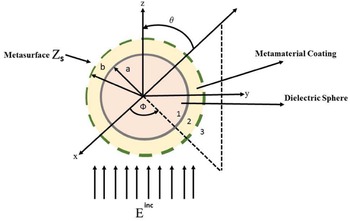
To formulate the problem, two concentric spheres of different radii are taken into account. The inner sphere is assumed to occupy region 1 whose relative permittivity and relative permeability are taken to be ε r1 and μ r1, respectively. The propagation constant for an inner sphere is k 1 = $k_{o}\sqrt {\mu _{r1} \epsilon _{r1}}$ where k o is the free space propagation constant. The region 2 consists of a metamaterial coating having the relative permittivity as ε r2 and the relative permeability as μ r2. The propagation constant in this region 2 is k 2 = $k_{o}\sqrt {\mu _{r2} \epsilon _{r2}}$
 . The inner radius of sphere is taken to be a whereas its outer radius is b. Thus, coating thickness is Δ = b − a. The background region 3 is taken to be the free space. This metamaterial coated dielectric sphere is covered with a spherical MS which has almost zero thickness and is characterized by an isotropic and homogeneous averaged surface impedance of Z s Fig. 1. This surface impedance is given by Z s = R s − iX s. Here the surface resistance R s represents MS losses and X s represents the surface reactance of the MS which can be positive or negative. For a lossless MS, the surface impedance Z s is purely imaginary. Here, we have assumed lossless MS, i.e. Z s = iχs with the surface reactance of χs as adopted by Alù. It is also shown and discussed in the numerical results section.
The geometrical configuration of a metamaterial coated dielectric sphere covered by an MS having a homogeneous and isotropic surface impedance of Z s.

It is assumed that an x-polarized plane wave is incident upon an MS covered meta-material coated dielectric sphere whose electric field vector Einc can be expressed in terms of spherical vector wave functions (SVWFs) as below [Reference Bohren and Huffman4],

Here M(1)( · ) and N(1)( · ) are the SVWFs with nth order spherical Bessel function j n( · ) [Reference Bohren and Huffman4]. By using Maxwell's equations, the corresponding incident magnetic field vector Hinc can be obtained as follows:

where η o is the intrinsic impedance of the free space and E n = i nE o[(2n + 1)/(n(n + 1))]. The scattered electromagnetic field vectors (Esc, Hsc) in the background region can be expanded as follows,


where superscript (3) referred to the spherical harmonics for which the generating function is specified by spherical Hankel function of first kind, i.e. ${h_{n}}^{( 1) }({\cdot})$ . Here a n and b n are the unknown scattering coefficients and needed to be determined. Likewise, the electric and magnetic field vectors (E1, H1) inside the dielectric sphere can be written as,


where η 1 is the intrinsic impedance of the inner dielectric sphere. The factors c n and d n are unknown expansion coefficients. The electromagnetic field vectors (E2, H2) in the metamaterial coating region can be expanded in terms of SVWFs as below,


where η 2 is the intrinsic impedance of the metamaterial coating region and f n, g n, v n, w n are unknown expansion coefficients. Here M(2)( · ) and N(2)( · ) are the SVWFs with nth order spherical Neumann function y n( · ). It is noticed that the eight unknowns a n, b n, c n, d n, f n, g n, v n, and w n can be found by applying the tangential and impedance boundary conditions at the interfaces r = a and r = b, respectively and using the orthogonality property of angular functions. These boundary conditions are given in [Reference Bohren and Huffman4, Reference Alù34, Reference Chen and Alù35, Reference Awan and Seetharamdoo37].
Using equations (1)–(8) in these boundary conditions, the unknown coefficients can be determined. Once these unknowns are known then the electromagnetic fields in each region can be found from equations (1) to (8). For present study, the scattering coefficients a n and b n are of an interest. After some manipulations, they are given below,


where $\psi _{n}^{( 1) }( z) = [ zj_{n}( z) ] '/z$ , $\psi _{n}^{( 2) }( z) = [ zy_{n}( z) ] '/z$
 and $\psi _{n}^{( 3) }( z) =$
 $[ z h_{n}^{( 1) }( z) ] '/z$
 and prime (′) shows the derivative. For completeness, we have also derived the mathematical expressions of these scattering coefficients a n, b n for a metamaterial coated dielectric sphere without MS. In this case, they can be written as,


It can be shown that if we take k 1 = k 2 = k o, a = b, η 1 = η 2 = η o and Z s = 0 in equations (9)–(16) then the scattering coefficients a n and b n become same as that of a hollow perfectly electric conducting (PEC) sphere placed in the free space background which are given in [Reference Balanis38, Reference Jin39]. Likewise, if we take k 1 = k 2 = k, a = b, η 1 = η 2 = η in equations (17) and (18) using equations (11)–(16) then the the scattering coefficients a n and b n become consistent with that of a dielectric sphere having propagation constant of k and placed in the free space background medium and are given in [Reference Bohren and Huffman4, Reference Jin39]. This is also discussed and shown in the section of numerical results.
As we are interested in the radar cross-section (RCS), therefore, it is required to find the scattered electric field vector in the far zone. In this case, it is desired to use the asymptotic expressions for spherical Hankel function and derivative of spherical Hankel function for large argument as given by Bohren and Huffman, i.e.


Using equations (19)–(20) in equation (3), we can find the far zone scattered electric field vector. Once it is known then the normalized RCS σn = $\sigma _{3D}/\lambda ^{2}_{o}$ of a metamaterial coated dielectric sphere covered with a MS can be found using definition of RCS σ3D as given by Balanis, i.e.


where $P_n^1({\cdot})$ is an nth order associated Legendre polynomial of the first kind. It should be noted from equations (21)–(24) that if sin ϕ = 0 then σ n corresponds to an E-plane pattern whereas for cos ϕ = 0 it represents an H-plane pattern. For practical problems related to radar engineering, we are interested in the backscattering cross-section. The backscattering cross-section σ back can be calculated by substituting ϕ = 0 and θ = π in equations (21)–(24) for an E-plane pattern. For cloaking related applications, we are often interested in the total scattering cross-section σ T which can be calculated using the procedure as given in [Reference Bohren and Huffman4, Reference Alù34], i.e.

Some of the authors have used ordinary metals and dielectric to cloak a spherical scatterer without MS [Reference Hayran, Kurt, Herrero, Botey, Staliunas and Staliunas40, Reference Sheverdin and Valagiannopoulos41]. They argued that their proposed theory has applications in the recent paradigm shift of photonic inverse design [Reference Sheverdin and Valagiannopoulos41]. It should be noted that if the effective size of the considered spherical scatterer increases and its radius becomes electrically large then the proposed formulation in this section can not be used. In this case, for example, one can use the Watson transformation [Reference Valagiannopoulos42] and the technique given in [Reference Wu, Shang and Li43].
Numerical results
Numerical results along with their discussions have been presented in this section. As we are interested in the E-plane backscattering cross-section, that is why only E-plane backscattering cross-sections have been shown for all figures except for Figs. 2, 10 and 11(a). For all numerical results, we have assumed a lossless MS, i.e. Z s = iχs with the surface reactance of χs as adopted by Chen and Alù. In order to have the convergent results for summations encountered in equations (21) and (25), it is required to truncate the summation index n appearing in these equations to the highest value of N. The truncation criteria for these summations has been taken from [Reference Wu, Shang and Li43].
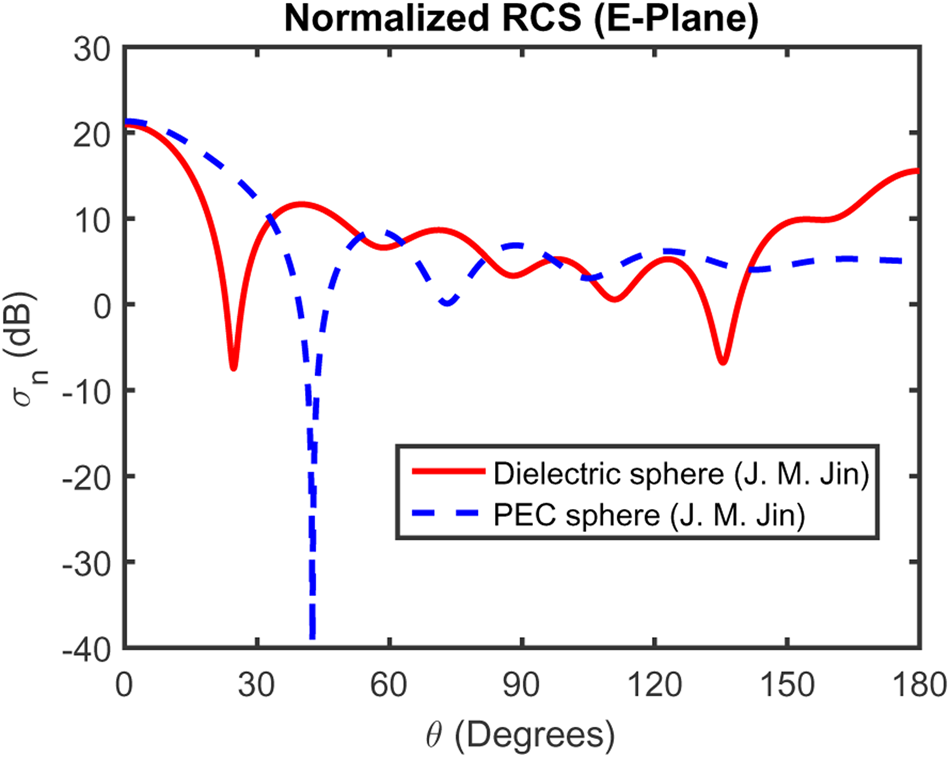
The normalized RCS σ n for dielectric and perfectly electric conducting (PEC) spheres based upon the proposed formulation using electrical and geometrical parameters as given by Jin [Reference Jin39]. These normalized RCSs are found to be in good agreement with those reported by Jin which validates the proposed formulation.

In order to validate the proposed formulation of a metamaterial coated dielectric sphere covered without MS and with MS as presented in Section ‘Problem formulation’, the normalized scattering cross sections σ n for dielectric and PEC spheres are shown in Fig. 2. For a dielectric sphere, it is assumed that ε r1 = ε r2 = 2.56, μ r1 = μ r2 = 1 and a = b = λ o in the proposed formulation of a metamaterial coated dielectric sphere without MS as adopted by Jin in Fig. 7.14(a) of [Reference Jin39]. It is found that the normalized scattering cross section is in good agrrement with those reported by Jin. Likewise, if we take ε r1 = ε r2 = 1, μ r1 = μ r2 = 1, a = b = λ o and Z s = 0 in the proposed formulation of a metamaterial coated dielectric sphere covered with MS then the σ n become same as that of PEC sphere given in Fig. 7.10(a) of [Reference Jin39]. These agreements with the reported works validate the proposed formulation. It is important to note that the inner dielectric core for Figs. 3–11 has been assumed to be made of a realistic material, i.e. MD except Fig. 10. This MD material is commercially available in the form of aluminum doped ferrite and has electromagnetic parameters of ε r1 = 13.8 + i0.1 and μ r1 = 11 [Reference Shore and Yaghjian36, Reference Awan, Ullah, Ullah and Ashraf44].
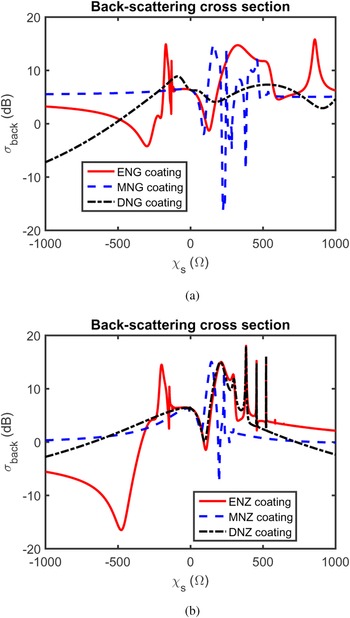
The influences of (a) ENG, MNG, and DNG coatings (b) ENZ, MNZ, and DNZ coatings upon the backscattering cross-section of a metamaterial coated magnetodielectric sphere covered by various lossless metasurfaces.

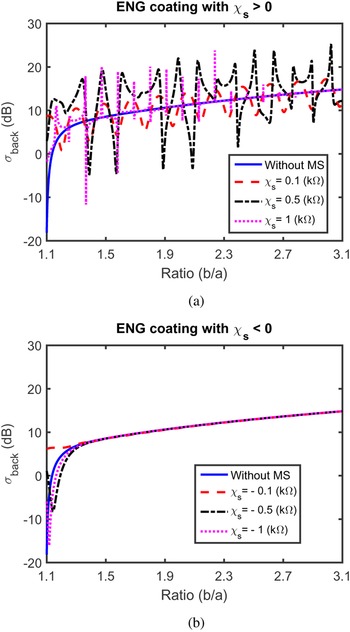
The backscattering cross sections of an ENG metamaterial coated magneto-dielectric sphere covered by a metasurface having (a) χs > 0 and (b) χs < 0 as a function of ratio (b/a) and their comparisons with σ back of an ENG metamaterial coated magneto-dielectric sphere without metasurface.

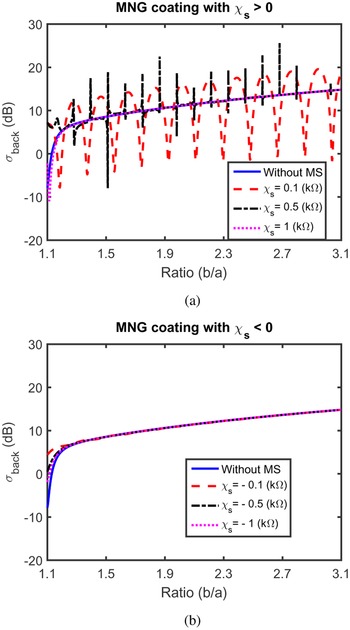
A comparative study of the backscattering cross-sections of an MNG metamaterial coated MD sphere covered by a MS having (a) χs > 0 and (b) χs < 0 as a function of ratio (b/a) and the backscattering cross-section of an MNG metamaterial coated MD sphere without MS.

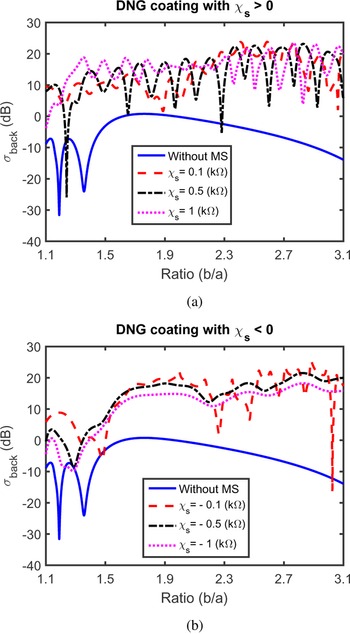
The backscattering cross sections of a DNG metamaterial coated MD sphere covered by a MS having (a) χs > 0 and (b) χs < 0 as a function of ratio (b/a) and their comparisons with σ back of a DNG metamaterial coated MD sphere without MS.

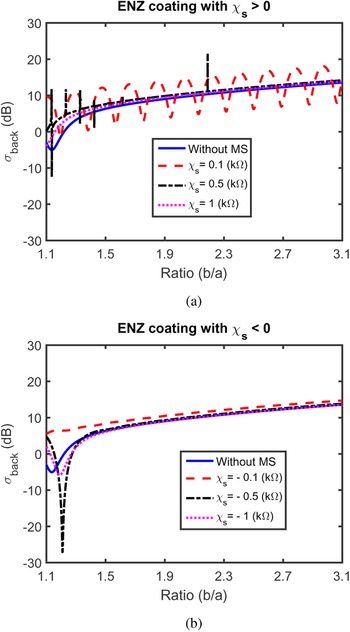
The σ back of an ENZ metamaterial coated MD sphere covered by a MS having (a) χs > 0 and (b) χs < 0 for various values of ratio (b/a) and its comparison with σ back of an ENZ metamaterial coated MD sphere without MS.

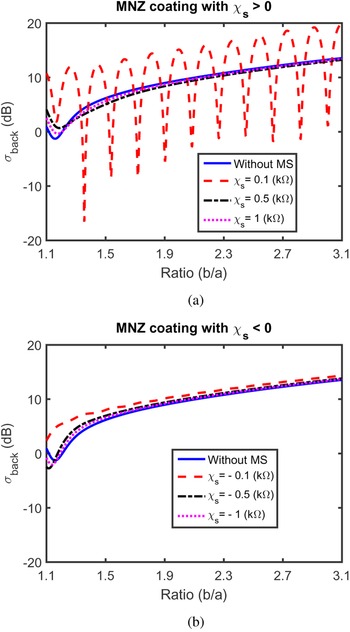
The backscattering cross-sections of an MNZ metamaterial coated MD sphere covered by a MS having (a) χs > 0 and (b) χs < 0 as a function of ratio (b/a) and their comparisons with σ back of an MNZ metamaterial coated MD sphere without MS.

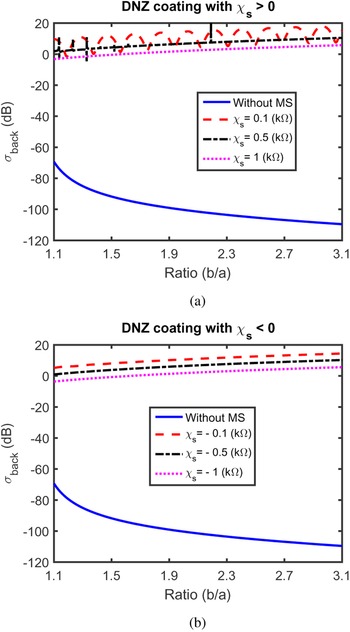
The backscattering cross-sections of a DNZ metamaterial coated MD sphere covered by an MS having (a) χs > 0 and (b) χs < 0 and their comparisons with σ back of a DNZ metamaterial coated MD sphere having no MS.

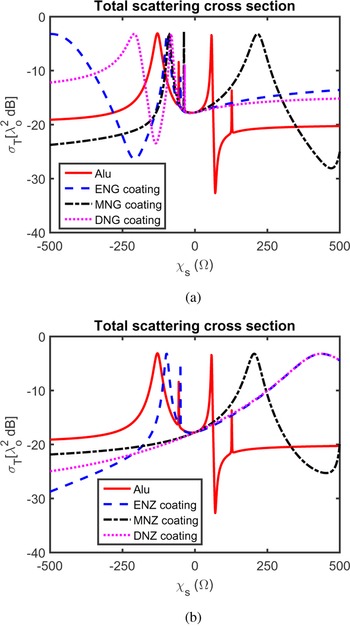
The total scattering cross-section σ T of a metamaterial coated dielectric sphere covered with MS as a function of χs for (a) ENG, MNG, and DNG coatings (b) ENZ, MNZ, and DNZ coatings and its comparison with a MS coated dielectric sphere. Here b = 0.1λ o and a = 0.08λ o with Δ = 0.02λ o which represents a thin coating layer. For a MS covered dielectric sphere case, it is assumed that ε r1 = ε r2 = 10, μ r1 = μ r2 = 1 and a = b = 0.1λ o as adopted by Chen and Alù. Using proposed formulation and taking all parameters as given in [Reference Alù34, Reference Chen and Alù35], it is found that the total scattering cross-section is in good agreement with [Reference Alù34, Reference Chen and Alù35].

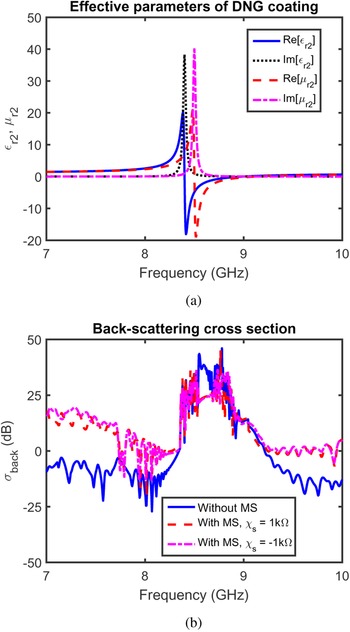
(a) The relative permittivity and permeability of a lossy DNG coating based upon the frequency dispersive model given in equations (26) and (27). (b) The backscattering cross-sections of realistic DNG coated MD sphere without MS and with MS having χs = ±1 kΩ as a function of frequency. Here geometrical parameters are taken to be b = 100 mm and a = 50 mm.

In Fig. 3, the influences of various types of metamaterial coatings upon the backscattering cross section σ back as a function of χs have been shown. In this case, it is assumed that a = λ o and b = 1.2λ o at an operating wavelength of λ o. It should be noted that the σ back = −10.24 dB for a bare MD sphere having radius of 1.2λ o. Here a bare MD sphere is taken to be a sphere made up of MD material having no coating and not covered by a MS. The electromagnetic parameters of ENG, MNG, and DNG coatings are selected in such a way that their impedance magnitudes are same as that of the free space. Therefore, it is assumed that ε r2 = −1, μ r2 = 1 for ENG, ε r2 = 1, μ r2 = −1 for MNG and ε r2 = −1, μ r2 = −1 for DNG coatings. Likewise, it is assumed that for an ENZ coating, ε r2 = 0.001 and μ r2 = 1 as given by Basharin et al. [Reference Basharin, Mavidis, Kafesaki, Economou and Soukoulis45]. Using this information, it is assumed that ε r2 = 1, μ r2 = 0.001 for an MNZ coating and ε r2 = 0.001, μ r2 = 0.001 for a DNZ coating. The backscattering cross sections for ENG, MNG, and DNG coated MD sphere covered with MS have been shown in Fig. 3(a). From Fig. 3(a), it is found that the maximum value of σ back = 15.8 dB and is observed for an ENG coated MD sphere having χs = 857 Ω. Likewise, the minimum value of σ back = −16.15 dB and is found for an MNG coating with χs = 224 Ω. The Fig. 3(b) deals with σ back of ENZ, MNZ, and DNZ coated MD as a function of χs. In this case, the maximum value of backscattering cross section is observed for an ENZ coated MD sphere having χs = 383 Ω. This maximum value of σ back is 18 dB. On the other hand, the minimum value of σ back = −16.5 dB and is again found for an ENZ coated MD sphere with χs = −478 Ω. From the above analysis, it is concluded that an ENZ coated MD sphere having some finite coating thickness and χs = 383 Ω can be used to enhance the σ back by 28 dB as compared to σ back of a bare MD sphere. In this case, both spheres have same size. Thus an ENZ coating having some fixed coating thickness and paired with a specific type of MS can be used to enhance the backscattering cross section as compared to a bare MD sphere. This enhancement in backscattering cross section is desirable for radar detection problems.
In Figs. 4–6, the backscattering cross sections as a function of ratio (b/a) for ENG, MNG, and DNG coated MD spheres covered with MS having χs > 0 or χs < 0 have been shown. These backscattering cross-sections are also compared with ENG, MNG, and DNG coated MD sphere without MS. Here the radius of inner MD core is taken to be one wavelength, i.e. a = λ o. It is studied that σ back linearly increases with the increase in the coating thickness of ENG and MNG coated MD spheres without MS. Likewise, if ENG and MNG coated MD spheres are coated with MS having χs > 0 then the σ back represents a fluctuating behavior with the increase in coating thickness except for an MNG coated MD sphere with χs = 1 kΩ. On the other hand, for ENG and MNG coated MD spheres having χs < 0, the backscattering cross-sections are fluctuating for very thin coating and become almost same for relatively thicker coatings, i.e. 1.35 ≤b/a≤3.1. Thus, it is concluded that the backscattering cross section is almost independent of MS having χs < 0 for a relatively thicker coatings of ENG and MNG coated MD spheres. The maximum value of σ back is 25.6 dB and observed for an MNG coated MD sphere having χs = 0.5 kΩ for b = 2.68a. For the same geometrical parameters, the σ back for an MNG coated MD sphere without MS is 13.5 dB. This shows that there exists an enhancement of 12.1 dB in σ back for this specific MS covered MNG coated MD sphere as compared to the σ back of an MNG coated MD without MS. Likewise, the minimum value of σ back is -11.6 dB and found for an ENG coated MD having χs = 1 kΩ for b = 1.37a. In this case, if there is no MS then we have σ back of 7.57 dB for an ENG coated MD sphere having b = 1.37a. From here, it is argued that a MS having χs = 1 kΩ can be used to reduce σ back by 19 dB for an ENG coated MD sphere having no MS. Such type of reduced backscattering may find applications in the stealth design. From Fig. 6, it is seen that MS with χs > 0 or χs < can be used to enhance the σ back for a DNG coated MD sphere by increasing the coating thickness except at some specific ranges of coating thicknesses where σ back diminishes. In this case, the maximum value of σ back is 25.35 dB and observed for a DNG coated MD sphere having χs = −0.1 kΩ with b = 2.88a. For the same value of b, the value of σ back becomes −9.55 dB for a DNG coated MD sphere without MS. Thus, it is argued that a MS with χs = −0.1 kΩ can be used to enhance σ back of almost 34 dB for a DNG coated MD having some specific coating thickness.
The Figs. 7–9 deal with the backscattering cross sections of ENZ, MNZ, and DNZ coated MD sphere with and without MS as a function of increasing coating thickness. It is studied from Figs. 7 and 8 that for relatively smaller value of χs, i.e. 0.1 kΩ, the backscattering cross sections of ENZ and MNZ coated MD spheres represent fluctuating behaviour with an increase in the value of b. The maximum value of σ back is 21.52 dB and observed for an ENZ coated MD sphere having χs = 0.5 kΩ for b = 2.19a. For the same geometrical parameters, an ENZ coated MD sphere without MS has σ back = 10.36 dB. Thus, it is observed that this specific type of MS can be used to enhance the σ back by 11.16 dB as compared to the σ back of an ENZ coated MD sphere. As the value of χs approaches to ±1 kΩ for an ENZ coated MD sphere, the value of σ back is almost independent of coating thickness and become nearly same as that of σ back of an ENZ coated MD sphere without MS for 1.35 ≤ b/a ≤ 3.1. The minimum value of σ back is − 27.21 dB and observed for an ENZ coated MD sphere having χs = −0.5 kΩ for b = 1.21a. If the same ENZ coated MD sphere is covered with no MS then we have σ back = −0.583 dB for b = 1.21a. This shows that a MS having χs = −0.5 kΩ can be used to enhance σ back by 26.63 dB as compared to σ back of same ENZ coated MD sphere without MS. It is observed from Fig. 9 that the significant decrease in σ back is found in case of DNZ coated MD sphere. It is also studied that with the increase in the coating thickness of DNZ coating, σ back further decreases. Thus, it is concluded that a DNZ coating can be used to hide a finite size MD sphere. On the other hand if the same DNZ coated MD sphere is covered with MSs having χs = ±0.1 kΩ, ±0.5 kΩ and ±1 kΩ then a significant enhancement in the σ back is observed as compared to σ back of a DNZ coated MD sphere without MS. This is an interesting result which shows that specific types of MSs with either χs < 0 or χs > 0 can be used to significantly enhance the backscattering cross section. For example in case of χs = 0.5 kΩ with b = 2.19a this enhancement in the σ back approaches to almost 122 dB and such type of enhanced backscattering cross section finds application in radar detection related problems.
The total scattering cross-section σ T of a metamaterial coated dielectric sphere covered with MS as a function of χs has been shown in Fig. 10. In fact, Alù and co-workers [Reference Alù34, Reference Chen and Alù35] have shown that a non-magnetic dielectric sphere with the relative permittivity of 10 and radius of 0.1λ o can be cloaked using a lossless MS having χs = 70 Ω. Based upon the proposed formulation given in the present study, we reproduce the total scattering cross-section result as reported in [Reference Alù34, Reference Chen and Alù35] which further validate the proposed theory. In order to highlight the effects of MS reactance, very thin metamaterial coating layers have been assumed. This is because our spherical scatterer has metamaterial coating and covered with a lossless MS. That is why we have inserted a very small layer of metamaterial coating having thickness Δ = 0.02λ o between MS and dielectric sphere as considered by Alù et al. and want to study how this very thin layer of considered metamaterial affects the cloaking phenomenon. It is observed that this thin layer of considered metamaterials weakens the cloaking phenomenon. It is further argued that a thin layered metamaterial coated dielectric sphere can not be apparently cloaked using lossless MS having χs lying in the range − 0.5 k Ω ≤ χs ≤0.5 kΩ.
In the previous analysis, it is assumed that all considered metamaterials are lossless, but these metamaterials are inherently lossy and frequency dispersive [Reference Pendry, Holden, Robbins and Stewart46–Reference Smith, Schultz, Markos and Soukoulis49]. Therefore, in order to show the effects of losses in these metamaterial coatings, we have considered only DNG coating. In this case, it is assumed that the corresponding frequency dispersive relative permittivity ε r2(ω) and relative permeability μ r2(ω) are governed by the following equations:


In order to have lossy DNG metamaterial coating, we have chosen ω pe/2π = 3.2 GHz, ω pm/2π = 3.3 GHz, ω oe/2π = 8.4 GHz, ω om/2π = 8.5 GHz with Γm = Γe = 2 GHz, see for example [Reference Ziolkowski and Heyman48, Reference Smith, Schultz, Markos and Soukoulis49]. It is seen form Fig. 11(a) that a DNG behavior is observed from f r = 8.5 GHz to f p = 8.98 GHz. Thus, there exists a DNG bandwidth of 0.48 GHz. From closer look of Fig. 11(b), it is observed that there exists a specific DNG range of frequencies, i.e. 8.540GHz≤ f ≤8.695GHz for which MS having χs = ± 1kΩ can be used to reduce the backscattering cross section as compared to the σ back of a DNG coated MD without MS. In this case, an optimum case exists at f = 8.55 GHz where we have σ back = 43.524 dB for a lossy DNG coated MD sphere without MS. On the other hand, at the same optimum frequency, if the same DNG coated sphere is covered with (i) χs = 1 kΩ and (ii) χs = −1 kΩ then we have σ back = 22.6 dB and σ back = 21.8 dB respectively. Thus, it is concluded that metsurfaces with χs = ±1 kΩ can be used to reduce the backscattering cross section of almost 20 dB for a lossy DNG coated MD sphere at a specific DNG frequency of 8.55 of GHz.
Concluding remarks
The scattering characteristics of a metamaterial coated MD sphere covered by a MS has been studied. The problem has been solved analytically based upon the Mie theory and with the application of boundary conditions. Two types of boundary conditions, i.e. tangential and impedance boundary conditions have been used to solve the problem. The main focus of the current study is to investigate the backscattering cross-section of a metamaterial coated MD sphere covered by a MS. The influences of various types of metamaterial coatings including ENG, MNG, DNG, ENZ, MNZ, and DNZ and lossless MSs upon the backscattering cross-section have been explored. During the study, it is found that a DNZ coating can be used to hide a finite size MD sphere in the backscattered direction. If the same DNZ coated MD sphere is covered with the considered types of lossless MSs having positive or negative surface reactances then these MSs can be used to significantly enhance the backscattering cross-section. For example, in the case of a DNZ coated MD sphere covered with the surface reactance of 0.5 kΩ and has a coating thickness of 1.19a then this enhancement in the backscattering cross-section approaches to almost 122 dB. This is an interesting result that finds applications in the radar detection problems. The proposed formulation is also extended to the lossy DNG metamaterial coated MD sphere covered with a lossless MS. It is found that for a specific part of the DNG bandwidth, a lossless MS having surface reactance of ± 1 kΩ can be used to reduce the backscattering cross-section as compared to the backscattering cross-section of a lossy DNG coated MD sphere without MS. It is also studied that for the specific DNG frequency of 8.55 GHz, the metasurfaces with surface reactances of ±1 kΩ can be used to reduce the backscattering cross-section of almost 20 dB for the lossy DNG coated MD sphere.
 Farah Rasheed Abbasi received her Masters degree in Electronics from the Quaid-i-Azam University Islamabad, Pakistan in 2017. She has also received her Master of Philosophy degree in Electronics from the same university in 2021. Her main areas of research include electromagnetic scattering, metasurfaces, and metamaterials.
 Zeeshan Akbar Awan received his Master of Philosophy from the Department of Electronics, Quaid-i-Azam University, Islamabad, Pakistan in 2002. He has completed his Ph.D. degree in Electronics from the same university. He has worked as a Post-Doctoral candidate within LEOST Laboratory of the COSYS department in IFSTTAR, Lille, France from January to July 2018. He is presently an assistant professor at the Department of Electronics, Quaid-i-Azam University, Islamabad, Pakistan. He has authored or co-authored more than 30 research articles. His research interests include electromagnetic metamaterials, metasurfaces, and antenna theory.
 Arshad Hussain received his M.Phil from the Department of Electronics, Quaid-i-Azam University, Islamabad, Pakistan in 2002. He completed his Ph.D. from the State Key Laboratory of Analog and Mixed-Signal VLSI, Department of Electrical and Computer Engineering, Faculty of Science and Technology, University of Macau, Macau (SAR), China. He also completed a one-year Post-Doctorate from the Department of Information and Communication Engineering, Chosun University, GwangJu, South Korea. He is currently working as an assistant professor at the Department of Electronics, Quaid-i-Azam University, Islamabad, Pakistan. His current research interests are analog circuits, switched-capacitor circuits, design of low power high resolution delta-sigma ADCs, and electromagnetics.