Introduction
In recent years, there has been considerable attention focused on the possibility of identifying a subset of anxiety disorders termed fear circuitry disorders. Proposals for the fifth edition of the Diagnostic and Statistical Manual of Mental Disorders (DSM-5) have suggested that this grouping would include post-traumatic stress disorder (PTSD), panic disorder/agoraphobia, social anxiety disorder and specific phobia; generalized anxiety disorder (GAD) and obsessive compulsive disorder (OCD) are conceptualized as having aetiologies that differ from fear circuitry disorders, and are clustered elsewhere (Andrews et al. Reference Andrews, Charney, Sirovatka and Regier2009).
It is proposed that the aetiology of fear circuitry disorders may involve elevated arousal in the context of an aversive event. Based on animal conditioning paradigms, it is hypothesized that these disorders commence when otherwise innocuous stimuli are paired with an inherently aversive event; subsequent exposure to the conditioned stimuli signals threat and results in anxiety (Milad et al. Reference Milad, Rauch, Pitman and Quirk2006). The exemplar disorder of fear conditioning is PTSD, although there is also evidence that aversive or traumatic experiences can precede onset of panic disorder (Faravelli, Reference Faravelli1985; Manfro et al. Reference Manfro, Otto, McArdle, Worthington, Rosenbaum and Pollack1996) and social phobia (McCabe et al. Reference McCabe, Antony, Summerfeldt, Liss and Swinson2003), although this evidence is very mixed (Rapee et al. Reference Rapee, Litwin and Barlow1990). Support for the fear circuitry category has also drawn on findings that whereas fear circuitry disorders tend to be characterized by excessive amygdala reactivity, and to a lesser extent impaired regulation of that response by the medial prefrontal cortex (Rauch & Drevets, Reference Rauch, Drevets, Andrews, Charney, Sirovatka and Regier2009; Shin & Liberzon, Reference Shin and Liberzon2010), different neural networks appear to be involved in non-fear circuitry anxiety disorders (Cannistraro et al. Reference Cannistraro, Wright, Wedig, Martis, Shin, Wilhelm and Rauch2004; Rauch et al. Reference Rauch, Wedig, Wright, Martis, McMullin, Shin, Cannistraro and Wilhelm2007). Although the key networks of the amygdala and medial prefrontal cortex are also implicated in other anxiety responses, such as GAD (Nitschke et al. Reference Nitschke, Sarinopoulos, Oathes, Johnstone, Whalen, Davidson and Kahin2009), there is greater evidence for this network across the fear circuitry disorders (Shin & Liberzon, Reference Shin and Liberzon2010).
Fear conditioning models are given some support by evidence that individuals with chronic PTSD are hyper-responsive to trauma reminders (Pitman, et al. Reference Pitman, Orr, Forgue, de Jong and Claiborn1987; Blanchard et al. Reference Blanchard, Kolb, Taylor and Wittrock1989). A key postulate is that fear conditioning involves increased sympathetic nervous system, or impaired parasympathetic nervous system, activity in the immediate aftermath of trauma exposure. As a consequence, considerable attention has been given to potential biological markers in the acute phase of trauma. Most of this work has involved the study of elevated heart rate (HR) in the acute phase because that index is regarded as a marker of the strength of the unconditioned and/or conditioned response. Consistent with this proposition, numerous studies have found that individuals who subsequently develop PTSD display higher HR in the initial days after trauma exposure than those who do not develop PTSD (Shalev et al. Reference Shalev, Sahar, Freedman, Peri, Glick, Brandes, Orr and Pitman1998; Bryant et al. Reference Bryant, Harvey, Guthrie and Moulds2000, Reference Bryant, Harvey, Guthrie and Moulds2003, Reference Bryant, Marosszeky, Crooks and Gurka2004, Reference Bryant, Salmon, Sinclair and Davidson2007; Bryant & Harvey, Reference Bryant and Harvey2002; Kassam-Adams et al. Reference Kassam-Adams, Garcia-Espana, Fein and Winston2005; De Young et al. Reference De Young, Kenardy and Spence2007). It is worth noting, however, that elevated HR has not been observed in a minority of studies (Blanchard et al. Reference Blanchard, Hickling, Galovski and Veazey2002; Buckley et al. Reference Buckley, Nugent, Sledjeski, Raimonde, Spoonster, Bogart and Delehanty2004) or has been only partially replicated (Shalev & Freedman, Reference Shalev and Freedman2005; O'Donnell et al. Reference O'Donnell, Creamer, Elliott and Bryant2007) in others.
One limitation of current evidence for the fear circuitry group of disorders is that there is no evidence concerning a mechanism involved in the onset of these disorders. One potential test of fear circuitry is the extent to which HR following trauma predicts fear circuitry disorders, but not other psychiatric disorders. There is convergent evidence that trauma can precipitate the occurrence of a broad range of fear circuitry and non-fear circuitry disorders (Mayou et al. Reference Mayou, Bryant and Ehlers2001; Bryant et al. Reference Bryant, Creamer, O'Donnell, Silove, Clark and McFarlane2010). If the fear circuitry model is correct, one should observe elevated HR in patients exposed to trauma who develop PTSD, panic disorder, agoraphobia and social phobia, but not in those who develop GAD, OCD or major depressive disorder (MDD). To test this hypothesis, we conducted a large longitudinal study of survivors of traumatic injury across four hospital sites and assessed HR and blood pressure recorded in the immediate aftermath of the trauma. Participants were reassessed 3 months later to determine the relationship between these initial measures of HR and blood pressure and the development of subsequent psychiatric disorder. To test this prediction rigorously, we sought to improve the design in comparison with previous studies. First, whereas most studies have limited their investigation to PTSD [a few have also included depression (Shalev et al. Reference Shalev, Sahar, Freedman, Peri, Glick, Brandes, Orr and Pitman1998; Bryant et al. Reference Bryant, Creamer, O'Donnell, Silove and McFarlane2008)], we assessed the full range of anxiety disorders. Second, previous studies have not excluded patients who may have had the specific disorder before the trauma, which represents a potential confound. In the present study, we report analyses on patients who developed a disorder for the first time after trauma exposure.
Method
Participants
Injury patients admitted to four level 1 trauma centres across three states in Australia were recruited into the study between April 2004 and February 2006. The study was approved by the Research and Ethics Committee at each hospital. Inclusion criteria for the study included aged between 16 and 70 years, could understand and speak English proficiently, and had a hospital admission of greater than 24 h following traumatic injury. Individuals were excluded from the study on the basis of clinical interview if they were currently psychotic or suicidal, were non-Australian visitors, cognitively impaired, or under police guard. Individuals were also excluded if they had any traumatic brain injury because of evidence that traumatic brain injury is associated with altered HR (Baguley et al. Reference Baguley, Heriseanu, Felmingham and Cameron2006). Individuals who met the entry criteria were randomly selected using an automated procedure, stratified by length of stay; this procedure guarded against preferential recruitment of patients who were admitted for longer time periods. Following written informed consent, trained researchers conducted clinical interviews assessing past psychiatric history, current PTSD and current depression. They obtained permission to follow up patients 3 months after hospital admission with a telephone interview for a second clinical interview assessing MDD, PTSD, panic disorder, agoraphobia, social phobia, OCD and GAD, combined with self-report measures of anxiety and depression.
Procedure
Multiple HR recordings were taken, beginning at the first contact with the patient, which was either at the scene of the injury by paramedics or at initial admission to the emergency department, using radial, brachial or carotid pulse palpation measured over 60 s. Previous studies have demonstrated a relationship between subsequent PTSD and HR after trauma measured in the emergency room (Zatzick et al. Reference Zatzick, Russo, Pitman, Rivara, Jurkovich and Roy-Byrne2005), within 48 h of trauma (Bryant et al. Reference Bryant, Creamer, O'Donnell, Silove and McFarlane2008) and 1 week after trauma (Shalev et al. Reference Shalev, Sahar, Freedman, Peri, Glick, Brandes, Orr and Pitman1998). To increase the reliability of the HR assessment, we utilized four HR recordings that were drawn from the initial 48 h (two on day 1 post-trauma and two on day 2 post-trauma; at least 4 h apart) of the patient's file by the researchers and the mean HR recorded. We adopted this approach in order to (a) increase reliability of HR recording, and (b) index persistent arousal that may reflect stronger fear responses in the acute trauma phase. Systolic and diastolic blood pressure was also recorded at the same time intervals with automatic blood pressure monitors.
Trained clinicians (n=8) assessed prior psychiatric disorder (including MDD, PTSD, panic disorder, agoraphobia, social phobia, OCD, GAD) during hospitalization using the Mini-International Neuropsychiatric Interview (version 5.5; MINI; Sheehan et al. Reference Sheehan, Lecrubier, Harnett-Sheehan, Amorim, Janavs, Weiller, Herqueta, Baker and Dunbar1998). In addition, PTSD symptoms were assessed during hospital admission and at 3 months post-injury using the Clinician-Administered PTSD Scale – IV (CAPS-IV; Blake et al. Reference Blake, Weathers, Nagy, Kaloupek, Gusman, Charney and Keane1995). The CAPS possesses good sensitivity (0.84) and specificity (0.95) relative to the Structured Clinical Interview for DSM-IV (SCID) PTSD diagnosis, and also possesses sound test–retest reliability (0.90). During hospital admission patients also completed the Hospital Anxiety and Depression Scale (HADS; Zigmond & Snaith, Reference Zigmond and Snaith1983). At the 3-month assessment, patients were assessed for PTSD using the CAPS-IV, and for other psychiatric disorders using the MINI. Of all CAPS and MINI interviews, 5% were rescored blind to the original scoring to test inter-rater reliability. The PTSD diagnostic consistency for the CAPS was 1.00 and for the MINI across all diagnoses it was 0.99.
Information regarding demographic, hospital admission and injury-related factors was obtained from medical records and trauma registries from each of the hospitals. Injury information included the Injury Severity Score (ISS; American Association for Automotive Medicine, 1990), which is a measure of overall injury severity, cause of traumatic injury, hospitalization length and presence of traumatic brain injury.
Data analysis
Demographic, injury characteristics and HR measures for participants and those lost to 3-month follow-up were compared using t tests for continuous measures or χ2 for categorical measures with a Bonferroni adjustment (α=0.005) to allow for the multiple comparisons.
HR data were examined in several ways. First, we compared HR in patients with each psychiatric disorder against those with no disorder at 3 months using t tests (Bonferroni adjusted α=0.005). Second, we followed previous HR studies (Zatzick et al. Reference Zatzick, Russo, Pitman, Rivara, Jurkovich and Roy-Byrne2005) by determining an appropriate cut-off for HR to identify participants who would develop PTSD by studying HR cut-off scores reported in previous studies (Shalev et al. Reference Shalev, Sahar, Freedman, Peri, Glick, Brandes, Orr and Pitman1998; Bryant et al. Reference Bryant, Harvey, Guthrie and Moulds2000; Zatzick et al. Reference Zatzick, Russo, Pitman, Rivara, Jurkovich and Roy-Byrne2005), as well as conducting receiver operating characteristic (ROC) analysis of the current data. These approaches converged on adopting a cut-off of 96 beats per min. This HR level was then used to identify the capacity of baseline HR to predict each of the psychiatric disorders at 3 months. We calculated sensitivity, specificity, positive predictive power and negative predictive power for elevated HR as predictors of psychiatric diagnosis. Positive predictive power is the probability that a patient with elevated HR will develop psychiatric disorder, and negative predictive power is the probability that a patient without elevated HR will not develop the psychiatric disorder.
The extent to which elevated HR predicts subsequent disorder in relation to other factors that may account for post-traumatic adjustment was examined through separate hierarchical logistic regressions. The order of factors entered in regression analyses was based on demographic and injury-related factors that may influence the effect of HR on subsequent disorder. Specifically, at the first step we entered gender, ISS, patient's age and type of injury. At the second step, we entered baseline HR. To accommodate the co-morbidity between fear circuitry and non-fear circuitry disorders, we further calculated the associations between HR and subsequent disorder in patients who had only a fear circuitry or only a non-fear circuitry disorder.
Results
There were 1593 participants approached; 992 agreed to participate and had HR data and full psychiatric assessment collected during admission. A total of 390 participants experienced a mild traumatic brain injury (MTBI) and were excluded because of evidence that MTBI alters HR (Tan et al. Reference Tan, Fink, Dao, Hebert, Farmer, Sanders, Pastorek and Gevirtz2009). The 602 participants included in the study comprised 475 males and 127 females of mean age 39.29 (s.d.=13.58) years, and the mean ISS was 9.73 (s.d.=6.43). Participants spent an average of 11.79 (s.d.=12.12) days in hospital. Most participants were injured in transport accidents (n 478, 79%); the rest suffered traumatic falls, industrial accidents or assaults (n 124, 21%). Individuals who refused to participate in the present study did not differ from participants in terms of gender (χ2=1.86, degrees of freedom=1, p=0.11), age [t(1590)=2.36, p=0.08], days in hospital [t(1591)=0.85, p=0.78] or ISS [t(1544)=1.68, p=0.17]. At the 3-month follow-up assessment, 76 patients could not be contacted or declined to participate; 526 were interviewed by telephone, representing 87% of the baseline sample. Patients at the follow-up assessment did not differ from those who did not participate in terms of gender (χ2=0.45, n=602, p=0.87), age [t(600)=2.36, p=0.08], prior psychiatric diagnosis (χ2=0.17, n=602, p=0.68), length of hospital stay [t(600)=0.52, p=0.97], ISS [t(600)=0.86, p=0.89] and initial HR [t(600)=0.18, p=0.12].
A total of 164 patients had a new psychiatric disorder at the follow-up assessment (i.e. that did not exist before trauma exposure): 22 (4%) patients met criteria for PTSD, 48 (9%) for MDD, 14 (3%) for panic disorder, 24 (5%) for social phobia, 17 (3%) for agoraphobia, five (1%) for OCD, and 34 (6%) for GAD. As there were few cases of OCD, this disorder was not included in subsequent analyses. Overall, there were 77 (15%) cases of a new fear circuitry disorder (i.e. individuals who had never had a previous fear circuitry) and 87 (17%) cases of a new non-fear circuitry disorder. Of the patients, 66 had a single diagnosis and 98 had at least two disorders. In terms of having a fear circuitry disorder (PTSD, panic disorder, agoraphobia or social phobia), 27 (6%) had a fear circuitry disorder without co-morbid non-fear circuitry disorder, and 49 participants (11%) had a non-fear circuitry disorder without co-morbid fear circuitry disorder.
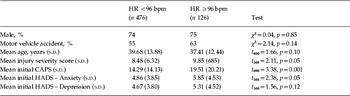
Table 1 demonstrates that patients with elevated HR scored significantly higher on baseline PTSD severity and marginally (p<0.05) on ISS and HADS-Anxiety scores than those without elevated HR. It should also be noted that there was no difference in ISSs between patients with (mean=9.13, s.d.=4.35) and without (mean=8.78, s.d.=6.69) a fear circuitry disorder (p=0.80), and with (mean=8.42, s.d.=5.62) and without (mean=9.15, s.d.=7.46) a non-fear circuitry disorder (p=0.59).
Patient characteristics according to initial HR

HR, Heart rate; bpm, beats per min; s.d., standard deviation; CAPS, Clinician-Administered Post-Traumatic Stress Disorder Scale; HADS, Hospital Anxiety Depression Scale.
Patients with a new fear circuitry disorder (but with no co-morbid non-fear circuitry disorder and who had never suffered a prior fear circuitry disorder) were more likely to have elevated HR than those without any disorder (48% v. 13%, Fisher's exact test, p=0.001). Patients with a non-fear circuitry disorder (but with no co-morbid fear circuitry disorder and had never had a prior non-fear circuitry disorder) were no more likely to have elevated HR than those without any disorder (10% v. 12%, Fisher's exact test, p=0.99). There were no differences for any disorders in terms of systolic or diastolic blood pressure.
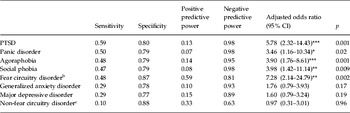
Table 2 presents the sensitivity, specificity, positive predictive power and negative predictive power for elevated HR. Although the sensitivity for each of the fear circuitry disorders was reasonable (range 0.47–0.59), and greater than that of other disorders, the positive predictive power was poor. More impressively, the positive predictive power for elevated HR in predicting any new fear circuitry disorder that was not co-morbid with a non-fear circuitry disorder was reasonable (0.59). The hierarchical logistic regressions indicated that after adjusting for injury severity, age, gender and type of traumatic injury, baseline HR significantly predicted PTSD, panic disorder, agoraphobia and social phobia at 3 months. In contrast, baseline HR did not predict MDD or GAD. Importantly, having an elevated baseline HR predicted fear circuitry disorders that were not co-morbid with a non-fear circuitry disorder [adjusted odds ratio (OR) 7.28] but did not predict non-fear circuitry disorders that were not co-morbid with a fear circuitry disorder. In terms of other predictors, ISS predicted agoraphobia [adjusted OR 0.91, 95% confidence interval (CI) 0.85–0.99] and fear circuitry disorders (adjusted OR 0.90, 95% CI 0.81–0.99), and younger age predicted PTSD (adjusted OR 0.97, 95% CI 0.94–0.99).
Sensitivity, specificity, positive predictive power, negative predictive power and adjusted odds ratios of elevated heart rateFootnote a and new psychiatric disorders controlling for age, gender, injury severity and trauma type

CI, Confidence interval; PTSD, post-traumatic stress disorder.
a Elevated heart rate is defined as ⩾96 beats per min.
b Fear circuitry disorder includes a new fear circuitry disorder that is not co-morbid with a non-fear circuitry disorder.
c Non-fear circuitry disorder includes a new non-fear circuitry disorder that is not co-morbid with a fear circuitry disorder.
* p<0.05, ** p<0.01, *** p<0.001.
Discussion
The observation that PTSD occurred significantly less frequently than other anxiety disorders highlights the range of psychiatric disturbances that can occur after trauma. Previous research has indicated the range of psychological disorders that develop after trauma (Blanchard et al. Reference Blanchard, Hickling, Taylor, Loos and Gerardi1994; Mayou et al. Reference Mayou, Bryant and Ehlers2001), which reinforces the need to acknowledge the potential role of trauma in development of a range of disorders beyond PTSD.
The finding of elevated HR in survivors of trauma who subsequently develop PTSD accords with previous studies (Shalev et al. Reference Shalev, Sahar, Freedman, Peri, Glick, Brandes, Orr and Pitman1998; Bryant et al. Reference Bryant, Harvey, Guthrie and Moulds2000, Reference Bryant, Harvey, Guthrie and Moulds2003, Reference Bryant, Marosszeky, Crooks and Gurka2004, Reference Bryant, Salmon, Sinclair and Davidson2007; Bryant & Harvey, Reference Bryant and Harvey2002; Kassam-Adams et al. Reference Kassam-Adams, Garcia-Espana, Fein and Winston2005; Zatzick et al. Reference Zatzick, Russo, Pitman, Rivara, Jurkovich and Roy-Byrne2005). More importantly, the present study demonstrated that elevated HR in the acute phase after a traumatic event was also associated with subsequent new cases of panic disorder, agoraphobia and social phobia. This association was not observed in MDD or GAD. These effects were observed after controlling for patients' age, gender, injury severity and type of injury. This pattern is consistent with the proposal that PTSD, panic disorder, agoraphobia and social phobia comprise a group of fear circuitry disorders (Rauch & Drevets, Reference Rauch, Drevets, Andrews, Charney, Sirovatka and Regier2009). A strength of the present study was that it comprised a large, multi-site study that assessed trauma survivors within days after trauma, and subsequently assessed them for various disorders that never existed before the trauma. This methodology extends the current knowledge by identifying the role of HR with onset of new fear circuitry disorders.
The notion of fear circuitry disorders often involves the assumption that they are generated by fear conditioning, mediated by increased noradrenaline at the time of an aversive event. The amygdala is centrally involved in the acquisition of fear conditioning in humans (Milad et al. Reference Milad, Wright, Orr, Pitman, Quirk and Rauch2007; Alvarez et al. Reference Alvarez, Biggs, Chen, Pine and Grillon2008), an inference supported by converging evidence from several sources. For example, neuroimaging studies indicate increased amygdala response in reaction to fear stimuli in individuals with PTSD (Shin et al. Reference Shin, McNally, Kosslyn, Thompson, Rauch, Alpert, Metzger, Lasko, Orr and Pitman1997; Rauch et al. Reference Rauch, Whalen, Shin, McInerney, Macklin, Lasko, Orr and Pitman2000; Bryant et al. Reference Bryant, Creamer, O'Donnell, Silove and McFarlane2008), panic disorder (van den Heuvel et al. Reference van den Heuvel, Veltman, Groenewegen, Witter, Merkelbach, Cath, Van Balkom, van Oppen and van Dyck2005; Domschke et al. Reference Domschke, Ohrmann, Braun, Suslow, Bauer, Hohoff, Kersing, Engelien, Arolt, Heindel, Kugel, Deckert and Ohrmann2008) and social phobia (Tillfors et al. Reference Tillfors, Furmark, Marteinsdottir, Fischer, Pissiota, Långström and Fredrikson2001, Reference Tillfors, Furmark, Marteinsdottir and Fredrikson2002; Phan et al. Reference Phan, Fitzgerald, Nathan and Tancer2006). Although there is some evidence for increased amygdala reactivity in GAD (McClure et al. Reference McClure, Monk, Nelson, Parrish, Adler, Blair, Fromm, Chamey, Leibenluft, Ernst and Pine2007; Monk et al. Reference Monk, Telzer, Mogg, Bradley, Mai, Louro, Chen, McClure-Tone, Ernst and Pine2008) and OCD (van den Heuvel et al. Reference van den Heuvel, Veltman, Groenewegen, Dolan, Cath, Boellaard, Mesina, van Balkom, van Oppen, Witter, Lammertsma and van Dyck2004; Van Laere et al. Reference Van Laere, Nuttin, Gabriels, Dupont, Rasmussen, Greenberg and Cosyns2006), that pattern has been shown in only a minority of studies (Shin & Liberzon, Reference Shin and Liberzon2010). Whereas each of these studies is limited by assessing neural circuitry in patients with chronic disorders, the current design provides a novel test of the fear circuitry proposal because it allows an index of arousal at the time of onset of the new disorders.
We recognize that fear conditioning expects the stimuli occurring at time of encoding to be directly linked to the focus of the subsequent anxiety. Fear circuitry models typically hypothesize that social phobia may develop as a result of aversive conditioning following a negative social experience. Similarly, panic disorder purportedly develops following intense fear in association with perceived catastrophic somatic experience. In the context of traumatic injury, it is less clear how panic, agoraphobia or social phobia may be conditioned. Several possible explanations exist. These patients may have a pre-existing vulnerability to these anxieties (e.g. fear of negative evaluation), which is triggered by the trauma. It is also possible that events that occurred in the course of the traumatic injury involved experiences that conditioned concerns of social or somatic events. For example, the occurrence of panic is common during trauma (Nixon & Bryant, Reference Bryant2003), and this conditioning may directly lead to fear of subsequent cues that may signal panic.
The measure of elevated HR may be a function of increased sympathetic or reduced parasympathetic activation. Impaired parasympathetic activation in PTSD is suggested by evidence indicating lower respiratory sinus arrhythmia in those with the disorder (Cohen et al. Reference Cohen, Kotler, Matar, Kaplan, Miodownik and Cassuto1997, Reference Cohen, Kotler, Matar, Kaplan, Loewenthal, Miodownik and Cassuto1998), although not all studies have supported that association (Yeragani, Reference Yeragani1995). The absence of any association between fear circuitry disorders and blood pressure levels raises the possibility that vagal tone, rather than sympathetic activation, may play a role in the association between HR and onset of subsequent fear circuitry disorders.
Although the adjusted ORs of elevated HR for predicting subsequent fear circuitry disorders were higher than of other predictors, such as injury severity or younger age, the discriminatory capacity of HR to predict fear circuitry disorders was modest and not of an order that would allow accurate clinical prediction. This finding accords with previous results that indicate that although acute HR is associated with subsequent PTSD, its predictive power is limited (Bryant, Reference Bryant2006). It is possible that HR may have limited predictive capacity for fear circuitry disorders because it reflects the degree of the unconditioned, rather than conditioned, response. This possibility accords with evidence from one study that elevated HR was associated with exposure to terrorist attacks more than motor vehicle accidents, regardless of PTSD development (Shalev & Freedman, Reference Shalev and Freedman2005), suggesting that the elevated HR may be associated with the severity of the threat more than the extent of fear conditioning. It should also be noted that positive predictive power is influenced by prevalence rates of the predictor and outcome variables relative to the population being studied. For example, the sensitivity of a test can drop markedly when the prevalence rate decreases (Baldessarini et al. Reference Baldessarini, Finklestein and Arana1983). Finally, it should be noted that most early markers of post-traumatic response have only modest predictive power (Bryant, Reference Bryant, Harvey, Guthrie and Moulds2003).
We note several limitations to the present study. First, we relied on paramedic assessments of HR rather than controlled assessment of HR, 24 h electrocardiogram (ECG) or HR variability. Second, we also note that HR can be influenced by a range of factors, such as posture during assessment, blood loss and medication (we could not ensure that HR was obtained before opioid administration). These factors suggest that caution is required in interpreting the HR data until properly controlled HR acquisition is obtained in future studies. Third, we note that we conducted the follow-up interviews by telephone; however, there is convergent evidence that structured clinical interviews conducted by telephone compare favourably with personal interviews (Aziz & Kenford, Reference Aziz and Kenford2004). Fourth, we did not index specific phobia, which is one of the anxiety disorders described as a fear circuitry disorder. Fifth, we did not determine whether HR before the traumatic injury was a risk factor for the development of a subsequent fear circuitry disorder.
In summary, the present study provides the first evidence of one possible common mechanism underpinning the onset of fear circuitry disorders. We note the validity of arguments that challenge the basis for a constellation of fear circuitry disorders, including mixed evidence concerning neural circuitry and the relevance of aversive events precipitating many cases of these disorders. For example, some individuals develop anxiety disorders without a prior aversive experience, and the role of environmental stressors can be moderated by genetic vulnerability (Silberg et al. Reference Silberg, Rutter, Neale and Eaves2001). Nonetheless, the finding of elevated HR in those who develop fear circuitry disorders is consistent with fear conditioning being one possible mechanism by which individuals may develop this group of anxiety disorders.
Acknowledgements
The present study was supported by an NHMRC Program grant (no. 568970), a Victorian Trauma Foundation grant (no. V-11) and a National Health and Medical Research Council Australian Clinical Research Fellowship (no. 359284).
Declaration of Interest
None.