INTRODUCTION
Individuals with Parkinson's disease (PD) frequently experience cognitive decline in various domains (Woods & Troster, 2003). Several studies indicate a “frontal” impairment in patients with PD, insofar as they are impaired in executive function tasks such as inhibition, task set switching, and planning (Lewis et al., 2003; Muslimovic et al., 2005). Deficits have also been reported with regard to working memory or attention (Lewis et al., 2003; Muslimovic et al., 2005). Moreover, individuals with PD evidence retrospective memory problems, showing impaired performance on free recall tasks, but spared performance on recognition and cued recall tasks; this finding contrasts to patients with Alzheimer's disease who are impaired in all three types of retrospective memory task (Whittington et al., 2000). In line with these findings, PD patients' memory deficits have traditionally been attributed to retrieval rather than encoding difficulties (Higginson et al., 2003), although some authors (e.g., Higginson et al., 2003; Woods & Troster, 2003) propose that the observed memory impairments result from executive dysfunction (see, e.g., Muslimovic et al., 2005, for a different view).
Considering these well-established cognitive deficits in PD, it seems remarkable that a more complex cognitive process, which requires both memory recall and executive functioning, has only recently started to attract attention in the cognitive neuropsychology of PD—this cognitive process is prospective memory (Brandimonte et al., 1996). Remembering to perform an intended action at a particular point in the future, that is, prospective memory, is essential in everyday life because the self-initiated enactment of previously formed intentions lies at the core of independent living. Without prospective memory abilities, or even with low levels of performance, taking medications, attending appointments, or more generally taking the chance to act, are likely to be missed (Einstein et al., 1992). Importantly, the cognitive components currently assumed to be involved in prospective memory closely mirror those cognitive functions that are impaired in PD. We will elaborate on this below.
Conceptually, the similarities and differences of prospective memory to other memory functions, such as working memory, are currently under debate (Kliegel et al., 2007). Whereas some studies indicate that prospective memory in general requires working memory resources to continuously keep the intention active while being engaged in an ongoing activity (Smith & Bayen, 2004), others report no or only weak relations between working and prospective memory (Martin et al., 2003). These studies assume that the prospective intention leaves working memory until an encounter at the relevant moment triggers the retrieval of the intention and its return to working memory (McDaniel et al., 2004). Irrespective of its exact mechanisms, there seems to be a consensus that prospective memory is a separate and dissociable memory function (Salthouse et al., 2004); this view is also supported by physiological evidence revealing ERP components (i.e., N300, Prospective Positivity) that seem to be unique for prospective memory (e.g., West et al., 2006).
Prospective remembering (e.g., remembering to stop at the grocery store on the way home to buy meat for dinner), is currently seen as a multiphase process requiring two essential components: a retrospective storage component (recalling what it was that had to be purchased at the store) and a prospective component relying on executive functions, such as planning (forming and executing the intention to pass by the store before going home), monitoring for the appropriate moment to initiate the intended action (stop at the store), inhibition of ongoing activities (driving home), and flexible switching from ongoing activities to the planned action (doing the grocery shopping). Hence, successful prospective remembering requires cognitive functions that seem to be impaired in individuals with PD. Consequently, a reduced prospective memory performance in patients with PD in comparison to controls may be expected.
To the best of our knowledge, only two studies have experimentally investigated prospective remembering in individuals with PD. Katai et al. (2003) applied a time- and an event-based prospective task. Participants were presented with an ongoing category judgment task. For the event-based prospective memory task, participants were instructed to tap the desk whenever the word “cow” or “orange” appeared in the category judgment task. A total of four prospective memory cues occurred. For the time-based task, participants were asked to tap the desk after 10 and 15 min. Katai et al. found that PD patients were only impaired in the event-based task; these deficits were attributed to disrupted executive control processes, which are necessary for the self-initiated retrieval of the delayed intention and for the required switch from the ongoing to the prospective task. In contrast, PD patients' time-estimation abilities appeared to be intact as they were able to solve the time-based task successfully. A second study explored the nature of PD patients' deficits using a complex multi-intention prospective memory paradigm, which allows the disentangling of the four phases of prospective remembering; that is, intention formation, intention retention, intention initiation, and intention execution (Kliegel et al., 2005). Participants were required to plan and initiate the delayed execution of six intentions. PD patients displayed difficulties in the intention formation phase (they developed less elaborate intentions). Moreover, they more frequently failed to initiate their complex intention in response to the prospective target. However, no group differences were observed in retrospectively remembering the self-generated plans and in the execution of the plan. Kliegel et al. concluded that PD patients seem to be impaired in prospective memory and that this deficit may be due to an impairment in the intention formation component.
The present study was conducted to extend this line of research by targeting the deficit in event-based prospective memory using a different task that includes a demanding ongoing activity (West et al., 2006). Moreover, we explored a potential mechanism for compensating a prospective memory deficit that is currently under debate in the cognitive literature. Specifically, we tested the hypothesis that stressing task importance in the intention formation phase might improve prospective memory performance. The rationale for this assumption rests on studies which have shown that the perceived importance of the prospective memory task may enhance performance (Kliegel et al., 2001; Sommerville et al., 1983). The mechanism by which importance is assumed to influence prospective remembering is as follows: Prospective memory tasks are generally dual task situations involving the performance of an ongoing task and the timely switch of attentional resources to an embedded prospective task (see, e.g., Einstein et al., 1992); as such, both tasks compete for attentional resources. It has been suggested that the task which is perceived as more important receives more attention and consequently performance on this task is enhanced (Kliegel et al., 2001). In the present study, we explored the influence of task importance on performance deficits in PD by applying an event-based prospective memory paradigm that focused either on the ongoing or the prospective task. We predicted that, if PD patients' diminished event-based prospective memory performance is attributable to impaired intention formation, then external aids highlighting the importance of the event-based task provided in the intention formation phase may help to reduce or even eliminate performance deficits in the delayed initiation of the intention.
METHOD
Participants
Twenty-six adults participated in the current study: 13 patients with PD (Mage = 60.2 years; SD = 7.4 and Mdisease duration = 4.81 years; SD = 3.0) and 13 healthy age-matched controls (HC; Mage = 62.0 years; SD = 8.6). All participants were right-handed, had no history of drug or alcohol abuse, and had not previously been diagnosed with any other neurological, psychiatric, or cardiovascular diseases. Participants with depression (Beck Depression Inventory > 10) or dementia (Mini-Mental State Examination < 24) were excluded. Seven patients with PD were Hoehn and Yahr stage 1, four were stage 2, and for two patients no classification could be obtained. All patients were treated with a combination of levodopa and pergolide. No patient exhibited an “on–off” phenomenon and none were taking any anticholinergic drugs. Patients were taken off antiparkinsonian medication at least 12 hr before testing. Importantly, PD patients in the present study were comparable to patients in previously conducted studies of prospective memory with respect to disease duration, Hoehn and Yahr stage, and medication type.
All participants gave informed consent, and the study was approved by the local review board. Any human data included in this manuscript was obtained in compliance with the Helsinki Declaration. No significant group effects were observed with regard to education [PD: M = 10.8 years, SD = 2.5; HC: M = 11.5 years, SD = 1.7; F(1,23) = .86] or premorbid intelligence [PD: M = 114.6, SD = 14.2; HC: M = 121.2, SD = 13.1; F(1,24) = 1.49] as assessed by a verbal ability test (Lehrl et al., 1991).
Procedure and Materials
Several neuropsychological baseline measures were assessed. As measures for short-term and working memory, the digit span forward and backward subscales of the Wechsler Adult Intelligence Scale (WAIS) were applied. To assess participants' tonic and phasic alertness, that is, their readiness to respond, the corresponding subtests of the Test for Attentional Performance (TAP Alertness, Zimmermann & Fimm, 2002) were administered. Tonic alertness refers to the ability to maintain an elevated level of responsiveness when anticipating a test stimulus; participants were required to respond as quickly as possible to a cross presented on a screen. Phasic alertness measures the sudden enhanced attentiveness after presentation of a warning signal (cued reaction) that announces a test stimulus (Plohmann et al., 1998). Dependent variables were individuals' reaction times.
For the ongoing activity of the prospective memory task participants were presented with a two-back verbal working memory task (see, e.g., West et al., 2006, for a similar procedure). Consonants (x, y, z were excluded) were displayed one by one on a PC-screen for 200 ms with an interstimulus interval of 2500 ms; half were written in upper case and half in lower case. Participants were asked to decide whether or not the present stimulus had occurred two stimuli ago and indicated their decision by pressing one of two highlighted buttons on a keyboard. In the course of the task, 51 two-back items (25.5% of 200 stimuli) were presented. For the prospective memory task, participants were instructed to press a third highlighted button when one of six predefined stimuli (M, m, N, n, F, f) appeared. In total, eight prospective memory cues were presented. Prospective memory cues and two-back items never occurred at the same time. Dependent variables were the accuracy of two-back task performance and the accuracy of prospective responding.
Task importance was manipulated during the intention formation phase. In the prospective focus condition, participants were told that it was more important to do well in the prospective memory task than in the ongoing n-back task. In the ongoing focus condition, participants were told that the ongoing n-back task was more important than the prospective memory task. All participants completed both experimental conditions in counterbalanced order with a 90 min delay in-between. After receiving adequate instructions, participants completed a practice block (50 ongoing task and 2 prospective memory cue items) following which the first test condition was administered. Each condition consisted of 200 stimuli, and only participants with correct retrospective memory for the instructions and stimuli were included in the analyses.
RESULTS
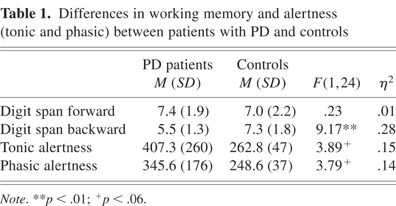
All effects were significant at the p < .05 level unless otherwise noted, and effect size is reported as eta-squared (η2). Multivariate analyses of variance were conducted to evaluate group differences in neuropsychological baseline measures. A significant effect was found only for working memory (Table 1). With respect to the alertness measures, a trend toward significance was observed. (As observed by an anonymous reviewer, patients appeared to show a greater improvement in reaction times between the phasic and tonic alertness conditions; however, this difference was not significant. Moreover, covarying the difference score in the prospective memory task analyses did not change the results.)
Differences in working memory and alertness (tonic and phasic) between patients with PD and controls

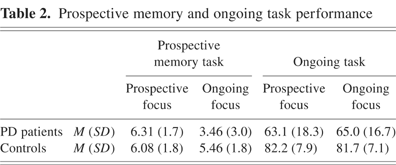
Repeated measures analyses of variance (ANOVA) were calculated to evaluate participants' performance on the ongoing and prospective memory tasks (Table 2). (Further analyses were conducted to detect possible order effects in the repeated-measures ANOVA. However, no order effects emerged.) In the ongoing task, a significant main effect of group was found [F(1,23) = 15.1; p < .01; η2 = .40], indicating a reduced two-back performance in PD patients. Neither the main effect of task importance [F(1,23) = .08; η2 = .00] nor the interaction between group and task importance [F(1,23) = .19; η2 = .01] were statistically reliable.
Prospective memory and ongoing task performance

Regarding prospective memory performance, a significant main effect for task importance was revealed [F(1,24) = 18.2; p < .01, η2 = .43]; participants showed better prospective memory performance under task conditions stressing prospective memory importance. In addition, a significant interaction between task importance and group emerged [F(1,24) = 7.6; p < .01; η2 = .24]: in the condition stressing the importance of the prospective memory task, PD patients' performance did not differ from that of healthy controls, whereas their performance was impaired in the other condition. No significant overall group effect was found [F(1,24) = 1.4; η2 = .06].
Finally, analyses of covariance were calculated to further investigate the cognitive processes underlying group differences in prospective memory. Covariates were variables that either showed a significant difference between groups or revealed a trend toward significance. When ongoing two-back task performance was covaried (mean performance in both ongoing conditions), the interaction between task importance and group was no longer significant [F(1,23) = 3.69; p > .05; η2 = .12] and the effect size was reduced by 50%. A similar result was obtained when digit span backward was covaried [F(1,23) = 2.82; p > .05; η2 = .11], an effect size reduction of 64.2%. The covariation of the two measures of alertness reduced the size of the interaction effect to 29.2%, but it remained significant [tonic: F(1,22) = 4.56; p < .05 (.044); η2 = .17; phasic: F(1,22) = 4.38; p < .05 (.048); η2 = .17].
DISCUSSION
The present study is only the second investigation of event-based prospective memory performance in individuals with PD. Moreover, the influence of task importance on participants' performance was explored for the first time.
The results showed that patients with PD can perform as well as controls in event-based prospective remembering when they are asked to concentrate on the prospective task. Hence, planning and the successful execution of a previously formed intention can be improved in PD patients when importance is externally emphasized. This finding is in line with previous findings which suggest that specific task importance manipulations can help boost performance in general (see Kliegel et al., 2001). Recently, this effect has been demonstrated to be beneficial in groups showing impaired prospective memory performance such as adolescents (Wang et al., 2006) and older adults (Kliegel et al., 2004, April). The beneficial effect of importance observed in the present study is all the more remarkable when we consider the complexity of our prospective memory task compared with that of Katai et al. (2003), whose PD patients evidenced event-based prospective memory impairments on a less complex task. Our two-back task can be regarded as much more demanding than the self-paced category judgment task of Katai et al. (2003), and the eight prospective stimuli used in the present study place far greater demands on retrospective memory than the two prospective stimuli used by Katai et al. (see also Einstein et al., 1992, who reported that age differences between older and younger adults only emerged in a task version with four distinct but not with one single prospective memory targets).
In line with previous studies, PD patients were inferior to controls in prospective remembering when the ongoing task was stressed. This finding suggests that PD patients will (possibly only) differ from control participants in event-based prospective memory paradigms where the prospective task component is not highlighted or even down-graded.
Importantly, participants' ongoing task performance did not interact with task importance. At first glance, this finding seems contrary to the hypothesis that the importance effect operates through a trade-off in attentional resources between prospective memory and the ongoing task. In the present study, it is possible that this trade-off was present but not detectable in the accuracy scores we used and unfortunately response times (which may be more sensitive to this effect) were not recorded. An alternative explanation is that the importance effect may not operate in the performance phase, through redirecting processing resources from the ongoing task to the prospective memory task; but rather at the intention formation phase. The intention-superiority literature (e.g., Goschke & Kuhl, 1993) assumes that intentions are encoded in memory with higher activation than other to-be-remembered material. In this conceptual framework, the importance effect could be explained by importance instructions leading to especially high activation of the prospective cues at the time of encoding (intention formation phase). This way, retrieval of the cues would be enhanced in the performance phase through increased activation of the intention without needing to affect ongoing task performance. These possible alternatives should be addressed in future studies.
The present pattern of results has important methodological implications. While Katai et al. (2003) appear to have instructed participants to perceive the prospective component as an equally important aspect of the entire test procedure, some cognitive researchers tend to introduce prospective memory tasks rather casually as a “secondary” aspect of the test session (for an overview, see Kliegel & Martin, 2003). The current study demonstrates that the way of presenting the prospective memory task will affect outcome enormously and suggests that the casual introduction of prospective memory tasks could significantly underestimate PD patients' prospective memory performance.
Of conceptual relevance is the question of which cognitive processes may be underlying these effects, and the present study offers some initial evidence with regard to this question. A first possible process differentiating patients with PD and controls is their working memory capacity. The current results revealed a reduced capacity in PD patients compared with healthy controls, which corroborates previous findings suggesting that working memory deficits might underlie PD patients' impairment in prospective memory planning (Kliegel et al., 2005). Consistently, covarying working memory performance (assessed in two distinct ways) reduced the effect of task importance on prospective memory performance to a nonsignificant level. Alertness was tested as a second cognitive processing resource potentially underlying the group differences observed; however, the critical interaction remained significant even when covarying for attentional resources.
Clinical implications of these findings suggest that PD patients are not generally impaired in executing previously formed intentions. When told that prospective remembering is especially important, they can perform this task as well as healthy controls, even under demanding conditions. Therefore, interventions should be targeted toward structuring the daily demands made upon PD patients and helping to maintain their autonomy by explicitly prioritizing to-be-performed intentions during the intention formation phase.
ACKNOWLEDGMENTS
No conflict of interest is declared. M.K. acknowledges financial support from the Swiss National Science Foundation.