INTRODUCTION
The Andalusian coast (southern Spain) is the northern limit on both sides of the geographical border between the Atlantic Ocean and the Mediterranean Sea. Then, any animal moving between these two bodies of water swims in front of this coast. This is the case of the juvenile loggerhead sea turtle (Caretta caretta L. 1758), coming to the Mediterranean Sea from the Atlantic nesting beaches (Bjorndal et al., Reference Bjorndal, Bolten, Gordon and Camiñas1994; López-Jurado & Andreu Reference López-Jurado, Andreu and Salvador1998; Cejudo et al., Reference Cejudo, Varo-Cruz, Liria, Castillo, Bellido and López-Jurado2006, Revelles et al., Reference Revelles, Carreras, Cardona, Marco, Bentivegna, Castillo, De Martino, Mons, Smith, Rico, Pascual and Aguilar2007). The loggerhead turtle is the most abundant sea turtle in the Andalusian waters (Bellido et al., Reference Bellido, Castillo, Martín and Mons2005). The use of this coast by this species is not known with detail, although recent studies show that Atlantic turtles cross the Gibraltar Strait to the western Mediterranean basin, which is used as feeding grounds and later they return crossing again these waters (Camiñas & De la Serna, Reference Camiñas and De la Serna1995; Carreras et al., Reference Carreras, Pascual, Cardona, Fernandez, San Felix and Aguilar2004; Eckert et al., Reference Eckert, Moore, Dunn, Sagarminaga, Eckert and Halpin2008).
The final location of the strandings depends on the location where the animal dies or stays adrift and the physical conditions (currents, winds, tides and waves) prevailing in the area until the turtles strand (Epperly et al., Reference Epperly, Braun, Chester, Cross, Merriner, Tester and Churchill1996; Hart et al., Reference Hart, Mooreside and Crowder2006; Bellido et al., Reference Bellido, Báez, Sanchez, Castillo, Martín, Mons and Real2008). There is a relation between the number of strandings recorded on the coast, the abundance of loggerhead turtles in the sea and the main source of threats for the turtle in the area close to the coast (Epperly et al., Reference Epperly, Braun, Chester, Cross, Merriner, Tester and Churchill1996; Tomás et al., Reference Tomás, Gozalbes, Raga and Godley2008). Consequently, different causes of stranding could be site-specific or have different incidence in different areas (Bellido et al., Reference Bellido, Báez, Farfán, Camiñas, Castillo, Martín, Mons and Real2007a).
Every year, more than 50 loggerhead turtles strand in Andalusian waters, distributed along its 1000 km of coast (Bellido et al., Reference Bellido, Castillo, Martín and Mons2005, Reference Bellido, Báez, Farfán, Camiñas, Castillo, Martín, Mons and Real2007a). The present study analyses the spatial trend of loggerhead turtle strandings on the Andalusian coast, looking for the evidence of spatial differences in stranding patterns for dead and alive turtles at both sides of the Gibraltar Strait. In addition, main causes of stranding are reported, as well as the annual trends during the period 1997–2006.
MATERIALS AND METHODS
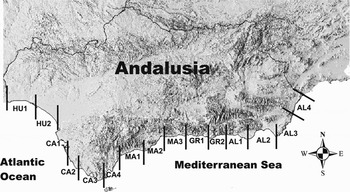
The Andalusian coast involves five provinces (Huelva, Cadiz, Malaga, Granada, and Almeria), and for the present study has been divided into several operational zones, grouping coastal regions depending on the geographical characteristics (capes or bays), orientation, coast type (beaches or cliffs) and river mouths. This way, 15 strandings zones, differing in coast length, have been delimited along the coast (Figure 1).
Andalusian coast division in strandings zones. Scale: 1:3000000.

These zones were grouped in different areas and subareas:
• Area: Atlantic Coast (HU1, HU2, CA1, CA2 and CA3)
■ Subarea: Atlantic Huelva (HU1 and HU2)
■ Subarea: Atlantic Cádiz (CA1, CA2 and CA3)
• Area: Mediterranean Coast (CA4, MA1, MA2, MA3, GR1, GR2, AL1, AL2, AL3 and AL4)
■ Subarea: Alborán Sea (CA4, MA1, MA2, MA3, GR1, GR2, AL1 and AL2)
■ Subarea east Almería (AL3 and AL4)
Stranding data
Loggerhead stranding data were recorded between the years 1997 and 2006 by the Threatened Marine Species Recovery Centre (in Spanish abbreviation CREMA) of Andalusia. The CREMA has a volunteer stranding network with a strong presence in all the municipalities of the Andalusian coast, complemented by other institutions, such as local police or scientist groups, which collaborate in the detection and attention to the strandings. The location of every stranding was identified using the name of the beach, cape, or port where the turtle was found, and the corresponding municipality. The above-mentioned zones comprised a set of municipalities, so it was easy to assign individual stranding data to the corresponding operational zone. The cause of the stranding in each zone has been identified when possible, by necropsy and live animal diagnostics, and included in one of seven categories: buoyancy, cold stunning, longline fishery, net fisheries, debilitated turtle syndrome (DTS), traumatisms, and others. The non-advanced state of decomposition of most of these turtles facilitated the identification of local stranding cause.
Statistical analyses
The proportion of turtles stranded alive and dead have been compared among the zones, and among areas and subareas, using a G-test of independence (Sokal & Rohlf, Reference Sokal and Rohlf1981, p. 735) to test whether their stranding distribution differed significantly from a homogeneous distribution. GR2 has been eliminated from this test because no alive stranding was reported there. Zones or areas with no significant differences in the relative proportion of dead and alive strandings could be considered as subsets of homogeneous distribution in the proportion of dead and alive strandings, so they were grouped together in subsequent analyses.
The identification of zones where strandings were significantly higher or lower than expected according to availability was made by using Bonferroni normal statistics to obtain confidence intervals for the prevalence in each zone (Byers et al., Reference Byers, Steinhorst and Krausman1984; Cameron & Spencer, Reference Cameron and Spencer2008):

where  is proportion of strandings by zone, α = 0.05, k is the number of zones tested, Zα/2 k is the upper standard normal table value corresponding to a probability tail area of α/2k, and n is the total number of strandings. The availability of each zone was calculated according to its coast length, so that the expected use was the proportion of the Andalusian coast corresponding to each zone. The observed prevalence was the proportion of strandings computed for each zone. If the confidence interval of the observed prevalence in a zone overlapped the expected prevalence according to availability, then there was no significant difference between prevalence and availability. If the confidence interval was above availability of a zone, that zone was more prevalent than expected, whereas if the confidence interval was below availability, that zone was less prevalent than expected (Byers et al., Reference Byers, Steinhorst and Krausman1984; Cameron & Spencer, Reference Cameron and Spencer2008).
This test was also applied to the distribution of total, live and dead strandings in the groups of zones with no significant differences in the relative proportion of dead and alive strandings, resulting from the use of the G-test of independence (see above).
RESULTS
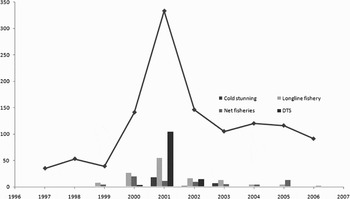
The strandings recorded on the Andalusian coast during 1997–2006 are shown in Table 1. During this period, 1045 strandings of loggerhead turtles were recorded on the Andalusian coast, 227 of them alive and 818 dead. Causes of stranding were identified for 359 loggerheads. Annual stranding distribution and main causes of stranding each year are shown in Figure 2. In the summer of 2001 the debilitated turtle syndrome (Norton et al., Reference Norton, Keller, Peden-Keller, Day, Stedman, Segars, Greiner, Harms, Frick, Dodd, Schroeder, Sheridan, Hecker, Jacobson, Foley, Murphy, Cluse, Teas, Bresette and Baer2004) was the main cause of an abnormal rise in the number of loggerheads stranded that year (Bellido et al., Reference Bellido, Martín, Castillo, Mons and Tomás2002).
Annual stranding distribution and main causes of stranding per year.

Stranding distribution on the Andalusian coast during the years 1997–2006 in the established zones. Alive, dead and total have been separated.

Dead turtle strandings occurred mostly in Atlantic zones (especially HU2 and CA1), while alive turtles were more frequent in Mediterranean zones (especially MA2 and AL2).
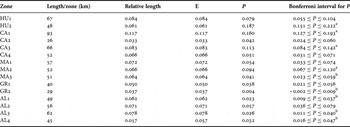
The comparison between observed proportion of strandings and expected values according to availability in the different zones is shown in Table 2.
Zone occupancy by loggerhead sea turtles (Caretta caretta) total strandings on the Andalusian coast (N = 1045). Total and relative length per zone are included (total length considered = 793 km). E, expected proportion of usage; P, proportion of strandings observed in each zone (observed). Bonferroni intervals provide confidence intervals for PZ = 2.935.

azones with more strandings than expected according to availability; bzones with less strandings than expected according to availability.
Zones with more strandings than expected are more frequent on the Atlantic area, while those with less strandings than expected are more frequent on the Mediterranean coast.
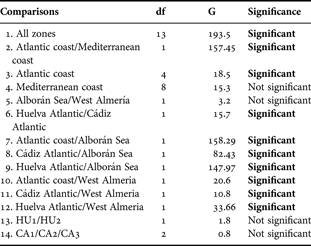
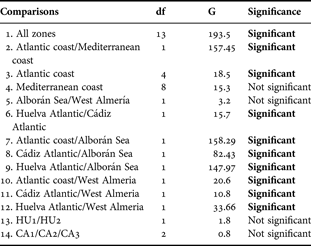
Table 3 shows the significance of the differences among the relative proportion of alive and dead turtles stranded in the areas and subareas defined. There is a significant difference between the Atlantic and the Mediterranean areas (Table 3, Comparison 2). In the same way, every comparison among the proportion of alive and dead turtles stranded between Atlantic and Mediterranean zones produced significant differences (Table 3, Comparisons 7, 8, 9, 10, 11 and 12). There is no significant difference in the proportion of dead and alive turtles stranded neither in the zones of the Mediterranean area nor between the two Mediterranean subareas (Table 3, Comparisons 3 and 4). There are significant differences among zones on the Atlantic area (Table 3, Comparison 6). These differences inside the Atlantic coast are located between the subareas of Cádiz and Huelva (Table 3, Comparison 6), but not within them (Table 3, Comparisons 13 and 14). Therefore, the Andalusian coast can be divided in three parts according to the relative distribution of dead and alive strandings, namely Huelva, Atlantic Cádiz and Mediterranean.
Differences in the proportion of alive and dead loggerheads stranded among established areas and subareas, using G-test of independence. Significant values in bold P < 0.01.
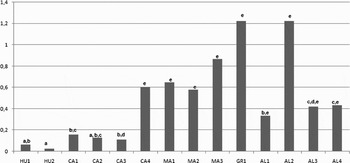
The relation of alive/dead loggerhead stranded in the Andalusian zones have been represented in a bar graph with an alphabetic code, where zones without pair-wise significant differences according to the G-test of independence share the same letter meaning the same pattern in the ratio of alive versus dead loggerheads stranded (Figure 3).
Relation of loggerhead turtle (Caretta caretta) alive and dead (alive/dead) per stranding zone. Zones without significant differences according to the G-test of independence share the same superscript letter.

Five patterns a, b, c, d, and e are identified in growing order of importance of the presence of alive turtles in strandings. The pattern a is exclusive on the Atlantic coast, although it does not involve all the zones. The pattern e is characteristic of the Mediterranean coast, as it involves all these zones and is absent from the Atlantic area. Patterns b, c, and d are transitional between a and e, and they have not a clear geographical ascription. It is interesting to verify that, except b in AL1, these three patterns b, c, and d do not appear in zones of the Alboran Sea.
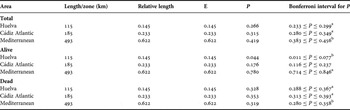
Table 4 shows the comparison of expected and observed strandings in the three areas resulting from Table 3, applied to total, alive and dead strandings separately.
Area occupancy by loggerhead sea turtle (Caretta caretta) total, alive and dead strandings on the Andalusian coast (N = 1045). Total and relative length per zone are included (total length considered =793 km). E, expected proportion of usage; P, proportion of strandings observed in each zone (observed). Bonferroni intervals provide confidence intervals for P Z = 2.394.

azones with more strandings than expected according to availability; bzones with less strandings than expected according to availability.
Again, for total and dead strandings, the Atlantic coast has more strandings than expected while the Mediterranean area is underused in relation to availability. However, for alive loggerheads, the Mediterranean areas hold more strandings than expected while Huelva is avoided and Atlantic Cádiz does not differ significantly from the proportion of strandings expected according to availability.
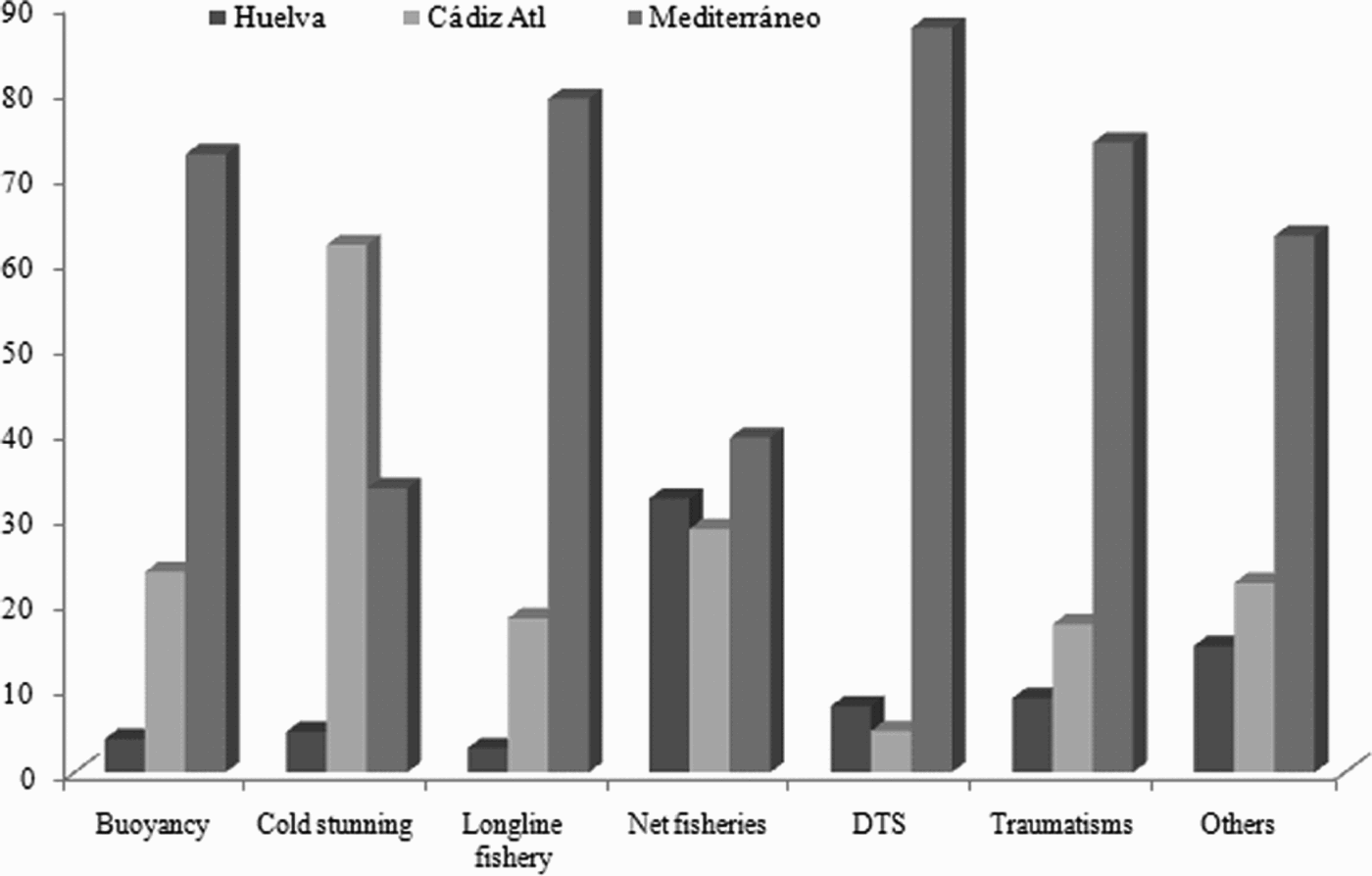
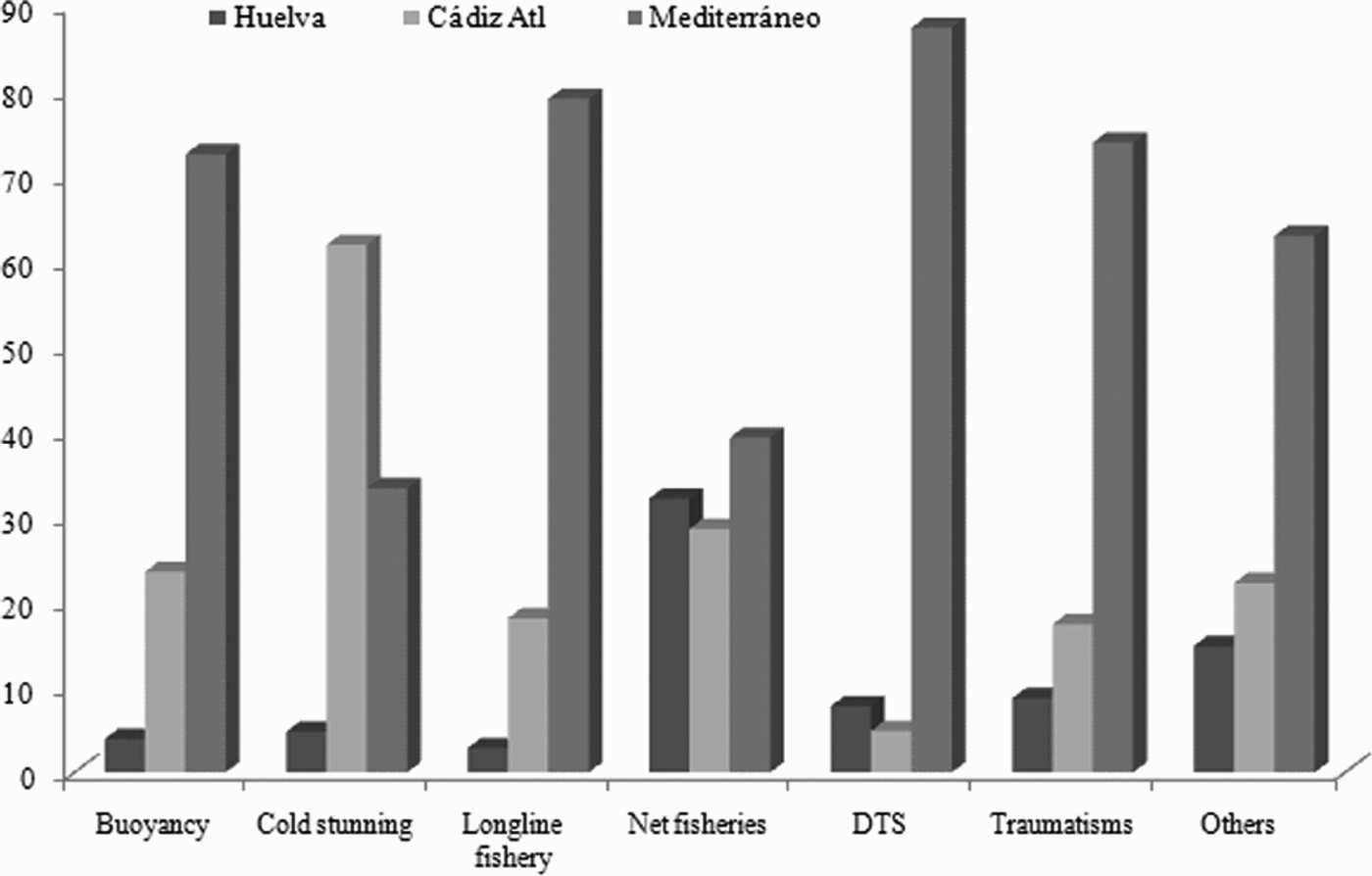
The prevalence of each cause of strandings in the different areas is shown in Figure 4. Two main causes have been identified in the Atlantic areas, cold stunning and other fisheries different from longline, whereas in the Mediterranean area, longline fishery and debilitated turtle syndrome are the main causes of strandings.
Prevalence of different causes of stranding in the different areas defined on the Andalusian coast.
DISCUSSION
Temporal trends in strandings could respond to changes in the numbers of loggerheads recruited to the Mediterranean from the Atlantic Ocean (Tomás et al., Reference Tomás, Fernández and Raga2003). The peak of turtles stranded in 2001 is similar to others registered in different locations of the Mediterranean Spanish coast (Tomás et al., Reference Tomás, Fernández and Raga2003). Although on the Andalusian coast this rise in the strandings was associated to debilitated turtle syndrome with a massive infestation of ectoparasites (Figure 2), no parasites were found in loggerheads stranded in other locations on the Mediterranean Spanish coast.
No permanent populations of loggerhead turtles have been recognized in Andalusian waters, so all the stranding turtles were presumed to be migrating (Camiñas & De la Serna, Reference Camiñas and De la Serna1995; Bolten, Reference Bolten, Bolten and Witherington2003; Bellido et al., Reference Bellido, Castillo, Martín and Mons2005). For this reason, the changes detected in the stranding rate, with the Atlantic coast presenting more strandings than expected while the Mediterranean coast presents less strandings than expected, could be partially explained by differences in the density of sea turtles navigating in front of the Andalusian coasts and/or by changes in the mortality rate. However, Atlantic Andalusian waters have been scarcely studied in relation to loggerheads (Báez et al., Reference Báez, Camiñas, Sagarminaga, Torreblanca and Real2007). The high incidence of strandings on the Atlantic coast could indicate an important presence of loggerheads in these waters, especially in the province of Huelva. Ours results are in agreement with those of Camiñas & Valeiras (Reference Camiñas and Valeiras2001), who suggested that the waters next to Huelva and Cádiz coasts could be an important area for sea turtle concentration. Ramos et al. (Reference Ramos, Millán, Vila, Jiménez, Bernal, Anade and Báez2004) also observed an unusually high number of sea turtles next to the River Guadalquivir mouth during the summer of 2004. It is necessary to investigate why the concentration of loggerhead sea turtles in these waters is so important, even in places so far from the Gibraltar Strait as Huelva. Abundance of loggerheads in the Atlantic Andalusian coast could be favoured by the presence of shallow waters, the incidence of deep rivers, such as the Guadiana and the Guadalquivir, causing surge of productivity near the coast, and the proximity to the Atlantic currents. The low incidence of longline fisheries as cause of loggerhead stranding in this area and the important effect of other neritic fisheries could also be indicative of the presence of loggerheads in shallow waters. Thus, this area merits attention as a possible concentration area for loggerheads with a more permanent character than previously thought.
The spatial distribution of strandings suggests that there is not a common stranding pattern for dead and alive loggerheads. There are significant differences for both strandings pattern in the two sides of the Gibraltar Strait, following a relatively gradual trend. While the Atlantic coast far from the Gibraltar Strait presents more dead strandings than expected, the Mediterranean coast is preferred for alive strandings, with the intermediate Atlantic coast close to the Gibraltar Strait presenting the expected proportion of dead and alive turtles according to coast availability.
The individuals stranded dead on the Andalusian coast are not only representative of the loggerhead presence in these waters, but also of the negative interactions between sea turtles and human activities (Bellido et al., Reference Bellido, Castillo, Martín, Mons, Farfán and Real2007b). In the western Mediterranean Basin, many loggerhead turtles die or are injured every year, usually because of interactions with human activities (Marco et al., Reference Marco, Carreras and Castillo2008). Buoyancy, traumatism, normally of human origin, and longline are the main causes affecting turtles in these waters. Then, in the Alborán Sea an important conflict exists between migratory routes of the Atlantic loggerheads and activities such as fishery or sport navigation. Although no data are available about loggerhead mortality on the Atlantic coast close to the Strait of Gibraltar, causes of dead strandings could be presumed to be similar to those acting in the western Mediterranean. Casale et al. (Reference Casale, Mazaris, Freggi, Basso and Argano2007), in experimental studies, have estimated an annual mortality rate of 27% for loggerheads in the western Mediterranean. Our results suggest that negative interaction with human activity resulting in strandings of dead loggerheads are more frequent or more acute on the Atlantic Andalusian coast, particularly on the coasts of Huelva, than on the Mediterranean Andalusian coast. This is certainly true of the coastal fishing activity, because there is a differential distribution of dangerous fisheries along the Andalusian coast. According to Báez et al. (Reference Báez, Camiñas and Rueda2006), the trammel net fishery (an artisanal fishery practised in the south of Spain) is the most dangerous for sea turtles next to the coast, and it is practised with particular intensity in front of the coast of Huelva and the western part of Cádiz. Around the Strait of Gibraltar and in the Alborán Sea the trammel net fishery is replaced by bottom longlines mainly targeting Pagellus bogaraveo (Brünnich, 1768), which are not dangerous for marine turtles (Báez et al., Reference Báez, Camiñas and Rueda2006).
Strandings pattern ‘e’, with the highest proportion of alive turtles, is the only pattern found in 6 of the 9 Mediterranean zones, all of them in the Alborán Sea. This sea is a narrower water portion than the western Mediterranean basin and the North Atlantic Ocean. Therefore, the Alborán Sea may act as a concentrator for the Mediterranean migrant fauna, so favouring the increased sea turtle density in these waters. The important marine traffic and the fishery effort in the zone may affect the sea turtles navigating in the zone, although longline fishery has been shown not to be the main cause of loggerhead strandings in the Alborán Sea (Bellido et al., Reference Bellido, Báez, Farfán, Camiñas, Castillo, Martín, Mons and Real2007a). However, the relative narrowness of this sea may facilitate that sea turtles could reach the beach still alive, even if they have suffered negative incidences (bycatch, shocks or traumas). Another possibility is that loggerheads make any functional use of the beach, for example for recovering after stress or resting when being ill or tired, especially in the case of small turtles (Bellido et al., Reference Bellido, Báez, Sanchez, Castillo, Martín, Mons and Real2008). The presence of a strong superficial current of Atlantic water entering to the Mediterranean through the Gibraltar Strait (Cano, Reference Cano1977) may impel sea turtles to swim near the coast to reduce the energetic expenditure, as adult sea turtles are known to do in their movements between feeding and breeding grounds in other parts of the world (Luschi et al., Reference Luschi, Hays and Papi2003). The small continental shelf, that favours great depth offshore, may allow the sea turtles in the pelagic phase to approach the coast.
Future studies must take into account fishing effort, marine habitats for sea turtles, and the size, age, and stage of life cycle of the turtles stranded (Tomás et al., Reference Tomás, Fernández and Raga2003) to get a comprehensive view of loggerhead strandings on the Andalusian coast.
ACKNOWLEDGEMENTS
Data from strandings have been handed over for this work by the Consejería de Medio Ambiente de la Junta de Andalucía. This study was supported by the Consejería de Innovación, Ciencia y Empresa of the Junta de Andalucía, Spain (Project P05-RNM-00935).