INTRODUCTION
Legislator responsiveness to constituency preferences is often seen as the cornerstone of American representative democracy. However, the interests of minority groups are not always well represented. Recent research has found that Latinos tend to be most unequally represented in districts where they numerically comprise a significant non-majority portion of the electorate (Griffin and Newman Reference Griffin and Newman2007), echoing Key's (Reference Key1949) assertion that congressional support for black interests correlated negatively with black constituency size in nonmajority-minority districts. Thus, although the expectation is that electorally-minded politicians typically reflect the preferences of their constituents, this does not always hold for minority sub-constituencies.
We explore the relationship between the roll-call behavior in the House of Representatives on votes of significant interest to Muslim-Americans and the presence of Muslims in the legislators' district. Muslim-Americans have become an increasingly important and visible minority in American politics, targeted for increased scrutiny from the public and media as well as from executive and legislative responses to Islamic terrorism and the fear of home-grown or home-assisted terrorism (Ayers Reference Ayers2007; Kalkan et al. Reference Kalkan, Layman and Uslaner2006). During the 109th Congress, the House of Representatives voted on a number of legislative proposals responding to the threat of terrorism, including the renewal of the Patriot Act in the United States and other provisions for domestic surveillance programs that were seen, rightly or wrongly, to target Muslim-Americans in particular. Earlier Congressional unity on counter-terrorism measures disintegrated into more divided voting on these issues, with a clear partition in both the House of Representatives and the Senate on domestic security and surveillance programs.
This research seeks answers to two related questions: First, how does the presence of Muslim-Americans in a district impact the voting behavior of representatives on roll-call votes relating to legislative proposals seen to target this group? Second, is the responsiveness of legislators to Muslim constituents dependent on other factors such as the party affiliation of the legislator?
Understanding how legislators represent Muslim-Americans is important for a number of reasons. This question is significant given both the changing perception of Muslim-Americans and the related legislative activity following the terrorist attacks of September 11, 2001. Although foreign nationals masterminded and carried out these attacks, Muslims living in America became a salient, identifiable, and targeted sub-group in American society (Cainkar Reference Cainkar, Jamal and Naber2007). The nature of representative democracy places great emphasis on responsiveness and the need for legislators to balance the competing interests and preferences of their constituents. Whether Muslim-Americans feel represented by the political process is a question of enormous normative and practical importance. In countries such as the United Kingdom, the perceived lack of representation for Islamic communities and the isolation young Muslims feel from the political process have been presented by the media as explanations for the growth in domestic Islamic extremism and domestic terrorist attacks. A majority backlash in the United States could work to weaken the ties that typically bind all Americans. Does any basis exist for a similar backlash or is the more complex American political process better able to absorb and represent Muslim-American interests?
Considering the difference in representation and responsiveness among different minority groups in the United States is important for understanding how general the minority constituency-legislator backlash phenomenon is in American politics. Is the position of religious minorities such as Muslims analogous to other religious or minority groups?
Mapping constituency-legislator congruence has become increasing popular in recent years, with scholars seeking evidence that key district characteristics help explain patterns of roll-call voting. Typically, these characteristics revolve around the economic interests of constituents, but we need to be mindful of the impact of non-economic constituency preferences on the behavior of legislators. This article contributes to the existing congressional literature by seeking to explain legislator behavior according to non-economic constituency interests. In doing so, we build on an increasingly important body of literature linking district religious characteristics to congressional voting behavior.
The rest of the article is organized as follows. First, we provide a more detailed overview of theories linking constituency preferences and legislator behavior, explaining why these competing approaches could provide a basis for understanding legislators' voting records on issues of importance to Muslim-Americans. Section two tests these competing theories by considering voting behavior on key domestic security and surveillance votes during the 109th Congress. The article concludes with an analysis of the empirical evidence and its consequences for understanding religious minority representation in contemporary America.
REPRESENTATIONAL CONGRUENCE OR BACKLASH
It is widely held that members of Congress are elected to represent the interests of constituents and, as part of this relationship the expectation is that legislators give close attention to the attitudes and preferences of voters in their districts (Fenno Reference Fenno1978). This attention to district preferences is said to manifest itself in how legislators actually behave in the legislative and extra-legislative arena (Mayhew Reference Mayhew1974). Thus, for example, the assumption is that legislators echo the preferences of their constituents in public pronouncements on and off the floor of the chamber, as well as in the legislative proposals and amendments initiated. Perhaps the greatest expectation of a relationship between a member's behavior and the preferences of constituents comes when the member votes (Clinton Reference Clinton2006).
Notably this district-member link is not universal across all legislatures. Indeed, the ability to predict legislative voting behavior by reference to constituency has only limited comparative success (Cain et al. Reference Cain, Ferejohn and Fiorina1987). In many legislatures, party label is the defining explanation of individual legislative behavior (Carey Reference Carey2007). Yet, in the United States, legislators are often expected to act independent of their parties, partially to protect and promote the interests and preferences of their constituents. The centrifugal characteristics of Congress, with relatively strong committees and the dispersion of power from parties to individual members are held as evidence of the core re-election interest of legislators (Katz and Sala Reference Katz and Sala1995, although see also Cox and McCubbins Reference Cox and McCubbins2005).
Because of the candidate-centered nature of the American electoral process, incumbent politicians must cultivate a relationship with voters in their districts (Carey and Shugart Reference Carey and Soberg Shugart1995). This involves a host of extra-legislative activity such as constituency case-work, but also entails listening and responding to the preferences and attitudes of constituents. Because party label may matter relatively little at election time, legislators must explain how they voted in the chamber to represent the preferences of voters back in their district. Indeed, incumbents often face direct challenge on their prior voting record in campaign debates and TV spots. An incumbent knows that if voting behavior does not align with the preferences of constituents an electoral disadvantage may very well accrue. Canes-Wrone et al. (Reference Canes-Wrone, Brady and Cogan2002) found that the more incumbents supported their parties in roll-call votes, the lower their vote share in a subsequent election. A common observed action is for legislators to alter their voting behavior in response to signals from their own electoral performance of changing preferences in the electorate (Grossback et al. Reference Grossback, Peterson and Stimson2005).
Advocates of this congruence theory of legislative behavior have found evidence of links between district characteristics and members voting behavior. Typically, the demographic and political composition of the district becomes a proxy for measuring voter preferences (recent examples include Meinke (Reference Meinke2005) on minimum-wage votes and Rosenson (Reference Rosenson2007) on Senate rules).
Research linking religious characteristics to roll-call voting has increased dramatically in recent years. District religiosity is now firmly established as a source of influence on members' voting behavior.Footnote 1 Exploring the relationship between the religions character of congressional district and legislative voting behavior, Green and Guth (Reference Green and Guth1991) found that conservative voting records are associated with members from districts with higher membership in theologically-conservative protestant churches. House members from constituencies with greater proportions of more moderate protestant and non-protestant bodies tend to have more liberal voting records. Oldmixon's (Reference Oldmixon2005) in-depth study of religion in the United States House of Representatives concluded that legislators' religious affiliation and district religiosity influences legislative behavior on moral, social, and cultural issues such as school prayer. Oldmixon et al. (Reference Oldmixon, Rosenson and Wald2005) find that House legislators with large Jewish constituencies tend to be some of strongest supporters of the state of Israel in roll-call votes. In an extension to the Senate, Rosenson et al. (Reference Rosenson, Oldmixon and Wald2009) find that the Jewish population in senators' home states predicts patterns of pro-Israeli sponsorship or co-sponsorship decisions in the 103rd-107th Congresses. Looking at roll-call behavior on gay rights issues in the House of Representatives from 1993–2002, Oldmixon and Calfano (Reference Oldmixon and Calfano2007, 56) conclude that “while partisanship and ideology largely structure decision making, legislators are also highly responsive to the presence of conservative Protestants and (to a lesser extent) Catholics in their constituency.” Notably absent in this literature linking district religious characteristics to members roll-call behavior are studies that focus on Muslim-Americans as a potentially influential religious group. This article seeks to at least begin to understand how this increasingly salient religious minority is impacting the roll-call behavior of legislators.
Our research seeks to understand how members' roll-call behavior on votes of special interest to Muslim-Americans relates to district characteristics, and, in particular, the portion of Muslims in a member's district. Post-September 11 targeting of this religious minority came not just from the public (as discussed below) but also from an elite-level response. Although politicians were careful to caution against blaming or associating Muslim-Americans with the events of 2001, that community would nevertheless come to feel the focus of executive and legislative action. The Patriot Act in the United States, passed within weeks of the September 11th attacks, highlighted American-Muslims fears of how they were perceived and treated, feeling that domestic security and surveillance legislation was directed toward them. Such feelings were only reinforced by public statements from agencies such as the Federal Bureau of Investigation, which defended the targeting of the financial arrangements of small Muslim businesses in the United States to ensure that these were not sources or conduits of funding of extremists interested in attacking the United States. As Ajrouch and Jamal, (Reference Ajrouch and Jamal2007, 863) noted:
Events following 9/11 including the War on Terror, the emergence of Homeland Security, the Patriot Act, as well as more micro-transformations such as heightened security at airports, [have] altered the lives of Middle Eastern Americans in many ways.
In reporting a survey of Muslim attitudes, the Council on American-Islamic Relations (2006a), noted that civil rights issues have dominated American-Muslim discourse since September 11 and that civil rights is a more important issue for more American-Muslims than, for example, either of the wars in Afghanistan and Iraq.
Some of the clearest evidence of domestic Muslim discontent toward government action comes from evidence of their changing engagement with the political process. Researchers have uncovered strong evidence of greater Muslim-American mobilization, including voter registration, which they explain by reference to Muslims' displeasure at executive and legislative action. Awareness among Muslim-Americans about the Patriot Act allied with the feeling of threat and discrimination drove many Arab-Americans to register for the very first time, a significant step in voter mobilization (Cho et al. Reference Cho, Gimpel and Wu2006). Using data from a survey of Muslim-Americans conducted in 2004, Ayers and Hofstetter (Reference Ayers and Hofstetter2008, 20) conclude that “9/11 and the U.S. Patriot Act, via Muslim anxiety and alienation, heightened American Muslims' political interest and increased political participation.” Looking at actual voting behavior, Ayers (Reference Ayers2007) argues that the post September 11 hostility toward Muslim-Americans explains their shift in support away from Bush between the 2000 and 2004 general elections. For all these reasons, we can feel relatively confident in assuming that the majority of Muslim-Americans feel strongly about much of the September 11-related legislative output and actions of the government.
By combining a congruence theory of legislative action, with the knowledge that Muslim-Americans felt strongly about issues that were the subject of votes in Congress, one can reach a clear empirical expectation. If legislators are responsive to the preferences of constituents and if responsiveness and representation includes representing minority interests, a clear pattern of roll-call voting on Muslim-sensitive issues should emerge. Members of Congress with more Muslims in their districts should be more pro-Muslim in their voting behavior than colleagues with fewer Muslim constituents. This relationship is the central theoretical expectation to be tested. However, a second possible relationship, opposite to the one predicted by classical congruence theory, must first be discussed. While classical accounts of legislator behavior place great emphasis on the responsiveness of legislators to constituency characteristics and preferences (Miller and Stokes Reference Miller and Stokes1963), the presence of minorities in a district sometimes correlates negatively with the legislative support shown by the representative toward that minority.
A negative relationship between legislative actions and the characteristics of a member's constituency is often found, particularly where minority interests are the subject of legislative action (Whitby Reference Whitby2000). Earlier research on the United States Congress found such a negative relationship between the size of a minority constituency in a given district and a member's congressional support for black interests (Key Reference Key1949). Districts with large numbers of black constituents tended to have representatives whose votes showed a decidedly negative attitude toward African-American interests. This counter-intuitive finding probably has its explanation in a backlash hypothesis, where white racial conservatism among the majority population, and ultimately their responsive elected officials, grew as the black population in the districts increased but remained non-majority. More recently, Griffin and Newman (Reference Griffin and Newman2007) discovered evidence of a similar backlash against Latino voters in a district, finding that where Latinos comprise a significant but non-majority portion of the population, representatives tended to be least legislatively supportive of Latino interests. When the Latino population rises to between 40% and 50% of the population, representatives vote in greater accord with their white constituents' preferences than when Latinos formed a smaller proportion of the population in the district.
Central to this “backlash” perspective is an understanding of the electoral and representational consequences of district heterogeneity. Not always can an incumbent act in such a way as to satisfy all voters. Where voter preferences within a district diverge, incumbents must effectively ally themselves with the sub-constituency (or sub-constituencies) that can produce an electoral reward — typically re-election (Bishin Reference Bishin2000). In classical accounts of congruence theory, the assumption is that a rational legislator will gravitate to the median preference in their district. However, an incumbent representative may give unequal attention to the preferences of the sub-constituency that can produce an electoral reward, possibly at the expense of the median voter or minority group. If the preferences of sub-constituencies are asymmetrical, and the preference differences are electorally salient, the strength of congruence between the legislator and the majority sub-constituency will be strong. Where a minority sub-constituency is itself an electoral issue, the outcome may be an inverse relationship between the proportion of voters in the minority sub-constituency and the legislator's voting behavior toward that sub-constituency's interests.
Some evidence of a general majority voter backlash toward Muslim-Americans must exist if the backlash hypothesis has a basis to accurately predict roll-call-behavior in Congress. Substantial evidence suggests that the median American voter takes a somewhat negative view toward Muslim-Americans. As Kalkan et al. (Reference Kalkan, Layman and Uslaner2006) noted, Muslims quickly became another “other” group following the terrorist attacks of September 11th. Muslim interest groups in America have noted a number of phenomena that lead to the conclusion that the community has been the subject of discrimination, and on occasions, physical attack. However isolated such events are, survey evidence clearly indicates that many Americans have formed very negative attitudes toward Muslim-Americans. A 2004 study by the Media and Society Research Group at Cornell University found that 44% of Americans believed some form of curtailment of Muslim-Americans' civil liberties was necessary because of security fears (see further, Nisbet et al. Reference Nisbet, Nisbet, Scheufele and Shanahan2004). In the same survey, 27% of respondents said that Muslim-Americans should be required to report their movement to the federal government, and 26% said that mosques in American should be closely monitored by law enforcement agencies. A survey of non-Muslim-Americans by the Council on American-Islamic Relations (2006b) found that just 27% of the general population rated themselves as accepting and having a tolerant view of Islam and Muslims. Kalkan et al. (Reference Kalkan, Layman and Uslaner2006, 2) conclude that “Muslims may be emerging as a powerful, and most likely negative, reference group for the political attitudes and behavior of American voters.”
The issue for us is not just that Muslim-Americans are a sub-constituency, rather perhaps that the proportion of Muslim-Americans in a district is impacting the level of hostility other voters in that district feel. If this is the case, Muslim-Americans may well join other minorities who are suffering a lack of substantive representation, and moreover, were or are the subject of negative, backlash-based, representation by their congressional representatives.
What remains are two competing hypotheses regarding the likely relationship between Muslim voters and the voting behavior of their representatives. What follows is an effort to uncover the level of empirical support for each hypothesis.
DATA, RESULTS, AND ANALYSIS
To test these competing predictions of legislative representation of Muslim-Americans, we focus on the roll-call behavior of members of the House of Representatives on key votes during the 109th Congress (2005–2006). Attention to the 109th rather than earlier Congresses has a number of advantages: First, voting on security related matters in the immediate aftermath of the September 2001 attacks reflected unusually high levels of Congressional unity. Second, with the passage of time, voters are likely to have a more settled attitude toward Muslim-Americans, either reverting to pre-September 11 attitudes or else fastening negative perceptions to that community. Finally, the 109th Congress is particularly important because it saw a number of significant votes of special interest to Muslim-Americans, including the reauthorization of the Patriot Act.
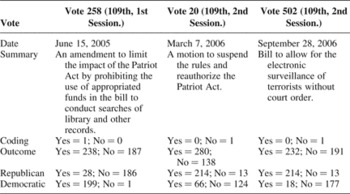
Three roll-call votes were of great interest to Muslim-Americans and highlighted the “them vs. us” attitude toward this newly-salient religious minority.Footnote 2 Table 1 provides an overview of the votes included in this study. Perhaps the most significant vote concerns the reauthorization of the Patriot Act by virtue of the inclusion of a sunset clause in the original bill. The 2001 Patriot Act became increasingly controversial and faced particularly heavy criticism from Muslim-American groups such as the Council on American-Islamic Relations. The Act gave greater authority to the federal government to fight international and domestic terrorism. It provided for less obstructive gathering of intelligence on Americans. It also allowed for deportation of immigrants suspected of terrorism-related activity. Whether or not to reauthorize the Act was the source of much debate in the spring of 2006. The vote to reauthorize the Patriot Act provided a key opportunity for legislators to send a signal to their constituents of their attitudes toward Muslim-American interests and preferences. Unlike the initial passage of the Patriot Act, the 2006 reauthorization resulted in a more divided House, with 138 members voting against reauthorization compared to 280 members voting in favor. Democrats were the most divided, with approximately one-third of Democrat Representatives voting in favor.
Summary of votes included in this study

The two other votes included in the analysis concern surveillance programs. On June 15, 2005, the House voted on a proposal from Representative Sanders (I–Vt.) that would have prohibited the use of public funds to conduct searches of certain material such as library records or bookseller customer lists. The effect would have been to limit the ability of government agencies to implement certain of the more controversial aspects of the original Patriot Act. A divided House voted by a margin of 238 to 187 to adopt the measure. Finally, we consider voting on a bill designed to allow for the electronic surveillance of suspected terrorists within the United States. The proposal greatly enhanced the power of the federal government to eavesdrop based on the declared existence of an imminent threat. The bill passed the House in September 2006 by a margin of 232 to 191. In our analysis, we code each vote to indicate whether the voting behavior of the member exemplifies a pro-Muslim-American preference or not. Table 1 provides more information on the coding of each vote.
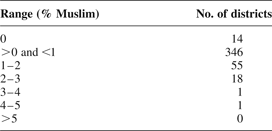
To show how members' voting behavior on the aforementioned votes may have been influenced by the portion of Muslim-Americans in a member's district, we compile data on the Muslim population of Congressional districts. Because the United States Census Bureau is not permitted to ask questions regarding religious affiliation in the Decennial Census, we rely on the data collected by the Association of Statisticians of American Religious Bodies in their 1999–2000 Religious Congregations and Membership Study (see further, Jones et al. Reference Jones, Doty, Grammich, Horsch, Houseal, Lynn, Marcum, Sanchagrin and Taylor2000). This data provides county-level membership numbers for all major religions, including Muslims.Footnote 3 To transform this county-by-county data to congressional district level, we employ geographical correspondence software (MABLE/Geocorr2K). This provides us the best possible measure of the proportion of Muslims in each Congressional district. A summary of this data appears in Table 2. In no congressional district do Muslim-Americans form anything close to a majority of the population (unlike other highly salient minority groups in American politics). New York's 13th Congressional District records the highest proportion of Muslim-Americans with 4.7% of the population.
Percentage Muslim per congressional district

Source: Authors calculation. See text for explanation.
Although most Congressional districts are identical or almost identical in population within each State, some variation exits in the size of Congressional districts from State to State. Hence, rather than taking the number of Muslims in each Congressional District as the independent variable, we calculate the percentage of Muslim in each district (number of Muslims divided by the total district population).
We control for other factors that might impact members voting behavior on the selected security-related issues and follow up with a series of robustness tests to ensure the accuracy of our empirical analysis. The variable Party is a dummy, indicating whether the member is a Republican or Democrat. Because of the high correlation between party affiliation and DW-Nominate scores, we do not include DW-Nominate in the models (see further, Jackson and Kingdon Reference Jackson and Kingdon1992). Notably, in robustness tests, the variable Party scores slightly stronger as a predictor of voting on our selected votes than DW-Nominate. Also included is a variable to capture the racial composition of the district's population. Because of the evolution of civil rights, non-whites may feel greater antipathy toward government surveillance programs and the potential for law enforcement to target certain communities. Non-White is a measure of the percentage of the district population that report being non-white. Data are from the 2000 Census of Population, 109th Congressional District Summary Files. In robustness tests, the partisanship of the congressional district, using voting patterns in the 2004 presidential election, do not significantly alter any of the results. Neither do we find evidence that the religious affiliation of the individual member is significant in explaining observed voting patterns, a result similar to Lublin (Reference Lublin2005) who found a decline in the significance of religious affiliation on congressional voting behavior.
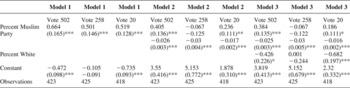
The results of the probit analysis are presented in Table 3, with separate models calculated for each of the votes analyzed. The most important finding is that the percentage of Muslim-Americans in a Congressional district has a positive and significant effect on the probability that the district's representative will vote in keeping with Muslim-American preferences on surveillance and domestic counter-terrorism votes during the 109th Congress. In other words, representatives from districts with relatively more Muslims are more likely to vote for protecting perceived Muslim-American interests and preferences. This result is consistent across various models, and remains robust for two of the three votes even when controlling for a legislator's party. Similarly, the positive effect of the proportion of Muslims in a district remains positive and significant when controlling for district ethnicity. This provides clear evidence of the absence of a backlash phenomenon among representatives whose districts have a Muslim-American population. The results provide some general support for congruence between legislators and Muslim-Americans.
Probit analysis of select security/surveillance votes

Note: Robust standard errors in parentheses. * significant at 10%; ** significant at 5%; *** significant at 1%.
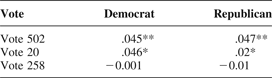
Table 4 provides a more intuitive interpretation of the probit results, reporting the estimated substantive effect of the key variables of interest. Using simulations performed with the CLARIFY software, we simulate the predicted probability of observing a pro-Muslim-American vote (Tomz et al. Reference Tomz, Wittenberg and King2001; King et al. Reference King, Tomz and Wittenberg2000). The baseline probabilities are calculated using the mean value of percentage Muslim. We examined how the probabilities change as the key variable (percentage Muslim) increases by one standard deviation above its means, holding other explanatory variables constant. Using the complete models that control for both party and ethnicity, we estimate the effect of a change in the proportion of constituents that are Muslim on the probability of voting in favor of Muslim-American interests. We estimate simulated probabilities using CLARIFY for both Democrats and Republicans as the variable percentage Muslim is increased by one standard deviation above its mean value.
Simulated probabilities

*Significant at 10%. **Significant at 5%.
For a white Democrat representative, an increase in the percentage of Muslims in a district by one standard deviation over its mean increases the probability of a vote being pro-Muslim by 4.5% on average. For a white Republican, a similar increase in the proportion of constituents who are Muslim results in a 3.5% increase in the probability of voting in congruence with Muslim interests. These conclusions are based on the average of the two statistically significant results. Interestingly, this result is significant for two of the three votes. The presence of Muslim-Americans in a member's district is not a robust predictor of the likelihood of voting yes on the June 2005 vote to limit the impact of the Patriot Act.
CONCLUSION
At the outset, we discussed the possibility of a relationship between how representatives vote in Congress and the composition and preferences of voters in their district. Our specific interest is in exploring how the presence of Muslim-Americans in a district impacted the roll-call behavior of legislators on domestic security votes of special interest to Muslim-Americans. The possibility of two very different relationships remained open, depending on whether legislators exhibited a backlash against Muslim-American constituents or sought to represent Muslim-American interests and preferences.
The analysis of the Muslim-American composition of congressional districts and how members of Congress voted on three legislative proposals of high salience in the Muslim-American community confirms the absence of a representative backlash against Muslim-Americans. Indeed, we find some evidence that having more Muslims in a district makes that representative more sympathetic to Muslim-American preferences, even controlling for other factors such as party and district ethnicity. That Muslim-Americans have been the subject of much public and governmental scrutiny is undeniable. That this negative exposure has not crystallized into a legislative backlash is an interesting and significant conclusion both theoretically and normatively. The absence of a Muslim-American legislative backlash is particularly interesting in light of evidence that other minorities, such as African-Americans or Latinos face unequal, non-linear, representation depending on the size of their constituency.
This difference in representation between religious and non-religions minorities is worthy of further investigation. One explanation for the difference in representation may reflect the high priority given to economic interests in American politics.Footnote 4 Lower-income and less-well-educated white voters may see themselves as competing with Latinos and African-Americans for jobs and thus may feel a greater sense of economic threat from these minorities. In contrast, Muslim-Americans are a well-educated and relatively high-income group and therefore are less likely to be competing with working-class or less-well-educated non-Muslim whites for jobs or economic advantages. Moreover, if the threat that non-Muslim whites may feel from Muslims is not based on economic self-interest, closer association such as living in geographical proximity may work to reduce mistrust and ultimately lead to positive, pro-Muslim perspectives. Understanding further such differences between religions minorities and ethnic minorities may help explain the divergence in representational outcomes experiences by both groups.