Introduction
The Eurasian Bronze Age, spanning over 2000 years from the beginning of the third millennium until well into the first millennium BC, was perhaps the first long period in human history when widespread trade networks created the conditions for expanded transfer of knowledge, building techniques and artistic creativity. One of the major innovations underpinning this development was the use of tin bronze to make tools and weapons. Evidence for the extent of trade in copper and tin across Europe is provided by large amounts of bronze found in areas where there are no local deposits of tin or copper; for example, southern Scandinavia.
Around 1600 BC there was a significant increase in the supply of copper and tin in southern Scandinavia (Vandkilde Reference Vandkilde1996, Reference Vandkilde2014). A recent research project has demonstrated that these metals were not smelted from local ores but brought to Scandinavia mostly from the Mediterranean and the Alps (Ling et al. Reference Ling, Hjärthner-Holdar, Grandin, Billström and Persson2013, Reference Ling, Stos-Gale, Grandin, Billström, Hjärthner-Holdar and Persson2014); however, the compositions of some Scandinavian bronzes dated between 1600 and 1300 BC show clear consistencies with copper from Cyprus, in terms of both lead isotope and trace elements.
At about the same time, another phenomenon appeared in southern Scandinavia: the first phase of figurative rock art (Ling Reference Ling2012). In this paper, we argue that the production of Bronze Age rock art in Scandinavia was a response to changes in metal trade routes and networks. Several scholars have argued that there are non-domestic, cosmopolitan features in rock art with connections to Mediterranean iconography (Thrane Reference Thrane and Bader1990; Kristiansen & Larsson Reference Kristiansen and Larsson2005). New discoveries lead us to propose that a particular image in Scandinavian rock art appears to represent ‘oxhide’-shaped ingots, characteristic of the Bronze Age trade in Cypriot copper. The images also show ships in styles dated to the late second millennium BC. The critical and challenging issue here is the question of the interconnectedness of these two distant regions during the Bronze Age.
Bronze Age copper trade and oxhide ingots
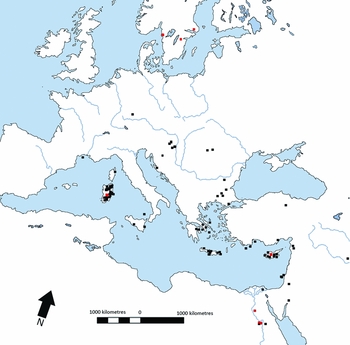
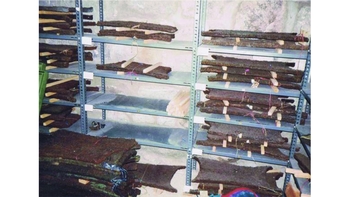
‘Oxhide ingots’ are characteristically Late Bronze Age (LBA) objects that were transported around the Mediterranean from around 1550 to 1100 BC mostly on ships but also overland (Figures 1 & 2). The name for these ingots was coined over 100 years ago by archaeologists who assumed that the shape imitated an ox hide, a pre-metal trading commodity of specified value; this led to the theory that ‘oxhide ingots’ were a form of the earliest currency. Typical oxhide ingots are flat oblong ingots of 99.9 per cent pure copper, between 40 and 100mm thick, with lengths varying from 300 to 600mm and weights varying from 10 to 37kg (Figure 2). Four elongated corners that resemble the legs of an ox give the ingots their name; in practice, the ‘legs’ provide handles for carrying these heavy objects. Amongst the cargo of a ship that sank at Cape Uluburun on the coast of south-western Turkey in the late fourteenth century BC there were also ingots with only two handles (Figure 2) (Pulak Reference Pulak and Yalçin2000, Reference Pulak, Yalçin, Pulak and Slotta2005). Another important feature of these ingots is their surface appearance, which is characteristic of smelted, unrefined and unalloyed copper. Such copper ingots, and their fragments, were found in large numbers in Sardinia, Cyprus, mainland Greece and Crete. Single examples are known from Egypt, Italy, Bulgaria, Turkey and Germany (Figure 1). A very thorough study of oxhide ingots found in the central Mediterranean was published recently, including whole and fragmentary ingots from Cyprus, Sardinia and Sicily (Lo Schiavo et al. Reference Lo Schiavo, Muhly, Maddin and Giumlia-Mair2009). Fragments of oxhide ingots were also identified in a metal workshop of the Cretan Late Minoan I (LMI) period (1600–1450 BC) at the site of Mochlos (Soles & Stos-Gale Reference Soles, Stos-Gale, Soles and Davaras2004) and on the Gelidonya shipwreck, dated to about 1200 BC (Bass Reference Bass1967).
The current known distribution and representations of oxhide ingots. Black squares: findspots of real and miniature oxhide ingots. Red squares: findspots of oxhide ingot images. Images have been reproduced in several different ways, such as on rock panels in Sweden, bronze objects in Sardinia, objects in Cyprus, and in paintings in Egypt. Map from Sabatini in press.

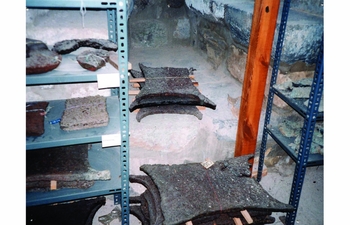
Copper oxhide ingots from the Uluburun shipwreck in the store room of Bodrum Castle in 1995 (photo: Z.A. Stos-Gale). A two-handled oxhide ingot is visible on the second shelf from the top in the centre of the photograph.

The shipwreck at Uluburun, dated to about 1307 BC, contained the largest assemblages of Bronze Age trade goods ever found in the Mediterranean (Pulak Reference Pulak, Yalçin, Pulak and Slotta2005). The cargo included 10 tons of copper ingots and a ton of tin ingots. The tin ingots were also of the ‘oxhide’ shape but smaller than the copper ingots. The shapes of copper ingots varied greatly: 354 were oxhide shaped, but there were also over 30 two-handled ingots and another 130 of various plano-convex shapes (Pulak Reference Pulak and Yalçin2000).
The origin of copper used for casting oxhide ingots
A large research project analysing lead isotope composition of oxhide ingots was undertaken in the Isotrace Laboratory at the University of Oxford between 1980 and 2000 (Stos-Gale et al. Reference Stos-Gale, Maliotis, Gale and Annetts1997; Gale & Stos-Gale Reference Gale, Stos-Gale, Yalçin, Pulak and Slotta2005; Stos Reference Stos, Shortland, Freestone and Rehren2009). Other researchers have also published the elemental and metallurgical characteristics of these ingots (e.g. Kassianidou Reference Kassianidou, Bonfante and Karageorghis2001; Hauptmann et al. Reference Hauptmann, Maddin and Prange2002). The majority of analysed oxhide ingots (close to 600 examples) are consistent with a Cypriot origin (Stos-Gale et al. Reference Stos-Gale, Maliotis, Gale and Annetts1997; Gale & Stos-Gale Reference Gale, Stos-Gale, Yalçin, Pulak and Slotta2005). These results agree with archaeological opinions held before analyses were available. Purification of smelted copper was not practised until the sixteenth to seventeenth century AD; therefore, in the Bronze Age the purity of the extracted metal depended entirely on the type of available ores. In contrast to many European copper ore deposits, the Cypriot copper smelted in the second millennium BC had very low levels of impurities, and was therefore of superior quality. The characteristic oxhide shape may have been a ‘hallmark’ of high-purity Cypriot copper. These ingots are also much larger than the majority of copper ingots produced in the Bronze Age; they therefore represent highly advanced metal-extraction and casting skills.
Lead isotope evidence for the origin of oxhide ingots implies that the overwhelming majority of ingots are fully consistent with the lead isotope compositions of ores from the Apliki and Skouriotissa mines in the Solea valley in the central-north Troodos Mountains, Cyprus (Stos-Gale et al. Reference Stos-Gale, Maliotis, Gale and Annetts1997). However, four oxhide ingots from Uluburun (KW 2700, KW 648, KW 626 and KW 624 in the Oxford Archaeological Lead Isotope Database (OXALID 2014)), two from Sardinia (SI-C and CA-8 in OXALID 2014) and a LMIb fragment from Mochlos in Crete (Soles & Stos-Gale Reference Soles, Stos-Gale, Soles and Davaras2004; CA20/12 in OXALID 2014) are consistent with lead isotope compositions of copper ores from deposits located in the region of Larnaca and the Limassol Forest in southern Troodos (Stos-Gale et al. Reference Stos-Gale, Maliotis, Gale, Rehren, Hauptmann and Muhly1998). This raises the possibility that there were also a small number of oxhide ingots in circulation, perhaps produced earlier than the fourteenth century BC, which were made of copper from other Cypriot deposits. The Apliki, Mavrovouni and Skouriotissa mines in the Solea are the richest and most exploited copper mines in Cyprus; according to the lead isotope evidence so far, their exploitation in the Bronze Age was strongly centred on the production of oxhide ingots. Lead isotope analyses of Bronze Age copper-based metals from the Mediterranean indicate that the huge amount of copper cast into the oxhide ingots consistent with lead isotope ratios of the Apliki mines is not reflected in lead isotope compositions of other Bronze Age copper artefacts analysed so far. It seems that many oxhide ingots, and their fragments, are still found because they might have been, to a certain extent, valued for their own sake.
The oxhide ingots seem to have held a special place in the metal trade in the Bronze Age, but Cypriot copper was also traded in many other shapes, as proven by the variety of ingot shapes on the Uluburun wreck (Pulak Reference Pulak, Yalçin, Pulak and Slotta2005) and by the presence of copper from other Cypriot mines on Bronze Age sites in Cyprus and Greece (Stos-Gale & Gale Reference Stos-Gale, Gale, Knapp and Cherry1994).
Cypriot bronzes in Sweden?
Recently, 70 bronzes from Bronze Age sites in Sweden were analysed for lead isotope and chemical composition (Ling et al. Reference Ling, Stos-Gale, Grandin, Billström, Hjärthner-Holdar and Persson2014). The majority of the artefacts seemed to have the lead isotope and chemical characteristics of copper ores from the western Mediterranean and the Alps. However, one artefact had characteristics consistent with the multi-metallic deposit in Lavrion, Greece (see also Gale et al. Reference Gale, Kayafa, Stos-Gale and Tzachili2008, Reference Gale, Kayafa, Stos-Gale, Giumlia-Mair, Craddock, Hauptmann, Bayley, Cavallini, Garagnani, Gilmour, La Niece, Nicodemi and Rehren2009; Muhly Reference Muhly2011), and five artefacts had lead isotope and chemical compositions consistent with Cypriot copper ores (Ling et al. Reference Ling, Stos-Gale, Grandin, Billström, Hjärthner-Holdar and Persson2014: 123–24). The lead isotope ratios of these five artefacts are so far unique amongst northern European bronzes: no such lead isotope ratios were found amongst 400 artefacts from the British Isles (Rohl & Needham Reference Rohl and Needham1998; OXALID 2014) or Danish and Norwegian bronzes (A.L. Melheim pers. comm.).
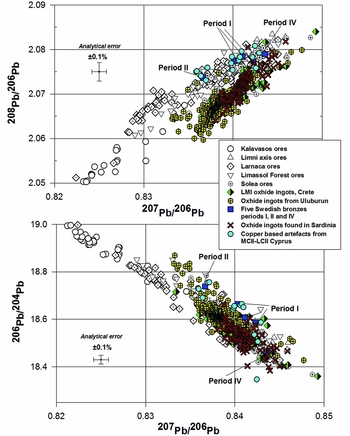
Four axes and one dagger found in Sweden and dated to Scandinavian periods Ib and II (1600–1300 BC) are fully consistent, in terms of lead isotope composition, with ores from deposits in the Limassol Forest and near Larnaca, as are four oxhide ingots from Uluburun and one from Crete. The lead isotope ratios for the samples of Cypriot ores, the five unusual oxhide ingots and the Swedish artefacts mentioned above are plotted in Figure 3. There are no available chemical analyses of the five ingots with an isotopic composition consistent with these Cypriot ores. These ingots are isotopically unusual because, as stated above, the majority of analysed oxhide ingots appear to be made from ores from the Skouriotissa-Apliki region (Hauptmann Reference Hauptmann, Lo Schiavo, Muhly, Maddin and Giumlia-Mair2009; Gale & Stos-Gale Reference Gale, Stos-Gale, Kassianidou and Papasavvas2012). The majority of the copper oxhide ingots analysed for their trace element compositions show impurities below 0.1 per cent. There are a few exceptions from Uluburun with nickel and antimony levels higher than that (Hauptmann et al. Reference Hauptmann, Maddin and Prange2002: tab. 1, 20–22), but these are consistent with ores from Apliki-Mavrovouni mines and have different lead isotope compositions to the Swedish bronzes. In the Limassol Forest there are some copper ores with very high nickel and arsenic content (data in OXALID 2014). We considered carefully the element compositions of the five Swedish artefacts that have lead isotope ratios consistent with Cypriot ores, and compared them with the element data of bronzes found in Cyprus that are also consistent with Cypriot ores; this was discussed in a previous paper (Ling et al. Reference Ling, Stos-Gale, Grandin, Billström, Hjärthner-Holdar and Persson2014). It has been noted that copper oxhide ingots dating to the end of the fourteenth century BC or later typically have uniform element compositions (Stos-Gale et al. Reference Stos-Gale, Maliotis, Gale and Annetts1997: 109). Few Cypriot tin bronzes have undergone comprehensive elemental analysis; however, there are some ‘outliers’ consistent with the lead isotope compositions of Cypriot ores and with antimony and nickel contents above 0.1 per cent (data in OXALID 2014).
Mirror-image plots of the lead isotope data for the Cypriot ores and artefacts compared with the five Swedish bronzes that are consistent with an origin from Cypriot copper. The lead isotope analyses of several hundred oxhide ingots are published on the University of Oxford website OXALID (2014). From these data we selected the LMI ingots from Crete, the ingots from Uluburun and those from Sardinia, as they are chronologically comparable to the suggested depictions of the oxhide ingots in Sweden.

Three of the Nordic artefacts consistent with an origin from Cypriot ores (Ling et al. Reference Ling, Stos-Gale, Grandin, Billström, Hjärthner-Holdar and Persson2014: 123, 124, fig. 13) are dated to the equivalent of the Middle Cypriot III to Late Cypriot I period (MCIII–LCI; 1650–1450 BC); this was not the most prolific period in the trade of Cypriot copper and the only known oxhide ingots dated to this period are from Mochlos, Crete (LMIb; c. 1600–1550 BC). However, there are a number of Cypriot artefacts dated to MCII–LCII that have the same lead isotope compositions as these three Swedish bronzes dated to periods Ib–II. The lead isotope analyses of Cypriot copper-based artefacts indicate that the copper deposits in the Limassol Forest and near Larnaca were exploited from the Early Cypriot Ic period (2000–1900 BC) (Stos-Gale & Gale Reference Stos-Gale, Gale, Knapp and Cherry1994; OXALID 2014). Examples of Cypriot artefacts, contemporary with the Swedish axes, and with identical lead isotope compositions, are listed in Table 1.
Comparison of lead isotope data for the Swedish bronzes and Cypriot copper-based artefacts (data from Ling et al. Reference Ling, Stos-Gale, Grandin, Billström, Hjärthner-Holdar and Persson2014; OXALID 2014).

The fourth artefact consistent isotopically with the ores from Cyprus is a socketed axe from Uppland (UMF 6005, analytical data in Ling et al. Reference Ling, Stos-Gale, Grandin, Billström, Hjärthner-Holdar and Persson2014) dated to Period IV (1100–950 BC). This is fully consistent with lead isotope compositions of ores from the Skouriotissa mines in the Solea and an oxhide ingot from the Mathiati mine in Cyprus (Figure 2). The axe is as low in trace elements as the majority of oxhide ingots.
Identical lead isotope compositions, even combined with the elemental data, are insufficient to guarantee ‘consistency’ with a given ore since a number of European ore deposits, of similar geological age, show at least partly identical lead isotope compositions. For example, single ore samples from the Massif Central, the Black Forest, Tyrol and the British Isles have lead isotope ratios within ±1 normalised Euclidean distance from the ratios measured for these Swedish axes. However, a close scrutiny of these results shows that none of these deposits contains copper ores that have both similar geochemistry to the axes and documented Late Bronze Age copper production. Only in Cyprus are there ores with the same geochemistry and lead isotope compositions as the Swedish axes and documented Bronze Age copper production.
Oxhide ingots in Scandinavian rock art?
The southern Scandinavian sites represent a collection of figurative rock art from the Bronze Age that is one of the largest and most complex in Europe. The inclusion of southern Scandinavia in the Bronze Age European trade network was probably the major catalyst for the emergence there of rock art around 1700–1600 BC (Kristiansen Reference Kristiansen1998) (Figure 4).
Rock art from western Sweden chronologically determined in relation to shoreline dating. Ship images with inward-turned prows dominate during the Early Nordic Bronze Age, about 1700–1100 BC, while outward-turned prows ending in animal heads are characteristic of the Late Nordic Bronze Age, 1100–500 BC, as are symmetrical ship images of the pre-Roman Iron Age, 500–200 BC. No. 1 after Ling Reference Ling2008.

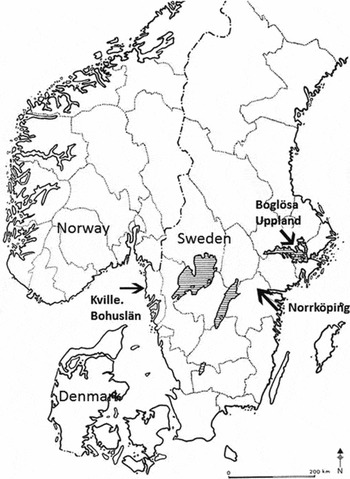
Most Bronze Age rock art is found in the region of Bohuslän, south-west Sweden (Coles Reference Coles2005); other representations are found in the regions of Uppland and Norrköping, in eastern Sweden (Figure 5). In this paper we suggest that some panels from these regions show representations of oxhide ingots. We begin by examining the most convincing images (from western Sweden and Norrköping) and then consider the more tentative ones (from Uppland).
Map of Scandinavia marking the rock art regions discussed in the text.

Bohuslän
In the region of Bohuslän there are figurative representations, including ships; some date to the Early Nordic Bronze Age Period Ib (1600–1500 BC) (Kaul Reference Kaul1998: 85; Ling Reference Ling2008: 101, 105).
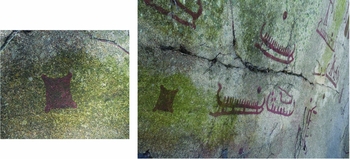
Most interestingly, the same sites that have early representations of ships also have images that look like oxhide ingots. These images have been known for some time but have never been identified as Mediterranean oxhide ingots. The first image recognised as an oxhide ingot was at the famous site of Torsbo, in panel Kville 156:1 (Figure 6). This area is well known for numerous rock panels with representations of ships dating from 1600–1500 BC (Figures 6 & 7).
Rock art image of an oxhide ingot in the panel Kville 156:1 at the site of Torsbo. Left: detail of the oxhide ingot image. Right: the panel showing the ingot image alongside ships (photograph: A. Mederos).

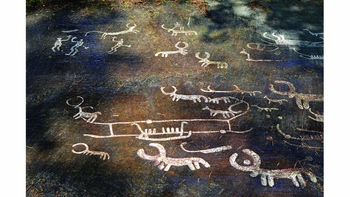
Ships and bulls on the rock depictions from the Kville area in western Sweden (Kville 159). Photograph: Catarina Bertilsson. Source: SHFA.

Another particular feature of these panels is the depiction of large bulls close to the ships (Figure 7). The bull image may have been introduced from southern Europe, as the southern Scandinavian rock art tradition started to flourish at the same time the region became involved in European metal networks, between 1700 and 1500 BC. It is significant that analyses of bronzes suggest that copper from the Mediterranean, where the bull image was an established feature of ritual since the beginning of the Mesolithic–Neolithic transition (Warren Reference Warren1989; Hodder Reference Hodder2012: 60, 133–34), reached southern Scandinavia between 1600 and 1500 BC (Ling et al. Reference Ling, Stos-Gale, Grandin, Billström, Hjärthner-Holdar and Persson2014).The panel Kville 156:1 measures c. 5m × 3m and includes 20 ships and other images (Figure 6). This panel is most often cited because of two representations of large, slender ships from Period Ib, located in the lower right part of the panel (Kaul Reference Kaul1998: 73). The feature that seems to represent an oxhide ingot is located in the lower middle part of the panel and at first glance appears to be simply a small rectangle; each side is about 100mm in length. However, closer examination shows that all four sides are concave, forming a shape typical of oxhide ingots (Figure 6).
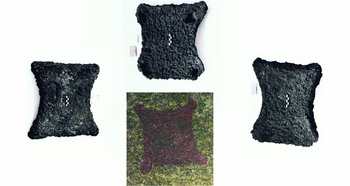
This particular shape of oxhide ingot is characteristic of the LMI copper ingots excavated in Crete at the palace of Hagia Triada and Tylissos (Gale Reference Gale and Gale1991: 202: pl. 2a–c) and Mochlos (Jeff Soles pers. comm.). Buchholz (Reference Buchholz1959) referred to them as ‘Type I’, and they are sometimes called ‘Kissenbaren’ or ‘pillow ingots’. Ingots of this shape have been excavated from the sea at Cape Kyme, on the south-east coast of the island of Evvoia, and were also amongst the cargo of the Uluburun shipwreck (Figures 8 & 9). Another remarkably similar depiction of a copper ingot of this shape exists on the Tomb of Rehmire in Egypt, dated to the Eighteenth Dynasty (c. 1504–1425 BC) (Wachsmann Reference Wachsmann1987: pls. XLII A & B, XLIII A). It is remarkable that the typological chronology of the images of ships and the shapes of potential oxhide ingots in images correspond so well.
Top centre, left and right: oxhide ingots from Crete dated to 1600–1400 BC (photographs: Z.A. Stos-Gale); bottom centre: possible representation of an oxhide on the panel Kville 156:1, Sweden (photograph: A. Mederos).

Copper oxhide ingots excavated by George Bass and Cemal Pulak at Cape Uluburun, off the coast of south-west Turkey, in the French Tower in Bodrum Castle in 1995 (photograph: Z.A. Stos-Gale).

Norrköping
Norrköping, located in eastern Sweden (Figure 5), is famous for its many Bronze Age remains, including house structures and heaps of fire-cracked stones (Fredell Reference Fredell2003: 81–85). The region also has remarkable rock art images, depicting weapons (swords and axes), ships and other objects. Most of them are dated to between 1600 and 1100 BC (Fredell Reference Fredell2003: 97–120) and are close to the river Motala Ström.
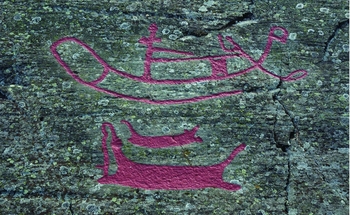
One of the largest sites, Östra Eneby 1:1, measures 175m × 85m and has 57 panels of figurative rock art located on a large outcrop situated close to the Motala Ström. Most panels have representations of ships and weapons that can be dated to between 1500 and 1300 BC. The panel showing a possible oxhide ingot is located on the eastern part of the rock and includes depictions of two ships that can be dated to between 1500 and 1300 BC (Ling Reference Ling2013: 85). The larger ship measures 520mm × 220mm; inside it are two warriors and an object that closely resembles an oxhide ingot (Figure 10). The ingot depicted here, with two relatively straight sides, can be dated to the same period as the ship. The presence of an object resembling an oxhide ingot on this ship is thought-provoking. This area being thought of as an important meeting place during the Bronze Age makes the case even more intriguing (Fredell Reference Fredell2003: 221). In fact, many of the rock art regions in southern Scandinavia could have served as important maritime meeting grounds where the metal was traded and then distributed to more remote inland areas (Figure 5).
Depiction of a possible oxhide ingot onboard a ship dated to 1400–1300 BC, from a rock panel in Norrköping, Sweden (photograph: Catarina Bertilsson).

Uppland
There are another two rock art panels in eastern Sweden that have possible representations of oxhide ingots, located about 200km north-west of Norrköping in the region of Uppland. However, it must be stressed that these images are not as obvious as those described above and should therefore be regarded as hypothetical, especially the latter, Rickeby 138:1. One of Uppland's most elaborate figurative panels, Boglösa 131:1, is located in the Hemsta area. The site includes depictions of 220 ships, 22 humans, 67 animals, 7 foot soles, 2 circle figures and a large image (500mm × 300mm) that could be seen as an oxhide ingot. Most of the ships on this panel seem to have been produced between 1500 and 1300 BC. However, the possible representation of an unfinished oxhide ingot overlies a ship dated to between 1500 and 1300 BC (Figure 11; see also Figure 9), so it could be a later image. In fact, there are many ‘unfinished’ Bronze Age rock art images in southern Scandinavia (Ling Reference Ling2008, Reference Ling2012). The shape of this possible oxhide ingot resembles whole copper oxhide ingots found on the Uluburun shipwreck (Pulak Reference Pulak, Yalçin, Pulak and Slotta2005) and shown in Figures 9 and 11. An even better match for the shape of the ingot in this image is a fragmented ingot with two straight handles found in the Mathiati mine in Cyprus (Kassianidou Reference Kassianidou, Lo Schiavo, Muhly, Maddin and Giumlia-Mair2009: fig. 20).
Comparison of oxhide ingot from Uluburun (left) and possible oxhide ingot depiction on the panel Boglösa 131:1 in Uppland, Sweden (photographs: Z.A. Stos-Gale and E. Kjellén).

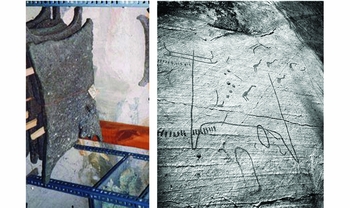
Our final example is a more ‘spectacular’ re-interpretation of an image that might be seen as a possible oxhide ingot, from Boglösa 138:1 in Uppland (Figure 12). The site has around 100 figurative images. One of these is a large chiselled image interpreted as either a cloak or a chair (Kjellén & Hyenstrand Reference Kjellén and Hyenstrand1977; Coles Reference Coles and Gräslund2000: 72). Our alternative interpretation is that it might represent an unfinished image of an oxhide ingot or perhaps half an oxhide ingot. An example of half an ingot was discovered among a number of whole oxhide ingots in the storeroom of the LMI palace of Hagia Triada, Crete (Cucuzza et al. Reference Cucuzza, Gale and Stos-Gale2004). Some of the tin oxhide ingots found on the Uluburun wreck were also halved (Yalçin et al. Reference Yalçin, Pulak and Slotta2005: 572, no. 48), so it is even possible to interpolate that the images might have been not only of copper, but also of tin ingots.
Top left: half an ingot from Hagia Triada; top right: halved tin ingots from Uluburun (photograph: Z.A. Stos-Gale); bottom: a possible half ingot depicted on the rock panel Boglösa 138:1, Uppland, Sweden (photograph: J. Ling, documentation by S. Broström).

The image of the possible oxhide ingot overcuts images of ships dated to between 1600 and 1500 BC (Ling Reference Ling2013: 36–38) and was therefore probably added later (Figure 12). The potential ‘oxhide’ is about 1.68m × 1.50m. This is much larger than the real oxhide ingots, but most figurative rock art images do not represent objects at actual size; this is especially true of ships and humans (Coles Reference Coles2005). Moreover, the current interpretation of this image as a cloak is not convincing (Almgren Reference Almgren1960).
The identification of oxhide ingot representations in the Bronze Age rock art of southern Scandinavia implies that the people in this part of the world at that time must have seen these objects. The proposed findings become even more compelling when we consider the significance of their depiction with maritime images, in environments that favoured maritime activity in the Bronze Age, when the trade in copper and tin oxhide ingots was mostly by sea.
Discussion and conclusions
The archaeological and scientific evidence indicates that metals were traded between southern Scandinavia and the eastern Mediterranean in the Bronze Age, but is there evidence for other trade, travel or interactions between these distant regions at that time?
One of the major reasons for southern Scandinavia's thriving economy during the Bronze Age was the natural occurrence of amber in this region (Kristiansen & Larsson Reference Kristiansen and Larsson2005). Amber is abundant in Neolithic graves in southern Scandinavia but very rare in Bronze Age grave goods. At the same time, amber became a common feature in prestige contexts in Europe, including the eastern Mediterranean (Harding & Hughes-Brock et al. Reference Harding and Hughes-Brock1974; Beck & Shennan Reference Beck and Shennan1991; Czebreszuk Reference Czebreszuk, Bergerbrant and Sabatini2013; Kaul Reference Kaul2013). The most compelling evidence that amber was being traded for metal is Baltic amber found in the same regions as the copper deposits that were exploited in the Bronze Age (Ling et al. Reference Ling, Stos-Gale, Grandin, Billström, Hjärthner-Holdar and Persson2014). Moreover, these are the deposits characterised by lead isotope ratios consistent with southern Scandinavian bronzes (Ling et al. Reference Ling, Stos-Gale, Grandin, Billström, Hjärthner-Holdar and Persson2014).
It is worth noting that Harding and Hughes-Brock (Reference Harding and Hughes-Brock1974; see also Harding Reference Harding1984, Reference Harding and Bader1990), argued for three main episodes for the influx of amber to the Aegean world in 1600, 1500 and 1200 BC (see also Czebreszuk Reference Czebreszuk, Bergerbrant and Sabatini2013). This is consistent with the dating of southern Scandinavian bronze artefacts that have compositions matching copper ores from the eastern Mediterranean and indicates that amber was an important trade commodity between these regions (Kaul Reference Kaul2013). It therefore seems quite possible that the creators of the southern Scandinavian rock art included images known to them from trade interactions.
There is little doubt that Cypriot oxhide ingots and tripods, as well as Mycenaean pottery, reached the western Mediterranean in the LBA. There may also have been a northern trade route covering a similar distance. The representations of ships on rocks in Sweden show that Scandinavian peoples could have encountered oxhide ingots on their journeys through Europe. It could be that some of the trader-travellers crossed Europe and came back with these curious, large and valuable objects. The value of one such ingot can be expressed by the fact that, with an appropriate amount of tin (which also was traded in the eastern Mediterranean in oxhide form), one could make at least 10 to 15 high-quality swords.
The Cypriot copper does not seem to have been brought to northern Europe in large quantities but trickled along the Bronze Age trade routes. One possibility is the sea route from Cyprus to the mouth of the Danube on the Bulgarian coast, then via river transport to the shores of the Baltic in northern Germany or Poland, and finally over the Baltic to Sweden (cf. Kristiansen Reference Kristiansen1998; Kaul Reference Kaul2013; Ling et al. Reference Ling, Stos-Gale, Grandin, Billström, Hjärthner-Holdar and Persson2014). This connection is seen in the southern Scandinavian metalwork of about 1600 BC showing strong influences from the Carpathian Basin in terms of form and decoration (Vandkilde Reference Vandkilde1996: 224, Reference Vandkilde2007, Reference Vandkilde2014; Kristiansen Reference Kristiansen1998: 360). Another possibility is the western maritime Atlantic trade route along the coast of southern France reaching the Iberian Peninsula. This route could also have included Sardinia and Italy, where Cypriot oxhide ingots were certainly brought in the LBA (Stos-Gale & Gale Reference Stos-Gale, Gale, Tykot and Andrews1992; Hauptmann Reference Hauptmann, Lo Schiavo, Muhly, Maddin and Giumlia-Mair2009). From there another route could have been northwards, through France (perhaps using the Rhone and Garonne) to Brittany, the British Isles and Scandinavia, or via the Atlantic communities (Cunliffe Reference Cunliffe2008: 237, fig. 7.22; Czebreszuk Reference Czebreszuk, Bergerbrant and Sabatini2013). The western maritime route might have been established in the Neolithic by ‘Beaker’ groups. The British Isles would have had a very strategic position in this western European north–south network, and tin from Cornwall and Devon might have been included in this trade (Harding Reference Harding and Bader1990; Eogean Reference Eogean, Waddell and Shee Twohig1995; Czebreszuk Reference Czebreszuk, Bergerbrant and Sabatini2013).
It seems that rock art in southern Scandinavia might represent images from journeys undertaken while trading amber for copper and tin. So far, no oxhide ingots from Cyprus have been found in northern Europe, so the possible presence of the images of oxhide ingots in Sweden might indicate that Scandinavian peoples were travelling to the Mediterranean, rather than acting through a middle-man (Kaul Reference Kaul2013). We could, perhaps, consider the maritime-themed rock art depictions as records of travellers’ tales, where representations of reality mingle with myths, magic and sailors' stories.
Acknowledgements
Our thanks to Dr Serena Sabatini, organiser of the multidisciplinary conference in April 2013 when the ingot shapes were discovered. Also to Prof. Shelley Wachsmann and Prof. Kristian Kristiansen for most helpful comments at this conference and for encouragement to publish this idea. Thanks also to Prof. Cemal Pulak for useful remarks on earlier drafts of this paper. When writing this paper we learned that the resemblance of the Kville 156:1 image to oxhide ingots was noticed by Lasse Bengtsson some 20 years ago, but not published. This research was funded by the Swedish Research Council.