


Introduction
Child sexual abuse (CSA) is a major global public health concern. Recent UNICEF estimates indicate that approximately one in five girls and one in seven boys worldwide experience some form of sexual violence during childhood (UNICEF 2023). These headline figures are supported by a large global analysis published in The Lancet, which found that 18.9% of females and 14.8% of males experienced sexual violence before the age of 18 (Cagney et al. Reference Cagney, Spencer, Flor, Herbert, Khalil, OConnell, Mullany, Bustreo, Singh Chandan, Metheny, Knaul and Gakidou2025). Earlier meta-analyses using community and student samples reported somewhat wider sex differences, with prevalence estimates of approximately 20–24% among females and 7–8% among males (Pan et al. Reference Pan, Lin, Liu, Zhang, Zeng, Chen and Wu2021; Pereda et al. Reference Pereda, Guilera, Forns and Gómez-Benito2009). Although estimates vary according to definitions, study populations and methodology, the evidence consistently demonstrates that CSA is common across cultural and geographical settings.
CSA is strongly associated with a wide range of adverse mental health outcomes across the lifespan. An umbrella review of 559 studies found that CSA was associated with the majority of examined health outcomes, including significantly increased risks of depression, anxiety disorders, post-traumatic stress disorder (PTSD) and borderline personality disorder (Hailes et al. Reference Hailes, Yu, Danese and Fazel2019). A large systematic review and meta-analysis involving over three million participants similarly reported elevated lifetime risks of anxiety, depression, eating disorders, PTSD and suicide attempts among individuals exposed to CSA (Chen et al. Reference Chen, Murad, Paras, Colbenson, Sattler, Goranson, Elamin, Seime, Shinozaki, Prokop and Zirakzadeh2010). The association with suicidal behaviour has been replicated in subsequent meta-analyses demonstrating significantly increased odds of suicide attempts among individuals with histories of CSA (Ng et al. Reference Ng, Yong, Ho, Lim and Yeo2018). Longitudinal and registry-based studies further demonstrate increased utilisation of mental health services among individuals exposed to CSA, including higher rates of psychiatric treatment and a significantly increased likelihood of contact with mental health services (Cutajar et al. Reference Cutajar, Mullen, Ogloff, Thomas, Wells and Spataro2010; Spataro et al. Reference Spataro, Mullen, Burgess, Wells and Moss2004). Taken together, these findings underscore the importance of incorporating psychiatric assessment within multidisciplinary responses to CSA.
Within Ireland, available data similarly indicate that CSA is common. The Irish Sexual Violence Survey reported that 29% of adults experienced sexual violence before the age of 17 (36% of females and 22% of males), with even higher rates among 18–24-year-olds (41%), emphasising the scale of the problem among more recent cohorts (Central Statistics Office 2023). Earlier national survey data also reported CSA involving physical contact in 20% of women and 16% of men in a representative adult sample (McGee et al. Reference McGee, Garavan, Byrne, OHiggins and Conroy2011). Clinical and forensic data further highlight the severity and complexity of cases presenting to specialist services. In a study of children undergoing forensic medical examinations in Ireland between 2018 and 2022, substantial proportions reported penetrative abuse, reflecting the high levels of trauma among children referred for specialist assessment (Bergin et al. Reference Bergin, Alzaabi, Barrett, Roe, Walsh, Geoghegan and Harty2025). While such clinical samples do not represent population prevalence, they illustrate the need for coordinated, trauma-informed specialist services capable of addressing the complex medical, psychological and social needs of children and families affected by CSA.
Given these complex medical, psychological and safeguarding needs, integrated multidisciplinary services are increasingly recommended internationally. Models such as Child Advocacy Centres in the United States and specialist trauma services aim to bring together medical assessment, forensic processes, child protection and mental health support in order to reduce fragmentation and improve outcomes for children and families. Clinical guidelines for the evaluation of suspected CSA emphasise the importance of including psychiatric or broader mental health assessment within comprehensive evaluations to identify emotional and behavioural sequelae, inform safeguarding processes and guide appropriate treatment and follow-up (Adams et al. Reference Adams, Kaplan, Starling, Mehta, Finkel, Botash, Kellogg and Shapiro2007; Jenny and Crawford-Jakubiak Reference Jenny and Crawford-Jakubiak2013; Kellogg Reference Kellogg2005).
In Europe, the Barnahus (‘Children’s House’) model has become the leading child-friendly, multidisciplinary and interagency response for child victims and witnesses of violence, including CSA. Originally developed in Iceland, Barnahus brings together child protection, criminal investigation, forensic interviewing, medical and therapeutic services within a single child-friendly setting, with the aim of preventing re-victimisation and ensuring coordinated case management and effective judicial proceedings (Council of the Baltic Sea States Secretariat 2017). Ireland has progressively adopted the Barnahus model, with the first pilot implemented in the west of the country in 2019 and becoming operational in 2022, followed by the launch of Barnahus South in 2022. Barnahus East, serving the Dublin region, is due to become operational in 2026, reflecting a national commitment to implementing integrated, child-centred responses to CSA. Within these models, access to specialist child and adolescent psychiatry is crucial for responding to acute risk, complex comorbidity and psychotropic prescribing decisions.
Emerging evidence suggests that integrated paediatric mental health models can improve access to specialist psychiatric assessment and treatment engagement. Collaborative child psychiatry programmes embedded within paediatric services have been associated with markedly higher service utilisation, including fourfold higher odds of completing psychiatric evaluations and sevenfold higher odds of engaging in follow-up care compared with usual referral pathway (Grimes et al. Reference Grimes, Creedon, Webster, Coffey, Hagan and Chow2018). These findings highlight the potential benefits of embedding psychiatric expertise within multidisciplinary services working with vulnerable children, including those affected by CSA, and are directly relevant to jurisdictions implementing Barnahus-inspired models. However, there is limited evidence describing such models specifically within CSA-focused services.
In Ireland, specialist therapeutic services have been developed to respond to the complex needs of children affected by sexual abuse. ‘‘The Alders Unit’ is a specialist CSA service providing assessment and trauma-informed therapeutic interventions for children and families across two hospital-based sites in North and South Dublin (Children’s Health Ireland (CHI) at Connolly and Tallaght), serving a regional catchment including Dublin, Kildare, Wicklow, Louth, Meath, Cavan and Monaghan. Care is delivered through a multidisciplinary model incorporating psychology, social work and psychotherapy, with interventions including assessment, individual therapy, family work, parent support and group programmes, alongside consultation and training to external professionals and contributions to research and policy development.
‘‘The Alders Unit’ represents one of the largest specialist CSA therapeutic services in Ireland, reflecting substantial demand for trauma-informed care in this population. Service data for 2024 indicate that the unit received more than 545 referrals, representing a 37% increase compared with 2023, and delivered over 6,000 clinical sessions; approximately 80% of children attending the service were female (Children’s Health Ireland: The Alders Unit 2025). In addition to direct therapeutic work, the service maintains strong inter-agency links with health, child protection and justice services to support coordinated responses to children and families affected by CSA. Child and adolescent psychiatry was formally embedded within the multidisciplinary team in September 2023, with psychiatry input provided one day per week at each site. This model provides specialist assessment and management of psychiatric presentations arising in the context of CSA and complex psychosocial adversity.
Despite the recognised importance of psychiatric assessment within multidisciplinary responses to CSA, the nature and extent of psychiatric involvement within specialist CSA services remains poorly described. Existing research has largely focused on the prevalence of CSA, associated mental health outcomes and barriers to treatment engagement, with far less attention to how child and adolescent psychiatry is integrated into multidisciplinary CSA services or Barnahus-type models. Published evidence describing psychiatric provision within specialist CSA therapeutic services in Ireland remains extremely limited, and there are no published data on psychiatric activity within Barnahus-aligned services.
This gap is particularly relevant in the current Irish policy context. Ireland is in the process of implementing the Barnahus model nationally, with integrated, child-centred responses to CSA being developed across physical and mental healthcare, child protection, therapeutic and law enforcement services. Within this evolving landscape, ‘The Alders Unit’ represents a key specialist CSA service in the east of the country, and child and adolescent psychiatry was formally embedded within its multidisciplinary team in September 2023 on a limited basis (one day per week per site). Systematic information on which children are referred to psychiatry, the psychiatric conditions identified, the interventions provided and subsequent care pathways is essential to inform service planning, workforce development and the design of psychiatry input within Barnahus-aligned models of care.
Against this background, the present study has two main aims. First, to describe referrals to the embedded child and adolescent psychiatry clinic within the Alders Unit across its two sites, including the demographic and clinical profile of referred children, reasons for referral, diagnoses and formulations, interventions delivered and subsequent service utilisation and care pathways. Second, to provide the first empirical description of psychiatric provision within a specialist CSA service in Ireland in order to generate baseline evidence to inform the development of integrated, trauma-informed models of care, including emerging Barnahus services.
Methods
Study design and setting
This study was a retrospective chart review of all children and adolescents referred to child and adolescent psychiatry within ‘The Alders Unit’, a specialist CSA service operating across two sites in Dublin (CHI at Connolly and Tallaght). The embedded child and adolescent psychiatry service was formally established in September 2023. The study period extended from 1 January 2024 to 31 December 2025, approximately four months after the introduction of the psychiatry service, by which time the service model and referral pathways were operating routinely. All consecutive, unique children and adolescents referred to the embedded child and adolescent psychiatry service during the study period were eligible for inclusion. Repeat referrals for the same individual were not included. Data were extracted from routine clinical records and entered into a structured anonymised database for analysis.
Data sources and data handling
Data were obtained from routine clinical documentation held within ‘The Alders Unit’ and child and adolescent psychiatry records. No personal identifiers (e.g. names, addresses, dates of birth, or medical record numbers) were collected. Each case was assigned a unique study identification number, and the de-identified dataset was stored on secure CHI servers accessible only to members of the research team. Analyses were conducted on aggregate data only.
Variables and data collection
Data were extracted using a structured pro-forma developed for this study. Variables included
-
• Demographics: age at referral to psychiatry, gender.
-
• Referral details: date of referral to ‘The Alders Unit’, therapeutic interventions received prior to psychiatry referral, source of referral (e.g. psychology, psychotherapy, social work), date of referral to psychiatry, date of first psychiatry assessment, and reason(s) for referral.
-
• Psychiatric diagnoses and formulations: primary and comorbid psychiatric diagnoses, presence of neurodevelopmental disorders (e.g. Attention Deficit Hyperactivity Disorder (ADHD), autism spectrum disorder (ASD), intellectual disability), and use of standardised rating scales where applicable (e.g. Conners).
-
• Interventions: psychotropic medications (class and agent), and other psychiatric interventions (e.g. psychoeducation, safety planning, liaison with schools or external services).
-
• Service utilisation and care pathways: number of psychiatry follow-up appointments, prior CAMHS involvement, referrals made by psychiatry to other services (e.g. CAMHS/Adult Mental Health Service (AMHS), Child Disability Network Team, paediatrics), and discharge outcomes. Duration of psychiatric involvement was recorded as a marker of service utilisation and categorised into less than 12 months, 12–24 months, and greater than 24 months of follow-up within the integrated psychiatry clinic.
-
• Contextual and clinical information: relevant medical history, school placement, substance use, and psychosocial stressors (e.g. family adversity, child protection involvement).
Derived variables and coding
Several variables were further categorised to support analysis. Psychosocial stressors were grouped into predefined domains (family relational difficulties, family mental illness or addiction, peer difficulties, socioeconomic stressors, non-sexual intra-familial abuse/neglect, and major life events). Domains were derived deductively using clinically relevant domains informed by existing literature on childhood adversity, psychosocial stressors and developmental psychopathology (Anda et al. Reference Anda, Butchart, Felitti and Brown2010; Felitti et al. Reference Felitti, Anda, Nordenberg, Williamson, Spitz, Edwards, Koss and Marks1998; McLaughlin et al. Reference McLaughlin, Greif Green, Gruber, Sampson, Zaslavsky and Kessler2012). Domains were refined iteratively during data extraction to ensure they adequately captured the patterns observed within the dataset. A cumulative adversity variable was created by summing adversity domains and categorising cases into one or fewer versus two or more adversities. This approach was informed by cumulative risk models suggesting that the accumulation of psychosocial adversities may present greater risk for adverse mental health outcomes than individual stressors alone (da Silva et al. Reference da Silva, Vilete, Coutinho, Luz, Mendlowicz, Portela, Figueira, Ventura, Mari, Quintana, Ribeiro, Andreoli and Berger2024; Evans and Cassells Reference Evans and Cassells2014; O’Hare et al. Reference O’Hare, Watkeys, Whitten, Dean, Laurens, Harris, Carr and Green2023). Dichotomisation was undertaken to facilitate clinically meaningful interpretation and support analysis within a relatively small retrospective sample.
Reasons for referral were coded into mutually exclusive categories based on the primary documented concern (acute risk, neurodevelopmental concerns, anxiety-related presentations, mood difficulties, perceptual disturbances/possible psychosis, behavioural or emotional dysregulation, sleep difficulties, and eating-related concerns). Primary psychiatric diagnoses were grouped into depressive disorders, anxiety disorders, trauma-related disorders (PTSD/complex PTSD), neurodevelopmental disorders, emerging emotionally unstable personality disorder traits, and no primary Axis I diagnosis. A separate variable captured any query or confirmed neurodevelopmental disorder. Service-use variables were coded to include prior CAMHS involvement (yes/no), psychotropic prescribing (yes/no and by class), and onward referral to CAMHS/AMHS or inpatient/day hospital services.
Ethical considerations
The study was reviewed and approved by the CHI Research Ethics Committee (REC-607-25) and through Tusla’s research governance process as a practitioner-led study using routinely collected clinical data. All data were anonymised prior to analysis and no attempt was made to re-contact participants. The study was conducted as a service evaluation and quality improvement initiative in accordance with CHI and Tusla policies and adhered to the principles outlined in the Declaration of Helsinki. As this was a retrospective review of anonymised routinely collected clinical data, individual informed consent was not required/was waived by the Research Ethics Committee.
Reporting framework
The study is reported in accordance with the Strengthening the Reporting of Observational Studies in Epidemiology guidelines for observational research (von Elm et al. Reference von Elm, Altman, Egger, Pocock, Gøtzsche and Vandenbroucke2014). Consideration was also given to the REporting of studies Conducted using Observational Routinely collected health Data recommendations, particularly in relation to the description of data sources, coding procedures, and data handling (Benchimol et al. Reference Benchimol, Smeeth, Guttmann, Harron, Moher, Petersen, Sørensen, von Elm and Langan2015).
Statistical analysis
Data were analysed using IBM SPSS Statistics (Version 29.0). Descriptive statistics were used to summarise demographic characteristics, referral patterns, psychiatric diagnoses, interventions, and service utilisation. Associations between categorical variables were examined using chi-square tests or Fisher’s exact tests where expected cell counts were small. A two-tailed significance level of p < 0.05 was applied. To protect participant confidentiality, categories containing three or fewer individuals were reported as ≤3 where appropriate.
Results
Demographics and CSA context of service users referred to psychiatry
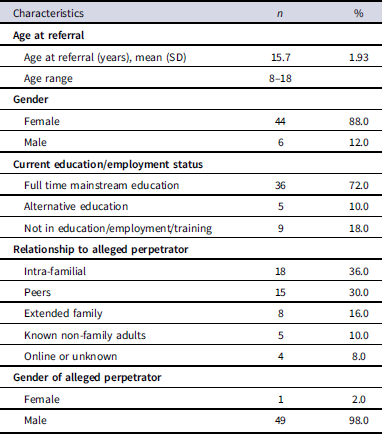
A total of 50 children and adolescents were included in the analysis (Table 1). This accounts for approximately 5% of all referrals to the Alders Unit over the two-year study period, based on annual service activity reports (Children’s Health Ireland: The Alders Unit 2025).
Demographics and CSA context of service users referred to psychiatry

Table 1. Long description
A table with 7 rows and 3 columns. The columns are labeled Characteristics, n, and %. The table provides detailed demographic information about service users referred to psychiatry. Row 1: Age at referral, Age at referral (years), mean (SD), 15.7, 1.93. Row 2: Age range, 8-18. Row 3: Gender, Female, 44, 88.0. Row 4: Gender, Male, 6, 12.0. Row 5: Current education/employment status, Full time mainstream education, 36, 72.0. Row 6: Current education/employment status, Alternative education, 5, 10.0. Row 7: Current education/employment status, Not in education/employment/training, 9, 18.0. Row 8: Relationship to alleged perpetrator, Intra-familial, 18, 36.0. Row 9: Relationship to alleged perpetrator, Peers, 15, 30.0. Row 10: Relationship to alleged perpetrator, Extended family, 8, 16.0. Row 11: Relationship to alleged perpetrator, Known non-family adults, 5, 10.0. Row 12: Relationship to alleged perpetrator, Online or unknown, 4, 8.0. Row 13: Gender of alleged perpetrator, Female, 1, 2.0. Row 14: Gender of alleged perpetrator, Male, 49, 98.0.
The mean age at referral to child and adolescent psychiatry was 15.7 years (SD = 1.93, range 8–18 years). Most were female and in full-time education, with a smaller proportion not in education, employment or training or attending alternative education settings. Intra-familial and peer perpetrators were most frequently identified, and alleged perpetrators were overwhelmingly male.
Psychosocial adversity and pre-existing interventions
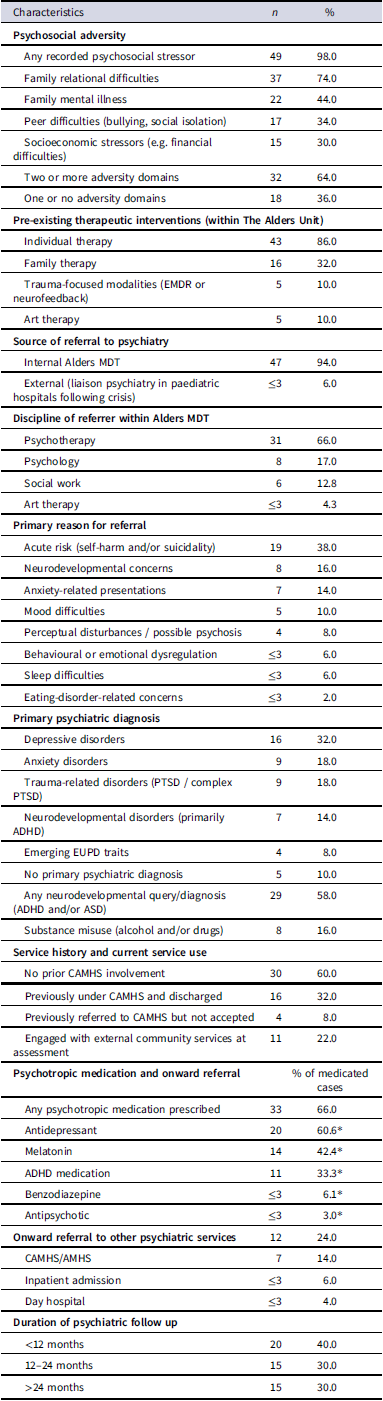
Psychosocial adversity and pre-existing interventions are summarised in Table 2. There was a high burden of psychosocial adversity. Almost all young people had at least one documented psychosocial stressor. Family relational difficulties were the most prevalent stressor (n = 37, 74.0%), followed by family mental illness (n = 22, 44.0%). Peer difficulties, including bullying and social isolation, were identified in 34.0% of cases (n = 17), while socioeconomic stressors, primarily financial difficulties, were present in 30.0% (n = 15). Histories of non-sexual intra-familial abuse and neglect requiring child protection involvement were also documented, alongside major life events such as serious illness or bereavement. When psychosocial adversity was examined across domains, 64.0% of young people (n = 32) experienced two or more adversities, while 36.0% (n = 18) had one or no identified stressors.
Psychosocial adversity, clinical profile and service use among young people referred to the embedded psychiatry clinic (n = 50)

Table 2. Long description
A table with 18 rows and 3 columns. The columns are labeled Characteristics, n, and %. The table summarizes various characteristics of young people referred to a psychiatry clinic, including psychosocial adversity, pre-existing therapeutic interventions, source of referral, discipline of referrer, primary reason for referral, primary psychiatric diagnosis, service history, psychotropic medication use, onward referral, and duration of psychiatric follow-up. Each row lists a specific characteristic, the number of cases (n), and the percentage (%). Notable characteristics include high levels of psychosocial adversity, with 98.0% experiencing at least one psychosocial stressor, and 64.0% experiencing two or more adversities. Family relational difficulties are the most prevalent stressor (74.0%), followed by family mental illness (44.0%). The table also details the types of pre-existing therapeutic interventions, sources of referral, and primary reasons for referral, among other clinical and service use data.
* Percentages calculated among cases prescribed psychotropic medication (n = 33).
† Categories containing three or fewer individuals are reported as ≤ 3 to minimise the risk of participant re-identification.
Most children and adolescents were receiving individual therapy (n = 43, 86.0%). Family therapy was provided in 32.0% of cases (n = 16). A smaller proportion received specific trauma-focused interventions such as Eye Movement Desensitisation and Reprocessing (EMDR) or neurofeedback (n = 5, 10.0%), and art therapy was utilised in 10.0% of cases (n = 5).
Referral patterns and presenting concerns
Referral patterns and presenting concerns are summarised in Table 2. Most referrals to psychiatry were generated internally by the Alders Unit multidisciplinary team (n = 47, 94.0%). A minority of referrals were external (≤3 cases), all originating from Paediatric Liaison Psychiatry services in acute hospital settings following crisis presentations. Within The Alders Unit multidisciplinary team, most referrals to psychiatry were made by psychotherapy disciplines (n = 31, 66.0%), followed by psychology (n = 8, 17.0%) and social work (n = 6, 12.8%). Art therapy accounted for a small proportion of referrals (≤3 cases). Acute risk, including self-harm and suicidality, was the most common reason for referral to psychiatry (n = 19, 38.0%). Neurodevelopmental concerns (n = 8, 16.0%) and anxiety-related presentations (n = 7, 14.0%) were also frequent, followed by mood difficulties (n = 5, 10.0%). Perceptual disturbances or possible psychotic symptoms were present in 8.0% of cases (n = 4). Behavioural and emotional dysregulation, sleep difficulties and eating disorder concerns were each identified in ≤3 cases.
Psychiatric diagnoses, treatment and service utilisation
Psychiatric diagnoses, treatment and service utilisation are summarised in Table 2. Depressive disorders were the most common primary psychiatric diagnosis (n = 16, 32.0%). Anxiety disorders and trauma-related disorders, including PTSD and complex PTSD, were equally represented (n = 9, 18.0% each). Neurodevelopmental disorders, primarily ADHD, accounted for 14.0% of cases (n = 7), while emerging emotionally unstable personality disorder traits were identified in 8.0% (n = 4). No primary psychiatric diagnosis was identified in 10.0% of cases (n = 5). A substantial proportion of children and adolescents had a query or confirmed neurodevelopmental disorder, including ADHD and ASD (n = 29, 58.0%). Substance misuse, including alcohol and/or drug use, was identified in 16.0% of cases (n = 8), most commonly involving alcohol and cannabis, with isolated cases involving cocaine and synthetic cannabinoids.
Most children and adolescents had no prior involvement with CAMHS (n = 30, 60.0%). A further 32.0% (n = 16) had previously been under CAMHS and were discharged, while a small proportion had been referred but not accepted (n = 4, 8.0%). A minority of children and adolescents were engaged with external community services at the time of psychiatric assessment (n = 11, 22.0%), including youth services, addiction services, non-governmental organisations, primary care psychology, and homeless services.
New psychotropic medication was initiated by the embedded child and adolescent psychiatry service in 66.0% of cases (n = 33). Among those commenced on medication, antidepressants were most commonly used (n = 20, 60.6%), followed by melatonin (n = 14, 42.4%) and ADHD medications (n = 11, 33.3%). Benzodiazepines and antipsychotics were each prescribed in ≤3 cases. Among those prescribed medication (n = 33), most were receiving monotherapy (n = 22, 66.7%), with 30.3% (n = 10) prescribed two medications and ≤3 cases involving three medications. Among cases involving more than one medication (n = 11), melatonin was included as an adjunctive agent in the majority (n = 8, 72.7%).
Referral to other psychiatric services was required in 24.0% of cases (n = 12). Most referrals were to community mental health services (CAMHS or AMHS) (n = 7, 58.3%), while a subset required more intensive interventions, including inpatient admission and day hospital treatment, each occurring in ≤3 cases. Duration of psychiatric involvement is summarised in Table 2. Psychiatric input was frequently longitudinal rather than episodic. Sixty percent of young people remained under psychiatric care for more than 12 months, including 30.0% who continued to require follow-up beyond 24 months. Although 40.0% had received less than 12 months of input, this likely underestimates longer-term involvement, as the study period was limited to two years and included young people referred later in the observation window who remained actively engaged with the service at study completion.
Associations between adversity, clinical characteristics and care pathways
Psychosocial adversity showed a graded relationship with both clinical risk at presentation and subsequent care pathways. Young people with two or more adversity domains were more likely to be referred for acute risk (self-harm and/or suicidality) than those with one or no identified adversities (46.9% vs 22.2%), although this association did not reach statistical significance (φ = 0.24, χ2(1) = 2.97, p = 0.09). Those with greater psychosocial adversity were also more likely to be referred on to other psychiatric services: among young people with onward referrals, 86.7% had two or more adversity domains compared with 54.3% of those not referred on (φ = −0.31, χ2(1) = 4.78, p = 0.03).
Prior contact with CAMHS was associated with both clinical presentation and diagnostic formulation. Almost half of young people without prior CAMHS involvement were referred for acute risk compared with less than one fifth of those with previous CAMHS contact (47.1% vs 18.8%; φ = −0.27, χ2(1) = 2.97, p = 0.05). All young people with previous CAMHS contact received a primary Axis I diagnosis at the time of assessment, compared with 73.5% of those without prior involvement; all cases without an Axis I diagnosis were in the no-prior-CAMHS group (φ = 0.32, χ2(1) = 5.17, p = 0.02). Prior CAMHS involvement was also associated with the pattern of diagnoses identified, with higher proportions of young people with anxiety disorders or ADHD having previous CAMHS contact compared to those with mood or trauma-related disorders, and none of the cases with a primary formulation of emerging emotionally unstable personality disorder traits having prior CAMHS involvement (χ2(5) = 12.54, p = 0.03).
Patterns of psychotropic prescribing and onward referral were closely aligned with clinical formulation. Psychotropic prescribing varied significantly by primary diagnosis (φ = 0.47, p = 0.05), with 71.4–77.8% of young people with mood, anxiety, PTSD/complex PTSD or ADHD diagnoses receiving medication, compared with 40.0% of those without an identifiable Axis I disorder; none of the young people whose primary formulation related to emerging emotionally unstable personality disorder traits were prescribed psychotropic medication. Acute risk at referral was also associated with onward referral: 47.4% of young people referred for acute risk were subsequently referred on to other psychiatric services compared with 19.4% of those without acute risk concerns (φ = 0.30, χ2(1) = 4.40, p = 0.04).
Discussion
This study provides, to our knowledge, the first empirical description of integrated child and adolescent psychiatry input within a specialist CSA service in Ireland. Over a two-year period, approximately 5% of children referred to ‘The Alders Unit’ required psychiatric input. This subgroup was characterised by high levels of acute risk, cumulative psychosocial adversity, and significant psychiatric and neurodevelopmental comorbidity. Psychiatric involvement was also frequently prolonged, with most young people requiring follow-up extending beyond 12 months. Taken together, these findings indicate that psychiatric involvement within CSA services is concentrated among a small but clinically complex, high-risk, and often longitudinally managed subset of young people.
The findings highlight that the primary role of psychiatry within this setting extends beyond diagnosis to include risk assessment, formulation, containment and care planning. Acute risk, including self-harm and suicidality, was the most common reason for referral, underscoring the central role of psychiatry in managing safety within this population and aligning with evidence that CSA is associated with markedly increased risks of suicidality (Angelakis et al. Reference Angelakis, Austin and Gooding2020; Devries et al. Reference Devries, Mak, Child, Falder, Bacchus, Astbury and Watts2014). In this study, psychiatric presentations were not limited to trauma-related disorders but spanned affective, anxiety, neurodevelopmental and emerging personality difficulties. This pattern demonstrates the complex and multifaceted nature of clinical need among this cohort, consistent with evidence that CSA is associated with a broad range of psychiatric outcomes rather than a single diagnostic profile (Hailes et al. Reference Hailes, Yu, Danese and Fazel2019; Rousset et al. Reference Rousset, Essadek, Corcos and Robin2025; Sahu et al. Reference Sahu, Chaudhury, Pathak, Singh, Mujawar, Arya, Mishra, Sharma and Garg2021).
The high proportion of young people outside mainstream education further highlights significant functional impairment within this cohort. Difficulties maintaining educational engagement likely reflect the combined impact of trauma exposure, psychiatric morbidity, psychosocial adversity and neurodevelopmental difficulties, reinforcing the need for integrated psychiatric input that extends beyond symptom management to include educational liaison, advocacy and broader functional recovery. These findings may also support the inclusion of additional disciplines focused on functional rehabilitation and participation, such as occupational therapy, within multidisciplinary CSA services.
Our cohort showed a high prevalence of suspected or confirmed neurodevelopmental disorders, with over half of young people having a query or diagnosis of ADHD and/or ASD. This aligns with literature describing a bidirectional relationship between CSA and neurodevelopmental conditions, whereby neurodevelopmental differences may increase risk of victimisation, while exposure to trauma and cumulative adversity may amplify or unmask underlying neurodevelopmental difficulties. Population-based and survey studies indicate that adverse childhood experiences, including sexual abuse, are associated with increased odds of later ADHD diagnosis and heightened ADHD symptomatology, with particularly pronounced effects reported for females (Sanderud et al. Reference Sanderud, Murphy and Elklit2016; Zhang et al. Reference Zhang, Gao, Yu, Zhang, Wang, Zhou, Liu, Sun, Liao and Wang2022). In addition, large cohort and twin studies suggest that children and adolescents with ADHD, autism or higher overall neurodevelopmental symptom loads are at elevated risk of sexual victimisation, with especially strong associations observed among girls (Christoffersen Reference Christoffersen2022; Ohlsson Gotby et al. Reference Ohlsson Gotby, Lichtenstein, Långström and Pettersson2018). School-based data further highlight that sexual abuse is common among adolescents with co-occurring ADHD and depressive symptoms, reinforcing the intersection between neurodevelopmental differences and CSA exposure (Sonnby et al. Reference Sonnby, Åslund, Leppert and Nilsson2011).
Despite significant clinical need and risk, few young people in our cohort required onward referral to external psychiatric services, with most managed by psychiatry within the integrated multidisciplinary model. This mirrors hospital-based child protection teams in Korea, where child and adolescent psychiatrists form part of an in-house team that identifies and manages abuse within the hospital, and where psychiatric consultation within the team strongly predicts appropriate follow-up in outpatient psychiatry rather than ad hoc external referral (Han et al. Reference Han, Bang, Song, Lee and Cheon2025). Likewise, the Nemours Children’s Health model in Delaware integrates medical, forensic and behavioural health services, including access to psychiatry, within a child advocacy centre, enabling most CSA survivors to receive coordinated assessment and trauma-focused care on-site, with only the more complex or high-risk cases requiring additional specialist referral (Dovi et al. Reference Dovi, Macaulay, Repine, De Jong, Williams and Deutsch2022). Our findings suggest that similar integrated models can be implemented within Irish CSA services.
Psychiatric involvement within ‘The Alders Unit’ was also frequently longitudinal rather than episodic. Most young people remained under psychiatric follow-up for more than 12 months, with a substantial proportion requiring ongoing involvement beyond two years. This likely underestimates the true duration of psychiatric input, as the study window was fixed at two years and included young people referred later in the observation period who remained actively engaged with the service at study completion. These findings suggest that integrated psychiatry within specialist CSA services functions not simply as a consultation model but as an ongoing component of multidisciplinary care for a subgroup of highly complex young people.
Psychotropic prescribing within the service was cautious, targeted and clearly formulation-driven. Medication use was largely confined to young people with defined Axis I disorders, including mood, anxiety, trauma-related conditions and ADHD, with no psychotropic prescribing where the primary formulation related to emerging emotionally unstable personality disorder traits. For young people whose primary difficulties were conceptualised as emerging emotionally unstable personality traits, management focused on formulation, risk assessment, safety planning, family/systemic work and ongoing psychological intervention rather than psychotropic medication. Importantly, all young people referred to psychiatry had already received psychological intervention, consistent with best-practice guidance that psychological therapies are first-line, with medication reserved for more severe or persistent cases, where difficulties persist, or for specific indications such as ADHD (Hazell Reference Hazell2018; Hussain et al. Reference Hussain, Dubicka and Wilkinson2018; Pettitt et al. Reference Pettitt, Brown, Delashmitt and Pizzo2022; Pringsheim et al. Reference Pringsheim, Gaudet, Pillay, Hartling, Fletcher, Wilcox, Patten and Martino2024; Puustjärvi et al. Reference Puustjärvi, Raunio, Lecklin and Kumpulainen2016; Wolraich et al. Reference Wolraich, Hagan, Allan, Chan, Davison, Earls, Evans, Flinn, Froehlich, Frost, Holbrook, Lehmann, Lessin, Okechukwu, Pierce, Winner and Zurhellen2019).
Within ADHD, medication was introduced where clinically indicated but alongside ongoing non-pharmacological supports, reflecting a multimodal approach. Taken together, these findings suggest that psychiatry within ‘The Alders Unit’ practices safe, evidence-based prescribing tailored to clinical need. Our data provide an example of how integrated psychiatry can support more judicious use of medication within a trauma-focused service. This is particularly relevant in the Irish context, where recent look-back reviews (Halpin 2026; Maskey 2022) have highlighted concerns regarding high rates of psychotropic prescribing, polypharmacy and limited access to psychosocial interventions, with subsequent calls to move away from medication-first models of care.
These findings have important implications for the development of Barnahus and Barnahus-aligned services like ‘The Alders Unit’ in Ireland. This study provides the first empirical estimate of psychiatric demand within a large specialist CSA service, indicating that approximately 5% of children required direct psychiatric input. This likely represents a minimum estimate, as the embedded psychiatry service remained at a relatively early stage of development during the study period. Although the study commenced after an initial implementation period, referral pathways and clinician familiarity with the service may have continued to evolve, potentially resulting in an underestimation of the demand for integrated psychiatric input. In addition, psychiatry input was available for only one day per week at each site, which may also have limited the number of children and adolescents referred for psychiatric assessment. Although this study cannot determine optimal staffing levels, the findings indicate that even a relatively small referral proportion can generate substantial cumulative caseload because many cases require prolonged follow-up.
Overall, the findings support the inclusion of child and adolescent psychiatry within Barnahus services in Ireland, including the developing Barnahus East service, as an embedded and sustained component of multidisciplinary care rather than an ad hoc consultation pathway. The high rates of neurodevelopmental complexity, educational disruption and psychosocial adversity also highlight the importance of broader multidisciplinary supports, including strong links with education, disability, social care and functional rehabilitation services such as occupational therapy.
Strengths and limitations
This study has several strengths. To our knowledge, it provides the first empirical description of child and adolescent psychiatry input within a specialist CSA service in Ireland, at a time of national implementation of the Barnahus model of care. The study includes all consecutive referrals to psychiatry within a large regional service, enhancing its ecological validity and relevance to real-world clinical practice. The use of detailed clinical records allowed for comprehensive characterisation of psychosocial adversity, referral pathways, diagnoses, interventions and care trajectories within a multidisciplinary setting.
However, several limitations should be considered. The study was conducted within a single specialist service and may not be generalisable to other settings, particularly where service configuration or access to psychiatry differs. Nonetheless, the study reflects psychiatric practice across two multidisciplinary sites within a large regional referral network, which may enhance its relevance to the development of integrated CSA services within broader health systems. The sample size, while reflecting all eligible cases, was relatively modest and may have limited statistical power for detecting associations. Data were derived from routine clinical documentation and were therefore dependent on the accuracy and completeness of records, with potential for under-reporting of certain variables such as psychosocial stressors or substance use.
The study also did not include formal outcome measures or longitudinal symptom trajectories, limiting conclusions regarding treatment effectiveness or longer-term clinical outcomes. In addition, referral to psychiatry occurred within a multidisciplinary service model and may have been influenced by clinician judgement and evolving service pathways, introducing potential selection bias regarding which young people received psychiatric assessment. Although the study commenced after an initial four-month implementation period, the embedded psychiatry service remained at a relatively early stage of development. Referral pathways and clinician familiarity with the service may therefore have continued to evolve during the study period, potentially influencing referral patterns and the proportion of children referred for psychiatric assessment. Finally, the retrospective design limits conclusions regarding causality, and the categorisation of clinical variables, including psychosocial adversity and diagnostic groupings, required clinical judgement, which may introduce subjectivity.
Despite these limitations, the present findings support the value of integrating child and adolescent psychiatry within specialist CSA services and highlight the complexity of psychiatric need in this population. Future research should evaluate patient and family outcomes associated with integrated child and adolescent psychiatry within specialist CSA services, including symptom change, service engagement and longer-term functioning. In addition, implementation research is needed to determine how child and adolescent psychiatry can be most effectively embedded within multidisciplinary CSA services across different clinical settings, including the workforce, inter-agency and organisational factors that facilitate or hinder successful adoption and scale-up of this evidence-based model. Prospective multicentre studies evaluating clinical, functional and service outcomes would further strengthen the evidence base and inform the wider development of Barnahus models of care in Ireland and internationally.
Conclusions
This study provides the first empirical description of integrated child and adolescent psychiatry within a specialist CSA service in Ireland, demonstrating that psychiatric input is required among a small but clinically complex subset of young people with high rates of acute risk, cumulative psychosocial adversity, and substantial psychiatric and neurodevelopmental comorbidity. The findings highlight the value of integrating child psychiatry in supporting risk assessment, formulation, prescribing where indicated, and care planning within CSA services, while maintaining safe and evidence-based prescribing and targeted onward referral to external psychiatric care. In the context of national Barnahus implementation and recent concerns regarding over-medicalisation in CAMHS (Bowers 2026; Fergusson et al. Reference Fergusson, Reed-Purvis and Foulkes2023; Mental Health Commission 2023), these data provide timely baseline evidence to inform the design, resourcing and governance of child psychiatry within integrated, trauma-informed models of care.
Funding statement
This research received no specific grant from any funding agency, commercial or not-for-profit sectors.
Competing interests
The authors declare no conflicts of interest.
Ethical standards
The authors assert that all procedures contributing to this work comply with the ethical standards of the relevant national and institutional committee on human experimentation and with the Helsinki Declaration of 1975, as revised in 2008. The authors assert that ethical approval for publication of this study has been provided by their local Ethics Committee.

 Open access

