INTRODUCTION
The north-eastern region of Venezuela is part of the east upwelling eco-region (Miloslavich et al., Reference Miloslavich, Klein, Martín, Bastidas, Marin, Spiniello, Miloslavich and Klein2005) and includes some of the most productive marine ecosystems of the country. These ecosystems sustain high abundances of fisheries resources (Novoa et al., Reference Novoa, Mendoza, Marcano and Cardenas1998). This feature, coupled with the high diversity of coastal ecosystems, increase the interest for the development of conservation policies directed to prevent and/or mitigate negative environmental impacts associated with human interventions at the area. In particular, there is an ongoing project aiming to construct a shipping terminal on the Araya Peninsula that could adversely affect coastal marine biodiversity in the region. In this sense, the knowledge about the biota and resources in the area is a key requirement for designing conservation measures.
In the area, molluscs, particularly bivalves, are a key group from an ecological and socio-economic perspective, contributing significantly to local biodiversity. These are distributed virtually over all available ecological niches and sustain important fisheries’ species, constituting the livelihood of many families in the coastal community (Lodeiros et al., Reference Lodeiros, Marín and Prieto1999; Lodeiros & Freites, Reference Lodeiros and Freites2008). However, vast areas of the region are still lacking a detailed faunal inventory. In particular, previous assessments made in the Araya Peninsula are mainly restricted to epibiotic molluscs associated with bivalve banks (Prieto et al., Reference Prieto, Ruiz, García and Álvarez2001; Villafranca & Jiménez, Reference Villafranca and Jiménez2004; Acosta et al., Reference Acosta, Prieto, Ruiz and Gil2007; Licet et al., Reference Licet, Acosta, Prieto and Garcia2009).
In this vein, the objective of this study was to analyse diversity and community structure of the benthic macrofaunal molluscs (excluding epibionts) of the coastal area defined for the location of the shipping terminal on the Araya Peninsula. This inventory would provide a baseline for identifying potential impacts on coastal ecosystems of the region, based on a stratified, easily replicable sampling design. Additionally, we evaluated different species richness estimators and compared the results with published information so as to provide a framework for empirical validation of different sampling methods.
MATERIALS AND METHODS
Study area
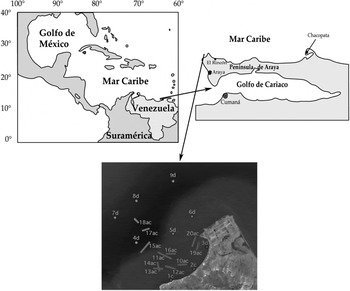
The study area is located in the north-western Araya Peninsula in north-eastern Venezuela. Coastal waters of this region are confined to a corridor formed by the coastline of the Peninsula de Araya and the islands of Coche, Margarita and Cubagua (Figure 1). The study area comprised 1800 m of coastline, characterized by sandy beaches and a subtidal zone projecting to 20 m deep. It is characterized by soft bottoms with some gravel patches and banks of molluscs, particularly Arca zebra, and beds of the octocoral Muricea elongata, not sampled in this study.
Study area in the Araya Peninsula, Venezuela, showing the locations of the dredged locations (D1–11) and the coastal fringe sampled with corer and grab. (c) Stations sampled with the stainless steel corer; (d) stations sampled with an Ekman-type dredge; and (ac) stations sampled with an Arca zebra dredge.

Sampling
The study involved the identification and quantification of soft bottom mollusc species, collected from three expeditions, one in the intertidal and shallow subtidal zone (up to 1 m depth) and two in the subtidal zone (depth <20 m).
The first expedition was conducted in the littoral zone, and sediment samples were taken at three stations (Western, Central and East). Each station was divided into two areas; namely intertidal and subtidal zone, the latter between 0.5 and 1 m depth. In each zone we carried out 15 samples using a stainless steel corer with an internal diameter of 11.2 cm and 25 cm in height.
The second expedition was conducted in the sublittoral zone, on-board the RV ‘Guaiqueri II’ from the Instituto Oceanográfico de Venezuela (Universidad de Oriente). Sampling was performed with an Ekman-type dredge, (surface sampled = 44.4 square inches) at six stations located between 8 and 20 m depth. At each station, two replicated samples were taken.
In the third expedition, some 11 samples in the subtidal zone from 20 to 30 m from the shore were taken with a dredge. The dredge used was rectangular and similar to those used for the operation of Arca zebra fishermen in the region, with a dimension of 0.5 m wide by 0.3 m blade height, with a net bag of 0.8 m with 2.5 cm mesh size, coated with a metal mesh.
In all cases, organisms were removed from the sediments via sieving through a 5-mm mesh and stored in labelled plastic bags. The material was then fixed in 8% formalin and transported in insulated containers to the laboratory. The material was washed in tap water and preserved in 70% ethanol. Organisms were wet weighed to the nearest 0.1 g for individuals with a body mass of >1 g and to the nearest 0.0001 g for organisms with a body mass of <1 g. In the laboratory, species determination was made by means of morphological comparisons. Systematics was based on Thièle (Reference Thièle1929–1935), Warmke & Abbott (Reference Warmke and Abbott1961), Abbott (Reference Abbott1974), Díaz & Puyana (Reference Díaz and Puyana1994) and Lodeiros et al. (Reference Lodeiros, Marín and Prieto1999). Voucher material was deposited at the Malacological Collection of the Grupo de Investigación de Biología de Moluscos, Universidad de Oriente.
Data analysis
Sample-based rarefaction (Gotelli & Colwell, Reference Gotelli and Colwell2001) was applied using the species richness estimators Chao 1 and Chao 2 (Chao, Reference Chao, Kotz, Vidakovic and Balakrishnan2004). An individual based rarefaction technique was also used to depict differences in species richness between environments at a standardized abundance level. These estimators are used to determine whether the sample adequately represents the species richness of a community, allowing comparison of samples of different sizes.
RESULTS
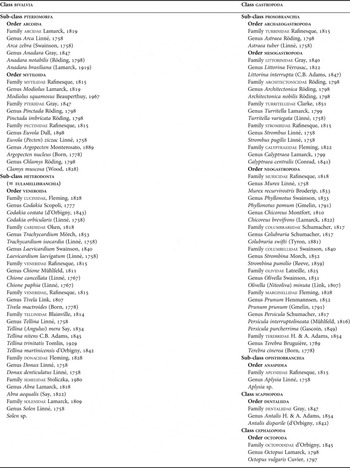
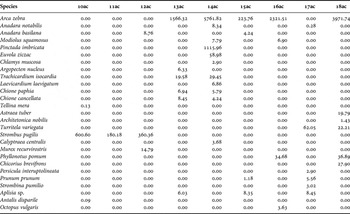
A total of 771 organisms of the phylum Mollusca were examined, belonging to 41 species: Bivalvia, Gastropoda and one each of Cephalopoda and Scaphopoda. The taxonomy of the complete list of species is shown in Table 1.
Systematic list of mollusc species collected from the Araya Peninsula.

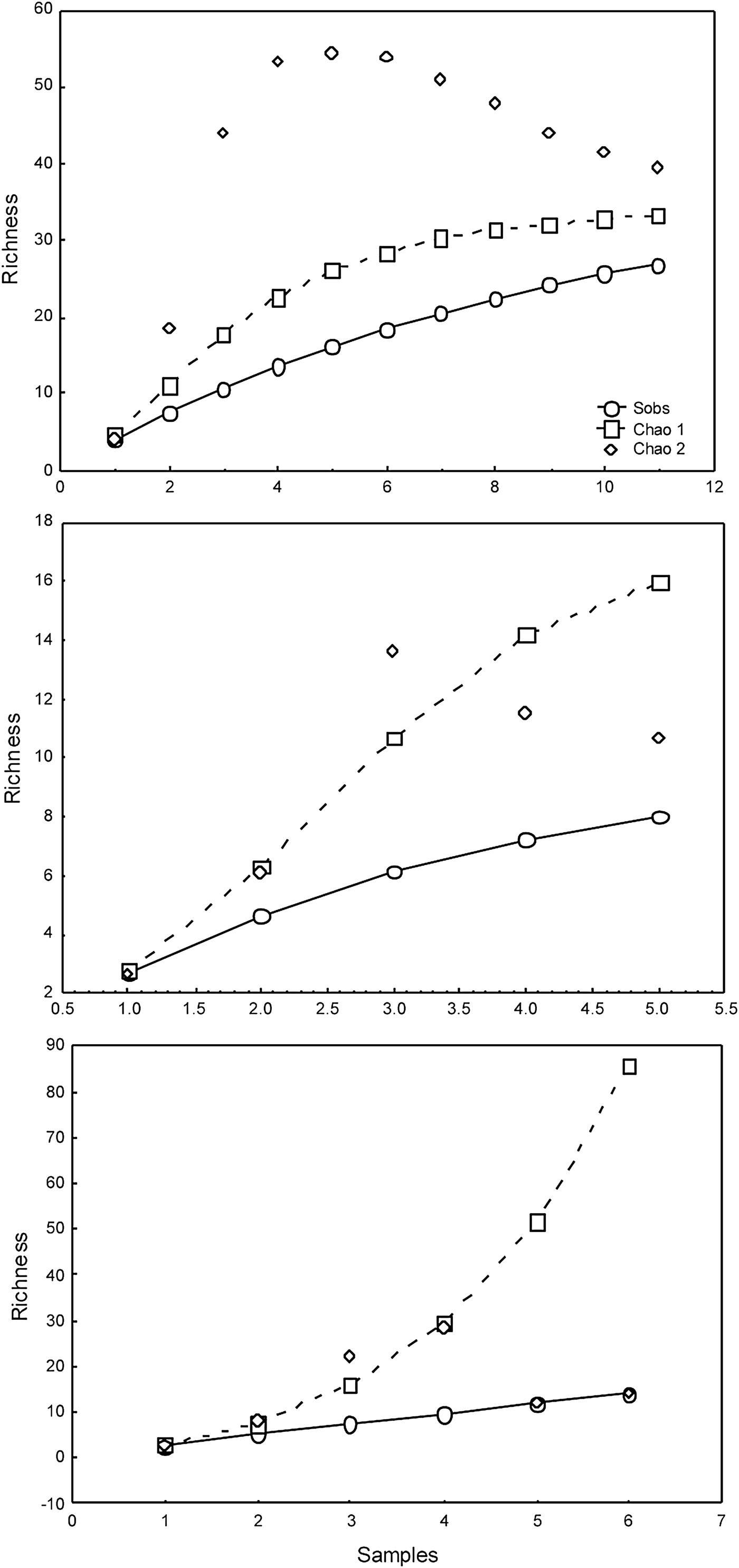
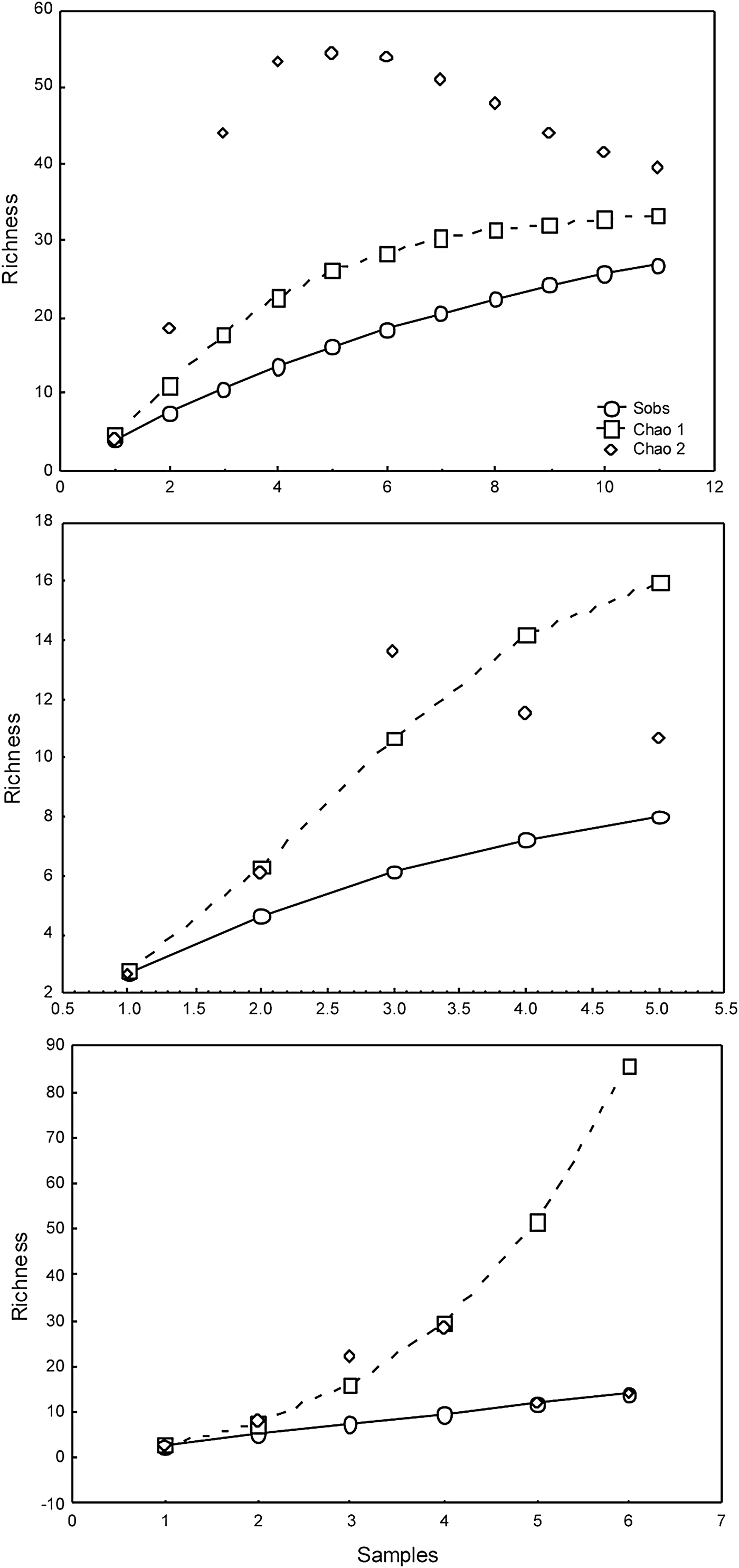
Species richness was maximum for subtidal, dredged samples, with 27 species retrieved, followed by 14 species collected by grabs and 8 species obtained with corers in the intertidal and shallow subtidal. However, when we compared individual-based rarefaction values for a sample size of 10, 20 or 30 individuals, there were no significant differences between gears/environments (analysis of variance): F (6,30) = 2.09, P = 0.08. In addition, sample-based richness estimators suggest that local mollusc biodiversity should be higher; in particular, up to 80 species are expected only in the shallow subtidal (Figure 2). In terms of abundances, the species Arca zebra, Pinctada imbricata, Donax denticulatus, Olivella minuta and Strombus pugilis were the five dominant species across all environments.
Sample-based rarefaction curves for the subtidal (Arca zebra dredge), intertidal (corer) and shallow subtidal (Ekman dredge).
Intertidal and shallow subtidal (corer sampling)
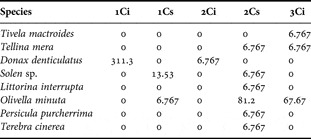
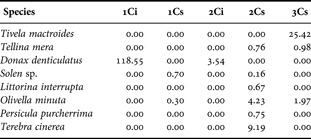
From 79 collected individuals (50 in the upper-intertidal and 29 in the lower-subtidal), four Gastropoda and four Bivalvia species were identified, of which two were common to both areas (the bivalve Solen sp. and the gastropod Olivella minuta). The highest abundance of the intertidal zone observed for the bivalve Donax denticulatus (46 individuals) followed by Olivella minuta with 22 individuals, the remaining species showing an abundance of <2 individuals (Table 2). Donax denticulatus accounts for >95% of the total biomass in the intertidal zone (Table 3).
Density (ind m2) for stations sampled with corers. 1C, 2C and 3C are the Western, Central and East Stations; i, intertidal zone; s, subtidal zone.

Biomass (g m2) for stations sampled with corers. C1, C2 and C3 are the Western, Central and East Stations, i, intertidal zone; s, subtidal zone.

Subtidal zone (Ekman dredge sampling)
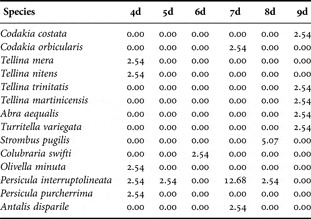
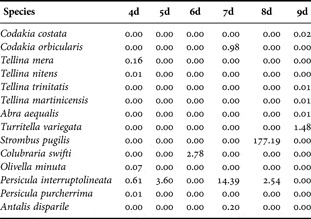
In contrast to the ‘Intertidal and shallow subtidal’, in the sublittoral zone organisms were represented by 14 species: seven Bivalvia (4 spp. of the genus Tellina), six Gastropoda and one Scaphopoda (Table 4). Strombus pugilis represented >85% of the biomass collected (Table 5).
Density (ind m2) for stations sampled with an Ekman-type dredge in the shallow subtidal.

Biomass (g m2) for stations sampled with an Ekman-type dredge in the shallow subtidal.

Sublitoral zone (Arca zebra dredge sampling)
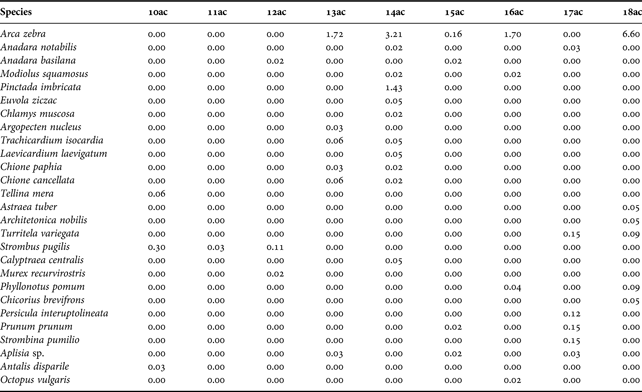
The distribution of the dredges is shown in Figure 1. Arca zebra (Swainson, 1833), pearly oyster Pinctada imbricata (Röding, 1798), and the gastropod Strombus pugilis were detected in the samples (Table 7). Arca zebra was the most abundant species reaching densities of 0.15 to 6.6 ind m2 and biomass ranging from 5.3 to 230.76 g m2 (3.4–152.30 g m2 of dry biomass), associated with gravel and sandy bottoms. The pearly oyster was observed associated only with A. zebra in a transect performed in the western part outside the study area with an abundance of 1.43 ind m2, reaching a biomass of 17.32 and 11.65 g m2 wet and dry biomass, respectively (Table 6). The gastropod S. pugilis, found on transects 1–2, 3–4 and 5–6, which correspond to the central study area, is characteristic of muddy areas. Although their density was low (from 0.03 to 0.3 ind m2), the biomass is high, ranging from 18.45 and 13.58 g m2 wet and dry biomass, respectively (Table 7).
Density (ind m2) for stations sampled with an Arca zebra dredge in the shallow subtidal (no molluscs were collected at Stations 19ac and 20ac).
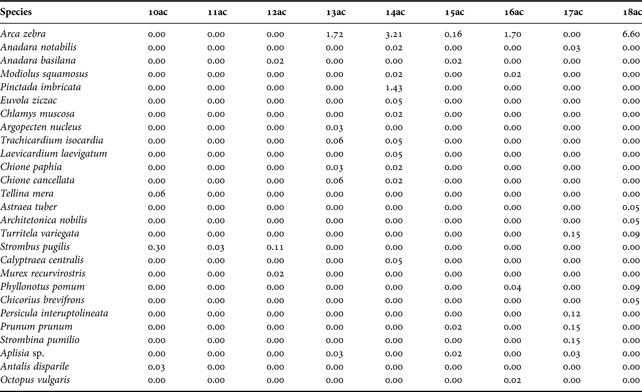
Total biomass (g species) for stations sampled with an Arca zebra dredge in the shallow subtidal (no molluscs were collected at Stations 19ac and 20ac).

DISCUSSION
In contrast to previous inventories of molluscs in north-eastern Venezuela (Graterol, Reference Graterol1986; Jiménez, Reference Jiménez1994; Prieto et al., Reference Prieto, Sant, Méndez and Lodeiros2003; Díaz & Liñero, Reference Díaz and Liñero2004; Jiménez et al., Reference Jiménez, Márquez and Díaz2004; Villafranca & Jiménez, Reference Villafranca and Jiménez2004; Fernández & Jiménez, Reference Fernández and Jiménez2006; Acosta et al., Reference Acosta, Prieto, Ruiz and Gil2007; Licet et al., Reference Licet, Acosta, Prieto and Garcia2009), richness and diversity appear to be low. Similarly, the number of species of bivalves was higher than the gastropods, a group usually with greater diversity. These differences may be related to several factors, initially to differences in the systems targeted by previous studies, which are mostly rocky shores, seagrass meadows and banks of molluscs, which harbour higher species richness than the soft substrates in the study area. Another factor to consider is that previous works included several surveys throughout the year, in larger areas and using different sampling methodologies.
Four species of socio-economic importance in north-eastern Venezuela were found: the pearl oyster Pinctada imbricata, the Chipichipe Donax denticulatus, the Pepitona Arca zebra and the gastropod Strombus pugilis. Although all the above mentioned species showed high biomasses, these are not very attractive for the development of small-scale fisheries, with D. denticulatus being the exception. Official statistics of catches of D. denticulatus show relatively low levels, but there are currently no regulations for the extraction of this species. Hence the need to study more biological aspects and sustainable production of this species is strongly stressed. This observation, along with the importance of this resource to the local economy, stresses the need for the development of long-term monitoring plans on this species, in order to minimize the impact on the species’ populations in the study area. Strombus pugilis is common on the Venezuelan coast, but there is little information on its banks and specific distribution, therefore it is considered a species insufficiently known in the Red Book of Venezuelan Fauna (Rodríguez & Rojas, Reference Rodríguez and Rojas2003), indicating a serious lack of knowledge about its distribution, abundance and population parameters. In this vein, data on this species are of great importance for biodiversity management in Venezuela. Pinctada imbricata has a particular socio-economic importance, since the species can both serve as a food source and produce pearls, a fact that caused its exploitation since the discovery of America until the middle of the last century (Lodeiros et al., Reference Lodeiros, Pico, Prieto, Narváez and Guerra2002). Currently, this species is being exploited for human consumption and sustains an important fishery, particularly in the Guamache–Cubagua area in the Araya Peninsula. Some studies show that it is an excellent species to be cultivated because of its biological feasibility and attractiveness of dual production of meat and pearls (Lodeiros & Freites, Reference Lodeiros and Freites2008). In Venezuela, A. zebra is particularly abundant on the east coast of Margarita Island, to the east of Coche Island, the west coast of the Araya Peninsula, Morro de Chacopata and the northern coast of the Gulf of Cariaco. The artisanal fishery targeting A. zebra is currently the most important bivalve fishery in the region. It is estimated that more than 6000 people benefit from such fishing and in recent years a production of 40–50 tons y−1 was reached (Mendoza, Reference Mendoza2009).
Our results highlight that the studied area in the Araya Peninsula may be important in terms of mollusc conservation. Given the presence of several species of socio-economic interest and the existence of a wide diversity of species and environments, including octocoral beds, we suggest that the area should be monitored and management plans should be designed in order to avoid or minimize damage to this rich molluscan assemblage.
ACKNOWLEDGEMENTS
This study was part of the environmental study ‘Estudio ambiental específico para la localización y caracterización socioambiental del terminal de embarque y patio de tanques en la Península de Araya’, performed by the Consultora Ambiental de la Universidad de Oriente CA (CAMUDOCA) to the Petróleos de Venezuela (PDVSA).