

Psychologists who work with school-aged populations often receive referrals regarding learning difficulties (LDs) and, within the range of LDs, specific learning disorders (SLDs; Cottrell & Barrett, Reference Cottrell and Barrett2017). Hence, psychologists are well placed to provide early assistance to students with SLDs, aimed to foster their psychosocial and academic wellbeing (O'Connor, Bocian, Sanchez, & Beach, Reference O'Connor, Bocian, Sanchez and Beach2014). However, to competently offer relevant stakeholders appropriate support, psychologists first require training (Australian Psychological Society, 2007) to understand the often idiosyncratic academic and psychosocial struggles of this student cohort (Cottrell & Barrett, Reference Cottrell and Barrett2016).
Accordingly, it is important to know how Australian postgraduate psychology courses teach material related to supporting students with SLDs, such as dyslexia. This study sought to investigate the curricula of postgraduate psychology programs to gain insight into how preservice psychologists are formally trained to identify, advocate for, and support the personal and social needs of individuals with learning differences (e.g., LDs, SLDs). This is especially important as the learning behaviours or styles of individuals with LDs or SLDs can sometimes be misperceived as laziness by parents and teachers, or masked, often to avoid others’ negative judgments (Gilmore & Boulton-Lewis, Reference Gilmore and Boulton-Lewis2009; Riddick, Reference Riddick2010).
Operationalising SLD
Due to the focus on psychologists’ practices and training, this paper adopted the definition of SLD outlined in the Diagnostic and Statistical Manual of Mental Disorders (5th ed.; DSM-5; American Psychiatric Association [APA], 2013). The DSM-5 classifies SLD as a neurodevelopmental disorder characterised by impairment in at least one academic domain (of reading, written expression or mathematics) for at least six months ‘despite the provision of interventions that target those difficulties’ (APA, 2013, section 315). These difficulties need to be psychometrically or clinically confirmed, and not better explained by other intrinsic (e.g., emotional or behavioural issues, sensory impairment) or extrinsic (e.g., inadequate learning experiences, differences in culture or language to the educational setting) factors and manifest during childhood (APA, 2013).
The DSM-5’s (stipulative) definition of SLD is one of many, most of which agree SLD is manifested as unexpected underachievement (Kavale, Spaulding, & Beam, Reference Kavale, Spaulding and Beam2009). Psychologists utilise one of three dominant models for operationalising unexpected underachievement (Cottrell & Barrett, Reference Cottrell and Barrett2016). These models are: (1) IQ achievement (or aptitude/achievement) discrepancy model (DM), (2) response-to-intervention (RTI) model, and (3) profile of strengths and weaknesses (PSW) models. As described by Ihori and Olvera (Reference Ihori and Olvera2015), the IQ-achievement DM and PSW approaches rely on standardised cognitive and achievement testing to operationalise unexpected underachievement as occurring when below-average academic achievement is significantly below what is expected based on the individual's ability, with ability being measured by (1) overall intelligence level (i.e., IQ) in the DM, or (2) at least one, but not all, academically relevant cognitive abilities within an aptitude profile (using particular PSW protocols; e.g., Flanagan, Fiorello, & Ortiz, Reference Flanagan, Fiorello and Ortiz2010). Further, PSW models use cognitive assessment to detect cognitive deficits in abilities that are important for the development of specific academic subskills (e.g., phonological awareness, rapid automatised naming; Jacobs, Flanagan, & Alfonso, Reference Jacobs, Flanagan, Alfonso, Thielking and Terjesen2017).
In contrast, RTI models, such as that adopted by the DSM-5 for SLD identification, tend to operationalise unexpected underachievement as achievement that is significantly and substantially below what is expected based on the individual's age (or grade). In such models, frontline delivery of evidence-based classroom instruction is prescribed to all students. Students who fail to show adequate academic gains are given increased levels of instruction intensity and focus to address their particular academic weaknesses, with students at the highest level being identified as having SLDs (O'Connor et al., Reference O'Connor, Bocian, Sanchez and Beach2014). While lauded as a ‘service delivery model for the purposes of both prevention and remediation’, the RTI approach has been criticised for having ‘no indication of a true positive (SLD identification)’ (Flanagan, Reference Flanagan2011, p. 14) since it does not incorporate mechanisms of differential diagnosis (e.g., ruling out alternative causes of learning difficulties, such as intellectual disability).
Partially due to the overreliance on IQ scores in place of well-established academically-relevant cognitive ability factors employed in PSW models, the IQ-achievement DM as a method of SLD identification has been repeatedly discredited. While it was consequently removed from the DSM-IV-TR edition (Jacobs, Flanagan, & Alfonso, Reference Jacobs, Flanagan, Alfonso, Thielking and Terjesen2017), this has not eradicated its use in practice (Unruh & McKellar, Reference Unruh and McKellar2013). Meanwhile, debate lingers over which model, RTI or PSW, most validly and feasibly identifies SLD, with some scholars proposing an amalgamation of the two (Jacobs et al., Reference Jacobs, Flanagan, Alfonso, Thielking and Terjesen2017). Thus, a main rift in the RTI-only versus PSW debate is the belief (or lack thereof) in the necessity to use standardised cognitive assessment when identifying SLDs.
In North America, there has been a legislative shift away from requiring an aptitude/achievement discrepancy to RTI for SLD identification, with some evidence showing this has influenced psychologists’ practices and attitudes in a similar direction (Sullivan & Long, Reference Sullivan and Long2010). Unlike North America, a legislated definition of SLD has not been established in Australia (Jacobs et al., Reference Jacobs, Flanagan, Alfonso, Thielking and Terjesen2017) despite ‘an urgent need’ (Watson & Boman, Reference Watson and Boman2005, p. 47). Without national guidelines to operationalise SLD, it is perhaps unsurprising that recent evidence indicates divergence in how Australian psychologists understand SLD, regardless of professional experience (Klassen, Neufeld, & Munro, Reference Klassen, Neufeld and Munro2005; Meteyard & Gilmore, Reference Meteyard and Gilmore2015).
SLD Identification in Australia
Historically, Australian researchers and policy makers have used inconsistent terms and definitions for SLD/LD (Watson & Boman, Reference Watson and Boman2005). Similarly, Australian psychologists have employed different labels for SLD (dyslexia being the most popularly used) and opinions about whether such labels and diagnoses are practically helpful (Klassen et al., Reference Klassen, Neufeld and Munro2005). While nomenclature differences between psychologists can be rectified by their common reliance on the DSM-5, it is arguably important that psychologists adopt a uniform discourse that is consistent with how individuals with particular SLD and LDs would prefer to be socially and politically identified (Macdonald, Reference Macdonald2013). Further, varied SLD identification and assessment protocols have been reported by surveyed Australian professionals (mostly psychologists) experienced in SLD-related referrals (Meteyard & Gilmore, Reference Meteyard and Gilmore2015). While the RTI model was the most endorsed and least contested of all SLD identification models, most practitioners (153 out of 203) still believed cognitive assessments are important for identifying SLDs (Meteyard & Gilmore, Reference Meteyard and Gilmore2015). The reasons provided for such a stance (from most to least popular) included: (1) highlighting cognitive deficits (referred to above) as potential causes of SLD, (2) establishing discrepancies between IQ and achievement scores, (3) contributing data to a comprehensive assessment, (4) excluding intellectual disability as a cause for poor academic performance, and (5) identifying cognitive strengths and weaknesses to inform intervention planning (Meteyard & Gilmore, Reference Meteyard and Gilmore2015). Notably, many supported the (eschewed) IQ-Achievement DM, with 69% of the sample rating it as important or extremely important for identifying SLDs. Australian practitioners’ support for the dispelled model may, at least in part, be indicative of their initial training experiences.
Preservice Training of Australian Psychologists
To date, there has been no research focused on how Australian psychologists are trained to conceptualise and action SLD referrals. Australian clinical psychology students indicated that their coursework contained an adequate coverage of (unspecified) theory but required more preparation for general decision making (Scott, Pachana, & Sofronoff, Reference Scott, Pachana and Sofronoff2011). With respect to SLD decision making, Klassen et al. (Reference Klassen, Neufeld and Munro2005, p. 309) found that some Australian psychologists ‘keep doing these things (assessment practices) because [they] don't know what else to do . . . [and] tend to fish around to try to find something that does work’.
Only one previous study from North America has investigated preservice curricula for what and how school psychologists were taught to make clinical decisions related to SLD referrals. Analysing 123 units that taught SLD decision making, Barrett, Cottrell, Newman, Pierce, and Anderson (Reference Barrett, Cottrell, Newman, Pierce and Anderson2015) found that certain SLD identification models were stressed proportionally more (or less) depending on the unit content. Units that only taught cognitive testing (12% of the overall sample) predominantly emphasised the IQ-Achievement DM. In contrast, units that only focused on standardised achievement (educational) assessment (16% of the overall sample) had considerably larger coursework dedicated to RTI. Finally, units that taught a combination of cognitive and achievement assessment were the most common (45% of the overall sample) and stressed the IQ-Achievement DM more than RTI (36% versus 11%; Barrett et al., Reference Barrett, Cottrell, Newman, Pierce and Anderson2015). Very few learning goals (only 8% of analysed units) centralised around identifying SLD in culturally and linguistically diverse populations.
The Present Study
To date, it is unclear how Australian tertiary institutions prepare future psychologists to make clinical decisions when working with SLD referrals. It is also unknown which (if any) theoretical approach is currently taught to guide empirical understanding, identification, assessment of, and/or intervention planning for SLD cases. Preservice training can influence psychologists’ beliefs which, in turn, can influence practice (Cottrell & Barrett, Reference Cottrell and Barrett2017). Thus, analysing the teaching content of Australian psychology programs may help explain differences in Australian psychologists’ preferred SLD-related labels (Klassen et al., Reference Klassen, Neufeld and Munro2005) and identification practices (Meteyard & Gilmore, Reference Meteyard and Gilmore2015).
The aim of the present study was to investigate the extent to which current Australian postgraduate psychology courses prepare preservice psychologists to make SLD-related decisions. By analysing the content of internet-based unit handbooks, the four questions asked were: (1) What course types, differentiated by degree type and field of psychology, contain units that teach SLD-related content? (2) What label(s), across units, are used to describe SLD? (3) Do units differ in time spent teaching SLD content? (4) What are the areas of conceptual and practical knowledge and/or skills taught by SLD units?
Method
In the present article, the term degree type means qualification level (e.g., masters, doctors); course refers to a sequence of study in a particular field (e.g., Master of Organisational Psychology); and unit means an individual subject of study that provides accreditation towards the completion of the overall course (e.g., Child Psychopathology). A duplicate unit is a unit offered by an institution to multiple different postgraduate psychology courses/cohorts.
Procedure
To identify the training of individuals most likely to become registered psychologists, only Australian postgraduate psychology courses eligible for registration with the Psychology Board of Australia (Australian Psychology Accreditation Council, n.d.) during September 2017 were included. Data about the courses and units were collected from tertiary institutions’ publicly available websites. Research-based courses that do not teach practice-based competencies (e.g., Doctor of Philosophy [PhD]) and courses intended for already-graduated psychology postgraduates (e.g., bridging courses) were immediately excluded. Two eligible courses were offered only in conjunction with a PhD, so these two courses were retained but with their PhD research components removed from analysis. Practical research/thesis units (not to be mistaken for units about research) were eliminated from analyses. To capture current training practices, only the most recently published online unit handbooks, dated 2017 or later, were examined.
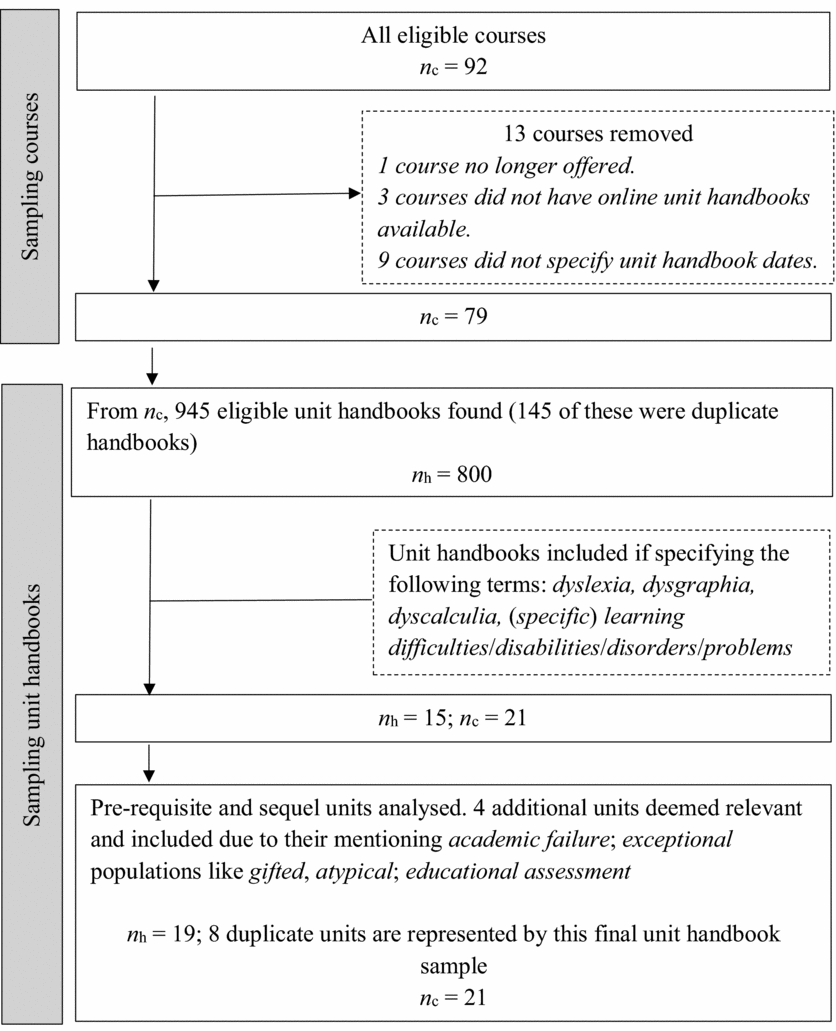
Given the terms LD and SLD have often been used interchangeably in Australia (Skues & Cunningham, Reference Skues and Cunningham2011), unit handbooks needed to make explicit reference to LD or SLD (a narrowed focus similar to Barrett et al., Reference Barrett, Cottrell, Newman, Pierce and Anderson2015) in any section (unit description, learning outcomes, scheduled activities, assignments, contact information, recommended or prescribed resources) to be automatically included. Prerequisite and postrequisite (if any) units of SLD/LD units that were automatically included were scrutinised and included if they suggested containing SLD/LD-related content. Figure 1 details how and why course and unit handbooks were included and excluded from further analyses.
Course and unit inclusion/exclusion criteria. nh = number of unit handbooks (duplicate units counted once). nc = number of courses.

All unit handbook sections were carefully read by the first author. Units differed in how much they focused on SLD/LD, thus were demarcated based on whether they focused on SLD/LD (1) solely (SLD/LD-exclusive), (2) within a broader topic (SLD/LD-embedded), or (3) implicitly through sequentially and conceptually related material (SLD/LD-unspecified). Descriptive and thematic analyses were used to interpret the collected qualitative data, guided by the research design by Hazel, Laviolette, and Lineman (Reference Hazel, Laviolette and Lineman2010) because they, like the present study, analysed course syllabi contents thematically (in regard to the research questions) and descriptively (to represent frequencies of various course and unit contents).
Descriptive analyses addressed this paper's first three research questions. First, frequencies of SLD/LD units were mapped across different courses (including frequencies of duplicate units, to gauge the number of cohorts who receive this training). After this point, duplicate units were represented once in frequency counts to avoid results being skewed toward mainly reflecting duplicate units’ contents. Second, frequencies of the labels given to describe learning impairments were calculated. Third, the contact hours of SLD/LD-exclusive units only were recorded, since it was unclear how much time the other units devoted to teaching SLD/LD.
The first author read all 19 unit handbooks’ descriptions, learning outcomes, and lesson schedules for theme identification. Using a ‘cutting and sorting’ approach (see Ryan & Bernard, Reference Ryan and Bernard2003), similar handbook quotes were grouped into separate ‘piles’. The amount of repetition in each pile was scrutinised; piles that had scant examples were (if appropriate) amalgamated with other larger piles. Finally, conceptual and relational similarities within, and differences between, the piles guided the inductive extraction of themes.
The first author analysed 100% of the unit handbooks. An independent researcher evaluated 20% of randomly selected handbooks (n h = 189, n c = 50; where n h is the number of unit handbooks [duplicates counted once] and n c is the number of courses) to determine inclusion eligibility. Another independent researcher analysed 32% (randomly selected) of the included handbooks for blind thematic analysis (n h = 6, n c = 14) to examine conceptual or practical knowledge/skills related to SLD (i.e., the fourth research question). Both independent researchers had completed all coursework components of a postgraduate educational and developmental psychology course. The first author originally found five major themes while the second coder identified four major themes and two subthemes. Interrater discrepancies were discussed, with consideration of the entire dataset, to reach full consensus on five final themes, as presented by this paper. Cohen's kappa for decisions to include/exclude units was 0.96 and for coding units by the five final themes it was 0.71, indicating good agreement (Cohen, Reference Cohen1968).
Results
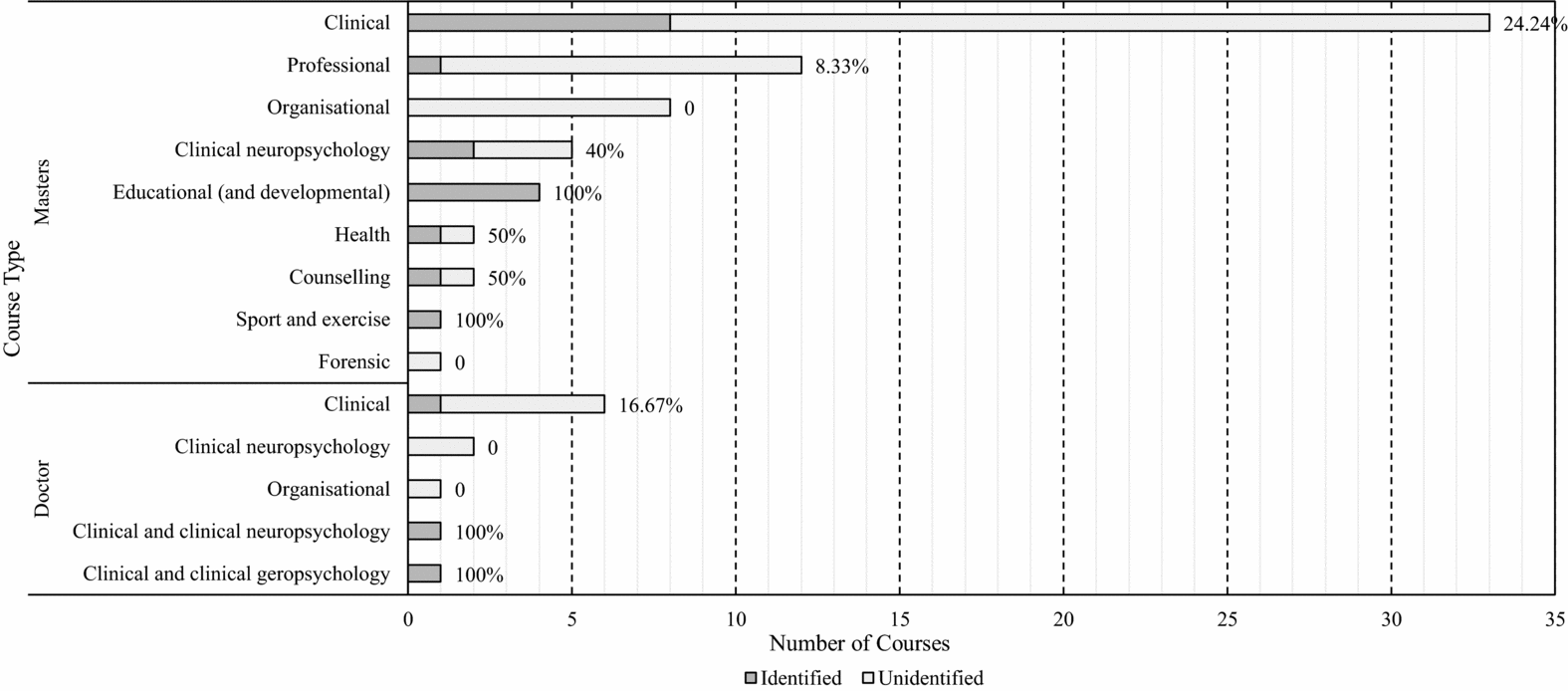
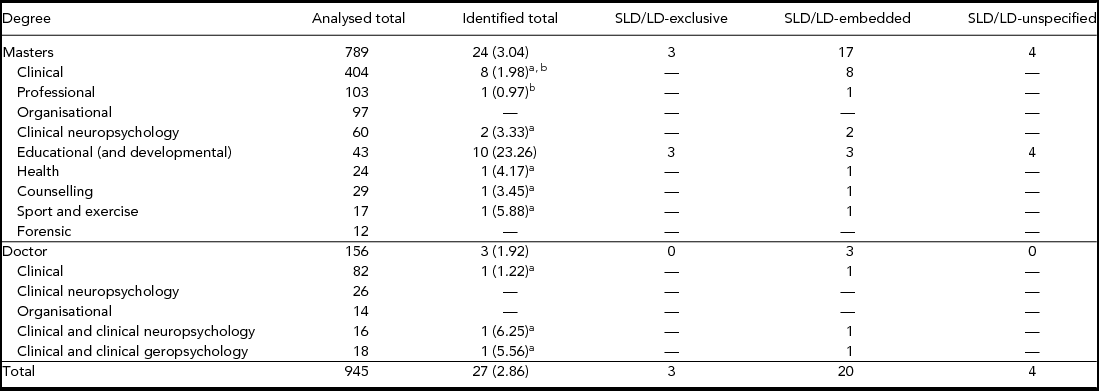
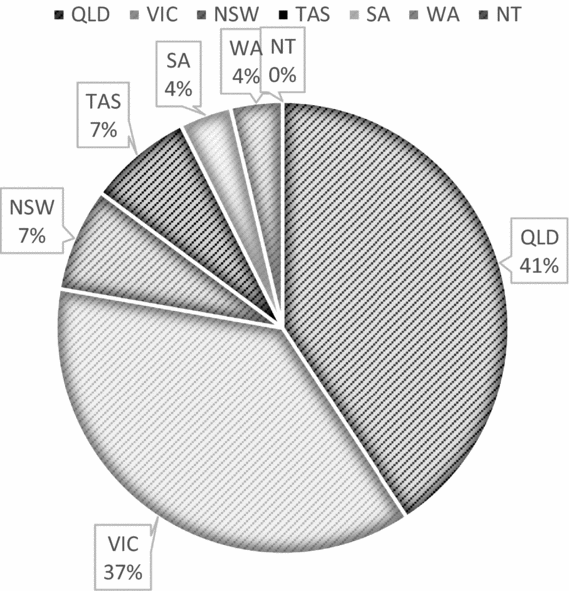
Of the 79 analysed courses, 26.58% contained SLD/LD units (see Figure 2). These courses collectively offered 800 units (or 945 when duplicates are considered, as displayed in Table 1) with 2.38% of these containing SLD/LD content. Approximately 53% of SLD/LD-identified units were located in (all four) educational (and developmental) masters course streams, about 42% in the clinical psychology masters programs, and the remaining units were interspersed thinly across other degree and course types. Supplementary analyses revealed an uneven geographical distribution of SLD/LD units, with none located in the Northern Territory (see Figure 3). Furthermore, only educational (and developmental) psychology courses included SLD/LD-exclusive and SLD/LD-unspecified units. All 27 SLD/LD units were mandatory for course completion; of these, there were two duplicate units. ‘Duplicate unit A’ was offered across eight courses while ‘Duplicate unit B’ was a constituent of two courses. Duplicate units are represented in Table 1 but beyond this initial analysis will be only considered once in frequency counts. However, SLD/LD duplicate units’ categorical belongings will be denoted by a (for unit A) and b (for unit B) in subsequent results.
Frequencies of SLD/LD units across course types. Percentages denote within-course type proportions of SLD/LD units.

Units Identified as Teaching SLD/LD Content, by Degree and Course Type

Note: Percentages represent within-course proportions. All duplicate units are represented here.
a Contains duplicate unit A. b Contains duplicate unit B.
Geographical locations of SLD/LD unit offerings. Duplicate units included.

Descriptive Analysis
SLD labels
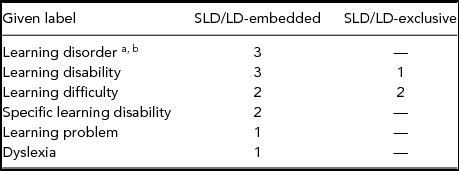
Across SLD/LD-embedded and SLD/LD-exclusive units, a mix of labels was found, with learning disorders and learning disability being most common, but no reference to the DSM–5’s label, specific learning disorder (APA, 2013; see Table 2). Further, SLD/LD-exclusive unit handbooks contained disparate labels.
SLD/LD Labels in Unit Handbooks

Note: a Label used by duplicate unit A. b Label used by duplicate unit B.
Contact times
The three SLD/LD-exclusive units listed their total contact times as 12, 24, and 52 hours.
Thematic Analysis
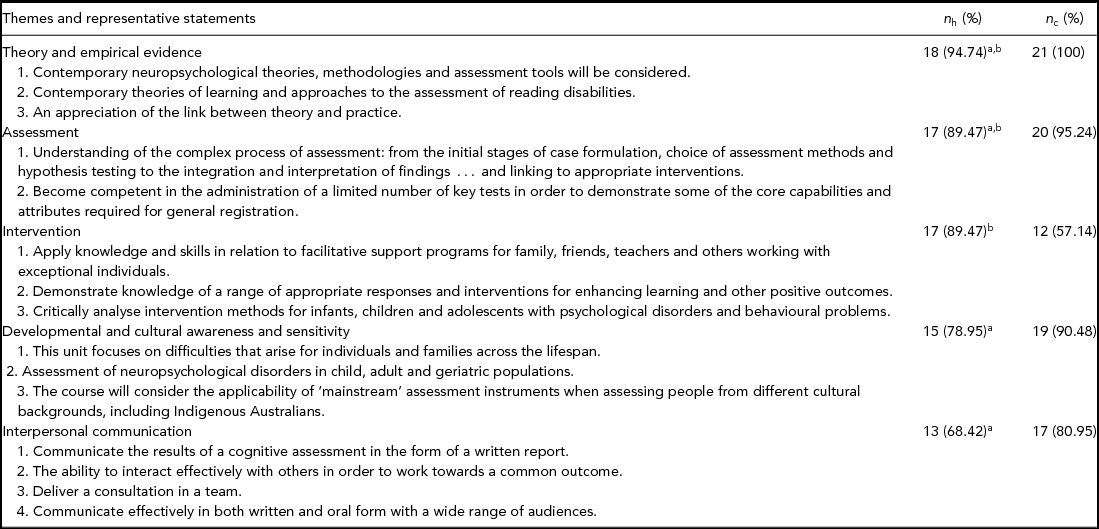
Across all types of SLD/LD units, the two coders found five themes that summarised the areas of conceptual and practical knowledge and/or skills taught in units that addressed SLD/LD: theory and empirical evidence, assessment, intervention, developmental and cultural awareness and sensitivity, and interpersonal communication. Unit handbook quotes that are exemplars of each theme are listed in Table 3.
Representative Quotes and Distribution of Identified Themes

Note: n h = number of unit handbooks (duplicate units counted once). n c = number of courses.
Theory and empirical evidence
As shown, theory and empirical evidence was the most widespread topic across all SLD/LD units and courses (n h = 18a,b, n c = 21). Most handbooks emphasised links between practice and theory, empirical evidence, and research. Evidence-based practice was endorsed in many aspects of psychological practice (e.g., assessment, diagnosing, intervention planning). While there were no particular theories mentioned, theoretical frameworks from various psychological fields were listed, including: developmental (n h = 4), neuropsychological (n h = 3), neurodevelopmental and cognitive (n h = 2a, each), and neuropsychobiological (n h = 1). Eightb handbooks did not specify any detail beyond informing readers they taught theory and/or research surrounding their topics.
Assessment
The majority of handbooks and courses (n h = 17a,b, n c = 20) listed teaching skills and knowledge related to psychological assessment, in a broad sense. Preservice psychologists were taught how to formulate a hypothesis, choose appropriate means to test it, interpret and communicate findings, and use results to inform intervention designs. Further analyses revealed that eight handbooksb did not specify any detail about what assessments were taught (including all three SLD/LD-exclusive units) while the remaining handbooks mostly mentioned assessment types rather than specific tools. Clinicala, cognitivea, and behaviourala assessments were the most commonly mentioned (n h = 5, for each type); followed by tests of achievement (n h = 4a); personality (n h = 3a); memory (n h = 3a); forensic, neuropsychological and psychometric (n h = 2, for each type); emotions (n h = 1); and attention (n h = 1). Two handbooksa listed learning disorders assessment as a type (among cognitive and achievement testing) but did not clarify the underpinning procedures (e.g., whether they overlap with cognitive and/or achievement tests, or are different such as an RTI-only approach and/or otherwise). Finally, twoa handbooks referred to previous versions of cognitive assessments (e.g., Wechsler Intelligence Scale for Children, Fourth Edition) and one referred to the previous DSM-IV when discussing assessment and identification of SLD/LD.
Intervention
While 17b unit handbooks (spread across 57.14% of the analysed courses) included teachings about intervention and related issues, only one handbook specified a particular intervention approach (i.e., positive behaviour support, an approach that adopts an RTI framework for managing challenging behaviours). Seven handbooks listed general intervention strategies such as family interventions, behavioural management/interventions, programs (unspecified; literacy support; clinical; or on topics such as discipline, bullying, trauma, integration), completing funding applications, and curriculum adjustment. Thirteenb handbooks (noting an overlap by three handbooks) were less specific about their intervention-related content by listing terms such as intervention, remediation, rehabilitation, management, treatment, and recommendations (to various stakeholders or about unspecified instructional procedures).
Developmental and cultural awareness and sensitivity
Overall, 78.95% of unit handbooksa,b across 19 courses mentioned teaching psychological knowledge and practices (e.g., selecting assessment tools, interpreting and reporting results) that are sensitive to client diversity in age (n h = 15a,b) and culture (n h = 6a,b). Sixb units prepared students to work with individuals from birth until adolescence while the remaindera stated a lifespan approach, including working with individuals from infancy or early childhood to adulthood or late adulthood. None of the SLD/LD-exclusive units mentioned culture and only one explicitly mentioned teaching how to provide services to individuals across the lifespan. While three handbooks highlighted the importance of considering clients’ alternative comorbid presentations (e.g., sensory or neurological deficits, fatigue, distractibility, and physical disabilities), such content was not prominent enough to warrant expanding the theme beyond being sensitive to client differences in development and culture.
Interpersonal communication
Across 17 courses, 13 unit handbooksa contained objectives about developing students’ communication skills in written forms (n = 9a), interpersonal collaborations (n = 8a), and their oral expression (n = 5a). Of the handbooks that emphasised written communication, fivea specified developing students’ report writing, one highlighted academic writing, and the remaining three were nondescript beyond written communication. Of the handbooks that emphasised interpersonal collaboration, foura did not list who preservice psychologists were intended to work with while the remaining four emphasised working effectively with exceptional individuals, their parents, families, teachers, schools, and other involved psychologists and professionals. Finally, all handbooksa that specified developing students’ oral communication skills did not provide explicit elaboration about the content of such verbal conveyances; however, three handbooks briefly mentioned teaching students to become proficient in orally communicating to a wide range of audiences (unspecified). One SLD/LD-exclusive unit was not represented in the interpersonal communication theme while another stated building students’ interpersonal skills to work with other (educational) psychologists and exceptional individuals and their teachers and parents. The final SLD/LD-exclusive unit stated it intended to build students’ abilities to effectively communicate to an array of audiences in spoken and written form (including the findings of assessments).
Discussion
The present study was the first to begin investigating the content of postgraduate units that teach future Australian psychologists about SLD/LD. SLD/LD was mentioned explicitly by 19 of the 800 unique postgraduate psychology units, or 21 of the 79 postgraduate psychology courses, offered by Australian tertiary institutions in 2017 or 2018. While they comprised 5% of the available courses, perhaps not surprisingly, masters of educational (and developmental) psychology courses contained proportionally more SLD/LD units (23.26%) than any other course and were the only course type that delivered units exclusively devoted to teaching SLD/LD. Across SLD/LD-embedded and SLD/LD-exclusive handbooks, six different terms were used to describe learning impairment, with learning disorder being most disseminated (when duplicate units are also counted). Thematic analysis revealed five areas (assessment, intervention, theory and empirical evidence, developmental and cultural awareness and sensitivity, and interpersonal communication) of conceptual and practical knowledge and/or skills taught within units that address SLD/LD.
The present results suggest SLD/LD content is scant across Australian postgraduate psychology courses, and concentrated mostly in Queensland and Victorian courses. Even when SLD/LD was explicitly documented in online handbooks, only three units were solely devoted to this topic (albeit to different extents, as suggested by their disparate contact hours). With 5–15% of Australians estimated to have SLDs (Skues & Cunningham, Reference Skues and Cunningham2011), in contrast to the 20% estimated as having mental health issues (Slade et al., Reference Slade, Johnston, Teeson, Whiteford, Burgess, Pirkis and Saw2009), the present results suggest a legitimate gap between preservice learning and the required knowledge and skills to appropriately and adequately support individuals with learning impairments. Being powerfully positioned as SLD diagnosticians, it is important that psychologists are adequately versed in the personal and social ramifications (positive and negative) experienced by individuals living with SLDs. Explicit training about SLDs could help prevent psychologists from inadvertently negatively impacting the livelihoods of people with SLDs by, for example, failing to recognise their experienced struggles and (biological and social) disadvantages, perpetuating detrimental stereotypes about them, and/or hindering just efforts that promote their inclusion and access to community regimes such as schooling (Riddick, Reference Riddick2010). Future research is encouraged to take an ecological perspective that asks practitioners and individuals with SLDs about their beliefs, experiences, and attitudes concerning how and why (aspects of) psychological services can facilitate meeting the needs of people with particular SLDs, at the individual and broader sociopolitical levels.
The interchangeability of SLD and LD terms, which has been historically commonplace in Australia (Skues & Cunningham, Reference Skues and Cunningham2011), appeared unrectified at the institutional level. Our results align with previous findings that suggest Australian psychologists use various labels to describe SLD (Klassen et al., Reference Klassen, Neufeld and Munro2005). A lack of uniform terminology can have negative implications in research (e.g., estimating prevalence rates, synthesising previous literature; Skues & Cunningham, Reference Skues and Cunningham2011) and practice (e.g., identifying appropriate support strategies; Serry & Hammond, Reference Serry and Hammond2015). To reduce miscommunication among support structures, ‘a shared language about [learning] difficulties . . . is paramount; particularly for those involved with assisting affected individuals [e.g., psychologists, teachers, parents]’ (Serry & Hammond, Reference Serry and Hammond2015, p. 157). Through stakeholder and expert consensus, beginning the process of creating national legislature or policy to streamline the SLD language used (at least, at a national level) merits consideration.
While theory was prioritised across all cohorts that explicitly learned about SLD/LD (possibly converging with previous expressions that there is an over-abundance of theoretical teachings; Klassen et al., Reference Klassen, Neufeld and Munro2005), the collected data could not ascertain which (if any) SLD identification models (e.g., IQ-Discrepancy DM, RTI, PSW) are endorsed in preservice training. It may be inferred that an RTI-only approach (i.e., one with a concentrated focus on environmental factors; Cottrell & Barrett, Reference Cottrell and Barrett2017) is less likely to be adopted by Australian psychologists as almost 50% of cohorts identified as learning about SLD/LD are intended to become familiarised with cognitive assessments, and most previously surveyed Australian psychologists considered cognitive assessments useful for SLD identification (Meteyard & Gilmore, Reference Meteyard and Gilmore2015). Moreover, it was unclear whether cognitive assessment practices were taught alongside PSW frameworks and/or the discredited IQ-Discrepancy DM (and/or otherwise).
SLD/LD unit handbooks tended to appreciate developmental and (to a lesser extent) cultural differences in learning. However, similar to Barrett et al. (Reference Barrett, Cottrell, Newman, Pierce and Anderson2015), there was relatively less content about being culturally sensitive in SLD practices. In this light, it is vital that psychologists are aware of the intersectional impacts that various intra- and interpersonal factors can have, especially those that can create further social and academic disadvantage, in the presentations of individuals with SLDs (Macdonald, Reference Macdonald2013). Greater emphasis during preservice training on the interplay between SLD and other dimensions of diversity could help raise psychologists’ awareness of how appropriate, valid, or fair some current psychological protocols (e.g., in assessment, providing help or recommendations) are for individuals with multifaceted presentations (Flanagan, Reference Flanagan2011).
There are a number of limitations in the present study. While collecting information from web-based handbooks enables nationwide sampling, it may increase the likelihood of obtaining incomplete (e.g., SLD/LD units that did not mention SLD/LD in their handbooks may have been missed) and/or inaccurate data (e.g., at least three handbooksa may not have been updated as they referenced dated versions of diagnostic and assessment tools). Also, most handbooks did not provide in-depth elaborations about their teachings, and it cannot be ascertained whether preordained activities are executed (e.g., curriculum adjustments might be made). Finally, while tertiary studies are integral to psychology training, other important sources of developing SLD-related knowledge and skills outside of coursework (e.g., placements, professional development workshops, research, personal experiences) were not investigated as part of this research. To address these limitations, future research could directly survey currently registered psychologists about their knowledge about (particular) SLDs and their practices that uphold the wellbeing and rights of individuals with SLDs.
The present findings highlight potential areas that need improvement in current teaching practices surrounding SLD. Course and/or unit co-ordinators are encouraged to review, reflect, and revise their preservice psychology training courses to include greater content explicitly devoted to teaching students about persons living with SLDs, and how their experiences intersect with their various identity markers (e.g., culture, economic class, gender). Practitioners are urged to self-reflect upon their attitudes, experiences, and beliefs relating to SLD and their level of preparedness to assist individuals with such learning differences. Additionally, given the implications of our results, many preservice practitioners may need additional training to ensure they are appropriately skilled to identify and understand how lifelong SLDs impact the lives of individuals, even beyond their academic livelihoods (Riddick, Reference Riddick2010). Practitioners must have the skills to identify and guide people with SLDs in directions that empower them to actively participate in the community and consolidate a positive identity for themselves: this could be the difference between a person with an SLD believing they are inherently stupid or lazy and their feeling supported and capable of success in their pursuits and passions (Watson & Boman, Reference Watson and Boman2005).
Financial Support
The first author was supported via an Australian Government Research Training Program Scholarship and acknowledges the Commonwealth's kind contribution.
Conflicts of Interest
None.
Ethical Standards
Ethical approval was not required.