Introduction
Whiteflies (Hemiptera: Aleyrodidae) are a pest that affects a variety of crops and cause serious economic damage worldwide. They are hemimetabolous insects whose first nymphal stage is mobile, whereas the later immature stages are sessile. Both nymphs and adults feed by piercing and sucking the sap from foliage. All immature stages can cause serious damage, even the immobile nymphal stages. The spiraling whitefly Aleurodicus dispersus Russell, originating from the Caribbean region of Central America (Russell, Reference Russell1965) is a highly polyphagous species, which has been recorded on 295 genera of plants belonging to 90 families and more than 480 species, including many vegetable, ornamental and fruit crops (Srinivasa, Reference Srinivasa2000). A. dispersus has four different nymphal stages in its life cycle. The hatching crawlers settle near the leaf vein for feeding, and then they go through the immobile nymphal stages by permanently attaching to the leaf. They secrete a copious white waxy flocculent material which is readily spread elsewhere by wind, and excrete the sticky honeydew which encourages dense growth of sooty moulds on the leaf, reducing the photosynthetic capacity of the host plants (Kumashiro et al., Reference Kumashiro, Lai, Funasaki and Teramoto1983; Mani & Krishnamoorthy, Reference Mani and Krishnamoorthy2002).
Antennae are important sensory organs involved in the detection of many important environmental stimuli (Zacharuk, Reference Zacharuk, Kerkut and Gilbert1985). The antennae of insects carry a wide range of sensilla with different sensory modalities. Sensilla are the highly specialized sensory structures responsible for detecting environmental stimuli associated with olfaction, gustation, mechanoreception and thermo- and hygroreception (Altner & Prillinger, Reference Altner and Prillinger1980; Zacharuk, Reference Zacharuk1980, Reference Zacharuk, Kerkut and Gilbert1985; Altner & Loftus, Reference Altner and Loftus1985; Whitman & Eller, Reference Whitman and Eller1990; Steinbrecht, Reference Steinbrecht1997). Antennal sensilla in many insects, including flies, have been extensively recorded as olfactory receptors implicated in various behaviors e.g., host location and discrimination (DeVaney et al., Reference DeVaney, Eddy, Handke and Lopez1970; Greenberg, Reference Greenberg1970; Hays & Vinson, Reference Hays and Vinson1971; Weseloh, Reference Weseloh1972; Shanbhag et al., Reference Shanbhag, Müller and Steinbrecht1999; Gullan & Cranston, Reference Gullan and Cranston2000; Ochieng et al., Reference Ochieng, Park, Zhu and Baker2000; Merivee et al., Reference Merivee, Ploomi, Rahi, Bresciani, Ravn, Luik and Sammelselg2002). Sensilla are most commonly presented on the antennae of insects (Schneider, Reference Schneider1964; Zacharuk, Reference Zacharuk, Kerkut and Gilbert1985).
There is very little information about the morphology of whitefly nymphal antennae and antennal sensilla. This study aimed to investigate by scanning electron microscopy the developmental and structural changes of antennae and antennal sensilla in crawlers (first-instar nymphs) and the immobile stages of A. dispersus; determine whether the olfactory system of immobile A. dispersus nymphs were degenerate or not; explore the relationships between structure and behavior and establish the theoretical foundation to characterize chemical communication in A. dispersus.
Materials and methods
Insects
Specimens used in the study were the first, second, third and fourth instars of A. dispersus nymphs. Insects were collected from guava leaves in Hainan University, China (E109°18′17″, N19°27′18″) with an insect needle (No: 00) under a stereomicroscope (Stemi 2000-C, Carl Zeiss, Germany). The specimens were respectively kept in four 2 ml glass vials with 70% alcohol before being prepared for scanning electron microscopy (SEM).
Scanning electron microscopy
The specimens were removed from the alcohol and fixed in 2.5% glutaraldehyde for 24 h at −4 °C, washed six times for 20 min each in a phosphate buffer solution (PBS), and dehydrated in a graded alcohol series of 30% (twice for 10 min each), 50% (twice for 10 min each), 70% (long placed), 80% (once for 10 min), 90% (once for 10 min), 100% (three times for 10 min each). This was followed by treatment in isoamyl acetate (twice for 15 min each) and critical-point drying. Subsequently, the specimens were mounted on the platform by double-sided adhesive tape with a ventral orientation. Finally, the specimens were sputter coated with gold and observed at 10 kV using a scanning electron microscope (Nova Nano SEM430, Netherlands).
Terminology
The various sensilla observed on the antennae of nymphal A. dispersus were classified based on their morphological details as revealed by SEM and followed the nomenclature of Schneider (Reference Schneider1964) and Zacharuk (Reference Zacharuk1980, Reference Zacharuk, Kerkut and Gilbert1985).
Statistical analysis
Sensilla on the dorsal, ventral and two-side profiles of antennae of four nymphal stages were counted and measured. Measurements (μm) were obtained from photomicrographs of at least ten individuals of the same type and a slide caliper (GB/T1214.1–1214.4) was used to calculate the means. Means were analyzed by general linear model (GLM) procedure and a least significant difference (LSD) multiple comparison separation test was performed with SPSS 12.0.
Results
General description of antennae
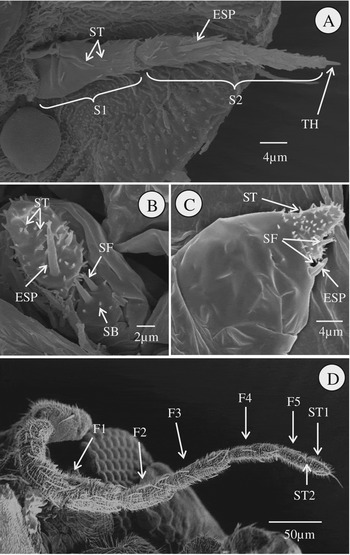
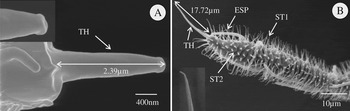
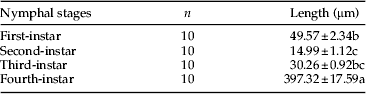
Immature A. dispersus bore a pair of antennae which were located between the compound eyes on the ventral side of the body. The morphology of four different nymphal stages of A. dispersus antennae are illustrated in fig. 1. There was a terminal hair (TH) at the tip of the first- and fourth-instar nymphal antennae (fig. 1A, D). The first-instar nymphal TH had a smooth cuticle, a blunt tip and was inserted into the cuticular depressions (fig. 2A), measuring 2.39±0.11 μm in length and a basal diameter of 0.46±0.02 μm. The TH of fourth-instar nymph was inserted into a wide cuticular socket, and measured 17.32±0.71 μm in length and had a basal diameter of 0.75±0.08 μm (fig. 2B). The base of the second-instar nymphal antennae was wrinkled without sensilla, whereas the other parts of the antennae were smooth with sensilla. The fourth-instar nymph's body is enclosed by a thick wall made up of the antennae, eyes and legs. Antennae were not apparent under light microscope and scanning electron microscope, unless their thick walls were removed. The length of four different nymphal stages of A. dispersus antennae is shown in table 1. The fourth-instar nymphal antennae were the longest. The first-instar nymphal antennae were significantly longer than the second-instar nymphal antennae (df=3, F=394.06, P<0.01). No difference was observed between the second- and third-instar nymphal antennae, and so were the first- and the third-instar nymphal antennae.
General morphology of antennae of immature A. dispersus. (A–D) SEM photograph in first-, second-, third- and fourth-instar of A. dispersus nymphal antennae. S1, S2, show two segments comprised the antennae of first-instar nymph; ST, ST1, ST2, sensilla trichoidea, sensilla trichoidea 1, sensilla trichoidea 2; ESP, elevated sensilla placodea; TH, terminal hair; SB, sensilla basiconica; SF, sensilla furcatea; F1, F2, F3, F4, F5 show five flagellar subsegments comprised the flagellum.

Terminal hair on the antennae of first- and fourth-instar of A. dispersus nymph. (A) Terminal hair on the antennae of first-instar of A. dispersus nymph. Inset: The high magnification picture of terminal hair. (B) The fifth flagellar subsegment. Inset: The tip of TH at high magnification. TH, terminal hair; ST1, sensilla trichoidea 1; ST2, sensilla trichoidea 2; ESP, elevated sensilla placodea.

Length (mean±SE) of various nymphal stages of A. dispersus antennae.
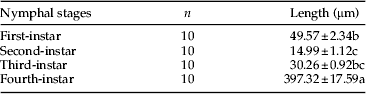
Means with different letters in the same column are significantly different (GLM, LSD, P<0.05).
First-instar nymph
The antennae of first-instar nymph were filiform in shape and composed of two segments (fig. 1A). It was the second longest of A. dispersus nymphal antennae (table 1). Only sensilla trichoidea (ST) and elevated sensilla placodea (ESP) were found on the first-instar nymphal antennae.
Second-instar nymph
The antennae of second-instar nymph were degenerate and made of an indistinct segment (fig. 1B). Second-instar nymphal antennae were shorter than all the other nymphal antennae (table 1). Four morphologically different types of sensilla were detected on the antennae of second-instar nymphs. They were ST, ESP, sensilla furcatea (SF) and sensilla basiconica (SB).
Third-instar nymph
The antennae of third-instar nymphs were similar to that of the second-instar nymph, which were also degenerate and made of an indistinct segment. The antennae of third-instar nymph were longer than the second-instar nymph (table 1), and the base of the third-instar nymphal antennae was swollen (fig. 1C). Only ST, ESP and SF were found on the antennae of third-instar nymph.
Fourth-instar nymph
The antennae of fourth-instar nymph were found to be similar to that of the adult A. dispersus (Zheng et al., Reference Zheng, Wu and Fu2010). The filiform antennae of fourth-instar nymph consisted of a basal scape, a clavate pedicel and a long flagellum composed of five subsegments (fig. 1D). The antennae were measured 397.32±17.59 μm in length (table 1). The entire surface of the flagellum was covered with annular wrinkles (figs 1D and 2B). Seven morphologically different types of sensilla were observed on the antennae of fourth-instar nymph. They were sensilla trichoidea 1 (ST1), sensilla trichoidea 2 (ST2), ESP, sensilla chaetica (SCH), SB, sensilla campaniform (SCA) and sensilla coeloconica (SCO).
Types of sensilla
The distributions of various types of sensilla on the antennae of four different nymphal stages of A. dispersus are shown in table 2. ST and ESP were found on the antennae of each nymphal stage of A. dispersus; SCH only occurred on the antennae of fourth-instar nymph. SF occurred on the antennae of second- and third-instar nymph, and SB were found on the antennae of second- and fourth-instar nymphs. In addition, SCA (fig. 5) and SCO (fig. 8) were only found on the antennae of fourth-instar nymphs, whereas the ST of fourth-instar nymph included ST1 and ST2 (fig. 3D).
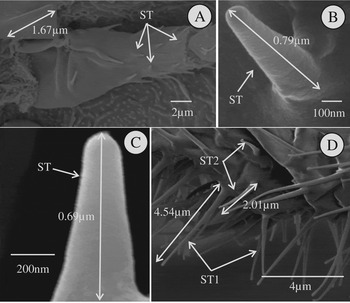
Sensilla trichoidea on the antennae of immature A. dispersus. (A–D) Sensilla trichoidea on the antennae of first-, second-, third- and fourth-instar of A. dispersus nymph. Inset of (A): The high magnification picture of sensilla trichoidea on the antennae of first-instar of A. dispersus nymph. ST, sensilla trichoidea; ST1, sensilla trichoidea 1; ST2, sensilla trichoidea 2.

Distribution of the various types of sensilla on the antennae of various nymphal stages of A. dispersus.

Note: ‘+’, indicates sensilla present; ‘−’, indicates sensilla absent; ST, ST1 and ST2 are sensilla trichoidea, sensilla trichoidea 1 and 2; SCH, sensilla chaetica; ESP, elevated sensilla placodea; SF, sensilla furcatea; SB, sensilla basiconica; SCO, sensilla coeloconica; SCA, sensilla campaniform.
Sensilla trichoidea
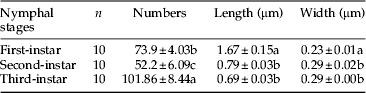
Sensilla trichoidea were found on the antennae of each nymphal stage of A. dispersus. The ST of first-, second- and third-instar nymphs had a similar shape and size (fig. 3). There were significant differences in the numbers of first-, second- and third-instar nymphal ST (df=2, F=14.387, P<0.01), and the length of first-instar nymphal ST were significantly longer than that of the second- and third-instar nymphal ST (df=2, F=36.787, P<0.01) (table 3). There was no significant difference in the length of second- and third-instar nymphal ST. The first-instar nymphal ST were straight hairs with blunt tip, and directly connected to the cuticle without a conical socket and pore (fig. 3A). They were the most numerous types of sensilla found on the antennae of first-instar nymphs. The ST of second- and third-instar nymphs were similar to that of the first-instar nymphs, but some of them were shorter because of the degenerate antennae (fig. 3B, C). ST were also the most numerous type of sensilla found on the antennae of second- and third-instar nymphs, but there was a significant difference in numbers (table 3) (df=2, F=14.387, P<0.01). The number of ST on second-instar nymphs was the least and was significantly larger on the third-instar nymphs (table 3), and usually distributed on the tip stem of third-instar nymphal antennae.
Numbers, length and width (mean±SE) of ST of first-, second- and third-instar of A. dispersus nymph.
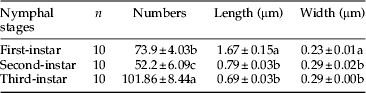
Means with different letters in the same column are significantly different (GLM, LSD, P<0.05).
The ST of fourth-instar nymph were blunt-tipped straight hairs with a smooth cuticle. They were most commonly located in a conical socket and elevated above the cuticle. Numerous ST were distributed on the surface of the entire antennae. Two types of ST were found on the antennae of fourth-instar nymph. ST1 were elongated and tapered from the middle to the apex of the antennae. They formed a large angle with the longitudinal axis of the antennae (fig. 3D). They had a mean length and width of 4.54±0.12 and 0.03±0.00 μm, respectively. The location, distribution and shape of ST2 were similar to that of the ST1, measuring 2.01±0.15 μm in length with a basal width of 0.02±0.00 μm. ST2 had a blunt or sharp tip. The angle formed with the longitudinal axis of the antennae was much smaller (fig. 3D).
Elevated sensilla placodea
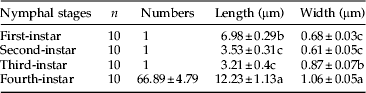
The number, length and width of ESP of four different nymphal stages of A. dispersus are shown (table 4). Only one ESP was found on the antennae of first-, second- and third-instar nymphs. The fourth-instar nymphal ESP were the longest and widest (table 4). The first-instar nymphal ESP were longer than that of the second- and third-instar nymphs, but the width was smaller than that of the third-instar nymphs (table 4). There was no significant difference in the length of second- and third-instar nymphal ESP, but a significant difference in the width (df=3, F=37.319, P<0.01).
Numbers, length and width (mean±SE) of elevated sensilla placodea of various nymphal stages of A. dispersus.
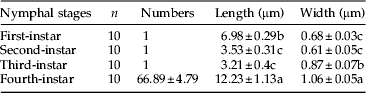
Means with different letters in the same column are significantly different (GLM, LSD, P<0.05).
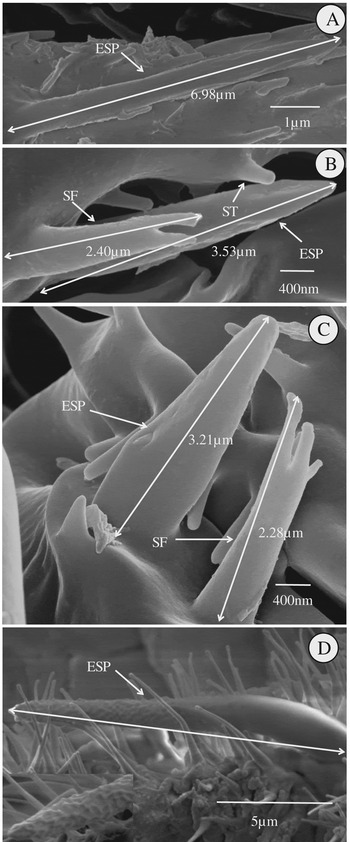
The ESP of first-instar nymphs were long and oblate with no pore, which was universally located at the base of second segment in the ventral side of the first-instar nymphal antennae. They gradually tapered the apex and were parallel to the longitudinal axis of the antennae (fig. 4A). The location and distribution of the ESP on the second- and third-instar nymphal antennae were similar to that of the first-instar nymphs (fig. 4B, C). The shape and width of ESP of second-instar nymph was similar to that of the first-instar nymphs, but they were shorter (table 4). The ESP of third-instar nymphs had a blunt tip and were shorter and wider than that of the first- and second-instar nymphs (table 4), but there was no difference in length with the second-instar nymphal ESP.
Elevated sensilla placodea on the antennae of immature A. dispersus. (A–D) Elevated sensilla placodea on the antennae of first-, second-, third- and fourth-instar of A. dispersus nymph. Inset of (D): The high magnification picture of elevated sensilla placodea on the antennae of fourth-instar of A. dispersus nymph. ESP, elevated sensilla placodea; ST, sensilla trichoidea; SF, sensilla furcatea.

The ESP of fourth-instar nymphs were the longest and the most conspicuous sensilla type on the antennae of fourth-instar nymph. The elongate plate-like sensory organs were elevated above the antennal surface. The base of the ESP was a smooth shaft with no pore, but the other parts had corrugated shafts (fig. 4D). The EPS were evenly distributed on flagellar subsegments and generally aligned in parallel to the antennal axis. There were significantly more EPS than on the other nymphal stages (table 4). The EPS decreased in size from the flagellum base (fig. 1D).
Sensilla chaetica
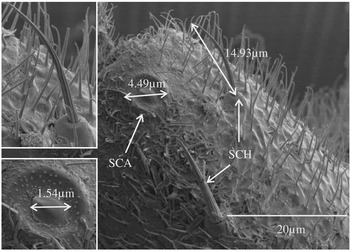
Sensilla chaetica occurred only on the antennae of fourth-instar nymphs. There were two SCH on the ventral surface of the pedicel of each antennomere (fig. 5). They were thorn-like and sharp-tipped with strong longitudinal grooves. They were slightly curved and inserted into a large cuticular socket. SCH had a mean length and basal diameter of 14.93±1.22 and 1.38±0.06 μm, respectively.
Sensilla chaetica (SCH) and sensilla campaniform (SCA) on pedicel of fourth-instar of A. dispersus nymph. Inset: The high-magnification pictures of SCH and SCA.

Sensilla basiconica
Sensilla basiconica were found on the antennae of second- and fourth-instar nymphs, both had different morphologies and distributions (fig. 6). The SB of second-instar nymphs were small cone-shaped pegs with a sharp tip and were vertical to the longitudinal axis of the antennae (fig. 6A). One or two sensilla were found on the basal part of second-instar nymphal antennae. The SB of fourth-instar nymph were similar to SCH, but were short in length and slightly oblate (fig. 6B). They were fitted into a tight socket and sparsely distributed on pedicel and the first flagellar subsegment of fourth-instar nymphal antennae. The SB of fourth-instar nymphs had a mean length and diameter of 10.42±0.57 and 0.84±0.06 μm, respectively.
Sensilla basiconica on the antennae of first- and fourth-instar of A. dispersus nymph. (A) Sensilla basiconica on the antennae of first-instar of A. dispersus nymph. (B) Sensilla basiconica on the antennae of fourth-instar of A. dispersus nymph. Inset: The high magnification of sensilla basiconica. SB, sensilla basiconica.

Sensilla furcatea
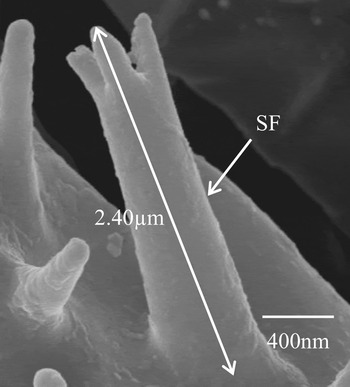
Sensilla furcatea were only found on the antennae of second- and third-instar nymphs. The SF of second- and third-instar nymph were similar in number, shape and size (figs 4B, C and 7). The SF were distinctive although similar in profile to the SP, having a strong and long base but furcating at the tip. The tip stem of the SF were divided into two forks (fig. 4B) or four forks (figs 4C and 7), and were sparsely distributed on the second- and third-instar nymphal antennae. One to three SF were found and measured 2.40±0.19 μm in length and 0.51±0.02 μm in width, 2.28±0.15 μm in length and 0.56±0.04 μm in width, on the second- and third-instar, respectively.
Sensilla furcatea on the antennae of second-instar of A. dispersus nymph. SF shows sensilla furcatea with four forks.

Sensilla campaniform
A single SCA was found near the apical socket of the antennal pedicel near the expanded flagellar base on fourth-instar nymphs (fig. 5). The SCA was a dome-shaped sensory structure; the ambient cuticle was protuberant with many tiny cuticular granules surrounding it (fig. 5). The base of the SCA had a 4.49±0.25 μm basal diameter. The central conelet was oval with smooth cuticle whose base was an obvious cuticular depression ring, measuring 1.54±0.09 μm in basal diameter.
Sensilla coeloconica
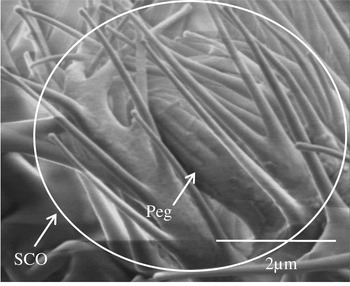
Sensilla coeloconica were composed of a central grooved peg on the floor of a relatively shallow depression, surrounded by inwardly directed microtriche (fig. 8). About ten or more microtriches occurred on a large stalk, or were situated sparsely around the peg. Each grooved peg was surrounded by two or three stalks which were intertwined at the tip of their stalks. There were at most five SCO each antennomere distributed on the second flagellar subsegment of fourth-instar nymphal antennae.
Sensilla coeloconica. SCO, sensilla coeloconica.

Discussion
The morphology and ultrastructure of the antennae and various antennal sensilla of four different A. dispersus nymphal stages were studied. In the immobile stages of A. dispersus nymphs, the length of their antennae increased with the development stage. The antennae of second- and third-instar nymphs were shorter than those of first-instar nymphs because of degenerate antennae, whereas the fourth-instar nymphal antennae were the longest and fully developed (table 1). We found two types of sensilla on the antennae of the first-instar, three types on the third-instar nymphal antennae, four types on the second-instar and seven types on the fourth-instar nymphal antennae (table 2).The types and morphology of antennal sensilla in first-, second- and third-instar nymphs are fewer in number and simple, whereas the type, morphology and distribution of antennal sensilla on fourth-instar nymphs are similar to that of the adult A. dispersus (Zheng et al., Reference Zheng, Wu and Fu2010).
The ST was the most numerous and commonly distributed type of antennal sensilla in A. dispersus nymphal stages (fig. 1). The longer and sharp-tipped ST1 and ST2 with a blunt or sharp tip were alternately distributed on the whole antennae of fourth-instar nymph (figs 2B and 3D). As the nymphs developed, the number and length of antennal sensilla also developed. For example, the number and width of the third-instar nymphal ST were the most numerous and widest of the three younger nymphs (table 3). The number and length of second-instar nymphal ST were fewer and shorter than that of the first-instar nymphs (table 3) and this degenerate form or disappearance may reflect the non-mobile nature of this nymphal stage. Trichoids hairs have been reported to perform either or both mechano- and chemo-sensory function (Zacharuk, Reference Zacharuk, Kerkut and Gilbert1985). Smooth surfaces without pores on ST on the antennae in first-, second- and third-instar nymphs suggest that these ST may serve as mechano-receptors. Previous transmission electron microscopy (TEM) studies showed socket like insertions of ST in fourth-instar nymphs and studies in other Aleyrodidae and Psyllidae insects revealed the lack of pores (Mellor & Anderson, Reference Mellor and Anderson1995; Onagbola et al., Reference Onagbola, Meyer, Boina and Stelinski2008). As such, the ST in fourth-instar nymphs likely also served as mechano-receptors.
Only one ESP was found on the antennae in first-, second- and third-instar nymphs, and the location, distribution, and dimension of ESP in fourth-instar nymphs were similar to that of the adult A. dispersus (Zheng et al., Reference Zheng, Wu and Fu2010). Single-sensillum research showed that sensilla placodea in Microplitis croceipes were indeed olfactory receptors which responded in a dose-dependent manner to plant volatiles (Ochieng et al., Reference Ochieng, Park, Zhu and Baker2000). The elongated or oval sensilla placodea are very common in Hymenoptera (Barlin & Vinson, Reference Barlin and Vinson1981; Pettersson et al., Reference Pettersson, Hallberg and Bigersson2001), and the elevated elongated sensilla placodea with multiple pores on Coccophagus pulvinariae suggest an olfactory function (Barlin & Vinson, Reference Barlin and Vinson1981). In our study, all ESP lacked a multiple cuticular pore system; as such their specific function in A. dispersus is yet to be confirmed electrophysiologically.
The SF only occurred on the antennae of second- and third-instar nymphs. This type of sensilla has not been reported in Hemiptera families. We found one to three SF each flagellar antennomere. They were first reported in Coleophora obducta (Yang et al., Reference Yang, Yan and Liu2009) and their function was not yet described.
The SCH of fourth-instar nymph were similar to that of the adult A. dispersus (Zheng et al., Reference Zheng, Wu and Fu2010), Aleyrodes proletella, Bemisia tabaci and Trialeurodes vaporariorum (Mellor & Anderson, Reference Mellor and Anderson1995). Previous studies suggested that SCH could serve as a proprioreceptor perceiving antennal movement and position or have mechano-sensory functions (Ochieng et al., Reference Ochieng, Park, Zhu and Baker2000; Onagbola et al., Reference Onagbola, Meyer, Boina and Stelinski2008). According to Mellor & Anderson (Reference Mellor and Anderson1995), the TH on the tip of the first- and fourth-instar nymphal antennae (fig. 1A, D) which were similar to that of A. proletella, B. tabaci and T. vaporariorum were also probably a kind of SCH. Second- and third-instar nymphs are not motile, and this is reflected in the degeneration of the SCH. The fourth-instar nymphs also are non-motile, but their SCH were developed and similar to that of the adult A. dispersus and other related species. In general, the antennal sensilla development occurs in the pupal stage of holometabolous insects (Snodgrass, Reference Snodgrass1956; Schmidt & Kuhbandner, Reference Schmidt and Kuhbandner1983; Zimmermann, Reference Zimmermann1991; Eichmuller & Schafer, Reference Eichmuller and Schafer1995; Steiner & Keil, Reference Steiner and Keil1995). A. dispersus is a hemimetabolous insect, but their fourth-instar nymphal stage is similar to the pupal phase of holometabolous insects. Their antennae and antennal sensilla development were comparable with that of adult A. dispersus.
The SB were structurally and functionally similar in most insect species studied (Schneider, Reference Schneider1964). The SB in fourth-instar nymphs were similar to SCH in morphology with a non-flexible base. They were analogous to those found in M. croceipes and Microplitis pallidipes (Ochieng et al., Reference Ochieng, Park, Zhu and Baker2000; Gao et al., Reference Gao, Luo and Hammond2007). They were characterized by a grooved surface and projected slightly more perpendicularly to the axis of the antennae than ST. Previous studies suggested that multiple pores in the cuticle of the smooth, thin-walled SB served as an olfactory function (Steinbrecht, Reference Steinbrecht, Hahn, Matoltsy and Richards1984), whereas the SB with non-porous cuticular of the grooved surface should be a gustative function (Ochieng et al., Reference Ochieng, Park, Zhu and Baker2000; Gao et al., Reference Gao, Luo and Hammond2007). In our study, SB presumably played a gustative function. The SB in second-instar nymph was different in shape from that of fourth-instar nymph which may be due to the degenerate antennae.
The SCO has been described under different synonyms as subterminal sensilla (Weseloh, Reference Weseloh1972), smooth basiconica sensilla (Norton & Vinson, Reference Norton and Vinson1974a, Reference Norton and Vinsonb), ampullae sensilla (Voegelé et al., Reference Voegelé, Cals-Usciati, Pihan and Daumal1975), multiporous grooved sensilla (Barlin & Vinson, Reference Barlin and Vinson1981), bulb sensilla (Cave & Gaylor, Reference Cave and Gaylor1987), basiconic sensilla (Van Baaren et al., Reference Van Baaren, Barbier and Nénon1996, Reference Van Baaren, Boivin, Lelannic and Nénon1999) and SCO type I (Roux et al., Reference Roux, Van Baaren, Gers, Arvanitakis and Legal2005; Bourdais et al., Reference Bourdais, Vernon, Krespi, Lelannic and Van Baaren2006). The SCO only occurred on the second flagellar subsegment of A. dispersus fourth-instar nymphal antennae and were similar in morphological features to that of adult A. dispersus (Zheng et al., Reference Zheng, Wu and Fu2010), A. proletella, B. tabaci and T. vaporariorum (Mellor & Anderson, Reference Mellor and Anderson1995). In social insects, SCO serve as chemo-receptors that respond to air temperature changes (Ruchty et al., Reference Ruchty, Romani, Kuebler, Ruschioni, Roces, Isidoro and Kleineidam2009). In some lepidopterans, they are reported to have receptor neurons that responded to host plant volatile compounds (Pophf, Reference Pophf1997), and in homopterans they function as hygro-receptors preventing desiccation of the antennae (Kristoffersen et al., Reference Kristoffersen, Hallberg, Wallén and Anderbrant2006). In whitefly, SCO have been previously referred to as lachneat (Bink-Moenen, Reference Bink-Moenen1983), rhinaria (Domenichini, Reference Domenichini1981) and primary sensilla (Gill, Reference Gill and Gerling1990). Altner et al. (Reference Altner, Schaller-Selzer, Stetter and Wohlrab1983) considered SCO to have thermo-hygroreceptive functions in several non-parasitic species.
The SCA occur in all parts of the body subjected to stress, and are concentrated near joints such as halters, palps, legs, the base of wings and even the eyes (Schneider, Reference Schneider1964; Bromley et al., Reference Bromley, Dunn and Anderson1980; Chapman, Reference Chapman1982). When they occurred on the antennae, they are found in small numbers. For example, only one was observed on the pedicel in apids (Bromley et al., Reference Bromley, Dunn and Anderson1979), and as well as on the fourth-instar nymph of A. dispersus. The SCA play the role of mechano-receptors with no pores in their cuticular structures (Slifer & Sekhon, Reference Slifer and Sekhon1961; Stort & Barelli, Reference Stort and Barelli1981; Hashimoto, Reference Hashimoto1990; Zacharuk & Shields, Reference Zacharuk and Shields1991; Olson & Andow, Reference Olson and Andow1993; Chapman, Reference Chapman1998; Basibuyuk & Quicke, Reference Basibuyuk and Quicke1999; Kleineidam et al., Reference Kleineidam, Romani, Tautz and Izidoro2000). The SCA with pores could be involved in gustatory functions and be highly susceptible to humidity (Dietz & Humphreys, Reference Dietz and Humphreys1971). Therefore, the SCA in fourth-instar nymph with no pores may serve as mechano-receptors.
Generally, the antennae and antennal sensilla of second- and third-instar nymph are more degenerate than those of the first-instar nymph. The antennae and antennal sensilla in fourth-instar nymph were similar to those of the adult A. dispersus (Zheng et al., Reference Zheng, Wu and Fu2010). The ESP in fourth-instar nymphs were, however, a little different from those of the adult. At the base of the ESP is a smooth shaft in fourth-instar nymph, whereas they have a whole corrugated shaft in adult A. dispersus.
In conclusion, we have provided an extensive description of the antennae and antennal sensilla of nymphal spiraling whitefly using SEM since many of these structures could not be clearly observed using light microscopy. This information can be a great help for revealing the developmental course of whitefly's antennae and antennal sensilla, and allow us to better understand the behavior of this whitefly species.
Acknowledgements
We are grateful to Professor Geoff Gurr (Charles Sturt University, Orange, NSW, Australia) for English revision and critical reading of the manuscript. We thank Ms Xin-fang Chen (Instrumental Analysis and Research Center of South China Agricultural University) for assistance with SEM. This study was supported by the Special Fund for Agro-scientific Research in the Public Interest of China (grant no. 201103026-4 and 200803023-02), and the Fund Project for Transformation of Agricultural Scientific and Technological Achievements from the Ministry of Science and Technology of China (grant no. 2011GB23260037).