Introduction
Recent geological studies based on the most ancient sedimentary rocks from the Jack Hills, Australia, provide evidence of the presence of water in open reservoirs on early Earth, 4.1–4.3 Ga (Wilde et al. Reference Wilde, Valley, Peck and Graham2001). They were dated using zirconium grains (Mathez Reference Mathez2001), the most ancient samples on Earth, with a fraction size of several millimetres. The presence of liquid water, a key component for the origin of life on early Earth, which appeared hundreds of millions of years later than the planet formation, changes the current understanding of the starting time of both the beginning of chemical evolution and the appearance of primary living forms. This fact essentially changes the commonly accepted geological history of early Earth.
The data mentioned above agree with the results of earlier studies, which were also based on material evidence, according to which prerequisites for the development of a living cell were already present on Earth 3.8–4 billion years ago (Schidlowski Reference Schidlowski1988).
This pattern of the living cell formation from the primary forms, possessing only replication ability with simple genetic code, is the most complex and mysterious event, which requires a relatively long time and specific conditions, with a probable scale of a few hundred million years.
This chronology of the processes strongly restricts the time of the prebiotic stage of evolution, which, according to the classical scenario (Dickerson Reference Dickerson1978), was necessary for the accumulation of organic compounds (OC), the creation of primary living structures from inorganic matter, and, much later, for the formation of a proper living cell. Within the frame of traditional thinking this would be a very difficult or almost inconceivable scenario. Life would have had appeared much earlier and more quickly. But how could this occur?
The analysis of these data has cast doubt on the reliability of the traditional scenario of prebiotic evolution and the mechanisms of its implementation. These mechanisms are based on the influence of various natural factors, such as ultraviolet (UV) solar radiation, lightning discharges and radiation, mostly in a hypothetical atmosphere of early Earth (Urey Reference Urey1952; Miller & Urey Reference Miller and Urey1959; Margulis & Sagan Reference Margulis and Sagan1997; Galimov Reference Galimov2001; Goldsmith & Owen, Reference Goldsmith and Owen2001). When this scenario was first proposed, there were scarce data on the composition of the primary atmosphere as compared with the present time. As a result, many scientists concluded that the atmosphere at that time was of a regenerative nature, i.e., contained hydrogen, ammonia, methane and water vapours. An atmosphere rich in hydrogen and deprived of oxygen is called regenerative, as opposed to the modern oxidizing atmosphere that is rich in oxygen and deprived of hydrogen.
This concept was reluctantly accepted, since only at such composition of gases was it possible to receive ‘key’ OC in the model experiments. An oxidizing atmosphere, i.e., that containing oxygen, was completely rejected because in this case OC synthesis would be impossible. While currently the assumption of a regenerative atmosphere is often criticised, it is still impossible to determine the atmospheric composition. As a result, there is a special interest in the processes of a biogenic synthesis of OC on early Earth, i.e., those independent of the presence or composition of atmosphere.
Other complications in the determination of the correct mechanism are related to the fact that early Earth conditions hardly allow the potential participation of solar radiation in the synthesis of OC. It is known that in the first few hundred million years Earth, being in a nascent state, was exposed to intensive meteoric bombardment (Hartmann et al. Reference Hartmann, Ryder, Dones, Grinspoon, Canup and Righter1990; Pechernikova & Vityazev Reference Pechernikova, Vityazev, Adushkin and Nemchinov2005). The estimates (Managadze Reference Managadze2009) based on atmospheric dust content measurements at the Mount Wilson observatory following the explosive disintegration of the Tungus meteorite in 1908 (Bronshten Reference Bronshten1987) testify that the dense dust clouds that appeared on early Earth during impact formation of craters prevented solar radiation reaching Earth's surface. This is one of the basic difficulties in the traditional mechanism, according to which the formation of polymers was prevented by the low density of monomers because of concentration break.
Moreover, it was unknown when, by which processes and why the breaking of mirror symmetry was an event that led to the asymmetrical development of isomers (Bonner Reference Bonner1984, Reference Bonner1991; Kizel Reference Kizel1985; Gol'danskii & Kuzmin Reference Gol'danskii and Kuzmin1989; Keszthelyi Reference Keszthelyi1995; Avetisov & Gol'danskii Reference Avetisov and Gol'danskii1996). Simple and reliable mechanisms that could have prevented the destruction of OCs synthesized under the influence of solar radiation and allowed their accumulation have not been discovered. There is no uniform and universal mechanism that can provide OC synthesis in the Earth ‘warming’ scenario, nor in the interstellar gas-dust clouds in the ‘cold’ cosmic scenario (Gol'danskii & Kuzmin Reference Gol'danskii and Kuzmin1989). What is more important is that no present mechanism provides the required high efficiency of OC synthesis at the ultra-low temperatures of the interstellar environment (Spitzer Reference Spitzer1978). All of the above indicate that a biogenic synthesis, in particular the synthesis of complex OC, which is required for the emergence of life, was probably provided by essentially different, presently unknown mechanisms.
Nevertheless, at this stage of study of the ‘Eternal Problem’ in the laboratory the possibility of synthesizing key monomers and the formation of different polymers has been shown. Note that OC synthesis in the plasma medium of a decaying discharge was carried out for the first time by Löb (Reference Löb1906). Subsequently, A. Oparin (Oparin, 1924); S. Miller, H. Urey (Miller, Urey, 1959); S. Fox (Fox, Nakashima, 1980); C. Ponnamperuma (Ponnamperuma, 1972), and many other talented experimenters have showed that the claimed occurrence of OC can be synthesized in many various processes on Earth, and not only in plasma. This success installed confidence of a fast solution of ‘Secrets of Life’. However, this is not the case.
A prominent feature of early works is the so-called ‘empirical’ approach, according to which the presence in nature of basic components of biological molecules was enough for the establishment of living matter. Therefore, the basic studies have focused on the synthesis of these compounds in laboratory conditions, modelling the influences of various natural events in a medium that presumably occurred on early Earth. These works were very useful, since they have shown the opportunity for synthesis in conditions within nature of the major molecular structures necessary for the formation of living matter.
However, at this time, a number of studies (Frank Reference Frank1953; Eigen Reference Eigen1971; Prigogine 1980; Avetisov & Gol'danskii Reference Avetisov and Gol'danskii1996) have shown that the creation of the living matter based on statistical sampling with the replacement of monomers is impossible.
These works considerably stimulated further studies in the field of the origin of life. Simultaneously they have demonstrated a way of resolving difficult and unapproachable problems in the future, at least, by gaining an understanding of what natural phenomenon or sequence of many phenomena are required for the emergence of the first living creature, the primogenitor of the biosphere, which provided a huge and incomprehensible variety of surprising forms of life.
Basic idea of a new concept
To overcome the above difficulties and contradictions, about 10 years ago a new scenario was proposed for OC synthesis in impact plasma at the prebiotic stage of evolution on early Earth (Managadze 2001a, 2001b). This universal mechanism could have provided a biogenic synthesis of OC both on Earth, in a meteorite impact, and in interstellar clouds, in hypervelocity collisions of dust particles (Managadze Reference Managadze2003, Reference Managadze2005a, Reference Managadze2005b, Reference Managadze2007). The mechanism proposed for Earth's environment does not require the presence of an atmosphere or solar radiation. Furthermore, it is highly efficient at the ultra-low temperatures of interstellar clouds, because its efficiency does not depend on the ambient temperature (Managadze et al. Reference Managadze, Brinckerhoff and Chumikov2003a, Reference Managadze, Brinckerhoff and Chumikovb).
In a recently published book (Managadze Reference Managadze2009), it was shown using the system approach that the processes accompanying the hypervelocity impact of meteorites simultaneously with the synthesis of OC could provide the most important and necessary conditions for the occurrence of primary forms of living matter, which possess the ability of replication and a primitive genetic code. According to the system approach, the ability of these analogues of natural phenomena were considered jointly with the main requirements for the origin of life. This approach offers a great help in solving some important problems.
According to this approach the most important stages of these processes must include:
— delivery of carbon and necessary biogenic elements in meteorite bodies to the area of impact;
— maintenance in the area of the meteorite impact of high density of energy, which is necessary for the conversion of substances into plasma phase, and generation of a torch, providing fast plasma-chemistry reactions in this medium, with the synthesis of the macromolecular structures of OC;
— support of the processes of prebiotic ordering of the substance to assemble complex organic compounds;
— the breaking of the mirror symmetry of enantiomers, synthesized in local chiral physical fields of a plasma torch;
— maintenance during the adiabatic flyaway plasma torch of conditions for spontaneous breaking of the mirror symmetry with the formation of a homochiralic medium due to the development of a plasma instability;
— formation in the impact crater of an area that is necessary for the survival and evolution of living matter in the case of its occurrence, possessing a moderate temperature for a rather long time, rich in water and OC;
— delivery of products of synthesis into the interior of the space objects, where the appearance and evolution of primary forms of life are possible, in the case of the presence of extreme temperature on their surface.
Hence, the processes accompanying a meteoric impact in connection with conditions of primary forms are necessary for the establishment of living matter that were self-sufficient and did not depend on conditions on the surfaces of space bodies. This testifies that the initial stage of prebiotic evolution could have developed without the energy of the Sun or an atmosphere.
Thus, the basic ideas of the new concept and the scenario of its implementation in nature are clear. This is provided by the following conditions. These processes are based on the results obtained in laboratory experiments, which provide material evidence of the processes that occur on Earth and in space and are well-known natural phenomena. We shall consider each process separately.
It is important that the proposed concept does not involve at all the stage of chemical evolution in its classical interpretation. This is due, first and foremost, to the fact that the most important organic compounds needed for the formation of primary forms of living matter arise instantaneously, in a single act of a meteorite impact. Because of their local nature, the processes that accompany the meteorite impact, as well as the new concept, do not conflict with the earlier proposed scenarios. Therefore the proposed concept says nothing about the possible complexification of organic compounds on the primeval Earth during the chemical evolution in its classical interpretation.
Within the framework of the new concept chemical evolution can be viewed as the time spend by nature on the processes of the formation in the protoplanetary cloud of meteorite bodies rich in carbon and biogeneous elements, and the time span of intense meteorite bombardment of the Earth surface, which resulted in the emergence of the primary forms of living matter.
It is possible that the sum of these times is comparable to the duration of the stage of chemical evolution in its classical, generally agreed interpretation.
Abiotic synthesis of organic compounds
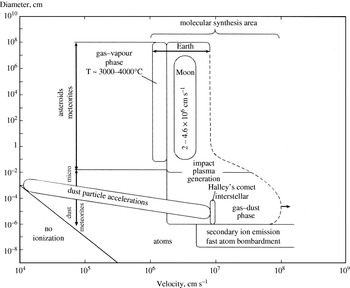
The mechanism of synthesis is based on hypervelocity collisions of the fragments of matter. If the velocity of a meteorite exceeds the critical value or is more than 15–20 km s−1, this interaction results in the emission of mater resembling the form of a high-temperature, dens plasma torch, which facilitates crater formation (Zeldovich & Raizer Reference Zeldovich and Raiser1966). A particular case of this process is meteoric impact on Earth and the collision of dust particles accelerated in the interstellar clouds, which arises in hypervelocity conditions (Spitzer Reference Spitzer1978; Bochkarev Reference Bochkarev1992) (Fig. 1). In both cases, in the presence of carbon and other OC-forming elements in the composition of colliding bodies, these compounds are synthesized in the resultant plasma torch. The complexity of the resultant OC depends on the characteristic size of the interaction area (for example, the size of the meteorite) and tends to increase monotonically with its size. The mechanism proposed for a biogenic synthesis differs from the mechanisms related to the influence of atmospheric electrical discharges, cold ionosphere plasmas and the shock waves generated by falling meteorites. The same refers to other mechanisms connected with the high-temperature influence of volcanic heat on geological formations (including the eruption of underwater volcanoes) and of heat released during meteoric impact (Barak & Bar-Nun Reference Barak and Bar-Nun1975; Mukhin et al. Reference Mukhin, Gerasimov and Safonova1989; Mackie et al. Reference Mackie, Colket and Nelson1990; Blank et al. Reference Blank, Miller, Ahreus and Winans2001). Note that torch-like plasma formation, with its unique characteristics, has never been discussed in the context of the OC of a biogenic synthesis.
The overall picture of impact plasma generation in various processes in nature and the laboratory as a function of the body size and velocity (this diagram is based in part on Kissel & Krueger Reference Kissel and Krueger1987).

The identity and high similarity of plasma torches of the laser and impact origin at their use as a source of ions for time of flight (TOF) mass spectrometry was widely known for a long time. This has once again been shown during laboratory calibration of the dust-impact PUMA instrument, for mission VEGA (Kissel et al. Reference Kissel1986; Sagdeev et al. Reference Sagdeev1987; Sagdeev Reference Sagdeev, Grewing, Praderie and Reinhard1988), and in work (Avrorin et al. Reference Avrorin1996) concerned with the numerical modelling of the formation of ions in impact action.
The molecular ions of organic compounds generated during the model process were recorded by the TOF laser ablation mass-reflection — LASMA (Managadze & Shutyev Reference Managadze, Shutyev, Vertes, Gijbels and Adams1993; Managadze & Managadze Reference Managadze and Managadze1999; Brinckerhoff et al. Reference Brinckerhoff, Managadze, McEntier, Chang and Creen2000).
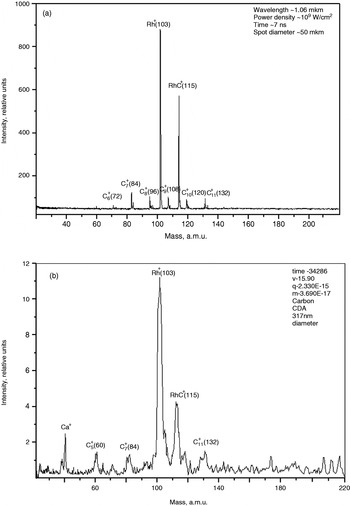
With the discovery of the properties of the plasma torch concerning the maintenance of the synthesis of new compounds, there was a necessity for experimental confirmation of the identity and similarity of torches of the laser and impact origin with regard to synthesis. Such confirmation was also necessary in order to demonstrate the possibility of the use of laser plasma as a model of the plasma torch for the impact processes. The experimental results confirming the high similarity of these torches as medium of synthesis are shown in Fig. 2. A comparison of these results indicates that the processes associated with plasma torch scattering are similar and the end-products of the synthesis are identical, suggesting that the initial composition of the substances is similar. This allowed us to expand the scope of laser modelling in order to address the problems of the impact influence and to simplify considerably the investigation of the phenomenon.
Comparison between mass spectra from laser modelling of hypervelocity impact and those obtained in the dust-impact experiments. Spectra were obtained (a) under the impact of laser radiation on the target made of a pure C and Rh mechanical mixture, with the laser wavelength 1.06 μk and W~109 W cm−2, and (b) in dust-impact experiments using a dust particle accelerator with the impact of carbon particles (weight~3.7×10⁻¹⁴ g, diameter~317 nm and velocity~16 km s−1) on the pure Rh target. This ensured the identity of the chemical composition of the initial components.

Special attention was paid to the correct selection of the basic characteristics of the laser source. The criteria of exact and limited modelling, specially developed (Managadze & Podgorny Reference Managadze and Podgornyi1968) for the reproduction of large-scale space processes in laboratory conditions, were used for this purpose. The analysis has unequivocally shown that reduction of the duration of laser radiation from 10 to 0.5 ns provides the reproduction of impact processes for meteorites with sizes from 10 to 100 μm, which answers the criteria of exact modelling. This results from the fact that a short pulse laser source does not influence the plasma torch. It interfered with the input of the additional energy of laser radiation in the torch and the destruction of OC synthesized in plasma.
A laser with a pulse duration of 7–10 ns was only used at the initial stage of experimental study. Later it was replaced by a laser with an impulse of at most 0.5 ns. The radiation of either laser was focused in a spot 50 μm in diameter, which could be increased by several times. The plasma arising from such influence is at a power density of 109 W cm−2, which according to the estimates corresponds to a meteorite with a minimum diameter of 10 μm.
The presence in the laboratory of a more powerful laser provides an increase in diameter of the spot of up to 1.5–2 mm. In this case, at the same density of capacity, the equivalent meteorite diameter could have reached 100 μm. The use of lasers with different characteristics (see below) provided plot of the dependence of the mass of organic molecules synthesized in a torch on the meteorite diameter, which allowed results of special scientific value to be obtained, which are discussed in more detail below.
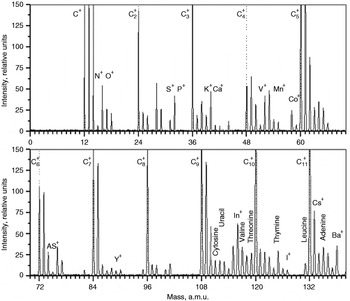
A series of experiments has shown (Managadze 2001a, 2001b, Reference Managadze2003, Reference Managadze2005a, Reference Managadzeb, Reference Managadze2007, Reference Managadze2009; Managadze et al. Reference Managadze, Brinckerhoff and Chumikov2003a, Reference Managadze, Brinckerhoff and Chumikovb, Reference Managadze, Brinckerhoff, Managadze and Chumikov2006; Brinckerhoff et al. Reference Brinckerhoff, Bugrov, Kelner, Managadze, Managadze, Saralidze, Srama, Stubig and Chumikov2004) that, as pure carbon and inorganic compounds containing only H, O and N (for example, chemically pure NH4NO3) are used as an initial material, a highly effective synthesis of different organic molecular structures takes place in the plasma torch. These compounds (for the spectrum, see Fig. 3) include carbines, intermediate reaction-capable compounds that are important for the creation of ‘key’ life molecules and probably monomers of amino acids, nitrogen bases and their dimmers and trimmers (Fig. 4).
Mass spectrum of the target of carbon powder and NH4NO3 mechanical mixture, obtained with W L~109 W cm−2 and t L~0.4 ns. During the analysis of the spectrum, the mass peaks of the matrix elements and isotopes, microadditives and compounds of CM and CMHN (N=1–3) were not considered. The remaining peaks were interpreted as synthesized compounds composed of C, H, O and N. The presence of these elements in the target and application of strict peak selection rules leads to the conclusion that the new peaks' appearance is caused by the complication of synthesized OC.

Typical mass spectra of OC synthesized in a laser-generated plasma torch under the action of pure carbon and its mechanical mix with NH4NO3 for the spot diameter~50 mkm and pulse duration~1 ns. In these spectra 11 amino acids and carbines were identified.

The presence in a spectrum of peaks coinciding in mass with certain amino acids was not regarded as evidence that they appear in these syntheses. The presence of these peaks suggests the possible presence of an amino acid of the given mass in mixed molecular isomers, forming peaks. However, the occurrence of such mass peaks usually initiates a search for respective amino acids. The identification of amino acids was performed by other devices and a different methodology after the accumulation of the necessary quantity of products of synthesis on a substrate for taking measurements. The mass peaks corresponding to important compounds, such as alanine, cytosine, valine, threonine, thymine, leucine and adenine were recorded. The identification of amino acids (Managadze et al. Reference Managadze, Brinckerhoff, Managadze and Chumikov2006) conducted later, using the method of chromate-mass spectrometry, confirmed these results.
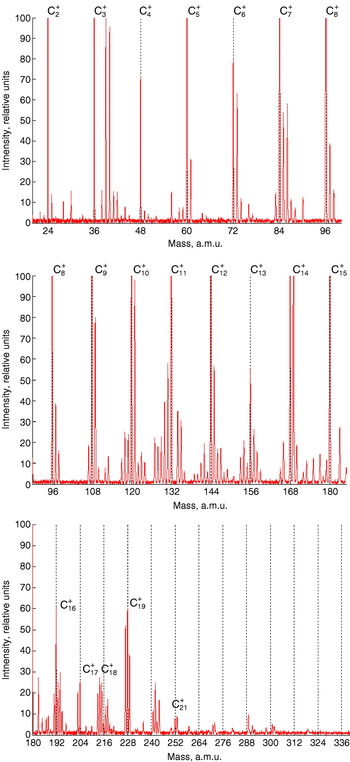
A number of carbon-containing compounds were identified using typical mass spectra. The following compounds were identified: carbines or linearly chained carbon, fullerenes and their fragments, giant fullerenes up to 6000 a.m.u. These results are evidence of the well-pronounced orderliness of the matter in molecules mostly containing carbon. The carbines or linearly chained carbon were identified by means of electron microscopy and Raman spectroscopy.
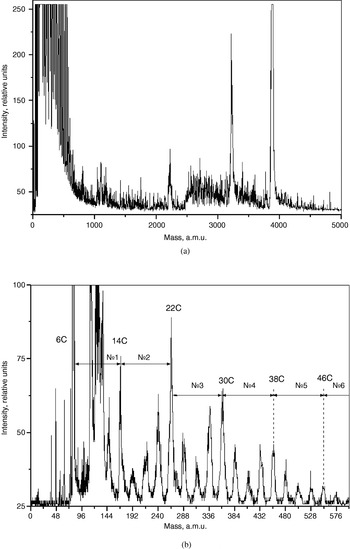
The mass spectrum received at the diameter of laser influence of 1.5–2 mm is shown in Fig. 5. The prominent features of the spectrum are presented in the figure caption. The probability of these spectra was at most 10−3, which is a rather low value on a laboratory scale. However, on a space scale, this should be regarded as a very high probability.
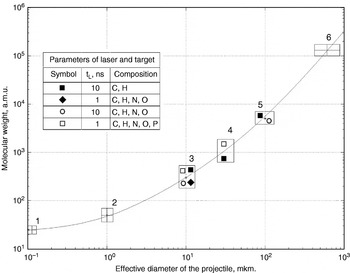
The results presented above, along with the data on the synthesis of organic molecules observed in interstellar clouds, allowed the construction of the curve shown in Fig. 6. Approximation of this curve shows that the synthesis of an organic macromolecule of 105 a.m.u. corresponds to the impact of a meteorite of a millimetre-size class. As other biogenic elements are added in the carbon medium, the ordering of the matter undoubtedly remains, although it decreases a little. Special significance of these results is indisputable; however, the comprehension of their value requires time and additional studies.
(a) A complete spectrum of the mixture of carbon powder and 15NH415NO3, received by a laser radiation spot of 1.5–2 mm in diameter. The mass peaks 2250, 3250 and 3900 a.m.u. are interpreted as a dendrite type, hyperbranching polymer OC; the mass peaks in regions 170–600 a.m.u. as acetylenes carbon; and those in 1000–2000 and 2500–3100 a.m.u. as peptides. (b) A fragment of the same spectrum, with the mass peaks in region N 1 interpreted as amino acids; in regions N 2–6, as hyperbranching linear acetylenes carbon —C2—C2—, the ‘sp’ carbon allotrope and cycle-alkenes (C8).

Dependence of the molecular mass of synthesis products on the effective size of the meteorite. The following typical areas of organic compounds synthesis are indicated: areas 1 and 2 are related to the interstellar medium with dust particles of 0.1 and 1 μm in diameter and organic molecules from 20 to 40 a.m.u. and from 50 to 100 a.m.u., respectively. Experimental data indicated as spots in the areas 3–5 are obtained during laboratory simulation of impact processes. In area 3, the following symbols are used: ▪ – carbines*, ○ – amino acids*, ◆– oligomers of amino acids, □ – nucleotides; in area 4: ▪ – fullerenes *, □ – oligonucleotides; in area 5: ▪ – hyperfullerenes*, ○ – highly branching acetylene carbines and dendrites. Area 6 corresponds to the macromolecule that is close to the protoviroids in mass, and is obtained by approximation of the experimental curve (* indicates identified compounds).

Prebiological ordering of organic molecules
It is well known that high degree and ‘density’ of ordering are particularly important characteristics of living organisms. This is connected with the fact that they consist of a considerable quantity of co-operating subsystems requiring complex operation. In the case considered, such operation and necessary order is carried out by means of the macromolecular structures of biogenic origin. These problems were repeatedly discussed in the literature (Eigen Reference Eigen1971; Nicolis & Prigogine Reference Nicolis and Prigogine1977; Eigen & Schuster Reference Eigen and Schuster1979; Prigogine 1980), including ordering processes and the prebiotic evolution of life. In particular, Prigogin has shown that, in a non-equilibrium medium, ‘dissipative structures’ arise (Kondepudi & Prigozhin Reference Kondepudi and Prigozhin1999), resulting in the ordering and organization of the matter through fluctuations. It is important to underline that, in all previously published works, classical chemical reactions were only considered. The exclusive possibilities of plasma chemistry have not been considered.
In this connection the following question is of special interest: whether or not the inorganic substance ordering occurred in a plasma torch at the stage of prebiotic evolution. It is supposed that the necessity of inorganic substance ordering in the process of OC synthesis is an important and accepted condition for the appearance of living matter.
To answer the question stated, let us pay attention to the experimental results.
The appearance of Q-switched lasers in the 1960s gave rise to experiments of the effect of nanosecond laser pulses on a carbon target. In the regime of low-energy ions registration in mass spectra we observed some regular formations of carbon structures: from carbines to fullerenes, even in 1990 (Managadze Reference Managadze1992). Subsequently, similar spectra were also observed in other laboratories, for example, by Zhang et al. (Reference Zhang1999). However, they have not caused the particular interest of scientists, since the spectra are formed in a non-standard regime of the laser TOF mass analysers. The nature of their formation was also unknown; in particular, it was not clear whether they were present in the initial substance and ‘picked up’ by laser action, or if they were synthesized in the plasma torch. The question of the possibility of the synthesis of OC in the torch plasma was not considered seriously due to the absence of results confirming the possibility of similar processes.
Detection of the multi-charged hydrocarbons in the plasma torch (Managadze 2001a, 2001b, Reference Managadze2003; Managadze et al. Reference Managadze, Brinckerhoff and Chumikov2003a, Reference Managadze, Brinckerhoff and Chumikovb) at the initial stage of the new concept's development was the first reliable proof of the possibility of new compound synthesis of this medium. The experimental results give no way to provide an alternative explanation for the effect observed. In particular, the occurrence of identical compounds could have been explained only by the association of multi-charged carbon with neutral hydrogen.
Independent data obtained during the detection of carbines and fullerenes in meteoric craters, such as Geis (Goresy & Donnay Reference Goresy and Donnay1968) and Chiksculub (Heymann et al. Reference Heymann, Chibante, Brooks, Woldbach, Smith, Korochantsev, Nazarov and Smalley1996), also indicated the possibility of synthesis of carbon structures in the impact processes.
Thus, preliminary proof of the possibility of ordered and regular carbon structure synthesis in the plasma torch of lasers and, therefore, impact influences, has been obtained. Subsequently, a technique allowing regular and precise reproduction of these processes and synthesis of the ordered carbon structures in laboratory experiments was developed. This approach has provided a better insight into the process and acknowledgement of the presence of the ordering effect. This research was important for the development of the new concept and provided interesting continuation (Managadze Reference Managadze2009).
As carbon and hydrogen were present in torch plasma, while other biogenic elements were absent, the problem was that the conditions of the synthesis of key compounds required for the emergence of life were not met. It was not known whether or not the ordering observed could have remained, at least partially, during the introduction of other biogeneous elements into a target containing carbon and hydrogen. The answer to this question was very important and it turned out to be positive.
The results of laboratory experiments presented in Figs. 4–6 show that, as N and O are added to the target in addition to carbon and hydrogen, the ordering remained, as is evident from the distribution of mass peaks in the carbines spectra. However, between carbine peaks additional mass peaks appeared, coinciding in mass with some amino acids and nitrogen bases. After the synthesis, product was accumulated on the substrate and chromate-mass-spectrometric measurements were carried out. The study has shown that these mass peaks contain some biological amino acids, 12 of which are identified with certainty. By the distribution and periodicity of mass peaks in the spectrum presented in Fig. 6, organic molecules of about 5000 a.m.u., which were synthesized in the torch, were interpreted as highly branching acetylene carbons and dendrites.
These results are of particular scientific value, since they corroborate the ordering of the inorganic substance in the synthesis processes in the presence of the most important biogenic elements in the plasma torch under conditions closely similar to the impact influences in nature.
Possible mirror simmetry breaking of the enentiomeres
The reason and time of mirror symmetry breaking in the bioorganic world has remained unknown for many decades.
For a better understanding of the above concept, as well as its urgency, versatility and complexity, it is desirable to take a close look at the original publications (Bonner Reference Bonner1984, Reference Bonner1991; Kizel Reference Kizel1985; Gol'danskii & Kuzmin Reference Gol'danskii and Kuzmin1989; Mason Reference Mason1991; Keszthelyi Reference Keszthelyi1995; Avetisov & Gol'danskii Reference Avetisov and Gol'danskii1996), which expertly present the whole issue and describe the basic contradictions and difficulties in its research. Brief and simplified modern perception of the problem is described as follows.
Two essentially different scenarios of the mirror symmetry breaking have been proposed (Gol'danskii & Kuzmin Reference Gol'danskii and Kuzmin1989): the scenario of asymmetric origination, according to which the breaking occurred at an early chemical or pre-biological stage, and the scenario of biogenic breaking, according to which the symmetry was violated at a later biological stage. The biogenic scenario is improbable as, according to Gol'danskii & Kuzmin (Reference Gol'danskii and Kuzmin1989), the self-replication machinery necessary for the establishment of life could not be formed in a racemic medium.
Two factors were considered in the scenario of asymmetric origination that could have been responsible for the symmetry breaking: the action of physical fields and the spontaneous breaking of symmetry.
The action of local and global chiral physical fields as the source of the symmetry breaking was claimed primarily during the search for a mechanism for asymmetric generation and the accumulation of chiral compounds on Earth or in space, but these factors could have been amplified by interaction with the systems featuring the spontaneous breaking of the mirror symmetry (Kondepudi & Nelson Reference Kondepudi and Nelson1983, Reference Kondepudi and Nelson1985).
The local physical fields, or so-called chiral factors, can cause the enantiomers' selective synthesis. These are circularly polarized light, including that generated during the process of solar flares and different combinations of static magnetic fields with linearly polarized radiation, as well as combinations of gravitation and centrifugal motion, the combination of mechanical forces and electromagnetic fields and the impact of storm discharges (Kizel Reference Kizel1985; Gol'danskii & Kuzmin Reference Gol'danskii and Kuzmin1989).
Global chiral factors arise from weak interactions. They include polarized products of β-decay and weak neutral currents. Their effect is asymmetric everywhere, but too small to provide tangible asymmetry (Zeldovich & Saakian Reference Zeldovich and Saakian1980; Bonner Reference Bonner1984; Keszthelyi Reference Keszthelyi1995).
Particular selection rules were developed to determine which of the above-mentioned local asymmetric factors are ‘true’ and which are ‘false’. Thus, according to Barron (Reference Barron1986, Reference Barron1994), the combination of polar and axial fields may be principally considered as a necessary (but insufficient) condition for the formation of a chiral factor that results in asymmetric synthesis. Thus the “true” chiral factors considered are circularly polarized radiation and combination of magnetic field with linearly polarized radiation.
There are certain difficulties in the scenario of the symmetry breaking under the physical fields; maximum asymmetry achieved in the presently known processes, including that of laboratory experiments, is evidently insufficient for the synthesis of homochiralic structures comparable with biopolymers (Avetisov & Gol'danskii Reference Avetisov and Gol'danskii1996). The complexity of these structures provides serious difficulties in the description of their evolution towards complication. This relates to the fact that the number of evolving objects for homochiralic macromolecules consisting of approximately 50 or more links becomes so large that it may lead to specific events and, in particular, to the error catastrophe (e.g. Avetisov & Gol'danskii Reference Avetisov and Gol'danskii1996). These and some other limitations help to form the conclusion that if the symmetry breaking occurred at the chemical stage of evolution, all presently known physical factors could hardly play a determining role here. This conclusion is supported by the fact that, to date, no local chiral factors whose allocation on Earth could have asymmetry for the whole planet have been recognized.
According to the scenario of spontaneous breaking of mirror symmetry, the generation of chiral pure forms of organic compounds is thought to be connected with the chirality's self-organization, which initially occurs in a racemic medium as the original non-equilibrium phase transition, rather than with the external asymmetric impact. The issue is also considered in connection with the possible intensification of weak chiral asymmetry under the influence of spontaneous processes. According to the theory developed by Morozov (Morozov Reference Morozov1978, Reference Morozov1979; Morozov & Gol'danskii Reference Morozov and Gol'danskii1984), the process leading to self-organization of charily pure forms of organic compounds is based on the non-linearity of physical–chemical transformations controlling the formation of living systems in the protobiosphere. Experimental confirmation of the above concept is given by Soai et al. (Reference Soai, Shibata, Morioka and Choji1995), who observed an increase in enantiomeric excess in the enantioselective autocatalysis.
Thus, the symmetry breaking may principally have spontaneous character, although this conclusion is not well grounded, because the evolution of homochiralic structures at the biological level of complexity in catalytic processes of spontaneous symmetry breaking requires high chiral purity. This is the major contradiction in the scenario of spontaneous symmetry breaking, but it does not exclude this scenario (Avetisov & Gol'danskii Reference Avetisov and Gol'danskii1996).
There is a contradiction between the ‘cold’ space scenario, which suggests that at least some of the biopoesis stages take place in space, and the ‘warm’ Earth scenario, which suggests the appearance of the chiral clarity of a prebiotic medium. This contradiction was also associated with the fact that a universal mechanism that is able to operate effectively both under the extreme conditions of cold space and on Earth has not yet been found. The low temperature in outer space prevents the implementation of the scenario for spontaneous breaking of mirror symmetry, as the organic molecules trapped in the ice shell of dust particles become insufficiently mobile for autocatalysis realization (Gol'danskii & Kuzmin Reference Gol'danskii and Kuzmin1989).
The above picture of bioorganic world mirror symmetry breaking suggests that the symmetry breaking could have occurred at the chemical stage of evolution. All presently known chiral physical factors could not play a determining role in the appearance of asymmetry and, possibly, the evolution of the prebiotic world had the character of spontaneous mirror symmetry breaking. However, each of these assertions is related to a number of difficulties and contradictions that could not be passed over within our knowledge about nature. Thus, today, in spite of about 150 years of research, the problem of mirror asymmetry origination remains an open question (Gol'danskii & Kuzmin Reference Gol'danskii and Kuzmin1989; Avetisov & Gol'danskii Reference Avetisov and Gol'danskii1996).
The examination of the most essential contradictions of the problem gives the impression that certain earlier unknown mechanisms were involved in the processes of mirror symmetry breaking and that the elucidation and taking into account of these mechanisms could help to overcome the difficulties and achieve an essential advantage in this field. Therefore, the detection of a new mechanism of symmetry breaking in nature, regardless of scenario type – physical field impact or spontaneous breaking – is very important and is worthy of detailed examination.
The analysis of experimental results on the generation of electromagnetic fields in a plasma torch under the influence of laser irradiation (Korobkin et al. Reference Korobkin, Motilev, Serov and Edwards1977; Briand et al. Reference Briand, Adrian, Tamer, Gomes, Quemener, Dinguirard and Kieffer1985; Bykovskiy & Nevolin Reference Bykovskiy and Nevolin1985; Stamper Reference Stamper1991; Bychenkov et al. Reference Bychenkov, Kasyanov, Sarkisov and Tichonchuk1993) indicates the appearance of local electric and magnetic fields and different plasma instabilities, which are capable of generation of circularly polarized radiation that can lead to the breaking of the mirror symmetry. Such fields can be related to a composition of magnetic field with linear polarized radiation or to axial electric and magnetic fields with constant direction defined by the dynamics of the torch flyaway. It is known (Barron Reference Barron1986, Reference Barron1994) that such a combination of non-perpendicular electric and magnetic fields for unbalanced processes in a torch, as well as the presence of the circularly polarized irradiation of plasma meet the requirements of the so-called local chiral physical fields, ensuring the asymmetric origin of isomers.
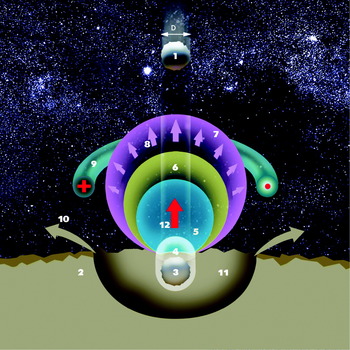
The scheme of the process of scattering of the plasma of the ‘impact origin’ is presented in Fig. 7. This scheme was created based on the measurements obtained from the scattering of a laser torch. This substitution has two explanations; firstly, these processes are rather similar and, secondly, it is almost impossible to conduct similar research for impact processes. However, it is highly probable that, in the process of the scattering of plasma of the impact origin, there will be similar physical fields.
Scheme of the main physical areas and fields of plasma torch, generated in the hypervelocity impact: 1 – meteorite (projectile); 2 – surface (target); 3 – meteorite and surface substance involved in the process of plasma generation; 4 – dense and hot nucleus of the torch; 5 – zone of adiabatic scattering of the plasma; 6 – zone of electrons flyaway without collisions; 7 – zone of hot electrons run away and formation of ion flux; 8 – vectors of the electric field; 9 – circular magnetic field; 10 – direction of target substance eruption during the formation of the crater; 11 – crater generated by the impact; 12 – axial magnetic field.

It is noteworthy that the hypothesis proposed (Managadze 2005a, 2005b, Reference Managadze2007, Reference Managadze2009) is strongly supported by the experimental study of the plasma torch generated under laser irradiation, providing a model of the impact torch. Note that local fields that are presumably generated in the plasma torch at the initial stage (or originally) are most likely unable to provide significant breaking of symmetry in the synthesis of isomers. However, the expected slight breaking of symmetry possibly increases with time and determines the ‘sign’ of chiral polarity for the bioorganic world. However, this weak field could keep the ‘polarity’ of spontaneous fields (Kondepudi & Prigozhin Reference Kondepudi and Prigozhin1999).
A high degree of organization of the plasma medium, where the enantiomers are synthesized, could occasionally promote global breaking of mirror symmetry in spontaneous processes. This, in turn, could have given rise to the synthesis of homochiralic macromolecular structures.
The hypothesis proposed for the possibility of mirror symmetry breaking in a plasma torch arose from experimental grounds. It was found in a previous experimental study of electromagnetic fields and linear-polarized emission of the laser-produced torch plasma, which is a close analogue of impact plasma. The analysis of these results suggests the correspondence of electric and magnetic fields of the torch to the local chiral physical field criteria. These fields can lead to the breaking of symmetry of enantiomers in the process of their synthesis.
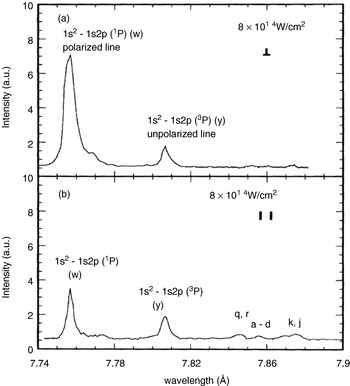
In turn, strong, non-equilibrium plasma processes accompanied by significant instabilities are capable of spontaneous breaking of symmetry through the ‘dissipative structures’. Thus, the results of measurements of the linearly polarized radiation observed in a plasma torch (Fig. 8 (Kieffer et al. Reference Kieffer, Matte, Chaker, Beaudoin, Chein, Coe, Mourou, Dubau and Inal1992, Reference Kieffer, Matte, Chaker, Beaudoin, Chien, Coe, Mourou, Dubau and Inal1993)) are evidence of a high degree of orientation of the vector of electric field, which occasionally reaches 100%. This suggests unusually strong anisotropy in the plasma medium of a torch, which is caused mostly by spontaneous processes. It is important that this radiation, combined with magnetic field, should also be capable of ensuring the emergence of what would be acknowledged as the “true” chiral factor.
Helium-like and lithium-like aluminium lines from a laser-produced plasma. The polarization components are resolved (Kieffer et al. Reference Kieffer, Matte, Chaker, Beaudoin, Chein, Coe, Mourou, Dubau and Inal1992, Reference Kieffer, Matte, Chaker, Beaudoin, Chien, Coe, Mourou, Dubau and Inal1993). These results are evidence of considerable breaking of isotropy in the plasma medium of a torch, presumably caused by spontaneous processes.

Presently, the effect of slight symmetry breaking in the plasma torch synthesis products, presumably in amino acids, is considered to be tentatively established. To confirm the symmetry breaking effect, repeated experiments with a much greater mass of synthesis products are required.
Protoviroid – primogenitor of the biospere
To accomplish the development and verify the viability of the new concept it is necessary to establish a modern hypothetical model for the primary form of living matter, which could be considered as a primogenitor of the modern biosphere. The main additional requirements of a photogenic being are connected with the necessity for an intelligible explanation for the acquisition of a primitive genetic code.
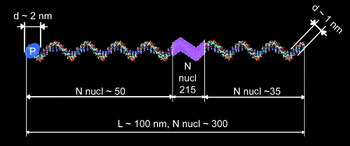
The hypothetical model of the protoviroid proposed by Altstein (Reference Altstein1987) was chosen as the primary form of living matter. This arises from the fact that this original hypothesis (the Progene Hypothesis) describes concretely and clearly the mechanism of the simultaneous appearance of the first gene, protein coding by this gene and the simplest genetic code. According to the model proposed, the protoviroid consists of two macromolecules, i.e., a polynucleotide or gene (of about 300 monomers) and a polypeptide (processive polymerase, ~100 amino acids). The protoviroid was reproduced by replication, transcription and translation processes. These processes were in general similar to respective modern processes. They used nucleotide triplets related to non-random amino acids. The protoviroid evolved according to the Darwin principle: inheritance–variability–natural selection. It was proposed as the first living creature on Earth, the parent of the biosphere. The protoviroid mass could be of about 105 a.m.u. The laboratory model of the impact processes has shown that it is possible to synthesize macromolecules comparable in mass and structure with the protoviroid in an atmosphereless environment in a plasma torch produced by the impact of a meteorite of only a few millimetres in diameter.
The block diagram of Altstein's protoviroid is shown in Fig. 9. The author created this diagram under Altstein's supervision. It is noteworthy that a 100 nm-long protoviroid fits well into the structure of Martian meteorite ALH-84001. What does this mean?
The block diagram of Altstein's protoviroid, consisting of one thread polynucleotide, including ~300 monomers and processive polymerase (designated by the letter P), including ~100 amino acids. The molecular mass of this formation is ~100 000–120 000 a.m.u. Colour spheres in polynucleotides are the following elements: blue is carbon, red is oxygen, dark blue is nitrogen, white (visible at magnification) is hydrogen and yellow is phosphor; the arrangement of elements corresponds to the molecular structure. As the polymerase moves along the string from left to right (from the 3′ end to 5′ end), complimentary polynucleotides are synthesized and polymerase is formed with the order of amino acids corresponding to the order of nucleotide triplets, i.e., the process translation developed.

Possessing considerable flexibility, the concept offered is applicable to a wide range of hypothetical models of primary forms of living matter, including that of the ancient ribonucleic acid (RNA) World, which implies a single-polymer structure consisting exclusively of RNA molecules (Spirin Reference Spirin2007).
The impact crater as survival area
A crater, where a high concentration of OC is reached, may be considered as a bowl of the future ‘warm water reservoir’, in which difficulties of ‘concentration break’ can be overcome and where necessary conditions for further evolutionary development of the protoviroid are provided.
The explosive scattering of a plasma torch has a spherical configuration. Therefore, a considerable part of the products of synthesis can be directed downwards relative to the vector of velocity and remain on the crater bottom. For a torch of laser origin, the small depth of a crater and the absence of the body of a meteorite in the upper hemisphere provides equal streams of products of synthesis upwards and downwards. This has been proved experimentally. After the influence of the laser on the crater bottom, the target showed the presence of products of the synthesis of OC that were initially absent.
In the case of meteoric impact, the overall picture of the spatial distribution of products would have been different.
This is connected with the fact that, in the course of a blow, the upper hemisphere is blocked by the meteorite body and a hot plasma medium with ultrahigh density appears between the colliding bodies. Therefore, until the meteorite body is completely evaporated, the upper hemisphere is partially closed for scattering of the plasma torch. It is closed partially because plasma is nevertheless thrown out in a backlash, which is formed between the meteorite and the surface. As a meteorite penetrates into Earth's surface, an intermediate crater is formed. This intermediate formation is three times as deep and five times as great in diameter as the meteorite (Ivanov Reference Ivanov, Adushkina and Nemchinov2005b). Therefore, in this configuration, until the clearing of the meteorite body from the upper hemisphere, a considerable part, not less than 65% of the synthesis products, could have appeared on the walls and the bottom of the intermediate crater.
Hence, as a meteorite is 1 km in diameter, the bottom of a 3 km-deep intermediate crater could have been sated by simple and complex organic molecules. At the final stage of the formation of the crater, organic products of synthesis occur up to a depth of 3 km. In rare instances considerable heating of the matter in the impact zone results in thawing ice under the surface and, hence, the appearance of water.
It is possible to assert that ‘hothouse’ conditions for a meteorite of 1 km could have remained with high probability for 1 million years, while the time of cooling for a crater formed by the blow of a meteorite of 10 km is 10 m.y. (Ivanov Reference Ivanov2004). It is noteworthy that, during the first 200 m.y. of its existence, Earth's surface was bombarded by 1010 1-km sized meteorites and 107 of size 10 km (Ivanov Reference Ivanov, Adushkina and Nemchinov2005a; Pechernikova & Vityazev Reference Pechernikova, Vityazev, Adushkin and Nemchinov2005).
These areas, which were widespread on early Earth, could have provided the emergence, survival and evolution of primary forms of living matter and played a key role in the origin of life.
Discussion
A distinctive feature of the meteoric impact as a natural phenomenon is the fact that all major processes considered above promoting the establishment of primary forms of life developed simultaneously. The efficiency of the process is provided by the high density of substance, which is 106 times as dense as the atmosphere, as assumed in the traditional scenario, and the power density is 1018 times as great as the solar radiation.
In contrast to the traditional scenario, the scenario proposed means stage-by-stage development (Dickerson Reference Dickerson1978) of a regenerative atmosphere – the synthesis of monomers and their associations in polymers and isolation of these polymers by the formation of primary living matter, as well as the presence of solar energy within a time considerably shorter than several hundred m.y.
In the scenario proposed, the initial conditions are correctly determined by factual evidence from space or by calculations reproducing the processes of Earth's formation. In particular, characteristic sizes and the time of events are reconstructed based on lunar craters, meteorite composition is determined based on the composition of carbonaceous chondrites and the nuclei of comets, and the average velocity of the impact of planetesimals or comets is based on calculations.
The time of preservation of heat in the impact crater is determined by a simple formula, in which it is necessary to include only two parameters: the energy of the impact and the heat conductivity of geological rock (Ivanov Reference Ivanov2004). These parameters are easy to determine in each concrete case. This allows one to conduct laboratory modelling of the new mechanism with good accuracy. If this is the case, the symmetry breaking with the same ‘sign of chiralitys’ of enantiomers, i.e., the prevalence of L-amino acids, is expected both in outer space and on Earth. On Earth these conditions are fulfilled. The study of alanine amino acid in the Marchison meteorite (Engol et al. Reference Engol, Macko and Sifler1990) has shown that L-enantiomers prevailed in its chemical content; in particular, the D/L enantiomer's ratio was 0.85±0.05. For glutamine amino acid, the D/L ratio was equal to 0.54. The author indicated that the experimentally observed violation of symmetry cannot be explained by Earth impurities.
The estimations were made for interstellar gas-dust clouds (Bochkarev Reference Bochkarev1992) of the organic compounds yield efficiency in the processes of hypervelocity collision and, in particular, for dust particles and the classical mechanism of molecules' synthesis on the surface of dust particles (Dolgarno Reference Dolgarno and Evrett1979). It was expected that only 10% of dust particles would reach v cr (Spitzer Reference Spitzer1978), and the yield efficiency of molecular ions in the impact processes would also be 10% (Brinckerhoff et al. 2004). According to the data obtained, the yield efficiency for particles of 10−5 cm in diameter is about 102 times higher than the case of impact processes and increases with diameter (Managadze et al. Reference Managadze, Brinckerhoff and Chumikov2003a).
At the early stage of the formation of Earth's surface, the energy contribution of meteorite impacts is estimated to be from approximately 1022 (Kobayashi & Saito Reference Kobayashi, Saito, Akabosh, Full and Neverro-Gonzales2000) to 2× 1024 eV m−2 per year (Grieve Reference Grieve1980). The results of impact experiments with carbon particles with the mass 10−14 g and velocity of approximately 16 km s−1 show that, on average, the formation of 1 molecule of approximately 100 a.m.u. requires approximately 100 eV of energy. Based on these data it is possible to derive the number of organic molecules that were synthesized under the impact of carbonaceous chondrites moving at a speed of approximately 15–20 km s−1, containing on average approximately 3% carbon and providing energy of approximately 1024 eV m−2 per year. This provides the synthesis of 1020–1021 molecules/m2 per year, which is more than two orders of magnitude higher than the respective values obtained under the influence of other natural factors, such as UV radiation of the Sun, volcanic heat, cosmic rays, radioactivity and electric discharges, i.e., generally accepted efficient energy sources of organic compounds synthesis. In addition, the energy contribution of a meteorite impact is almost equal to, or higher than, the energy contribution of the above-mentioned energy sources (Kobayashi & Saito Reference Kobayashi, Saito, Akabosh, Full and Neverro-Gonzales2000).
The above estimates show that the contribution of hypervelocity impact in the processes of organic compounds synthesis in space and on early Earth probably dominated.
There is a number of independent data that confirm the concept proposed. This is primarily related to the fact of mirror symmetry breaking in the amino acids from the meteorite Murchison, where the asymmetry sign coincides with that of the bioorganic world (Engol et al. Reference Engol, Macko and Sifler1990). This indicates the universal nature of the mechanism of their formation. Compounds, such as carbines and fullerenes, were obtained in the above-mentioned modelling experiment. The detection of carbines in the Ries meteoric crater in Germany (Goresy & Donnay, Reference Goresy and Donnay1968) and fullerenes in the Chicxulub impact crater in Mexico (Heymann et al. Reference Heymann, Chibante, Brooks, Woldbach, Smith, Korochantsev, Nazarov and Smalley1996) formed after the falling of the Yucatan meteorite 65 million years ago show the identity and universality of the processes in plasma torches.
It is possible that the mechanism proposed may turn out to be the only one in nature that simultaneously provides the synthesis of complex OCs, ordering, the mirror symmetry breaking of isomers and produces the area of survival of living matter.
It is important that the appearance of the macromolecular structure resembling the protoviroid is of little probability, even in the course of flyaway of the plasma torch. The time of scattering of a torch is suitable for ‘instantaneous origin.’ In addition to the conditions mentioned above and the absence of dense atmosphere, the overcritical velocity of impact of a meteorite of at least 1–2 mm in diameter is required.
However, ‘slow origin’ of the protoviroid in an impact crater, which according to Altstein (Reference Altstein1987) could have taken approximately 10–15 minutes, is also possible.
It is noteworthy that the possibility of OC synthesis through a biotic mechanism is proved in nature by the presence of life. Therefore, the scenario proposed here and the universal mechanism of its realization, which is fundamentally new, should not be taken as ‘another’ proof of possibility of a biogenic synthesis or ‘one of the probable ways’ of its implementation.
A distinctive feature of the new concept is the fact that the scenario proposed works with high probability, even in the case of the minimum initial requirements, and the mechanism of realization is a uniform fast proceeding catalytic process, which provides and supports chemical reactions of synthesis with the fast removal of intermediate products, which are involved in subsequent reactions.
This provides the synthesis of complex polymeric OCs in a single impact event, where large-scale destructive processes caused by the impact are combined with much weaker ordering, which can provide general growth of entropy in conjugated processes of this type.
We estimated the efficiency of the OC yield induced by hypervelocity collisions of dust particles in the interstellar gas-dust clouds. According to these estimates, the ratio of H and He atoms concentration to the dust particles concentration is approximately 108 and only 10% of dust particles reach the overcritical velocity. The results indicate that collisions of dust particles are extremely rare due to their low concentration. However, because of the ultra-low temperature of interstellar space, a total yield of OC at hypervelocity collision of dust at the generation of a plasma torch is significantly higher than the OC yield in the commonly accepted mechanisms that are based on the formation of molecules in the gas phase or the sticking and association of atoms on the surface of dust particles.
An important feature of the new concept is the possibility of its experimental verification and, in particular, in experiments with the collision of two bodies, projectile and target, launched from counter-flying satellites (Managadze & Eismont Reference Managadze and Eismont2009). This configuration provides an overcritical velocity (~16 km s−1) impact and simultaneous measurements of the mass of synthesized organic compounds by the prototype of LIMA-D onboard TOF mass-spectrometer developed for remote sensing of Phobos in 1986 (Managadze & Shutyev Reference Managadze, Shutyev, Vertes, Gijbels and Adams1993).
Conclusions
Previously unknown properties of the plasma torch, arising at the hypervelocity collision of fragments of matter, are revealed in experiments. The adiabatic flyaway of the plasma torch gives rise to the synthesis, arrangement and ordering of complex OCs and presumably to the breaking of mirror symmetry in the enantiomers synthesized.
Based on these properties of the plasma torch, the newly established mechanism of synthesis of OCs could have occurred on early Earth due to the hypervelocity impact of meteorites and in interstellar dust-gas clouds due to hypervelocity collision of dust particles.
Experimental studies of the plasma torch have shown that the arising strongly non-equilibrium plasma medium, which is far from the thermodynamic equilibrium, can be regarded as a dissipative structure with a high catalytic activity, capable of providing strong spontaneous breaking of mirror symmetry in the plasma medium, with the formation of homochiralic molecular structures.
The results of experimental studies show that the environment that forms in the process of the expansion of the plasma torch and that has all the properties of a “truly” chiral environment is capable of producing local chiral physical fields with a stable asymmetry “sign” that trigger a weak breaking of the enantiomer symmetry. When such a field acts as a “trapping field” on spontaneous processes, the dissipative structures that form in the highly nonequilibrium plasma may result in a spontaneous breaking of symmetry and the formation of homochiral molecular structures with the preservation of the asymmetry “sign” of local chiral physical fields of the plasma torch.
Complex analysis of the above-stated properties of the plasma medium suggests that the plasma torch of the meteorite impact provides the necessary conditions for the appearance of primary forms of living matter.
It is shown that the crater of meteoric impact could have been the zone of the origin of primary forms of living matter, which provided survival and evolutionary development for the time range from one hundred thousand to several million years. Thus, the high concentration of organic compounds was combined with the moderate temperature necessary for thawing ice and providing an aquatic zone of survival.
Complex OC and viable molecular structures synthesized in the plasma torch during meteoric impact could have penetrated into deep layers of rocks or water reservoirs located under the surface of planets and their satellites, with extreme superficial temperatures and, hence, could have given rise to the extraterrestrial form of life.
The results received testify that the primary form of life, along with the medium for survival and evolution on Earth, could have arisen at the stage of the formation of the planet due to ‘instant’ processes of meteoric impact. However, an infinite quantity of attempts was required for this purpose.
An insight into the physical basis of the new concept and the scenario of its realization requires certain knowledge of the physics of plasma and plasma chemistry and the physics of hypervelocity impact. This knowledge allows the settled perception of this natural phenomenon to be changed considerably. A large meteorite fall, with the formation of a huge plasma torch, should not be regarded as only the most powerful and destructive influence of planetary scale with catastrophic consequences. This event may have a creative effect, which gave rise to an exceptional form of matter, which eventually resulted in the development of mankind.
Acknowledgements
We are grateful to A. Altstein, V. Avetisov, V. Afonin, W. Brinckerhoff, O. Chkhetiani, V. Davankov, E. Nikolaev and D. Papadopulos for the discussion and valuable advice, to A. Rukhadze, G. Sarkisov and Yu. Kasyanov for their interest in this work and to A. Chumikov, N. Managadze and D. Moiseenko for their participation in the experiments and the preparation of the publication.