Introduction
Cerebellar dysfunction has been proposed to explain the heterogeneity of cognitive-affective deficits and symptoms observed in schizophrenia (Schmahmann, Reference Schmahmann1991; Andreasen & Pierson, Reference Andreasen and Pierson2008). Consistent with this notion, studies have reported reduced total cerebellar or vermian volume in established schizophrenia (Ichimiya et al. Reference Ichimiya, Okubo, Suhara and Sudo2001; Loeber et al. Reference Loeber, Cintron and Yurgelun-Todd2001; Ho et al. Reference Ho, Mola and Andreasen2004; Picard et al. Reference Picard, Amado, Mouchet-Mages, Olie and Krebs2008), during the early stages of psychosis (Okugawa et al. Reference Okugawa, Nobuhara, Takase and Kinoshita2007; Charalambides et al. Reference Charalambides, Lappin, Morgan, Morgan, Fearon, Okon-Rocha, Jones, Murray and Dazzan2009), and also longitudinally with the onset of psychosis (Pantelis et al. Reference Pantelis, Velakoulis, McGorry, Wood, Suckling, Phillips, Yung, Bullmore, Brewer, Soulsby, Desmond and McGuire2003; Borgwardt et al. Reference Borgwardt, McGuire, Aston, Gschwandtner, Pfluger, Stieglitz, Radue and Riecher-Rossler2008). The cerebellum is rich in cannabinoid receptors (Ashton et al. Reference Ashton, Appleton, Darlington and Smith2004) and deficits in cerebellar-dependent functions such as internal self-paced timing (O'Leary et al. Reference O'Leary, Block, Turner, Koeppel, Magnotta, Boles Ponto, Watkins, Hichwa and Andreasen2003), classical eyeblink conditioning (Skosnik et al. Reference Skosnik, Edwards, O'Donnell, Steffen, Steinmetz and Hetrick2008) and oculomotor function (Huestegge et al. Reference Huestegge, Radach and Kunert2009) have been demonstrated in humans following acute or chronic cannabis use. These cerebellar-mediated processes are aberrant in schizophrenia (Picard et al. Reference Picard, Amado, Mouchet-Mages, Olie and Krebs2008) and long-term heavy cannabis use in general can lead to cognitive deficits that are similar to those evident in schizophrenia (Solowij & Michie, Reference Solowij and Michie2007). We have previously reported preliminary data suggestive of smaller cerebellar volumes in cannabis users (Ward et al. Reference Ward, Solowij, Peters, Otton, Chesher and Grenyer2002). More recently, we reported bilaterally reduced hippocampal and amygdala volumes in long-term heavy cannabis users compared with non-user controls (Yücel et al. Reference Yücel, Solowij, Respondek, Whittle, Fornito, Pantelis and Lubman2008), with hippocampal reduction (12%) of a magnitude similar to that seen in schizophrenia (Wright et al. Reference Wright, Rabe-Hesketh, Woodruff, David, Murray and Bullmore2000; Velakoulis et al. Reference Velakoulis, Wood, Wong, McGorry, Yung, Phillips, Brewer, Proffitt, Desmond and Pantelis2006). Moreover, smaller left hippocampal volume in the cannabis users was significantly correlated with cumulative exposure to cannabis and also with cannabis exposure-related subclinical psychotic symptoms in these otherwise healthy adults. The accumulating evidence suggests that cannabis use may lead to the development of cognitive deficits, psychotic symptoms and specific regional brain alterations. No studies have examined the effects of cannabis use on cerebellar structural integrity in adult long-term heavy cannabis users with or without schizophrenia.
In this study we examined the effects of very long-term and heavy cannabis use on cerebellar structure in a sample of patients with chronic schizophrenia and also in otherwise healthy individuals. We hypothesized that cannabis use would be associated with reduced cerebellar volume compared to non-use, and that this reduction would be greater in schizophrenia patients with co-morbid cannabis use. If confirmed, the finding would suggest that heavy cannabis use is not only harmful to the human brain but also especially harmful to already vulnerable individuals, such as those with psychotic illnesses.
Method
Participants, substance use and symptom measures
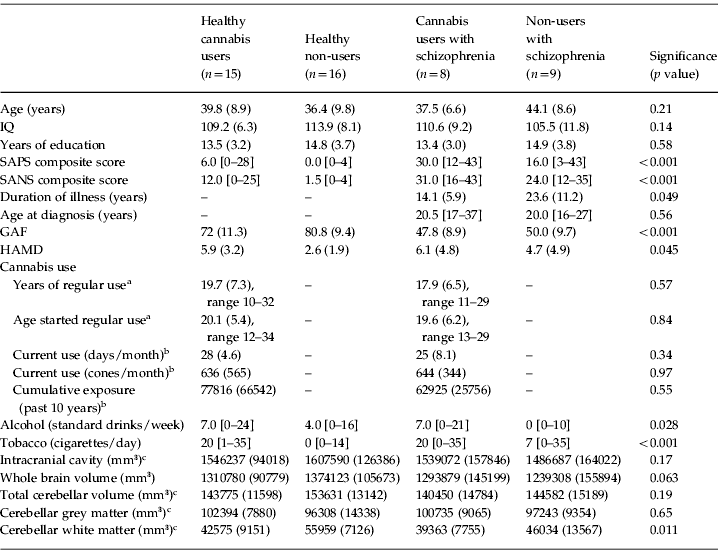
Right-handed males were recruited from the general community, by referral from psychiatrists or through the Australian Schizophrenia Research Bank (ASRB), to form the following comparison groups: otherwise healthy long-term heavy cannabis users (THC; n=15); healthy non-user controls (CON; n=16); cannabis users with schizophrenia (SZ+THC; n=8) and non-users with schizophrenia (SZ–THC; n=9). The SZ–THC group was recruited to match the clinical and demographic characteristics of the SZ+THC group. Clinical and demographic characteristics and substance use were assessed by structured interview, and drug use was confirmed by urinalysis. Cannabis users with and without schizophrenia had similar levels of current use and very extensive cannabis use histories (near daily use for 9–32 years). Cannabis use had generally preceded the onset of schizophrenia by several years. No participant had used any other illicit substance regularly (i.e. ⩽10 lifetime episodes) and alcohol use was limited to <24 standard drinks per week. Overall, there was a significant difference between groups in alcohol use (standard drinks/day; χ2=9.12, p=0.028) and tobacco use (cigarettes/day; χ2=25.06, p < 0.001). This was due to the healthy control group using significantly less tobacco than any other group (p < 0.057–0.001) and the SZ–THC group using less alcohol than either of the non-schizophrenia groups (p=0.005 and 0.02). Alcohol and tobacco use were included as covariates in the analyses. All groups were matched on age (range 21–60 years), pre-morbid IQ (National Adult Reading Test) and years of education. Demographic, clinical and substance use characteristics are provided in Table 1.
Demographic, clinical, drug use and MRI volumetric measures

MRI, Magnetic resonance imaging; SAPS, Scale for the Assessment of Positive Symptoms; SANS, Scale for the Assessment of Negative Symptoms; GAF, Global Assessment of Functioning; HAMD, Hamilton Depression Rating Scale.
Values given as mean (standard deviation) or median [range].
a Regular use was defined as at least twice a month.
b Cannabis users had used at this level for the majority of their drug-using careers; a ‘cone’ is the small funnel into which cannabis is packed to consume through a water pipe in a single inhalation. Without the loss of sidestream smoke, the quantity of tetrahydrocannabinol (THC) delivered by this method is estimated as equating three cones to one cigarette-sized joint. Thus, the cannabis users with and without schizophrenia smoked the equivalent of 213 joints per month, or approximately seven joints per day. Estimates of lifetime dose beyond 10 years in these very long-term users became skewed and unreliable, hence the 10-year estimate was used in correlational analyses.
c Total, grey and white-matter volumes represent means corrected for intracranial cavity and adjusted for differences in alcohol and tobacco use across samples.
The Structured Clinical Interview for DSM-IV Axis I Disorders (SCID) was used to screen for any psychiatric disorders among healthy participants, and to confirm a schizophrenia diagnosis. All patients were stabilized on atypical antipsychotic medication (except for one currently antipsychotic free in the SZ–THC group). Estimated chlorpromazine equivalent doses did not differ between SZ+THC and SZ–THC (median 200 mg in each group; p=0.54). The duration of illness (years since diagnosis) was longer in the SZ–THC group compared with SZ+THC (t=2.14, p=0.049), but there was no difference in the duration of the prodrome (p=0.37) or the total number of hospitalizations (p=0.48). Psychotic symptoms were assessed using the Scales for the Assessment of Positive and Negative Symptoms (SAPS and SANS; Andreasen, Reference Andreasen1983). Patients had significantly higher SAPS and SANS composite scores than healthy participants (Table 1), and SZ+THC had non-significantly higher symptom scores than SZ–THC (SAPS: p>0.2; SANS: p>0.09). Healthy cannabis users had significantly higher SAPS and SANS scores than healthy non-users (SAPS: z=3.57, p<0.001; SANS: z=3.66, p<0.001). Depressive symptoms, assessed by the Hamilton Depression Rating Scale (HAMD) and Global Assessment of Functioning (GAF), also differed between the four groups (Table 1). HAMD scores were significantly higher in THC (t=2.60, p=0.013) and in SZ+THC (t=2.33, p=0.024) compared to CON, and GAF scores were lower in both schizophrenia groups compared to both THC (SZ+THC: t=5.53, p<0.001; SZ–THC: t=5.21, p < 0.001) and CON (SZ+THC: t=7.63, p<0.001; SZ–THC: t=7.39, p<0.001) and in THC compared to CON (t=2.45, p=0.018).
All protocols were approved by the University of Wollongong and South Eastern Sydney and Illawarra Area Health Service Human Research Ethics Committee and the study was performed according to approved guidelines and regulations. After complete description of the study to the participants, written informed consent was obtained. Patients were deemed by their psychiatrists, case managers or ASRB assessors to have the capacity to provide informed consent.
Magnetic resonance imaging (MRI) procedures and measurements
MRI data were obtained using a Phillips Intera 3-Tesla scanner at the Symbion Clinical Research Imaging Centre, Prince of Wales Medical Research Institute, Sydney, Australia. A three-dimensional volumetric spoiled gradient recalled (SPGR) sequence generated 180 contiguous coronal slices. Imaging parameters were: echo time (TE)=2.9 ms; repetition time (TR)=6.4 ms; flip angle=8°; matrix size 256×256; 1 mm3 voxels.
Cerebellar volumes were delineated using semi-automated methods adapted from a parcellation technique developed in our laboratory (Yücel et al. Reference Yücel, Stuart, Maruff, Velakoulis, Crowe, Savage and Pantelis2001). In brief, a cerebellar template was initially created from the original Montreal Neurological Institute (MNI) Colin27 MRI brain image using a manual tracing method. The original MNI image was then warped and registered onto each target brain using 168 parameters of the Automated Image Registration (AIR) 5.25 package. Using these warp parameters, the cerebellum template from the MNI brain was then registered to each target brain to create a cerebellar mask. Each mask was algebraically multiplied with the target brains to produce a cerebellum grey-scale image. To avoid susceptibility to partial voluming and inhomogeneity effects, grey and white tissue volumes of the whole cerebellum were obtained by algebraically multiplying the binary cerebellar mask for each image with segmented grey and white tissue matter images of the whole brain extracted using the FSL Functional Automated Segmentation Tool (Zhang et al. Reference Zhang, Brady and Smith2001). Reliability analyses were conducted between manual tracing methods and the current semi-automated method for 10 randomly selected brains and obtained intraclass coefficient correlations of 0.98 for grey matter and 0.99 for white matter. Cerebellar data were normalized for variation in total intracranial volume between all individuals using a covariance method described by Free et al. (Reference Free, Bergin, Fish, Cook, Shorvon and Stevens1995).
Statistical analysis
Data were examined for outliers and normality. The primary measures for analysis (i.e. cerebellar volumes, cannabis use measures) were normally distributed and group differences investigated using analysis of covariance (ANCOVA), with alcohol and tobacco use as covariates. Planned contrasts (least significant difference) examined differences between cannabis users and controls within the healthy (THC versus CON) and schizophrenia samples (SZ+THC versus SZ – THC), and also between healthy cannabis users and users and non-users with schizophrenia (THC versus SZ+THC and THC versus SZ – THC). Relationships between cerebellar volumes and cannabis use measures or psychological symptoms were examined using two-tailed Pearson product-moment correlations for normally distributed data, or Spearman rank order correlations for skewed data (e.g. SAPS, SANS scores).
Results
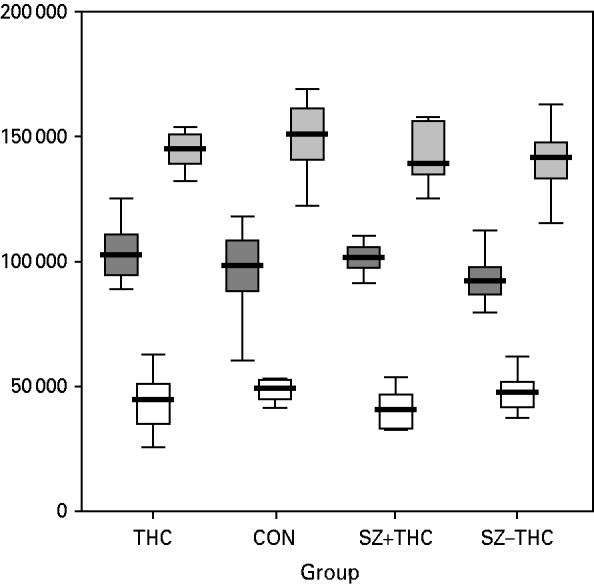
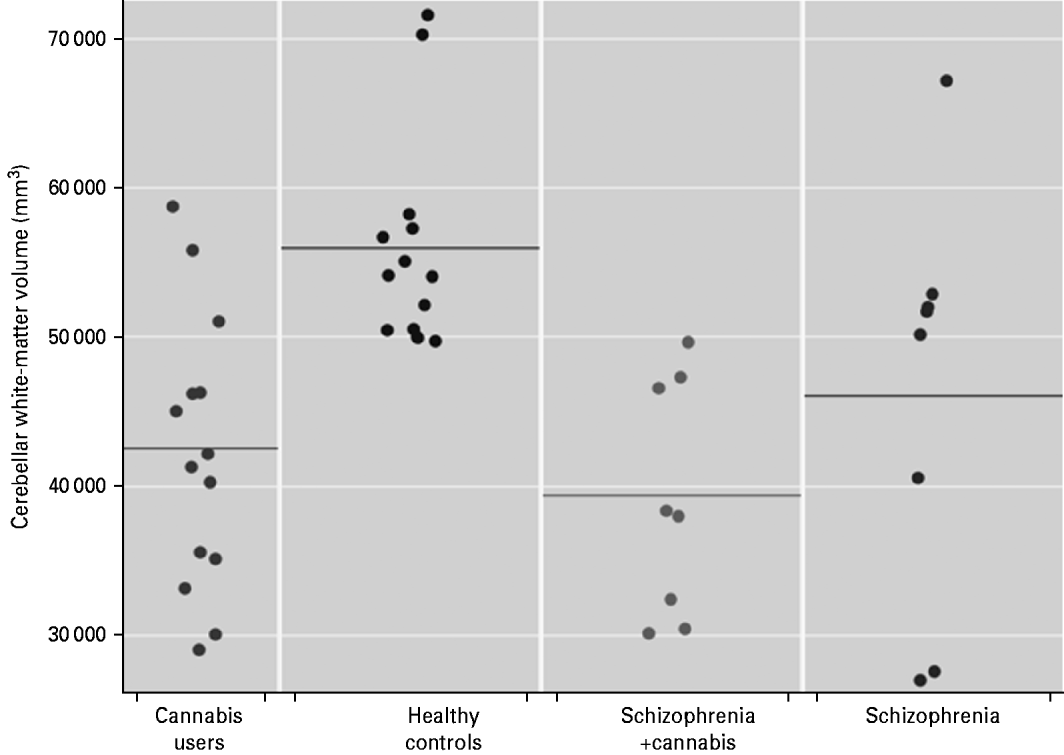
Cerebellar grey-matter, white-matter and total volumes are reported in Table 1 and depicted in Figs 1 and 2. ANCOVA with current levels of alcohol and tobacco use as covariates determined a significant overall difference between the four groups in white-matter volume [F(3, 38)=4.23, p=0.011], but groups did not differ in grey matter [F(3, 38)=0.55, p=0.65] or total cerebellar volume [F(3, 42)=1.68, p=0.19]. Whole-brain white-matter volume did not differ between groups [F(3, 42)=0.58, p=0.63] and its inclusion as a covariate in the analysis of cerebellar white-matter volume did not alter the significant overall group difference [F(3, 37)=3.70, p=0.02]. Similarly, whole-brain grey-matter and total volume did not differ significantly between groups [F(3, 42)=2.20, p=0.10; F(3, 42)=1.83, p=0.16 respectively], and their inclusion as covariates in respective analyses of cerebellar grey-matter and total cerebellar volume did not alter the lack of overall group differences found for those measures [cerebellar grey matter: F(3, 37)=0.53, p=0.66; cerebellar total volume: F(3, 41)=0.85, p=0.47]. These results indicate the specificity of group differences to cerebellar white-matter volume.
Cerebellar total ( ), grey-matter (
 ) and white-matter (□) volumes by group (corrected for intracranial cavity).

Cerebellar white-matter volume by group (corrected for intracranial cavity and adjusted for differences in alcohol and tobacco use).

Pairwise comparisons revealed that the THC group had a 23.9% smaller white-matter volume than CON (t=3.04, p < 0.004) with a large effect size [Cohen's d=1.32, 95% confidence interval (CI) 0.41–2.1]. White-matter volume was also significantly smaller relative to CON in the schizophrenia groups: by 29.7% in SZ+THC (t=3.30, p=0.002, Cohen's d=1.63, 95% CI 0.50–2.48) and by 17.7% in SZ – THC (t=2.13, p=0.037, Cohen's d=1.0, 95% CI 0.01–1.84). SZ+THC and SZ – THC did not differ in white-matter volume (p=0.20), yet the difference between these groups showed a medium effect size (Cohen's d=0.64, 95% CI –0.39 to 1.61). The THC group did not differ in white-matter volume from either of the schizophrenia groups (SZ+THC: p=0.45; SZ – THC: p=0.45). White-matter differences between THC and CON and SZ+THC and CON remained significant when lifetime estimates of exposure to alcohol and tobacco were controlled (THC versus CON: t=2.28, p=0.029; SZ+THC versus CON: t=2.43, p=0.02), but the difference between SZ – THC and CON was no longer significant (p=0.09). GAF did not correlate with cerebellar volumetric measures (p> 0.13), but the HAMD score correlated inversely with both white-matter (p=0.058) and total cerebellar volume (p=0.01), but not grey matter (p=0.60) in the entire sample. Controlling for HAMD in the analysis retained the significant group differences for white matter (THC versus CON: t=2.73, p=0.01; SZ+THC versus CON: t=2.96, p=0.005; SZ – THC versus CON: t=1.94, p=0.06).
An overall interaction between schizophrenia diagnosis and cannabis use status did not reach significance for white-matter volume [F(1, 38)=1.15, p=0.29], but the main effect of cannabis use (regardless of diagnosis) was highly significant [F(1, 38)=7.76, p=0.008]. The main effect of diagnosis (schizophrenia versus healthy sample regardless of cannabis use) was also significant [F(1, 38)=4.31, p=0.045].
Total cerebellar volume correlated marginally and inversely with the duration of regular cannabis use in healthy cannabis users (r=–0.49, p=0.06). Age also correlated inversely with total cerebellar volume in this subgroup (r=–0.53, p=0.04), but not in any other subgroup nor in the overall combined sample (r=–0.19, p=0.20). Partial correlations in THC alone showed that neither age nor duration of cannabis use remained significantly correlated with total volume after controlling for the other, suggesting that both increasing age and duration of exposure to cannabis may be related to smaller cerebellar volume. Despite the association between duration of use and total cerebellar volume in healthy users, no such relationship was apparent in the SZ+THC group (p > 0.70). Age also correlated inversely with white-matter volume in the overall combined sample (r=–0.40, p=0.007), with a trend in healthy controls (r=–0.50, p=0.07) but not in the other subgroups. The groups did not differ in age and the differences between groups in white-matter volume remained significant after controlling for the effect of age [F(3, 36)=3.14, p=0.037]. No other cannabis use measures correlated with any measure of cerebellar volume in either THC or SZ+THC or the combined cannabis-using sample.
The SAPS composite score correlated positively with white matter in the SZ+THC group (Spearman's ρ=0.72, p=0.022) but inversely with total volume in the SZ–THC group (Spearman's ρ=–0.70, p=0.018). No associations between SAPS composite scores and cerebellar volumes were evident in the healthy cannabis users, and SANS composite scores did not correlate with cerebellar volumes in any group. The duration of illness correlated significantly and inversely with total cerebellar volume in the SZ – THC group only (r=–0.71, p=0.032), with a trend apparent also for grey matter (r=–0.69, p=0.06). No trends in this direction were apparent in SZ+THC (total: p=0.31; grey matter: p=0.90). After controlling for differences in duration of illness, a trend towards a difference between SZ+THC and SZ – THC in white-matter volume emerged [F(1, 11)=3.25, p=0.09] (smaller in SZ+THC) but there were no differences in grey matter (p=0.51) or total volume (p=0.26). In the SZ–THC group, there were also trends towards smaller total cerebellar volume (r=0.62, p=0.078) and smaller grey-matter volume (r=0.69, p=0.058) the earlier the age at onset of illness, with no such association in SZ+THC (total: p=0.86; grey matter: p=0.51). Given these bidirectional differences between SZ+THC and SZ – THC, we performed a subsequent analysis in which clinically relevant variables (duration of illness, SAPS, SANS, GAF and HAMD scores, and alcohol and tobacco use measures) were included as covariates in the analysis, and a significant difference in white matter emerged between these schizophrenia groups [F(1, 7)=7.33, p=0.03].
Discussion
The primary finding of this study is of significantly smaller cerebellar white-matter volume in cannabis users compared to non-users, with the greatest reduction relative to healthy controls evident in schizophrenia patients with co-morbid cannabis use. White-matter volume was 23.9% smaller in healthy cannabis users and 29.7% smaller in schizophrenia patients who used cannabis. Our analyses indicate that cannabis use and schizophrenia are both independently associated with smaller cerebellar white-matter volume; schizophrenia patients who did not use cannabis also showed a 17.7% reduction in white matter relative to healthy controls. However, the results suggest that cannabis use may confer a relatively greater adverse effect on cerebellar white matter than schizophrenia. Effect size analyses also indicated that the largest effect observed (i.e. the greatest reduction in cerebellar volume relative to healthy controls) was when cannabis use was co-morbid with schizophrenia. To our knowledge, this is the first report demonstrating cerebellar white-matter structural anomalies in association with cannabis use in chronic schizophrenia patients and in otherwise healthy adults. As a cross-sectional investigation, however, it cannot be determined whether these anomalies resulted from or preceded cannabis use.
Integration with other studies of brain structure in cannabis users
Our findings accord in general with three recent studies that indicate brain structural alterations in cannabis-using first-episode psychosis patients and, more specifically, with growing observations of white-matter anomalies in otherwise healthy cannabis users. In first-episode psychosis patients, decreased grey-matter volumes of the anterior cingulate (Szeszko et al. Reference Szeszko, Robinson, Sevy, Kumra, Rupp, Betensky, Lencz, Ashtari, Kane, Malhotra, Gunduz-Bruce, Napolitano and Bilder2007), right posterior cingulate cortex and left hippocampus (Bangalore et al. Reference Bangalore, Prasad, Montrose, Goradia, Diwadkar and Keshavan2008) were reported among those who used cannabis compared to their non-using counterparts and to healthy controls. Trends towards smaller left and right cerebellar volumes were also apparent (Bangalore et al. Reference Bangalore, Prasad, Montrose, Goradia, Diwadkar and Keshavan2008). Rais et al. (Reference Rais, Cahn, Van Haren, Schnack, Caspers, Hulshoff Pol and Kahn2008) reported more pronounced total cerebral grey-matter volume reduction over 5 years in first-episode schizophrenia patients who used cannabis compared to those who did not (2.67%) and also compared to healthy controls (5.09%), with greater lateral and third ventricle enlargements. The results were suggested to explain some of the detrimental effects of cannabis use in schizophrenia patients.
In a recent study of otherwise healthy cannabis-using adolescents (28-day abstinent), Medina et al. (Reference Medina, Nagel and Tapert2010) reported larger cerebellar inferior posterior vermis volumes relative to controls and these were associated with poorer executive function. However, we are not able to compare our findings directly with this latter study as we did not parcellate the vermis, Medina et al. (Reference Medina, Nagel and Tapert2010) were unable to parcellate white matter from grey matter (given their lower resolution MRI protocols), there are large age differences between the samples, and we also included chronic schizophrenia patients. In a previous study, Medina et al. (Reference Medina, Nagel, Park, McQueeny and Tapert2007) found an association between whole-brain white-matter volume and depressive symptoms on the HAMD in cannabis-using adolescents. A similar relationship with cerebellar white-matter volume was revealed in the overall combined sample of this study, but white-matter volume remained significantly reduced in cannabis users after controlling for HAMD scores, which were not in the clinically significant range. Whole-brain white-matter volume did not differ between groups in our study, and differences in cerebellar white-matter volume were retained after controlling for whole-brain white-matter volume, indicating specificity.
Pathology in white-matter structural integrity has recently been reported in diffusion tensor imaging (DTI) studies of young adult (Arnone et al. Reference Arnone, Barrick, Chengappa, Mackay, Clark and Abou-Saleh2008; Allin et al. Reference Allin, Khan, Walshe, Kontis, Nosarti, Barker, Rifkin and Murray2009) and adolescent (Ashtari et al. Reference Ashtari, Cervellione, Cottone, Ardekani and Kumra2009) cannabis users in the corpus callosum and various frontotemporal, occipitofrontal and posterior connections that develop during adolescence. It is suggested that cannabis use, particularly during adolescence, may affect the trajectory of normal brain maturation resulting in white-matter aberrations.
White-matter changes may reflect an altered trajectory of normal development or premature ageing
In our sample, regular cannabis use commenced around age 19–20, but initiation to cannabis use occurred a year or two prior to regular use, and some participants commenced regular use as early as age 12–13. Neurodevelopmental processes such as myelination, dendritic proliferation and synaptogenesis in the cerebellum are thought to occur through childhood, adolescence and young adulthood. Cerebellar grey matter has been shown to decrease whereas white matter increases between the ages of 15 and 19 in healthy adolescents (Parker et al. Reference Parker, Mitchell, Kalpakidou, Walshe, Jung, Nosarti, Santosh, Rifkin, Wyatt, Murray and Allin2008). The cerebellum reaches maturity late, with changes occurring through the late 20s and early 30s, akin to the late development of prefrontal cortex. There is evidence that the developing brain may be particularly sensitive to the effects of drugs and substance abuse, resulting in aberrant brain developmental processes (Lubman et al. Reference Lubman, Yücel and Hall2007). Whether the reduction in white matter that we report in cannabis users with and without schizophrenia may be interpreted in this manner requires further prospective research.
Smaller white-matter volume might also reflect premature ageing. Cerebellar white-matter volume gradually declines between the ages of 18 and 99 and more rapidly than grey matter (Andersen et al. Reference Andersen, Gundersen and Pakkenberg2003; Pieperhoff et al. Reference Pieperhoff, Hömke, Schneider, Habel, Shah, Zilles and Amunts2008). Total cerebellar volume in the healthy cannabis users of our study decreased with the duration of regular cannabis use, and with age, which may give credence to premature ageing effects in association with cannabis use. Because white-matter volume did not correlate with any specific measure of cannabis use, the findings cannot be interpreted as dose related. It remains possible that smaller cerebellar white-matter volume preceded cannabis use and may somehow be related to a propensity or predisposition to use cannabis. Longitudinal studies are required before these results could be interpreted as a true reduction, implying change from a baseline state.
Potential mechanisms by which cannabis may impact white matter
Credence to our interpretation that cannabis use interferes with white-matter development is given by evidence that chronic exposure to cannabinoids alters genes involved in neuronal growth and myelination (Grigorenko et al. Reference Grigorenko, Kittler, Clayton, Wallace, Zhuang, Bridges, Bundey, Boon, Pagget, Hayashizaki, Lowe, Hampson and Deadwyler2002), genes that are also known to be altered in chronic schizophrenia (Hakak et al. Reference Hakak, Walker, Li, Wong, Davis, Buxbaum, Haroutunian and Fienberg2001). An abundance of cannabinoid receptors in the developing nervous system, and particularly on neural fibre tracts in white-matter progenitor cell regions, suggests that the endocannabinoid system is involved in regulating the structural and functional maturation of the nervous system, including a demonstrated role in neurogenesis, glial cell formation, neuronal migration, axonal elongation and myelin formation (Berghuis et al. Reference Berghuis, Rajnicek, Morozov, Ross, Mulder, Urbán, Monory, Marsicano, Matteoli, Canty, Irving, Katona, Yanagawa, Rakic, Lutz, Mackie and Harkany2007; Fride, Reference Fride2008). Oligodendrocytes and oligodendroglial cells express cannabinoid receptors and oligodendrocyte dysfunction is also implicated in schizophrenia (Tkachev et al. Reference Tkachev, Mimmack, Ryan, Wayland, Freeman, Jones, Starkey, Webster, Yolken and Bahn2003). Downregulation of cannabinoid receptors with regular exposure during adolescence and early adulthood might suppress oligodendrocyte function, resulting in decreased myelination. Furthermore, recent research showing that tetrahydrocannabinol (THC) accumulates primarily in neurons but that transformation to its metabolite THC-COOH depends on the presence of glia suggests that the adverse effects of cannabinoids on the brain may occur through a combination of pathways involving cannabinoid receptor activation, accumulation of cannabinoids and their metabolites, and upregulation of neuro-inflammatory cytokines (Monnet-Tschudi et al. Reference Monnet-Tschudi, Hazekamp, Perret, Zurich, Mangin, Giroud and Honegger2008). Notably, some cytokines (e.g. interleukin-1) promote demyelination of neuronal axons and cannabinoids have been shown to modulate this system (Molina-Holgado et al. Reference Molina-Holgado, Pinteaux, Moore, Molina-Holgado, Guaza, Gibson and Rothwell2003), which may be dysfunctional following chronic exposure to cannabis.
Links with development of psychosis
Alterations in white matter may also underlie the propensity of cannabis to cause psychosis (Allin et al. Reference Allin, Khan, Walshe, Kontis, Nosarti, Barker, Rifkin and Murray2009). A recent study found evidence of a different pattern of white-matter development in adolescents and young adults at high risk for psychosis and that aberrant white-matter integrity was predictive of functional outcome (Karlsgodt et al. Reference Karlsgodt, Niendam, Bearden and Cannon2009). Another study found a trend towards reduced white matter in the right posterior lobe of the cerebellum in a prodromal group who went on to develop psychosis compared to their counterparts who did not develop psychosis, yet both groups showed increases in cerebellar white-matter volume over a 12- to 18-month follow-up period, with concomitant decreases in total cerebellar volume and grey matter (Walterfang et al. Reference Walterfang, McGuire, Yung, Phillips, Velakoulis, Wood, Suckling, Bullmore, Brewer, Soulsby, Desmond, McGorry and Pantelis2008). The authors discussed these findings in terms of progressive changes occurring in the cerebellum in an at-risk mental state, regardless of subsequent development of psychosis. The mean age of our healthy cannabis-using sample was near 40 years, making it unlikely that they were in a prodromal state at the time of our assessments and unlikely that these individuals would develop psychosis if they had not done so thus far in their almost 20-year history of heavy cannabis use. However, they had developed changes in the brain, in cerebellar white matter (this study) and in hippocampal and amygdala volumes (Yücel et al. Reference Yücel, Solowij, Respondek, Whittle, Fornito, Pantelis and Lubman2008), and also subclinical positive and negative psychotic symptoms and memory deficits (Yücel et al. Reference Yücel, Solowij, Respondek, Whittle, Fornito, Pantelis and Lubman2008), similar to those evident in schizophrenia. Together these features resemble an at-risk mental state, which we surmise to be associated with their very long-term and heavy cannabis use.
White-matter anomalies and phenomenological differences between chronic schizophrenia patients with and without cannabis use
In accord with previous studies of white-matter anomalies in schizophrenia (Davis et al. Reference Davis, Stewart, Friedman, Buchsbaum, Harvey, Hof, Buxbaum and Haroutunian2003), we found smaller cerebellar white matter in our schizophrenia sample. The largest effect size relative to healthy non-user controls was observed in the SZ+THC group (the smallest white-matter volume of all groups studied), suggesting a greater impact of cannabis in this clinical population. Furthermore, phenomenological differences were observed between the SZ+THC and SZ – THC groups. Cannabis users with schizophrenia had non-significantly greater positive and negative symptom scores than schizophrenia non-users, and the groups differed in the associations between symptomatic or illness-related measures and cerebellar measures. Smaller cerebellar grey matter has been reported in association with longer duration of illness in schizophrenia (Premkumar et al. Reference Premkumar, Fannon, Kuipers, Cooke, Simmons and Kumari2008). In our study, smaller total cerebellar volume correlated with increased duration of established schizophrenia only in the patients who did not use cannabis (SZ – THC). In SZ–THC, greater positive symptoms were also associated with smaller total cerebellar volumes. By contrast, positive symptoms in SZ+THC were associated with larger white-matter volume. This is difficult to reconcile with the smaller white matter observed in this cannabis-using group, which was significantly smaller relative to patients without cannabis use when duration of illness and symptoms were covaried in the analysis. These results in general suggest differing pathophysiological processes and functional outcomes in schizophrenia with and without co-morbid cannabis use. Cannabis use may alter the course of brain changes in schizophrenia. Alternatively, people with schizophrenia who use cannabis may differ in phenomenological traits and/or genotypes that confer differing vulnerabilities. The small sample sizes of our study dictate a need for replication, but credence to our findings is given by other evidence that the cerebellum is associated with positive psychotic symptoms (Levitt et al. Reference Levitt, McCarley, Nestor, Petrescu, Donnino, Hirayasu, Kikinis, Jolesz and Shenton1999; Whalley et al. Reference Whalley, Gountouna, Hall, McIntosh, Whyte, Simonotto, Job, Owens, Johnstone and Lawrie2007; Picard et al. Reference Picard, Amado, Mouchet-Mages, Olie and Krebs2008). The elevated positive and negative psychotic symptoms in the healthy cannabis users of our study were not associated with cerebellar volume measures. We previously reported an association in this same cohort between subclinical positive psychotic symptoms and reduced left hippocampal volume (Yücel et al. Reference Yücel, Solowij, Respondek, Whittle, Fornito, Pantelis and Lubman2008). Differing relationships between cannabis use indices (e.g. duration of use) and cerebellar volumetric measures in healthy cannabis users compared to users with schizophrenia also suggest potential differences in pathophysiological processes associated with cannabis use in the two populations.
Limitations and conclusions
Our findings must be interpreted with caution given the small sample sizes and replication is required. However, our samples were unique in terms of their extensive cannabis use histories (5–7 joints per day on average for ⩾10 years; mean 18–20 years use) and absence of significant other drug use, neurological or other psychiatric confounds. Furthermore, the large effect sizes observed indicate that the results are robust and reproducible. As this was a cross-sectional study, it is not possible to determine whether smaller cerebellar white-matter volume may have preceded cannabis use and somehow be related to a propensity or predisposition to use cannabis. However, total cerebellar volume in the cannabis users of this study decreased with the duration of cannabis use, suggesting that our findings could be conjectured as sequelae to this long-term heavy exposure to the drug. The potential effect of long-term treatment with antipsychotic medications in the patient samples is unknown and may also interact with exposure to cannabis. In this study we only examined grey-matter, white-matter and total cerebellar volume, and not the vermis, and MRI cannot differentiate between cerebellar white matter and the deep output nuclei buried within, which would have been included in our white-matter volume estimates. Further studies parcellating the cerebellum into subregions, replication studies with larger samples, and longitudinal studies are required to better understand and interpret the complex effects of cannabis on the cerebellum that have been suggested in this study, in both healthy cannabis users and people with schizophrenia who also use cannabis.
In conclusion, this research adds to the growing body of evidence that cannabis use may alter brain structure and function, and demonstrates adverse effects associated with long-term heavy cannabis use on cerebellar structural integrity. Cerebellar white-matter volume was smaller in cannabis users than in non-users and a greater reduction relative to healthy non-users was observed in cannabis users with schizophrenia. These findings may be explained by aberrant neurodevelopmental processes associated with cannabis exposure in adolescence or young adulthood, but may also reflect premature ageing effects. White-matter pathology has been suggested to play a primary role in the cognitive deficits observed in schizophrenia, which are thought to arise due to faulty integration of cortical-cerebellar-thalamic-cortical circuits (Wexler et al. Reference Wexler, Zhu, Bell, Nicholls, Fulbright, Gore, Colibazzi, Amat, Bansal and Peterson2009). As white matter is an anatomical substrate for connectivity, similar functional connectivity disturbances may underlie the cognitive deficits observed in long-term heavy cannabis users. Differing associations between cerebellar measures and psychotic symptoms and duration of illness in users versus non-users with schizophrenia suggest different functional consequences of cannabis use in relation to disease processes within the disorder. White-matter loss may underlie the propensity for cannabis use to cause psychosis in vulnerable individuals and contribute to a poorer course of illness in patients who use.
Acknowledgements
This research was supported by grants from the Clive and Vera Ramaciotti Foundation, the Schizophrenia Research Institute utilizing infrastructure funding from NSW Health, the National Health and Medical Research Council of Australia (Grant 459111) and the University of Wollongong. The study was also supported by the Australian Schizophrenia Research Bank (ASRB), which is supported by the National Health and Medical Research Council of Australia, the Pratt Foundation, Ramsay Health Care, the Viertel Charitable Foundation and the Schizophrenia Research Institute. Dr Yücel is supported by a National Health and Medical Research Council Clinical Career Development Award (Grant 509345). Dr Whittle is supported by an Australian Research Council Postdoctoral Fellowship (DP0878136). Dr Lubman is supported by the Colonial Foundation. Scans were performed at the Symbion Clinical Research Imaging Centre, Prince of Wales Medical Research Institute, under the supervision of Dr R. Shnier. Neuroimaging analysis was facilitated by the Neuropsychiatry Imaging Laboratory managed by B. Soulsby at the Melbourne Neuropsychiatry Centre and supported by Neurosciences Victoria. Portions of this work were presented at the 14th Annual Meeting of the Organization for Human Brain Mapping, Melbourne, June 2008.
Declaration of Interest
None.