INTRODUCTION
Sheep are normally grazed under conditions that expose them to gastrointestinal parasites, often leading to chronic subclinical infection and to loss of production. According to Perry et al. (Reference Perry, McDermott, Randolph, Sones and Thornton2002), on a global scale, gastrointestinal parasitism is one of the most important animal diseases in terms of its impact on the poor. Coop et al. (Reference Coop, Graham, Jackson, Wright and Angus1985) experimentally estimated that gastrointestinal infection reduced the growth rate of lambs in UK conditions where Teladorsagia circumcincta is the predominant parasite species by up to, or even in excess of, 25%.
Parasite control is normally achieved by a combination of anthelminthic treatment and pasture management. However, there has been increasing concern about the development of anthelminthic resistance in parasite populations (Waller Reference Waller1997; Jackson & Coop Reference Jackson and Coop2000). Thus, control strategies, which are complementary to the use of anthelminthics and grazing management, are sought. Selection of lambs for enhanced resistance to nematode infections is such an option.
There is good evidence in sheep that genetic selection of resistant sheep, using faecal egg count (Fec) as the indicator trait of resistance, could contribute to the improvement of flock health and performance. Heritabilities for Fec are estimated usually in the range of 0·2–0·4 (McEwan et al. Reference McEwan, Mason, Baker, Clarke, Hickey and Turner1992, Reference McEwan, Dodds, Greer, Bain, Duncan, Wheeler, Knowler, Reid, Green and Douch1995; Eady et al. Reference Eady, Woolaston, Mortimer, Lewer, Raadsma, Swan and Ponzoni1996; Raadsma et al. Reference Raadsma, Gray, Woolaston, Piper and Ruvinsky1997; Stear et al. Reference Stear, Bairden, Duncan, Holmes, McKellar, Park, Strain, Murray, Bishop and Gettinby1997; Bouix et al. Reference Bouix, Krupinski, Rzepecki, Nowosad, Skrzyzala, Roborzynski, Fudalewicz-Niemczyk, Skalska, Malczewski and Gruner1998) and successful selection has been demonstrated in long-term experiments in New Zealand and Australia (Woolaston & Piper Reference Woolaston and Piper1996; Morris et al. Reference Morris, Vlassoff, Bisset, Baker, West and Hurford1997, Reference Morris, Vlassoff, Bissett, Baker, Watson, West and Wheeler2000; Woolaston & Windon Reference Woolaston and Windon2001).
However, understanding of the development of genetic differences in the immune response to nematode infections is incomplete. Moreover, there are many technical questions to be addressed with regard to the design of breeding programmes. In a commercial animal-breeding scheme it would be preferable to take as few Fec measurements as possible, so as to keep the cost low and achieve a compromise between the cost and the accuracy of the measurements. At the same time these measurements should accurately reflect the resistance status of the host. Additionally, there needs to be confidence that the measurement(s) have a reasonably high correlation with measurements that could have been taken at different time points. This is especially the case with Fec measurements, as they are known to be extremely variable both across and within time (Bishop et al. Reference Bishop, Bairden, McKellar, Park and Stear1996). Detailed analyses of repeated Fec measurements may allow these issues to be addressed, for example by quantifying the change in heritability with age and assessing inter-age genetic correlations.
In animal breeding, two techniques have been commonly used for analysing repeated measurements; (i) a repeatability model in which a genetic correlation of unity between measurements taken at different time points is assumed and (ii) a multivariate model in which the different measurements are treated as different traits. Neither of these two methods allows phenotypic interpolation between time points from the data and the multivariate analysis also does not allow genetic interpolation. Random regression and covariance functions are related statistical techniques that are now being increasingly used for analysing repeated measurements and they are of interest for several reasons. The principles of techniques such as these are described by Meyer & Hill (Reference Meyer and Hill1997) and include (a) the fact that they can produce a description at every point along the continuous (time) scale of measurement enabling an interpolation between the ages for which records are available and (b) they are likely to make more efficient use of the data. The application of random regression techniques to Fec in growing lambs is particularly attractive because it enables a full description of the development of genetic differences in resistance to nematodes and it is of use helping to define measurement protocols in practical breeding schemes. The aim of the present paper is to use random regression analyses of Fec data to enable these specific questions to be addressed. This analytical technique will be applied to a dataset of Fec measurements taken in growing lambs, previously described by Bishop et al. (Reference Bishop, Bairden, McKellar, Park and Stear1996) and augmented by one year's extra data. The objective is to get a full description of the genetic properties of the data and how they change over time, of utility for both scientific and practical purposes.
MATERIALS AND METHODS
Animals and experimental design
A description of the data collected for the first 3 out of the 4 years in this dataset was given by Bishop et al. (Reference Bishop, Bairden, McKellar, Park and Stear1996). The data were collected from a commercial flock of Scottish Blackface sheep on an upland farm in Scotland, exposed to natural, mixed, predominately T. circumcincta infection while grazing. A total of 193, 188, 195 and 156 lambs were studied in 1992, 1993, 1994 and 1995, respectively. The lambs were sired by a total of 30 rams. Most of the lambs were twin-born within a 2-week period. Lambs were kept in two separate fields prior to weaning each year. After weaning at about 16 weeks of age, all lambs were moved to one field so as to minimize variation in exposure to infective larvae.
Each year faecal samples were collected from the rectum when lambs were 4 weeks of age on average, and thereafter at 4-week intervals until the lambs were 24 weeks of age (26 weeks in 1992 and 1993) giving six sampling occasions per animal. Fecs were made from a 3 g sample of faeces using the modified McMaster technique (Gordon & Whitlock Reference Gordon and Whitlock1939; Bairden Reference Bairden1991) with each egg count representing 50 eggs/g. In 1993 duplicate aliquots from the same faecal sample were counted for the fourth, fifth and sixth sampling time. In 1994 quadruplicate counts were made for faecal sample 6. In 1995 and 1996 quadruplicate counts were made for all six sampling times. The majority of larvae recovered from culture were T. circumcincta (Stear & Bishop Reference Stear and Bishop1999). Other parasites identified from the faecal samples but not analysed were from the genera Strongyloides, Nematodirus and Eimeria. After collection of each faecal sample, all lambs were treated with a broad-spectrum anthelminthic, which was given at the dose per kg live weight recommended by the manufacturer, based on the weight of the heaviest lamb at the time of the treatment. The efficacy of the anthelminthic was tested with a Fec reduction test and there was no evidence of drug resistance within the flock.
Data analyses
The genetic analysis of the Fec data was completed using ASREML (Gilmour et al. Reference Gilmour, Thompson, Cullis and Welham1999), with the trait being the Fec from each aliquot. Thus, there were replicated Fec measurements across time and between aliquot samples at the same time point. The fixed effects fitted to the model were the same as those fitted by Bishop et al. (Reference Bishop, Bairden, McKellar, Park and Stear1996). They included sex, birth type, testing time and the interaction of field and year of birth. Date of birth was fitted as a covariate, to account for the fact that the lambs were born over a time period of approximately a month. At all sampling times, the distribution of Fec between animals was positively skewed and therefore individual Fec measurements were transformed by ln (Fec+25) prior to analyses. Genetic analyses were conducted using an animal model, and all known genetic relationships between animals were included in the analyses.
Following initial random regression analyses (described below), problems of convergence were identified. Given the fact that the heritability of the first sampling time was found to be very low (Bishop et al. Reference Bishop, Bairden, McKellar, Park and Stear1996), the data for this sampling time were excluded from further analyses and this resolved apparent convergence problems.
Four random effects were fitted: genetic, individual animal environmental, litter and residual effects (i.e. between-aliquot sampling effects). For each animal the genetic trend in Fec over time was fitted as a polynomial with random coefficients (coefficients for individual animals were fitted as deviations from a mean curve). Covariances between parameters (intercepts or slopes) of different animals were assumed to be proportional to the corresponding relationship elements of the A matrix. Hence, this polynomial represented the genetic effects. Secondly, a similar effect was fitted as a polynomial for environmental effects, namely the individual animal environmental effect. Having five measurements available, the polynomials fitted could theoretically be up to quartic, for each of the above two random effects. Initially, a polynomial of first degree was fitted for both effects. Subsequently, the degree of the polynomial was increased for one effect while the other remained of first degree. It was not possible to fit higher than linear polynomials to both effects simultaneously, due to convergence problems. Thus, at all times, either the genetic or the individual animal environmental effect was fitted as a polynomial of first degree with the other varying to up to third degree polynomial. A litter effect was fitted as well, constant across all time points. Attempts were made to fit a separate litter effect for each sampling time but there were convergence problems and thus it was decided to keep it constant. Finally a random residual term, specific for each of the testing times, was also fitted, describing variation between replicated measurements at a specific time point. A model with all the fixed effects described, a linear genetic animal effect, cubic individual animal environmental effect, constant litter effect, and residual effect fitted independently for each sampling was finally fitted. This model was chosen after testing it against other models using a likelihood ratio test.
The output of ASREML for each polynomial fitted included a matrix containing the values of the polynomials, Φ, and a symmetric matrix, Ĉx, containing the variances and covariances of the polynomial coefficients which was constructed following the notation and procedures of Kirkpatrick et al. (Reference Kirkpatrick, Lofsvold and Bulmer1990). This procedure was done both for the genetic and the individual animal environmental effect (co)variance matrix. The genetic and individual animal by test environmental (co)variance matrices were estimated as, respectively:

and

The phenotypic (co)variance matrix was estimated as the sum of all variances at time t:
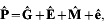
where  is the litter effect variance matrix and ê the residual variance matrix (diagonal, with the estimated residual variances on the diagonal). Having obtained all the relevant (co)variance matrices the heritability and the genetic and phenotypic correlations between measurements taken at different times were estimated.
For interpolation the following methodology was implemented using GENSTAT (Lawes Agricultural Trust 1993). The matrix Φ was expanded adding the relevant number of rows, corresponding to the time points interpolated. For the first column the values added to these rows were a constant. For the rest of the columns these values were estimated from the relevant equations given by Kirkpatrick et al. (Reference Kirkpatrick, Lofsvold and Bulmer1990) for the coefficients of the polynomials. In this way the Φχ matrix was expanded to Φχ*, which has the same number of columns but more rows than Φχ. In Eqns (1) and (2), substituting Φχ* for Φχ and Φχ*′ for Φχ′ yields the new genetic and environmental matrices. The litter (maternal) effect variance matrix, , was expanded by adding an appropriate number of columns and rows with the (constant) litter variance on the diagonal and zeros in the off diagonal positions. Matrix ê was expanded by taking the weighted average of the appropriate variances, as the residual variance was assumed to change in a linear fashion between two estimated variances. As previously, having estimated all the relevant (co)variance matrices, the phenotypic and genetic correlation matrices were estimated along with the heritabilities for every time point.
Three time points were interpolated between different sampling times, i.e. weekly time points, giving in total 17 time points after interpolation compared with the original five data sampling times. From these expanded matrices, the genetic and phenotypic correlation matrices describing relationships between time points were estimated along with the heritabilities for each of these time points.
For comparison, five univariate analyses using a repeatability model within time were performed, using ASREML, for each time point for which data were available. In these analyses, the same fixed effects were fitted as above, along with the random terms describing the genetic, litter, individual animal and residual effects.
RESULTS
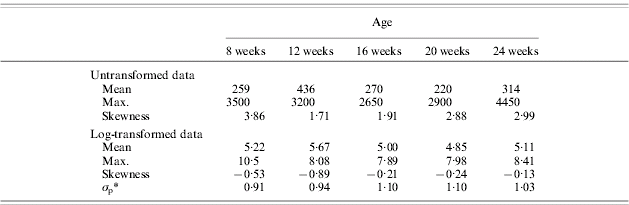
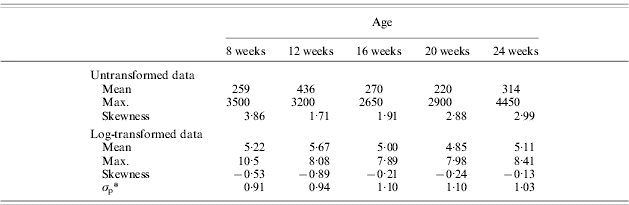
In Table 1 the means, maxima and coefficient of skewness are shown for the trait analysed, ln (Fec+25) and for the untransformed data. The minimum values for the raw and transformed data were zero and 3·22, respectively. In the same table the phenotypic standard deviations for log-transformed Fec, estimated from the univariate analyses, are shown. The phenotypic standard deviations on the logarithmic scale are all close to unity, i.e. typical of log-transformed Fec. Prior to transformation the measurements were heavily right-skewed. The transformed data were only slightly left-skewed. This together with the phenotypic standard deviation implied that the transformation was relatively successful in rendering the trait closer to a normal distribution.
Means, maximum values and skewness for untransformed and log-transformed Fec measured from 8 to 24 weeks of age. Phenotypic standard deviations are shown for the log-transformed data
* σp is the phenotypic standard deviation.
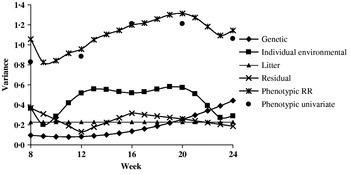
The variance components estimated with the random regression model are shown in Fig. 1. It can be seen that the additive genetic variance increases as the lambs grow older. The individual animal environmental variance does not show a simple trend over time; however, it stabilizes for a relatively long period between 12 and 20 weeks of age. For the residual variance only five values were available, corresponding to the five actual measurements analysed. The rest of the points were interpolated using a weighted average, with respect to the neighbouring variance estimates. Thus the interpolated residual variance changed smoothly from one time point to the other. The litter effect was assumed to be the same for all sampling times, thus it is shown as a straight line.
Variance components and the phenotypic variance for log-transformed Fec as estimated by a random regression (RR) model, and the phenotypic variance as estimated by univariate model.

In the same figure the phenotypic variance as estimated by the random regression model is shown along with the five phenotypic variances estimated by the within-time repeatability univariate model. There is reasonable agreement between the phenotypic variance estimates of the two models, although there is a tendency for the random regression model to estimate a slightly higher phenotypic variance.
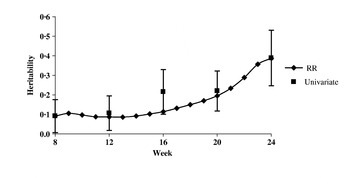
In Fig. 2 the heritabilities estimated by the random regression model and the univariate repeatability model (along with the standard errors for the latter) have been plotted. As can be seen, the estimated heritabilities of the two models agree well, except for the 16th week of age at which time the discrepancy is, nevertheless, still not statistically significant. At this specific time point the univariate model estimates a litter variance component of zero, which is not the case for the estimates of litter effect for the other sampling times. The univariate heritability estimate is thus likely to be inflated at this time point, assuming that the true litter variance component is greater than zero.
Estimates of heritability for log-transformed Fec from the random regression (RR) model and the univariate repeatability model. The bars represent the s.e. of the univariate heritability estimates.

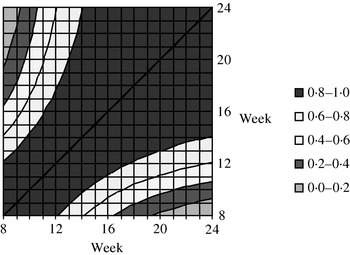
Figure 3 shows the genetic correlations between Fecs at different sampling points in the form of a contour plot. The tabulated ages on the axes are the sampling times at which data were available.
Contour plot of the estimated genetic correlation between log-transformed Fec measurements at different ages as estimated by the random regression model.

The estimated genetic correlations agree with a priori expectations, with measurements close in time having a higher genetic correlation, which diminishes as sampling times become further apart. However, the decline of the genetic correlation becomes quite rapid once the sampling times are far apart and the genetic correlation of measurements taken in the first sampling time have an almost zero genetic correlation with samples of Fec samples taken 4 months later. Visualizing the contour plot in three dimensions, it resembles a wide plateau, with a steep drop at the edges. Of all the possible pairs of sampling times, over 0·6 had a correlation greater than or equal to 0·80, from which it can be arbitrarily assumed as indicating that the measurements are genetically the same trait. According to this criterion, all measurements taken after 16 weeks of age are genetically the same trait.
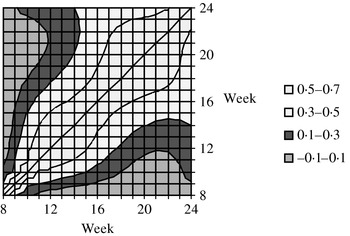
In Fig. 4 the phenotypic correlation between Fecs taken at different sampling times is shown. The phenotypic correlations between different measurements are lower than the genetic correlation and in no case do they exceed 0·65. In addition their pattern is much more complex than the genetic correlations. This is especially the case for the early measurements, where small changes in time lead to relatively large changes in the value of the correlation. In large sectors of Fig. 4 the correlations are very low (<0·3) and sometimes they are slightly negative.
Contour plot of the estimated phenotypic correlation between log-transformed Fec measurements at different ages as estimated by the random regression model.

DISCUSSION
The objective of the present study was to obtain a good description of the age-dependent genetic properties of Fec data from a population of lambs. Changes in the genetic and phenotypic parameters in this dataset were studied over time and, as a result of the properties of the random regressions, the development of genetic differences in the resistance of lambs to nematode infections may be described. Additionally these results may be used in the planning of sampling strategies under field conditions.
The heritability estimates obtained by the random regression model and the univariate within-time repeatability model are similar at all ages with the exception of the estimate at 16 weeks of age. This discrepancy is most probably due to the different way these models treat the litter variance. In the random regression model, it is assumed to be constant over the time period examined. Strictly speaking the litter effect should be allowed to change over time. This was attempted but the analysis failed to converge. In the univariate repeatability model the litter effect variance component estimate at 16 weeks was zero, which is biologically unlikely, especially as this point coincides with weaning and the estimate of the same component at later time points was higher. The implication of a zero estimate for the litter variance component is that true litter variation was partitioned towards the genetic component, resulting in an overestimate of the heritability. Whilst a constant litter effect is not the most satisfying assumption, the resulting genetic variance and heritability estimates are consistent with reasonable a priori expectations, giving confidence in the plausibility of the random regression approach for this dataset.
Bishop et al. (Reference Bishop, Bairden, McKellar, Park and Stear1996) analysed a subset of the current dataset. Their estimates of correlations differ from the estimates in the present study, without any apparent pattern in the way in which the correlations differ. These differences could be attributed to either (a) the fact that the current dataset is expanded by one more year of data or (b) the different transformation (ln (Fec+25)) used compared with Bishop et al. (Reference Bishop, Bairden, McKellar, Park and Stear1996) (ln (Fec+1)). Given the large standard errors of the estimated correlations of Bishop et al. (Reference Bishop, Bairden, McKellar, Park and Stear1996) a difference in the estimates is not surprising. However, the larger the increment added to Fec, the more attenuated the log transformation, and these different transformations do have an effect on the results. This was illustrated in further analyses where we compared univariate heritability estimates obtained when using the transformations ln (Fec+1) and ln (Fec+25), respectively. The heritabilities were as follows: 8 weeks: 0·14 and 0·09; 12 weeks: 0·12 and 0·11; 16 weeks: 0·19 and 0·22; 20 weeks: 0·16 and 0·22; and 24 weeks: 0·28 and 0·39. As a summary, the transformation used in the current analysis (ln (Fec+25)) resulted in a distribution closer to the normal distribution and also a more consistent pattern of change in the estimated heritabilities with age.
The contour plot of the genetic correlations between time points in Fig. 3 can be split into three arbitrary periods. The first is the period of the life of the animal up to week 12 for which the samples taken at different sampling times have a genetic correlation greater than or equal to 0·8 with Fec measurements taken at week 8 of the animal's life. A second period, which starts at week 14, may be defined as that which starts as soon as the Fec taken at the specific sampling time has a correlation greater than or equal to 0·8 with the Fec sample taken when the animal is 24 weeks old (last sampling time). This leaves a third small transition stage, i.e. from 12 to 14 weeks. This pattern agrees with the acquired nature of resistance to gastrointestinal parasites (Stear et al. Reference Stear, Strain and Bishop1999) where immunity is age-dependent and is mounted gradually after the animal is challenged. Furthermore, it can be deduced that measurements of Fec taken after the third month of life of the animal (i.e. at week 14) can be treated as the same trait. However, measurements taken at week 14 have a relatively low heritability and as it can be seen in Fig. 1 there is a tendency for the genetic variance to increase with time. The heritability reaches its maximum value (within this time period) at 6 months of age. Therefore, in terms of maximizing the available genetic variation, this dataset suggests that the best sampling time for Fec would be when the animal is 6 months old. Earlier measurements would be measuring essentially the same trait, but would be less effective in terms of genetic progress, as the heritability is lower. There are no data to extrapolate beyond 6 months of age.
Random regression models for estimating genetic and phenotypic parameters have been applied mainly to growth (Meyer Reference Meyer1999, Reference Meyer2005; Albuquerque & Meyer Reference Albuquerque and Meyer2001) and milk yield (Kettunen et al. Reference Kettunen, Mantysaari and Poso2000; Jensen Reference Jensen2001; Strabel & Jamrozik Reference Strabel and Jamrozik2006) in cattle. The pattern of genetic correlations predicted by random regressions for these cattle traits differs markedly from the pattern of genetic correlations for Fec in our analyses. The genetic correlations for growth and milk production traits stays, in general, high (>0·80) for a longer time period than they do for Fec. The decline in the genetic correlation is also more rapid for Fec than the above production traits. The above pattern is also observed for the phenotypic correlation. The current results may be interpreted as showing the development of immunity across time (as assessed by the genetic correlation and heritability pattern) and also complex patterns of immune response across time (as assessed by the phenotypic correlation patterns).
In conclusion, the random regression model has provided an adequate and informative description of the data. It has the advantage, compared to other models, that it allows genetic and phenotypic interpolation from the data allowing us to obtain a better understanding of the behaviour of the genetic and phenotypic parameters in the time period for which data are available. These in turn allow assessments to be made of the impact of measuring lambs at different ages on overall potential genetic progress.
Data collection for this project was funded by the then Overseas Development Organization, now the Department for International Development of the United Kingdom. However, the Department can accept no responsibility for any information or views expressed. We thank the Hellenic State Scholarship Foundation (SSF) for funding D.V. and the BBSRC for additional support.